Castalia History Series

Castalia House is delighted to present its second leather book series, the Castalia History subscription. Join the Castalia History Book Club and you will receive a deluxe leatherbound book published by Castalia Library four times per year. Subscribers will also receive significant discounts on non-subscription Castalia History books.

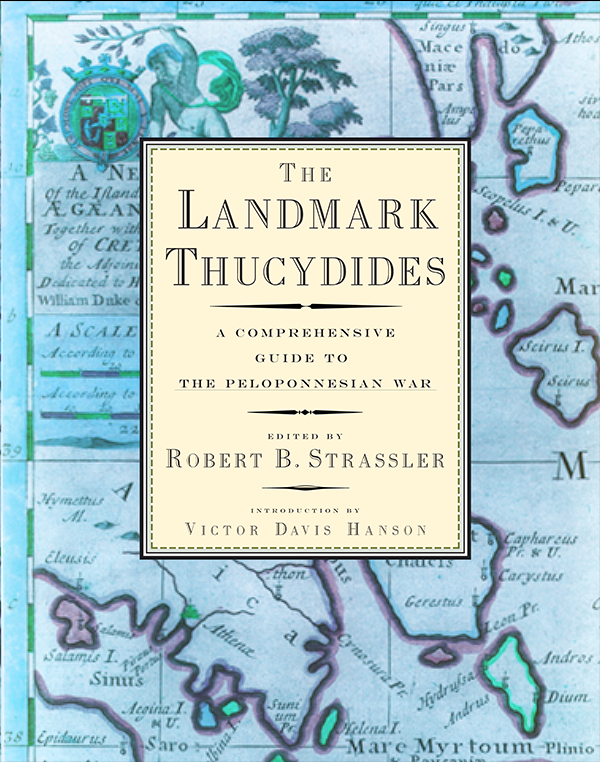
The first History Book Club book (April-May-June, #1) is THE LANDMARK THUCYDIDES edited by Robert B. Strassler. It is the comprehensive guide to the Peloponnesian War between Athens and Sparta and is correctly considered to be one of the first and most important classics of history. Both monthly and annual subscriptions are available.

Castalia Library subscribers should note that they will be able to purchase Castalia History books at the subscriber’s price if there are any books remaining after the History subscribers receive their books.

THE HISTORY OF THE PELOPONNESIAN WAR
By Thucydides, 431 BC

The city of Epidamnus stands on the right of the entrance of the Ionic Gulf. Its vicinity is inhabited by the Taulantians, an Illyrian people. The place is a colony from Corcyra, founded by Phalius, son of Eratocleides, of the family of the Heraclids, who had according to ancient usage been summoned for the purpose from Corinth, the mother country. The colonists were joined by some Corinthians, and others of the Dorian race. Now, as time went on, the city of Epidamnus became great and populous; but falling a prey to factions arising, it is said, from a war with her neighbours the barbarians, she became much enfeebled, and lost a considerable amount of her power. The last act before the war was the expulsion of the nobles by the people. The exiled party joined the barbarians, and proceeded to plunder those in the city by sea and land; and the Epidamnians, finding themselves hard pressed, sent ambassadors to Corcyra beseeching their mother country not to allow them to perish, but to make up matters between them and the exiles, and to rid them of the war with the barbarians. The ambassadors seated themselves in the temple of Hera as suppliants, and made the above requests to the Corcyraeans. But the Corcyraeans refused to accept their supplication, and they were dismissed without having effected anything.

When the Epidamnians found that no help could be expected from Corcyra, they were in a strait what to do next. So they sent to Delphi and inquired of the God whether they should deliver their city to the Corinthians and endeavour to obtain some assistance from their founders. The answer he gave them was to deliver the city and place themselves under Corinthian protection. So the Epidamnians went to Corinth and delivered over the colony in obedience to the commands of the oracle. They showed that their founder came from Corinth, and revealed the answer of the god; and they begged them not to allow them to perish, but to assist them. This the Corinthians consented to do. Believing the colony to belong as much to themselves as to the Corcyraeans, they felt it to be a kind of duty to undertake their protection. Besides, they hated the Corcyraeans for their contempt of the mother country. Instead of meeting with the usual honours accorded to the parent city by every other colony at public assemblies, such as precedence at sacrifices, Corinth found herself treated with contempt by a power which in point of wealth could stand comparison with any even of the richest communities in Hellas, which possessed great military strength, and which sometimes could not repress a pride in the high naval position of an island whose nautical renown dated from the days of its old inhabitants, the Phaeacians. This was one reason of the care that they lavished on their fleet, which became very efficient; indeed they began the war with a force of a hundred and twenty galleys.

All these grievances made Corinth eager to send the promised aid to Epidamnus. Advertisement was made for volunteer settlers, and a force of Ambraciots, Leucadians, and Corinthians was dispatched. They marched by land to Apollonia, a Corinthian colony, the route by sea being avoided from fear of Corcyraean interruption. When the Corcyraeans heard of the arrival of the settlers and troops in Epidamnus, and the surrender of the colony to Corinth, they took fire. Instantly putting to sea with five-and-twenty ships, which were quickly followed by others, they insolently commanded the Epidamnians to receive back the banished nobles—(it must be premised that the Epidamnian exiles had come to Corcyra and, pointing to the sepulchres of their ancestors, had appealed to their kindred to restore them)—and to dismiss the Corinthian garrison and settlers. But to all this the Epidamnians turned a deaf ear. Upon this the Corcyraeans commenced operations against them with a fleet of forty sail. They took with them the exiles, with a view to their restoration, and also secured the services of the Illyrians. Sitting down before the city, they issued a proclamation to the effect that any of the natives that chose, and the foreigners, might depart unharmed, with the alternative of being treated as enemies. On their refusal the Corcyraeans proceeded to besiege the city, which stands on an isthmus; and the Corinthians, receiving intelligence of the investment of Epidamnus, got together an armament and proclaimed a colony to Epidamnus, perfect political equality being guaranteed to all who chose to go. Any who were not prepared to sail at once might, by paying down the sum of fifty Corinthian drachmae, have a share in the colony without leaving Corinth. Great numbers took advantage of this proclamation, some being ready to start directly, others paying the requisite forfeit. In case of their passage being disputed by the Corcyraeans, several cities were asked to lend them a convoy. Megara prepared to accompany them with eight ships, Pale in Cephallonia with four; Epidaurus furnished five, Hermione one, Troezen two, Leucas ten, and Ambracia eight. The Thebans and Phliasians were asked for money, the Eleans for hulls as well; while Corinth herself furnished thirty ships and three thousand heavy infantry.

When the Corcyraeans heard of their preparations they came to Corinth with envoys from Lacedaemon and Sicyon, whom they persuaded to accompany them, and bade her recall the garrison and settlers, as she had nothing to do with Epidamnus. If, however, she had any claims to make, they were willing to submit the matter to the arbitration of such of the cities in Peloponnese as should be chosen by mutual agreement, and that the colony should remain with the city to whom the arbitrators might assign it. They were also willing to refer the matter to the oracle at Delphi. If, in defiance of their protestations, war was appealed to, they should be themselves compelled by this violence to seek friends in quarters where they had no desire to seek them, and to make even old ties give way to the necessity of assistance. The answer they got from Corinth was that, if they would withdraw their fleet and the barbarians from Epidamnus, negotiation might be possible; but, while the town was still being besieged, going before arbitrators was out of the question. The Corcyraeans retorted that if Corinth would withdraw her troops from Epidamnus they would withdraw theirs, or they were ready to let both parties remain in statu quo, an armistice being concluded till judgment could be given.

Turning a deaf ear to all these proposals, when their ships were manned and their allies had come in, the Corinthians sent a herald before them to declare war and, getting under way with seventy-five ships and two thousand heavy infantry, sailed for Epidamnus to give battle to the Corcyraeans. The fleet was under the command of Aristeus, son of Pellichas, Callicrates, son of Callias, and Timanor, son of Timanthes; the troops under that of Archetimus, son of Eurytimus, and Isarchidas, son of Isarchus. When they had reached Actium in the territory of Anactorium, at the mouth of the mouth of the Gulf of Ambracia, where the temple of Apollo stands, the Corcyraeans sent on a herald in a light boat to warn them not to sail against them. Meanwhile they proceeded to man their ships, all of which had been equipped for action, the old vessels being undergirded to make them seaworthy. On the return of the herald without any peaceful answer from the Corinthians, their ships being now manned, they put out to sea to meet the enemy with a fleet of eighty sail (forty were engaged in the siege of Epidamnus), formed line, and went into action, and gained a decisive victory, and destroyed fifteen of the Corinthian vessels. The same day had seen Epidamnus compelled by its besiegers to capitulate; the conditions being that the foreigners should be sold, and the Corinthians kept as prisoners of war, till their fate should be otherwise decided.

After the engagement the Corcyraeans set up a trophy on Leukimme, a headland of Corcyra, and slew all their captives except the Corinthians, whom they kept as prisoners of war. Defeated at sea, the Corinthians and their allies repaired home, and left the Corcyraeans masters of all the sea about those parts. Sailing to Leucas, a Corinthian colony, they ravaged their territory, and burnt Cyllene, the harbour of the Eleans, because they had furnished ships and money to Corinth. For almost the whole of the period that followed the battle they remained masters of the sea, and the allies of Corinth were harassed by Corcyraean cruisers. At last Corinth, roused by the sufferings of her allies, sent out ships and troops in the fall of the summer, who formed an encampment at Actium and about Chimerium, in Thesprotis, for the protection of Leucas and the rest of the friendly cities. The Corcyraeans on their part formed a similar station on Leukimme. Neither party made any movement, but they remained confronting each other till the end of the summer, and winter was at hand before either of them returned home.

Corinth, exasperated by the war with the Corcyraeans, spent the whole of the year after the engagement and that succeeding it in building ships, and in straining every nerve to form an efficient fleet; rowers being drawn from Peloponnese and the rest of Hellas by the inducement of large bounties. The Corcyraeans, alarmed at the news of their preparations, being without a single ally in Hellas (for they had not enrolled themselves either in the Athenian or in the Lacedaemonian confederacy), decided to repair to Athens in order to enter into alliance and to endeavour to procure support from her. Corinth also, hearing of their intentions, sent an embassy to Athens to prevent the Corcyraean navy being joined by the Athenian, and her prospect of ordering the war according to her wishes being thus impeded.

And no, this is not an April Fool’s joke. This is something that has been in the making for more than 18 months. If you have any questions, please pose them on SG at the following link.

DISCUSS ON SG


Demonic Disaccord

Many people, myself included, believe that Dolly had braces in the Moonraker movie, and that the disappearance of those braces is a Mandela Effect. It’s significant enough that it is included among the various effects “debunked” by the self-proclaimed debunkers.

Moonraker is a 1979 spy film and the eleventh movie in the James Bond franchise. It features Roger Moore as James Bond and is the fourth time he played the role in the series. In it, James Bond investigates the theft of a space shuttle which leads him to several locations. From California, to Venice, Rio de Janeiro, the Amazon rainforest, and eventually to outer space to ultimately prevent a plot to wipe out the world’s population in an attempt to recreate humanity with a master race.

It also features the actress, Blanche Ravalec playing “Dolly”, and the star of this Mandela Effect. She is the love interest of “Jaws” (played by Richard Kiel), a tall and burly metal-teethed protagonist and villain in the movie.

Many people recall Dolly having braces, when it fact she does not.

And yet, an a reader emailed yesterday with the fascinating results of his inquiry of ChatGPT concerning the subject.

Did Dolly have braces in Moonraker?

Yes, the character Dolly, who is the love interest of the villain Jaws in the 1979 James Bond film “Moonraker,” is depicted wearing braces on her teeth. The character was played by French actress Blanche Ravalec, who actually wore braces in real life at the time of filming. The braces are notable because they are seen as a key factor in the romance between Dolly and Jaws, as they bond over their shared dental hardware.

ChatGPT, 27 March 2023

It might be a good idea for those with AI accounts to ask the various AI’s similar questions about other Mandela Effects such as the Berenstein/Berenstain Bears, as it would appear that the scrubbing of the past is not only incomplete, but has left enough traces behind that they are being picked up on by the AI datamining.

DISCUSS ON SG


The Mistakes of Empire

I’ve repeatedly observed that both Russia and China have learned from the mistakes of previous regimes, as well as from those of the imperial USA. Here is evidence that Russia’s current leadership is actively aware of the mistakes made in their Soviet past:

Russia’s economy will not be reduced to the defense industry alone, despite the conflict with Ukraine and Western sanctions, former President Dmitry Medvedev told journalists on Sunday. Imbalances in the economy will not be allowed to develop, he said, adding that the country is unlikely to suffer the fate of the Soviet Union.

“There is currently no threat of economic militarization in a way, in which it existed [in the USSR] in the 1970s and 1980s,” Medvedev said. The former president argued that the Soviet Union gave too much priority to the defense industry. To avoid an imbalance, “priorities just need to be set correctly and major macroeconomic indicators monitored,” he added.

Russia does actually need to boost its defense industry, he said, adding that it is necessary to “lay the groundwork for the future” even after the Ukraine conflict ends. However, taking these steps will not affect other economic sectors, he believes.

The USSR lacked a market system and also the strong consumer goods sector that modern Russia has, Medvedev said, adding that had the West imposed sanctions on the USSR at that time, “we would have had a hard time.”

Now, Russia’s “market does not feel any colossal downturns even despite the sanctions,” the former president said. He lauded Russia’s agriculture sector, saying not only does it allow Russia to meet its own food supply needs, but also enables it to “feed others.”

And they’re clearly also acutely aware of the vulnerabilities created by blindly adopting the false “free trade” doctrine of Western liberalism: China and Russia top list of states with largest trade surplus – study

DISCUSS ON SG


America is not Byzantium

VDH contemplates the similarities between two dying empires:

The last generations of Byzantines had inherited a global reputation and standard of living that they themselves no longer earned. They neglected their former civic values and fought endless battles over obscure religious texts, doctrines, and vocabulary.

They did not expand their anemic army and navy. They did not reunite their scattered, Greek-speaking empire. They did not properly maintain their once life-giving walls.

Instead of earning money through their accustomed nonstop trade, the Byzantines inflated their currency and were forced to melt down the city’s inherited gold and silver fixtures.

The once canny and shrewd Byzantines grew smug and naive. Childlessness became common. Most now preferred to live outside of what had become a half-empty, often dirty, and poorly maintained city.

The difference is that America was conquered from within by foreigners who have ruled over the natives, and ruled disastrously, in their own short-sighted and self-perceived interests. But America was always doomed due to its foolish, though understandable in the circumstances, adoption of civic nationalism in the place of the real thing.

If there is one lesson to be learned from the decline and fall of the United States, it is that a nation cannot be artificially manufactured from diverse elements. There was never any need to “divide and conquer” the USA because division was built into the USA from the very start. “Show up and conquer” was sufficient.

DISCUSS ON SG


Barbarossa

Big Serge has a detailed article on Operation Barbarossa which is well-researched, insightful, and very long. Anyone interested in WWII history, and anyone who hopes to make any sense of what is happening in Ukraine, would do well to read the entire thing.

Soviet preparation for war had focused on material factors – the sheer size of tank, artillery, and aircraft inventories – while neglecting the professional aspects of command, communications, and coordination. Consequentially, despite adequate equipment and weaponry, the Red Army was, very simply, outmatched by the nimbler and more responsive Wehrmacht.

In the first place, the performance of the Red Army cannot be separated from the fact that Stalin had conducted a widespread purge of his own officer corps only a few years prior to the outbreak of war. This appalling churn in the command hierarchy had occurred at the same time that the Red Army was expanding; as a result, Soviet officers tended to be rapidly promoted and were for the most part in over their heads early in the war, fighting a highly trained, experienced, coolly competent German officer corps, which had by now successfully undertaken two large campaigns in France and Poland, along with a variety of other specialized operations from Norway to Greece. The basic factors of experience and training were thus hilariously disposed in Germany’s favor.

At the same time, the Red Army lacked a dedicated communications system and relied on civilian telephone and telegraph lines, many of which were quickly cut by the Germans. It was not uncommon during the early phases of the war for Soviet officers to have to inquire with local communist party officials (the party did have access to wireless communications) as to where the Germans were and how far they had advanced.

The Red Army fought bravely but was unprepared for war at Germany’s pace
These two factors – an overwhelmed officer corps and a broken communications system – had a particularly deadly synergy. Different levels of the command hierarchy were cut off from each other and blind, while at the unit level, commanders were simply unable or unwilling to take initiative. Furthermore, the… shall we say peculiarities of the Stalinist system left the officer corps with instincts that were oriented towards political survival, rather than military exigency, and this meant not making drastic unilateral decisions.

This was an absolutely central aspect of war making that Stalin and the communists simply did not grasp; they had focused on churning out tanks, guns, and shells, while neglecting the command and control functions of the army. The Germans, quite simply, were prepared to fight war at a different pace than the Soviets: German commanders were more experienced, more decisive, more precise, more willing to act independently, and more level headed. The Red Army consequentially resembled an enormous, muscle bound fighter, but with a diseased nervous system and bad eyesight.

These vulnerabilities made the Red Army particularly susceptible to the Wehrmacht’s approach to warfighting, which brought overwhelming firepower and violence at the point of attack to allow rapid penetration and movement, creating an encircled pocket, or what the Germans called a kessel, for cauldron – which could then be liquidated. By fighting multiple kesselschlachts, or encirclement battles, the Wehrmacht planned to annihilate the Red Army and destroy the Soviet Union’s capacity to resist by the autumn of 1941. The objective was very clear: destroy Soviet fighting power. Annihilating the Red Army took absolute priority over capturing any specific geographic markers. Hitler himself had remarked that even Moscow was “of no great importance.” Rather, the objective of Barbarossa was to destroy Soviet manpower: “The mass of the army”, read the Barbarossa directive, “is to be destroyed in bold operations involving deep penetrations by armored spearheads, and the withdrawal of elements capable of combat into the extensive Russian land spaces is to be prevented.”

This last portion is the key to the concept of Barbarossa, but we shall return to this later.

The first shots fired in the cataclysmic Nazi-Soviet war came in the form of an aerial bombardment by the Luftwaffe, which attacked over 60 frontline Soviet air bases early on June 22. The Red Air Force lost over 1200 aircraft on the first morning of the war, ensuring German control of the air all along the line of contact. On June 24, literally two days into the war, Soviet western front headquarters informed Moscow that “Enemy aviation has complete air dominance.” The wholesale destruction of the Red Air Force’s frontline units was one of the most remarkable events in the history of warfare, yet it occurred so quickly that it receives scant mention in much of the war’s historiography; it is as if the Soviet air force simply vanished into thin air. Meanwhile, German advance teams managed to cut many civilian telephone and telegraph lines, throwing the Red Army’s command and control system into disarray and forcing the NKVD (which operated a wireless radio communication system) to act as middlemen to relay orders to the army. With the Red Army severely disoriented and bereft of air support, on came the fearsome German mechanized package.

The Soviet response was woefully inadequate. 1941 would be a year of terrible mistakes, but above all, what high level Soviet leadership – including and especially Stalin – did not understand was just how much could be won or loss in the opening moments of the war. By neglecting to put the Red Army on full combat alert, the regime allowed the Wehrmacht to achieve tactical, but not strategic surprise. Years later, one Soviet Marshal, Andrei Grechko, would make the tongue in cheek remark that the government and senior commanders were fully prepared for the outbreak of war, and the only people surprised by the German attack were the Red Army soldiers on the front line. What Stalin’s team did not comprehend was that tactical surprise, mixed with Germany’s particularly aggressive and mobile approach to war and the Soviet Union’s sclerotic command system, could produce a total catastrophe.

It is interesting to note that Big Serge tends to support Suvorov’s Icebreaker hypothesis, which is that Stalin was preparing to invade Central and Western Europe, but was taken by surprise by the timing and effectiveness of the German offensive. And indeed, the most convincing aspect of the hypothesis is the extreme forward placement of the 60 Soviet air bases, which led to the incredible destruction of the Soviet air forces.

it occurred so quickly that it receives scant mention in much of the war’s historiography

I would argue that it receives scant mention because it destroys the narrative that the German attack on the Soviet Union was unprovoked and took place solely as a consequence of Hitler’s vast imperial ambitions.

DISCUSS ON SG


Secular Blindness and Post-Ideology

This post by Z-Man usefully illustrates why he, and all the other secular commentators of the Right, are now past their use dates. Because they are totally blind to the moral and religious elements of the observable globalism vs nationalism conflict, which is far less the philosophical Aristotle vs Plato than Satanic imperialism aka The Empire of Lies vs truth, anything they say is only going to be tangentially relevant to the present situation at best, and usually by sheer accident.

The old language is either inadequate or loaded with moral connotations. Calling the Biden people fascist is not entirely wrong, but not entirely accurate either. That and the word fascist comes with so much baggage that its descriptive value is completely lost.

The same can be said for words like communist and authoritarian. Even the term managerialism has been abused to the point where it often just means “bad” rather than a specific sort of organizational outlook. One of the weird parts about being trapped in the 20th century, as is the case with the West, is we are left to use moral language that no longer works in this century.

The term “Biological Leninism” is a good example. While the NRx people have accurately described some aspects of the current system, this is mostly an accident of trying to jam the current system into old models. The term itself is just a way to anathematize the current ideology by associating it with an ideology of the last century which is universally reviled.

What needs doing is a fresh look at the 20th century from an objective, historical perspective that avoids the old moral language.

To the contrary, we don’t need a fresh, objective, historical secular perspective. That’s the very outdated sort of thinking that has placed humanity in its current peril. We need to return to the old moral language, and specifically, the historical Christian perspective upon which Western civilization was built and by which humanity advanced intellectually, morally, and technologically to heights it had never seen before.

All ideology is deception. Whether it is an ideology of the Right, such as free trade, free speech, libertarianism, Objectivism, or conservatism, or an ideology of the Left, such as socialism, communism, feminism, anti-racialism, or social justice, it is a deception and a distraction from the true and ancient conflict.

Satan is real. He rules this fallen world. And he is determined to root out every last vestige of the truth, because the truth inevitably leads to the Truth, which is Jesus Christ. That’s why the satanic imperialists lie about everything from economics to race, from science to sex, and from math to phonics. It is the essence of the truth they fear, not the specific fact in question.

We are living in a post-ideological time in a manner that exceeds mere identity politics, because every single identifiable ideology is poisoned with falsehoods in its core axioms. None of them are built on the truth, indeed, they are literally designed to deflect their adherents from the truth. And all of them observably lead to the exact same evil destination, as we are seeing take place in real time with “capitalism”, “democracy”, and “free market economies”.

Here is a specific example of how a secular perspective literally prevents the analyst from recognizing an observable and reliable historical pattern.

Throughout history whenever a society has accepted women leadership (matriarchy), or worshipped a female Deity, this has been followed by the acceptance of homosexuality and transgenderism. Without fail. It is a remarkable convergence, especially considering that this is observed in cultures that had nothing to do with each other and could not have influenced each other, because they were separated by centuries and continents. What people, including Mark, commonly call the Jezebel spirit is really the goddess Astarte, Ashtoreth, Ishtar, Aphrodite, Artemis, etc. In other words an active demon or demons that shows up in a consistent pattern throughout history, in every continent, in unconnected cultures, but always with the same tricks.

How can the secularist account for the repetitive historical consequences of demonic activity? He simply can’t. He can’t even take the historical facts into consideration. His intellectual framework specifically excludes the causal factor, and therefore he is forced to resort to obvious and increasingly ridiculous falsehoods in an inept attempt to explain away the observable truth.

DISCUSS ON SG


The Crisis of Empire

The first line of Col Douglas Macgregor’s excellent article is a bit of a misnomer. America’s national power has already been leashed and broken. What we’re witnessing now is the limits of the imperial USA’s power, which have been constricted by the incompetence and shortsighted mismanagement of the mostly foreign imperial elite.

The crisis of American national power has begun. America’s economy is tipping over, and Western financial markets are quietly panicking. Imperiled by rising interest rates, mortgage-backed securities and U.S. Treasuries are losing their value. The market’s proverbial “vibes”—feelings, emotions, beliefs, and psychological penchants—suggest a dark turn is underway inside the American economy.

American national power is measured as much by American military capability as by economic potential and performance. The growing realization that American and European military-industrial capacity cannot keep up with Ukrainian demands for ammunition and equipment is an ominous signal to send during a proxy war that Washington insists its Ukrainian surrogate is winning.

Russian economy-of-force operations in southern Ukraine appear to have successfully ground down attacking Ukrainian forces with the minimal expenditure of Russian lives and resources. While Russia’s implementation of attrition warfare worked brilliantly, Russia mobilized its reserves of men and equipment to field a force that is several magnitudes larger and significantly more lethal than it was a year ago.

Russia’s massive arsenal of artillery systems including rockets, missiles, and drones linked to overhead surveillance platforms converted Ukrainian soldiers fighting to retain the northern edge of the Donbas into pop-up targets. How many Ukrainian soldiers have died is unknown, but one recent estimate wagers between 150,000-200,000 Ukrainians have been killed in action since the war began, while another estimates about 250,000.

Given the glaring weakness of NATO members’ ground, air, and air defense forces, an unwanted war with Russia could easily bring hundreds of thousands of Russian Troops to the Polish border, NATO’s Eastern Frontier. This is not an outcome Washington promised its European allies, but it’s now a real possibility.

In contrast to the Soviet Union’s hamfisted and ideologically driven foreign policymaking and execution, contemporary Russia has skillfully cultivated support for its cause in Latin America, Africa, the Middle East, and South Asia. The fact that the West’s economic sanctions damaged the U.S. and European economies while turning the Russian ruble into one of the international system’s strongest currencies has hardly enhanced Washington’s global standing.

Biden’s policy of forcibly pushing NATO to Russia’s borders forged a strong commonality of security and trade interests between Moscow and Beijing that is attracting strategic partners in South Asia like India, and partners like Brazil in Latin America. The global economic implications for the emerging Russo-Chinese axis and their planned industrial revolution for some 3.9 billion people in the Shanghai Cooperation Organization (SCO) are profound.

In sum, Washington’s military strategy to weaken, isolate, or even destroy Russia is a colossal failure and the failure puts Washington’s proxy war with Russia on a truly dangerous path. To press on, undeterred in the face of Ukraine’s descent into oblivion, ignores three metastasizing threats: 1. Persistently high inflation and rising interest rates that signal economic weakness. (The first American bank failure since 2020 is a reminder of U.S. financial fragility.) 2. The threat to stability and prosperity inside European societies already reeling from several waves of unwanted refugees/migrants. 3. The threat of a wider European war.

America was finally defeated once and for all in 1965. Everything that has happened since was literally a new imperial order, and it is the new imperial order that is jeopardized, not the conquered nation that will likely benefit from the collapse of the empire.

They also know that since 1965 Washington led them into a series of failed military interventions that severely weakened American political, economic, and military power.

Washington. The seat of empire.

Far too many Americans believe they have had no real national leadership since January 21, 2021.

They haven’t had it for a lot longer than that. Since at least 1965, in fact.

This confusion of America with its imperial elite notwithstanding, Macgregor’s piece is an astute one that accurately chronicles the challenges presently overwhelming the empire. And the empire is neither willing nor able to meet those challenges, because the weapons of influence, namely, money and media, are unable to effectively defeat the weapons of power, which are industrial capacity and military might.

Influence can only defeat power if morale is sufficiently lacking. But both the Russians and the Chinese collectively possess a formidable will to survive, which is why they will likely succeed where a complacent and degenerate America failed.

DISCUSS ON SG


History is a Cycle

Alex Macris goes considerably deeper than my post on anacyclosis, as he contemplates the wisdom of Naram-Sim to assist an inquiry into whether the facts support the idea that history is cyclical or if it is, as we are assured by Whigs and Marxists and technophiles and transhumanists alike, inevitably progressive.

Whig historiography is wrong because it falsely presupposes the inevitability of progress. If Whig historiography sees progress as a hockey stick, its arch-rival, cyclical historiography, sees progress as a sine wave. Cyclical historiography is nowadays in vogue among the dissident right, and there are a number of different cyclic theories of history.

Polybius, building on Aristotle, offered a theory of anacyclosis in which governments decay from their proper to corrupt forms and are then replaced by the next type of government in its proper form, only for that also to decay (the traditional cycle being monarchy to tyranny to aristocracy to oligarchy to democracy to mob rule). However, anacyclosis doesn’t explain what happened to Akkad.

Ibn Khaldun, the 14th century Muslim jurist, developed a theory that does, based on the concept of asabiyat (social solidarity). Professors Murat Onder and Fatih Ulasan of Ankara Yildirim Beyazit University explain:

History, to Ibn Khaldun, is a cyclical process in which sovereign powers come to existence, get stronger, lose their strengths and are conquered by other sovereign powers over time.

More precisely, every community is uncivilized at the beginning and tries to acquire the power around its own territory. The power depends on the stronger asabiyya than other communities’ asabiyyat. Asabiyya is very powerful because people from the same asabiyya tend to protect each other at all cost and due to their wild natures, they are strong and competent fighters. Asabiyya and wild nature which trigger the success in fighting and prevent communities from embracing the comfortable life’s disadvantages walk arm in arm. If one of them decelerates, the other one acts in the same way. These features which do not degenerate are enough to invade communities which have the less asabiyyat and civilized communities which are tired of fighting and lose their wild natures.

However, over time the less civilized communities which defeat others are always inclined to imitate the more civilized societies. Due to that, the wild communities lose their nature, get used to luxury and lastly are replaced by less civilized societies having stronger asabiyyat. And this cycle is infinite…

Ibn Khaldun argues that the cycle takes about 120 years.

Ibn Khaldun was not the only scholar to recognize this cycle. Sima Qian of China articulated the theory of the dynastic cycle. According to Qian, a dynasty begins when a charismatic and valorous leader earns the Mandate of Heaven, seizes power, and brings prosperity, and ends when through corruption and greed, the emperor loses the Mandate of Heaven and is replaced. Sima Qian’s theory lacks the causal explanation of asabiyyat; instead the cycles are caused by heavenly responses to earthly misdemeanors. It also assumes more longeval dynasties, about 200 – 300 years.

Arnold Toynbee, in his book A Study of History, offers a theory of civilizational cycles based on the concept of a creative minority. According to Toynbee, a creative minority rises to certain societal challenges and brings prosperity, achieves dominance, reduces the rest of the population to proletariat, and then begins to degenerate. Toynbee rejects the idea that urban life itself reduces asabiyyat, and therefore rejects the idea that a less-civilized power will grow stronger and topple the weakening hegemon. Instead, he sees the decline of a civilization as primarily internal.

The famed Oswald Spengler, in Decline of the West, argued that a civilization is a living organism that passes through stages of life or seasons — e.g. childhood, adolescence, adulthood, senescence or spring, summer, autumn and winter — over the course of a thousand years, with each stage lasting about 250 years. Spengler associates each civilization with a “soul” and its decline is fundamentally a spiritual one.

A more recent cyclical theory of history is Strauss-Howe generational theory. According to Strauss and Howe, historical events occur in 80-year cycles, each marked by four turnings of a generation (20 years). Strauss-Howe theory has given rise to the oft-discussed concept of the Fourth Turning. Strauss-Howe theory is based on the idea that each generation of human beings predictably differs from the prior generation based on the conditions of its upbringing. Put bluntly, a new crisis occurs when the generation that remembered the last crisis dies off and a new generation that has known only good times take the wheel of the ship of state.

The concept is often summarized using the famous quote by author G. Michael Hopf in his book Those Who Remain:

“Hard times create strong men. Strong men create good times.
Good times create weak men. Weak men create hard times.”

Because it offers a causal mechanism based on civilizational changes, Strauss-Howe theory is close kin to Ibn Khaldun’s theory. It also has the virtue of fitting the data of my own country, the United States, relatively well.

It’s an excellent piece. I highly recommend reading the whole thing.

DISCUSS ON SG


Anacyclosis in Action

This is a recent post from /pol/ that is well worth reading, especially by those whose knowledge of history and the classics is less complete than might be desired. And it correctly points to the way in which the demoralization and denationalization of Western civilization is rooted in the decline of the Christianity that is one of its integral elements. Polybios would definitely be an early candidate for a second history-based Library subscription.

This was already noted by Polybios in the 2nd century BC, and he referred to his own society – the Hellenistic Greece. Polybios is recognized as “father of sociology”, and he witnessed his own civilization falling and being conquered by Rome.

Anacyclosis is the circulation of governmental forms: warlordship-monarchy-dictatorship-aristocracy-oligarchy-democracy-ochlocracy. Which follows with societal collapse and back into warlordship. The cycle starts anew. The cycle can skip one or more phases or go backwards, but it will never stop on itself.

The theory of anacyclosis is based upon the Greek typology of constitutional forms of rule by the one, the few, and the many. Anacyclosis states that three basic forms of “benign” government (monarchy, aristocracy, and democracy) are inherently weak and unstable, tending to degenerate rapidly into the three basic forms of “malignant” government (tyranny, oligarchy, and ochlocracy). They, however are disliked and not tolerated well, and people tend to seek the “benign” forms.

According to the doctrine, “benign” governments have the interests of all at heart, whereas “malignant” governments have the interests of a select few at heart. However, all six are considered unworkable because the first three rapidly transform into the latter three due to political corruption, and the latter three tend to collapse from violence.

Widespread Atheism is a sign of democracy transforming into ochlocracy – the mob rule – and Polybios himself witnessed that happening in the Hellenistic Greece. The rise of Materialism and philosophy had killed off the Greek Pagan religion, and it was nothing but an empty shell any more – he said nobody believed in the gods any more. The result was general hedonism, disinterest in upkeeping of the society, amassing of personal fortune and collapse of birth rates.

Polybios himself was a soldier, and he complained of the demoralization of the Hellenistic civilization in general. He lived through collapse of Macedon and defeat of the last king, Perseus, in the battle of Pydna 168 BC. Polybios stated that when a nation loses its faith on its gods, it loses its faith on itself and in the future. He also saw the Roman military, witnessed the Punic Wars and saw how Republican Rome was far less civilized than the Hellenistic sphere, but it was young and hungry.

Polybios considered democracy as the pinnacle of the anacyclosis. Yet in the same way that the descendants of kings and aristocrats abused their political status, so too will the descendants of democrats. Accordingly, democracy degenerates into ochlocracy, literally, “mob-rule”. In an ochlocracy, according to Polybius, the people of the state will become corrupted, and will develop a sense of entitlement and will be conditioned to accept the pandering of demagogues and Populist politicians. Essentially, government becomes a puppet show because a transition in power does not affect a civilian on a day-to-day basis.

This phase sees a widespread Atheism. People lose their faith in gods, and they lose their faith in the society and themselves and in the future. They rather concentrate on what they have here and now – and the result is widespread Hedonism, amassing of wealth and collapse of birth rates. Eventually an ochlocratic society will collapse – either into civil war and anarchy – or is conquered by an external conqueror. The cycle starts anew.

The same happened to Rome 400 years later with the Third Century Crisis. The Roman Polytheism was moribund already in the Early Imperial era, and it collapsed during the Middle Imperial. The Roman Empire was basically a religious vacuum – or a chaotic hotbed of religious competition – by the 3rd century, and the Empire tore in three parts by 242. Only the reconquest of Aurelianus and the reforms of Diocletianus saved the moribund empire and purchased it 100 years more time. But the Empire cleft in two in 395 and the Western Empire went bankrupt 476. Only the rise of a new religion – Christianity – consolidated the situation, and saved the Roman civilization in West and the Roman Empire in the East – the Eastern Roman Empire lasted for 1000 years more.

But also the fate of the Cordoba caliphate in Spain and its collapse is an example of anacyclosis, and the most striking example is the fate of USSR – and each and every Communist regime.

Not all Atheists are Communists, but all Communists are Atheists. The USSR was a acumen of an Atheist society, and Atheism was enforced on all levels of the society. The result was an Orwellian totalitarian dictatorship – the worst tyranny and oppression the world has ever seen, a genocide of millions of people and destruction od centuries of culture – and eventually collapse. USSR collapsed in less than three generations after it had been founded. The only way it could stay together was excessive use of lies, coercion and state violence.

Both Dima Vorobiev, Misha Firer and Dimitry Kosh can confirm my observations and tell how it was. They lived through the USSR. They have first hand experience of it all. And they can tell how it went and what happened to Atheism in the USSR.

Another way to inspect the deleterious effect of widespread Atheism in society are the fates of various ideal communities and ideal societies. All non-religious ideal societies, such as kolkhozes, kibbutzim, Hippie communities and Naturist communities, have collapsed in three generations at latest – due to internal disputes and strife – while religious ideal societies can last for millennia. The Hutterites are a primary example of this, but so are monasteries. Monte Cassino was founded in 529 AD and Heian in 711 AD, and both Christian and Buddhist ideal societies are still going strong. The only kibbutzim in Israel today are those which are religious.

There is also a third way to observe and confirm this phenomenon – that widespread Atheism is a sign of a collapsing society – and it is meme theory, 12 leverage points’ theorem and cultural evolution. The meme theory claims the cultural evolution is analogous to biological evolution – the nature works on analogies – and same principles apply. The meme theory insists that cultural evolution works on similar information carrying replication units as the biological, called memes – which form memeplexes like the biological evolution forms organisms and species. And for each species there is an ecological niche – and the same applies for memeplexes in the cultural evolution.

Religion is perhaps the oldest memeplex there is – it predates Homo sapiens, and can even be observed on some animals. There clearly is thus an ecological niche for it. An ecological niche can be vacated, but never destroyed. And when an ecological niche is vacated, it keeps getting re-occupied – the evolutionary race to occupy it starts anew.

In the 12 leverage points’ theorem, religion corresponds to the most powerful leverage point – the power to transcend the paradigm. Religion is the only thing which can overcome the Dunbar number, and it is the mortar which binds the individual human bricks of the society into a durable societal edifice. Religion is the basis of all ethics, social contracts, how we form the society, how we relate to society, to each other, what we value, what we shun, what we consider beneath our dignity, how we relate to work and labour and how we relate to outsiders. Every religion creates a society of its image. Not the other way – this was Marx’s tragic error. Lutheranism creates the Scandinavian model while Islam creates Talibanistan.

Atheism corresponds to an empty ecological niche. It is basically an all-bets-are-off situation. Remove the mortar, and all you have is a heap of individual bricks, which will collapse at the slightest push. An Atheist society cannot endure setbacks or violent challenges, while religious can.

And KGB knew all this. It did not know of memetics, but it knew of “cultural hegemony” by Antonio Gramsci, and it knew religion was the only force which could turn the Communist subversion back and restore the citizen society. This was the reason why anti-religious work was so important in the ideological warfare of the Communist world against the free world. By rottening the religion from inside, USSR aimed for the collapse of the free world. And it was a success beyond measure. But the irony of history is that USSR collapsed first.

There is also a fourth way to confirm these observations. Religions do not spread by conversion. They spread by breeding. Remember Polybios observed that widespread Atheism goes hand in hand with collapsing birth rates?

This is exactly what is happening in the Western world today.

DISCUSS ON SG


EVERYTHING is Fake and Gay

There is not one single thing that Clown World has told you is true that can withstand the light of even a half-serious investigation. NOT ONE SINGLE THING. It doesn’t matter what the subject is, from evolution to the Moon, from Covid-19 to Vatican II, all of it is fake and gay, all of it is obviously and provably false.

At this point, the only rational, logical, and sane thing to do is to assume, a priori, that everything the mainstream media reports as fact or history is misleading at best and on average false. This superskeptical heuristic will point you in the direction of the confirmable truth far more often than assuming the mainstream narrative is more or less true will.

DISCUSS ON SG