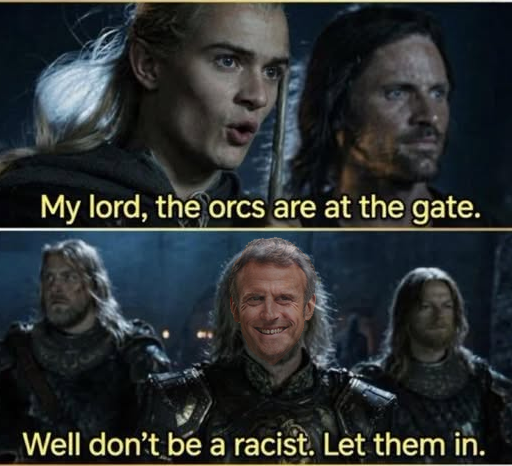
Migration is Literally Invasion

For 50 years, the traitors in the West have insisted that immigration is not invasion. And now the inevitable has become undeniable:

Spain has deployed just 60 troops to its North African exclave of Ceuta after thousands of migrants overwhelmed security forces and stormed across the border from Morocco, with up to 30,000 more people reportedly swarming the frontier. The Spanish Interior Ministry said the military contingent consisted of three platoons of 20 soldiers each, sent to reinforce the Guardia Civil after officers admitted that the border had “totally collapsed.” Madrid also dispatched specialized police units, bringing their total number to around 200, as well as 30 additional Guardia Civil officers.

The small military deployment came after Ceuta’s regional government pleaded with Madrid to take “decisive” action, close the border and declare a national emergency, warning that local police, hospitals and migrant reception facilities had been overwhelmed.

Prime Minister Pedro Sanchez’s government rejected the emergency request, arguing that migration does not qualify under legislation covering natural disasters, major accidents and other national catastrophes.

Of course it doesn’t. It’s war. Migrants and refugees should be met with military force at the border, or they will wage war on the native population. This is a larger invasion than the original one from North Africa that led to 700 years of Muslim occupation.

UPDATE: the invading force is up to 49,000 strong and they’re pillaging the towns.

Terrifying footage showed scores of people seemingly breaking into homes across the city late at night. One clip appeared to show a man on top of a ladder, hitting a first-floor window with an object. After migrants flooded into the city, many local shops chose to close early. Enrique Serrano, who runs a women’s clothing store in central Ceuta, told Reuters business owners were organising self-defence because they believed police resources would be insufficient.

DISCUSS ON SG


Immigration and Economy

It’s been eleven years since Angela Merkel imported about a million young immigrants who were supposed to help the German economy and make up for the failure of Germans to have the children required to sustain the German social welfare system. And the verdict is not a positive one.

German auto giant BMW is planning to slash some 8,000 jobs globally by the end of 2027, according to several news media outlets, including Reuters and Bloomberg. German workers are expected to be particularly affected as the manufacturer is dealing with high production costs in Europe, as well as plunging sales in China, according to the reports.

The automaker employed 87,436 people in Germany as of late 2025, which accounted for more than a half of its global headcount. The company has already been making gradual reductions, with a reported decrease of 2.3% compared to 2024, according to Bloomberg.

It comes just a day after another German carmaker, Porsche, announced plans to eliminate another 5,000 jobs by 2035, bringing its total planned reduction to around 9,400 positions. Its parent company, Volkswagen, is considering slashing up to 100,000 jobs amid a protracted industrial slump caused by high energy prices. The Federation of German Industries (BDI) warned last week that the nation’s industrial sector was losing 15,000 jobs every month in what it described as a “critical” situation.

The “immigration is good for the economy” lie cannot be hammered hard enough. It was always false, but it was just barely possible to appeal to the abstract theory in the absence of any conclusive evidence refuting it. But, as with Darwin and DNA, the evidence is now available, and it conclusively and comprehensibly refutes the Post WWII-era justification.

DISCUSS ON SG


The EU is a Pirate State

Send in the Marines…

European states have developed a mechanism that allows them to sell confiscated Russian oil without transferring the proceeds to its rightful owners, according to a decision in the official journal of the EU. European countries intend to dispose of seized Russian oil without transferring the proceeds to its owners; the corresponding decision was published in the official journal of the European Union, reports RIA News.

Before the adoption of the new package of sanctions, the embargo prohibited the purchase, import and transportation of Russian energy resources, but there was no mechanism for selling goods without transferring profits to the owner. The new amendments introduce this possibility for the first time. The mechanism will allow European countries to remove confiscated products from the ban, sell them to third parties and keep the proceeds for themselves.

I seem to recall something about “the shores of Tripoli”. The US Marines were sent there to deal with a piracy problem, and now we’ve got the European Union literally operating as an oil-pirating operation.

DISCUSS ON SG


The Addition of Economic Attrition

Instead of accepting the reality of its military defeat, Ukraine has tried to create political pressure on Russia by targeting the civilian population. To which, of course, Russia has responded by escalating and expanding the economic pain on Ukraine and Europe:

Ukraine is trying to redirect part of the cargo flow from the Odesa region. Due to the strikes on the port infrastructure of Odesa and ships in Ukrainian territorial waters, the largest container shipping operator, Maersk, has suspended operations at the Black Sea Fish Port and redirected ships to the Romanian port of Constanta. On July 27, Ukraine initiated an emergency meeting of the UN Security Council due to the cessation of ship traffic in the Odesa ports.

In addition, there is a slight increase in the volume of rail traffic of grain and oilseed cargoes, redirected from the Greater Odesa area, to the western railway border crossings (key stations: Chop, Uzhgorod, Mostyska, Rava-Ruska, Yagodin, Batievo, Vadul-Siret) and the Danube ports (Izmail, Reni, Kilia). The early involvement of the Moldovan port of 🇲🇩Giurgiu and the Romanian 🇷🇴Constanta (to which barges can be delivered from the Danube ports) is expected.

In the scheme of increasing rail transportation to the west, large grain storage facilities, located directly at the border stations or within 5-30 km of them, will play a key role, due to the need to transship from the broad gauge (1520 mm) to the European gauge (1435 mm).

However, land routes are not capable of completely replacing sea exports: their combined throughput is estimated at only 1-1.2 million tons per month, compared to the required 5-6 million tons. And this is under the condition that strikes on the railway infrastructure will not increase.

It is clear that the Russian side has finally found a truly sensitive vulnerability of the enemy and its sponsors, and pressure on them needs to be increased. The importance of Ukrainian agricultural products for its European sponsors will increase significantly this season – according to estimates by European industry associations, the June heatwave in Europe led to a loss of almost 9 million tons of grain.

This is why one has to have serious questions about the reality of war, especially when foreign leaders, or national leaders owned by foreign interests are involved. Ukraine can’t possibly win. The people are suffering greatly. And yet the leadership remains as bellicose and belligerent as ever.

And it’s not only Ukraine. Germany should be surrendering now too; its energy costs are skyrocketing and its economy is practically dehydrating. And yet, the so-called “leaders” keep banging on their war drums.

DISCUSS ON SG


Europe’s Fake Democracy

It’s more than a bit ironic that both the USA and the European Union justify their wars on Russia and Iran as defenses of “democracy” when both organizations are observably anti-democratic in nature. All of their institutions are quite literally designed to prevent the will of the people from being enacted.

If anybody cares, what actually happened is that an extension of the European Union’s mass surveillance regulation known as Chat Control 1.0 failed to make it out of the European Parliament twice in March. Unable to summon a clear parliamentary majority, advocates (mostly in the centre-Right European People’s Party (EPP)) turned to the European Council, which adopted the failed Chat Control 1.0 renewal on July 2nd. The Council’s position hardens automatically into law unless the European Parliament can summon an absolute majority to stop it. To forestall any such majority from forming, the EPP on Tuesday moved with member state backing for urgent procedure, angling to force their scheme through in the last days before the summer holiday, after many MEPs had already left. The parliament narrowly approved the urgent procedure, and in consequence there were not enough votes to stop Chat Control 1.0 when it came for a vote today. Hours ago, a majority of 314 MEPs voted to stop Chat Control against the wishes of the Council, while a minority of 276 voted to let it happen. Because 314 is less than the absolute majority of 361, Chat Control 1.0 passed even though most MEPs present didn’t want it to.

It was a sleazy vote, not least because it’s far from clear this procedural manoeuvre was even appropriate in this case. Also, electronic surveillance is bad, but if we are honest with ourselves this battle was already lost.

Neither the EU Council nor the US Supreme Court are elected to their positions, so neither the EU nor the US government can even be considered representative democracies, much less genuine ones.

DISCUSS ON SG


The EU’s Inverted Values

Brussels was ridiculed today over plans to start allowing influencers to cover summits – but only if they’re Europhiles.

Eurocrats have issued guidance to EU capitals on which YouTubers, TikTokers and Instagrammers should be allowed to shoot and post about the bloc’s unelected officials in action.

But a leaked copy reveals anyone who has ‘published views against EU values’ should be banned.

Critics said it was a blatant attempt to shut down free speech and prevent more countries from leaving the bloc – or entice Britain into rejoining – amid a rise in the popularity of Right-wing and euroskeptic parties across the Continent.

There has been growing talk in recent years of a potential Frexit, Dexit or Italexit – slang for France, Germany and Italy’s version of Brexit – as euroskeptic parties are increasingly on the march.

Watching European Union officials trying to talk about things like freedom and democracy and the press is like watching a particularly dorky German trying to rap. They simply can’t get the rhythm, the rhyme, or even the background sampled melody right.

DISCUSS ON SG


The Banned Article

Russia’s Foreign Minister, Sergey Lavrov, was asked to write an article for a European political magazine, but it was pulled from publication at the last minute. Here is the article that Clown World didn’t want Europeans to read:

Some reflections on resolving the Ukrainian crisis, Europe and global security

At a meeting in London on June 7, 2026, the leaders of Britain, France, and Germany, as well as Vladimir Zelensky, laid out five preconditions for Russia to secure a “just and lasting peace” in Ukraine. United Europe now presents this list of demands as the basis for dialogue with Moscow.

More than two decades of negotiations with Europe, as part of the collective West, lead to only one conclusion: engaging Russia in dialogue has served as a diplomatic smokescreen for the geopolitical expansion of Western institutions, above all NATO and the European Union, eastwards, right up to Russia’s borders.

Europe’s complicity in fueling the Ukrainian crisis is undeniable. Together with the United States, European countries orchestrated the Orange Revolution in Kiev in 2004. To create an anti-Russian bridgehead in Ukraine, they spent years buying off politicians and entire parties, rewriting history and educational curricula, cultivating and nurturing Ukrainian nationalism, and going to great lengths to pull Ukraine away from Russia.

In 2013, the European Union outright rejected our proposal for a compromise on the association agreement – a deal Brussels had long been pressing Viktor Yanukovich to sign. It is worth recalling that Ukraine was offered unilateral market opening without reciprocal commitments – terms that would have proved incompatible with Kiev’s continued membership in the CIS free-trade zone. When Viktor Yanukovich requested a deferral, the Europeans incited street riots that swiftly escalated into a coup d’état in Kiev in February 2014.

Germany, France, and Poland then proved themselves to be equally treacherous. Having guaranteed that the agreement reached between the opposition and Viktor Yanukovich would be honored, they washed their hands of it the moment that same opposition, their own handiwork, took power. “Democracy,” they shrugged, “takes unexpected turns.”

Europe thereafter lent its backing to the new authorities. In Odessa on 2 May 2014, the burning alive of dozens of innocent supporters of closer ties with Russia did not draw a single word of condemnation from European capitals.

As co-guarantors of the 2015 Minsk Agreements, France and Germany effectively encouraged the Ukrainian regime to sabotage its own commitments. As Angela Merkel and François Hollande later conceded – after the special military operation had already begun – Kiev’s implementation of the Minsk Agreements, unanimously approved by the UN Security Council, was never genuinely intended. The objective, they admitted, was merely to buy time: to shore up the Armed Forces of Ukraine and flood them with Western weaponry.

Russia, for its part, explored every diplomatic avenue to defuse Europe’s security crisis. However, in January 2022, the United States and NATO rejected Russia’s proposal for legally binding mutual security guarantees. European NATO members actively endorsed that rebuff.

Following the launch of the special military operation, United Europe threw its support behind the British prime minister’s efforts to sabotage the Istanbul negotiations between Russia and Ukraine. Boris Johnson’s appeal to Kiev – “don’t sign anything, just fight” – slammed the door on genuine diplomacy for the foreseeable future.

Current situation

So what has prompted European leaders to suddenly shift their rhetoric and start talking about negotiations, and what are they aiming to achieve with these statements? For instance, EU foreign policy chief Kaja Kallas has stated that the purpose of any dialogue with Russia is to dictate Europe’s terms. These include paying “reparations” to Ukraine; withdrawing troops from Transnistria and the South Caucasus; abolishing the “foreign agents” law; and accepting strict limits on the size of the Russian Federation’s Armed Forces. In her framing, “there can be no just and lasting peace without accountability for Russia.” During the UN Security Council session on 19 May 2026, an EU representative made the point unequivocally: “Supporting Ukraine militarily does not contradict the pursuit of peace, but rather serves as a fundamental prerequisite for any credible, good-faith negotiations.”

Europe’s plan is to talk with Russia while simultaneously pressing ahead with a campaign of legal warfare orchestrated through the Council of Europe. Within this once-respected organization, an entire infrastructure is being assembled for the express purpose of “holding Russia accountable”: a Register of Damage, a Claims Commission, and a Special Tribunal.

The European Union has also given the green light to detaining merchant vessels on the high seas. Several incidents have already taken place in the Baltic and the Atlantic. At the same time, the West studiously averts its gaze from the terrorist acts of sabotage perpetrated by the Armed Forces of Ukraine in the Black and Mediterranean Seas.

The real objective of Europe’s leaders, then, is not to negotiate with Russia. It is to shore up the Zelensky regime and preserve it as a launchpad for continued confrontation against Russia. With this in mind, European leaders are scrambling to secure a ceasefire as quickly as possible and for one reason only: to prevent the collapse of the Armed Forces of Ukraine on the battlefield. The plan is to “freeze” the conflict without addressing its root causes, and then rapidly deploy military contingents from the Anglo-French “coalition of the willing” onto Ukrainian soil.

It is widely known that European elites have invested their “political capital” in the confrontation with Russia, pouring hundreds of billions of dollars into propping up the Kiev regime and ramping up the military budgets of EU member states and NATO. Europe now aims to achieve “defense readiness” against Russia by 2030. Until then, they mean to buy time by whatever means are available. In a strikingly candid remark this April, Belgium’s chief of staff put it bluntly: “We still have a few years. Thanks to the courage and blood of the Ukrainians, who are buying us that time.”

United Europe continues to dream of expansion. It intends to absorb Ukraine and Moldova while pulling Armenia into its sphere of influence. NATO has already expanded eastward, swallowing up Finland and Sweden. As for Ukraine, it is increasingly being eyed as the “striking fist” of a future European military force, independent of the United States and independent of NATO.

Risks to global security

This state of affairs poses serious threats to global security. A direct confrontation between NATO and Russia could rapidly escalate into an exchange of nuclear strikes, with catastrophic consequences.

Under the banner of “strategic autonomy,” Europe is witnessing a significant build-up of its military capabilities, including in the nuclear sphere. Paris’s intention to extend its “nuclear umbrella” to several EU and NATO member states is a source of deep concern. This will do nothing to strengthen the security of France itself or of the recipients of its so-called protection.

For all that, Europe’s political and military establishment continues to attribute aggressive plans to Russia – plans that, they claim, reach far beyond Ukraine. The Russian president has stated on numerous occasions that all of this is nonsense, provocation, and disinformation, aimed solely at extracting budget funds for the fight against Russia. That is scarcely the climate for substantive dialogue.

Russia’s position

As for negotiations, Vladimir Putin reiterated at the St. Petersburg International Economic Forum that Russia is not opposed to contacts with any party. We see Europe, however, as a party bent on Russia’s defeat – a stance the Europeans themselves openly avow. Dialogue with Europe, therefore, cannot be conducted as though it were an impartial third-party observer.

Russia would prefer to achieve the goals of the special military operation through diplomacy.

That requires reliably guaranteeing security along Russia’s western borders and ensuring respect and dignity for our citizens and compatriots, including the right to speak their native Russian language and practice the Orthodox Christian faith. Further military, political, and economic expansion by the West is unacceptable: it runs counter to the imperatives of a multipolar world.

European leaders should recognize that the model of regional security built in Europe over decades, ever since the adoption of the Helsinki Final Act in 1975, has been destroyed by their own hands. And it will never be restored. We must now move toward creating a continent-wide security architecture open to all Eurasian countries and reflective of today’s multipolar reality.

The principle of equal and indivisible security, trampled upon by the Euro-Atlanticists, can be embodied within a new Eurasian architecture. When the time is ripe, Europe too will be able to join this great effort.

The key point is that meaningful dialogue requires the restoration of trust, shattered by the anti-Russian actions of the West, and Europe as part of it, in the post-Cold War era. Trust can be recovered only through concrete steps that demonstrate a sincere commitment to moving away from using diplomacy as a cover for expansionist ambitions. Trust cannot be restored, nor can dialogue be resumed, through ultimatums such as the one issued to Russia in London on 7 June 2026.  It is noteworthy that the London ultimatum was unequivocally reaffirmed by the ambassadors of Britain, France, and Germany at the meeting at the Russian Foreign Ministry on 11 June 2026 – a meeting they had so insistently requested.

DISCUSS ON SG


Where is the IRA?

I don’t believe the Irish fought British rule for more than 60 years for the right to be invaded and beheaded by Africans:

A Sudanese man arrested over the attempted ‘beheading’ in Belfast is an asylum seeker, it emerged today.

PSNI Chief Constable Jon Boutcher said the suspect is believed to have travelled from Sudan to Paris, and then from Paris to Dublin, on unknown dates, before taking a bus to Belfast in February 2023.

There, he immediately claimed asylum, before he was given leave to remain in the UK in September 2023.

He has been arrested on suspicion of attempted murder after the horrific attack at 10.30pm last night, which left a man in his 40s in a critical condition with ‘significant’ eye injuries and wounds to his face, neck and back.

Social media footage shows a man standing astride a bloodied victim holding a knife to his throat and his fist in the air. He starts making a sawing motion as witnesses scream: ‘He’s trying to cut his head off’…

Anti-immigration activists have called for mass protests in Belfast this evening, prompting fears of widespread disorder. Some posts online called for men over 18 to attend, wear dark clothing and ‘be prepared to fight or be arrested’.

Chief Constable Boutcher urged people to let ‘the police do their job unfettered and undistracted’.

Enough. Mass immigration isn’t military invasion, it’s something far more insidious and much worse for the native populations being subjected to it.

As any American Indian can attest. And the American Dilemma is now the Irish Dilemma.

The American dilemma is now the European dilemma.

In America, it all begins with the fact that we have had a multiracial society from the very beginning. When the English arrived, there were already Indians. We then imported another race: Africans. And after that, we let in everyone, from everywhere. The American multiracial society has been a total failure, and that should have been clear to Europeans at a time when they still had white countries.

Part of the problem, however, was that even if European intellectuals had understood that America had a racial problem, they were convinced they could solve it. They thought the problem was not multiracial society itself. The problem was those ignorant, prejudiced Americans—especially Southern Americans—and Europeans were sure they could teach us to do better.

But even Lee Kwan Yew couldn’t solve the problem. A corrupt collection of unelected European bureaucrats have zero chance of succeeding where the most brilliant politician of the 20th century couldn’t.

DISCUSS ON SG


All Indicators

Andrei Martyanov, whose track record has been very good for more than a decade, believes Russia is going to strike Europe, specifically Germany, soon in retaliation for manufacturing the drones used by Ukraine to attack Russian territory.

Now, per strikes–all indicators are that Russia will strike Europe. Russia doesn’t need to use nukes because she has more than enough conventional means for both destruction of a critical industrial infrastructure involved in support of 404 and, if it comes down to it, decapitating governments of hostile countries.

Russia has enough conventional means to strike at any facility in Europe and the US IS NOT coming for a simple reason–it has no resources. Demilitarizing NATO was one of the key strategic aims of the Special Military Operation once it became clear that the US sabotaged Istanbul talks and Iran has demonstrated it fully. Who will be hit first? Yeah, I am inclined to see Germany “getting the message”–it is long overdue.

And Russia will be perfectly justified in attacking any of the belligerent parties. It would be very difficult for the leaders of the EU, the UK, Germany, and even Switzerland to have more incompetently mishandled their various relations with Russia in futile attempts to appease Clown World and keep the US military in Europe. All they had to do was stay neutral and keep out of what was never any of their business in the first place.

Their collective lunacy is only exceeded by that of Finland and Sweden, who were perfectly safe as neutral parties, but have now unnecessarily painted targets on their national chests by joining NATO and declaring themselves enemy of the Russian Federation.

And now, ironically, they all find themselves falling afoul of both the USA and China as well. The last four years have been marked by some of the most incompetent national diplomacy in the history of international relations.

DISCUSS ON SG


Who’s Locking Out Who?

The EU attempting to sanction China tends to remind one of Rorshach. They’re not locking China out of the global economy, they’re locking themselves out of it.

The European Union has taken yet another step in its long-running confrontation with Russia. But what now stands out is not only the scale – it is the restless, almost reflexive expansion of sanctions as a default instrument of policy. In April, EU authorities unveiled their 20th round of sanctions targeting Russia and Belarus, while pointedly extending their reach toward China.

What was once framed as a targeted response now resembles a sanctions regime without clear geographic or strategic limits. By including 56 designations tied to Russia’s military-industrial complex – 17 of them in China, the United Arab Emirates, Belarus, and Central Asia – the EU has effectively dissolved the boundaries of its own confrontation. Another 60 entities now face tightened export controls tied to alleged contributions to Russia’s defense sector.

For the first time, even a Chinese state-owned entity has been targeted by anti-Belarusian sanctions. In Brussels, this is justified through the language of “dual-use” goods. But outside Europe, the perception is of a growing tendency toward economic coercion that stretches legal authority across borders, fueled by an escalating appetite for pressure.

China’s response was swift: officials condemned what they described as “long-arm jurisdiction,” rejecting the EU’s attempt to discipline Chinese firms operating far beyond European territory. More importantly, Beijing read the move as a signal of the EU’s shifting posture toward China itself. Within a day, China placed seven European entities on its control list over arms sales to Taiwan, imposing restrictions that mirror the EU’s own extraterritorial reach. These measures prohibit the transfer of Chinese goods to the targeted firms, extending the ripple effects well beyond those directly sanctioned.

These EU leaders don’t seem to understand that they don’t really matter anymore. They can preen and posture all they like, but there is nothing that Europe has that China needs. It’s understandable if the US politicians don’t grasp that they’re no longer the center of global power, since the lessons of the recent debacle in the Middle East are still being learned.

But all the nations of Europe can’t even defend themselves against invasion from the south and east; their ability to do anything at all about China is nonexistent. They can’t even do much about Russia except hold their own breath, refuse to buy Russian energy, and kill their own economies.

It does seem that those whom the gods would destroy, they first make mad.

DISCUSS ON SG