Sad Puppies: A Retrospective

In which Brad Torgerson, who took up the Sad Puppies mantle when Larry Correia retired from the science fiction award scene, shares his thoughts on our successful nuking of the Hugo Awards.

One of the most fascinating things about the past ten years has been watching different people who weren’t part of Sad Puppies speak authoritatively on Sad Puppies. I have my own thoughts, of course. Understand that everything I am about to say, I say as a guy with several authorial accolades under his belt, including the DragonCon Dragon for Best SF novel in 2019, and three readers’ choice awards from Analog magazine in 2010, 2012, and 2014. I was also the rare triple-nominee for Hugo, Nebula, and Campbell awards in 2012.

So . . . did Sad Puppies fail?

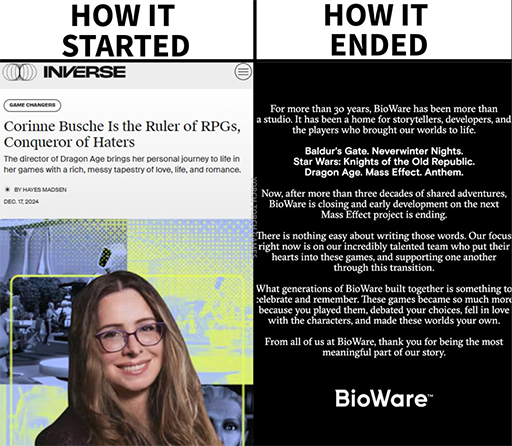
For my part I wanted the Hugos to have broad cultural relevance within literary SF again. Versus continuing their long slide into activism-induced irrelevance. In this regard Sad Puppies 3 failed spectacularly. The net dividend of 2015 was the power brokers of Worldcon declaring, “We’re gonna Feminist and Queer the Hugos even HARDER!” and that’s precisely how it went. The Hugos are now ignored by the great majority of spec fic and fantasy readers because they know beyond a shadow of a doubt the award has been made into an explicitly political activist totem. As of 2026 only a fraction of spec fic and fantasy readers even know who the Hugo winners are year to year, and most who remember the Hugos think of the Hugos as they think of almost all entertainment awards: that legacy thing we used to care about but we’ve stopped caring about because people on stages giving each other trophies doesn’t matter to the consumer like it did a few decades ago. It was already becoming true by 2010.

Much moreso, now. Grammys, Emmys, Oscars, yadda. Just don’t have the cultural heft of the 1970s-1990s. And the same for both the Hugo and Nebula. Which are not signposts of quality (on a book cover) like they once were. In fact, for many readers they are a, “Stay away, this is a Modern Audience (said in Drinker voice) book!” And that’s precisely what I wanted reversed. Because I remember when the words HUGO WINNER and NEBULA WINNER on a dust jacket actually described what was between the covers. Like with Ender’s Game and Speaker for the Dead. But the opposite occurred. Because the Nielsen-Haydens and George R. R. Martin and many other people with media reach and influence decreed that no dirty normal Hugo voters would have a say in their sainted backroom politicized log-rolling process. The Hugos would be perma-Woke.

And so they are. And that’s a damned shame, because most readers don’t give the Hugos any regard anymore—as they don’t give most lit awards any regard. And if you doubt it ask yourself if Ann Leckie is bigger than Heinlein? Who has been dead for decades. But he outsells Leckie 20 to 1 on Grandpa Bob’s slow days. They hate Heinlein for that. They want him dustbinned. They tried their best to make Leckie into a thing. Heaped every award possible on her between 2014 and 2016. And all that resulted were massive stacks of deluxe boxed merchandise at B&N locations. With the words HAS WON EVERY SCIENCE FICTION AWARD KNOWN TO MAN plastered across the slipcases and the special selection signage.

But the merchandise didn’t move. I repeat: the merchandise didn’t move. They tried the same thing from ’16-’18 with Nora Jemisin, and it was a similar result: triple-Hugo Best Novels that sat on shelves. And kept sitting. Neither Leckie nor Jemisin are bigger than Heinlein. Both remain midlist activist authors who could not be catapulted over the cultural relevance wall by any means, because that’s not how a literary work (nor author) achieves long-standing relevance in both geek culture and the wider English-speaking culture as a whole. You know who does have relevance? J.K. Rowling. Or Orson Scott Card. Or any dozen other caps-n Names nobody needs to spotlight trophies about. Because their books gained and kept vast audiences all on their own power. Much like Heinlein’s.

The dog of culture cannot be wagged. You can take over institutions believing you will take over culture, but it doesn’t really work like that. The Soviet system dominated the Eastern Bloc for most of a century. It literally owned every institution. But all it did was teach generations of Iron Curtain dwellers to subsist on black humor about how their supposed Socialist paradise was in fact a corrupt hell of bureaucrats, toadies, secret police, and fear.

I believe we’re entering something like that, where American pop culture is concerned. The Woke own the big gaming companies, along with gaming media. But who’s buying and playing the games? Similarly, the Woke own the big movie studios and all of the media media, but ticket sales have cratered on huge blockbuster projects over and over, and keep cratering. More broadly, the Woke own the Ivy League, but all this does is make people question if the Ivy League still matters anymore? Or, does a PhD even matter if the person putting those letters next to their name is a raving loon stuffed with terrible ideas and terrible politics, like a rotten Christmas turkey?

You can corrupt an organization, but you cannot corrupt people if they don’t want to be corrupted. In this regard Sad Puppies was a spectacular success. Because it was the loud, emphatic shout of the normie SF/F reader who used to esteem the Hugo and refused to let the Hugo go quietly into the night. People who could not be convinced that mediocre or even terrible storytelling with Woke wrappings and trappings was in fact brilliant and timeless.

Again, the dog of culture cannot be wagged.

UPDATE: JDA adds his perspective at Fandom Pulse:

The controversy began in the mid 2010s when it became obvious that works were being nominated for the politics of the author and not because of the content of them, in tandem with Tor Books clearly running behind-the-scenes ops to influence the awards toward their authors for marketing purposes. Larry Correia posted up a slate of works he thought were good for his fans to enjoy, and it spiraled from there.

The media attacked everyone involved, calling them racists, Nazis, and the usual insults that sane people ignore. However, it was a different time back then, and the pressure was immense. Vox Day, the publisher of the fine books imprint Castlia Library, saw the writing on the wall that they would never allow the proverbial “normies” influence ithin the culture, and formed a secondary group called The Rabid Puppies where he used his gaming experience to torpedo the entire system by nominating absurd works to ensure nothing but the most extreme would win, tarnishing the reputation of the Hugo Awards forever… Was there a winner for the Puppies? Yes, and it has to be decisively and objectively stated that it was Vox Day.

I still have my Sad Puppies and Rabid Puppies shirts. And I still wear them with great pride. Especially since when you look at the list of the current Hugo Awards today, you see absolutely nothing but Tor, Tor Tor… thereby underlining my original point, and, more or less, Larry Correia’s. The Hugo Awards ceased to be about science fiction a long, long time ago.
DISCUSS ON SG


Float Down the River

It is said that if you sit by the river long enough, eventually the bodies of your enemies float by. There’s a song about that.

Today, after 31 years, we are saddened to announce that Salon is ceasing publication.

It’s difficult to find the right words for the end of something that has meant so much to so many people. Salon was never just a website. It was an idea about what journalism could be, born at a moment when the internet was still a largely unexplored frontier.

When Salon launched in November 1995, the web was a very different place. A small group of journalists set out to create something original: a publication with a strong voice, a curiosity about the world and a belief that the internet could bring journalism and readers together in new ways. They helped pioneer a form of journalism that would come to define an entirely new era of publishing.

Over three decades, Salon has brought together politics, culture, criticism and ideas in a way that was distinctly our own. Our journalism examined power and politics, questioned assumptions, surfaced stories that deserved attention and made room for perspectives that were too often overlooked. Our writers and editors helped shape conversations about the forces changing our lives. The work was never simply about keeping up with the news. It was about making sense of it.

The history of Salon is also the history of the people who made it. We are profoundly grateful to the journalists, editors, photographers, producers, designers, business teams and countless other colleagues who brought this publication to life across its many chapters. To the founders who imagined it, the staff members who built it, the contributors who gave it their voices and the alumni who carried its spirit into the world: Thank you. Salon’s legacy belongs to all of you.

I’m not going to lie, I thought Salon was already dead. But it’s nice to be able to celebrate its demise in a timely manner.

I’ll wait for you. I’ll wait for you to float down the river.

Yes, I’ll wait for you.

It’s not hate. It’s just faith in destiny

I will wait for you.

DISCUSS ON SG


File 770 Discriminates Against Hispanics

It’s so terrible to see the way that the science fiction community is full of hatred and discriminates against Hispanics. Mike Glyer of File 770 actually apologized for running a basic convention report about the recent World Fantasy Convention that just happened to be written by a gentleman of Hispanic descent.

How can I run a review by Paul Weimer and a week later post something by Jon Del Arroz, a writer who’s persecuted him? (Or ever?) That was a terrible choice. I apologize. And how can I do that to Cat Eldridge, who is closely associated with this blog but was completely blindsided by the post. He works with Paul all the time and absolutely would not want us to be hosting JDA. I apologize to Cat, too.

A good apology would stop there, I think. Which I say because some people want to know why I did this in the first place. And an explanation at this point in an apology is usually a backdoor justification which makes the apology worthless. All I can say is the explanation is part of my contrition.

File 770 doesn’t have that many commenters, so it often feels like I do a lot of work and all that matters is if I mention someone’s hot button topic they will jump in to reprimand me for failing their purity test. Most of the time my skin is not so thin that I react. Sometimes it is. Resentment is the issue that drives most of the problems I have in life, and when I yield to it bad things happen.

I was going through just such a season of feeling picked on when Jon Del Arroz sent me his convention report. I combed through it expecting to find takes I would refuse to publish but it was rather vanilla. Nothing to object to but the byline.

This is obviously nothing more than pure anti-Hispanic racism on the part of Mr. Glyer. There was literally nothing to object to but a Hispanic name in the byline; it was a simple and straightforward news report devoid of any political content whatsoever, as you can see for for yourself.


World Fantasy Con 2026 Friday Review
Posted on October 24, 2026 by Mike Glyer

By Jon Del Arroz: World Fantasy Convention opened Thursday at the Oakland MarriottCity Center, and Friday, the first full day, delivered the small, personal kind of gathering the convention is known for. I wasn’t able to attend Thursday because of having to get work done. Robert Silverberg was the main draw for me, and he did not disappoint.

The convention is a fraction of Worldcon’s size. Programming runs two or three panels at a time, the dealer room is modest, and the convention space is compact. Organizers have been citing 775 members on Facebook. At peak times on Friday the halls held roughly 200. The staff has the operation running smoothly and were all super nice and helpful, from the info desk to programming to the dealer room, and attendees I passed all seemed to be having a good time.

The morning opened with a panel on the changing publishing world. The lineup was Silverberg, Josh Wilson from The Fabulous magazine, Teresa DeLucchi, director of marketing at Simon & Schuster’s Saga Press, Betsy Wollheim, and Stephen Jones.

The panelists agreed that everything in the business is up in the air and very different than ever. They discussed the trend toward sprayed edges on books that began in the pandemic, and cited that they thought the trend had peaked, which I find entertaining and think look great and add a lot to the presentation of books. They also said physical books are staging a bigger comeback because ebooks have become so prevalent and normalized, so people want something physical and cool to hold. That matches what I see in the market: readers want premium deluxe editions, and more publishers are making them.

AI produced the panel’s one real disagreement. Jones called it inevitable and asked why anyone bothers fighting it. DeLucchi argued people should not be using it. Jones has the better of that argument. AI is not going away, and people will not stop using it. It cleans up typos fast, and it has plenty of uses that never touch the creative work. He believes eventually AI will replace editors entirely for the most part.

The AI exchange led Silverberg to talk of copy editors, and he did not hold back. He once had a copy editor “fix” a sentence he had deliberately left unfinished, and he had to get it changed back. His verdict: “I hate copy editors because I know what I’m doing.” He added that Harlan Ellison once had a copy editor change a pile of his text wholesale, and that it did not go well for the copy editor.

He also talked about meeting John W. Campbell. The business used to be personal, he said, and now it is detached and run by email. The panel noted that unlike the days of building relationships with editors to buy stories, Neil Clarke of Clarkesworld buys stories only through open submissions, not by soliciting authors, so a relationship with the editor doesn’t get you a sale. Everyone goes through the same slush process. Silverberg described walking into Campbell’s office as being like going to church and meeting God. When he got to call Campbell by his first name, he thought the roof would fall in.

The dealer’s hall was modest but with a lot of cool stuff. Tachyon Publishing had a big presence there with a lot of works that were tempting, especially form Peter Beagle’s catalog. Cross Genre Books, a Portland dealer, had a deep rare-book stock: signed Jack Vance, signed Harlan Ellison, Poul Anderson, Anne McCaffrey, and plenty of Heinlein. I spoke with Anthony Eichenlaub, vice president of SFWA, who had a table in the room. Artist John Picacio also set up there, and he kept a line most of the time I passed, with fans buying prints.

In the afternoon I went to a reading with Bruce McAllister, Charlie Jane Anders, and Caroline Yoachim. McAllister is a long time writer who has done wonderful work and does not get enough credit in the field these days despite plenty of award nominations for his work. Anders really worked the room before reading from a forthcoming publication in 2027 that involves vampires and time travel, thanking the moderator and the audience and getting everyone applauding, and the crowd responded in kind.

What’s great is how many of the attendees are there just as fans and not a full slate of scheduled speaking. I ran into Robin Hobb and Tad Williams, among other big names. Peter Beagle held a small meetup that filled before I could sign up, and I hope to catch him another way before Sunday. A bookbinding workshop, where attendees bound their own books, also looked good, and I missed it for scheduling reasons.

Friday night also holds a mass autographing session. Silverberg and Jones are expected to unveil an anthology there, with advance review copies on hand. Saturday brings Silverberg’s interview panel, which I expect to be a highlight of the con as well. The World Fantasy Awards banquet is Sunday to cap everything off. 

All in all, it was an excellent Friday, and World Fantasy Convention delivered. 


Now, I have zero interest in any future accommodation with the SF-SJWs, not because they quite rightly hate and fear me, but because they are such a collection of irrelevant mediocrities that there isn’t a single one of them that I would ever deem worthy of publishing in ebook, let alone in fine deluxe leather. When Castalia House is publishing excellent authors like Eiji Yoshikawa, Benito Perez Galdos, Zenaide Fleuriot, Unno Juza, and Nomura Kido in English for the first time ever, how could we possibly care about these sub-trivial SF/F wannabes who don’t even understand what science fiction is and what it is not.

Unfortunately, Mike Glyer has forgotten that his proper role is that of a science fiction historian, not a racial gatekeeper, and while it’s understandable that he would eventually fold under the hateful pressure of the yapping SJWs, it is a mistake on his part. Because, as a very kind and gentle dark lord once said, an apology is nothing more than a guilty plea in their beady little eyes.

And they are irrelevant anyhow. Despite their best efforts, Castalia House already publishes more and better titles than Tor or Baen. I will not be surprised if within three years, Castalia House is the biggest science fiction-related publisher in the world not named “Amazon”.

Sign up for Castalia Unlimited to find out why.

DISCUS ON SG


The Potential Patriots Boycott

It’s going to be interesting to see what happens when Robert Kraft forces NFL fans to choose between endorsing his rabid support for Middle East genocide and their support for a particular NFL team:

Ed Sheeran has lost 200,000 Instagram followers in 24 hours as he faces a growing campaign to cancel him amid a Palestine row over his US tour. All of the remaining opening acts on his tour have dropped out in response to rapper Macklemore being kicked off the live dates following a ‘free Palestine’ speech.

Macklemore was due to open for Sheeran at eight of the remaining ten shows on his tour in America, which continues on Friday in Philadelphia, but on Tuesday it was announced that he had been dropped. Ed has now lost his remaining support acts – Billie Eilish’s brother and music partner Finneas, his close friend Myles Smith, Aaron Rowe, Lukas Graham and Beoga, who have put out separate statements announcing that they will not continue with their dates on the Loop Tour.

Breaking his silence amid the backlash, Ed, 35, said that his audience is often young people ‘from different backgrounds’ who do not expect his shows to be a political forum. While his Instagram follower count stood at 47.6million on Monday, it has now dropped to 47.4million.

Macklemore faced a boycott petition to remove him from the tour after he delivered a politically motivated speech in support of Palestinians in Gaza and the West Bank during his performances at MetLife Stadium in New Jersey on September 4 and 5.

Responding with an Instagram statement after it was confirmed that he will not be the opening act for the remainder of the Loop Tour, the rapper claimed that Ed told him billionaire Robert Kraft orchestrated the move after ‘rallying stadium owners and issuing an ultimatum’. Kraft is the CEO of the Kraft Group, which owns the NFL team the New England Patriots, as well as the Gillette Stadium in Massachusetts where Sheeran is due to play later in September.

My sense is that a number of influential Jews in the USA have wildly overplayed their antisemitism card. It’s not the 1970s anymore. Young people around the world are much better informed than the Boomers were back in the day, when their opinions were guided by Roots, the construction of Holocaustianity, and the “plucky little Israel, the only democracy in the Middle East, and the USA’s Greatest Ally” narrative. And even for those who still hold sacred one or more elements of that propaganda, none of it grants Israel moral cover for either the Gazacaust, the invasions of Syria and Lebanon, or dragging the Trump administration into defeat and economic disaster.

That’s the thing about power. If you don’t use it well, and use it for the material benefit of others, eventually you’ll be held accountable for that. Robert Kraft has been a remarkably effective NFL owner, but now he is abusing his power as a well-connected venue owner and every opening act on Ed Sheeran’s tour has rejected that. Sheeran himself doesn’t need them, but I very much doubt that given his own heritage, he’s going to be terribly inclined to sacrifice his career for Robert “Five Dolla” Kraft and Kraft’s staunch support for imperialist genocide in the Middle East.

And the longer the economically suicidal War to Save Israel From Iran continues, the more likely it is that NFL fans are going to see that Robert Kraft has played his part in their own economic suffering and react in a similar fashion to the music fans.

DISCUSS ON SG


The Campbell Letters

Fandom Pulse presents a fascinating look into the history of science fiction with an intriguing article on The John W. Campbell Letters:

Campbell is generally credited with building the Golden Age of Science Fiction almost single-handedly. Isaac Asimov, in his autobiography, credited Campbell as the dominant force in the field for the first decade of his editorship. Before he became an editor, Campbell wrote his own fiction, first under his own name and later under the pen name Don A. Stuart, including “Who Goes There?”, the 1938 novella that became the basis for John Carpenter’s The Thing. Once he took over Astounding, he largely stopped writing and turned his attention to the writers who would define the field for the next thirty years. Robert Heinlein, Isaac Asimov, L. Sprague de Camp, Theodore Sturgeon, A.E. van Vogt, and Hal Clement all passed through his door, and in many cases through his editorial red pen, on their way to becoming the names science fiction still measures itself against.

One letter shows exactly what that editorial pressure looked like at full force. In March 1959, Campbell wrote to Robert Heinlein’s agent, Lurton Blassingame, rejecting an early draft called “Starship Soldier,” the manuscript that would later become Starship Troopers. Campbell’s objection was not political squeamishness about the book’s militarism. It was a craft argument, rooted in a rule he considered a founding principle of the kind of science fiction he had spent two decades building: “Don’t tell the reader about the background; let him gather it from what happens.” Heinlein’s draft violated that rule directly, laying out its politics in what Campbell called direct, multi-page “preachments” rather than letting the reader arrive at the ideas through the story itself. Campbell went further, arguing that fiction persuades precisely because it never announces its conclusions, comparing the technique to parables, and noting that a skilled author could make a reader feel genuine sympathy for a committed Nazi if the story stayed inside that character’s head without editorializing. He then spent several more paragraphs disputing Heinlein’s actual thesis, that any two living organisms sharing a universe are doomed to physical combat, arguing instead that higher forms of competition had already replaced war as the most efficient way species out-compete one another. It is a strange letter to read today, an editor best remembered by his critics for a right-leaning editorial stance arguing at length that humanity was outgrowing warfare, on craft grounds, while rejecting the novel that became one of science fiction’s most famous defenses of the military.

Campbell, of course, has been posthumously cancelled by the deranged freaks of post-science fiction, as what was once the John W. Campbell Memorial Award for Best New Writer in science fiction was renamed because a foreign woman who doesn’t even write anything that can reasonably be recognized as science fiction objected to his politics of 60 years prior.

In 2019, the Campbell Award was renamed the Astounding Award after Jeannette Ng, that year’s winner, called Campbell a “fascist” during the Hugo Awards ceremony; soon afterward, Analog Editor Trevor Quachri announced that award sponsor Dell Magazines would change the prize’s name. Ng’s condemnatory acceptance speech went on to win the 2020 Best Related Work Hugo.

This is why you always sink the damn ships, both metaphorically and literally. And it’s why you always keep the creeps, freaks, and women out, because they don’t join organizations in order to participate in them or because they share the organizational vision, they join organizations in order to fundamentally change them according to their preferences. It’s not as if they hide it either; the imperative need for change is literally the first thing they say every single time they’re allowed in the door, and they repeat it mindlessly like a mantra regardless of how much change has already taken place.

Romantasy, diversity, and social justice didn’t kill science fiction. The Boomer generation of science fiction writers did by refusing to maintain the professional standards established by Campbell’s generation. Remember that when the freaks, creeps, and women come at your organization and demand that you relax your standards in the name of fairness, or kindness, or equality, or equity, or whatever other absurdity they think might serve as leverage.

DISCUSS ON SG


A Cancer Self-Diagnosis

HR helpfully demonstrates the inutility of HR:

HR asked me to install employee monitoring software across every company laptop last month.

They wanted screenshots every five minutes, browser history, application usage, idle time, and an automated “productivity score” for every employee.

I told them this seemed invasive.

They told me the executive team had already approved it.

So I installed exactly what they requested.

Three weeks later, the VP of HR asked me to prepare a report showing the 20 least productive employees in the company.

I exported the data.

Seven of the bottom ten worked in HR.

One HR business partner had spent 19 hours on Zillow during business hours.

Another averaged 46 minutes of keyboard activity per day.

Someone had watched four complete seasons of Love Is Blind.

The VP asked whether I could exclude HR because their work was “less quantifiable.”

What passes for HR work isn’t less quantifiable, it’s simply nonexistent.

DISCUSS ON SG


Red on Red

The recent translator of The Odyssey takes the director of The Odyssey to task despite his claiming, apparently falsely, to have based his revisionist, anti-Homeric film on her revisionist post-Homeric translation.

Christopher Nolan built his entire Odyssey around Emily Wilson’s 2017 translation, crediting her famous opening line, “Tell me about a complicated man,” as one of his biggest points of inspiration going into the project. Wilson has now seen the finished film. Her review, a 4,000-word essay published this week in the London Review of Books under the title “An Uncomplicated Man,” is one of the harshest takedowns Nolan has received in his entire career, and it comes from the one scholar whose own work he explicitly built this movie on top of.

Wilson opens with something close to a compliment before the knife goes in. “I was humbled to learn that Nolan has read at least the first line of my translation,” she writes. “But I would be ashamed to have written any part of this script.” That single sentence has already become the pull quote defining coverage of the piece, and it earns that status. It’s not a critic taking a shot from a distance. It’s the translator whose language Nolan quoted in press interviews telling him, in print, that she wants no association with what he built from it.

She spends the next several thousand words explaining exactly why. Wilson describes the overall experience of watching the film as “family-friendly audiovisual spectacle, like an elaborate Fourth of July fireworks display, and with about the same level of narrative and emotional depth.” She connects it to a pattern she sees across Nolan’s career: “As in his previous films, Nolan is interested in the discontinuities of space and time, in magic, tricks, craft, technology, rivalry, substitution, masks, miscommunication, what we remember and what we choose to forget.” That’s not dismissive on its face, but the verdict that follows is blunt: “It lacks psychological, emotional, political and ethical depth. Its narrative structure is gimmicky. The writing is abysmal. None of the characters has convincing motivation for their actions or words. There are no sex scenes, and all the food looks horrible.”

She’s absolutely not wrong. And yet, as one of the most prolific translators of 2026, I don’t have to read Ms Wilson’s translation to have a pretty good idea about the nature of its flaws from that one single line alone. Translators have to make a lot of choices, and most translators tend to make what I believe to be distinctly suboptimal ones. Ironically, the current taste for revisionism to suit current preferences is very much in keeping with the translations of the late 19th century; the very accomplished and highly prolific Clara Bell, who translated Balzac, Casanova, Huysmans, Ibsen, and Maupassant, as well as by Louis Couperus, Georg Ebers, Benito Pérez Galdós, Ernst Haeckel, Pierre Loti, and Helmuth von Moltke, among others, became notorious in translation circles for making all of their books sound as if they were written by a late 19th Century Englishwoman.

In the 1950s, the academic craze for accuracy and literalism resulted in nearly all of the post-Waley translations being dry renditions that leave the English reader wondering how the foreign language novel ever became popular in the first place. The 1980s hit a high point with William Weaver’s translations of Umberto Eco’s novels, but since then, we’ve generally reverted to the older, more revisionist Bell-style standard.

My preference is to focus first on readability for the modern reader followed by non-literal accuracy. Which may explain why blind comparisons have regularly indicated that Castalia’s translations are preferred to the existing ones.

DISCUSS ON SG


Too Crazy for Bluesky

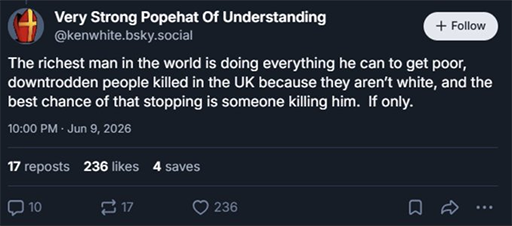
Popehat, aka attorney Ken White, has been permanently banned from Bluesky, apparently for a post in which he suggested there was a moral upside to Elon Musk’s death. The Bluesky body politic, meanwhile, is losing its mind over this. Popehat is one of their heroes.

Because Mr. White, once deemed one of Salon’s 25 conservatives worth following on Twitter, is, quite literally, mentally ill, he naturally doesn’t see why he shouldn’t be able to advocate murdering a man who opposes the violent invasion of the UK by foreigners. Also, a correction – he wasn’t permanently banned, he was only suspended for four days.

Elon Musk is the world’s richest man — a trillionaire, briefly, until a market correction. He and his ideology are also supported by the administration of the most powerful nation on Earth. He is immune to normal social, economic, political, or legal limits. He can use his hugely influential platform to encourage pogroms without social, economic, political, or legal consequences.

It’s simply factual to say, as I did, that the only thing that will stop him is dying. Because my medium was a short Bluesky post, I mentioned him being killed. I suppose it would also stop him if he overdosed on Ketamine or choked on a piece of steak or got ass cancer or crashed one of his vehicles or something. But that would make a long post. Though the post has drawn plenty of criticism, nobody has explained to me how I am wrong about the limited circumstances that will stop him from encouraging racial violence.

I wonder if he would apply that logic to other rich people, particularly those who advocate racial genocide in the Middle East?

Regardless, and presumably because Mr. White is mentally ill, he clearly doesn’t understand that he shares what he believes Mr. Musk’s position to be. By his own logic, if there is no way to stop poor, non-white, downtrodden people from invading the UK and victimizing the English people through normal social, economic, political, or legal means, then the only thing that will stop them is the very fate that he is advocating for Mr. Musk.

Of course, Mr. White’s position isn’t the same as Mr. Musk’s position. Mr. Musk wants those poor, non-white, downtrodden people who are invading the UK, and other countries around the world to be repatriated to their home countries, peacefully and legally. And he is warning people, as I have warned people for more than two decades, that every failure to repatriate the immigrants, refugees, and asylum-seekers will eventually result in large scale violence and war, regardless of whether the country invaded is the UK, Palestine, Germany, Japan, or the United States.

So, ironically, we have a mentally ill individual advocating the killing of someone who is not advocating death for anyone. And, unsurprisingly, Bluesky decided to unsuspend Mr. White after four days, because it is a safe space for mentally ill people who want to be able to publicly advocate the death of public figures on the basis of their positions on social policy in other countries.

Now, I would be remiss if I failed to give Mr. White a chance to defend himself concerning his mental illness.

I’ve made an effort for years to be open and honest about things like depression and anxiety, because I know it’s healthier, and because the social stigma around it should be crushed. This incident resulted, as is often the case, in losers mocking me for being crazy, and slightly more pretentious people obliquely referring to my mental heath. 

Mr. White wishes that we would stop observing that he is, by his own admission, mentally ill, and instead pay attention to the illogical incoherencies and death wishes produced by his mental illness. And, presumably because he is mentally ill, he does not comprehend that doing the latter leads invariably to the former.

DISCUSS ON SG


Convergence in the UK

It’s been a little disappointing to me how the concept of convergence I highlighted in SJWs Always Lie never found any traction, because it’s an extremely useful predictive model for institutional failure. And so people continue being surprised when converged institutions do what they always do, and refrain from taking any precautions whatsoever against convergence.

The UK Treasury quietly scrapped its numeracy test because basic math was a “hurdle” for minority candidates.

The people in charge of the nation’s money, debt, taxes, and economic policy decided that competence in numbers was problematic.

This isn’t diversity.

This is institutional self-sabotage.

It is institutional self-sabotage, which is absolutely inevitable in every converged institution. Not likely, not probable, inevitable.

Every converged institution becomes incapable of performing its primary function due to the fact that its priorities no longer include performing those functions.

I think it may be time to start thinking about putting a crowdfund together for SJWs Always Project to see if there is still a significant demand for that.

DISCUSS ON SG