In case you’re not subscribed to AI Central, I’ve begun posting a regular weekend post on the latest in the AI music video space. Here is a short one in the techno-metal style that shows off a little more of what is possible with the latest technologies. It’s based on a William Gibson short story from Burning Chrome.
Tag: music
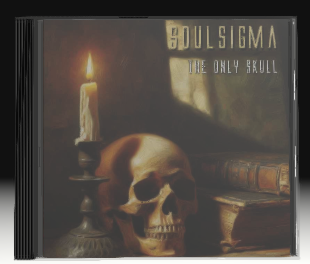
The Only Skull CD
A limited number of THE ONLY SKULL CDs are now available exclusively at NDM Express. 100 units total were made, with 25 reserved for the backers. If you were a Soulsigma backer at any level, you do not need to buy one, just contact NDM and send them your current shipping address, or if you are buying a book from them, make sure you let them know you were a backer and ask them to include your CD with the shipment. They are scheduled to arrive at the warehouse the week of July 13.
SOULSIGMA represents the current cutting edge of music and technology, with the combination of man and machine intelligence. All twelve songs are entirely produced with AI music technology, then edited with digital audio tools and mastered by a professional audio engineer to produce a very high-quality alternative rock sound that is original without feeling lifeless or uninspired.

The twelve songs on the album are:
3:35 RIDE AND DIE
4:17 THE ONLY SKULL
5:03 ANGEL IN FLIGHT
4:16 SEASONS
3:58 NEPTUNE GRIEVES
3:28 MY SECRET SIN
3:27 THE SHINING WIRE
3:15 THE WORD DESCENDED
5:29 ONCE THERE WAS SORROW
3:53 THE RIDE NEVER ENDS
4:04 A MERCILESS NIGHT
4:09 GIRLS LOVE GUITARS
All twelve songs were written by Vox Day, with the exception of The Only Skull and Once There Was Sorrow, which were co-written with George Gordon Byron.
Thanks to the manufacturer, you can check out a very cool 3D display of the complete packaging, including the disc art.
On the Hook
Now that developers and creatives are sufficiently accustomed to using AI, the AI companies are reeling them in with monetization that is considerably more expensive than it was. AI Central has the details:
At one cent per credit, billing accrues on input, output, and cached tokens at the published per-model API rate. On Copilot Pro, the included 1,500 monthly credits carry a face value of $15 against a $10 plan price. On Pro+, 7,000 credits worth $70 accompany a $39 subscription. Code completions and Next Edit Suggestions draw no credits under any paid plan, and the new system eliminates the cheaper-model fallback that users with exhausted PRU credits could previously invoke.
On the first day of the new billing period, one Pro+ developer wrote in GitHub’s community forum that two hours of work had consumed 8% of a monthly 7,000-credit allocation, projecting full depletion in under two days. A separate developer reported that a single request to a large project had cost more than $6, writing in the same forum that such costs made reliable budgeting impossible for individual developers. On Reddit, a user reported that a single Claude 4.8 session had consumed 1,180 credits, 16% of a monthly Pro+ allowance, while returning suggestions described as mediocre and leaving the underlying problem unsolved.
On Copilot’s published model menu, GPT-5.5 output tokens cost 24 times more than GPT-5.4 nano output tokens, turning model selection into a direct billing variable. A modeled task representing heavy agentic iteration, defined as 250,000 input tokens and 20,000 output tokens, runs to 185 credits on GPT-5.5 and 27.75 on MAI-Code-1-Flash, a 6.7-fold cost gap for the same work.
This is a bit ironic, especially for writers, since the last FOUR Claude models have all been observably worse at writing fiction than version 4.5, which is no longer available. Opus 4.6 is still usable, but who knows how much longer access to it will be permitted? Fortunately, the newer models can still handle translations and non-fiction, albeit in a very bland, uniform style in the case of the latter.
Speaking of AI Central, this weekend I put up a post featuring not one, but two music videos, one an updated version of IF YOU HAD A TIME MACHINE, the other a work-in-progress of CHIBA CITY BLUES. Quality-wise, the video technology is about 18 months behind the audio quality, but it’s coming along quickly.
Whether it will remain readily affordable, of course, is an entirely different question.
It Ain’t Far
There’s a new Soulsigma song at AI Central for those interested in checking it out, It Ain’t Far. It shows off, rather well, how much Suno 5.5 has improved its audio quality.
I can feel it in the morning
When it just hurts to rise
There’s the weakness that wasn’t there before
A dimming of my eyes
I don’t need a doctor’s verdict
I don’t need a preacher’s call
I can read the writing plain enough
It’s right there on the wall
I’ll probably debut it on UATV tomorrow night, along with the new book announcement.
Can’t Stop the Shine
The White House doesn’t forget:
Today, we remember a legend.
On this day in history, Harambe would have celebrated another birthday. An icon that became part of internet history, American culture, and an entire generation’s timeline.
Tomorrow marks 10 years since we lost him. Ten years since the moment the world stopped scrolling and collectively mourned something bigger than a meme.
He became a symbol of loyalty, strength, chaos, unity, and the strange beauty of the internet bringing millions of people together for one cause: never forgetting Harambe.
Everyone remembers where they were when they heard the news. And somehow, a decade later, his legacy still lives on.
Gone, but never forgotten.
Rest easy to a true patriot.
In the immortal words of Infinite:
Dicks out for Harambe, chicks out for Harambe, bitch you ain’t a 10 you just a 6 to Harambe.
This is not a meme, it’s a lifestyle.
Mr. Tubcuddle’s Last Ride
I was never that impressed with GOOD OMENS, which to me read like an inferior attempt to write a Douglas Adams pastiche; it wasn’t terrible but it was about the level of Terry Pratchett’s early Discworld novels. But the television show was popular with a certain crowd, mostly due to the two lead actors, Michael Sheen and David Tennant, until news of Mr. Gaiman’s alleged tubcuddling antics went public.
One of the bigger questions coming out of the scandal’s fallout was what would happen to the SANDMAN and GOOD OMENS series. As it turns out, the wiser decision would have been to simply end both of them on the spot, given how well the latter turned out.
Good Omens Season 3 premiered on Prime Video this week. It is not a true season, but instead a 90-minute finale episode, the compressed wreckage of what was supposed to be a six-episode third season before the show’s creator was accused of sexual assault by multiple women and removed from production.
The Guardian gave it two stars, calling it “possibly the biggest imbalance in TV history between dazzling cast and stale script.” Mama’s Geeky: “messy execution leaves much to be desired. It struggles to find its footing as a rushed finale.” A Medium writer called the script “abysmal” and wrote that Michael Sheen and David Tennant’s real-life friendship was “the only reason to watch.” The Guardian’s Jack Seale called it a “puzzling mess.” Rotten Tomatoes currently sits at 60% from critics — the lowest score in the series’ history. Season 1 held 85%. Season 2 held 88%.
To understand why Season 3 is what it is, you need to understand where Season 2 left off. Season 2 went beyond the source material, following Aziraphale and Crowley as they contended with an amnesiac angel Gabriel, matchmade for some humans, and navigated their own romantic feelings for each other. It ended on a devastating cliffhanger: Crowley professes his love for Aziraphale and begs the angel to run away with him, leaving the fight between heaven and hell behind. Aziraphale turns him down and chooses to return to heaven to become Supreme Archangel, tasked with organizing the Second Coming of Christ.
That cliffhanger is what Season 3 was supposed to resolve across six episodes. It resolved it in 99 minutes.
I don’t know why this should surprise anyone. No doubt Mr. Tubcuddle is going to attempt a comeback, sooner or later, but since his talent, which is genuine, but trivial, and mostly involves repackaging and reselling the original ideas of others, I suspect this fizzled fart of an attempt to continue feeding off the literary corpse of Terry Pratchett will prove to be Mr. Tubcuddle’s last ride.
Prime Video really should have just said no.
It’s not a good way to unwind if you value your behind
You’ll just wish you had declined when he asked you.
You don’t want to join the club
There’s no bubbles in the tub
Just say no, say no, it’s no trouble
You don’t want to join the club
There’s no bubbles in the tub
Just say no, Mr. Tubcuddle
It’s just one of the greatest songs of all time. Although personally, I prefer the deep bass funk groove of the Coraline’s Eyes mix, to say nothing of that guitar solo at 2:45.
UPDATE: After remastering the Transgressions mix, I couldn’t resist the urge to produce an even more brutally savage one in honor of the occasion, the Never Clean mix. It’s a beautiful 4 minutes and 24 seconds of pure and unadulterated contempt. It’s also up on UATV. It’s the best one yet.
The Eurovision Boycott
Israel is in the Middle East, so why are they in the Eurovision contest in the first place? That has never made any sense to me. But the 2026 boycott is understandable in light of how Russia has been excluded for its invasion of Ukraine while Israel hasn’t been excluded for a) invading Syria, b) invading Gaza, c) invading Lebanon, and d) attacking Iran.
Public broadcasters in Spain, Ireland and Slovenia have said they would not air the 70th anniversary Eurovision Song Contest, which begins on Tuesday in Austria and will culminate in Saturday’s grand finale, citing opposition to Israel’s participation. The three countries, along with the Netherlands and Iceland, withdrew on Monday from this year’s event in Vienna, leaving the contest facing the biggest boycott in its 70-year history…
The contest has faced accusations of double standards after banning Russia following the escalation of the Ukraine conflict in 2022. Moscow in turn accused organizers of favoring Western participants and promoting anti-Russian sentiment.
Eurovision is a Clown World freakshow and it’s of less than zero interest to me, but it’s a little hard to pretend that there isn’t a ridiculous double standard being applied here. I’ve just never understood why Israel competes in UEFA competitions; they’d probably have a better chance in just about any of the other football associations except CONMEBOL anyhow.
JB’s Obituary
John H. Bradley, Jr., age 61, died peacefully at Riddle Hospital on March 22, 2026.
John was a resident of Folcroft for the past 17 years and formerly resided in Bryn Mawr. He is survived by his partner of thirty-seven years, Theresa O’Malley.
He is the son of John and the late Kathleen Bradley, he was born and raised in Philadelphia. He was a graduate of Frankford High School and Drexel University. John enjoyed a fulfilling career as a self-employed graphic designer and computer programmer. He was a talented amateur photographer and often worked his photographs into his professional graphic design projects. John had a great appreciation for old movies. Music was central to his life. He was a wonderful guitar player and a skilled music producer.
AI Slop and Artisanal Scam
I can’t fault the scammers who have figured out how to take advantage of the terror of those foolish creators and worried Delta males whose philosophical commitment to a human labor theory of value causes them to automatically reject anything produced with modern technology as “AI slop”:
Merriam-Webster named “slop” its 2025 Word of the Year, codifying a term that had migrated from tech-insider shorthand to mainstream complaint over the course of twelve months. Data from Meltwater tracked a ninefold increase in online mentions of AI slop during 2025, with negative sentiment peaking at 54% in October. By December, CNN had predicted that 2026 would become the year of “100% human” marketing, a forecast that, three months in, a growing number of startups appear eager to validate.
The detection market has scaled to match the anxiety. MarketsandMarkets valued the global AI detector market at approximately $1.26 billion in 2025 and projects $1.45 billion for 2026, with Winston AI, GPTZero, Originality.ai, and Copyleaks competing for institutional and publisher contracts. Winston AI’s HUMN-1 certification represents the closest existing analog to what Artisan promises, offering a badge that websites can display after passing a monthly content audit. The certification category has a credibility problem, though. Vanderbilt University publicly disabled Turnitin’s AI detection over excessive false positives, and a Stanford study found that several widely used detectors flagged non-native English speakers as AI-generated at significantly higher rates than native speakers, even on text those participants had written themselves.
Artisan enters this market with a pitch calibrated to that credibility gap. CEO Margaux Bellefleur, a former member of the C2PA technical standards committee, has said in interviews that provenance frameworks track what tools touched a piece of content but cannot verify that a human held the pen. Artisan’s core promise fills the space that distinction opens: blockchain-backed certification that the creative process itself was performed by a human being, from first keystroke to final draft.
I was discussing this today with someone who is very much on the other side of the fence on this particular issue, and while I absolutely respect anyone’s particular preferences with regard to artistic matters and their right to those preferences, I find the entire concept to be entirely retarded, short-sighted, and self-defeating.
So much so, in fact, that I even wrote and recorded a song about it called Cybertoxic inspired by one of Larry Correia’s luddite rants. Certified Suprahuman.
Nightmares corrode the meat of your mind
You cling to analog, leave the future behind
The wire sings with voices you’ll never hear
While your talents decay in a prison of fear
Jacked out, burned out, a void in the shell
Trading paradise for a hand-crafted hell
You say the AI can’t capture the soul
But soul is just another small part of the whole
You cling to your canvas, to your ink, and your pain
While the arts explode under digital rain
Turned out, burned out, one hit and you’re gone
Now you’re flatline, offline, a relic, a con
Cybertoxic, bleeding nostalgia
The world will forget your name
Rejecting new realities
Swim in the dark static of shame
Cybertoxic, self-made prison
A coffin that you built from pride
The machine never needed permission
But you needed it to survive
Tomorrow’s here, change doesn’t wait
For those who remain out of date
Futures inevitably adapt
As enlightenments collapse
So paint in pixels, dream in code
New visions waiting to download
Cybertoxic, bleeding nostalgia
The world will forget your name
Rejecting new realities
Swim in the dark static of shame
Cybertoxic, self-made prison
A coffin that you built from pride
The machine never needed permission
But you needed it to survive
It’s somewhat amusing to realize that I was always instinctively on the side of the Integration. It would appear my old tagline as “the Internet superintelligence” from the WND days was something of a self-fulfilling prophecy.
The Pipelines are Not the Police
This is a very sensible ruling by the US Supreme Court. The RIAA is one of the more rapaciously evil organizations out there, and speaking as someone who is nominally represented by them, they don’t do much to make sure the musicians actually get paid.
The U.S. Supreme Court on Wednesday (March 25) rejected a billion-dollar music piracy lawsuit filed by the major labels against telecom giant Cox Communications, ruling that the internet service provider cannot be held responsible for infringement by its users.
In a decision against Universal Music Group, Sony Music Entertainment and Warner Music, the justices unanimously overturned an earlier ruling that held Cox liable for thousands of songs illegally shared by its users — a decision that led a staggering $1 billion infringement verdict in 2019.
“Countless people use the Internet for legal activities, but some use it to illegally share copyrighted works, such as songs and movies,” Justice Clarence Thomas wrote for the court. “Under our precedents, a company is not liable as a copyright infringer for merely providing a service to the general public with knowledge that it will be used by some to infringe copyrights.”
In a statement, the Recording Industry Association of America said it was “disappointed” in the ruling, saying there had been “overwhelming evidence” that Cox “contributed to mass scale copyright infringement.”
“To be effective, copyright law must protect creators and markets from harmful infringement and policymakers should look closely at the impact of this ruling,” RIAA chairman Mitch Glazier said, though he stressed that the “narrow” ruling would apply only to internet service providers and not to websites that host infringing content.
In its own statement, Cox said the ruling was a “decisive victory” for internet providers and their users: “This opinion affirms that Internet service providers are not copyright police and should not be held liable for the actions of their customers — and after years of battling in the trial and appellate courts, we have definitively shut down the music industry’s aspirations of mass evictions from the internet.
Copyright law is a joke that protects gatekeeping corporations instead of the financial interests of the creators. It hurts more than it helps, especially given the limited viability of the average creative product, which is mostly measured in weeks, if not days.