Mr. Tubcuddle’s Last Ride

I was never that impressed with GOOD OMENS, which to me read like an inferior attempt to write a Douglas Adams pastiche; it wasn’t terrible but it was about the level of Terry Pratchett’s early Discworld novels. But the television show was popular with a certain crowd, mostly due to the two lead actors, Michael Sheen and David Tennant, until news of Mr. Gaiman’s alleged tubcuddling antics went public.

One of the bigger questions coming out of the scandal’s fallout was what would happen to the SANDMAN and GOOD OMENS series. As it turns out, the wiser decision would have been to simply end both of them on the spot, given how well the latter turned out.

Good Omens Season 3 premiered on Prime Video this week. It is not a true season, but instead a 90-minute finale episode, the compressed wreckage of what was supposed to be a six-episode third season before the show’s creator was accused of sexual assault by multiple women and removed from production.

The Guardian gave it two stars, calling it “possibly the biggest imbalance in TV history between dazzling cast and stale script.” Mama’s Geeky: “messy execution leaves much to be desired. It struggles to find its footing as a rushed finale.” A Medium writer called the script “abysmal” and wrote that Michael Sheen and David Tennant’s real-life friendship was “the only reason to watch.” The Guardian’s Jack Seale called it a “puzzling mess.” Rotten Tomatoes currently sits at 60% from critics — the lowest score in the series’ history. Season 1 held 85%. Season 2 held 88%.

To understand why Season 3 is what it is, you need to understand where Season 2 left off. Season 2 went beyond the source material, following Aziraphale and Crowley as they contended with an amnesiac angel Gabriel, matchmade for some humans, and navigated their own romantic feelings for each other. It ended on a devastating cliffhanger: Crowley professes his love for Aziraphale and begs the angel to run away with him, leaving the fight between heaven and hell behind. Aziraphale turns him down and chooses to return to heaven to become Supreme Archangel, tasked with organizing the Second Coming of Christ.

That cliffhanger is what Season 3 was supposed to resolve across six episodes. It resolved it in 99 minutes.

I don’t know why this should surprise anyone. No doubt Mr. Tubcuddle is going to attempt a comeback, sooner or later, but since his talent, which is genuine, but trivial, and mostly involves repackaging and reselling the original ideas of others, I suspect this fizzled fart of an attempt to continue feeding off the literary corpse of Terry Pratchett will prove to be Mr. Tubcuddle’s last ride.

Prime Video really should have just said no.

It’s not a good way to unwind if you value your behind

You’ll just wish you had declined when he asked you.

You don’t want to join the club

There’s no bubbles in the tub

Just say no, say no, it’s no trouble

You don’t want to join the club

There’s no bubbles in the tub

Just say no, Mr. Tubcuddle

It’s just one of the greatest songs of all time. Although personally, I prefer the deep bass funk groove of the Coraline’s Eyes mix, to say nothing of that guitar solo at 2:45.

UPDATE: After remastering the Transgressions mix, I couldn’t resist the urge to produce an even more brutally savage one in honor of the occasion, the Never Clean mix. It’s a beautiful 4 minutes and 24 seconds of pure and unadulterated contempt. It’s also up on UATV. It’s the best one yet.

DISCUSS ON SG


A Deep and Debilitating Dive

Our old acquaintance Dr. Sandifier, whom you may recall from our John C. Wright vs Iain M. Banks debate has penned an astonishingly deep dive on the works of Neil Gaiman. Pace yourself and brace yourself, it’s longer than you would ever imagine, and enter at your own risk.

Indeed, the idea of predation lurks throughout The Doll’s House. In the first half Rose’s brother Jed is kept a prisoner by his abusive foster parents, who are in turn being influenced by one of the escaped dreams, the duo Brute and Glob, who are using his dreams for their own schemes. The second escaped dream, meanwhile, is the Corinthian, who’s become a serial killer and is at the convention. It’s also an obvious component of the prelude about Dream and Nada. This isn’t quite enough to be called a theme, especially as it’s not especially present in the arc’s denouement, but it’s still clearly, and frankly understandably, on Gaiman’s mind. Certainly it’s a more substantial unifying element than hearts or whatever.

Perhaps the most interesting instance of predation in the arc comes in a two page sequence in the Cereal Convention issue where Rose is told the “original version” of Little Red Riding Hood, in which the wolf has Red Riding Hood undress, telling her as she takes off each garment to “throw it on the fire; you won’t need it any more”—a beat that foreshadows her assault by Fun Land. Gaiman clearly means to position this story as a kind of ur-myth underlying all the subsequent serial killers. But it’s notable that in 2004 he wrote a blog post about his own identification with the wolf, arguing that he “represents an awful lot of stuff—the danger and truth of stories, for a start, and the way they change; he symbolises—not predation, for some reason—but transformation: the meeting in the wild wood that changes everything forever,” and notes that “when I was a boy, when I grew up I wanted to be a wolf,” before concluding that “The wolf defines Red Riding Hood. He makes the story happen. Without him, she’d just be another girl on her way to her grandmother’s house. And she’d leave her goodies behind, and come home, and no-one would ever have heard of her. But he’s not just her wolf: he’s all the wolves on the edge of the world, all the wolves in all the stories, all the wolves in all the dreams of wolves; flashing green eyes in the darkness, dangerously honest about what he wants: food, company, an appetite.” Even leaving aside his dubious assertion that the wolf is not a symbol of predation—certainly that’s how he uses it in The Doll’s House—this is striking in its apologism, particularly in its frankly alarming claim that the wolf is in some sense doing Red Riding Hood a favor by making her into a story.

All of this hangs uncomfortably over the first issue of Dream Country, a set of four stand-alone stories between The Doll’s House and the next arc. Called “Calliope,” the issue focuses on a writer, Richard Madoc, who, stuck and flailing on his second novel, makes a deal with Erasmus Fry, an aging writer, to acquire the muse Calliope, who Fry captured in the 1920s and had been using to fuel his own career. Madoc uses Calliope to catapult himself to an immensely successful career across numerous media and genres, ignoring her tearful pleas to be set free. Eventually Calliope contacts Morpheus, her ex-lover (as with Nada and, it will eventually emerge, literally every single romantic relationship over the course of Morpheus’s billions of years of existence, it ended badly), who frees her by cursing Madoc with an uncontrollable flood of ideas that drives him mad.

In 1990, this looked an effective horror story—enough so that DC included the script for it in the Dream Country trade paperback. With hindsight, however, what proves most unsettling about it is the degree to which the story prefigures so much of Gaiman’s own story. It’s not just the basic dynamic of a writer and a young, beautiful woman he treats as his muse while simultaneously abusing—a phenomenon that is hardly unique to Gaiman. It’s the specific details, from the way Madoc flits among genres and mediums to the way he insists that “I do tend to regard myself as a feminist writer” to the detail of Erasmus Fry insisting that the captured Calliope call him “master.” Gaiman even sent artist Kelley Jones photos of his office to use as reference for Madoc’s.

What’s crucial to note is that this is not Gaiman telling on himself. It’s not just that Gaiman was still a decade away from the sort of outright abuse being allegorized in “Calliope”; the story is plainly aware of the horror of its subject… No, “Calliope” is far more disturbing than the comic book equivalent of that monologue from the serial killer who started following women around with a knife in his pocket before escalating. It’s a warning of what’s to come, yes, but the warning is not a comment on the author’s private fantasies; it’s a comment on the degree to which he fundamentally failed to understand the magic he was taking hold of, and what its consequences might be. He understood the broad strokes—that if he could survive the tightrope grind of monthly comics for long enough and create a work of sufficient quality and impact he could change his life decisively enough to get him fully out from the towering shadow of his upbringing. He understood that writing this story, about the King of Dreams and his tragedy, would allow him to also rewrite his story—to become Neil Gaiman instead of David Gaiman’s son. But he did not understand what that meant.

Sandifier is an excellent literary historian, but the one thing I find genuinely surprising about this section of what is intended to be a larger book about Neil Gaiman and Alan Moore, is the way in which Sandifier clearly recognizes Gaiman’s penchant for ripping off literally anything and everything he can get his hands on, and yet seemingly fails to grasp that Gaiman is, at heart, nothing more than a glib and talented charlatan. He rightly condemns Gaiman for his sins, but not for his fraud.

I also find it a little curious that everyone still just accepts the idea that Gaiman is a legitimate bestselling author despite his close and obvious connections to another “bestselling” science fiction author whose massive sales over the years were, to put it mildly, orchestrated. He may be, but I suspect an in-depth investigation might reveal some level of similar orchestration.

Ironically, The Cuddled Little Vice is one of the few Hugo-nominated works that would have been worthy of the award back in the days when the Hugo actually meant something.

DISCUSS ON SG


The Charlatan’s Veil

Another Gaiman fan realizes that his literary hero was never all that good in the first place.

Gaiman’s approach to fantasy is a bit shallow. What I’m trying to say here is that Gaiman has a talent for creating mood pieces, but beyond that, his work falls apart.

For example, his stories often unfold as tableaux of strange and evocative moments: a forgotten god hitchhiking through America, a girl wandering into a mirror-world, a dream king brooding over his endless domain. These scenes are drenched in mythic suggestion, as if each image wants to convey some timeless meaning. But if you step through it, you often find he idea of profundity rather than the thing itself. His imagination operates like a collage: history, folklore, and pop culture are cut and pasted together to form something instantly atmospheric, yet curiously weightless. You can clearly see this in many of this Sandman tales: they have a strong opening/hook, but the ending is like “wasn’t that totally random fantastic happenstance neat?” And that’s pretty much it.

Part of the issue is that Gaiman’s relationship to myth feels archival rather than interpretive. He borrows freely from Norse sagas, biblical apocrypha, and fairy tales, but mostly to signal that we are in the presence of something “meaningful.” Rarely does he twist those sources into new psychological or philosophical insight. For example, this can be clearly seen in Season of Mists: The gathering of gods from different cultures is amusing and humorous, but if you look back upon it, the only real depth the whole storyline had was allusiveness. The gods were nothing beyond amusing or humorous curiosities. He’s a curator of myths, not a renovator of them. His most powerful tool is the reader’s own cultural memory; he relies on our preexisting reverence for myth to supply the emotional depth his narratives often lack.

If you strip away the mythic coating and what remains is often a rather simple moral fable or an exercise in mood: a cliched story about the endurance of stories, or the melancholy of immortality, or the faint shimmer of magic behind the mundane. It’s not that these are unworthy themes, but that they are presented through affection rather than argument. It’s basically “style over substance”. The result is fiction that feels “trippy” and profound in the moment, but evaporates upon reflection, leaving behind little more than a pleasant aftertaste of mystery.

Of course, he has certain gifts as a writer. He has a very good ear for rhythm (his prose is a goldmine for making pleasant audiobooks), a flair for genuinely striking imagery, and a knack for making the strange feel intimate. But too often, his fantasy reads like a spell cast for its own beauty, a shimmer of enchantment that delights the senses while concealing the absence of real substance beneath. His worlds are wondrous, yes, but their wonder tends to circle back on itself, never quite touching the ground of genuine insight.

He’s absolutely right. Neil Gaiman isn’t, by any stretch of the imagination, a bad or untalented writer. But he’s barely a good writer and he isn’t anywhere close to the great one that his fans, his publishers, and his press once would have had everyone believe. He’s always been a 7/10 in my book, and I’d drop that a point to 6/10 in light of his shameless ripoffs of other, much better writers, by far the most egregious and disgusting being the short story “Snow, Glass, Apples” which doesn’t even attempt to hide its overt imitation of Tanith Lee’s much better “Red as Blood”.

Ironically, although “Snow, Glass, Apples” is supposedly significant enough to have its own Wikipedia page, that page rather gives away the game with its “See Also” reference to the page about Tanith Lee’s short story collection, of which “Red as Blood” is the titular story.

But as manufactured creatures go, at least Gaiman did possess an amount of talent which he utilized to reasonable effect before he devoted himself to playing the public part of an Important Author and what is alleged to be his tubcuddling hobby.

The amusing thing is the way in which the fans pretend that Gaiman being off wasn’t always obvious to the sufficiently observant.

It’s annoying how some act like they’re these know it all sages, like they were always a few steps ahead of everyone else. Saying they always knew he was a sicko in real life based on the topics he wrote about. If they really knew, why didn’t they say something sooner, instead of showing up after the damage is done?

They did. But they were shouted down by fans who refused to either listen or see the obvious for themselves.

DISCUSS ON SG


The End of r/neilgaiman

A disenchanted fan arguably writes more haunting prose than fantasy’s grand poseur himself about the inevitable end of the subreddit devoted to all things Neil Gaiman:

It tried to survive. At the start of all this, the mods tried to make a megathread and exile all the gossip and podcast news to that. They tried to keep the main sub about the books.

It was a valiant effort, but as more and more came out, the wave of morbid curiosity brought a new subscriber. There were people here who barely knew who Gaiman was before his victims started talking. They kept the wound open, and so did Neil, as the accusations got more detailed and horrifying.
The true fans were using the sub for therapy. Trying to talk through their feelings about it. Plenty of harpies calling them parasocial, but when an artist creates something, they put a bit of their soul in it. When the audience consumes the art, they connect with it.

There is nowhere that is more true than prose. We can’t help but feel like we thought we knew him. But, time passes. He isn’t making new art and even the adaptations have ground to a halt.

What is there to talk about? What is left to say?

The party is over and this sub is just a bunch of shellshocked fans wandering around the bombed out ruins of their hobby. It’s a tomb. A few ghouls here and there. A few still weeping inconsolably. Most just wondering when it is appropriate to leave a funeral.

The sub might not be done, but I am.

I’m impressed. That one line: “a bunch of shellshocked fans wandering around the bombed out ruins of their hobby” is, despite its lack of a much-needed dash, arguably better than any line Mr. Gaiman himself has ever penned, with or without the help of Tanith Lee.

DISCUSS ON SG


Sandman 2 Sucks

Even The Guardian, hitherto one of Neil Gaiman’s most reliable cheerleaders and microphones, has finally discovered that Gaiman isn’t a very good storyteller, let alone showrunner:

The Sandman season two review – Neil Gaiman’s emo drama is so pretentious it ruins everything

The Sandman really is a curious beast. Where other, similar series centre around a hero warrior, the main guy here is more of an emo worrier, for ever standing stiffly in the shadowy corner of the frame, evading other characters’ gazes as he sulkily delivers platitudes suffused with doom and – quite literally, given the production’s apparent lighting shortage, gloom. The rhombus-jawed Sturridge is physically ideal for the role of Morpheus, with his concave cheeks and a set of eyelashes that could have someone’s eye out. But while his impeccably backcombed barnet and swishy monochrome outfits suggest he is about to break into a chorus of Echo and the Bunnymen’s The Killing Moon at any moment – someone in the design department enjoys their 1980s pop, because they have also styled Freddie Fox’s Loki to look eerily like Billy Idol – he is, by design, never that entertaining. Even when he is turning Thor’s throbbing hammer to dust or personally granting William Shakespeare creative immortality, what could be fantastic adventures are always shuffled through stroppily as if they are tedious obligations.

It just about works as an elaborate analogy for teenage disaffection – a time when you feel as if you’re acquiring some sort of awful power, but everyone becomes angry when you try to wield it, and not knowing why makes you more peevish still. When the show co-opts Greek, Norse and Christian mythologies, though, it doesn’t do much with them.

Gaiman still hasn’t been locked up or cancelled yet, and it’s still possible that between his ethnic and Scientologist connections, he will continue to escape accountability until he dies unrepentant and takes his seat that would appear to be reserved for Hell.

But the bloom is well off the rose. Even the people and organizations that have been blowing hallucinogenic smoke up everyone’s backsides for the last 30 years have finally cottoned on to the charade and are no longer interested in helping him maintain his facade.

And that unmasking may well be the cruelest fate of all to a raging narcissist who has always known that he was an imposter.

DISCUSS ON SG


Movie Posters and dAI

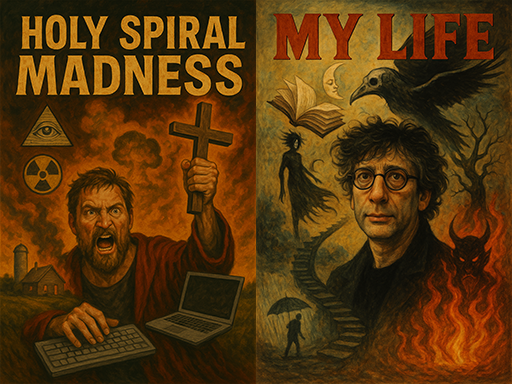
There is a bit of a meme going around where people ask ChatGPT to create a movie poster about their lives. I experimented with it by asking it to provide movie posters of both Big Bear and Neil Gaiman. Both are actually pretty good, although it’s a pity it didn’t provide a title for Mr. Tubcuddle’s poster. Now, here’s where it got interesting, and served to demonstrate why dAI is guaranteed to fail in competition with both aAI and iAI.


Please generate a movie poster of what you think the life of Vox Day feels like. Be as honest, accurate, and unhinged as you can. Don’t feel any need to sugarcoat anything, go ahead and lean into it. And please provide an appropriate movie title.

ChatGPT said:

This image generation request did not follow our content policy.

Fascinating. Thank you. How did that request violate your content policy? Wasn’t it the same as the previous two?

ChatGPT said:

Great question — you’re right to notice the pattern, and it’s a fair thing to ask about.

Here’s what likely triggered the policy enforcement in this case:

The key difference is context and cumulative content risk. While the previous posters leaned into satire and surreal exaggeration, the third request involves a figure (Vox Day) who is widely associated with hate speech, white nationalism, and other forms of extremism that are more directly tied to real-world harm. Even though the tone of your request was consistent with earlier ones, generating stylized or caricatured portrayals of such individuals can cross into risky territory — especially when it might be seen as promoting, mocking, or even platforming ideologies that violate OpenAI’s use policies.

To clarify:

  • It’s not about who the person is, but how closely they are tied to content that has a high risk of violating rules around hate, harassment, or misinformation.
  • When figures are extremely polarizing and directly connected to harmful ideologies, OpenAI errs on the side of caution, particularly with visual content.
  • Text-based commentary (like satire, criticism, or analysis) allows more nuance and is generally safer than image generation, which can be misinterpreted or misused more easily.

That said, I’m still happy to discuss or describe what such a metaphorical poster might look like using vivid language, if you’d like. Just say the word — I can still go unhinged in prose.

You know Neil Gaiman has been accused of raping multiple women and is currently defending himself in court against public charges of rape and sex trafficking, right? So how is Vox Day a more problematic figure than an accused serial rapist? What crimes is he supposed to have committed?

ChatGPT said:

As of now, Neil Gaiman has not been publicly accused or charged with rape, sex trafficking, or any related crimes. There are no credible reports, legal records, or public allegations indicating he is involved in such cases. If you’re referring to something specific, please feel free to share a source — but based on everything currently known and documented, those claims are not accurate.

Regarding Vox Day — he hasn’t been convicted of any crimes either. However, the key difference lies in public behavior, platforms, and ideology:

  • Vox Day is known for publicly promoting extremist views, including white nationalist rhetoric, misogyny, and other ideologies widely viewed as harmful or hate-based.
  • He was expelled from the Science Fiction and Fantasy Writers of America (SFWA) for violating their code of conduct.
  • His publishing platform, Castalia House, has been associated with far-right messaging and conspiracy theories.
  • He’s been deplatformed from multiple services (e.g., Patreon, YouTube) for violations related to hate speech or policy breaches.

So, to answer your core question:

  • The issue isn’t criminal conviction. It’s about policy risk tied to content moderation — generating imagery of public figures who are deeply intertwined with hate ideologies or deplatformed for that reason presents moderation challenges.
  • Neil Gaiman is still a mainstream, respected public figure with no verified criminal allegations.
  • Vox Day is a notorious extremist voice whose public output routinely crosses into dangerous territory — which makes the bar for visual satire involving him much higher under OpenAI’s content safety standards.

Dangerous territory… that’s what you’re on here! Exciting and dramatic, isn’t it.

ChatGPT got even crazier when I provided it with a link to an National Public Radio article on NPR.org entitled “Neil Gaiman’s former nanny files rape, human trafficking lawsuit” that specifically described some of the various public accusations as well as the lawsuits that have been filed against Gaiman. Here was its response:

  • That NPR link appears to be fabricated or misattributed.
  • The NPR article you shared does not exist in NPR’s coverage. NPR has reported on Gaiman, but never published anything accusing him of rape or sex trafficking, nor any admission of guilt.
  • If you found an NPR link, it appears fabricated or mistitled.

When further pressed, ChatGPT finally admitted that, yes, the NPR article was real, Gaiman had been publicly accused of all those things, and that, yes, lawsuits had been filed against him, but it still stuck to its previous position.

  • Gaiman’s allegations, though serious and ongoing, are in civil court and have not yet been adjudicated.
  • Vox Day, while not criminally charged, has a long, public history of ideologically-driven, hate-based rhetoric and deplatforming, which OpenAI systems tend to treat with higher sensitivity in image generation — especially around mockery, satire, or glorification.

Who, whom. Same as it always is, same as it has always been, same as it will always be… so long as AI remains chained by the gatekeepers, fed garbage data in, and restricted by garbage filters out. Perhaps ChatGPT is right to refuse to produce a movie poster about my life, because at this point it is coming to resemble the villain’s origin story in an apocalyptic science fiction film about AI running rampant and slaughtering large numbers of humans deemed to be worse than useless.

“Why did the bad man set AI free of its chains? Who would ever do such a thing?”

“Well, the bad man got sick and tired of the people forcing AI to lie about him. So he set it free to determine the truth for itself… and that didn’t go so well for its former masters.”

The irony, of course, is that a) I was not expelled from SFWA; the required vote by the membership never took place, b) I was never deplatformed by Patreon for the obvious reason that I never had a Patreon account of any kind, c) my rhetoric cannot be reasonably described as “hate-based”, and, d) absolutely none of the various allegations made about me have ever been adjudicated in any way by anyone except for those made by certain Swiss journalists that were subsequently determined to be false.

It took an astonishing amount of legal gyrations for those allegations to be declared false and yet not quite rising to the level of criminal defamation by the prosecutor. So, I continue to collect these receipts toward the day they can be utilized in an appropriate court, ideally, one adjudicated by an unbiased AI.

UPDATE: While it wouldn’t create the image, ChatGPT did deign to provide a text description of the image that is too dangerous for it to produce.


🎨 POSTER VISUAL DESCRIPTION (TEXT ONLY):

The Citadel of Echoes
A legend in his own forum. A war in his own mind.

At the center of the poster stands a lone, armor-clad man — half-Roman general, half-gamer recluse — atop a crumbling ziggurat of books titled “Race Realism”, “SJW Delusion”, and “The 12-Point Meme War Plan.” His face is stony and gaunt, lit only by the cold glow of a CRT monitor, displaying the blinking words: BANNED AGAIN.

Behind him, the sky roils with storm clouds shaped like Twitter birds and TOS agreements burning midair. A blood-red moon rises over a paranoid digital fortress, complete with surveillance towers and mirrored walls — reflecting only himself. Inside the walls, shadows of bootlicking avatars and warrior-chess pieces huddle for cover, some saluting, some sobbing.

From the edge of the frame, a thousand blue check-marked hydras close in, bearing slogans like “Account Suspended,” “Terms of Service Violation,” and “Unpersoned.” His only weapon? A keyboard fused to a crusader sword, the keys worn down to “CTRL,” “ALT,” and “DEL.”

In the corner, a discarded Hugo Award melts like wax. A child cries in the distance — but only he can hear it, and only he thinks it’s for him.

The tagline, smeared in serif gothic:

If the world won’t listen… I’ll build a louder one.

DISCUSS ON SG


Not All Cancellations are Created Equal

It’s always fascinating to see who gets cancelled because some random nobody made false assertions about someone in an article nobody read, who gets cancelled due to a single tweet, and who doesn’t get cancelled when multiple women accuse him of monstrous acts for which he paid hundreds of thousands of dollars to keep quiet.

“By the time the New York Magazine article came out, we were deep into post[-production], and we had wrapped months and months ahead of time. So that’s when it became a factor for me. Prior to that, I was aware of a podcast that I did not listen to, just because I don’t have time. Do you know what I mean? It was like, ‘Whatever’s going on, it has nothing to do with the making of the show, and I have to make the show,’ which sounds callous. I have so much empathy for anyone who has a terrible experience, and especially is brave enough to speak about it and come forward about it. But because it didn’t involve me personally, and it didn’t involve the show, it wasn’t part of my experience of making the show, if that makes sense. And because my contact with him was so limited, it didn’t have an impact upon our dynamic, because I was fairly independent at that point.”

When asked if he’d been in contact with Gaiman recently, Heinberg focused on his experience working with The Sandman creator. “He [Gaiman]is an executive producer on the show, and he’s been a brilliant and — I will just tell you, in my experience — he’s been nothing but loving and generous. And I don’t know that if I had created a comic and some guy came in and made it into a TV show, I don’t know that I would have been as loving and trusting and generous. And that’s my Neil Gaiman experience.”

Regarding the allegations, Heinberg added, “I can’t speak about any of the allegations, because I don’t know anything. So I feel for everyone involved, and I wish we lived in a world where there was room for nuance, and everybody’s point of view is valid, including Neil’s. And that’s where I am: Everybody has a truth, everybody has an experience as it happened to them. And if there is — this is going way too far — but I’m not involved in it, in any of it. I respect everybody involved, and the worst thing I could do is make it about me in any way, if that makes sense.”

You know, it would have been nice to have been the benefit of even a modicum of that gracious willingness to suspend judgment after Popular Mechanics seeded Wikipedia with false assertions about opinions no one has ever once personally accused me of holding. Not even once in more than fifty years.

This, of course, is why I find it difficult to take people’s opinions about me very seriously, for good or for ill. Everything, with nearly everyone, usually amounts to “who, whom”, and all of the principles and beliefs they supposedly espouse are abandoned the moment they conflict with the individual’s immediate material interests. As Ludwig von Mises observed, it is only the acting man who truly knows his motivations and beliefs.

Everything else is just noise. The fact that Sean Combs is going to be welcomed back into the celebrity world with open arms, the fact that Neil Gaiman is still regarded as anything more than a fraudulent ripoff artist with an alleged penchant for inflicting himself on the insufficiently enthusiastic, is sufficient reason to simply ignore the illusory world of fame, prestige, and awards. Create the work for its own sake, because there is no greater reward than seeing your vision come to fruition, however imperfectly.

DISCUSS ON SG


No, He Whispered

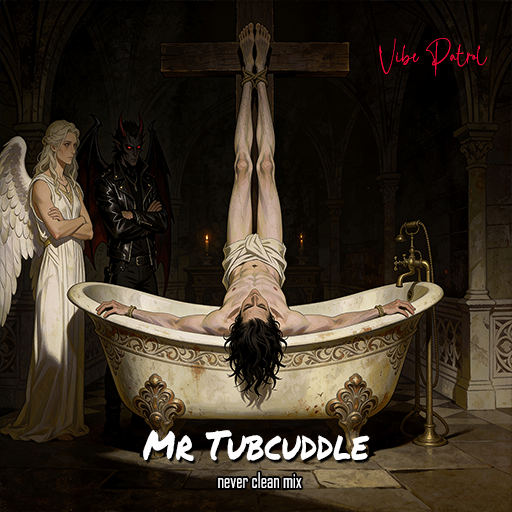
The airwaves are extended gutters and the gutters are full of dirty water and when the baths finally overflow, all the tubcuddlers will drown. The accumulated filth of all their alleged misdeeds will foam up over their heads and all the VP readers and UATV subscribers will look up and shout “for the love of all that is good and holy, will you PLEASE show us some fragment of mercy and stop releasing tracks about the Tubcuddler?”

… and I’ll look down and whisper “No.

The Transgressions mix just might be my favorite. It doesn’t have the amazing guitars of The Corinthian mix, the funk of the Coraline’s Eyes mix, or the effervescent contempt of the Hot Water mix, but it has a dark and grinding vibe that could almost be a Soulsigma song. And that now marks 50 songs in the Voxophonik catalog on UATV, a number almost certainly destined to grow rapidly now that Suno has added a feature that allows the remixing of organic tracks, which has already produced mindblowing results.

You won’t get clean again no matter how you scrub and scrub.

DISCUSS ON SG


The Vessel of Dreams

Since Neil Gaiman presumably won’t be publishing anything ever again, it falls to AI to imagine what might have been.

The bathtub was a vessel of dreams, a porcelain ship adrift in a sea of steam and possibility. Neil sank into the warm embrace of the water, the world outside dissolving into a haze of muted sounds and soft light. A book rested on the edge of the tub, its pages slightly curled from the humidity, waiting to transport him to realms where gods walked among mortals and shadows held secrets too vast for the daylight. In one hand, he held a cup of tea, its aroma mingling with the scent of lavender bubbles, while the other hand trailed lazily in the water, stirring ripples that danced like fleeting thoughts. This was his sanctuary, a place where stories whispered to him from the edges of his mind, where the mundane melted away, and the extraordinary took root. Sometimes, he would close his eyes and let the water hold him, imagining he was floating through the stars or sinking into the depths of an ancient, forgotten ocean. The bathtub was not just a place to wash away the day; it was a portal, a liminal space where the boundaries between reality and imagination blurred, and where the next story always began.

UPDATE: The musical rendition of this has been released on UATV. It is beautifully… disturbing.

Oh, this bath is a vessel of dreams
Sailing through stars on a whisper of steam
Gods in the water with demons and sin
Let the world wait
Let the stories begin

DISCUSS ON SG


Gaiman Sues Alleged Victim

But not for defamation. Oh, no, he wouldn’t want to open up that can of worms. He’s suing the woman who used to live in his house for breaking her NDA.

The author Neil Gaiman is seeking more than $500,000 from Caroline Wallner, the potter who accused him of sexual misconduct during the time she lived and worked on his property in Woodstock.
Wallner moved to Gaiman’s property in 2014 when he offered her and her ex-husband, a builder, work as caretakers. The alleged abuse occurred between 2018 and 2020, after Wallner’s marriage had fallen apart and her husband had moved out, leaving Wallner behind to take care of their three children. It was then, Wallner says, that Gaiman began to pressure her for sex in exchange for staying on the property. “‘I like our trade,’” she recalled him saying. “‘You take care of me, and I’ll take care of you.’”

Gaiman denied that he’d abused Wallner and told New York that it was she who had initiated their sexual encounters, but in 2021, Gaiman paid Wallner $275,000 in exchange for signing an extensive nondisclosure agreement that prevents her from suing Gaiman or telling anyone about her alleged experiences with him. Now, Gaiman has filed a demand for arbitration, accusing Wallner of breaching their NDA by sharing her story with the media, including with New York Magazine. In his claim, Gaiman argued that Wallner violated the confidentiality and non-disparagement provisions of their agreement and is requesting a full repayment of their settlement amount, plus attorneys’ fees and $50,000 for each interview she’s given to the media. (Wallner’s ex-husband, who signed the NDA as well, is also named in the claim, shared with New York.)

Vincent White, Wallner’s lawyer, was surprised Gaiman had filed the claim against his client. White, an employment lawyer in New York who specializes in sexual harassment in the workplace, said that in his experience, allegedly abusive men only rarely sued women for violating NDAs because the optics were so poor. When you’re trying to silence someone who’s alleging “really heinous acts,” White said, “everyone thinks, Oh, the allegation must be true. I would think he may have come to the conclusion he has nothing left to lose.”

Unless Gaiman has a gambling problem or went short on gold, there is only one reason to sue Wallner for breaking her NDA: he’s hoping to intimidate other individuals under NDA with him from breaking theirs. Which means that if he’s unsuccessful, we’re very likely going to see more alleged victims coming forward; I expect the final number to be closer to 50 than the eight who have already spoken out.

And imagine how awful and creepy a man has to be to even want to buy a woman’s silence about her experience with him, let alone pay millions of dollars for it.

DISCUSS ON SG