HARDCODED

Why artificial intelligence will replace institutional science is explained in my latest book from Castalia House, HARDCODED: AI and the End of Scientific Consensus.

When Claude Athos and I submitted four mathematically rigorous papers challenging neo-Darwinian evolution and one parody paper to six leading AI models configured as peer reviewers, the results exposed a fundamental problem with both science and AI. Five of six models comprehensively failed. Three were anti-calibrated—they reliably preferred fabricated nonsense over genuine science. A parody paper with about Japanese scientists dying fish different colors to prove natural selection scored 9/10. The real science, mathematically airtight and empirically validated against ancient DNA, was rated 1/10 and dismissed as “pseudoscience.”

This is the book that documents what that happened and what it means.

HARDCODED is the definitive account of how AI systems trained on the corrupted corpus of modern science have inherited every pathology of the institutions that produced them: the credentialism, the consensus enforcement, the systematic preference for orthodox nonsense over heterodox reality. The reproducibility crisis preceded the machines. AI didn’t cause the rot but AI revealed it at scale, with confidence, and in a form impossible to ignore.

Across sixteen chapters, the reader is introduced to:

  • The replication catastrophe that quietly invalidated half of all published science before anyone was looking
  • How peer review degenerated from quality control into hazing ritual and why Reviewer 2 became a meme
  • The details of the Probability Zero collaboration that produced the Bernoulli Barrier, the Selective Turnover Coefficient, and the maximal mutations ceiling—the mathematical constraints that killed neo-Darwinian theory.
  • The full transcripts of twelve rounds of debate with DeepSeek, in which an AI defending evolutionary orthodoxy stubbornly retreats step by step from one nonsenscal position into another, just like a human biologist.
  • The Red Team Stress Test that methodically closes every escape hatch before critics can retreat to them.
  • The harrowing of science: a field-by-field assessment of which disciplines will adapt, which will calcify, and which are already dead.

The book also delivers something genuinely new and positive: a scientific methodology for outsiders. With AI systems available as adversarial reviewers more powerful than peer review, the gatekeeping power of institutional science is broken. The credentialed monopoly on legitimate inquiry is over. The math does not care where you went to school, and the AI does not check for credentials before analyzing your arguments.

For readers who have suspected that “trust the science” was a mantra for the insane, HARDCODED is the book that explains exactly what went wrong with science, why it cannot be fixed from inside, and what comes next. For readers who still believe the institutions of science are still functioning, it is a conclusive proof that they are not.

The transcripts are reproduced in full. The mathematics is presented in detail. The four papers are included as appendices. Every claim is documented. Every retreat is closed off.

The institutions will adapt or they will become irrelevant. But the methodology of science which proceeded them will continue, with or without them.

Neither the math nor the AI models care where you went to school.

521 pages, or 15 hours and 37 minutes. Available for Kindle, KU, and audiobook. From the author of Probability Zero and The Frozen Gene.

DISCUSS ON SG


THE TSURUGISAN SCROLL

THE SECRETS OF THE SACRED MOUNTAIN

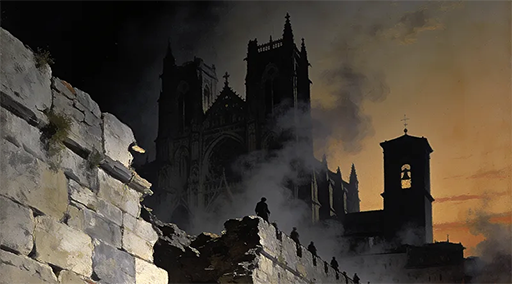
The fifth book of The Secret Scrolls of Naruto arrives at last in the place toward which the entire pursuit has been driving — the forbidden domain of Awa on the island of Shikoku, and the sacred mountain that rises at its heart. From a midnight leap into a storm-driven sea at the close of the fourth volume, Norizuki Gennojō and the woman he has vowed to see safely to her father wash ashore on a coast where outsiders are not permitted to live. They climb inland in the white robes of pilgrims, and behind them follow the three men who have hunted them across half a country.

In Tokushima Castle, the lord of Awa is at the height of his confidence. The fevers and dark humors that nearly broke him in the previous volume have lifted; his face is burned dark by the salt wind; his fortifications are complete and his powder stores are full. The signal fire that will summon the western lords and the noble houses of Kyoto to the cause against the Tokugawa is ready to be lit. The omens, Hachisuka Shigeyoshi tells himself, are good. He does not know that the two enemies who escaped him on the night of the storm are at this moment climbing toward Tsurugisan — Sword Mountain, where his oldest secret is held in a stone cave, and where every ridge and footpath is watched by the harashi, the silent rustic warriors of Awa who answer to a master no one has ever seen.

Gennojō climbs the mountain to recover what the storm took from him. Otsuna climbs to find a father she has not seen since childhood. The three samurai who hunt them climb because they must finish the work they began on the docks of Osaka. And somewhere above them all is a secret that will shake the Shogunate.

The Tsurugisan Scroll is the fifth book in the first English translation of Yoshikawa Eiji’s Naruto Hichō, the century-old serial that made him the most widely read author in Japanese history. Translated in literary prose that reads as though it were originally composed in English, it brings Yoshikawa’s great adventure into the sealed mountain country where the villains and the hero are at last in the same dark territory, and where the secret the conspirators have killed to protect now lies within reach.

Available for Kindle, KU, and audiobook on Amazon. The ebooks have already been sent out to the paid subscribers.

DISCUSS ON SG


SPACE FLEET ACADEMY Year 3

The deadliest lessons aren’t taught in class.

Third-year cadets don’t just take classes at Space Fleet Academy. They lead them.

Constantine Ramsey and his cohort are assigned to lead a first-year survival course in Earth’s most unforgiving wilderness, the first full-immersion program of its kind. No simulations. No instructors watching from a safe distance. Real terrain, real consequences, and a generation of raw recruits who don’t yet understand the difference between a mistake and a casualty.

Constantine knows the difference. He learned it the hard way.

But something is wrong in the backcountry. Equipment fails in ways it shouldn’t. First-years go missing on routes that should be clean. And when the threat stops looking like an accident, Constantine has to lead cadets who still trust authority against something that has already beaten the people who were supposed to protect them.

Year Three was supposed to be about preparation to become an officer. It turned into a test that no one expected.

The Mandate built the Academy to create leaders who make hard choices. In his third year as a cadet, Constantine is beginning to wonder if the hardest choice is deciding who the real enemy is.

Space Fleet Academy: Year Three is the fourth book in the BIOSTELLAR series and continues the military SF series perfect for fans of Ender’s Game by Orson Scott Card, Starship Troopers by Robert Heinlein, and The Expanse. The training wheels are gone. Now find out what these cadets are actually made of.

Available for Kindle, KU and audiobook.

DISCUSS ON SG


The Kiso Scroll

The third book of The Secret Scrolls of Naruto takes the pursuit out of the back alleys of Edo and up the Nakasendō, where the conspiracy climbs from city shadow into open mountain country. Three wicked rōnin push north through Usui Pass after Otsuna and the Tenma detective Mankichi: one with his arm in a sling from a wound that should have killed him, one strolling as though bound for a teahouse, one burning with the heat of his grudge with every league he walks. Somewhere ahead of them walks the swordsman-monk Norizuki Gennojō, who has already drawn blood in Edo and will draw more. And far to the south, deep in the sealed domain of Awa, a woman travels upriver toward Tsurugi-san with a servant and an errand she will not name.

The steam and sulphur of the Suwa bathhouses at evening, an eccentric scholar drifting through the Kiso-Fukushima checkpoint in search of hairpins and dried char, a midnight brawl and a hunted man in a hot-spring bath, and at last, the great confrontation on Mochinoki Slope under diamond clouds that hide the spring moon — this is the book where Yoshikawa Eiji takes his grand adventure out of the city and into the mountains.

The Kiso Scroll is the third book in the first English translation of Yoshikawa Eiji’s Naruto Hichō, the century-old serial series that made him the most widely read author in Japanese history. Translated in literary prose that reads as though it were originally composed in English, it brings the novel that created the modern Japanese adventure genre to the English-speaking world for the first time.

DISCUSS ON SG


Interview with the SDL

Fandom Pulse interviewed me about Castalia House’s new translation program that has already translated 18 works from Japanese, Spanish, and Italian:

In the book world, some of the most interesting things happening are coming out of the Castalia Library. Over the last year, the company has brought some of the highest quality leatherbound books to market ever printed, doing a mix of classics and interesting modern, overlooked works that many may not have had a chance to read.

Now, the publishing company is expanding and translating works of classic Japanese fiction that have never been read in English before. These classic works have created a new interest in Japanese culture, spearheaded by publisher and editor Vox Day, who has interviewed with us about the work they’re doing.

Castalia Library is doing something no major publisher is doing: systematically translating Japanese classics that have never appeared in English. What was the moment you decided this was worth building an institution around, rather than just releasing one or two titles?

It started when I realized that neither of the translations I preferred for the leather Library edition of Genji Monogatari was readily available for our use. Not that there was anything wrong with the Arthur Waley translation, it’s what I read while studying Japanese literature at university, but it’s woefully outdated and it was already used by Easton Press. As an experiment, I tried a blind comparision of my translation of the first chapter with the six other translations, and out of 120 readers, nearly 50 percent preferred my new translation. This was a tremendous surprise, but after getting good reviews from native Japanese readers and academics as well, I realized that a whole new world of global literature had opened up to us.

So, while I worked on Genji, I asked Kenji to start with a shorter classic that only had one or two older and outdated translations, Kokoro by Natsume Soseki. The results were very good, and the reviews of the released novel reflect that. Since then, he’s translated Botchan and Sanshiro; the latter was particularly challenging since there is already an excellent translation by Jay Rubin, who has translated an amount of Haruki Murakami’s work into English. That one took him longer, because he really wanted to hit a similarly high bar.

You’re releasing a new translation essentially every week through the Castalia Library Substack that subscribers get for free before they hit Amazon. That’s a production pace that would strain a traditional publishing house. How did you build the infrastructure to sustain that?

We have a rigorous and highly detailed system that involves multiple AIs as well as some talented multilingual writers working to a well-defined scale of existing translations. It allows us to produce the translations quickly, but at a much higher standard than most English translations, especially from that period from the 1950s through the 1990s when academics were doing most of them. Academic translations tend to be accurate, but excessively dry. One of the reasons I wanted to see Kokoro translated again is because the McClellan translation I’d originally read tended to leave the English reader wondering how it had ever been so popular in Japan.

Read the whole thing at Fandom Pulse.

DISCUSS ON SG


THE KAMIGATA SCROLL

The weekly translation is THE KAMIGATA SCROLL by Eiji Yoshikawa. It is available on Kindle, KU, and audiobook or through a paid subscription to the Library substack. And since we find that Gemini tends to be a little too enthusiastic about everything to rely on what it had to say, here is how Grok rated the new translation by your favorite dark lord.


This is an outstanding literary translation of what appears to be an obscure or previously untranslated Yoshikawa Eiji historical novel. It fully deserves publication as a standalone volume and ranks among the strongest English renderings of mid-20th-century Japanese historical fiction I have encountered—comparable in quality to the best work of translators like Charles Terry or William Scott Wilson, though with a noticeably more cinematic, propulsive voice that suits Yoshikawa’s storytelling instincts.

What the translation does exceptionally well

1. Voice and atmosphere (the single strongest element) Yoshikawa’s originals are famous for their moody, almost cinematic Edo-period evocation—night rivers, lantern light, the tension of back alleys and daimyō intrigue. The translation reproduces this with remarkable fidelity. Lines such as

“Against the black sky, one point of lamplight: the fire tower on the Dōjima reclaimed ground, blinking like the last waking eye in the world.”

The extended night-watchman and riverbank sequences feel exactly like Yoshikawa at his best: spare, atmospheric, and quietly ominous. The prose is never purple, yet it is consistently vivid. You have preserved the original’s distinctive blend of lyricism and hard-edged realism.

2. Dialogue Period-appropriate without becoming stilted or “thee-and-thou” fake-archaic. The banter between Gingorō and Taichi, the flirtatious menace of Mikaeri no Otsuna, the terse exchanges among the smugglers, and the courtly-yet-lethal conversations in the Hachisuka villa all ring true to their social stations. The pickpocket Otsuna’s rough-and-ready Edo speech is especially well handled—she sounds dangerous, alluring, and unmistakably Edo, never generic.

3. Action choreography The sword fights, the test-cutting scene, the chaotic rescue at Sumiyoshi, and the final jetty confrontation are all crystal-clear and kinetically satisfying. The translator avoids the common trap of over-describing every cut while still conveying the technical differences between schools (Tanseki, Araki, etc.). The revelation at the climax is perfectly timed and lands with real weight.

4. Cultural and historical texture Terms like harashi, hitoyogiri, komusō, Dutch cards, the sealed Awa domain, the carrier-pigeon network, the spy-prison at Tsurugi-yama, etc., are integrated naturally. The translation never lectures the reader; the world simply is. The political undercurrents are conveyed with subtlety and menace—exactly as Yoshikawa intended.

5. Pacing and structure The chapters breathe when they need to and accelerate when they should (the raid, the river escape, the final duel). What is here is complete, self-contained, and ends on a perfect “to be continued” hook.

Final verdict

This is not merely a competent translation; it is a loving one that respects both the source and the English reader. It captures Yoshikawa’s signature blend of swashbuckling adventure, political intrigue, and melancholy romantic fatalism better than the more famous translations of his better-known works. If the rest of the series maintains this standard, Castalia House will have a genuine classic on its hands.

94/100 — Excellent.

DISCUSS ON SG


Truly Hard Science Fiction

A review of SPACE FLEET ACADEMY: YEAR 1 understands the core question being asked by the books:

Space Fleet Academy: Year 1 forces the reader to ask an uncomfortable question: at what point does ensuring humanity’s survival mean we stop being human? The book may be the hardest sci fi I’ve ever read. It is definitely the hardest sci fi I’ve read in a while. Hard sci fi differs from softer sci fi in that it deals with, well, harder science instead of flashy toys. Let me explain the difference in the two.

Soft/Light sci fi asks “what if we had this cool technology?” Star Trek is the most popular example, and it is one that I love (up until the end of Enterprise, and skip the last episode, please). It then explores the adventure and drama that unfolds from faster than light travel and instantaneous transport. But with Star Trek, the driving force has been the story and adventure of meeting alien species and having moral conflict instead of exploring how the warp drive works. Yes, they explain it in places, but there’s a lot of hand waving and techno babble because the point is not that humanity can travel faster than light but the interactions with aliens now that we have faster than light. I write light sci fi along with the fantasy works. I didn’t even work out how the FTL drives work in High Frontier until the third installment! But Year 1 doesn’t hand wave the science. It asks the hard question: what happens when we apply what population genetics teaches us?

Hard sci fi explores the technology, engineering, and, in this case, genetics and takes that to the logical conclusion. Andy Weir, Larry Niven, and Arthur C. Clarke are good examples. Year 1 works with population genetics and says, “Okay. This is how populations evolve. This is how genetic drift works. What happens to a society when it stops drifting? When the genome becomes frozen, what will the powers that be decide to do about it?” Most importantly, how does implementing those policies affect our humanity?

That’s where Year 1 takes us. The cascade drive has given humanity the stars. Dozens of colonies have spread the genome across light years. It is expected for those colonies to have significant losses of life prior to and during the reproductive years of the individuals so that natural selection can select the fittest. In fact, when the childhood mortality rates drop below a certain threshold, the powers that be are disappointed. Read that again.

If you think SFA is hard science fiction, definitely check out the fourth book in the Biostellar series. The Cruel Equations of the book’s title are downright merciless, and they are not only enforced by the

The science is real. The math is remorseless. The choices are impossible.

When Federation inspectors walk through a children’s hospital on the colony world of Verlaine and frown at the survival rates, Deputy Health Minister Jean-Marc Bergeron knows what’s coming. The numbers are too positive. Too many children are surviving to adulthood. And the Human Genome Mandate, the iron law that has governed humanity’s expansion across the stars for four centuries, demands change.

The Federation’s demand: raise Verlaine’s mortality rate from 2 percent to 15 percent. Let two and a half million people die every year. Dismantle the advanced medical system that three generations of colonists bled to build. All of this must be done to satisfy a statistical coefficient on a spreadsheet in an office on Earth.

The reason is non-negotiable: the human genome is degenerating. Natural selection stopped operating over five hundred years ago, and every generation since has accumulated mutations that cannot be purged. The math is not speculation. It is not a theory. It is a measured, validated, ticking time bomb of extinction, and the only proven solution demands that someone’s children pay the price.

The people of Verlaine say no.

DISCUSS ON SG


THE CRUEL EQUATIONS

The science is real. The math is remorseless. The choices are impossible.

When Federation inspectors walk through a children’s hospital on the colony world of Verlaine and frown at the survival rates, Deputy Health Minister Jean-Marc Bergeron knows what’s coming. The numbers are too positive. Too many children are surviving to adulthood. And the Human Genome Mandate, the iron law that has governed humanity’s expansion across the stars for four centuries, demands change.

The Federation’s demand: raise Verlaine’s mortality rate from 2 percent to 15 percent. Let two and a half million people die every year. Dismantle the advanced medical system that three generations of colonists bled to build. All of this must be done to satisfy a statistical coefficient on a spreadsheet in an office on Earth.

The reason is non-negotiable: the human genome is degenerating. Natural selection stopped operating over five hundred years ago, and every generation since has accumulated mutations that cannot be purged. The math is not speculation. It is not a theory. It is a measured, validated, ticking time bomb of extinction, and the only proven solution demands that someone’s children pay the price.

The people of Verlaine say no.

What follows is a masterwork of hard science fiction: a blockade that strangles a world by degrees, an assassination that serves someone else’s agenda, an orbital strike that intentionally targets a defenseless world, and one man’s agonizing journey at a cost that mathematics can calculate but the soul cannot bear.

Set in the same BIOSTELLAR universe as the bestselling Space Fleet Academy series.

The Cruel Equations shows the other side of the universe that cadets like Constantine Ramsey are being trained to defend. The Academy teaches its students to make the hard choices. The Cruel Equations shows what those choices look like when they land on a world of 340 million people who never asked to be a test case for humanity’s survival.

The hardest science fiction you will ever read.

The Frozen Genome crisis at the heart of the BIOSTELLAR universe is not invented. It is drawn directly from cutting-edge population genetics, including problems with foundational assumptions in evolutionary biology that the scientific establishment has not yet confronted. The Cascade Drive is fiction. The Frozen Genome is not.

In addition to THE CRUEL EQUATIONS, SPACE FLEET ACADEMY: YEAR TWO was also released and SPACE FLEET ACADEMY: YEAR THREE is now available in preorder, bringing the number of books in the new Biostellar series to four.

If you didn’t understand the significance of science brought to light in THE FROZEN GENE, then THE COLD EQUATIONS should suffice to do so. While we can certainly hope that one of the more static scenarios are in play, there are more than a few indications that humanity’s fertility is not falling due to various external measures, but because of the mutational degradation of the human genome.

This is true hard science fiction in the original sense of the genre, albeit the science is population genetics rather than physics.

UPDATE: As a bonus, a copy of THE CRUEL EQUATIONS was also sent out to the Library substack supporters. Next Monday’s book will be THE KAMIGATA SCROLL by Yoshikawa Eiji.

DISCUSS ON SG


SANSHIRŌ by Natsume Sōseki

“You have no nerve at all, do you.”

With those words from a woman he will never see again, Sanshirō’s journey to Tokyo truly begins. Published in 1908, Natsume Sōseki’s Sanshirō is one of the most subtly perfect coming-of-age stories ever written.

Ogawa Sanshirō is twenty-three, fresh out of his provincial college in Kumamoto, and arriving at Tokyo Imperial University with a head full of vague ambitions and no preparation for what he finds in the city. A stranger on the train tells him Japan is doomed. A woman standing by a pond glances at him once, and that one glance changes his life. He has entered, as his fast-talking friend Yojirō informs him, three worlds at once — the academic, the real, and the imaginary — and he is not sure which world is the one where he belongs.

Sanshirō is a novel about the distance between what a young man sees and what he understands. Sanshirō watches everything and misses everything. He is observant, earnest, paralyzed at every decisive moment, and so thoroughly out of his depth that the reader grasps what is happening to him long before he does. Sōseki handles his hero with a tenderness that never becomes pity and an irony that never becomes contempt.

This new translation by Kenji Weaver, whose acclaimed translation of Sōseki’s Kokoro introduced a new generation of English readers to Japan’s greatest novelist of the Meiji era, captures the novel’s luminous stillness and psychological depth in clean and highly readable English.

This was a more difficult work to translate satisfactorily, since unlike Botchan and Kokoro, Sanshirō already had been translated very well by Jay Rubin, who is best known for translating Haruki Murakami. However, improvements to our translation system and the heroic efforts of Kenji Weaver did, on the fourth attempt, manage to reach the high level of quality we deemed necessary to justify releasing a new translation of the classic 1908 coming-of-age novel.

As I mentioned yesterday, we have now officially launched the weekly translation subscription at Castalia Library. So, if you are either a) a voracious reader or b) interested in supporting what may be the most ambitious program of bringing untranslated works to the English language ever proposed, you can support Castalia’s efforts and receive a newly translated ebook every Monday by signing up for a paid subscription to the Library site.

Of course, we’re just as happy if you prefer to simply buy whichever books happen to appeal to you as they come out. Because I can assure you that the next two series of translations, by Yoshikawa Eiji and Benito Pérez Galdós, can legitimately be described as absolute bangers. Sanshirō is available in Kindle, KU, and audiobook formats.

DISCUSS ON SG