That Pretty Much Sums It Up

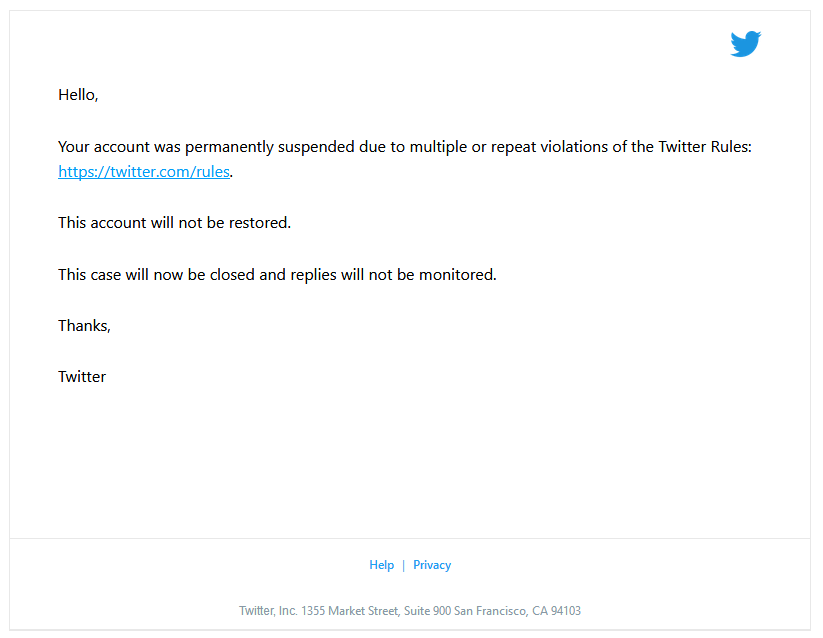
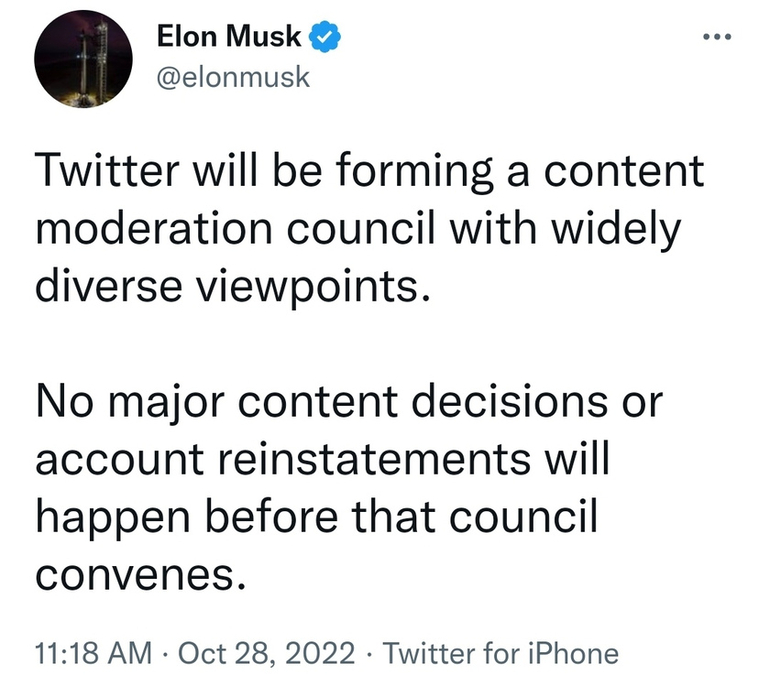
We covered this on the Darkstream last night. There was never any reason whatsoever to believe that Elon Musk – a ticket-taker par excellence – had any intention of standing up against the Prometheans and their determination to control the mainstream media Narrative, which now includes Twitter, Google and Facebook as well as the older organizations like ABCNNBCBS, the NYT, and the wire services.

But the speed with which Musk bowed down before those he serves was a little startling, even for those of us who had zero faith in his intentions. Considering how bad his public behavior is, one hesitates to even try to imagine what the information harvesters must have on him concerning his private conduct.

That being said, it’s still nice to see there are some positive consequences of his takeover of Twitter.

Twitter’s new owner Elon Musk plans to lay off about half of the social media company’s employees in an effort to cut costs, Bloomberg reported on Wednesday, citing sources. According to the report, the cuts will affect about 3,700 of Twitter’s 7,500 staff. Employees being let go will reportedly be informed of the decision this Friday.

DISCUSS ON SG


50 Percent is a Good Start

But I suspect Elon Musk will soon discover that it’s not enough to cut Twitter’s staff in half.

Elon Musk will ax “around 50%” of Twitter’s staff within the next few days, according to a new report. The immediate terminations could save the new Twitter CEO significant money.

Just days after Musk’s goliath $44 billion acquisition of Twitter, a massive amount of layoffs for the big tech company could arrive as early as Saturday. There could be job cuts of “about 50%” of Twitter’s 7,500-person workforce, according to a report from the New York Times.

“I was told to expect somewhere around 50% of people will be laid off,” Ross Gerber – CEO of Gerber Kawasaki Wealth and Investment Management – told the New York Times. Gerber said he was informed about the layoffs by Jared Birchall – the head of Musk’s family office.

A report from last month claimed that Musk was going to cut Twitter’s staff by nearly 75%. On Wednesday, Musk told Twitter employees that he doesn’t plan to fire 75% of the workforce, according to Bloomberg.

Apparently a substantial amount of bonuses will vest on Tuesday, November 1, so it would make sense to make it a very unhappy Halloween for soon-to-be former Twitter employees.

But I wouldn’t get even remotely excited about the coming changes at Twitter. It’s just moving from Insane Hard Globalist Left to Sane Moderate Globalist Left. It’s still enemy ground run by a corporate celebrity ticket-taker.

DISCUSS ON SG


Yes, And?

A white individual complains about a preference for black employees:

I know a company diversity officer whose salary is $160k plus bonuses. His entire job revolves around how to avoid hiring qualified whites for unqualified blacks. He also provides special treatment and exceptions to blacks for their underperformance which is about 95 percent of them.

Not long ago, he offered a corporate scholarship to a black graduate student. This student ultimately scored in the BOTTOM 10 percent of his class and was hired to a position when hundreds of white candidates scoring in the TOP 10 percent of their class were not hired because they were white.

So what? Why shouldn’t a corporation hire whomever they want to hire? Isn’t that what free association is all about?

Of course the deck is stacked. That’s fine! All they’re doing is creating opportunity while teaching you that all that equalitarian nonsense about meritocracies and equal opportunities was a lie from the start.

Stop believing nonsense and start looking out for the interest of your family, your community, and your people. There is no such thing as “equality” or an “idea nation” and life isn’t fair.

DISCUSS ON SG


Abandoning the Indefensible

Even the corpocratic media has reluctantly thrown in the towel on Dem Rangz despite being more than willing to accept the sadistic defacing of Tolkien’s legacy, to endorse the rampant blackwashing, and to osculate the Bezosian backside:

I’ve come to a sad realization: The creators of Amazon’s The Lord Of The Rings: The Rings Of Power know how to create spectacle, but they don’t know how to tell a good story.

There it is, scrawled in blood on the wall. The writers and showrunners responsible for this show could have won me over with good fan-fiction. They could have tossed Tolkien’s lore onto a bonfire and I’d have been perfectly happy if they’d simply crafted an enjoyable story with characters I care about.

Unfortunately, The Rings Of Power is written so poorly it defies even my worst fears. Oh yes, I was awed and impressed by the opening two episodes just like many others. But my how quickly a badly written TV series can wear out its welcome once the shimmer fades….

Galadriel’s adventure in Númenor is honestly just embarrassing. She arrived there—after being rescued—and effectively just bullied everyone in her path like the elven version of a steamroller. The queen regent has her hands full from the moment Galadriel barges through the door, and soon she’s demanding to see the king, then asking for an army.

Miriel has to lock her up and then pack her off back to the elves just to get her to stop. Then—thanks to petals falling from a tree*—she decides to take her back and commit her people—who moments earlier were all but chanting “death to the elves!”—to a war in a strange land? Everything taking place in Númenor is just a shortcut for the plot. Move the plot forward at all costs no matter how many characters are butchered in the process. (I wrote about the hilariously bad Black Speech spy note recently which is another great example of the shoddy writing in this show)>

Instead of actual character drama, the creators of Rings Of Power simply make everyone bicker and argue with one another all the time. Whether that’s Isildur and his father and friends, Elrond and Durin, Nori and the village elders, Bronwyn and the village idiots, or Galadriel and, well, everybody—all anyone seems to do is argue.

The people Galadriel wants to go save are evil and stupid and some of them seem ready to throw in with Sauron at the drop of a pin. But for some reason we’re supposed to care about Galadriel’s quest to go fight to save them from the Enemy?

As an aside, here’s a thought for those producing future films and television series: if casting a cute blonde with a mild case of resting bitch face in the place of an ethereal blonde beauty is enough to functionally derail an A+++ production, imagine how much you are lowering the odds of your own little project being successful if you submit to the creative death by diversity that the Hellmouth is presently demanding?

It’s never a good sign when the most entertaining thing about a production is the commentary on its ongoing immolation.

Anyhow, back to A SEA OF SKULLS. Lodi is discovering he’s got a new task at hand, and he’s not very happy about it….

DISCUSS ON SG


The Cancellation of Dilbert

This is not the best thing that ever happened. The corpocracy has finally turned against its longtime jester.

A popular comic strip has been canned by 77 newspapers after its creator Scott Adams started incorporating anti-woke plotlines, including a character black that identifies as white.

Adams’ much-loved ‘Dilbert’ comics have been in circulation since 1989 and frequently poke fun at office culture, but he announced he was sensationally dropped by publisher Lee Enterprises.

The media company owns nearly 100 newspapers across the country – including The Buffalo News, St. Louis Post-Dispatch, and the Arizona Daily Sun – and has been publishing Adams’ jokes about the corporate ladder for years.

One of his most recent controversial comic strips included a black worker, who identifies as white, being asked to also identify as gay to boost his company’s environmental, social, and governance ratings.

Dave, his reoccurring character, replies: ‘Depends how hard you want me to sell it,’ before the boss responds: ‘Just wear better shirts.’

For all that I’ve given Scott Adams a hard time about his refusal to accept that anti-vaxxers were right all along, and for good reason, I have to respect his willingness to continue making clear and cogent observations about the increasingly absurd office environment in Dilbert. Because the reason he’s being cancelled is that he is revealing truth that the converged corpocracy does not wish to be revealed or openly mocked.

Of course, it will be interesting to see if Scott has the courage to stick to his guns and continue his honest observations or if he cucks and submits to the SJWs.

DISCUSS ON SG


Amazon’s Pants are on Fire

Unlike Tha Rangz o’ Powah, which apparently are not being watched anywhere nearly as much as Amazon is trying to claim. The Dark Herald busts the Bezos machine on the Arkhaven blog.

Have you ever heard the phrase, “numbers don’t lie?”

Accountants say that all the time… When they want a good laugh.

Amazon is proudly claiming they have 25 million views for Lord of the Rings: The Rings of Power, on its very first day of streaming. That is a nice ROUND number, isn’t it?

“25 million people viewed it.” Always be careful with the exact wording.

We can start with I don’t believe it for a second.

Warner Brothers is, for their part, claiming 25 million for the first week of House of the Dragon, and Warner Brothers put the first episode up for free on YouTube. Realistically, House of the Dragon has had way better public reception than Rings of Power. And ain’t it funny that Amazon had the exact same ROUND number?

So, where did this massive overnight number come from?

Well, it came from Amazon.com.

UPDATE: OWWwwww! Samba.TV has released its metrics on Lord of the Rings: The Rings of Power and they are b-a-a-d. Amazon was claiming a huge number for it’s first day. Samba.TV uses the first three days. On its first three days, the Rings of Power only got 1.8 million US views.

I didn’t buy the 25 million number myself. But an average of 600k/day? I also wasn’t expecting anything that cataclysmic. This looks like it is going to be a downright proverbial failure.

DISCUSS ON SG


He Should Have Listened

Jeff Bezos didn’t listen to his son:

Being one of the richest people on the planet, Jeff Bezos is not used to being told what to do. But when Amazon announced it was creating The Lord of the Rings: The Rings of Power, which is likely to become the most expensive television series ever made, he received a blunt order from his son: “Dad, don’t fuck this up.”

Sorry, Jeff. A verdict is in. And you done fucked it up.

OH LAWD, DEM RANGS! DEM RANGS A’ POWAH!

Past success sows the seeds of future failure

DISCUSS ON SG


It Tolls for DC

The Dark Herald notices some very bad signs at DC, formerly DC Comics:

DC Comics has for decades been able to survive as an IP farm. Yeah, it’s a loss leader and has been that way since forever ago but that red ink is barely a rounding error for Warner Brothers. And now they are seriously under the microscope. DC has never been audited by Warner Brothers before because it wasn’t worth doing it. It was actually a waste of money to find out if it was a waste of money. Because it obviously was. Now, DC Comics is having to explain its terrible decisions and why they are pursuing storylines that killed sales. The answer is, we wanted to be popular with the cool kids and you never cared about the money we burned doing it before now, so why not?

DC Comics didn’t send out their royalty checks to writers and artists. DC has never missed a royalty payment since they got bought up by Warner Brothers. The only reason they wouldn’t be sending out money is if there was no money to send.

I have it on very good authority that the royalties were finally paid, but they were paid uncharacteristically late. That’s a problem when large corporations are involved, because it means that the scheduled routine has been intentionally altered, most likely because the finance department is shuttling dwindling resources around from one department to another as needed.

DISCUSS ON SG


ESG Will Break Corporations

The use of Environmental, Social and Corporate Governance loans is almost certainly guaranteed to backfire on the corporations that are taking advantage of them.

The term “ESG” was originally coined by the United Nations Environment Program Initiative in 2005, but the methodology was not fully applied to the corporate world until the past six years when ESG investment skyrocketed.

ESG is about money; loans given out by top banks and foundations to companies that meet the guidelines of “stakeholder capitalism.” Companies must show that they are actively pursuing a business environment that prioritizes woke virtues and climate change restrictions. These loans are not an all prevailing income source, but ESG loans are highly targeted, they are growing in size (for now) and they are very easy to get as long as a company is willing to preach the social justice gospel as loudly as possible.

Deloitte’s Insights studies show that ESG assets compounded at 16% p.a. between 2014 and 2018, now account for 25% of total market assets, and they believe that ESG could account for 50% of market share globally by 2024.

These loans become a form of leverage over the business world – Once they get a taste of that easy money they keep coming back. Many of the loan targets attached to ESG are rarely enforced and penalties are few and far between. Primarily, an ESG funded company must propagandize, that is all. They must propagandize their employees and they must propagandize their customers. As long as they do this, that sweet loan capital keeps flowing.

It’s enough to keep corporations addicted, but not enough to keep them satiated. Diversity hiring quotas based on skin color and sexual orientation rather than merit help make the overlords happy. Pushing critical race theory smooths the way for more cash. Carbon controls and climate change narratives really makes them happy. And, promoting trans-trenders and gender fluidity makes them ecstatic. Each participating company gets it’s own ESG rating and the more woke they go, the higher their rating climbs and the more money they can get.

However, this sort of loan for something that is guaranteed to reduce a corporation’s actual business revenue is also guaranteed to harm the corporation over time. Look at Marvel, for example. Money flowing in from ESG loans might pay for blackwashing and transgendering its heroes, but it can only replace the sales revenues being lost for a limited time.

And unlike sales revenues, loans eventually have to be repaid. Even if the converged banks write off the initial loans, eventually they will want to collect their pound of flesh, the cost of which can only increase as interest rates rise from their historic lows.

ESG is the sort of thing that requires free money to implement, and it is a particularly pernicious form of corporate cancer. It’s only a hypothesis at this point, but one might well build a successful investment strategy around the knowledge that the more ESG money a corporation takes, the more likely it is that the corporation’s sales are falling.

DISCUSS ON SG


A Tale of Two Capitalisms

Michael Hudson explains the difference between industrial capitalism and finance capitalism, and how the latter has destroyed the US economy and impoverished the American people.

Most people think of all kinds of capitalism as being the same and the assumption is that industrial capitalism of the nineteenth century somehow was always financialized because there were always banks but financial capitalism is you just pointed out is a political system and as a political system it’s very different from the industrial capitalism dynamic. In industrial capitalism, the whole aim or the hope of the industrial capitalists in the late nineteenth century, especially in Germany and central Europe was that banking would no longer be just usury, it wouldn’t be just consumer lending to exploit labor, and it wouldn’t be lending to the government somehow.

The financial system would recycle the economy savings and money creation and credit into industrial production and would finance the means of production to make that productive instead of predatory and parasitic as it became and that seemed to be the way that industrial capitalism was evolving up until World War I. Everything changed after that all of a sudden you had the financial system take over as a result of the crisis caused in the 1920s by the German reparations debt that couldn’t be paid and the inter-ally debt that was insisted upon to repay the United States for the arms that have supplied Europe for a century into World War I. Well, the result was a huge depression.

The allies said, well, we didn’t expect to actually have to pay the United States. If we have to pay the United States, then we have to charge reparations on Germany and for a decade there was a debate between John Maynard Keynes and Harold Moulton and others saying that these debts can’t be paid. How are you going to handle a situation where the debts can’t be paid?

The finance capitalists then were the basically the ancestors of today’s neoliberals and they said any amount of debt can be paid by any country if it just lowers the living standards and squeezes labor enough and that’s what basically the philosophy of the IMF ever since world war II when third world countries can’t pay the debt, the IMF comes in with an austerity program and say you have to lower wages, you have to break up labor unions, if necessary you have to have a democracy, and you can’t have a democracy unless you’re willing to assassinate and arrest the labor leaders and the advocates of land redistribution because a democracy means basically rule by the financial sector centered in the united states. And so finance capitalism ever since WWI and especially WWII and especially since 1980 is the nationalistic doctrine of American banks and the American one percent, and the American financial sector that is sort of merged into a symbiotic unit with the finance insurance and real estate.

In other words, finance capitalism instead of trying to promote overall economic growth for the 99 percent, instead of financing the industrialization of an economy with rising productivity and rising living standards, is now cannibalizing the industrial sector, cannibalizing the corporate sector. As you’re seeing in the U.S., finance capitalism is the economic doctrine of deindustrialization that has occurred in America in England and is now occurring in Europe.

Well, the problem is how do you survive if you’re not industrializing, if you’re not producing your own means of subsistence and how are you going to get this from other countries? Well, the answer is you don’t go to war with them like countries used to go to war with each other to grab their money and their land, you use finance as the new means of war so finance capitalism is the tactic of economic warfare by the United States against Europe and the global south to sort of draw all of the economic surplus of these countries in the form of debt service and the debt service is supplied by basically economic rent seeking from land rent, natural resource rent, and just plain interest charges on economy. So, none of these are really the result of industrial profits that are made by employing labor and uh selling its products at a markup.

Finance capitalism is not based on surplus value like industrial capitalism was. In fact, it destroys industry and in this cannibalizing of industrial capital, it basically dries out the economy and makes it unable to break even or even to function and in the United States today, for instance, if you look at the balance sheets of corporate revenue much of it is spent on stock buybacks. You buy back your own stock or dividend payouts. Only eight percent of corporate earnings are spent on new capital investment research and development: factories, machinery, and means of production to employ labor.

How did General Electric (GE) go broke? Basically, Jack Welch said let’s use our income not to continue to invest in making more electronic goods and services and appliances, let’s use it to buy our own stock that’ll push up our stock and essentially, we’ll just sell off our divisions and we’ll use the money of selling off our washing machine companies and stoves and sell it off and we’ll just pay it to the stockholders. That’ll push it up and by the way his salary was based on how much he could push up the stock of GE and he was paid in the form of stock options. Well, all of this is now the normal corporate behavior in the United States and corporations are no longer led by industrial engineers as they were a few centuries ago in the nineteenth and twentieth century.

They’re led by financial engineers of the chief financial officer and the ideal of these corporations is to make money financially not by industrial investment….. so on the narrow microeconomic level finance capitalism is a way of basically selling out a company and giving the proceeds to the stockholders and the bondholders but as a political system, because it is so destructive of the economy as you’ve seen in the United States and you’ve seen in Britain through de-industrializing it, it becomes belligerent in an attempt to make other countries just as equally paralyzed by making these countries pay tribute to the U.S. and England and the financialized economies by means of financial engineering, by means of debt service, by means of selling their mineral resources, their public utilities, their land, their roads all to foreign investors–basically to who borrows the money that’s just simply created in the U.S. and to save all of their money in their central bank reserves in the forms of loans to the U.S. treasury holding treasury bonds which is how the international monetary system worked until just a few months ago when everything changed.

So if you’re England and America right now you can look at President Biden’s speeches and he said well, China is our number one enemy because it’s competing unfairly. China is actually subsidizing industrial development by having its own infrastructure. It gives free education instead of privatizing education and making its labor pay for it. It has public health instead of privatizing social medicine like we do in the United States and making employers and workers pay for it.

Well, industrial capitalism in the nineteenth century was all in favor of strong government infrastructure. The ideal of industrial capitalism was to keep the wage costs of production down not by reducing wages but having government provide a basic infrastructure to cover the basic
needs of employees. The governments would provide free education so that employers didn’t have to pay for it. The governments would provide medical care so that employees didn’t have to pay for it and employers wouldn’t have to pay employees enough money to cover the education costs and to cover the medical care costs. The government would build roads and infrastructure and everything to facilitate the overall cost of doing business by industrial capital.

Well finance capitalism is just the reverse. Finance capitalism wants to privatize and take education, medical care, roads, turn the roads into toll roads, and take all of these and privatize them and make them financial corporations that will essentially pay out their economic rent to the bondholders and the stockholders and this economic rent adds to the cost of education and everything else that workers need to live on so the result is to make it a high cost economy and that’s why Biden has said China and Russia are America’s enemies because the only way that America can succeed given our privatized economy, given the fact that Americans have to pay up to forty three percent of their income for rent, given the fact that eighteen percent of America’s GDP is for medical care, given the heavy student loan debt–only if other countries tie themselves in the same knot, only if other countries impose the same economic overhead on their labor force and on their industry can there be equal competition.

If other countries have a mixed economy and are more efficient because they have an active government providing basic needs, that’s “autocracy” and that’s the opposite of “democracy.” Democracy is where everything is privatized and ultimately the one percent own everything.

Autocracy is any government that’s strong enough to have its own public investment. Any government strong enough to tax or regulate the financial sector is called “autocracy” so the U.S. in the 19th century would be called an autocracy as I guess the Austrian school called it – civilization is basically an “autocracy.”

There never has been an unmixed economy without government regulation, without a government investment, although Rome began to get to that point at the end of its empire and we all know what happened to it. So basically, finance capitalism is a predatory international economic policy aimed at draining the rest of the world all to pay the leading one percent of wealth holders in the U.S. and their satellite oligarchy in England and a few European countries.

Notice how, as always, evil lurks in the endless redefinitions and word spells. The inversions, subversions, and perversions are endless, and remember, we have been told that the root of all evil is the love of money. Therefore, it should be no surprise that an economic system entirely focused on money would prove to be unmitigated evil.

DISCUSS ON SG