I am the anti-hero

I certainly would have made a point of reviewing R. Scott Bakker’s books sooner if I had any idea that his response to my review would prove so vastly amusing:

This brings me to what I was most curious about, back when: What would Theo make of the thematics of the trilogy. To be honest, I thought this was where he would spill the most pixilated ink. Why? Because reading his blog, I realized that in many respects I had written the trilogy for him, for people who really, really, really think they’ve won the Magical Belief-and-Identity Lottery.

And this, if Vox Day is to be believed, is Theo in a nutshell. The Grand Prize Winner. Reading his blog, I had the impression of drawing circles inside of circles:

Fiscal conservatives…

Social and fiscal conservatives…

White, social and fiscal conservatives…

White, male, social and fiscal conservatives…

White, male, English-descended, social and fiscal conservatives…

White, male, English-descended, Anglican, social and fiscal conservatives…

I’m sure the list goes on, but this was as far as I was able to go. What began as snobbish hilarity quickly turned into consternation and a kind of baffled, dare I say? disgust. Discussions of partitioning America along more ‘rational’ identity-driven lines, of the ‘behavioural profile of African-Americans,’ of the ‘proper place of women,’ of the forced resettlement of immigrants, of the ‘flaws of democracy’ made me realize that Theo had more than a few fascistic leanings. I’m still shaking my head.

While I always appreciate a proper Genetic Fallacy, even more amusing is an inept one. I had no idea that I was a socially conservative Anglican, but now that I have been apprised of this I shall certainly do my best to acquire a Book of Common Prayer and start writing regular paeans to Sarah Palin and Rick Perry. I’m not precisely sure what “fiscal conservative” is supposed to mean nowadays, as this tends to sound rather like “gravity conservative” or “knows how to use an Excel spreadsheet” in light of the recent events in political economy. But I am white, male, and of English descent, to be sure. He could have even quite reasonably added “arrogant bastard” and “chick magnet” if he felt that would help his case somehow.

Of course, the Dread Ilk will no doubt see the humor inherent in the idea that the author of The Morality of Rape could possibly be “really, really, really offended” by its fictional depiction. Apparently Bakker didn’t get the “rape apologist” alert.

For all that he attempts to strike a contemplative pose, Bakker reveals a parochial and Panglossian view of the world as well as an ironic failure to contemplate its harsh and brutal reality even while attempting to portray it. And it is entertaining indeed to see the erstwhile champion of a thousand shades of grey proving my previous point about his adherence to a conventional substitute morality; on what basis could an amoralist possibly justify consternation and disgust? Aesthetics? As for the idea that a quad-lingual expatriate who has lived everywhere from Japan to Italy is an extreme example of parochialism, well, I can’t say I’m terribly concerned about what a Canadian who grew up in Ontario, went to university in Ontario, did grad school at Vanderbilt, and then moved back to Ontario happens to think on the matter….

His ideological ignorance is as nonsensical as his failure to understand the difference between diagnosis and prescription. Being one of the better-known libertarians in the media, #25 at the last ranking if I recall correctly, I am much, much farther away from any sort of fascist leanings than Bakker, whose politics appear to be fairly similar to those of the historical Italian Fascisti. And I should very much like to see Bakker attempt to defend ideas such as democracy being flawless, material sexual equality, and so forth, as it would likely prove even more entertaining than his inability to understand the aesthetic value of morality in fiction.

But all of this is beside the point. Either my criticism of his work stands or it does not. Is my review fair? Of course it is. I wouldn’t sacrifice my critical integrity simply to slam someone I disliked intensely and I don’t dislike Bakker. I don’t even know him. The more significant question is if my review of The Prince of Nothing is more accurate and relevant than those that have attempted to lionize Bakker as the third coming of George R.R. Martin. That, I leave to the readers to decide.

Bakker is a talented wordsmith. He is a very good world builder. He is more intelligent than the average genre writer, historically literate, and reasonably well-educated. Unfortunately, he is also an incompetent and juvenile philosopher who subscribes to an outmoded view of art. The latter tends to insert itself in the way of the stronger elements of his writing, particularly when it comes to the characters. Preaching no more lends itself to secular fiction than it does to religious fiction and should Bakker ever decide to control his instinctive desires to lecture and transgress, he will be the better writer for it.

But that is no concern of mine. It makes absolutely no difference to me if Bakker chooses to heed the criticism I have offered or not. I didn’t write the Black Gate review for his benefit and I am quite accustomed to most people ignoring me, regardless of whether I publicly advise them to buy gold at 323.30 (2002) or predict a $43,300 fall in housing prices (2008). I don’t expect Bakker to agree. I don’t even expect him to understand.

Instead of resorting to an ineffective ad hominem response, it would have been much more interesting if Bakker had simply explained why he felt it was so vital to show so much of the sex and rapine that fills his work, what it adds to the story, and why he feels his philosophical meanderings add to the story rather than detracting from it. However, give Bakker credit for correctly anticipating that I would like his work. I did. Being a fan of epic fantasy, I merely find it to be disappointing that he refuses to aim higher.
Kick Cameron out

The British Prime Minister is a lying, treacherous weasel and has to go:

David Cameron has ruled out a referendum on Britain’s membership of the European Union on the grounds that the UK had their say 36 years ago. A senior aide to the Prime Minister enraged eurosceptics yesterday by claiming that the UK must remain a member of the EU because Brussels bureaucrats have done ‘useful work’ on climate change and global poverty.

And he ignored the fact that no one under the age of 53 has ever had the chance to state their views on Brussels in a public vote.

Londonistan is burning, the Euro is disintegrating, and Cameron is still on holiday in Italy. I wouldn’t have thought it to be possible, but David Cameron is beginning to make Gordon Brown look like an honest, competent politician by way of comparison. But if “useful work” on nonexistent climate change and growing global poverty is really their best argument for staying in the EU, we should be able to count on Britain leaving it by next Tuesday.

The Conservative Party promised the British people a referendum. If the Conservative Prime Minister isn’t going to deliver one, he must resign.


WND column

Downgrading America

Over the last two months, numerous political commentators, as well as leading Democrats and Republicans, have vehemently insisted that a deal on the debt ceiling was necessary to avoid debt default and credit downgrades. Unsurprisingly, these happened to be the same commentators and politicians who did not see the crisis of 2008 coming and who have swallowed whole the ludicrous claim of “economic recovery” still being pushed by the Federal Reserve and the Bureau of Economic Analysis.

And once more, all of these public Panglosses have been proven wrong by events. This time, however, it took only three days to demonstrate their observable incompetence. The downgrade of U.S. credit was inevitable because the salient issue was never the debt ceiling or the inability of the federal government to borrow more money, but rather, the fact that it was already borrowing too much.


Review: The Prînce of Nöthing

About twenty years ago, I was at a used bookstore and I picked up what looked like an interesting medieval spin on James Bond.  It was set during the period of the Crusades, but appeared to be conceived as an action-thriller series rather like The Executioner, Mack Bolan.  I started reading it, but around page 30, when the slave girl sent by Saladin to spy on the Crusaders was in full throat enjoying her third rape at the hands of her captors, I suddenly realized that the book was not a historical novel but rather one of those strange 70’s porn novels with a thin veneer of historical fiction.  A little research indicates that the book was probably the fifth book in the Crusader series, Saladin’s Spy (1986), written by an author very familiar to Black Gate readers, although he published it under the pen name “John Cleve” rather than Andrew J. Offutt.  I hadn’t thought about that book for years, until I was casting about for a way to explain the epic fantasy of R. Scott Bakker’s series entitled The Prince of Nothing.

Read the rest at the Black Gate.


Downgrade and the debt sectors

Daniel Indiviglio makes some relevant points in his article about the downgrade at The Atlantic and he was one of the few who correctly saw it as a real possibility, but I think he ultimately goes off-track when he calls into question S&P’s decision to downgrade the U.S. sovereign credit rating:

S&P was not happy with the $2.2 trillion minimum debt reduction plan. That’s understandable. A bigger deal would certainly have been preferable from a fiscal soundness standpoint. But does the agency really estimate that the deal is is so dangerously small that there’s a realistic chance that the U.S. could now default at some point in the future? In particular, does U.S. debt really look significantly riskier now than it did in, say, April?

The bond market certainly doesn’t think so. Treasury yields are near all-time lows, despite all that political nonsense. And remember, the interest the U.S. pays on its debt is far, far smaller than its tax revenues. If the Treasury prioritizes interest payments, then there’s no conceivable way the U.S. could default.

I defended S&P’s initial decision to put the U.S. rating on negative watch back in May when politics were becoming poisonous. But to actually downgrade the U.S. after Washington managed to avoid its self-created crisis is another story. S&P should have acted like the other agencies and affirmed the U.S. rating, but kept it on negative watch until more deficit reduction plans were put in place over the next couple of years, as I explain here.

In fact, this might not turn out well for S&P. The firm might think it’s acting boldly or proactively. Instead, the market may question S&P’s reasoning skills. The rating agency is acting here on an assumption not shared by its peers at Moody’s and Fitch: that U.S. politics are so screwed up that they could render the nation unable to live up to its debt obligations. That’s despite pretty much everyone agreeing that the nation will be financially able to pay for its debt in the short-, medium-, and long-term.

Indiviglio did a great job of demonstrating that the U.S. downgrade was be almost perfectly in line with the historical Japanese downgrade, which took place when its net government debt reached 60% of GDP.  (It is presently around 225%).  However, he reaches the wrong conclusion, as many have, by getting sidetracked over the way in which S&P’s analyzed the political situation in the U.S.A. And while there was never any question of short-term default, (despite the scare tactics of both Democrats and Republicans), I very much disagree that the nation will necessarily be able to pay for its debt in the medium- and long-terms.

The real reason that the downgrade was not only inevitable, but correct, and not only correct, but the first in a series of downgrades, can be seen in projections based on the historical patterns in the Z1 debt sector charts. These show the S&P’s worst case scenario to be far too optimistic to be credible.

While the debt figures don’t match up perfectly, as August “Net debt held by the public” is a little different at $9.78 trillion than Q1-2011 “federal government debt outstanding” at $9.65 trillion, they are close enough for the purposes of comparison. Utilizing the Q1 figure provides a federal debt/GDP of 64.3%, which is much lower than 74% presently estimated by the end of 2011 by S&P’s. However, we can see how they reach that number by plugging in the expected growth in the amount of debt at the post-2008 quarterly average of $365 billion. This indicates an end of year federal debt figure of 10.74 trillion and a GDP figure of $14.513 trillion.

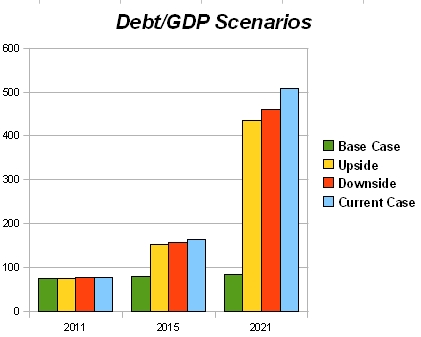
In other words, S&P’s is probably assuming that either GDP will contract $490 million in the second through fourth quarters or the rate of federal borrowing will slow down.  Either way, the so-called “double-dip recession” already appears to be baked in the S&P’s cake, assuming that its analysts are as capable of reading the Federal Reserve reports as Karl Denninger is. But that’s not the interesting aspect, from my perspective. What is interesting is the debt/GDP projections under the three future scenarios, Upside, Base Case, and Downside. Consider these projections of future federal debt to GDP ratios:

UPSIDE: 2011 74%, 2015 77%, 2021 78%
BASE CASE: 2011 74%, 2015 79%, 2021 85%
DOWNSIDE: 2011 74%, 2015 90%, 2021 101%

Where I suspect S&P’s has gone amiss, (and perhaps it had no choice in the matter due to its professional obligations), is by taking the CBO scoring figures seriously and thereby utilizing GDP estimates as the primary variable. Based on my calculations, it is also possible that S&P’s is simply plugging in the 66-year average rate of increase of federal debt, 5.92%, into their spreadsheets.  But it isn’t GDP that has changed so drastically over the last three years and significantly modified the debt/GDP ratio, it is the rapid 82.89% increase in the federal debt over the last 11 quarters. If we utilize federal debt as the primary variable and plug them into S&P’s GDP estimates, we get some very different results. (I’m going to ignore the inflation and tax estimates in order to reduce the number of variables; these are estimates for the purpose of critical comparison, not predictive projections.)

The S&P’s GDP estimates are as follows:

UPSIDE: 3% GDP growth + lapsed tax cuts
BASE CASE: 3% GDP growth
DOWNSIDE: 2.5% GDP growth

However, net GDP growth over the 13 quarters from Q1 2008 to Q2 2011 is $729.9 billion, or 5.1%. That is an annual rate of growth of 1.57% and assumes that overall credit continues to remain flat at $52.6 trillion while federal debt continues to rise at the rate that private debt contracts. Call it the CURRENT CASE. Plugging in 1.57% annual GDP growth and 22.7% annual federal debt growth provides the following debt/GDP ratios if one begins with the firm numbers from the end of year 2010.

CURRENT CASE: 2011 77%, 2015 164%, 2021 509%

And if we substitute actual rates of federal debt growth for the S&P estimates of it that are based on the notoriously unreliable CBO scoring, it becomes very clear that the debt/GDP projections are wildly inaccurate regardless of what rate of GDP growth is assumed and shows that the problem is not one that economic growth can possibly solve.  In fact, the revised UPSIDE case which takes historical debt growth into account is much worse than the Base Case that does not.

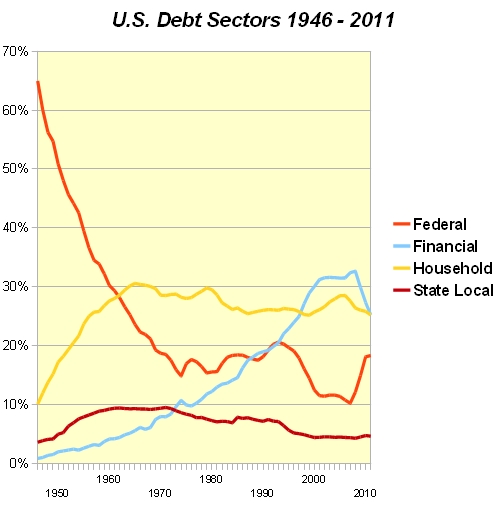
Notice that while the end of year 2011 figure (actually 76.8%) isn’t much worse than S&P’s is projecting at 74%, it is considerably worse than the DOWNSIDE in 2015 (164% vs 79%) and more than six times as bad in 2021 (509% vs 85%). But are these astronomical ratios even remotely possible? Could federal debt really rise to $26.1 trillion in 2015 from $9.6 trillion at present? After all, that would amount to 39.4% of all U.S. debt outstanding, assuming that the private sectors shrank at the same rate that the federal government sector expanded, and would indicate a Game Over default sometime in between 2016 and 2018.

This chart, which shows the historical percentage for each of the major debt sectors since 1946, demonstrates that at least the 2015 rate is clearly within the bounds of possibility. The Federal Government sector represented more than 39.4% of total U.S. debt until 1955. Furthermore, it also shows that the decline of Financial sector debt, which has contracted $3 trillion since 2008 and fallen from 32.7% of the total to 26.8%, could conceivably continue to dwindle away to less than one percent of the total, which would amount to an additional $11.2 trillion in debt-deleveraging that would need to be replaced by federal debt in order to prevent concomitant economic contraction. (It also, by the by, shows very clearly the real source of America’s current economic woes.) Government spending and borrowing is not the root cause of the problem, it is merely a failed attempt to cure the disease of massive private sector debt expansion and contraction.

Now, I am not making any predictions here, other than a general one that because private sector debt will continue to fall, there will be tremendous pressure to continue to increase federal spending and borrowing at rates more similar to that of the last three years than the historical norm. This is because the alternative is an immediate and sizable contraction of GDP.  As ugly as it appears, the CURRENT CASE scenario I have outlined is not a worst case scenario because it does not account for the economic contraction I expect to finally begin showing up in the GDP numbers later this year and in 2012.  The determining factor will be whether the rate of increase of federal debt is closer to the 22.7% annual rate of 2008-2011 or the 5.9% rate of 1946-2011.  Just out of curiosity, I looked at the latter, which in combination with the 1.57% 2008-2011 GDP growth produces the following scenario:

HISTORICAL CASE: 2011 66.3%, 2015 78.4%, 2021 100.9%.

Which of these five scenarios appears to be playing out should be readily apparent by the time the Q4-2011 debt sector numbers are published in the Federal Reserve’s Z1 report.  If the Household and Private sectors continue to decline and end-of-year federal debt/GDP is over 75%, then CURRENT CASE is probably in effect.

UPDATE – More like 3 in 3, I would say: “A Standard & Poor’s official says there is a 1 in 3 chance that the U.S. credit rating could be downgraded another notch if conditions erode over the next six to 24 months. The credit rating agency’s managing director, John Chambers, tells ABC’s “This Week” that if the fiscal position of the U.S. deteriorates further, or if political gridlock tightens even more, a further downgrade is possible.”

So much for those military pretensions

It is always educational to see how quickly the badge gang shows their true colors as soon as citizens start shooting back, regardless of the country:

An entire 20-man police force resigned in a northern Mexican town after a series of attacks that killed the police chief and five officers over the last three months, state officials said Thursday…. The mass resignation appeared to be connected to a Tuesday attack by gunmen that killed three of the town’s officers, Salas said.

American police have abandoned their erstwhile right to be regarded with any particular respect now that they have claimed the right to be able to murder American citizens with impunity. In most cases, police departments steadfastly refuse to prosecute, much less punish, police officers who have fired upon and killed innocent men, women, and even children.

There are the occasional exceptions, but even in such cases, police inevitably escape with a lesser penalty.


I am officially addicted

I heard Don’t Stop the Sandman a few months ago and thought it was hysterical. But the entire CD simply takes it to another level and redefines awesome.

“[T]he sound was achieved when the metal band was stranded on a desert island in 1989 with a CD player, plenty of batteries and the CD collection of a 13 year old girl.” I think my favorite part is when they segue into a Hells Bells riff backing the Madonna lyrics.

Rock Sugar is like the bastard love-child of Spinal Tap and Tenacious D. About the only way I can imagine it could ever be topped is if Al Jourgenson, Trent Reznor, and Rob Zombie were to team up and put out a CD covering songs by Britney Spears, the Pussycat Dolls, Girls Aloud, the Spice Girls, and Destiny’s Child.

They remind me of how it cracked all of us up when Paul threw in a Loverboy guitar riff after the Technojihad chorus without warning. It was the only time I can remember Mike, who had the freakish robot-like precision required to play live drums along with samples and tightly sequenced electronics, completely missing a beat.


My five highlight reel NFL players

Q: Randy Moss’ retirement made me wonder about the five player-specific NFL career highlight films that would be worth buying. My personal list would be Barry Sanders, Deion Sanders, Moss, Brett Favre and Ronnie Lott. There are players with better career numbers, but for “did you see what he just did” moments, these guys have to be at the top of the list.
— Eric, Ann Arbor

SG: I like this idea — seems like a natural for iTunes. (My five would be Moss, Barry Sanders, Gale Sayers, O.J. Simpson and Earl Campbell.)

Mine would be: Fran Tarkenton, Randy Moss, Barry Sanders, Reggie White, and Sammy Baugh.

Tarkenton for the ridiculously long scrambles, Moss for the deep routes, Sanders for the impossible escapes, White for the sacks, and Baugh just to see the all-around QB/DB/punter performance.

I still remember Reggie White playing against the Vikings. They called an ill-advised roll-out that called for Cris Carter to go in motion, then stay in and block the free defensive end, who happened to be White. White didn’t bite on the line feint, but stayed home, then literally threw Carter five yards into Warren Moon with one hand. He was dragging Moon down when the whistle blew and “in the grasp” was called. I was at that game with seats on the 20-yard line, the play was right in front of us, and it was the one of the most physically dominating defensive plays I’ve ever seen in the NFL; keep in mind that Carter was neither a small wide receiver nor a bad blocker. Even the most hard-core Vikings fans roared after that play.

It’s fascinating how one’s memory remembers things incorrectly. Until I found the clip, I would have sworn that White a) beat an initial blocker and b) actually knocked Moon down with Carter.


Downgrade on the way

Or perhaps not, if the administration can convince S&P to accept its fictitious numbers:

Two government officials tell ABC News that the federal government is expecting and preparing for bond rating agency Standard & Poor’s to downgrade the rating of US debt from its current AAA value. Official reasons given, one official says, will be the political confusion surrounding the process of raising the debt ceiling, and lack of confidence that the political system will be able to agree to more deficit reduction. A source says Republicans saying that they refuse to accept any tax increases as part of a larger deal will be part of the reason cited. The official was unsure if the bond rating would be AA+ or AA.

A third official says that S&P made a “serious mistake” in its analysis, “based on flawed math and assumptions,” so the Obama administration is pushing back. But even though “S&P has acknowledged its numbers are wrong, it’s unclear what they’re going to do.,” the official said.

But… but… I thought being able to borrow more money made the existing U.S. debt safer! Anyhow, I don’t think any government whose agencies have made the historical 2001 recession disappear, and whose unscheduled ex post facto revisions are nearly five times larger than the revised growth are in any position to claim anyone else is using “flawed math and assumptions”.

The worrisome thing is these are the agencies that still had Enron at AAA when it was going bankrupt. It boggles the mind to think how bad U.S. finances must be for the ratings agencies to actually notice.

UPDATE – The administration’s whining didn’t work:

– We have lowered our long-term sovereign credit rating on the United States of America to ‘AA+’ from ‘AAA’ and affirmed the ‘A-1+’ short-term rating….

– The outlook on the long-term rating is negative. We could lower the long-term rating to ‘AA’ within the next two years if we see that less reduction in spending than agreed to, higher interest rates, or new fiscal pressures during the period result in a higher general government debt trajectory than we currently assume in our base case.

Notice that nothing is said about the need to raise taxes. S&P knows as well as the American public that more taxes will only lead to more spending. And there will almost surely be less reduction in spending than agreed to, given that this has been the case following practically every budget deal of the last 31 years.

As I wrote several times prior to the hike in the debt ceiling, increasing the amount of debt doesn’t make default less likely, it makes it MORE likely.


Guess the Race

The Milwaukee News offers its readers a new round of the American media’s favorite game:

Police Investigating Multiple Beatings Near State Fair Park

Local law enforcement agencies are investigating several incidents near State Fair Park late Thursday night.

Milwaukee police said that around 11:10 p.m., squads were sent to the area for reports of battery, fighting and property damage being caused by an unruly crowd of “hundreds” of people. One officer described it as a “mob beating.”

Police said the group of young people attacked fairgoers who were leaving the fair grounds. Police said that some victims were attacked while walking. They said others were pulled out of cars and off of motorcycles before being beaten.

Milwaukee police said at least seven people were taken to area hospitals with non-life-threatening injuries. They said that number could go up as other responding agencies release information.

Who were these young people exhibiting their vibrancy so exuberantly? Were they Amish? Turkish immigrants? Native Americans? Ecuadorans? Who could possibly say? Since it’s Milwaukee, I’m going to guess it must be Norwegians run amok in light of the recent events in Oslo.

Wait a minute, this is interesting… apparently local TV wasn’t aware that its viewers enjoy playing the guessing game:

Witnesses tell Newsradio 620 WTMJ and TODAY’S TMJ4 of a mob of young people attacking innocent fair-goers at the end of the opening night of State Fair, with some callers claiming a racially-charged scene. Milwaukee Police confirmed there were assaults outside the fair. Witnesses’ accounts claim everything from dozens to hundreds of young black people beating white people as they left State Fair Thursday night….

“It was 100% racial,” claimed Eric, an Iraq war veteran from St. Francis who says young people beat on his car. “I had a black couple on my right side, and these black kids were running in between all the cars, and they were pounding on my doors and trying to open up doors on my car, and they didn’t do one thing to this black couple that was in this car next to us. They just kept walking right past their car. They were looking in everybody’s windshield as they were running by, seeing who was white and who was black. Guarantee it.”

Eric, a war veteran, said that the scene he saw Thursday outside State Fair compares to what he saw in combat.

“That rated right up there with it. When I saw the amount of kids coming down the road, all I kept thinking was, ‘There’s not enough cops to handle this.’ There’s no way. It would have taken the National Guard to control the number of kids that were coming off the road.

Drat, wrong again. I’m a little surprised to see that no one in the vicinity appeared to be carrying. I wonder what will happen this summer the first time a gang of “youfs” encounter an armed individual who isn’t inclined to take a beating.

Unsurprisingly, it’s the multicultis who are primarily to blame: “The incidents Thursday night come as the State Fair board over the last decade has worked to increase diversity at the annual fair, expanding its entertainment lineup and marketing to appeal to a younger, more multicultural audience. Diversity was a priority for State Fair Park Chairman Martin Greenberg, who spoke often of making it “truly the people’s park” – a “place of inclusion, not exclusion.”

Hey, mission accomplished! Nice job, guys.