Death of the Republican blogosphere

Instapundit, John Hawkins, and a number of right-wing bloggers consider why some consider the right-wing blogosphere to be on the decline:

[A] funny thing happened in 2002-2003 — the left side of the
blogosphere took off and eclipsed the Right side of the blogosphere.
Liberals ferociously loathed George W. Bush, just as conservatives had
detested Clinton, and they went online to congregate and get the
information they needed to fight back. Soon, the liberal blogs were
considerably bigger than the conservative blogs….although, and this is
an often overlooked caveat, there were still a number of significant
conservative websites, with large audiences, that many people don’t
consider to be “blogs:” Lucianne, The American Spectator, WorldnetDaily, Newsmax, etc.

So, since that was the case, when Barack Obama got into power, you’d
have expected that traffic on the Right side of the blogosphere would
have surged just as it did on the Left side of the blogosphere in the
early Bush years.

That didn’t happen.

Sure, there were a few outliers that took off: Hot Air, Redstate, and the Breitbart empire
for example, but most conservative blogs have either grown
insignificantly, stayed the same size, or even shrank. Most bloggers on
the right side of the blogosphere haven’t increased their traffic
significantly in years. Moreover, the right side of the blogosphere as a
whole is definitely shrinking in numbers as bloggers that have had
trouble getting traction are quitting and fewer and fewer bloggers are
starting up new blogs.

And Legal Insurrection laments the link-stinginess of the corporate blogs that have largely taken over both Left and Right alike.

I wish the reality weren’t so true that the days of collaboration and mutual support are waning. It’s nearly impossible to get a link out of the new big names in
conservative media.  It’s not even a conservative blogosphere anymore,
it’s for-profit and non-profit corporate media which are protective of
eyeballs.

I think there are several problems.  The first is the increased amount of corporatization among the blogosphere. Pajamas Media is the primary culprit here, but Gawker Media is also to blame. Once Nick Denton and Roger Simon showed that it was possible to monetize a blog or ten, pecuniary interests rapidly came to the fore. Suddenly everything had a price tag, links were worth money, and everyone’s behavior naturally became just a bit more self-centered and mercenary.  The H/T soon went the way of the dodo.

And everyone became increasingly afraid of offending the bigger dogs and getting cut off from the all-important link flow. For example, I used to be a regular guest on the Northern Alliance Radio Show. That stopped not long after I criticized Michelle Malkin for her shoddy research failure and thereby offended the Powerline guys, even though I remained on good terms with the Fraters Libertas.  I suspect this desire to curry favor is why the outliers that took off in terms of popularity have so little chili; they’re basically the blogosphere equivalent of the mainstream media whores.  Face it, Dana Loesch isn’t any smarter now that she’s a Breitbart bimbo than she was when she called herself Mamalogues(TM) and I was kicking her around in response to her various lunacies.

An even more important factor is the sapping of right-wing energy by thirteen straight years of relentless betrayal of conservative principles by the Republican Party. Libertarian realists like me are still going strong, since we never expected any better, but how much enthusiasm can conservatives expect to muster in support of nominal leaders like George W. Bush, John McCain, and Mitt Romney?  The political enthusiasm simply isn’t there anymore.  It’s not so much the right-wing blogosphere that is dying as the Republican one.

It may be worth noting that the Right also tends to fear controversy and mainstream criticism far more than the Left, not always without cause.  I’m a bit more controversial than the average blogger, and as a result, have an unusually small number of incoming links in relation to the readership.  Consider this fact: McRapey’s Whatever has between 30 to 40 percent less traffic than VP+AG these days, but Alexa shows 4,713 incoming links there, nearly 3,500 more than VP’s 941 and AG’s 315.  I’m not complaining. I’m  clear that readers will find their way here whether they are encouraged by others to do so or not. But the difference is noticeable.

Being an aggregator, Instapundit is one of the few bloggers who still links religiously to others. I’ve attempted to follow his example and I never cite any information from any blog without linking directly to it. But I don’t really bother with a blogroll per se anymore, because I have neither the time nor the interest to keep track of them as they spring up, post for a few months, or even a few weeks, and then fade away. 

These days, if someone sends me an email enthusiastically informing me that they have just launched a new blog and would love to exchange links, I don’t even bother to reply anymore.  I’ve seen far too many new blogs begin with a few enthusiastic posts, followed soon after by an apology for not having the time to post but promising that will change real soon now, then a last hurrah, after which comes the void. Blogging isn’t for everyone, but it usually requires trying it in order to learn whether it suits you or not… but I would recommend not requesting links from anyone until you’ve proven that you can do it for at least one year.

I think the corporatization of blogs makes independent that much more important, even if it is less common and less popular than it once was.  Otherwise, we might as all sit around and watch the three television stations permitted to us by our masters in the media.

From SF/F to R(SF/F)

A female SF/F writer explains the mediocrity of the modern female SF/F writers:

New York Publishing by definition has got the rat of Marxism in their
heads.  They always treated writers as widgets anyway.  Round the mid
seventies, early eighties they realized that they had more widgets with
outies than innies, and they decided to correct it the usual way.  “Buy
more women” the cry went out.  And in came not only a barrage of women
who had an easier time breaking in than men, but of women who were told
what kept them out had been discrimination.  And who, therefore, hated
the field they were getting into, because those meanies had kept them
out.  Out came an outpouring of “poor me female” writing.  Which in the
early nineties caused me to snarl at a Barnes & Noble, “I wish
someone would pass a law forbidding women from writing.” After I’d
walked up and down a fantasy shelf and found NOT ONE novel that wasn’t
about some abused high-magic chick whose father was a monster.

Here we digress from writing in general to genre writing.  It will
shock you to realize that different genres appeal to different people,
right?  In general romance – by and far the blockbuster of genres –
appeals to women.  I know this shocks you, since women are not at all by
evolution designed for being fascinated with relationships.  This
doesn’t mean men don’t read it.  I know several men who read Romance
(and no, it has nothing to do with their orientation) but the
proportions are so grossly skewed that if you see someone in public with
a romance novel and can’t see what gender they are, you can take a safe
bet it’s a woman.  At the other end of this, military fiction is read
mostly by men.
Fiction is no different than anything else. If one artificially lowers the barriers to entry, one is going automatically to reduce the quality of entrants one accepts. When it was decided, presumably by female editors and executives, that an insufficient number of female authors were being published in the SF/F genre, many women were given publishing contracts primarily on the sole basis of their being better writers than other female wannabes.

Now, I disagree with Sarah in that I don’t believe the female writers who entered the genre hated the field or even necessarily wanted to change it much.  I think, to the contrary, that they loved fantasy and science fiction, they merely wanted to “improve” it and make it just a little bit more to their liking.  Hence the shifting focus from ideas, plots, and worldbuilding towards characters and relationships… and romance!

This shifting focus didn’t have to be a bad thing. It wasn’t an intrinsic negative. There was certainly some room for considerable improvement with regards to characters, relationships, and style; one cannot read Asimov, Heinlein, Vance, or any of the lesser SF/F authors from the 1950s through the 1970s without being conscious of a certain clunkiness to the prose and a shallowness to the characters.

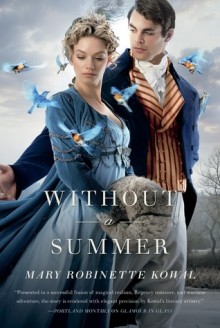
The problem was that in far too many cases, the ideas, plot, and worldbuilding aspects were simply thrown out, to such an extent that now, the average “fantasy” novel is little more than a thinly disguised romance novel. In many cases, the “SF/F” publishers aren’t even bothering to disguise it any longer. What is broadly described as “paranormal” fiction actually belongs to the romance genre, not the SF/F genre, as any reasonable examination of its tropes will swiftly reveal.  And the romantic transformation isn’t limited to the necro-bestial sub-genre of fantasy either. Consider the cover of Mary Robinette Kowal’s new novel, Without A Summer. Kowal is the current VP of SFWA. She’s nice, she’s talented, and she’s an award-winning writer. She was even nominated for the Best Novel Nebula in 2010.

What she isn’t is an SF/F writer.  She’s a romance writer. The marketing department at Tor Books clearly knows that. Both the Handsome Prince and the Pretty Princess with her bluebirds on the cover are straight out of Disney.  Giving a Nebula award to a book like this would be akin to giving Joe Abercrombie the Golden Tea Cosy or whatever award it is the RWA gives out because one of his mentally unstable killers happens to tenderly rape a female captive during a momentary interlude between bloody battles.

As for me, the last female writer I read was Dr. Helen Smith and her forthcoming book Men on Strike.  The last female novelist I read was Naomi Novik, whose fantasy novels, as should surprise absolutely no one, manage to reduce the broad human tragedy of the Napoleonic Wars to a pretty good tale about a relationship between a man and his accidentally acquired dragon.

It is due to this transformation from SF/F to R(SF/F) that despite there being more female “SF/F” authors than ever before, none of them compare favorably with the likes of Madeleine L’Engle, Susan Cooper, Ann McCaffrey, Tanith Lee and Lois McMaster Bujold, women who were always more than capable of competing with the men on pure merit alone.


Public intellectual = godless intellectual

In his speculation on whether public intellectuals matter, AC Grayling somehow manages to avoid noticing the giant elephant voiding its bowels in the room.

Can one give a catch-all definition of what it is to be a “public
intellectual”? Consider this list: Bertrand Russell, Albert Einstein,
Edmund Wilson, Lionel Trilling, Stephen Jay Gould, Norman Mailer, Susan
Sontag, Noam Chomsky, Richard Dawkins, indeed anyone on Prospect’s
list of people who merit or are thought to merit the label. They have
very little in common other than intelligence and engagement, and the
fact that they speak out. Those three things, accordingly, might be
taken to capture the essence.

Very little in common other than intelligence, engagement, and the fact that they speak out?  I don’t know, my highly developed pattern recognition skills suggest to me that there just might be something else these notable public intellectuals all have in common. Let’s look over his list one by one and see what the Internet has to say about their religious beliefs.

Bertrand Russell = atheist
Albert Einstein = agnostic
Edmund Wilson = atheist
Lionel Trilling = agnostic
Stephen Jay Gould = atheist-leaning agnostic
Norman Mailer = atheist (during his years as a public intellectual)
Susan
Sontag = atheist
Noam Chomsky = atheist
Richard Dawkins = atheist

My goodness, isn’t that an astonishing surprise! It goes without saying, of course, that A.C. Grayling is himself an atheist.  This failure to note this common point is so massive, and so glaring, that it is either intentional, or worse, an indication of the very small scope of the so-called public intellectual’s perspective. Of course, we should probably keep in mind that Grayling is known for his convenient memory lapses, having once falsely accused William Lane Craig of a false claim to have debated him.

This leads me to conclude that the correct answer to Grayling’s question is that public intellectuals matter very much to other public intellectuals.  As to their importance to the vast majority of the rest of the world, who don’t give a damn what a few self-important, self-promoting, godless individuals may happen to think about anything, they clearly don’t matter at all.

As I have previously shown, despite the statistical overrepresentation of the irreligious among the highly intelligent, there are still far more highly intelligent religious individuals than there are highly intelligent irreligious individuals.  To be precise, the ratio of theists with +2SD IQs to atheists with +2 SD IQs is more than 10 to one. The more significant question, therefore, is why are all of these much more numerous highly intelligent religious individuals so few and far between on this year’s list of celebrated world thinkers?  Why are so few of them invited to give TED talks?

Do their religious beliefs somehow negate their intelligence? Or could it be that there some other mysterious factor at work? This is all so very inexplicable in light of the fact that GSS studies over the past 40 years show that the MAJORITY of atheists have IQs of 100 or less.


The business of progressive science

The Left is forever attempting to cloak its evil lunacies in the veil of scientific authority.  It has been doing so since Marx first claimed his socialism was “scientific”. That is why they so ferociously defend St. Darwin and his holy theorum, why they try to portray political opposition as mental illness, and why, in the end, so many of the scientific studies to which they point turn out to be pure fabrications.

Stapel was an academic star in the Netherlands and abroad, the author of
several well-regarded studies on human attitudes and behavior. That
spring, he published a widely publicized study in Science about an
experiment done at the Utrecht train station showing that a trash-filled
environment tended to bring out racist tendencies in individuals. And
just days earlier, he received more media attention for a study
indicating that eating meat made people selfish and less social….

Stapel’s fraud may shine a spotlight on dishonesty in science, but
scientific fraud is hardly new. The rogues’ gallery of academic liars
and cheats features scientific celebrities who have enjoyed similar
prominence. The once-celebrated South Korean stem-cell researcher Hwang
Woo Suk stunned scientists in his field a few years ago after it was
discovered that almost all of the work for which he was known was
fraudulent. The prominent Harvard evolutionary biologist Marc Hauser
resigned in 2011 during an investigation by the Office of Research
Integrity at the Department of Health and Human Services that would end
up determining that some of his papers contained fabricated data. 
Every year, the Office of Research Integrity uncovers numerous
instances­ of bad behavior by scientists, ranging from lying on grant
applications to using fake images in publications. A blog called Retraction Watch
publishes a steady stream of posts about papers being retracted by
journals because of allegations or evidence of misconduct. 
Each case of research fraud that’s uncovered triggers a similar response
from scientists. First disbelief, then anger, then a tendency to
dismiss the perpetrator as one rotten egg in an otherwise-honest
enterprise. But the scientific misconduct that has come to light in
recent years suggests at the very least that the number of bad actors in
science isn’t as insignificant as many would like to believe. And
considered from a more cynical point of view, figures like Hwang and
Hauser are not outliers so much as one end on a continuum of dishonest
behaviors that extend from the cherry-picking of data to fit a chosen
hypothesis — which many researchers admit is commonplace — to outright
fabrication. Still, the nature and scale of Stapel’s fraud sets him
apart from most other cheating academics. “The extent to which I did it,
the longevity of it, makes it extreme,” he told me. “Because it is not
one paper or 10 but many more.” 
On a Sunday morning, as we drove to a village near Maastricht to see his
parents, Stapel reflected on why his behavior had sparked such outrage
in the Netherlands. “People think of scientists as monks in a monastery
looking out for the truth,” he said. “People have lost faith in the
church, but they haven’t lost faith in science. My behavior shows that
science is not holy.”

What the public didn’t realize, he said, was that academic science, too, was becoming a business.

Science, particularly academic science, is now a big business, and it is an unusually corrupt one that is primarily dependent upon the media and government funding.  It has no practical external limitations upon it holding its businessmen accountable. As Stapel’s example demonstrates, there is absolutely nothing – nothing – reliable about it.  This point should be driven home every single time anyone makes the absurd claim that science is the best, or the only, arbiter of truth and reality.

Here is how bad the corruption is: Stapel was actually teaching a graduate seminar on research ethics. Notice too that all of the established academics who caught wind of the fraud not only looked the other way, but advised others to do so as well.

We have a word for real and genuine science that is reliable enough to be trustworthy.  Engineering.

“At the end of November, the universities unveiled their final report at a joint news conference: Stapel had committed fraud in at least 55 of his papers, as well as in 10 Ph.D. dissertations written by his students. The students were not culpable, even though their work was now tarnished. The field of psychology was indicted, too, with a finding that Stapel’s fraud went undetected for so long because of “a general culture of careless, selective and uncritical handling of research and data.” If Stapel was solely to blame for making stuff up, the report stated, his peers, journal editors and reviewers of the field’s top journals were to blame for letting him get away with it.”


Neoreactionary space

It’s an informative visual, and certainly an excellent list of blogs well worth reading, but I’m a little surprised to see myself listed in between the Christian Traditionalists and the Ethno-Nationalists rather than triangulated between Christian Traditionalists, Economists and Masculine Reaction, which would put me right in between Taki and Roosh.  It’s always interesting to see what people take away from the blog.

Not that I object to the placement, of course, since my conceptual approach has become increasingly holistic as the intrinsic relationship between diverse subjects such as economics and Christian theology, or ethno-nationalism and pick-up artistry, becomes more and more readily apparent as 21st century realities render progressive 20th century visions moot.

And Neoreactionary is an apt description for the broad spectrum of intellectuals opposed to the progressive, globalist, multicultural action from 1965 to 2008. We’re not the reactionaries epitomized by the Archie Bunker caricature, we’re not the political naifs of the Silent and Moral Majority, as we know the reality of the successful Gramscian Long March and we know the progressive arguments much better than they do themselves.

Whether it is the financial crisis of 2008, the implosion of the great global warming fraud that marks the turning point, or something altogether else, I don’t know. But I have observed that something has changed, and that the conceptual energy is now on the side of we neoreactionaries and not the intellectually exhausted equalitarians.

One has only to look at the roster of TED talks to see how worn out and tired their ideas are. We are going to win in the long run because our concepts are derived from observable reality whereas theirs are not. In the war between ought and is, is always wins.


How anti-racism creates racists

 In news that should surprise no one, it appears that all those lectures on “white privilege”, the public service announcements declaring “raciss bad”, and television shows and advertisements selling “mudshark good” only ends up making people less tolerant:

Children who are given anti-racism lessons in school are more likely to be intolerant outside the classroom, a major study found yesterday.  It said accusing white pupils of racism causes animosity, and discussing sensitive ethnic concerns such as honour killings paints minority group children in a bad light.

The survey said children who live in mixed neighbourhoods are often free of hostility towards other racial groups. But it found that ‘when more attention in class is being paid to the multicultural society, the liberalising effect of positive contact in class on youngsters’ xenophobic attitude decreases’.

This actually isn’t news; there have been several studies indicating the same effect holds true with regards to the global warming propaganda.  But what I find most interesting is that the greatest negative effect isn’t on those who are avowedly racist or simply up-to-date on the relevant science, but rather, on the very moderates to whom the racemongers are primarily attempting to appeal.

A 2002 study on advertising showed adults are similarly resistant to the anti-racist propaganda: “People in two minds about their attitudes towards ethnic minority groups
become more unfavourable when exposed to anti-racism advertising or
arguments, according to new research sponsored by the ESRC. The ‘backfire effects’ occur both in conscious and non-conscious
feelings towards people from ethnic minorities, says a report based on
studies by a team led by Dr Gregory Maio of the School of Psychology at
Cardiff University.”

I suspect the backfire effect stems from the natural human instinct to rebel against propaganda and social totalitarianism. Consider the low point of the most recent European football championship. Even the most oppressed, left-leaning, racially conscious African immigrant could not watch the clumsy anti-racist statements read out in robotic fashion by the captains of the two teams playing in the final without feeling a momentary temptation to burn a cross on someone’s lawn, paint a Swastika on a synagogue, order dog at a Chinese restaurant, and sketch a cartoon of Mohammed on the nearest napkin.

The arguments for the anti-racist position are weak and everyone knows it.  That is why the one thing they cannot permit is free and open discourse on the subject, which is a red flag in the eyes of those of every sub-species, color, or creed who happens to value human liberty.

Intellectual fads come and go. The intrinsic intellectual and scientific weakness of the equalitarian position is less demonstrated
by the counterproductive nature of the heavy propaganda as the
equalitarians obvious awareness of their need to resort to it in the
first place. Equalitarianism is merely an eyeblink in the grand course of human history and the half-century of attempts to permanently enmesh the various nationalities and human sub-species is nothing that a decade or two of intense wide-scale violence will not easily undo. The ethnic cleansings of the 21st century will be all the more brutal for the multiculturalism and diversity celebrating of the latter half of the 20th.

It should not be hard to see that love for one’s own kind has been falsely spun as hatred for the Other.  And if one is told that one already hates the Other, even when one has no opinion at all about them, then most people are more likely to graduate to genuine hatred before they will give up their natural and instinctive love for their own. 

Who among you would stop loving your child simply because you were told that your love for your child was hatred for all the other children in their school?  Perhaps the most rabbity might, but faced with such a price, even the average rabbit would shrug and admit that, yes, they do indeed hate all those others.


West Hunter abuses E.O. Wilson

Solely in the mathematical sense, you understand:

Lord Kelvin said “I often say that when you can measure what you are
speaking about, and express it in numbers, you know something about it;
but when you cannot express it in numbers, your knowledge is of a meagre
and unsatisfactory kind; it may be the beginning of knowledge, but you
have scarcely, in your thoughts, advanced to the stage of science,
whatever the matter may be.”  Even those who didn’t have much math
sometimes wished that they did.  Chuck Darwin said “I have deeply
regretted that I did not proceed far enough at least to understand
something of the great leading principles of mathematics;  for men thus
endowed seem to have an extra sense.”

E. O. Wilson would have benefited from having that extra sense. If he
had it, he might not have suggested that ridiculous “gay uncle” theory,
in which homosexuality pays for itself genetically thru gay men helping
their siblings in ways that produce extra nieces and nephews. First,
that doesn’t even happen – so much for field work.  Second, it’s
impossible.  The relationship coefficients don’t work. Nephews and
nieces are only half as closely related as your own kids, so you’d need
four extra to break even, rather than two, as with your own kids.  Maybe
if Wilson had ever learned to divide by two, he wouldn’t have made this mistake.

Biology and softer-headed sciences such as anthropology are
absolutely rife with innumerates, and there is a cost.  If I hear one
more person say that average growth rates were very low in the old stone
age, a teeny tiny fraction of a percent [true], and so anatomically
modern humans only left Africa after it filled up, which took a hundred
thousand years, I’m gonna scream.  If I hear another anthropologist say
that she could understand how a small group could rapidly expand to fill
New Zealand, but just can’t see how they could fill up the Americas,
whole continents, in a thousand years – lady, they screwed, they had
babies, and they walked.  All it took was a weird, unacademic lifestyle
in which you raised three kids – pretty easy to do in the Happy Hunting
Ground.

This is helpful in illustrating why biologists, as well as science fetishists who harbor blind faith in biologists, shy away from the sort of quantifiable questions I posed to Mike Williamson earlier this week.  It’s true that quantification is not the magical be all and end all; economics is riddled by pseudo-quantifiable fictions that lead to bad theory and even worse policies. But without numbers, there is no precision, and without precision, there is no science, there is only, as Lord Kelvin suggested, the beginning of what could, eventually, become science.

And insofar as it remains unquantifiable and non-numeric, (to say nothing of unfalsifiable), the Theorum of Evolution by (probably) Natural Selection remains a matter of philosophy, not science.


Reinhart and Roghoff respond

I have been following the mini-scandal of sorts in economics ever since the revelation that debt stars Carmen Reinhart and Kenneth Roghoff committed a basic Excel error in their famous paper that served as the basis for their very good 2009 book, This Time It’s Different.  I refrained from jumping into it right away because I think it is usually best to hear what both sides have to say before attempting to reach any kind of judgment on the matter.

Also, from my neo-Austrian perspective, the basic idea that economic statistics can provide legitimate and meaningful guidelines for policy actions is a dubious one at best. The recent artificial boost to GDP by means of counting R&D expenditures twice, (to put it very, very crudely), is only one of many examples of the futility of attempting to derive economic principles from analyzing government-produced statistics.

Even so, I tended to suspect that the Neo-Keynesians were exaggerating the significance of the error, since the idea that beyond a certain amount, the addition of more debt will tend to reduce one’s ability to spend is not exactly logically controversial.  The fact that Krugman and others immediately attempted to turn the matter into a policy debate was also suspicious, since the Reinhart and Roghoff paper was hardly the only one published on the subject. And, as it happens, Reinhart and Roghoff’s response indicates that their admitted mistake was considerably less significant than the Keynesians and the inflationistas would like to pretend it is.

LAST week, we were sent a sharply worded paper by three researchers from the University of Massachusetts, Amherst, at the same time it was sent to journalists. It asserted serious errors in our article “Growth in a Time of Debt,” published in May 2010 in the Papers and Proceedings of the American Economic Review. In an Op-Ed essay for The New York Times, we have tried to defend our research and refute the distorted policy positions that have been attributed to us. In this appendix, we address the technical issues raised by our critics.

These critics, Thomas Herndon, Michael Ash and Robert Pollin, identified a spreadsheet calculation error, but also accused us of two “serious errors”: “selective exclusion of available data” and “unconventional weighting of summary statistics.”

We acknowledged the calculation error in an online statement posted the night we received the article, but we adamantly deny the other accusations.

They neglected to report that we included both median and average estimates for growth, at various levels of debt in relation to economic output, going back to 1800. Our paper gave significant weight to the median estimates, precisely because they reduce the problem posed by data outliers, a constant source of concern when doing archival research that reaches far back into economic history spanning several periods of war and economic crises.

When you look at our median estimates, they are actually quite similar to those of the University of Massachusetts researchers. (See the attached table.)

Moreover, our critics omitted mention of our paper “Public Debt Overhangs: Advanced-Economy Episodes Since 1800,” with Vincent R. Reinhart, published last summer, in The Journal of Economic Perspectives. That paper, which is more thorough than the 2010 paper under attack, gives an average estimate for growth when a country’s debt-to-G.D.P. ratio exceeds 90 percent of 2.3 percent — compared to our critics’ figure of 2.2 percent. (Also see the comparisons posted by the blogger known as F. F. Wiley, including his chart, a copy of which accompanies this essay.)

Despite the very small actual differences between our critics’ results and ours, some commenters have trumpeted the new paper as a fundamental reassessment of the literature on debt and growth. Our critics have done little to argue otherwise; Mr. Pollin and Mr. Ash made the same claim in an April 17 essay in The Financial Times, where they also ignore our strong exception to the claim by Mr. Herndon, Mr. Ash and Mr. Pollin that we use a “nonconventional weighting procedure.” It is the accusation that our weighting procedure is nonconventional that is itself nonconventional. A leading expert in time series econometrics, James D. Hamilton of the University of California, San Diego, wrote (without consulting us) that “to suggest that there is some deep flaw in the method used by RR or obvious advantage to the alternative favored by HAP is in my opinion quite unjustified.” (He was using the initials for the last names of the economists involved in this matter.)

Above all, our work hardly amounts to the whole literature on the relationship between debt and growth, which has grown rapidly even since our 2010 paper was published. A number of careful empirical studies have found broadly similar results to ours. But this is not the definitive word, as a smaller number of just as scholarly papers have not found a robust relationship between debt and growth. (Our paper in The Journal of Economic Perspectives included a review of that literature.)

Researchers at the Bank of International Settlements and the International Monetary Fund have weighed in with their own independent work. The World Economic Outlook published last October by the International Monetary Fund devoted an entire chapter to debt and growth. The most recent update to that outlook, released in April, states: “Much of the empirical work on debt overhangs seeks to identify the ‘overhang threshold’ beyond which the correlation between debt and growth becomes negative. The results are broadly similar: above a threshold of about 95 percent of G.D.P., a 10 percent increase in the ratio of debt to G.D.P. is identified with a decline in annual growth of about 0.15 to 0.20 percent per year.”

It’s important to understand how deep we are into uncharted waters here, as only 8 percent of the postwar observations in advanced economies exceeded 90 percent of GDP and levels over 120 percent are almost unheard of.  But regardless, as Reinhart and Roghoff point out, there are only four options: slow growth and austerity for a
very long time, elevated inflation, financial repression and debt
restructuring.  And the only one that offers any possibility of success without massive social disruption and violence is the last one.

More importantly, as we’ll be discussing in the next round of the Inflation/Deflation debate, policy makers may not have anywhere nearly as much choice in the matter as they believe they have.

As Zerohedge notes, US Government Debt/GDP presently stands at 104.8 percent, up from 103 percent three months ago.


NFL draft: Day One

Possibly the most boring draft ever, in terms of the glamor positions, but still of interest to real NFL fans. I’m pleased with the Vikings picks; three first-round talents at DT, CB, and WR fill the three positions we most needed in the absence of a real quarterback being available. 2013 would appear to be a rebuilding season for the Vikes, barring some serious and unanticipated improvement on the part of Christian Ponder.
Anyhow, this would be your open NFL Draft discussion. Not much else worth mentioning, except for the general lack of interest shown in Geno Smith and Manti Te’o.