But with a not inconsiderable amount of amusement.
#Arkhaven INFOGALACTIC #Castalia House
But with a not inconsiderable amount of amusement.
INFINITE JEST
David Foster Wallace
Rating: 3 of 10
If nothing else, I now understand why David Foster Wallace killed himself. Despite being built up as the literary wunderkind of his generation, despite having been widely acclaimed as the author of one of greatest novels of the 20th century, he could not escape the realization that, at least as a novelist, he was a poser and a literary charlatan. Thanks to a tireless campaign by the New York literati and the fact that so few people who claim to admire the book actually bothered to read his magnum opus, he dodged one bullet following the publication of Infinite Jest. But he couldn’t count on doing that twice, and he must have known that he would be left exposed to all and sundry upon publication of The Pale King.
Now, I’m not the least bit intimidated by large books nor do I find their girth intrinsically impressive. I very much enjoyed War and Peace as well as Cryptonomicon. My own most recent novel runs more than 850 pages. But I will admit that it was hard and brutal slogging through the overly self-conscious, over-educated banality of Wallace’s Infinite Jest; the only literary experience to which I can reasonably compare it is reading two of the later Robert Jordan novels in The Wheel of Time series, back to back, after both novels have been translated into German and back again into English by Google Translate. There is considerably less pulling of braids and considerably more in the way of physical and mental abnormalities in Infinite Jest, but that’s a fair approximation of the literary pleasure one can expect to find in Wallace’s so-called masterpiece.
It doesn’t take long to recognize Wallace’s High American Lit style. If you are familiar with Tom Robbins or John Irving, then you’ve read the distillation of David Foster Wallace. Infinite Jest is little more than an oversized, incoherent, less amusing version of The World According to Garp. It takes five times longer to say less than Still Life with Woodpecker. Take a few quirky and improbably intelligent characters with exaggerated vocabularies. Go into
excruciating detail concerning the minute-by-minute existence of their
quotidian routines, especially regarding the sexual or toilet aspects,
then throw in some highly implausible gonzo drama produced by their
relationships with their cartoonishly dysfunctional families, inexplicably deformed lovers, or hopelessly deviant housemates. Be sure to include a strong amateur sporting
element, be it wrestling or tennis. At all times, be careful to
utilize the high-low technique of an unfamiliar and elevated vocabulary
taken straight from the OED alternating with the crudest vulgar slang.
The perspective, at all times, is one of vaguely bemused detachment; the
narrative only observes, it never acts.
When I finished Infinite Jest, a review of Paul Auster’s New York Trilogy by Ferdinand Bardamu came to mind: “[T]his neutered New York has produced a literati that spends all day
sniffing its own farts. Jonathan Safran Foer, Colson Whitehead, Nicole
Krauss, Gary Shteyngart, Jhumpa Lahiri, David Foster Wallace (actually
wait, he’s dead — I’ve never derived so much joy from a suicide in my
life), and all the rest: worthless hacks devoid of curiosity, humanity
or talent.”
There is very little genuine humanity in Infinite Jest. It is a curiously autistic novel, as if the emotions of the characters described in such extensive detail are being cataloged by someone who has never actually felt them. It is a decrepit bordello of freaks and wrecks, whose fictional realities are as alien as they are unconvincing to the sane and sober reader. After finishing the book, I was curious to read its various reviews in order to see who had been courageous enough to openly declare that the American literary prince was strutting about in the buff. There were a few who weren’t afraid to point out that DFW wore no clothes, but to my surprise, easily the best review was by a writer who happens to know more than a little about inflated vocabularies and literary pretensions himself, our old friend Wängsty, known to the rest of the world as R. Scott Bakker. In his excellent review of Infinite Jest, he writes:
Like lovers and assholes (and reviews), books sort readers. I would argue that books like Infinite Jest identify
you–your affiliations, your beliefs and values, your politics–with the
same degree of accuracy as monster truck rallies….This is the whole reason why publishers are keen to plaster testimonials on the cover of their books: to milk our authority and social proof biases. Infinite Jest is literally festooned with blurbs from a galaxy of authoritative sources: It arrives literally armoured in literary authority. We are told by a variety of serious people (who are taken very seriously by other serious people) that this is a seriously serious book. There can be little doubt that as far as the 1996 literary ingroup was concerned, Infinite Jest was a smashing communicative success.
Which should be no surprise. “I come to writing from a pretty hard-core, abstract place,” Wallace explains in The Boston Phoenix interview. “It comes out of technical philosophy and continental European theory, and extreme avante-garde shit.” Given who he was, and given he saw this as a conversation with good friends, and given that the seriously serious readers likely shared, as good friends often do, the bulk of his attitudes and aesthetic sensibilities, it’s easy to see how this book became as successful as it did. Infinite Jest is the product of a ingroup sender communicating to other ingroup receivers: insofar as those other receivers loved it, you can say that as a communication Infinite Jest was a tremendous ingroup success.
The problem is that one can say the same about The Turner Diaries or Mein Kampf.
I don’t pretend to know what literature is any metaphysical sense, but I do think that it has to have something to do with transcendence. What distinguishes literature from fiction in general is its ability to push beyond, beyond received dogmas, beyond comfort zones, and most importantly (because it indexes the possibility of the former two), beyond social ingroups. This is why communicative success and literary success are not one and the same thing. And this is also why outgroup readers generally find ingroup estimations of literary merit so unconvincing.
Make no mistake, Infinite Jest is a piece of genre fiction: something expressly written for a dedicated groups of readers possessing a relatively fixed set of expectations. It just so happens that this particular group of readers happen to command the cultural high ground when it comes to things linguistic and narrative.
In the immortal words of Public Enemy, don’t believe the hype. Avante-garde shit, however extreme, is still, in the end, shit, and it tends to be more noxious than the more pedestrian varieties. Infinite Jest is what might have been a decent 250-page novel stricken with a terminal elephantiasian cancer. Wallace’s excess verbosity and endless, pointless, pretentious, indefatigable digressions hang off and over the story like giant slabs of flesh swollen with fatty tumors; if this book were to come to life and take the shape of a man, it would resemble Mohammad Latif Khatana.
The most impressive thing about Infinite Jest, or as I found myself thinking of it, Tedious Waste, is the sheer magnitude of the deceit in the Foreword written by David Eggers. There has seldom been a less honest paragraph written in the English language than this one:
“The book is 1,079 pages long and there is not one lazy sentence. The book is drum-tight and relentlessly smart, and though it does not wear its heart on its sleeve, it’s deeply felt and incredibly moving. That it was written in three years by a writer under thirty-five is very painful to think about. So let’s not think about that. The point is that it’s for all these reasons — acclaimed, daunting, not-lazy, drum-tight, very funny (we didn’t mention that yet but yes) — that you picked up this book. Now the question is this: Will you actually read it?”
There may not be one lazy sentence, whatever that might be, but there are thousands of totally unnecessary ones. The book is not drum-tight; it doesn’t even have an ending, or, for that matter, a coherent plot — and before any literati groupies attempt to protest, I will note that Wallace himself openly admitted as much — and it cannot possibly, by any reasonable metric, be described as “very funny”. There are the occasional moments where Infinite Jest generates mild amusement, to be sure, but I never once on any of the 1,079 pages found myself provoked to laughter. It is not deeply felt; the descriptions of the game of tennis are far more loving than those of any of the human relationships, and I have to sincerely question the sanity of anyone who found it “incredibly moving”. It does not wear its heart on its sleeve because it does not have one; it is heartless.
Eggrers’s Foreword is pure PR puffery on a scale to make the inveterate circle-jerkers known as the FourThree Horsemen of the New Atheism roll their eyes.
It is telling that the reader has to be challenged to actually read it the book they are, by virtue of reading the forward, presently reading. And yet, there is no point to actually reading the novel, even if one wishes to claim the literary cred for doing so. Given the observed behavior of the sort of people who desperately want to be seen as the sort of person who adores this sort of thing, the sort of individual who very much wants to consider himself part of the in-group for whom Wallace was writing, one can be sure that very, very few of them will have actually read more than a few chapters. A few casual references to “wheelchair terrorists”, “that amazing game that combined geopolitics with tennis”, and “lethally enstupidating Entertainment”, plus throwing in a knowing joke about this being “The Year of The Taco Bell Cool Ranch Doritos Locos Taco”, should inspire sufficient panic in any other individual who pretends to have read Infinite Jest to convince him to enthusiastically nod, vociferously agree, and immediately change the subject.
I can’t say that I derived any pleasure, let alone joy, from David Foster Wallace’s suicide. But it doesn’t surprise me terribly to learn that a man whose whole essence and identity were derived from the supposedly exceptional quality of his writing would elect to kill himself after producing such a overrated work of unmitigated fraudulence.
Infinite Jest is a joke, but it isn’t one that is intended at the reader’s expense. It is the author’s bitter view of himself and the small, shallow make-believe world in which he lived.
Story: 1 of 5. I won’t even bother attempting to describe the plot, such as it is. Suffice it to say that it is ludicrous, unconvincing, incoherent, unfinished, weirdly remniscent of the 1970s, and despite Wallace’s attempt to involve the reader’s imagination in its completion, leaves him absolutely devoid of any curiosity concerning “what really happened”. The insufficiently well-read might be surprised, even angered, to find their arduous effort in finishing the book so poorly rewarded. Those more familiar with the eminently predictable tricks of the neutered New York literati will simply smile wryly and close the book with a dismissive “yeah, I expected as much.”
Style: 3 of 5. Harold Bloom was a little too harsh when he said: “Infinite Jest is just
awful. It seems ridiculous to have to say it. He can’t think, he can’t
write. There’s no discernible talent.” There is talent there, there is intelligence, the problem is that it is not put to effective use. Wallace can write, but apparently his editor can’t edit. I enjoyed the occasional adroit turn of phrase, but they were far too few and far between to make up for the run-on sentences. I’ve translated Umberto Eco sentences from Italian that required five separate English sentences to make proper sense, and they were still shorter than some of Wallace’s unnecessarily extended monstrosities.
Characters: 0 of 5. I don’t think it is controversial to say that you not only will find it hard to keep the vast cast of characters straight, but you won’t give a damn about what happens to any of them. It’s almost a remarkable achievement of sorts that Wallace can provide so much detail about so many characters without making any of them feel even remotely credible or breathing life into any of them. It takes a certain amount of inadvertent skill to render a healthy young NFL punter who seduces every woman he comes across almost completely indistinguishable from a hospitalized former drug addict who is the whitest knight in the history of American literature. And Wallace’s characters aren’t merely cardboard, they are cut out from a John Irving novel.
Creativity: 3.5 of 5. I didn’t really know how to fairly consider this. Infinite Jest is certainly creative in certain senses, such as its structure and in some of the details of the idiotic plot. Its delving into the experience of addiction is actually fairly good. In other ways, there is a rigid adherence to exactly what one would expect from an author writing in this genre, complete with all the politically correct prejudices and myopic sensitivities. But in sum, it is different than the average novel, so I’m choosing to err on the side of mild generosity here.
Text sample: YEAR OF THE DEPEND ADULT UNDERGARMENT
On a White Flag Group Commitment to the Tough Shit But You Still Can’t Drink Group down in Braintree this past July, Don G., up at the podium, revealed publicly about how he was ashamed that he still as yet had no real solid understanding of a Higher Power. It’s suggested in the 3rd of Boston AA’s 12 Steps that you to turn your Diseased will over to the direction and love of ‘God as you understand Him.’ It’s supposed to be one of AA’s major selling points that you get to choose your own God. You get to make up your own understanding of God or a Higher Power or Whom-/Whatever. But Gately, at like ten months clean, at the TSBYSCD podium in Braintree, opines that at this juncture he’s so totally clueless and lost he’s thinking that he’d maybe rather have the White Flag Crocodiles just grab him by the lapels and just tell him what AA God to have an understanding of, and give him totally blunt and dogmatic orders about how to turn over his Diseased will to whatever this Higher Power is. He notes how he’s observed already that some Catholics and Fundamentalists now in AA had a childhood understanding of a Stern and Punishing–type God, and Gately’s heard them express incredible Gratitude that AA let them at long last let go and change over to an understanding of a Loving, Forgiving, Nurturing–type God. But at least these folks started out with some idea of Him/Her/It, whether fucked up or no. You might think it’d be easier if you Came In with 0 in the way of denominational background or preconceptions, you might think it’d be easier to sort of invent a Higher-Powerish God from scratch and then like erect an understanding, but Don Gately complains that this has not been his experience thus far. His sole experience so far is that he takes one of AA’s very rare specific suggestions and hits the knees in the A.M. and asks for Help and then hits the knees again at bedtime and says Thank You, whether he believes he’s talking to Anything/-body or not, and he somehow gets through that day clean. This, after ten months of ear-smoking concentration and reflection, is still all he feels like he ‘understands’ about the ‘God angle.’ Publicly, in front of a very tough and hard-ass-looking AA crowd, he sort of simultaneously confesses and complains that he feels like a rat that’s learned one route in the maze to the cheese and travels that route in a ratty-type fashion and whatnot. W/ the God thing being the cheese in the metaphor. Gately still feels like he has no access to the Big spiritual Picture. He feels about the ritualistic daily Please and Thank You prayers rather like like a hitter that’s on a hitting streak and doesn’t change his jock or socks or pre-game routine for as long as he’s on the streak. W/ sobriety being the hitting streak and whatnot, he explains. The whole church basement is literally blue with smoke. Gately says he feels like this is a pretty limp and lame understanding of a Higher Power: a cheese-easement or unwashed athletic supporter. He says but when he tries to go beyond the very basic rote automatic get-me-through-this-day-please stuff, when he kneels at other times and prays or meditates or tries to achieve a Big-Picture spiritual understanding of a God as he can understand Him, he feels Nothing — not nothing but Nothing, an edgeless blankness that somehow feels worse than the sort of unconsidered atheism he Came In with. He says he doesn’t know if any of this is coming through or making any sense or if it’s all just still symptomatic of a thoroughgoingly Diseased will and quote ‘spirit.’ He finds himself telling the Tough Shit But You Still Can’t Drink audience dark doubtful thoughts he wouldn’t have fucking ever dared tell Ferocious Francis man to man. He can’t even look at F.F. in the Crocodile’s row as he says that at this point the God-understanding stuff kind of makes him want to puke, from fear. Something you can’t see or hear or touch or smell: OK. All right. But something you can’t even feel? Because that’s what he feels when he tries to understand something to really sincerely pray to. Nothingness. He says when he tries to pray he gets this like image in his mind’s eye of the brainwaves or whatever of his prayers going out and out, with nothing to stop them, going, going, radiating out into like space and outliving him and still going and never hitting Anything out there, much less Something with an ear. Much much less Something with an ear that could possibly give a rat’s ass. He’s both pissed off and ashamed to be talking about this instead of how just completely good it is to just be getting through the day without ingesting a Substance, but there it is. This is what’s going on. He’s no closer to carrying out the suggestion of the 3rd Step than the day the Probie drove him over to his halfway house from Peabody Holding. The idea of this whole God thing makes him puke, still. And he is afraid.
And the same fucking thing happens again. The tough chain-smoking TSBYSCD Group all stands and applauds and the men give two-finger whistles, and people come up at the raffle-break to pump his big hand and even sometimes try and hug on him.
It seems like every time he forgets himself and publicizes how he’s fucking up in sobriety Boston AAs fall all over themselves to tell him how good it was to hear him and to for God’s sake Keep Coming, for them if not for himself, whatever the fuck that means.
SM has a request that is appropriate for National Autism Awareness Week. Let’s not forget to be aware of our Socially Autistic friends such as Richard Dawkins and Sam Harris:
hey vox, can you show me some evidence that dawkins sucks at math? would be awesome thanks.
“The anthropic principle has been an embarrassing problem for secular scientists in recent decades due to the way in which the probability of the universe and Earth just happening to be perfectly suitable for human life is very, very low. The extreme unlikelihood of everything being not too hot, not too cold, not too big, and not too small, to put it very crudely, has often been cited as evidence that the universe has been designed for us, presumably by God.
Now, Richard Dawkins is arguably not an individual particularly well-suited to play around with probability. He may not be quite as mathematically handicapped as Sam Harris, but he is known to have some issues in this regard, being openly mocked for his “comic authority” and “fatal attraction” to mathematical concepts by the French mathematician Marcel-Paul Schützenberger.
(“But look, the construction of the relevant space cannot proceed until a preliminary analysis has been carried out, one in which the set of all possible trajectories is assessed, this together with an estimation of their average distance from the specified goal. The preliminary analysis is beyond the reach of empirical study. It presupposes—the same word that seems to recur in theoretical biology—that the biologist (or computer scientist) know the totality of the situation, the properties of the ensemble of trajectories. In terms of mathematical logic, the nature of this space is entirely enigmatic.” )
Schützenberger’s contempt for Dawkins’s mathematical abilities is well-founded, as it’s generally not considered to be a good idea to adopt a casual approach to mathematical probability, as Dawkins does with the “one in a billion” chance of something like DNA spontaneously arising which he invents ex nihilo, before reaching the shocking statistical conclusion that if there are a billion billion planets and a one in a billion chance of life spontaneously arising on a planet, then life must exist on a billion planets throughout the universe! Dawkins is genuinely surprised by his astonishing discovery of mathematical division, so much so that he repeats it twice.”
– TIA p. 151
As a bonus, this was the reason behind the reference to Sam Harris:
“The first thing one notices is that Sam Harris can’t even manage elementary school math. The percentage for the safest cities determined by state voting patterns is not 62 percent; seventeen blue state cities divided by twenty-five total cities equals 68 percent safe blue cities.“
– TIA p. 124
Any Republican supporting the proposed immigration amnesty must be considered a RINO by definition:
The immigration proposal pending in Congress would transform the nation’s political landscape for a generation or more — pumping as many as 11 million new Hispanic voters into the electorate a decade from now in ways that, if current trends hold, would produce an electoral bonanza for Democrats and cripple Republican prospects in many states they now win easily.
Beneath the philosophical debates about amnesty and border security, there are brass-tacks partisan calculations driving the thinking of lawmakers in both parties over comprehensive immigration reform, which in its current form offers a pathway to citizenship — and full voting rights — for a group of undocumented residents that roughly equals the population of Ohio, the nation’s seventh-largest state.
It’s telling, is it not, how if the majority responding to a poll favor the legality of homosexuals playing marriage, this is indicative of an urgent moral imperative, but when there is an even stronger shift against LEGAL immigration, it is simply ignored. Such is the power of the media narrative.
“A just-released Fox News poll finds 55 percent of voters think fewer
legal immigrants should be accepted into the U.S. That’s up from 43
percent in 2010.
Majorities of Republicans (67 percent) and independents (53 percent)
as well as a plurality of Democrats (47 percent) want to decrease legal
immigration.“
But the latest push for amnesty demonstrates the intrinsic bankruptcy of the longtime conservative and Republican position that the immigration problem was rooted in its illegality. The legality or illegality has never been the issue. The issue has always been what it has been since the Israelites first immigrated to Canaan; the quantity. Mass immigration transforms the invaded nation in keeping with the culture of the newcomers and leads to the dissolution of the old structures and their replacement with new and different ones.
Both liberals and conservatives can say goodbye to American ideals, traditions, and even modes of thought. There is no picking and choosing about what will be saved and what will be thrown out. This is not a controlled process. For those progressives who supported immigration because they hated their traditional society, this was the equivalent of trying to hold up a liquor store by setting off an atomic bomb.
There are certain things upon which no society can compromise and hope to survive. One of them is the quantity of permitted immigration. Since Americans foolishly abandoned their pre-1965 laws against immigration, they have assured themselves one of two outcomes: partition or mass ethnic cleansing. Or, as history suggests is more likely the case, some combination of both.
And don’t blame the separatists and ruthless nationalists for their inevitable actions. They are the consequence, they are the symptoms. The responsible parties are all of those individuals, on both the political left and right, who bought into the myth of Ellis Island and welcomed tens of millions of alien invaders into the USA.
Perhaps I’m wrong. Perhaps this time it will be different and unlike every other reasonable historical analog I can recall. If you live there, you had certainly better hope so. What happened in Boston last week isn’t even the smallest taste of what is likely on the way.
UPDATE: It took her long enough, but Ann Coulter has finally figured out that the problem isn’t ILLEGAL immigration, but excessive legal IMMIGRATION.
Roosh suggests that it is best to limit one’s responses “to haters with a bigger audience than you.” I very much disagree. I think it is best to take on all comers and crush them no matter who they happen to be.
Who do you find more intimidating? The fighter who only takes on foes of greater size and stature in the ring or the one who brutally beats down a little girl with the same casual violence he uses to beat the hell out of a professional boxer? I suggest that the latter is almost surely going to be the much more fearsome opponent.
I understand why climbers like Richard Dawkins and PZ Myers will only debate those with whom the debate is somehow expected to enhance their stature. But that’s indicative of someone seeking personal PR, not intellectual competition, and in the long run, it is counterproductive because a refusal to engage costs both credibility as well as the ability to engage formidable opposition.
As for me, I’ll take on anyone, friend or foe. And every time I lose a point, or even a debate, it only makes me that much more prepared for the next round. Speaking of which, I should finish The Last Witchking soon, so I expect to have the next round in the inflation/deflation debate up on Monday.
This fascinating call to dumb down science by E.O. Wilson not only demonstrates my point about the relative lack of intelligence and intellectual rigor on the part of biologists, but is particularly untimely given the recent relevations concerning the economic work of some famous, and apparently similarly limited economists, Carmen Reinhart and Kenneth Rogoff.
For many young people who aspire to be scientists, the great bugbear
is mathematics. Without advanced math, how can you do serious work in
the sciences? Well, I have a professional secret to share: Many of the
most successful scientists in the world today are mathematically no more
than semiliterate.Many of the most successful scientists in the world today are mathematically no more than semiliterate.
During
my decades of teaching biology at Harvard, I watched sadly as bright
undergraduates turned away from the possibility of a scientific career,
fearing that, without strong math skills, they would fail. This mistaken
assumption has deprived science of an immeasurable amount of sorely
needed talent. It has created a hemorrhage of brain power we need to
stanch.
Mike Williamson answered the question I posed to him in response to his claims about creationists.
1. How do creationists “pose a serious threat to society”?
Society only functions when the majority of the people agree on basic fundamental ideas. A critical mass of people who believe reason and evidence don’t matter is a slippery slope to tyranny.
Williamson’s reasoning is totally specious here. The overwhelming majority of Americans were creationists from the very beginning, and yet somehow, with the exception of the Lincoln presidency, managed to avoid slipping into tyranny. And, as a matter of fact, there is a positive correlation between the number of non-Creationists in the United States and the growth of increasingly intrusive government.
Williamson is engaging in the very intellectual dishonesty he falsely imputed to me by erroneously attempting to equate “creationists” with “people who believe reason and evidence don’t matter”. I am a creationist. I also believe that reason and evidence matter a very great deal indeed. Williamson has asserted a false dichotomy that my mere existence is sufficient to expose. And I am very far from the only creationist who not only believes reason and evidence matter, but utilizes them more adroitly than Mr. Williamson does.
Moreover, Mr. Williamson’s entire argument is based on a demonstrably false assumption that a belief in creationism necessarily conflicts with a belief in evolution by natural selection. While I am a creationist who is skeptical of the Theorum of Evolution by (probably) Natural Selection as described by Richard Dawkins, it should be obvious that creationism and evolution by natural selection are at least potentially complimentary because natural selection intrinsically requires genes from which to select. As the brighter sort of evolutionists are fond of pointing out when pressed, evolution says absolutely nothing about the origins of life, it only concerns the transformation of one existing species into another. Even to a mere +3 SD intelligence like Mr. Williamson, it should be readily apparent that evolution by natural selection cannot possibly take place via the mutation of nonexistent genes.
Only evolution by natural selection combined with abiogenesis can be considered to be intrinsically opposed to creationism, and even that is debatable given that logic dictates the artificial replication of abiogenesis by scientists would offer more support a creator behind the abiogenesis than it taking place by time and chance alone.
2. There are an estimated 1,263,186 animal species and 326,175 plant species in the world. Assuming the age of the Earth is 4.54 billion years, what is the average rate of speciation?
The technical definition of species is somewhat iffy, at times arbitrary, and needs more work to be fleshed out.
Mr. Williamson not only cannot calculate a rate that absolutely must exist if his belief in evolution by natural selection is true, but admits that he cannot even define the species whose origins he strongly implies are incontrovertible. It should be apparent that he is not defending actual quantifiable, testable, and replicable science here, he is defending his irreligious faith in a particular historical science fiction that may or may not have any basis in fact. That doesn’t mean his faith may not be logically well-founded, it merely means that he cannot even begin to provide scientific evidence for what he is claiming is beyond skepticism. This is philosophy, not modern science.
3. How many mutations, on average, are required per speciation?
See above.
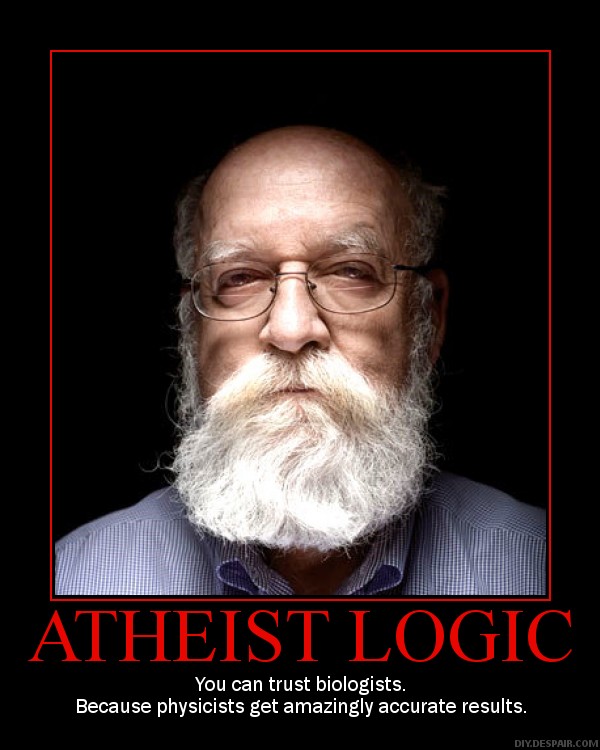
It is interesting, is it not, how even the most blindly faithful evolutionist runs from the sort of precision and quantification that is absolutely necessary if something is to be considered genuinely scientific in any meaningful sense? Being both trained and well-read in economics, the reader can safely believe me, I know pseudo-science when I see it. Biologists like to appeal to physics as the foundation of their claimed authority, but the fact of the matter is that if physicists were as haplessly ignorant and as unable to provide predictive models as evolutionary biologists, no one would take them very seriously either. This is why Daniel Dennett’s atheist logic is always so amusing: he asserts we are to trust biologists because physicists get amazingly accurate results.
4. What scientifically significant predictive model relies primarily upon evolution by natural selection?
Nothing as precise as physics, but holding a life science to that standard is stupid. Our understanding of genetics, animal behavior patterns, and in an incomplete way, social science, are all aided by the concept of natural selection.
Holding a life science to precise standards is stupid? That should be news to all those idiots working in genetics and medical science. And what about those amazingly accurate results Mr. Dennett promised us? In addition to that insulting blunder, Williamson resorts to trying to blatantly move the goalposts. But it’s not really his fault. What choice does he have? He can’t cite any scientifically significant predictive models that rely primarily upon evolution by natural selection because they don’t exist. After more than 150 years, TENS is still a useless and onanistic “science” that has little purpose beyond trying to prove itself.
Our understanding of genetics was not, and is not, aided by the concept of natural selection. The mindless adherence to evolution by natural selection actually inhibited the initial acceptance of Mendelian genetics, hence the need for the “Neo-Darwinian Synthesis” that finally allowed biologists to move on with the real science while still genuflecting respectfully to Saint Darwin. However, as I noted, we’re already seeing biologists admit that clinging to Darwin and Darwinism is unhelpful, and it won’t be too terribly long before they admit that the concept of natural selection is largely irrelevant with regards to manipulating genes as well.
5. Which of the various human sub-species is the most evolved; i.e. modified by mutation and natural selection from the most recent common human ancestor? Which is the least evolved?
There is no such thing as more evolved or less evolved. Evolution is not a linear progressive process where species “get better” over time. It is an amoral process. Genes either get passed on or they don’t. All evolution can tell is is which traits are more likely to thrive in specific environments. As for which human group has the most mutations from the baseline original human group, no idea.
Oh, Sweet Darwin! Someone obviously didn’t understand the question. It must be that pesky dearth of IQ points again. Since evolution by natural selection concerns the selection of mutations, there are most certainly “more evolved” and “less evolved” species; the reason the coelocanth is called a “living fossil” is because it has fewer mutations that have been selected over time than most other extant species. And it would not be possible to produce phylograms if it were not possible to declare which species was more evolved or less evolved from the purported common ancestor. Williamson not only incorrectly assumed the idea that “more evolved” means “better”, he incorrectly assumed that was the only possible meaning for the term even though I provided him with a different one.
6. Is the theory of evolution by natural selection strengthened or weakened by the claim that most DNA is devoid of purpose?
Strengthened. Junk DNA would seem to indicate evolution is a chaotic process with some unnecessary leftovers, which weakens the claim of specific intelligent design.
I just wanted to get him on record here. Remember, the ID model suggests that most DNA is NOT devoid of purpose. So, if junk DNA turns out to be more than junk, that will show that ID is a successfully predictive model and thereby provide scientific evidence for the idea that creatures on earth did not evolve by natural selection, but were designed. It will also show that another predictive model based on evolution by natural selection failed. Again.
I await any evidence that any creature on Earth is “intelligently” designed.
The usual response is, “but you don’t know the designer’s criteria,” which is a copout and unfalsifiable.
Any objective observation shows that every life form on Earth works just well enough to pass on its genes to its offspring. Most of the time. Those that don’t go extinct.
I’d like to see someone explain the “intelligence” behind a human foot, which no longer works as an effective grasper, and is not nearly as effective as a hoof for walking. Without modern footwear, we’re prone to serious mechanical failure of the joints and bone, usually shortly after our prime reproductive time.
And tiny babies will clutch with their feet when picked up from a crib, an instinctive hangover from our brachiator ancestors.
Keep an eye on genetic science. As we begin to learn more about how to manipulate genes, then we should begin to discover evidence of past genetic manipulations, if there is in fact any to be discovered. As for infelicities of design, I fail to see how anyone who has ever used Windows Vista or Windows 8 can claim that suboptimal design is evidence of an absence of either intelligence or design.
Religion has really become a bad joke. Physics destroys creation myths. Biology destroys creation myths. Geology destroys creation myths. Either Creation is a tale told to Bronze Age peasants as a way to explain a universe they couldn’t grasp, or this God person is running a serious long con.
It’s hilarious to watch an alleged “genius” trot out crap that was debunked a half century ago.
I will leave it to the resident physics PhD to demonstrate the absurdity of his claim about physics. I’ve already shown that biology cannot destroy creation myths because it doesn’t deal with them. As for geology, I can do no better than to quote the immortal words of Dr. Sheldon Cooper, “geology isn’t a real science”.
I will first mention that I am not a genius, “alleged” or otherwise, as I reject the idea that it is related to a specific IQ and I have no accomplishments that would merit the title. But I fear Mr. Williamson woefully misinterpreted that very significant peer-reviewed paper of fifty years ago that he cites, as it quite clearly not only defended, rather than debunked, the “crap” that I trotted out, but also provided absolutely conclusive scientific evidence for the existence of a Creator God as well as the precise age of the Earth down to the millesecond. It’s a pity I cannot quite recall the name of the highly reputable scientists who authored it or the exact issue of Nature in which it was published, but perhaps Mr. Williamson could be a lamb and remind us.
Relax, most immigrants aren’t going to kill you. They’re only going to lower wage rates, pollute the environment, live off your social benefits, transform your culture and your legal system, and make the USA considerably more like the third world hellholes from which they have escaped. The real problem, according to the Washington Post, isn’t a few murderous immigrants, but lawmakers stoking fear in the native populace:
CYNICS IN CONGRESS, eager to derail landmark legislation to overhaul the nation’s broken immigration system, have seized on last week’s events in Boston as a pretext to slow momentumon the issue. In the process, they may unwittingly provide a push for the very bill they hope to derail.
With scant regard for the actual immigration status of the bombing suspects, who came to this country legally as minors, Sen. Charles E. Grassley (R-Iowa) nonetheless framed the attacks in Boston in the context of the debate over immigration. With a suspect still at large Friday, he asked, “How do we ensure that people who wish to do us harm are not eligible for benefits under the immigration laws, including this new bill before us?”
His fellow Republican, Sen. Rand Paul of Kentucky, then sent a letter
to Senate Majority Leader Harry Reid (D-Nev.), arguing that the Senate “should not proceed [with immigration reform] until we understand the specific failures in our immigration system.”Just
what flaws in the immigration system are the senators talking about?
The failure to divine the future and predict that Tamerlan Tsarnaev, who
was a teenager when his family immigrated, and his surviving brother,
Dzhokhar, who was 9, might become radicalized years after arriving?
Well, yes. After all, we have been repeatedly ensured that the younger they are, the better immigrants will integrate and become Real White Americans who evere the Constitution, value American liberties, and vote in exactly equal numbers for Republicans and Democrats.
I know the Washington Post likes to blame everything on Republicans in Congress, but honestly, I would think that even the most propaganda-oriented progressive would admit that immigrants planting bombs and killing Americans is a perfectly rational reason to be less than wildly enthusiastic about immigration.
I haven’t changed my mind in the least about any of the things for which I have criticized him, but I do have to commend him for the spiritual perception he showed in his succinct dismissal of Rob Bell. He was interviewed about that last year by Justin Taylor:
“You famously tweeted, “Farewell Rob Bell” in response to his promotional video for his book Love Wins. Is there a place for theological reconciliation in the body of Christ?”
“To say yes to that—and you should say yes—would require serious definition. When you say theological reconciliation, you can mean two people with two different theologies working their way through to a common theology. That is their way of being reconciled. That’s what I give most of my energies to. I want to persuade people of what I see in the Bible, and work towards unity in truth. Probably what would be thought when [people] ask that question is: Can two people who maintain their differences in theology then be more reconciled? So, you wouldn’t say farewell; you would say hello. The answer is that it depends on the issues.
I don’t mind addressing the Rob Bell issue. When I watched the video of Rob Bell that was put up on Justin Taylor’s website, which was, I think, a link to his book on hell, my issue there was not primarily his view of hell. It was his cynicism concerning the Cross of Jesus Christ as a place where the Father atoned for the sins of his children and dealt with his own wrath by punishing me in his son. Rob Bell does not admire that. He doesn’t view the Cross that way, as a penal substitution.”
I detected a distinct whiff of sulfur about Bell from the first time I read a mainstream article lauding his ideas about Hell. And it became completely obvious that he is one of the wolves in sheep’s clothing about whom the Apostle Paul warned when he declared this last month: “I believe God [is] pulling us ahead into greater and greater
affirmation and acceptance of our gay brothers and sisters and pastors
and friends and neighbors and coworkers.”
Substitute any sinful adjective you like for “gay” and it rapidly becomes obvious how blatantly evil Bell’s position is. The god that he worships is not the God of the Bible, and most certainly is not the Christian God, who is not tolerant, who is not affirming, and who is not accepting of everyone. To claim otherwise is to eliminate the very foundation of the Christian faith, which is that all men are fallen, that Jesus Christ died for man’s sins, and that he offers the only way to the Father.
Piper was correct. There is no place for the Cross in Bell’s religion. There is not even any place for Jesus Christ. Whatever it may be, it is not Christianity.
The Official Story of the Boston Marathon bombing is already falling apart:
We have no idea whether or not the Chechen brothers Tamerlan and Dzhokhar Tsarnaev were the Boston terrorists. But several parts of the official narrative are already falling apart. Initially, the claim that they robbed a 7-11 is totally false. USA Today reported on April 19th:
“There was a 7-Eleven robbery in Cambridge last night, but it had nothing to do with the Boston Marathon bombing suspects. Margaret Chabris, the director of corporate communication at 7- Eleven,
says the surveillance video of the crime was not taken at a 7-Eleven
and that the suspect that did rob the 7-Eleven does not look like
Tamerlan or Dzhokhar Tsarnaev. “The suspect in the photos for that particular 7-Eleven robbery looks nothing like the suspects,” Chabris says. “The police or someone made a mistake. Someone was confused.”
At an earlier press conference morning, when [State Police
Superintendent Timothy Alban] described the manhunt and standoff that
resulted in the death of an MIT police officer, he also said that the
two brothers robbed a 7-Eleven.”Moreover, the FBI initially denied ever having spoken with either of the brothers. But CBS news notes: “The FBI admitted Friday they interviewed the now-deceased Boston Marathon bombing suspect Tamerlan Tsarnaev two years ago and failed to find any incriminating information about him.”
This is why I always say that the one thing we can always be sure is not the complete and unvarnished truth about any event such as Oklahoma City, Waco, Pearl Harbor, Sandy Hook, or 9/11 is the government’s Official version of it. Keep in mind that didn’t seem at all likely to me that a petty bombing with pressure cookers that killed fewer people than die in many car crashes could be some sort of false flag. I mean, what would be the point?
And yet even without most conspiracy theorists suspecting any funny business or actively looking into perceived contradictions, the government’s Official Story is falling apart.
I will say that the one thing that did bother me about the Official Story was way the bombers supposedly carjacked the guy, told him they were the bombers, and then let him go. That seemed remarkably stupid. So now, one has to wonder, were they the patsies? Perhaps not, perhaps they were simply morons. Even smart people do very stupid things under pressure sometimes. But that just takes us back to the original question: what was the point?
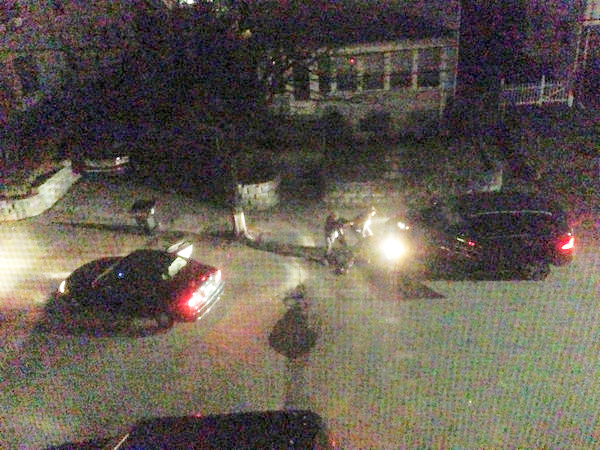
UPDATE: Images from the shootout. I enhanced the one here to make it easier to distinguish the details. As one has learned to expect, the police shooting was so bad that they actually managed to put a bullet in the second floor of the house from where these pictures were being taken.