The Excluded

This concept of intellectual exclusion may help explain why the credentialed elite are so often at odds with me. They can’t believe I am willing and able to challenge them so successfully, and I can’t believe what clueless idiots they are despite their credentialed positions of intellectual authority. It explains an awful lot; I thought they were smarter than they apparently are:

The probability of entering and remaining in an intellectually elite profession such as Physician, Judge, Professor, Scientist, Corporate Executive, etc. increases with IQ to about 133. It then falls about 1/3 by 140. By 150 IQ the probability has fallen by 97%! In other words, a significant percentage of people with IQs over 140 are being systematically and, most likely inappropriately, excluded from the population that addresses the biggest problems of our time or who are responsible for assuring the efficient operation of social, scientific, political and economic institutions.

“Over an extensive range of studies and with remarkable consistency, from Physicians to Professors to CEOs, the mean IQ of intellectually elite professions is about 125 and the standard deviation is about 6.5.  For example, Gibson and Light found that 148 members of the Cambridge University faculty had a mean IQ of 126 with a standard deviation of 6.3.  The highest score was 139.”

“From a theoretical standpoint, democratic meritocracies should evolve five IQ defined ‘castes’, The Leaders, The Advisors, The Followers, The Clueless and The Excluded. These castes are natural in that they are the result of how people of different intellectual abilities relate to one another.  This is based on research done by Leta Hollingworth in the 1930’s and the more recent work of D.K. Simonton.”

“Leta Hollingworth studied profoundly gifted children.  She reported them as having IQs of 180+, which was a R16 score.  As such, on today’s tests this equates to 159+.  Her conclusion was that when IQ differences are greater than 30 points, leader/follower relationships will break down or will not form.  It establishes an absolute limit to the intellectual gulf between leader and followers.”

In other words, more than a few PhDs at elite universities are more than two standard deviations below me in IQ terms. And here I am supposed to be impressed by a Bachelor’s degree in Philosophy of Language from a second-tier Midwestern university? In fact, given the ability of the Ilk and my Vile Faceless Minions to not only follow my lead in a disciplined manner but also correctly anticipate my intentions without having them explained, the evidence would tend to suggest that the mean intelligence of the regulars here is higher than the Cambridge faculty.

Based on my interactions with “intellectually elite professionals” this doesn’t shock me, although I’m a little surprised that both the mean and the ceiling as as low as they are.

So it should be no surprise that I’ve been “systematically and, most likely inappropriately, excluded” from the science fiction community, as its mean is probably around 1.5 standard deviations below the university professors. (Although in my estimation there are a few SF people with whom I have interacted who clearly have IQs over 139.) But in most instances, the intellectual gulf is simply too great.

Garth Zietsman has said, referring to people with D15IQs over 152, ‘A
common experience with people in this category or higher is that they
are not wanted – the masses (including the professional classes) find
them an affront of some sort.’  While true, it is more likely a symptom
than a cause of the exclusion.  We need to understand why they are an
affront.

I can tell him that. People who work very hard and spend years in order to climb to what they regard as the pinnacle of achievement actively resent those who can simply leap up to the peak. And because their knowledge is hard won, they tend to cling to it much more tenaciously than the more intelligent individual who is no more tied to one piece of information than the next. What makes it worse is that they cannot fathom that the more intelligent individuals do not think like they do.

Members of high IQ societies, especially those that require D15IQs above
145, often comment that around this IQ, qualitatively different
thinking emerges.  By this they mean that the 145+ D15IQ person doesn’t
just do the same things, intellectually, as a lower IQ person, just
faster and more accurately, but actually engages in fundamentally
different intellectual processes.  

I’ve been pointing this out for years, if you recall. But because I don’t think like the less intelligent, I am regularly labeled everything from stupid to racist. In my experience, the 150 IQ individual does not resent the
individual with the 160 or the 175 IQ, and this may be because being above 145, we all tend to engage in similar thought processes, albeit with different capabilities. The 135 IQ individual dislikes
and fears the 150+ individuals, while the 115 IQ individual either
doesn’t believe the 150+ individuals exist or blithely insists that they are crazy.

That’s
why I despise midwits. You simply can’t talk to them. They don’t even
try to understand you, but instead move to disqualify you as fast as they can. I have much more sensible conversations with
people in the 75 to 100 range than I do with most in the 105 to 120
range. The 125 to 140 crowd is okay as long as they don’t have an
inferiority complex, but when they do, they’re the biggest annoyances of
all.

People with D15IQs over 150 are effectively ‘The Excluded’, routinely
finding their thoughts to be unconvincing in the public discourse and in
productive environments.  If placed in a leadership position, they will
not succeed.

Now you know why I have such an allergy to being asked to lead in any way, shape, or form. In any event, this may be one of the more interesting aspects of Brainstorm (a reminder, there are 20 places left for the Wednesday session at 7:30 PM Eastern), as even those who aren’t +3SD or higher are, at least, open in principle to the wild and crazy thoughts being expressed by the higher intelligences. If we can figure out how to best harness a community of High IQ Excluded, we should be able to come up with more than a few interesting projects.


The Greek canary

Default is coming. So is Grexit. Bloomberg’s take:

How long can Greece carry on? With revenues just about covering the pay and pensions bill, there’s not much left over to make even the small(ish) payments due to the IMF in June. If Greece and its banking sector can limp a little further, the state should get a boost from income tax receipts that usually flow in July. Unfortunately, that might come too late to pay the ECB 3.5 billion euros due on July 20, and the repayment that follows in August looks like an impossible challenge without a disbursement of Eurogroup funds.

Should Greece’s citizens begin to lose faith in a positive outcome to negotiations, it’s quite possible that receipts could falter as more of the usual tax payments are held back and taxable activity is curtailed. Still, some boost to the Treasury’s bank balance is likely in July. General government revenues could be lifted by about 3.8 billion euros compared with the average for the other months of the year. That would get some way towards the figure needed to pay the ECB, though it might not come soon enough to avoid a missed payment.

Of course, making it as far as July depends on how long the Greek banking sector can survive. Absent a change to the haircut imposed by the ECB on Greek banks’ collateral, limitations on emergency liquidity assistance are unlikely to pose serious constraints before mid-July. Greek banks have enough collateral to access 93 billion euros in liquidity. That’s 13 billion euros above the current cap. The four-week average of increases by the ECB stands at 1.5 billion. At the current pace of increase, Greek banks could keep borrowing more for about eight weeks to offset deposit flight.

The usual suspects will insist that this is irrelevant because the USA has the ability to “print” its own currency, but again, the limit has nothing to do with printing and everything to do with finding someone willing to either borrow or loan the credit money. Furthermore, the Greek public is obviously quite willing to borrow, whereas the American public is not.

But this superficial assessment omits the fact that all the “Greek bailout” money went to the Greek banks, and deposits are loans to the banks. The negative interest rates beginning to appear around the world mean that the various publics are increasingly unwilling to loan their money to the banks, which is why the various proposals for banning cash and other means of preventing individuals to keep stores of value money outside the ever-widening maw of the banking system are being floated.

It’s a complicated subject and no one understands it completely, to the best of my knowledge. But rest assured that any solution that does not involve most of the banks writing off bad loans and then going out of business will be a failure.


Second-best ending ever

I have never watched Mad Men, never had any interest in it, but after reading about the final episode, that has to be the second-best ending of a television show ever, only surpassed by the epic end of Newhart. Third, in my opinion, would be the end of The Sopranos.

I love the fact that the show’s creator absolutely must have had the ending in mind from the beginning. That’s a first-rate lesson in doing storytelling right.

Somehow, I tend to doubt that A Game of Thrones will end anywhere nearly as well. While Benioff and Weiss have generally shown themselves to have much better storytelling instincts than George Martin, I’m still trying to figure out what on Earth is going on with Danerys inexplicably deciding to marry a member of the Mereen aristocracy. Fails as drama, fails as logic, and fails as being interesting.


Sexism and ideological bias in science fiction

Since we’re often informed by the SJWs how vital it is that more women are given awards on the basis of inclusivity, let’s begin with putting the facts out there. We already know, per Mike Glyer, that Hugos have been awarded to 19 conservative winners since 1996. I went through the list of Hugo Awards by Year and counted the number of women awarded, then counted the total number of awards given out. When more than one individual was awarded, I added the relevant percentage of that particular award (so one women in a group of four counted as 0.25, for example), and rounded up to a single decimal at the end.

2014: 9 of 17
2013: 4.8 of 17
2012: 8.8 of 17
2011: 6 of 16
2010: 2.8 of 16
2009: 4.5 of 15
2008: 1.3 of 14
2007: 3 of 14
2006: 3 of 13
2005: 4.8 of 14
2004: 4.7 of 13
2003: 4 of 13
2002: 1.5 of 13
2001: 2 of 13
2000: 1 of 12
1999: 1 of 12
1998: 0.5 of 12
1997: 1.5 of 12
1996: 1.5 of 13

TOTAL: 65.7 women have won 24.7 percent and 19 conservatives have won 7.1 percent of the 266 Hugo Awards given out since 1996. This is despite the fact that conservatives outnumber liberals by a factor of 1.6 in the USA, which means that conservatives are underrepresented by a factor of 11.3, versus women being underrepresented by a factor of 2.

Now, if the SJWs are to be believed, sexism is a serious problem but there is absolutely no evidence of left wing ideological bias. They keep repeating this despite the fact that the anti-right wing bias in science fiction is observably 5.6 times worse than the purported sexism about which they so often complain.

Which merely points us once more towards the truth of the lesson: SJWs always lie. And if the numbers aren’t enough to convince the more rhetorically minded, there is also a considerable quantity of anecdotal evidence of bias such as this comment from Martin Wisse:

To be honest, Worldcon fandom has been caught with its pants down by the Puppies, too slow to react to the first two attempts to game the Hugos. We all thought, and I was no exception, that after the Puppy nominees were trashed in the actual voting last year, the spoiled brats behind it would get the hint and fuck off.

Well, not so much. But at least we all know how seriously to take their pose of inclusivity.


Anti-GamerGate is afraid

CisWhiteMale ‏@Userlich
hey @voxday how do you feel about being lumped with Elliot Rodger

King of Bros ‏@Doomskander
I think it’s more hilarious that he’s further on the scary scale than Rodger

Vox Day ‏@voxday
I feel I’d like to correct them. I am considerably scarier than an inept loser like Elliot Rodger.


A History of Strategy chapter 1

A History of Strategy chapter 1 – ProProfs

The embed feature no longer works properly, so just follow the link above and click the big START button. Discuss it and ask any questions you might have in the comments below.

Keep in mind that the idea of the Voxiversity quizzes is not to catch you out or even test your knowledge, they are primarily designed to help you cement the basics of the book in question in your mind. The idea is that if you ace a series of Voxiversity quizzes, you possess the essential knowledge of the book required to understand it. I occasionally go back and retake some of the older Voxiversity quizzes just to ensure that I continue to retain the information involved.

The next quiz will be Chapter 2 on Saturday, 23 May.


The common factor

XDPaul points out that the parties responsible for what the Worldcon community is lamenting are not either the Sad or Rabid Puppies:

This is supposed to be a literary award, not playground taunts and bullying

If that was generally understood Sad Puppies would’ve never happened in the first place!

Exactly.

Scalzi should never have – unprovoked – called that guy he didn’t know a “a jackass, and a fairly ignorant jackass at that” in order to curry favor with established authors. All of this could have been prevented, had Scalzi not turned fandom into his private personal playground specially designed for these taunts and bullying of which you complain.

Taunts, bullying…and awards-gathering, of course. I know, let’s call it “Your Hate Mail Will Be Graded,” that epic scholarly work so highly regarded in the annals of SF.

If you want to condemn the one who set this all off, I think the former President of the SFWA, initial taunter, rape humorist, “easiest difficulty setting there is,” master of the recommendation list, and award-winning Professional Fan Writer John Scalzi is not a bad place to look.

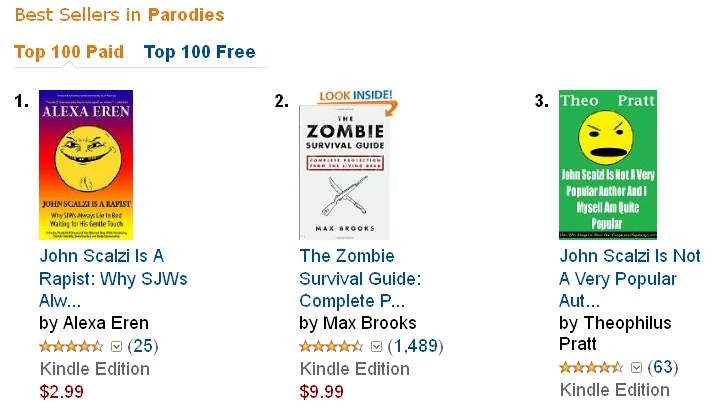
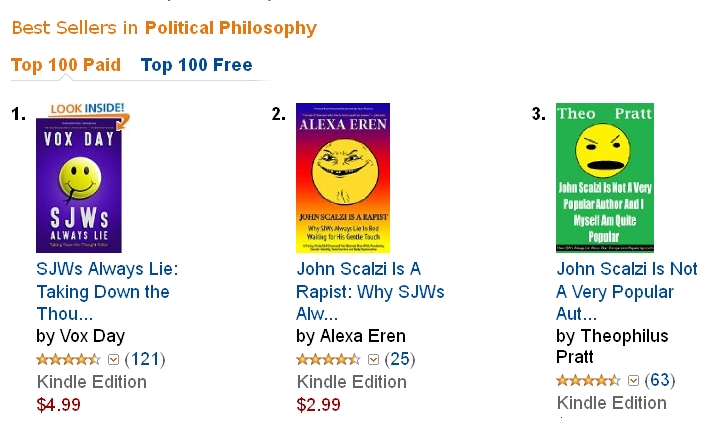
Everyone here knows why I went to the trouble of getting John Scalzi’s traffic statistics and unmasking him as the liar and fraud that he is. Perhaps fewer understand why Larry Correia is no fonder of the little charlatan, but Steve Moss explains:

 From what I can determine,the Corriea-Scalzi feud started as follows:
1. Ms. USA makes comments about women’s self-defense.
2. Corriea supports her comments.
3. Jim Hines’ criticizes Ms. USA and Corriea, in not too pleasant terms.
4. Corriea pins Hines’ ears back.
5. Scalzi goes after Corriea, and is his usually condescending and insulting self.
6. Scalzi gets his butt kicked in the Twitter exchange.
7. Many hot tempered words follow for the next 2-3 years year, with no sign of abating.

And then, of course, I would be remiss if I failed to recall this hilarious exchange:

John Scalzi ‏@scalzi Apr 8
I wish Larry Corriea had the balls to admit the reason he started the Sad Puppies campaign was that he just wanted a Hugo so fucking bad.
45 retweets 66 favorites

Larry Correia @monsterhunter45
I turned down my Hugo nomination and you still didn’t make the ballot.
360 retweets 501 favorites

The post-Loncon period in which McRapey repeated the very sort of falsehoods that the International Lord of Hate predicted the SJWs would attempt to put forth also merits mention. Meanwhile, Hugo nominee Kary English notes that the self-proclaimed inclusivity crowd has been more than a little bit hostile to outsiders, even to the point of harassing us with violent language.

“I’ve pretty much lost count of all the times I’ve seen someone say the Puppies should be shot, euthanized, put down, drowned, etc. It’s not cool. It’s not acceptable”

Perhaps someone should enquire of Sasquan if people who have harassed Hugo nominees in such violent fashion will be banned from the con, as I expect such statements are likely in clear violation of their Harassment Code. And finally, we have more evidence of the oft-observed truism; SJWs always lie:

Owlmirror on May 16, 2015 at 9:43 pm said:

    Scalzi should never have – unprovoked – called that guy he didn’t know a “a jackass, and a fairly ignorant jackass at that”

You mean VD’s anti-Semitism and misogyny don’t count as provocation?

    All of this could have been prevented, had Scalzi not turned fandom into his private personal playground specially designed for these taunts and bullying of which you complain.

You mean, VD would have not taunted and bullied anyone if not for Scalzi? What about the fact that he taunted and bullied women SF writers in the first place?

Yes, nonexistent anti-Semitism and misogyny don’t count as provocation, for the obvious reason that they do not exist. Nor does a single column addressing an attack on a disease-stricken Michael Kinsley by Susan Estrich and explaining the toxic effect of feminism on female intellects qualify as taunting and bullying women SF writers.

It’s fascinating to see how the SJWs resolutely refuse to see the obvious and recongize the single common factor in everything from award campaigning and pro Fan Writers to the culture war and the increased incivility in SF. This is particularly obvious once you take into account that I was an SFWA member participating in various events and activities without incident for seven years prior to McRapey first surfacing in the SF community.

However, the most interesting bit in the comments might have been easily missed, as Mike Glyer raised one of the few relevant points to be found amidst the lunatic sea of SJW rhetoric:

“How many conservatives have won the Hugo in the past 2 decades again?”

I just did a count and found 19 Hugos have been won by conservatives since 1996.

The determination of who is and who is not a conservative may be arbitrary, but as Mike has shown himself to be impartial throughout, there is no reason to quibble over it. This means that out of the approximately 304 266 Hugo Awards* that have been given out since 1996, only 7.1 percent have gone to conservatives. It will probably surprise no one here to learn that this factual observation of extreme left-wing bias in science fiction fandom was immediately met with the suggestion that conservatives simply aren’t very good at writing science fiction and fantasy.

“It could be just that Conservatives are not (at the present) very good at creating art…. Certainly (some) Conservative art in the PAST was good. Maybe there is
something about the current Conservative movement which curtails their
ability to create art? IDK.”

That could be. Or, you know, perhaps there is something to the assertion that nearly every single right-of-center author, male and female alike, has made about aggressive left-wing ideological gatekeeping in science fiction and fantasy. After all, the mere possibility that a few more right-of-center authors might win a Hugo has not only prompted a hate campaign in the international media, but open calls for changing the rules.

*This is a correction. I originally multiplied the number of years by the number of awards given out in 2014, but fewer awards were given in previous years.


#GamerGate has more fun

Vox Day @voxday
It’s too bad Sasquan isn’t closer to Vegas or I’d ask @TheMercedesXXX to dress like an Indian and accept the Hugo Award for me. #GamerGate

Mercedes Carrera ‏@TheMercedesXXX
@voxday that would be top Kek. And probably get me thrown out. Lol

#GamerGate has got to be the first consumer revolt that managed to bring together unequivocally evangelical Christians, unabashed porn stars, and undeniably fabulous homosexuals. Among many, many others. How evil are the SJWs, how universally loathsome is their ideology, that it can inspire such diverse tribes to unite against them?

We need a word to describe anti-SJWism. Then again, I suppose we’ve already got one. And that word would be “freedom”.


400,000 Comments!

John Scalzi @scalzi
Sometime in the last couple of days, my site reached the 400,000 comment marker. That’s, uh, a lot of comments.

400,000 comments is certainly a lot of comments. But then, you all know that since you have left 447,022 Blogger comments… since March 2012.

I keep hearing people claim these metrics don’t matter, but the strange thing is that they observably were said to matter quite a bit a few years ago when media publications from Lightspeed to the New York Times were marveling at Scalzi’s false claims. Not that I doubt his claims to have reached 400k comments, as based on our relative traffic, I assume his commenters were able to do in 7 years what took the commenters here only three. In fact, it was the observable discrepancy between the number of comments and his traffic claims that was the first hint that Johnny Con had a propensity for lying about the latter.

On a tangential note, since we’re speaking of someone with A DEGREE IN THE PHILOSOPHY OF THE ABUSE OF LANGUAGE or whatever it was, this comment from File 770 is an amusing exercise in completely missing the point:

Anna Feruglio Dal Dan on May 15, 2015 at 1:54 am said:
This is the point at which, as somebody who has actually STUDIED PHILOSOPHY AT COLLEGE LEVEL, I want to scream and cry.

Don’t get me wrong, Aristotele is a great mind. His contribution to philosophy and the history of human thought has been great, although he did stop science and logic and many other things in their tracks for several centuries – but that was not his fault, as anybody who has read The Name Of The Rose knows (yes, if you are a) Italian and b) a philosophy student, TNOTR is a fun read).

But he did not invent dialectic and what he meant by it is different from what Socrates, and Plato, and Kant, and Fichte, and Hegel, and Marx, and many others, mean by it. Kant in particular is rather scathing towards Aristotelian dialectic, saying, in short (I don’t have my copy of Critique of Pure Reason with me to check the exact quote) that the ancient Greeks thought they were so smart but they couldn’t reason their way out of a paper bag, which makes sense if you have the mind of Kant.

I suppose the most widely use of dialectic that I found is the hegelian sense: there are two opposing principles, which Hegel saw as fundamental principles of reality rather than logical propositions, and history proceeds by “finding out” that there is a third fundamental principle that makes both of them not so much false as superseded (well, history is what happens when the third principle unfolds itself, from what I understand of Hegel’s writings, but you know what I mean). This is all very abstract which is why I am not so fond of Hegel, but Marx’s idea of class struggle is a concrete example: there is a class that holds oppressive power over another, and in their interaction there arises a new state of affairs in which there is only one class that is neither the oppressive nor the oppressed one and everybody is happy.

The scientific method is also an example of dialectic, in a sense: if you want to stretch the definitions somewhat. Say that you contemplate the different models of the solar system, heliocentric and geocentric, and as a matter of fact both are valid explanation of observable facts, until Newton comes along with a better explanation that makes both of the models obsolete. (Yes, I know, gross simplification).

The history of the concept of dialectic is endlessly fascinating and stimulating. But one of the things any kind of dialectic presupposes is the ability to change, to discover the truth, or at least get endlessly closer to it.

The fact that somebody might seize on what we have left of the thoughts of a man who lived and died 2,300 years ago and think that that is the be all and end all of human thinking and call that dialectic just shows… well, a monumental lack of knowledge of the rest of the history of Western thought.

Lei non vuole gridare o piangere, invece lei vorebbe solo mostrare che l’ha una laurea in filosofia. In ogni caso, leggevo Il Nome Della Rosa tante volte, in inglese e ancora in italiano, in fatti, ho discusso quel libro due volte col stesso autore. Inoltre anch’io ho preso diversi corsi di filosofia all’universita’. Non significa nulla.

In any event, for all her very impressive philosophical book-larnin’, the signorina has managed to completely miss the point. I am not ignorant of Kant or Hegel or Marx, and I am perfectly aware that what Aristotle meant by dialectic is very, very different than what later definers of the term meant by it. That’s precisely why I am always careful to explain my reliance upon the Aristotelian form as opposed to the Marxian one I learned from the Marxian economists from whom I obtained my economics degree or any of the others. Instead of showing “a monumental lack of knowledge of the rest of the history of Western thought” on my part, she has demonstrated an impressive quantity of educated stupidity on her own.

What the signorina is doing is posturing in the modern fashion in which recognition of a thing is expected to pass for genuine knowledge of it. And yet, she doesn’t understand Aristotelian dialectic enough to do more than regurgitate some dimly remembered things she was told about it, or recognize that I am not pretending to make any use of Aristotelian dialectic to prove anything. As it happens, I tend to prefer the Thomistic method despite its various shortcomings.

All I am doing is utilizing the Aristotelian distinction between the dialectical and rhetorical populations as a useful heuristic that reliably proves useful in distinguishing between serious critics who merit serious responses and unserious ones who merit nothing more than contemptuous dismissal and a rhetorical kick in the empty head. I leave it to the reader to determine which population Ms Dal Dan most clearly belongs.

I find it reliably amusing to see how they cling to their pose of being intellectually superior and better educated even when they observably don’t understand what they’re reading.

Meanwhile, Glenn Haumann, the anti-Puppy who publicly called for posting fake reviews on Amazon, suggests a way The Most Despised Man in Science Fiction could rehabilitate himself in the eyes of science fiction fandom:

(Of course, science fiction reserves the right to re-evaluate your standing if you’re ever suspected of being involved in pedophilia.)

Apparently all one needs to do is to rape a few minors, unrepentantly write about it in the most graphic terms, and one can then not unreasonably expect to be named an SFWA Grand Master or win a World Fantasy Award for Lifetime Achievement Award. From Arthur C. Clarke to Tony Alleyne, from Marion Zimmer Bradley to David Asimov,  from Walter Breen to Ed Kramer, the science fiction community is one of the biggest collections of known pedophiles outside the British Parliament.

The widespread sexual aberrancy in the SF community was one of the many reasons I wanted nothing to do with it after my one mercifully brief encounter with Sad Freakville at Minicon. You have not seen true human wreckage until you’ve been to a science fiction convention. I’ve seen physically and psychologically healthier people on reservations and in refugee camps; one can hardly blame them for being drawn to escapism.


A historic privilege

In his landmark economics textbook, Paul Samuelson pointed out that domestic debt did not matter in the aggregate, with one notable exception.  He wrote: “The
interest on an internal debt is paid by Americans to Americans; there
is no direct loss of goods and services. When interest on the debt is
paid out of taxation, there is no direct loss of disposable income; Paul
receives what Peter loses, and sometimes – but only sometimes – Paul
and Peter are one and the same person…. In the future, some of our
grandchildren will be giving up goods and services to other
grandchildren. That is the nub of the matter. The only way we can impose
a direct burden on the future nation as a whole is by incurring an
external debt or by passing along less capital equipment to posterity.”

Setting aside whether it matters or not who owes what to whom, the recent report on external debt owed would therefore appear to be not entirely irrelevant in this regard.

The Treasury Department says overseas ownership of U.S. debt rose 2.1 percent in March to $6.18 trillion. That is below January’s record of $6.22 trillion. China added $37.3 billion of Treasury debt, bringing its stockpile to $1.26 trillion. That’s ahead of Japan, which added just $2.5 billion, lifting its total to $1.23 trillion.

In February, Japan became the leading owner of U.S. debt for the first time since August 2008. China overtook Japan that year as the Great Recession, higher government spending and a steep drop in tax revenue pushed up U.S. government borrowing.

As of the end of 2014, US government debt outstanding stood at $13 trillion. That means that with $6.18 trillion of it owed externally, 47.5 percent of the US public debt is of the sort that, even in Keynesian/Samuelsonian terms, imposes a direct burden on the future nation as a whole. And when you consider that the future USA – one can hardly call it a “nation” at this point – will be less white, less intelligent, and less productive on average, it should be readily apparent that the economy has absolutely no chance of growing itself out of the external debt owed regardless of which economic school of thought you belong.

What we are witnessing is nothing less than the gradual demise of the biggest, wealthiest economy in world history. It is truly a privilege and an education to behold. It is rather like being able to witness the death of the last Tyrannosaurus Rex. Regardless of how the fallout from the event may affect us personally, we have seen and experienced something that very few men have ever known.

I still remember living in Japan at the height of the Heisei Boom; I flew out of Narita less than five months before the consumption tax and the first round of monetary tightening marked the peak of that Golden Age and brought it to an end. In nearly three decades since, Japan has never again approached those heights of ease and luxury. Now we are looking at much the same thing, albeit on a considerably larger scale. But rather than mourn the recent past, we should appreciate it for the rare moment in history it was.

The Hobbesian Law was never abolished, it was merely held in abeyance for a time.