China’s grand strategy

An interesting perspective on what David Goldberg, for many years an opinion leader in the outdated “jump-to-China” plan, claims to perceive China’s grand strategy to be.

China’s notion of what it means to be the world’s superpower is different from ours, though, and begs examination.

An Ideological and Economic Competitor

Earlier this month, Dr. Kiron Skinner, head of Policy Planning at the State Department, had this to say: “In China, we have an economic competitor, we have an ideological competitor, one that really does seek a kind of global reach that many of us didn’t expect a couple of decades ago, and I think it’s also striking that it’s the first time that we will have a great power competitor that is not Caucasian.”

 As Victor Davis Hanson observed, Japan was, in fact, a great power competitor, and a formidable one, from its crushing defeat of Russia in 1905 to the end of the Second World War.

To put the present situation in context: Japan’s GDP [Gross Domestic Product] in 1940 was one-fifth of America’s and its population only half. China’s GDP is roughly the same as ours (25 percent larger than ours in purchasing power parity, according to the International Monetary Fund, or 30 percent smaller in nominal terms at the present exchange rate). Its population is more than four times [that of the U.S.]. China’s investment in frontier technologies exceeds America’s by a wide margin. It also graduates four times as many STEM [science, technology, engineering, and mathematics] Bachelor’s degrees and twice as many doctorates—and the skills gap is widening. One-third of [China’s] new labor market entrants have bachelor’s degrees, and one-third of those are in engineering.

Today, the two economies are of roughly equal size, but China is growing twice as fast. President Trump has said repeatedly that our economy is doing well while China’s economy is doing badly. He is misinformed. The perception that China is weak is widespread in Washington, and evidently contributed to the recent breakdown in trade negotiations. That is a strategic miscalculation that may have baleful consequences. China fears nothing but America’s technological edge, and that edge is eroding at an alarming pace.

National Principles and Imperial Designs

Dr. Skinner is broadly correct: We have never engaged a strategic rival with resources and skills on this scale. Today’s situation is radically different in another respect. In America and China we observe the confrontation of the national and the imperial principle in their purest form. America is history’s most successful nation-state. Its premise is the sanctity of the individual, the heritage of the English Protestants who in the 17th century envisioned a biblical republic. When I last had the privilege of addressing you three years ago, I spoke about our unifying political culture and its ever-present theme of the individual’s pilgrimage toward redemption. Our sense of the sacred in every citizen has proven a stronger and more enduring bond than the ethnocentric nationalisms of the Old World.

China is the oldest and—despite intermittent breakdowns—the most successful empire in history, subjecting the interest of the individual to the imperatives of the state. Unlike America, China never assimilated the scores of ethnicities who comprise its enormous population. Instead, it orders them into an imperial system ruled by a centralized elite and communicates by a system of imperial ideograms rather than a common tongue. It maintains a ruthless meritocracy that filters talent by standardized examinations. It has always viewed its people as raw material for imperial power and, within living memory, has sacrificed frightful numbers of them. The imperial order is perpetually at risk of fracture, and the succession of dynasties is interrupted by episodes of internecine war and unimaginable suffering. But the imperial system perpetually restores itself because the Chinese have had no alternative to warlords and anarchy.

Who is this “we”, (((David)))? What Goldberg, aka Spengler, omits from his analysis is the fact that the West is no longer the West, but rather, a failed and parasitized successor to what used to be the West. There is no us, there is no Judeo-Christian “sense of the sacred in every citizen” in the current Post-West. What Goldberg falsely claims is “a stronger and more enduring bond” than the nationalisms of the genuine West is not only intrinsically weak, it is leading directly to general collapse and a war of many tribes that will greatly serve China’s long terms strategic interests.

Goldberg’s analysis is obvious trash, resting as it does on such observably false assertions. But it is very useful to know it, because it informs us of what the current post-Western elite wants to believe and what the basis of their future actions will be.


Col Kratman on the Kurds

Long before the recent media campaign on behalf of the Kurds – which of course is nothing more than a pathetic neoclown attempt to put pressure on the God-Emperor Trump – Tom Kratman wrote about why the Kurds are not a people who merit help, much less sympathy, from anyone on the planet:

My first experience of the Kurds – rather, of how the rest of the area thinks of and feels about them – was before I’d ever met my first one. This was at a majlis, in the town of Judah (or Goodah), Saudi Arabia, sometime in December or so, 1990. Citizenship is kind of an iffy and flexible concept in that part of the world, so there were folk from Saudi, from Oman, from the Emirates. There was even one Arab who insisted he was a citizen of the Gulf Cooperation Council, since he was a fully documented citizen of so many places in the GCC. I had my doubts right up until he pulled out a bilingual ID card which, indeed, did seem to list him as a citizen of the GCC. One of the attendees had brought with him a book detailing the results of the chemical attack on the Kurdish town of Halabja by the army and air force of Saddam Hussein.

It was really heartbreaking, all those picture of gassed, dead, discolored, and decomposing Kurdish kids, who are, in fact, every bit as cute as the papers and television made them out to be. At least when they’re not dead they are. My team sergeant, Sig, and I were duly appalled and sickened.

The Arabs, though, didn’t seem to understand. To paraphrase, “What’s the problem? Don’t you understand that these were _Kurds_ who got gassed?”

At the time, I found that attitude completely inexplicable.

Fast forward a few months; we’ve incited the Kurds and Shia to rise up and overthrow Saddam. They didn’t, of course, while such an uprising would have looked difficult and might have done us some good. Oh, no; instead the Shia – whose rebellion was spontaneous, anyway – waited until it looked like the Iraqi Army was crushed and such an uprising would be easy. The Kurds – who were organized – waited even longer.

Sorry, boys, but when we offer you a quid pro quo, that doesn’t translate into “free lunch.” Moreover, when we’ve already offered someone a cease­fire it’s a bit late to try to get us to start hostilities again. In short, we owed them nothing.

Fast forward, again, to late May, 1991. I’d come home from the Middle East, hung around a while, and been sent back, this time to Operation Provide Comfort, the Kurdish Rescue, there to quasi govern a few towns, run refugee camps, coordinate humanitarian relief, and such like. While we’re waiting in the camp on the Turkish side of the border, not too far from Silopi, overwatched by a Turkish police fort on a hill, some Kurds got in position to fire at the fort such that, should the fort return fire, the Turks will be shooting at us. So much for gratitude from people you’re trying to save, eh?

Fortunately, Turkish discipline held firm and enlightened Kurdish dreams of advancing the cause of having a homeland of their own by getting their rescuers killed came to naught.

President Trump’s position of not defending the Kurds from our actual allies, the Turks, is legally, militarily, and morally correct. If anything, the US military is treaty-bound to defend the Turks against Kurdish incursions as per its NATO obligations.

And, of course, those tactics very likely explain this near-incident between Turkish and US forces:

The Pentagon confirmed Friday that US troops in Syria “came under artillery fire from Turkish positions” and demanded that Turkey halt all operations that could require the US to take “immediate defensive action.”


This is what hope looks like

Young white Americans understand, in a way most of their elders simply cannot, that they are caught up in an existential war against them, and they are desperate for the kind of hope the God-Emperor is providing them:

DONALD Trump’s rally in Minneapolis has turned heads after people pointed out that it looked more like a Justin Bieber concert rather than a political meeting. Teenage girls and boys were seen crying tears of joy as the US president talked about his win in the 2016 election to a 20,000-strong crowd in Minnesota.


Fake solar power

So much for the idea of powering your home with solar panels:

One valuable lesson has been learned from the California blackouts concerning the greens’ vaunted solar power.

People with solar panels fitted to their homes have long acted under the impression that these granted them some immunity to blackouts.  They now know better.  Those who went to the heavy expense of purchasing and installing solar panels are in the same situation as their neighbors: no light, no heat, no power.

How does this make sense?  If you’ve got a system that generates power all by itself, with no outside aid or assistance necessary, then it’s a sure thing that it’ll continue generating power even after the grid itself is shut down, right?

Ah, but we’re dealing here with corporate policy.  And when that enters the picture, then sense of any kind quickly departs the stage.

It turns out that solar panels do not supply power to the homes they are attached to.  Instead, they transmit power out into the grid itself.  A complex system of credits is employed to reimburse the homeowner.

Forget being reliant upon it; even being connected to a centralized system turns out to be a fatal flaw when the system collapses. But hey, at least they got a tax break for installing them, right?


He is not your father figure

A Roosh reader observes that Jordan Peterson’s parenting skills have turned out to be more than a little suboptimal.

Peterson’s daughter finally confirms she’s “separated” from her husband and has been “co-parenting” (not that this is remotely a surprise to anyone who has been glancing at her Instagram etc.)

Not that this is a new thought here but it’s rather damning that his daughter has turned out be “attempting to find herself” (in the usual fashion) even with a toddler child and seemingly very supportive and at least somewhat redpilled father. Very disheartening, obviously the fame and attention got to her head a bit but I’m well past the point of seeing Peterson as any sort of personal role model. Having read 12 Rules twice I can tell you there’s some valuable proto-morality that can set others in the right direction but “You will know them by their fruits” (Matt. 7:16a).

Perhaps we’ve seen enough of Peterson’s fruits to move on to deeper traditions as a whole.

This guy gets it.

Peterson made millions writing a book telling people how to live. But look at how someone turns out that had all the benefit of his advise 24/7.

No one who has read Jordanetics will be even remotely surprised by this. Jordan Peterson has been a terrible parent since he was passively permitting other children to mistreat his daughter at the park. The fact that a lot of young men have been looking up to Peterson as an ersatz father figure promises more than a few additional disasters in the future.

UPDATE: Seriously suboptimal.

She shows a screenshot of her prescription history. Two of those prescriptions are used to treat herpes.


Trumpslide 2020 cometh

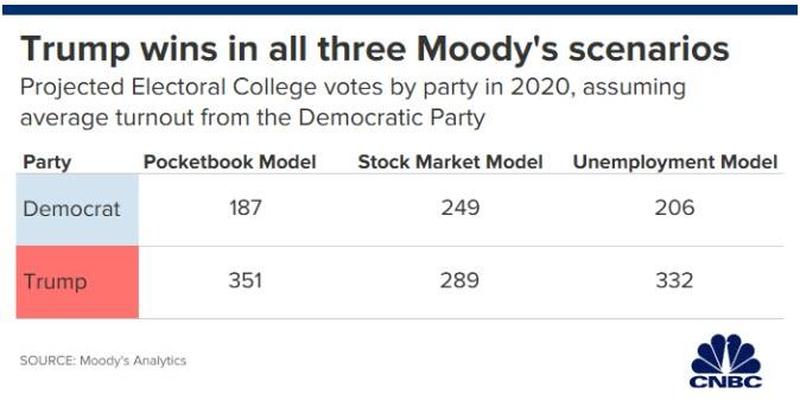
Moody’s has been highly accurate in predicting the outcome of elections dating back to 1980. The only time the company was incorrect was in 2016, when it predicted Hillary Clinton would narrowly win.

Three different economic models employed by the analytics agency suggest that Trump’s Electoral College victory is on course to surpass the 304-227 count that secured him victory over ‘Crooked’ Hillary.

The projections are based on economic factors, specifically how confident consumers are with their financial situation.

They’re already starting to use words like “steamroll”. Remember, you heard it here first.

UPDATE: In related news, the God-Emperor’s DOJ announces a massive blow against the Swamp:

South Korean National and Hundreds of Others Charged Worldwide in the Takedown of the Largest Darknet Child Pornography Website

Dozens of Minor Victims Who Were Being Actively Abused by the Users of the Site Rescued

Jong Woo Son, 23, a South Korean national, was indicted by a federal grand jury in the District of Columbia for his operation of Welcome To Video, the largest child sexual exploitation market by volume of content.  The nine-count indictment was unsealed today along with a parallel civil forfeiture action.  Son has also been charged and convicted in South Korea and is currently in custody serving his sentence in South Korea.  An additional 337 site users residing in Alabama, Arkansas, California, Connecticut, Florida, Georgia, Kansas, Louisiana, Maryland, Massachusetts, Nebraska, New Jersey, New York, North Carolina, Ohio, Oregon, Pennsylvania, Rhode Island, South Carolina, Texas, Utah, Virginia, Washington State and Washington, D.C. as well as the United Kingdom, South Korea, Germany, Saudi Arabia, the United Arab Emirates, the Czech Republic, Canada, Ireland, Spain, Brazil and Australia have been arrested and charged.

No wonder they wanted so desperately to impeach him. The noose around them just keeps inexorably tightening. And remember, Pizzagate is totally debunked because an actor filed a single shot at a computer….


24 hours, 300 percent

The Junior Classics campaign is going extremely well, having hit 300 percent of goal in less than 24 hours. You can acquire a digital set, a hardcover set, or a deluxe leatherbound set by backing the campaign.

The 2020 edition is about 85 percent 1918 and 15 percent 1958. This is because the 1918 volumes are generally better, but a) one of the original volumes was half-comprised of Alice in Wonderland whereas the later volume had a better and broader selection of stories, and b) the stories contained in the 1918 Volume 9 Stories of Today are seriously outdated and mediocre in comparison with the relatively timeless stories contained in the 1958 Volume 9, Sport and Adventure.

If you want multiple sets, just run through the buying process as many times as you require. You will receive multiple backer numbers.

The digital editions are both EPUB and MOBI (Kindle) format.


The Democrats back down

Remember that impeachment thing? You know, because the fate of the republic was at stake due to the high crimes of the president? Yeah, well, forget about that:

Speaker Nancy Pelosi (D-Calif.) said Tuesday she will not stage a vote on the House floor to officially launch an impeachment inquiry into President Trump. The decision came after Democratic leaders, returning to Washington following a two-week recess, had reached out to members of their diverse caucus to gauge the party’s support for such a vote.

After back-to-back meetings with party leaders and then the full caucus, Pelosi announced that no such vote would take place. Democratic aides emphasized, however, that the process remains fluid and that Pelosi may reverse course and stage such a vote at any point in the future.

“There’s no requirement that we have a vote, and so at this time we will not be having a vote,” Pelosi told reporters during a last-minute press briefing in the Capitol.

President Trump is using their emotional projection as bait. It’s one of the more brilliant political tactics I’ve ever observed; it’s worthy of an entire chapter by Machiavelli. What he’s doing is accusing himself of things that he knows they are doing. So they demand the very investigations that he wants, thereby forcing the media to extensively cover the very topics it wants to bury.


The Dark Ages, new and improved!

The Z-man doesn’t get the etymological origin of the term “Dark Ages” quite right, but he raises a good question about whether the West has already entered another one:

That’s a good point to wonder if the West has not already entered a new dark age, in which superstition rules over rationality. The concept of the microaggression is something superstitious people living in a dark age would have understood. After all, a microaggression is the idea that certain words and phrases, incantations, will cause a miasma to develop around the people saying and hearing the words. This miasma or evil spirit will cause those exposed to react involuntarily and uncontrollably.

In fact, everything about political correctness and multiculturalism relies on oogily-boogily that people in the dark age of Europe would have found ridiculous. The people of Europe in the middle ages may not have had a sophisticated understanding of the natural world, but they did not think the dirt had magical qualities. Magic Dirt Theory would have struck them as laughably ridiculous. They may not have understood cognitive science, but they knew the apple does not fall far from the tree.

As I explained in TIA, Petrarch’s term was the reversal of an earlier Christian perspective of the time before the coming of the Light of the World by an embittered Italian patriot looking at the ruins of the Roman Empire and despairing of the relatively barbaric German domination of his time.

Which is hauntingly similar to the situation which the people of the West may soon be facing. That is why it is so important to preserve knowledge now. Barbarians have never cared about building or minded living amidst filth, which is why we are already at the point where the fate of our indoor plumbing is in doubt.

It’s not enough to know about things. It’s not even enough to know how to maintain them. It is vital to learn how to design, develop, and build things if civilized society is to be preserved. We’re already bringing back the Junior Classics, but perhaps we also need to create a new series, Core Civilization, comprised of books that teach the core basics of everything from architecture to gardening and water engineering. Because it’s clearly time to begin thinking about these things.

I started to think about those people living in the Roman Empire wondering why the water no longer comes from the big stone thingy anymore. Some may have remembered their ancestors working on them for some reason, but they no longer recall why. The people who knew how and why those aqueducts worked were long gone. No one was around who could figure out how to make them work again, because they lacked the capacity to do it.