Shadowbanned!

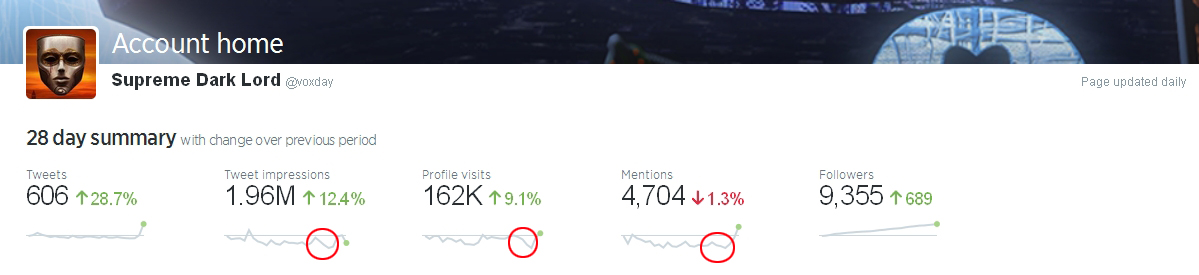
Apparently the Twitterthorities have deemed that I, too, am a threat to the innocent minds of the Twittership:

Dharma Warrior ‏@India_empower
@voxday strangely, your tweets don’t show up on my TL. I have to visit your Twitter page to read ur tweets.

Supreme Dark Lord ‏@voxday
It’s the Twitter shadowban. They’re trying to limit the reach of the Alt Right because we are too appealing.

I feel like Neal Patrick Harris at the end of the execrable Starship Troopers movie.

“They’re afraid… they’re afraid of us!” 

We don’t need to silence them in order to win. We only have to make sure that our voices are heard.


The technocultural war

Milo explains how Facebook-Instagram-Whatsapp has joined with the governments around the world in an unholy alliance to create a global Big Brother:

It’s not just Facebook we’re talking about. They own WhatsApp and they own Instagram. And WhatsApp and Instagram are two of the companies that are winning the short messaging war–that are winning the war for Millennial attention and for Millennial users. Twitter lost that war. Twitter only really appeals to media people: people like you and people like me. We want to kind of keep in touch with our peers. And then some of our fans who are, like, really really keen might sign up for a Twitter account just to see our witty sayings or whatever clever lines we toss off on the way to the train station in the morning. But primarily, Twitter has lost that war. Snapchat, Instagram, WhatsApp–these are the networks that have billions of users. These are the networks that are getting young users, and Facebook owns two of those three.

The other thing to bear in mind is that Facebook so far has a really really bad track record when it comes to free speech. And not just a bad track record censoring different political opinions like Twitter does. Facebook’s moves are even more sinister, in a way. Facebook has teamed up with governments to censor certain political opinions that the incumbent party doesn’t like. In Germany, for instance, Facebook has teamed up with Angela Merkel to censor reasonable, respectable, mainstream concern about mass Muslim immigration–or just about mass immigration in general–and has started removing this stuff and classifying it as “hate speech.” It is effectively slandering its own users saying that their perfectly reasonable points of view constitute “hate speech” and that they’re not going to be allowed on Facebook, and Facebook has promised the German government that this stuff will be removed within 24 hours. That is outright Orwellian. That is outright terrifying.

Facebook is pure ideological evil. Don’t use it. Don’t support it. We will have alternatives, they are in the works and they are on the way, but they are going to take time to develop and they are going to need your support.

But we don’t need to be worried. We need to be resolute. We can beat them. We will beat them at their game, even though they have the money power on their side. Because the money power is not merely creaking, it is cracking, and we are the side in harmony with truth and reality.

The pendulum always swings back. Never forget that. And the harder they work to restrain it and hold it fixed to one side, the more vicious and unstoppable the return of the pendulum will be.


New heights of convergence

Twitter, as per the second law, doubles down on social justice convergence:

To ensure people can continue to express themselves freely and safely on Twitter, we must provide more tools and policies. With hundreds of millions of Tweets sent per day, the volume of content on Twitter is massive, which makes it extraordinarily complex to strike the right balance between fighting abuse and speaking truth to power. It requires a multi-layered approach where each of our 320 million users has a part to play, as do the community of experts working for safety and free expression.

That’s why we are announcing the formation of the Twitter Trust & Safety Council, a new and foundational part of our strategy to ensure that people feel safe expressing themselves on Twitter.

As we develop products, policies, and programs, our Trust & Safety Council will help us tap into the expertise and input of organizations at the intersection of these issues more efficiently and quickly. In developing the Council, we are taking a global and inclusive approach so that we can hear a diversity of voices from organizations including:

  • Feminist Frequency
  • GLAAD
  • The Anti-Defamation League

It’s as if they are literally Hell-bent on self-destruction. This is truly remarkable! I have never been more confident about the Alt Right’s ability to seize the cultural high ground. There are more opportunities presenting themselves than we can possibly address at once.


Convergence at GitHub

We don’t use GitHub; although GitLab does have a Code of Conduct it does not yet have any other signs of SJW infestation. But the convergence at GitHub, which was apparent when its former CEO was forced out in 2014 over a “sexual-harassment scandal by a female employee who quit”, appears to have shifted into a higher gear.

  • Cofounder CEO Chris Wanstrath, with support from the board, is radically changing the company’s culture: Out with flat org structure based purely on meritocracy, in with supervisors and middle managers. This has ticked off many people in the old guard.
  • Its once famous remote-employee culture has been rolled back. Senior managers are no longer allowed to live afar and must report to the office. This was one reason why some senior execs departed or were asked to leave, one person close to the company told us.
  • Others tell us that key technical people from the old days like CTO Ted Nyman and third cofounder PJ Hyett are mostly absent from the office and not contributing much technically.
  • GitHub has hit “hypergrowth,” growing from about 300 to nearly 500 employees in less than a year, with over 70 people joining last quarter alone.
  • Some longer-term employees feel like there’s a “culture of fear” where people who don’t support all the changes are being ousted.
  • In addition to previously reported executive departures, Business Insider has learned that Ryan Day, VP of business development; Adam Zimman, senior director of technology partnerships; and Scott Buxton, controller, have all left in the last six months. Buxton departed in January.

And what are all these changes? The usual diversity-and-inclusivity nonsense.

One insider criticized GitHub’s “social impact team,” which is in charge of figuring out how to use the product to tackle social issues, including diversity within the company itself. It’s led by Nicole Sanchez, vice president of social impact, who joined GitHub in May after working as a diversity consultant.

While people inside the company approve of the goal to hire a more diverse workforce, some think the team is contributing to the internal cultural battle.

“They are trying to control culture, interviewing and firing. Scary times at the company without a seasoned leader. While their efforts are admirable it is very hard to even interview people who are ‘white’ which makes things challenging,” this person said.

Sanchez is known for some strong views about diversity. She wrote an article for USA Today shortly before she joined GitHub titled, “More white women does not equal tech diversity.”

At one diversity training talk held at a different company and geared toward people of color, she came on a bit stronger with a point that says, “Some of the biggest barriers to progress are white women.”

I suspect there is more than a little confusion between correlation and confusion taking place there; Facebook is fully SJW-converged, therefore full SJW convergence equals revenue growth, profit, and massive equity overvaluations.

But, as Mike Cernovich noted, it’s the SJWs at the venture capital firms who are aggressively pushing this by throwing large sums of money at the converged firms and inflating their values. Does that model still work? Probably not now that the Federal Reserve is out of bullets, but we’ll see.


The curation challenge

This is an excellent article that underlines the importance of what we are presently doing with Castalia House and REDACTED. It’s not about production or distribution anymore, but curation. And while the SJWs in possession of the cultural high ground understand this, they fortunately do not understand how to properly utilize it in a manner that will permit them to hold onto it.

For thousands of years, media was a privilege of the elite, concentrated in cities and confined to a single moment in time. With Edison’s phonograph, music had become non-rivalrous, infinitely replicable and indefinite. Yes, it took decades until the average family could afford a record player or radio, but the dawn of democratized consumption had arrived.

Unfortunately, however, this same trend led to an ossification in content creation and distribution. Records, after all, cost money. Production was expensive – as was distribution, marketing and promotion. So expensive, in fact, that almost every artist lacked the capital required to actually release their music – a need that paved the way for record labels (or TV studios, film studios, publishers etc.) that would finance said efforts in exchange for hefty royalty fees and content rights. These money men though wouldn’t and couldn’t afford to invest in every artist with a dream. Given the upfront cost of talent development and distribution, labels invested in “Arts & Repertoire” men, whose job it was to sift through countless musicians in order to identify the select few with “commercial viability”. Potential artists were then further cut down in number when it came time to actually distributing their content – and then again via marketing/promotional support. Underlying this fact was an unavoidable truth: content publishers had scale-related disincentives to support more than a handful of artists. Why record, distribute, market and promote 15 albums if you can achieve the same unit sales with 10?

Though this system was far from ideal, it was the inevitable outcome of a market in which talent was abundant, capital limited, distribution bandwidth (e.g. shelf-space, broadcast spectrum, print layouts) scarce, barriers high, and the cost of failure significant. But as a result, the content industry slowly shaped itself around a mysterious cabal of financiers and executive tastemakers that essentially programmed the national media identity. And anyone who wanted in had to move to New York, LA or Nashville, pay their dues and hope to work their way up until they could call the shots.

Of course, the music business was far from alone. The more expensive the medium, the more constrained the supply, the smaller the community and more homogenous the content. Local disc jockeys, newspapers and TV affiliates did have the opportunity to repackage and reprogram – to imprint their personality or take, if you will – but this was limited in scope, drew upon only the content that was already distributed, had to fit within an existing corporate identity and, again, depended on access to capital or infrastructure.

Over time, however, technology did what it does best: production costs fell, quality went up and distribution bandwidth increased. Economics, in turn, improved, as did the industry’s carrying capacity – the number of artists, titles, and pieces of content that could be supported. The media business was beginning to loosen up.

But it took until the late 2000s – more than a century after the phonograph – for creation and distribution to truly democratize. With the Internet, distribution became free and truly non-rival (if a bit non-excludable), while the proliferation of low-cost media equipment, mobile devices, and powerful editing software dramatically lowered the costs of production. The rise of creator-based consumption platforms and crowd-funding platforms, meanwhile, eliminated many of the remaining barriers hindering independent content creation. This meant that content could not only be created by those outside the business, but that commercializing this content became significantly less expensive and risky. This led to a massive increase in available, indexed and distributed content.

While the media business benefited from many of these changes, the consequences have been fundamentally destabilizing. The television industry has experienced such a surge in original content that annual cancellation rates have quintupled over the past 15 years (twice as many original scripted series were cancelled last year than even aired in 2000). Since 1985, the indie film industry has seen a nearly twentyfold increase in the number of theatrical releases even though ticket sales have remained flat (in 2014, the Head of SXSW’s film festival decried that “the impulse to make a film had far outrun the impulse to go out and watch one”). Plummeting music sales and unprecedented competition have made launching a new artist so expensive that catalogue sales now make up more than 200% of major label profits (in 2014, David Goldberg privately encouraged Sony Entertainment CEO Michael Lynton to essentially halt A&R efforts, as well as investments in actually making new music). With the democratization of media creation, it’s easier than ever to make content but harder than ever to make a hit.

Ironically, the increasing difficulty in creating hits has not bolstered the “hit maker” system but rather further weakened it instead. In 2013, Macklemore became the first unsigned artist since 1994 to have a number-one single in the United States – a feat he repeated just three months later. Mega-star Taylor Swift has been with an independent label since her debut album and multi-platinum groups such as The Eagles and Radiohead have left the majors to start their own. The struggles of print publishing are well-known, but the uniqueness of some of “print’s” recent successes are worth mentioning. The 50 Shades of Grey trilogy, which has outsold The Harry Potter septet on Amazon in the United Kingdom and made author E.L. James 2012’s highest-earning author, became a viral hit on FanFiction.net long before it was picked up in print (and it’s unlikely a publisher would have bought the rights upfront). Andy Weir’s The Martian is another self-publishing success story.

This metamorphosis is about far more than ever increasing amounts of content and a handful of stars existing outside the traditional media ecosystem. The entire media business is inverting. For decades, scarce capital and constrained distribution capacity meant that the media’s industry bottlenecks sat in the middle of the value chain. Today, however, the bottleneck has moved to the very end: consumer attention. This shifts the balance of power from determining what should be made to finding a way to convince people what to watch, listen to or read in a world of infinitely abundant content.

The preeminence of this challenge has given to the rise of a new type of aggregator-distributor, including news content sites like Gawker, the Huffington Post and BuzzFeed; video and music aggregation services like Netflix, YouTube and Pandora; and even physical products subscription offerings like Birchbox and Lootcrate. What’s more, it enabled the major social networks to use their customer data to build massive stickiness, launch their own publishing platforms and become traffic kingmakers. More broadly, this shift has swung the balance of power from programmers with the ability to greenlight content to curators with the ability to get that content heard, seen or read. Of course, the old programming and financing guard remain important, but with the democratization of production and the explosion of content creation, the power of 1st party programming is quickly being eclipsed by the ascendance of 3rd party content curation. The gatekeepers are still manning their posts, but the city outgrew the walls and the barbarians circumvented the gates entirely.

Content is still king, but distribution is no longer the gate at which the gatekeepers can control it. That doesn’t mean there will be no more gates or gatekeepers, but content will now be influenced rather than controlled, and the influencers will be different people with very different skill sets.

It’s easy to produce content now. It’s easy to distribute now too. But how do you reach the consumers, let them know your content exists, and convince them to try it instead of the myriad other options? That’s the curation challenge.

The Third Law at work

Oliver Keyes of the Wikimedia Foundation doesn’t like the fact that people have noticed his attempt to enforce SJW thought-policing on the R Foundation:

In which Oliver Keyes Sciences the Shit Out of the Arseholes on his Blog.

Every time you make a web request (with some exceptions we won’t get into here) browsers send along to the new page or server the place you’re coming from. If you click from here to this Wikipedia link, the Wikipedia request logs will show you came from my website.

Similarly, if you come from another site to my website, most of the time I can work out where that other site is. So I took the referers for people leaving comments. Then I turned them into human-readable text, stripped out those referers with fewer than 5 distinct users, and the results look a little something like:

suck it, MRAs

Unsurprisingly, Vox Day’s readers are arseholes. Not just some of them, but all of them: every one of them who managed to painfully peck at their keyboard and hit save was a pillock of the highest calibre, contributing absolutely nothing of value to to the conversation.

But given that it is Mr. Keyes who is speaking of “arseholes”, one should probably consider the source:

In a shocking decision today, the English Wikipedia’s highest volunteer governing body, the Arbitration Committee, has defrocked a Wikimedia Foundation paid contract staff member, Oliver Keyes, for “conduct unbecoming an administrator, and for bringing the project into disrepute”.

This morning, August 12th, the seventh straight unopposed vote to remove the administrator tools from Mr. Keyes was leveled by Scottish arbitrator, AGK. Recall, that Examiner reported several weeks ago that Keyes had uttered some rather crude and offensive remarks on Wikimedia Foundation discussion channels — including a suggestion that another Wikipedia editor should be set on fire, and a recommendation that someone should stab a particular woman in the throat with a pen, then look on “as her attempts to wave for help got increasingly feeble”.

This brings the Third Law of SJW to mind: SJWs always project. Which raises the obvious question: why is this guy still working at the Wikimedia Foundation? Does the Wikimedia Foundation endorse stabbing women in the throat?


An SJW has a point

It’s time to fork OSS. Not just one project, the entire community needs to be forked so we can let the SJWs see if they can develop software by doing nothing but policing one another’s behavior. After all, we’re told that this is the most important part of software development.

Storm Henry ‏@hnrysmth
I see the Gamergate people getting more involved in this CoC debate and I see the dev community members welcoming & signal boosting them

Storm Henry ‏@hnrysmth
I want to make it super clear how messed up this is. When that circus comes to town bad things happen.

Storm Henry ‏@hnrysmth
I also see developers, especially in the PHP
community, who are just openly Gamergaters on their main accounts under
their real names

Storm Henry ‏@hnrysmth
Defo wanna see consequences for the guys
bringing GG into the OSS community. Wanna see some Lanyrd speaker
profiles abruptly stop at 2015.

Storm Henry ‏@hnrysmt
an easy thing you can personally do to help if you’re a developer is unfollow/block the guys who you know are buddying up with gamergate etc

Storm Henry ‏@hnrysmt
precedent needs to be set: you can have full access to the OSS
community, or you can chill with the organised harassment community. not
both

Supreme Dark Lord ‏@voxday
You’re absolutely right. It’s time to fork the entire OSS community.


How to eject an SJW

See, now, this is how you jettison the officious little creatures from your project:

I’ve done my best to create a more welcoming environment: I serve on the Scholarship Committee for UseR 2016 Stanford and the R Foundation Task Force on Women, have written a load of things in blog or twitter form about the need for a stronger community and a more representative Foundation, and helped Kara Woo and Gavin Simpson draft the open letter to the R Foundation that mandated a code of conduct for real-world events. With all of that I think it’s fair to say that while I’m not a Hadley, I’m at least a moderately-useful member of the community.

Rewind a week, to last Monday: I’m wandering around Twitter seeing what everyone is up to, reading through, and spot a tweet that immediately makes me headdesk. It points to a line in the R source code containing a variable called, with all seriousness…

    iGiveHead

I don’t think that this is an intentional sexual reference – far from it, I’m certain it’s just due to an absence of familiarity with one particularly crass English idiom, and I have only ever known the developer who wrote the code (whose first language is not English) to be entirely proper, entirely reasonable, and the model of what a productive Core member should be.

But it needs to go anyway: it’s exclusionary as all hell to have language like this in the core implementation and we can’t expect people to instantly understand intentions.

So I grabbed the latest development version of R, generated a patch that changed the name, and submitted a bug report with the patch that made clear I didn’t think this was anyone’s fault and I was sure it was unintentional and there were no accusations of sexism or bad intent in play here….

Pretty quickly, two email threads kicked off. One involved a lot of members of core individually asking me to stop tapping people in (apparently every Bugzilla email bothers all of core) and explaining that my suspicion that it was unintentional was in fact correct.

The second – oh, the second.

The second was a set of emails from Duncan Murdoch, President of the R Foundation and an R Core member, in which he dismissed my “bug report” (note the skeptical scare quotes he put on it) “about some variable name that you find offensive is clearly an example of nothing more than shit-disturbing” and stated that myself, and those who had commented in favour of changing it, were no longer welcome to participate in R’s bug-tracker.

I independently confirmed that our accounts had been banned and locked – as had the bug, and replied to Duncan explaining my thinking and motivation and asking in what capacity the ban had been made.

The variable name is still there. I never got any reply to my email.

The result

So: unintentionally offensive variable name leads to a patch and the indication that it is much more than one person finding it offensive, leads to the President of the R Foundation dismissing the concerns as “shit-disturbing” and punishing the people who surfaced said concern.

That’s not an environment I want to be a part of. That’s not an environment I want to contribute to. That’s not an environment in which I can have any faith that there is a strong interest in creating a safe and inclusive space for computing.

Don’t cut them any slack. Don’t give them any second chances. Identify, eject, and ignore.

That’s how you treat an SJW. Every single time. Duncan not only handled the situation Like. A. Boss. but he prevented the useless little SJW from wasting dozens of man-hours on pointless SJW-created drama. And he even used the situation to smoke out other would-be thought police.

I don’t know if Duncan read SJWAL, but he’s definitely going to be featured in SJWADD. The best part is the fact that Duncan not only ejected the initial SJW, but everyone who went along with the SJW’s attempt at destructive virtue-signaling. And then refused to explain his action or engage with them. He knows damned well there is no benefit to doing so.

Don’t hesitate. Do likewise.


Quit Facebook

I’ve never been enthusiastic about Facebook. I hated the clunky interface from the start, saw little point in endlessly exchanging pictures and updates with acquaintances, and only set up an account there because it was required as part of a design job I had to do. I never used it – although since I linked my Twitter account to it, many thought I did – and I was content to leave it after Andrew Marston brought it to the attention of the Facebook police and got it deleted under the “real names” policy.

That being said, if I was on Facebook today, I would delete my account due to the way it is now waging open war against nationalists and American gun rights.

Facebook is banning private sales of guns on its flagship social network and its Instagram photo-sharing service, a move meant to clamp down on unlicensed gun transactions.

Facebook already prohibits people from offering marijuana, pharmaceuticals and illegal drugs for sale, and the company said on Friday that it was updating its policy to include guns. The ban applies to private, person-to-person sales of guns. Licensed gun dealers and gun clubs can still maintain Facebook pages and post on Instagram.

The time to choose your social media side is coming. Don’t support the enemy. Delete your account. It’s obvious that all the big social media companies are, at the very least, SJW-friendly, but some like Amazon and Google, and even Twitter, are still playing reasonably fair. Remember, Milo was only unverified by Twitter; he wasn’t banned. Amazon took down John Scalzi Is A Rapist: Why SJWs Always Lie In Bed Waiting For His
Gentle Touch; A Pretty, Pretty Girl Dreams of Her Beloved One While
Pondering Gender Identity, Social Justice, and Body Dysmorphia.
due to the legally-questionable title but the same book is still for sale on Amazon under its new name, John Scalzi Banned This Book But He Can Never Ban My Burning Love.

Others, like Facebook, Goodreads, and Wikipedia, are not so much tilting the playing field as refusing to let the Right even enter it. So don’t support them. You don’t have to. You really don’t.


The SJW war on Ruby continues

Despite being warned off by members of the group, and despite the Ruby project founder making it clear that thought policing and enforcement is not going to be permitted, Typhoid Coraline has taken advantage of the founder’s desire to be nice as he continues revising and spinning and attempting to take control of the project. This is his latest attempt after having the poison pill that is his Contributor Covenant knocked back:

As part of our collective culture we believe that the Ruby community should be open and welcoming to everyone, regardless of age, body size, disability, culture, ethnicity, gender, gender identity and expression, level of experience, nationality, personal appearance, race, religion, or sexual orientation.

This document provides community guidelines for a safe, respectful, productive, and collaborative place for people engaging with and contributing to to the Ruby community. It applies to all collaborative spaces and documents, including mailing lists, IRC, submitted patches, big reports, and pull requests.

  •     Participants must ensure that their language and actions are free of personal attacks and disparaging personal remarks.
  •     Participants must agree that the use of sexual imagery, sexual language, and sexual advances are not conducive to a professional environment and must be avoided.
  •     Participants must not publish non-public contact information about other members of the community, including physical addresses or other private information.
  •     Participants who disrupt the collaborative space, or participate in a pattern of behaviour which could reasonably be considered harassment will not be tolerated.

    Anyone asked to stop unacceptable behavior is expected to comply immediately.

Instances of abusive, harassing, or otherwise unacceptable behavior may be reported by sending an email to [INSERT EMAIL ADDRESS]. All complaints will be reviewed and investigated and will result in a response that is deemed necessary and appropriate to the circumstances. Respondents are obligated to maintain confidentiality with regard to the reporter of an incident.

We believe that by thoughtfully abiding by these community guidelines, we help Ruby fulfill its promise to make people happy and to put the needs of the community first.

This is a retreat from the Covenant, which covers all behavior by a contributor, whether it is related to the project or not. But the level of sheer dishonesty it entails is revealed by some of Typhoid Coraline’s SJW supporters.

I would recommend the Contributor Covenant. People complaining that it includes harassment in public spaces are most likely just guilty of doing so. Just because the harassment occurs outside the scope of the project does not make it any more ok!

It’s quite obvious from this thread alone how toxic this community is, I can’t believe so many people are essentially saying they don’t want to stop harassing people by coming up with silly excuses as if a CoC was somehow implementing communism.

The responsibility of enforcing the code of conduct should be handed to a committee comprised of people who have more experience with harassment which is often not recognised by people with more privilege. As well as that, what if Matz or one of the maintainers themselves were to violate the code of conduct? Nobody could stop them, therefore the CoC enforcement task should be carried out members of minority groups who will not violate the CoC. Nobody, not Matz or any maintainers should be exempt from consequences like demotion and banning. And as Matz has already stated, he will probably not have the time or willingness to deal with peoples reports of unacceptable behaviour.

Notice how their priority is not the Code of Conduct, but the committee that is charged with enforcing it. This SJW is considerably clumsier than Typhoid Coraline, in that he openly states how the committee will be stacked by “members of minority groups” who, by their very nature, “will not violate the CoC”. Remember, SJWs always set up rules that do not apply to them. They are above the law; laws are for those lesser people who are insufficiently idealistic.

Only an idiot would accept the establishment of an authority that not only has the ability to demote and ban him, but quite clearly has every intention of doing so. Sadly, there are more than a few naive idiots in the OSS world.

And, of course, anywhere there are SJWs, the First Law of SJW is in action:

I also support adopting a Code of Conduct. I believe CC 1.3 is a good base to work from simply because it is already used on many well known projects. I grew up in a “thick skin” internet age myself, so I personally prefer the “deal with it, fight back, or killfile” approach. That said, I live on top of a giant mountain of privilege. For my projects, I feel that I have a greater responsibility than simply serving my personal ideology. For me, I wasn’t quick to decide that adding a code of conduct to a project was a good thing, and I shared many of the concerns expressed by the non-troll commenters on this thread.

But the net effect of actually taking the time to listen and learn, not just to those active in social justice, but everyday people from many different backgrounds, was to find out… yes, this is a real problem. Sending a signal of support to those who have experienced that problem elsewhere in a way that’s loud and clear is worth doing. A CoC is one of the basic tools that can set the stage for accomplishing that, and if we trust the maintainers of this project, that trust will be preserved even after a CoC is implemented.

However, if the core team decides not to act on this, or acts on this in a way that’s half baked and idealistic, or acts in way that’s meant to preserve the “nice” attitude rather than making an effective decision — you will lose the trust of many who have come to realize that community management involves a lot more than the purely technical aspect of things. There are people in this thread that I’ve totally lost respect for already, who I’ve collaborated with before and previously thought of as very insightful voices in Ruby.

Not only the lies, but the threat is always the same. Do what I demand or I shall disapprove of you! However, it is clear from this Japanese Ruby administrator’s response that patience is wearing thin and the SJW attack has been recognized for what it is.

Currently, in order to maintain the integrity of the discussion in this issue, creating new accounts have been suspended. This means that we considered that this issue may be important, and this issue is occurring some hindrance to the development of Ruby. I hope that everyone who comments to this issue understands that.

After this issue was opened, many new accounts are created. Most of such accounts only commented to this issue. Normally new comers are welcomed, but in this case, sorry, I am watching such accounts with distrust.

My policy should be clear. I stand by the One-Finger Code of Conduct.