Democrats will be looking at a massacre in the Senate, and that’s not even including already-endangered seats in Nebraska, Missouri, Montana, and New Mexico, which just elected its first Republican woman governor last year. Democrats could wind up losing enough seats to give Republicans a filibuster-proof majority in the Senate if Obama chases away the white working-class vote that he’s been alienating for the past two years on ObamaCare and now his disastrous economic performance. If unemployment starts rising and growth remains low in the next few months, Democrats may insist on Obama finding a graceful exit before the primaries.
And guess who that leaves with an open path to the Democratic nomination? Hillary Clinton. She can step into the void with promises to return America to the economic policies of her husband. The Left may not have much love for Hillary any longer, but she was winning the very working-class Democrats in the 2008 primaries that Obama is losing to the Republicans now. States like Pennsylvania and Michigan would snap back into place for Democrats, and perhaps Wisconsin as well. Having Obama off the top of the ticket would take some of the downward pressure off of some other Senate races, and Hillary would likely be a plus in most.
If Hillary took Obama’s place in 2012, Republicans would face a much tougher electoral map. They would still have the advantage of running against Obama’s record, but the GOP may not capture that disaffected Democratic working-class vote if Hillary also ran against Obamanomics and promised a return to Clintonian prosperity.
That prediction from last summer isn’t looking quite so wildly insane now, is it…. Of course, if I do turn out to be correct, the only logical explanation will be that I have a Five-Pound Brain.
On the candidates. Had a short, rather contentious visit, with Rick Santourum in the parking lot on the way into the event. True story. He asked for my vote, I told him only when he got down on his knees and apologized for supporting Arlyn Spinchter. He refused, and tried to defend his actions by claiming that Spinchter allowed Bush to put two “conservative” justices on the SCOTUS. I countered with, “Do you really believe that Toomey would have lost?” To which he suggested only Spinchter could have gotten Roberts and Alito confirmed. I told him that I didn’t consider Bush a conservative, and I do not think helping a flaming liberal, baby killer lover, to be reelected to to the US Senate was a benefit to the cause of “life” which he claims to support. I walked away irritated, and he was visibly aggravated. He asked, I gave him my opinion. And I’m quite sure he did not appreciate it.
Saw a bunch of my Ron Paul supporting friends. I was there in 2007 when all of us supporting Ron Paul fit in a tent that would hold a couple of hundred people. He got 1305 votes that year, out of 14,302 votes cast. This year there were Paulistia’s everywhere. After being there about an hour, it was clear that either Paul or Bachmunn would win the vote. Both of them overwhelmed the rest of the candidates there with their supporters. Visually, it was a toss up who had the most supporters.
It would appear the Dread Ilk are prone to causing disturbances in the Force no matter where they go. And that is a downright laudable response to a mainstream politician. Be polite, but forthright. In a republic, politician’s posteriors are for kicking, not kissing.
It also sounds as if Ron Paul’s supporters should relax a little and be pleased with his second-place finish. Bachmann clearly made a strong showing and any potential shenanigans must have been minimal. Politics have always been dirty and you have to win big to prevent the establishment from cheating. I also tend to doubt that the Republican establishment was inclined to cheat in favor of Bachmann; they don’t like her much better than they like Paul, albeit for different reasons.
“Corporations are people, my friend. Of course they are. Everything corporations earn ultimately goes to people. Where do you think it goes?” – Mitt Romney
It is no wonder that Mitt Romney thinks corporations are wonderful. Corporations have provided him with most of the $18.4 million he has raised for his 2012 campaign for president, which is more than the nine other Republican candidates combined. Seventy percent of the contributions to the Romney campaign are the maximum $2,500, 10 times more than the seven percent of the maximum contributions to his chief rival for the party nomination, Michele Bachmann.
To Mitt Romney, corporations are not only people, they are his best friends.
The good ship Herman Cain has had an amusing run, but it should sink in today’s Iowa straw poll . And why wouldn’t he cast dispersions on Captain Underoos’s religion anyway? If I was a Republican candidate, I would totally demand that Mitt Romney show everyone his underwear. Does anyone remember how he answered CNN’s important “boxers or briefs” question?
The sad thing is that the Republican candidates simply don’t understand America. Ron Paul could have sewn up the nomination early if he’d simply answered “thong, baby, thong”.
1. Michele Bachmann 4,823 votes 2. Ron Paul 4,671 3. Tim Pawlenty 2,293 4. Rick Santorum 1,657 5. Herman Cain 1,465 6. Rick Perry 718 write-in votes 7. Mitt Romney 567 8. Newt Gingrich 385 9. Jon Huntsman 69 10. Thad McCotter 35
This effectively ends the Pawlenty campaign, unless he’s running for vice-president. It should also end the Romney campaign, but it won’t yet since he’s got all that money to spend. Paul will be ignored by the media unless he can manage to win something outright; pity he has moved in the wrong direction on immigration at precisely the wrong time.
Bachmann becomes the “Huckabee” candidate that the Establishment will throw to the social conservatives if necessary, but Perry becomes the de facto replacement for Romney as the chosen candidate. Cain will stay in as a sideshow, this really isn’t a bad showing for him. Santorum, Gingrich, Huntsman and McCotter all look pretty irrelevant now, not that some of them didn’t before.
UPDATE – Bingo: “Tim Pawlenty told supporters in a conference call this morning that he would be leaving the presidential race. “We needed a boost from Ames that didn’t happen,” he said, according to CNN.”
Looking as if she were about to cry, an 83-year-old Obama supporter shook her head. “I’m so disappointed in him,” she said. “It’s true: Hillary is tougher.”
During the last few days, the whispers have swelled to an angry chorus of frustration about Obama’s perceived weaknesses. Many Democrats are furious and heartbroken at how ineffectual he seemed in dealing with Republican opponents over the debt ceiling, and liberals are particularly incensed by what they see as his capitulation to conservatives on fundamental liberal principles.
In Connecticut, a businessman who raised money for Obama in 2008 said, “I’m beyond disgusted.” In New Jersey, a teacher reported that even her friends in the Obama administration are grievously disillusioned with his lack of leadership—and many have begun to whisper about a Democratic challenge for the 2012 presidential nomination. “I think people are furtively hoping that Hillary runs,” she said.
It may be furtive now, at least among the Democratic grass roots. The rumblings among the Democratic leadership began long ago. Take another 2,000 points off the Dow and Democrats will be wearing white hoods and waving nooses if Obama doesn’t withdraw from the nomination in favor of another Democrat, presumably the Lizard Queen.
David Cameron has ruled out a referendum on Britain’s membership of the European Union on the grounds that the UK had their say 36 years ago. A senior aide to the Prime Minister enraged eurosceptics yesterday by claiming that the UK must remain a member of the EU because Brussels bureaucrats have done ‘useful work’ on climate change and global poverty.
And he ignored the fact that no one under the age of 53 has ever had the chance to state their views on Brussels in a public vote.
Londonistan is burning, the Euro is disintegrating, and Cameron is still on holiday in Italy. I wouldn’t have thought it to be possible, but David Cameron is beginning to make Gordon Brown look like an honest, competent politician by way of comparison. But if “useful work” on nonexistent climate change and growing global poverty is really their best argument for staying in the EU, we should be able to count on Britain leaving it by next Tuesday.
The Conservative Party promised the British people a referendum. If the Conservative Prime Minister isn’t going to deliver one, he must resign.
Daniel Indiviglio makes some relevant points in his article about the downgrade at The Atlantic and he was one of the few who correctly saw it as a real possibility, but I think he ultimately goes off-track when he calls into question S&P’s decision to downgrade the U.S. sovereign credit rating:
S&P was not happy with the $2.2 trillion minimum debt reduction plan. That’s understandable. A bigger deal would certainly have been preferable from a fiscal soundness standpoint. But does the agency really estimate that the deal is is so dangerously small that there’s a realistic chance that the U.S. could now default at some point in the future? In particular, does U.S. debt really look significantly riskier now than it did in, say, April?
The bond market certainly doesn’t think so. Treasury yields are near all-time lows, despite all that political nonsense. And remember, the interest the U.S. pays on its debt is far, far smaller than its tax revenues. If the Treasury prioritizes interest payments, then there’s no conceivable way the U.S. could default.
I defended S&P’s initial decision to put the U.S. rating on negative watch back in May when politics were becoming poisonous. But to actually downgrade the U.S. after Washington managed to avoid its self-created crisis is another story. S&P should have acted like the other agencies and affirmed the U.S. rating, but kept it on negative watch until more deficit reduction plans were put in place over the next couple of years, as I explain here.
In fact, this might not turn out well for S&P. The firm might think it’s acting boldly or proactively. Instead, the market may question S&P’s reasoning skills. The rating agency is acting here on an assumption not shared by its peers at Moody’s and Fitch: that U.S. politics are so screwed up that they could render the nation unable to live up to its debt obligations. That’s despite pretty much everyone agreeing that the nation will be financially able to pay for its debt in the short-, medium-, and long-term.
Indiviglio did a great job of demonstrating that the U.S. downgrade was be almost perfectly in line with the historical Japanese downgrade, which took place when its net government debt reached 60% of GDP. (It is presently around 225%). However, he reaches the wrong conclusion, as many have, by getting sidetracked over the way in which S&P’s analyzed the political situation in the U.S.A. And while there was never any question of short-term default, (despite the scare tactics of both Democrats and Republicans), I very much disagree that the nation will necessarily be able to pay for its debt in the medium- and long-terms.
The real reason that the downgrade was not only inevitable, but correct, and not only correct, but the first in a series of downgrades, can be seen in projections based on the historical patterns in the Z1 debt sector charts. These show the S&P’s worst case scenario to be far too optimistic to be credible.
While the debt figures don’t match up perfectly, as August “Net debt held by the public” is a little different at $9.78 trillion than Q1-2011 “federal government debt outstanding” at $9.65 trillion, they are close enough for the purposes of comparison. Utilizing the Q1 figure provides a federal debt/GDP of 64.3%, which is much lower than 74% presently estimated by the end of 2011 by S&P’s. However, we can see how they reach that number by plugging in the expected growth in the amount of debt at the post-2008 quarterly average of $365 billion. This indicates an end of year federal debt figure of 10.74 trillion and a GDP figure of $14.513 trillion.
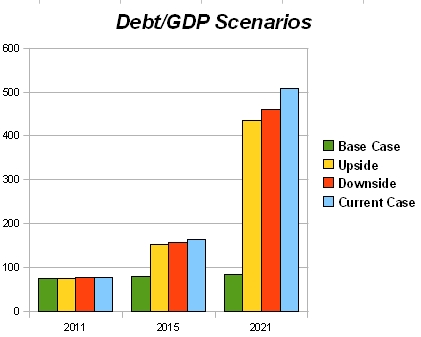
In other words, S&P’s is probably assuming that either GDP will contract $490 million in the second through fourth quarters or the rate of federal borrowing will slow down. Either way, the so-called “double-dip recession” already appears to be baked in the S&P’s cake, assuming that its analysts are as capable of reading the Federal Reserve reports as Karl Denninger is. But that’s not the interesting aspect, from my perspective. What is interesting is the debt/GDP projections under the three future scenarios, Upside, Base Case, and Downside. Consider these projections of future federal debt to GDP ratios:
Where I suspect S&P’s has gone amiss, (and perhaps it had no choice in the matter due to its professional obligations), is by taking the CBO scoring figures seriously and thereby utilizing GDP estimates as the primary variable. Based on my calculations, it is also possible that S&P’s is simply plugging in the 66-year average rate of increase of federal debt, 5.92%, into their spreadsheets. But it isn’t GDP that has changed so drastically over the last three years and significantly modified the debt/GDP ratio, it is the rapid 82.89% increase in the federal debt over the last 11 quarters. If we utilize federal debt as the primary variable and plug them into S&P’s GDP estimates, we get some very different results. (I’m going to ignore the inflation and tax estimates in order to reduce the number of variables; these are estimates for the purpose of critical comparison, not predictive projections.)
The S&P’s GDP estimates are as follows:
UPSIDE: 3% GDP growth + lapsed tax cuts BASE CASE: 3% GDP growth DOWNSIDE: 2.5% GDP growth
However, net GDP growth over the 13 quarters from Q1 2008 to Q2 2011 is $729.9 billion, or 5.1%. That is an annual rate of growth of 1.57% and assumes that overall credit continues to remain flat at $52.6 trillion while federal debt continues to rise at the rate that private debt contracts. Call it the CURRENT CASE. Plugging in 1.57% annual GDP growth and 22.7% annual federal debt growth provides the following debt/GDP ratios if one begins with the firm numbers from the end of year 2010.
CURRENT CASE: 2011 77%, 2015 164%, 2021 509%
And if we substitute actual rates of federal debt growth for the S&P estimates of it that are based on the notoriously unreliable CBO scoring, it becomes very clear that the debt/GDP projections are wildly inaccurate regardless of what rate of GDP growth is assumed and shows that the problem is not one that economic growth can possibly solve. In fact, the revised UPSIDE case which takes historical debt growth into account is much worse than the Base Case that does not.
Notice that while the end of year 2011 figure (actually 76.8%) isn’t much worse than S&P’s is projecting at 74%, it is considerably worse than the DOWNSIDE in 2015 (164% vs 79%) and more than six times as bad in 2021 (509% vs 85%). But are these astronomical ratios even remotely possible? Could federal debt really rise to $26.1 trillion in 2015 from $9.6 trillion at present? After all, that would amount to 39.4% of all U.S. debt outstanding, assuming that the private sectors shrank at the same rate that the federal government sector expanded, and would indicate a Game Over default sometime in between 2016 and 2018.
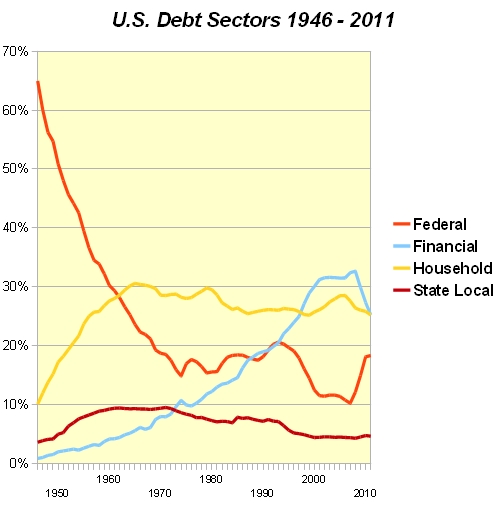
This chart, which shows the historical percentage for each of the major debt sectors since 1946, demonstrates that at least the 2015 rate is clearly within the bounds of possibility. The Federal Government sector represented more than 39.4% of total U.S. debt until 1955. Furthermore, it also shows that the decline of Financial sector debt, which has contracted $3 trillion since 2008 and fallen from 32.7% of the total to 26.8%, could conceivably continue to dwindle away to less than one percent of the total, which would amount to an additional $11.2 trillion in debt-deleveraging that would need to be replaced by federal debt in order to prevent concomitant economic contraction. (It also, by the by, shows very clearly the real source of America’s current economic woes.) Government spending and borrowing is not the root cause of the problem, it is merely a failed attempt to cure the disease of massive private sector debt expansion and contraction.
Now, I am not making any predictions here, other than a general one that because private sector debt will continue to fall, there will be tremendous pressure to continue to increase federal spending and borrowing at rates more similar to that of the last three years than the historical norm. This is because the alternative is an immediate and sizable contraction of GDP. As ugly as it appears, the CURRENT CASE scenario I have outlined is not a worst case scenario because it does not account for the economic contraction I expect to finally begin showing up in the GDP numbers later this year and in 2012. The determining factor will be whether the rate of increase of federal debt is closer to the 22.7% annual rate of 2008-2011 or the 5.9% rate of 1946-2011. Just out of curiosity, I looked at the latter, which in combination with the 1.57% 2008-2011 GDP growth produces the following scenario:
Which of these five scenarios appears to be playing out should be readily apparent by the time the Q4-2011 debt sector numbers are published in the Federal Reserve’s Z1 report. If the Household and Private sectors continue to decline and end-of-year federal debt/GDP is over 75%, then CURRENT CASE is probably in effect.
UPDATE – More like 3 in 3, I would say: “A Standard & Poor’s official says there is a 1 in 3 chance that the U.S. credit rating could be downgraded another notch if conditions erode over the next six to 24 months. The credit rating agency’s managing director, John Chambers, tells ABC’s “This Week” that if the fiscal position of the U.S. deteriorates further, or if political gridlock tightens even more, a further downgrade is possible.”
It is impressive how quickly the Republican Establishment – for whom you know I am said to be the Voice – managed to flip most of the Congressional class of 2010. Remember this when you’re urged to vote Republican in support of small government next fall. Remember this when the Tea Party stalwart tells you that he’s going to Washington to change how things are done there and represent the interests of those who elected him:
The House GOP freshmen were sent to Washington with a mandate from their constituents to rein in spending and put an end to the practice of the federal government borrowing far more than it takes in. But at the end of a furious spending battle that gripped Washington, most of the second coming of the Republican revolution voted for a bipartisan deal that increases the debt ceiling and cuts the deficit, raising the specter of disenchantment and possibly retribution from the activists who propelled them into office last fall.
Some of the tea-party driven supporters will undoubtedly conclude that their freshmen were bought out by the Republican establishment. All told, 59 freshmen voted for the debt bill – two-thirds of the rookie class – and 28 voted against it.
But the freshmen tell a different story of how they came to support the bill, one born out of listening sessions with leadership, an evolution in understanding the economic consequences of a default and opportunities to vote their priorities on the House floor. And, they say, their leadership was able to make them feel enough like valued members that when the time for tough votes came, they were ready to be team players in lending their support.
The Republican establishment has at least 30 years of experience in breaking the freshmen to heel. They did it en masse in 1994 and they’ve done it again now. This is why it is not merely stupid, but by Einstein’s metric, insane, to attempt to change anything by electing Republicans. The Tea Party has to break away and go third party if it is to have any chance at all at reducing government spending.
It probably won’t work that way either, given the changed demographics of the American electorate, but it should be obvious that it is mathematically impossible to effect any meaningful change over time if two-thirds of the “elected revolutionaries” can be successfully suborned within the first year of their taking office.
[W]e don’t have two competing parties in Washington. We have one-party governance, totally unresponsive to the will of the people and the rule of law. Republicans and Democrats represent two wings of the same party – both of which, at the end of the day, don’t really covet a return to constitutionally limited government.
Disaster?
Catastrophe?
Outrage?
Yes, but none of these words even comes close to adequately characterizing the betrayal perpetrated by the Republican establishment in Washington over the last few days.
The era of big government is back with a vengeance – and apparently here to stay.
There are no limits. There are no restraints. There is no accountability. There is no end to red ink as far as the eye can see.
As I have been telling you for ten years, voting Republican will NEVER be a panacea for the cornucopia of ills that have rendered America a revenant. There probably is no panacea, as it is hard to envision any workable solution that does not involve the division of the country into at least three parts. There simply aren’t the votes to “take back America” because too many nominal Americans dislike historical America, disvalue its freedoms and despise its Constitutional values.
And, thanks to the post-1965 influx of third-world immigrants, there will never be the votes. No Hispanic nation, no African nation, no Arabic nation, and very few European nations have EVER placed any value on “the rights of Englishmen” that were asserted in the Declaration of Independence. One need only read the aberrant parodies of the Declaration in the various UN and EU versions or national constitutions to see this is the case. Mere change of geographic location has not sufficed to significantly modify the core philosophies or ideologies, or in many cases, even the national identities of those immigrants.
It is time to pull out of the Republican Party altogether. This may mean that Obama will win a second term if he is not put out to pasture by the Democratic Party elders during the nomination process. This will almost surely mean that there will be no meaningful opposition in Washington to the bi-factional ruling party in 2012 and possibly 2014.
But the complete inability of the Republican Party to do anything of substance, to cut so much as a single dollar from the current amount of spending, means that the “realistic” forty-year strategy of “elect more conservative Republicans” has completely failed. It failed when Reagan was elected. It failed in 1994. It failed when Republicans held the White House and both houses of Congress. It has failed after the 2010 success of the Tea Party. Because it is clear that it is no longer even possible to prevent the bi-factional swan dive from the economic Tarpeian Rock, it is time to shift focus and to begin preparing for the post-mortem rebuilding.