Gamma self-destruction on stage

There was a fair amount of talk about the socio-sexual rank of the candidates early during the campaign at Alpha Game. One of my readers concluded the following about Ted Cruz:

Ted Cruz: Beta, with a bit of Sigma. Seems to be instinctively serving as a lieutenant to Trump in some aspects, by cornering certain voters who won’t warm up to Trump, such as the evangelicals. Has a Sigma streak with his willingness to offend the Democrats and cuckservatives running the Senate, and which seems to have inoculated him against being an Establishment sellout, or at least less than Rubio or Rand Paul. Indeed, he seems to be rising above the less-“offensive” Rubio and Paul, despite Rubio’s backers having spent far more money than Cruz’s.

I was never confident about that, particularly when Cruz refused to accept the role that could very well have led to being Trump’s Vice-President, but instead very stupidly began attacking Trump through a series of legalistic maneuvers that couldn’t possibly influence the ultimate outcome. Some people saw that as Sigma behavior, but I most certainly did not. It struck me more as a delusional Gamma inflicted with the usual Gamma Alpha-hate.

And last night, we got our confirmation when Ted Cruz sperged out in front of the entire nation, struck a classic Noble Sir pose, and revealed himself to be the Gamma of all Gammas, sabotaging himself in a belated and futile, attempt to dethrone the Republican Alpha.

Republicans from all corners of the party scorned Ted Cruz Wednesday night after the Texas senator delivered a speech before the Republican National Convention that not only failed to endorse nominee Donald Trump, but encouraged audience members to not do so if it would violate their “conscience.”

“I think it was awful,” echoed New Jersey governor and Trump-supporter Chris Christie after Cruz’s speech. “And quite frankly, I think it was selfish.”

“For the life of me, I don’t know why he is doing this,” Fox News Channel and conservative talk-radio host Sean Hannity said. “I think there is going to be long-term damage for the party and for him.”

“Trump trusted Ted and was rewarded with a betrayal,” piled on former Arkansas Gov. Mike Huckabee.

Before his speech, some Republicans held out hope that Cruz would succumb to the pressure and endorse Trump. But, when it became clear that he would decline to express support for the GOP nominee, audience members rebelled, loudly booing the once-beloved conservative star until he exited the stage.

“The best unity I saw was everyone booing him off the stage,” Donald Trump Jr. said of the moment during an appearance on Fox News.

And Republicans were apparently not shy about expressing their frustration to Cruz’s face.

CNN reported that some donors were so furious at Cruz they called him a “disgrace” as he tried to enter a suite following his speech. An unnamed state party chair was so angry with the Texas senator that he had to be restrained, the news outlet reported.

Sheldon Adelson, a major Republican Party donor, even denied Cruz entry to his personal suite after his speech, according to CNN and BuzzFeed.

Cruz’s wife, Heidi, also came under verbal assault on the convention floor, with delegates heckling her. She had to be escorted outside by security, according to reports.

Trump, for his part, said Cruz’s speech did not bother him. “Wow, Ted Cruz got booed off the stage, didn’t honor the pledge! I saw his speech two hours early but let him speak anyway,” he tweeted. “No big deal!”

Unbelievable. You can hide your true sociosexual nature, but it is always going to come out sooner or later. As one Twitter wag put it: “I saw a video of a Buddhist monk self-immolate, and Ted Cruz still did it better.”


Trump shows loyalty again

This is one reason why Trump is laying waste to the US political scene. Disloyal, treacherous politicians have never encountered anyone like him.

In other words, a friend and employee screwed up, created a problem, and yet neither of the Trumps threw her under the bus. They had to know from the beginning whose mistake it was, but they refused to identify her. And then they wouldn’t permit her to fall on her sword in her attempt to take full responsibility for her error.

That is more than a leader, that is a teacher.

That being said, I would still look hard into whoever wrote the rick-rolling into the speech. That tends to smack of intentional mischief, perhaps even malice.


They are finally starting to get it

David Frum @davidfrum
Big message of last night: the GOP has decisively turned its back on Bush-Clinton dynastic politics to embrace a Trump dynasty instead

And about time too. Pat Buchanan explains further:

Free-trade globalism was a crucial component of the New World Order, whose creation George H. W. Bush called the new great goal of U.S. foreign policy at the United Nations in October of 1991.

Bush II and Jeb are also free-trade zealots.

But when the American people discovered that the export of their factories and jobs to low-wage countries, and sinking salaries, were the going price of globalism, they rebelled, turned to Trump, and voted for him to put America first again.

Does anyone think that if Trump loses, we are going back to Davos-Dubai ideology, and Barack Obama’s Trans-Pacific Partnership is our future? Even Hillary Clinton has gotten the message and dumped TPP.

Economic nationalism is the future.

The only remaining question is how many trade deficits shall America endure, and how many defeats shall the Republican Party suffer, before it formally renounces the free-trade fanaticism that has held it in thrall.

The Bush idea of remaking America into a more ethnically, culturally, diverse nation through mass immigration, rooted in an egalitarian ideology, also appears to be yesterday’s enthusiasm.

Diversity is dead. Multiculturalism is dead. Globocop is dead. Globalism and free trade are terminal. Mass migration is on its last legs. Most importantly, nationalism is on the rise and hasn’t even begun to crescendo.

Stay angry, friends. Stand firm. Give them no quarter or respite, for they will give you none.


RNC: Iowa and Colorado leave in huff

I’m not even going to pretend to be following this, but apparently Ted Cruz’s gang is still butthurt or something.

Iowa and Colorado delegations have left RNC convention. Will not return

Of course, the Colorado “delegation” is the one that wasn’t elected, so it’s a little ironic they’re upset about Trump’s team running a rules game on them. Strategic geniuses, those guys.

This is an open thread to discuss the Republican National Convention.


Cantoring Paul Ryan

The most dishonest politician in America faces being upset in his home district:

Following a new primary election poll showing that House Speaker Paul Ryan has plummeted to well below 50 percent in his home district, Ryan is out with new mailers assuring Wisconsin voters of his desire to secure the border, and urging them to support him in his contentious August 9th primary election.

The new mailers touting Ryan’s support for border security is interesting given that just last year, Ryan championed a spending bill that fully funded President Obama’s open borders agenda– including funding sanctuary cities, executive amnesty, and the release of criminal aliens. The mailers also come amid new reports indicating that, one month after his election, Ryan plans to bring up “criminal sentencing” measures that could release thousands of criminal illegal aliens from prison onto the streets.

“Keeping America safe is a big job. And it’s the most important one there is,” the Ryan mailer reads. “Protect our Homeland— that means securing the border, confronting Islamic Terrorism, and tackling new threats by stopping them from reaching our shores… Paul Ryan for U.S. Congress… Vote Tuesday, August 9th”

However, new reports indicate that immediately following his primary election, Speaker Ryan plans to bring up legislation that could release thousands of criminal illegal aliens from prison and into American communities.

As Roll Call reports, “The House will take up legislation to overhaul the criminal justice system in September, Speaker Paul D. Ryan said.”

I’ll be very disappointed in the people of Wisconsin if they fall for this cuckservative charlatan’s faux change-of-direction on immigration. Paul Ryan is the most dishonest politician in America since Bill Clinton hung up his quivering lower lip.


A terrible candidate

Even the mainstream media is beginning to admit that Hillary Clinton is an almost exceptionally horrible candidate:

With a toxic cloud hanging over Clinton’s makeshift campaign office at the Radisson hotel in Manchester, Clinton’s chief speechwriter, Dan Schwerin, and her top policy adviser, Jake Sullivan, decamped for Sullivan’s mother-in-law’s house in the Seacoast town of New Castle to rethink the entire campaign’s approach.

There, huddled together in the February snow, they scrapped her spaghetti-on-the-wall policy approach and came up with a sturdy slogan that aimed to capture the historic nature of her candidacy while making a pitch to African-American and Hispanic voters: “Breaking Down Barriers.”

There was just one problem: Their candidate hated it.

“This is useless,” a frustrated Clinton vented when Schwerin and Sullivan — two of her longest-serving aides — presented the new plan to her that glum Tuesday morning of Feb. 9 in her Manchester hotel suite.

The feeling was mutual. Her staff admired her attention to detail, but knew she was often her own worst enemy. Clinton is known for taking a draft of a speech and changing it some indelible way to make it more literal and less readable. (The joke at her Brooklyn campaign headquarters is that she would take the public safety slogan “If You See Something, Say Something,” and, in her literal-minded way, change it to say, “If You See Something, Alert the Proper Authorities.”)

The entire episode illustrated Clinton’s paradox: On the one hand, she’s a deeply involved candidate who trusts her own instincts. But on the other, she still struggles, after all these years, when it comes to messaging — and remains almost hostile to the idea of a narrative that Barack Obama, Bernie Sanders, Elizabeth Warren and even Donald Trump seem to craft so naturally.

Her best campaign strategy is to go into hiding until November and hope that the Democratic demographics do the job for her. It’s not a good sign when even your campaign staff are joking about how clueless and inept you are.

Interviews with more than half a dozen Clinton allies inside and outside her campaign reveal a candidate who remains deeply insecure when trying to commit to a message about her campaign, and reluctant to indulge in the rhetorical flourishes that make for the rousing poetry of campaigns.

Of course she’s deeply insecure. She’s never achieved one single damn thing on her own. She couldn’t even manage to keep her husband faithful.


Reality bites Democrats

Democrats are starting to realize that they’ve lined up behind a terrible candidate:

Nervous Senate Democrats raised concerns with Hillary Clinton during a private meeting in the Capitol Thursday over a recent poll showing Donald Trump leading or tied in several battleground states.

“Some people were freaked out, they were looking down at the polls on Real Clear Politics and asking why it was so close,” said a Democratic senator who attended the meeting, referring to a website lawmakers were checking out on their personal devices.

Clinton’s response? “She said there are other issues. People are unhappy and they don’t trust institutions,” the senator explained.

A second Democratic source in the meeting confirmed there was “a mention of the Florida poll.”

A Quinnipiac University poll released this week showed the presumptive GOP presidential nominee up 42 percent to 39 percent in swing-state Florida. Clinton had an 8-point lead in Quinnipiac’s poll of the state last month.

The same survey showed Trump ahead 2 points in Pennsylvania, another big swing state, and tied in Ohio. The three states have been pivotal in the last four presidential elections.

The source emphasized that no one suggested that Clinton wasn’t running a strong race or questioned her performance.

Instead, it was an acknowledgement that the presidential race will be very close even though many Washington-based strategists and pundits across the ideological spectrum question Trump’s seriousness as a candidate.

“There was concern raised about the race because we know it’s going to be a close race,” said the source.

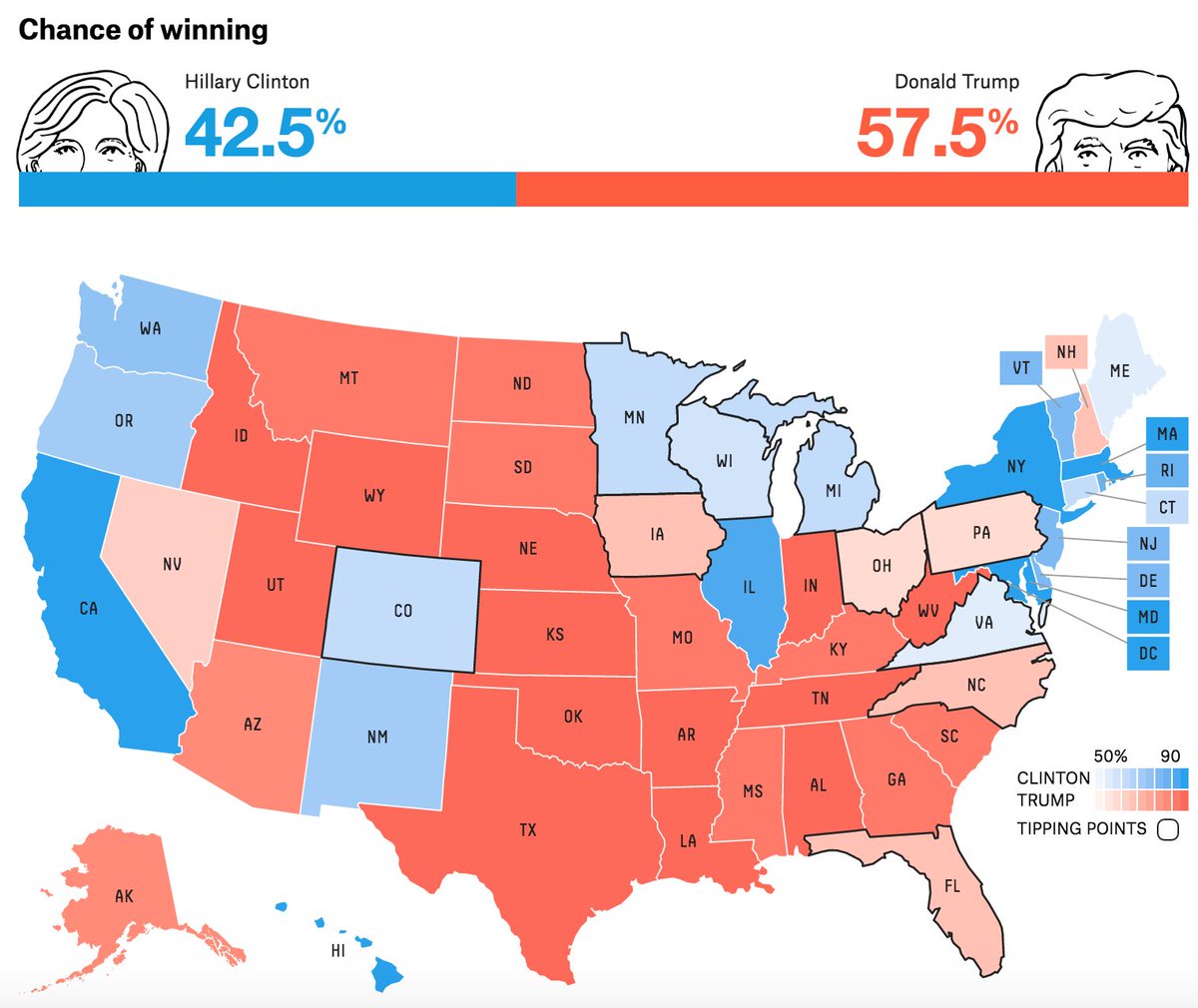
I’ve predicted a Trumpslide rather than a close race. The predictions here have varied tremendously, with expert number-cruncher dh seeing an easy Clinton win, and virtually everything else in between.

  • SciVo: Trump 352
  • dh: Clinton 307, Trump 231
  • EscapeVelocity: Trump 270 to 280

What will happen will happen, regardless of what any of us think. But here is my explanation for why the analysis of the usual numbers don’t matter. One, it is too early for them to be relevant. At this stage, Leave was far behind Remain in the #Brexit referendum. At this stage, Dukakis was 17 points ahead of Bush. So, the number crunchers will almost surely change their tune as the numbers change.

Two, the candidates’ actions and world events will affect the numbers. Both these trends favor Trump. What is Hillary going to do to Trump that will reduce his appeal, versus what Trump is going to do to her? And what events are going to take place around the world that will enhance Hillary’s appeal versus Trump’s, especially when Hillary is going around saying things like this as entire families are being wiped out in France by Muslims.

All Trump has to do is relentlessly quote Hillary on about a dozen different subjects and he’ll win. As for those who say my political predictions are uniformly bad or that I am out of the US political prediction business, let me point out four things.

  • I make my predictions very early. I don’t wait until it is obvious. Where is the fun in that?
  • I called #Brexit correctly
  • I called Trump being the Republican nominee correctly
  • The US presidential election is not about US politics this year.

Trump picks Pence

I don’t know much about Indiana governor Mike Pence, so I don’t have an opinion on this. The big question is what his voting record on immigration is. I expect he’s probably fine on guns and so forth.

UPDATE: He looks pretty damned good.

1. He Wanted To Report & Deport Undocumented People In The Hospital

In 2004, then-Senator Pence voted for Undocumented Alien Emergency Medical Assistance Amendments Bill HR 3722, which would have required hospitals to gather and report information on possible undocumented patients before hospitals could be reimbursed for treating them. The bill would have also stated that hospitals wouldn’t be required to provide care to undocumented people if they could be transported to their home country (AKA deported while they’re in the hospital) without a “significant chance” of their condition getting worse. Luckily, the bill failed.

2. He’s Rated 100% By FAIR

The very conservative Federation for American Immigration Reform (FAIR) is a national, non-profit, public interest membership organization that seeks to “improve” border security and stop illegal immigration. A 100 percent rating from them is a like a stamp of approval that Pence is throughly anti-immigration.

Other than his criticism of Trump’s proposed Muslim ban, he appears to be about as strongly anti-immigration as an elected Republican gets. He even “ordered state agencies to suspend the relocation of any more Syrian refugees to Indiana.”

UPDATE: Announcement postponed due to the latest Muslim mass murder in France.


Trump makes up the gap

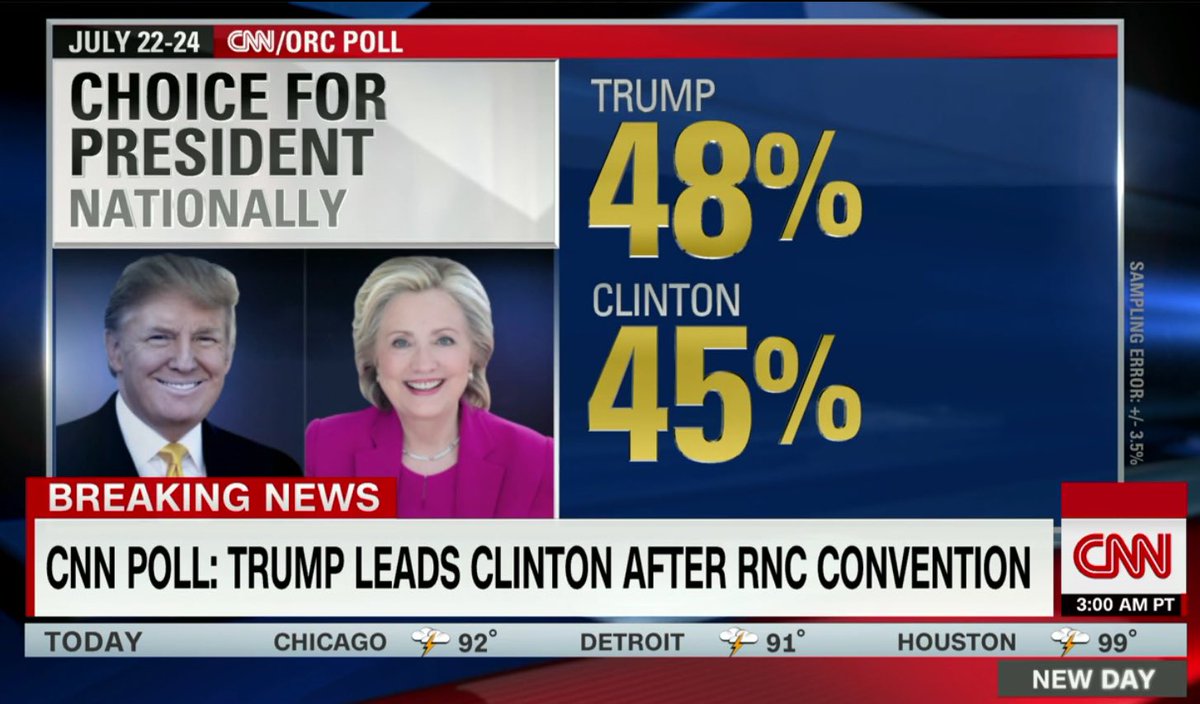
He hasn’t even begun campaigning in earnest against Crooked Hillary Clinton and already Donald Trump is poised to take the swing states:

With a drop in grades on honesty and moral standards, Democrat Hillary Clinton loses an 8-point lead over Republican Donald Trump in Florida, and finds herself in too-close-to-call races in the three critical swing states of Florida, Ohio and Pennsylvania, according to a Quinnipiac University Swing State Poll released today.

Clinton loses ground on almost every measure from a June 21 survey by the independent Quinnipiac (KWIN-uh-pe-ack) University. The Swing State Poll focuses on Florida, Ohio and Pennsylvania because since 1960 no candidate has won the presidential race without taking at least two of these three states.

The presidential matchups show:

  •     Florida – Trump at 42 percent to Clinton’s 39, compared to a 47 – 39 percent Clinton lead June 21;
  •     Ohio – Clinton and Trump tied 41 – 41 percent, compared to a 40 – 40 percent tie June 21;
  •     Pennsylvania – Trump at 43 percent to Clinton’s 41 percent, compared to June 21, when Clinton had 42 percent to Trump’s 41 percent. With third party candidates in the race, results are:
  •     Florida – Trump leads Clinton 41 – 36 percent, with 7 percent for Libertarian Gary Johnson and 4 percent for Green Party candidate Jill Stein;
  •     Ohio – Trump at 37 percent to Clinton’s 36 percent, with Johnson at 7 percent and Stein at 6 percent;
  •     Pennsylvania – Trump over Clinton 40 – 34 percent with 9 percent for Johnson and 3 percent for Stein.

“Donald Trump enters the Republican Convention on a small roll in the three most important swing states in the country. He has wiped out Hillary Clinton’s lead in Florida; is on the upside of too-close to call races in Florida and Pennsylvania and is locked in a dead heat in Ohio,” said Peter A. Brown, assistant director of the Quinnipiac University Poll.

Remember, you heard predictions of a Trumpslide here first. Trump isn’t merely going to win, he’s going to win big because Crooked Hillary is a spectacularly bad candidate, and the chances that she’s going to survive the inevitable presidential debates intact are slim at best.

Scott Adams concurs:

The new Quinnipiac poll shows Trump now leading in 4-out-of-5 battleground states. Most of the polling was done before the FBI announced its email server decision. Do you know what else was happening during that time to influence polls?

Answer: Nothing

In other words, Trump didn’t do anything outrageous for a few weeks. That’s all he needs to do from here on out – more nothing – to win in a landslide. The “Crooked Hillary” harpoon he landed a few months ago is bleeding her out. Trump’s glide path to victory involves picking his cabinet and acting serious for a few months. That’s all it will take.


Democracy debate part 1

Konrad Razumovsky challenged me to a debate in response to my contention that direct democracy is superior to representative democracy. This is his initial statement.

“My opinion, as I have previously expressed, is that the problems of “mob rule” of which the Founders so famously warned have proven to be considerably fewer and less problematic than the problems of establishing a political elite that uses the illusion of democratic approval as a protective shield. Now that technology makes it viable for larger polities, direct democracy is a moral imperative in any society with a government that is justified by the will of the people.”
—Vox Day

For the purposes of this, I am using a slightly modified version of the definition of democracy from Merriam-Webster: a democracy is “a form of government in which the people choose leaders, or specific laws, by voting”.

I do grant, and cannot reasonably dispute the following: one, representative democracies or democratic republics do limit the impact of the will of the people, by intention or accident is irrelevant; two, the most dangerous thing for a nation, in the long run, is a political elite which is divorced from the common man, a political elite who believe they are justified and also able to sell their chicanery to said common man with a gross misrepresentation of the intent of a particular government; third—and finally, technology does many exceptional things, with respect to man’s ability to influence his condition including the methods by which government can be built.  That said, I have no real issue with direct democracy in theory, or in practice, but I am forced to dispute the implicit claim that a democracy is an appropriate form of government for a larger scale polity, with or without technological intervention and irrespective of its moral gravity.  That is to say that a direct democracy has a number of internal issues which render it ineffective, if not outright detrimental, to a civilization of a certain size.  Briefly, these are: one, no amount of technological development is equal to the task of preventing the poor use thereof; two, democracies derive their legitimacy from the collective people of the nation, which would be fine if governments existed to care for the people, which they do not; three, economics applies to voting just as much as everything else; fourth—and finally, though mob rule is, indeed, a historical falsity, something very similar to it does exist and is exactly the thing which placed the silly political elite into power in the current era.  There will then need to be some minor legwork done on historic democracies to determine if the theoretical framework matches the practice.

While it must be admitted by all reasonable men that modern information based technology has certainly made it possible for a democracy to function on a scale significantly larger than previously possible, in terms of both geography and population, these advances do little to address the frailty of the ballot box.  In the more traditional rendition of a democracy, there are legions of little vote counters who, being human, can each be induced by their own ideologies or the machinations of others to forget or misplace certain votes; there are instances of the dearly departed or even pets casting votes; and there is one supreme holder of the ballots who could, were he so inclined, read a different name than the one at the top of the chart.  I freely admit that technology removes the human element from these scenarios, the vote counters are machines who are incorruptible by their own bias and cannot be blackmailed; a machine is compelled to follow its programming regarding the necessary certification that a particular voter is eligible to cast such a vote, thereby reducing the rate at which Spot or Aunt Mildred interferes with mortal affairs; and a machine is honest about who is where on the final printout. 


All of this rests on the assumption that the machine(s) administering the vote enjoy a state of being free of that kind of harassment designed to cause a shift in the eventual outcome of the vote being so administered.  Obviously, direct and physical tampering with these Democratic Servers is undesirable, so steps must be taken to remove the possibility of such.  I see two feasible solutions: one, the voting process may be moved entirely to the cloud, divorcing it from a physical existence; or two, the physical Democratic Servers must be fiercely protected against intrusions.  The problem with the first is that everyone on the planet would have access to the voting system, regardless of the level of authentication required to vote, a machine is only a machine—it is easily fooled by anyone with sufficient knowledge of the systems which compose it.  In other words, the account security for these voting systems would need to be impregnable, not only from foreign agents, but also from those running for office.  Due to the grand and illustrious history of impregnable vaults being busted, unsinkable ships being sunk, irrefutable evidence being refuted, and unstoppable armies being crushed, it strikes me as a point of absurdity to assume that any such system built today will last any serious amount of time.

The solution to this seems simple enough: just appoint a certain group, a set of experts—if you will, to continually update the security protocols.  Of course, this puts the entire democracy at the mercy of these programmers for its integrity, which undermines the entire point of a democracy in the first place, in that the government is derived by the will of the people.  We would be better off simply making the computer programmers the oligarchs of the new world order from the get-go to avoid all of the inevitable build up to that point.  Which leaves the second option: defending the physical counting machine.  This is also a doomed scenario because the defenders of the machine become like the programmers in the first scenario, able to unaccountably pick and choose what inputs the machine receives thereby determining the outcome.  Ultimately, this is not a new problem: every democratic system, above a certain size, will have a praetorian guard of some sort.  None of which is meant to say that technology has no place in a democracy, simply that technology does not solve the problem of the concentration of political power into the hands of a few over time.  So, to put a finer point on it, technology does not preclude in any way, shape, or form the establishment of a political elite who use the illusion of democratic approval as a protective shield, either as the wielders of legislative or executive powers.

Strip away every piece of government and political theory, until the very first portion of it is obvious, and we will see that government cares precisely not at all about the people under it because they are not its purpose and concern, in the West at any rate.  This singular purpose is the recording of property beyond that which is unquestionably within an arbitrary individual’s control.  Indeed, the entire function of government is to provide the threat of violence necessary to keep the integrity of property lines.  I could go into considerable detail regarding this facet of government, but this is neither the time nor the place for that.  Suffice it to say that physical property which is too large to conveniently command as an extension of oneself is the thing which demands the fomentation of a government of any variety.  To put it bluntly, a democracy, even if that democracy functions perfectly, places political power in the hands of all living members of a particular society regardless of their standing in terms of property which requires the existence of a government.  If all members of this democracy share a portion of this property, there is no problem as each member of the democracy ultimately has the same interest: the protection of the integrity of property as defined by the legal code enacted by this democracy; if only some members of the democracy enjoy the privileges of property ownership, then there becomes a schism in the end goals of the populace due to one group having property and the other not.  In times past, I would probably feel compelled to simply dismiss this schism as the product of the basest portions of human nature and therefore an ignorable affliction in an enlightened society, however, the past few decades serve as ample evidence that even the mightiest and most careful cultures can be brought low.  The moral standing of property envy is irrelevant at this point, it exists and must be countenanced and thwarted in some more robust manner than an appeal to fragile culture.  Until such a time as men become wholly divorced from their envy and petty jealousies, such that those without strive to achieve the same status as those who by grace have instead of simply using any and all possible leverage—including the use of government force—to deprive the latter group from their holdings, allowing such men, those who do not bear some interest in the ultimate good of the nation—and, by extension, the weight of property, dilutes or undermines the ultimate point of the establishment of a government in the first place.  Therefore, a democracy will eventually destroy itself.

Economics, the study of rational choice, is most assuredly a matter of concern for the democrat, simply because it is the ideal means by which men do their voting.  Obviously, the hope is for every voting member of a democracy to make his choices rationally, but the decision to vote is, itself, subject to a rational tradeoff.  It is a common observation that a vote in a democracy above a certain size is functionally useless.  A single vote in a nation of one hundred is worth considerably more than a single vote in a country of millions.  Granted, technological advances can make the costs associated with voting, leaving work early, time consumed casting the ballot, among others, much smaller but does little to ensure that a particular vote is actually worth casting in the grander sense.  Consider California, where it is not uncommon to find men of the right choosing not to vote simply because there is no point in doing so.  The analysis by these men is a simple one: there is a significant number of individuals within the State of California, to the point where an individual vote is insignificant, and the vast majority of Californians simply disagree with these right leaning voters.  A callous solution would be to instruct these people to move elsewhere, where their neighbors tend to agree with them, but this is an implicit admission that the discrete vote matters not at all.  Were the large scale democrat to admit that his ideology necessarily ignores the trees for the forest, I would have considerably less of a problem with the whole system of thought as the link between an increase in large scale democracy and the decline of individual rights could be more adequately documented and discussed.  To put it in a slightly more direct way, if a democracy exceeds a certain population threshold, then the democracy ceases to be able to effectively operate in a manner which is consistent with classically liberal thought.

Mob rule, or the tyranny of the majority, does not exist, in any meaningful form, but its close cousin, let’s call it the tyranny of geography, does.  For example, communities on the edge of the ocean have considerably different concerns than the community on a mountainside.  It would be unreasonable to expect the mountainside community to build houses on stilts to avoid tidal flooding, and the seaside community to have steeply sloped roofs to more effectively shed snowfall.  Such dichotomies can be found everywhere, with certain areas developing a particular solution to a problem which does not exist elsewhere.  Now, geography and climate can certainly cause people to behave differently discretely, but it has not been established that this would impair the ability of the aggregate of such localities to enact an effective democracy.  Indeed, if the total population of the seaside community and the mountainside community are virtually equivalent, then neither party would be able to force every house to have stilts or steep rooves, instead getting what seems not disagreeable to both.  The only problem is that such an arrangement simply does not happen in reality.  Let us examine New York State.  There is a collection of a few cities along the coast which dominate the entire policy of the state despite the rest of the state being of precisely the opposite political affiliation.  In other words, a concentration of people, brought about by geographic concerns, such as the suitability of a particular place to function as a port or commerce hub, may very well have certain governmental needs which do not exist outside of the densely populated areas, a governmental solution which could very easily eliminate the livelihood of these rural or suburban communities, and a democracy places complete authority over these potentially suffocating policies in the hands of those who choose to live in hyper concentrated areas without providing ser
ious recourse to those in the boonies.  In a democracy, cities warp the political landscape to their own benefit, sometimes costing the smaller and more numerous communities which share its jurisdiction greatly.  If the wholesale ruination of the nonurban is permissible, then a democracy with a large footprint is acceptable; if not, then democracy must be limited in geographic size.

To briefly reiterate, a successful democracy would be fairly small in size and scale, encompassing a small area geographically and inhabited by a certain, relatively low, number of residents.  Bold claims to be sure, but not without historic precedence: I would draw your attention to both the Iceni tribes of pre-Roman Britain and the Her Majesty’s Privateers of the colonial era.  Both cases are successful democracies, successful in that they enjoyed social stability and developed cultures which further lubricated the systems put in place, with the community placing authority in an individual, either chief or captain, whose concern ensured that the democracy as a whole was benefited.  Should this figure of authority be found wanting, he did not have armies at his disposal to put down a vote of no confidence because his army consisted of his neighbors and friends who had a real interest in the good of the community as a whole.  In short, if the chief or captain failed to perform their duties in an acceptable manner to the people of the democracy, then removing them was an almost trivial matter: the army which did the removing was the army who followed his orders was the people who did the voting.  Of course, these examples merely show that a democracy does work on a local level but fails to evidence an inability of the system to meet the needs of a larger populace, in terms of both raw numbers and territory.  For this, we should investigate the history of Athens which, after having demonstrated its superiority in every possible field to its harshest critic—Plato, quietly fell apart due to internal issues between the various voting groups as these groups matured past their nascence within a few generations.

None of which quite addresses the most obvious point of a pure democracy: the laws or leaders enjoying the vote.  How precisely does the leader enact his will?  If historic trends are any indication, then a democracy is simply a form of government used to legitimize a dictator.  Does the democracy then choose to be of the form where every proposed law is voted on by the general populace?  If so, then one of two eventualities arise, either: one, the populace appoints, presumably by democratic means, a body of persons who propose laws, which is the establishment of a political elite who are naturally compelled to use their power for their own purposes; or, the laws are crowdsourced in some fashion, which would probably result in charming little laws akin to the naming of certain Antarctic Icebreakers.

All of these issues combined, or any one of them—really, is sufficient to fully dissuade the serious political philosopher from accepting democracy as some great panacea for the ills of society.  There is a place for democracy, to be sure—as it is very good at what it does under the appropriate circumstances, but its structural integrity is built solely upon its locality.  If a democracy reigns supreme over too large an expanse of people or places, then it will eventually destroy the very livelihood of those different people and places simply due to the nature of the thing.  This is an observation noted by the Founders, and was solved in their day by establishing requirements beyond that of mere life for voters and building the United States Senate upon the legislatures of the various states.  In fact, there was a little war fought over how ineffective these precautions were in thwarting the tendencies of democracies from 1861 to 1865, with numerous potential solutions being offered by one of the sides in that conflict.  More than any other factor, the spread of the belief of the justness of a pure and true democracy has contributed to the decline which is now so apparent throughout the West.  Insisting that more of the same is the solution is to argue that the United States, and nations like it, should cease to be one nation; a perfectly acceptable assertion, to be sure, but very different from the initial conceit of an objectively superior form of government for a nation of any serious size whose government derives its legitimacy from the will of the people.

I will post my response here sometime in the coming weeks, but I will note that Konrad appears to have completely missed the target by attacking the concept of democracy itself instead of defending the superiority of representative democracy to direct democracy. I have no intention whatsoever of defending the core concept of democracy itself, as my argument is neither theoretical nor idealistic in nature, but entirely practical, eminently possible, and directly relevant to the present political situation.