THE TSURUGISAN SCROLL

THE SECRETS OF THE SACRED MOUNTAIN

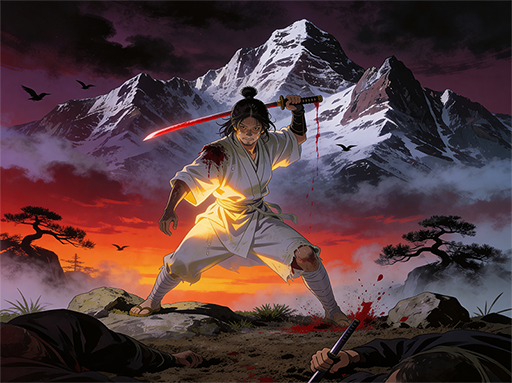
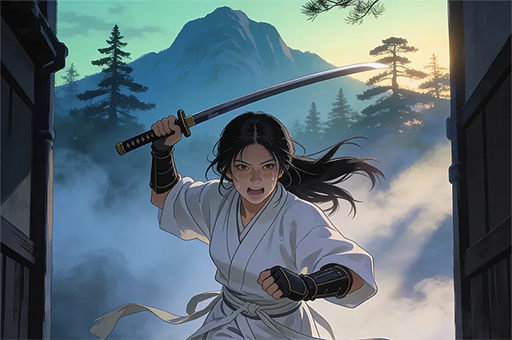
The fifth book of The Secret Scrolls of Naruto arrives at last in the place toward which the entire pursuit has been driving — the forbidden domain of Awa on the island of Shikoku, and the sacred mountain that rises at its heart. From a midnight leap into a storm-driven sea at the close of the fourth volume, Norizuki Gennojō and the woman he has vowed to see safely to her father wash ashore on a coast where outsiders are not permitted to live. They climb inland in the white robes of pilgrims, and behind them follow the three men who have hunted them across half a country.

In Tokushima Castle, the lord of Awa is at the height of his confidence. The fevers and dark humors that nearly broke him in the previous volume have lifted; his face is burned dark by the salt wind; his fortifications are complete and his powder stores are full. The signal fire that will summon the western lords and the noble houses of Kyoto to the cause against the Tokugawa is ready to be lit. The omens, Hachisuka Shigeyoshi tells himself, are good. He does not know that the two enemies who escaped him on the night of the storm are at this moment climbing toward Tsurugisan — Sword Mountain, where his oldest secret is held in a stone cave, and where every ridge and footpath is watched by the harashi, the silent rustic warriors of Awa who answer to a master no one has ever seen.

Gennojō climbs the mountain to recover what the storm took from him. Otsuna climbs to find a father she has not seen since childhood. The three samurai who hunt them climb because they must finish the work they began on the docks of Osaka. And somewhere above them all is a secret that will shake the Shogunate.

The Tsurugisan Scroll is the fifth book in the first English translation of Yoshikawa Eiji’s Naruto Hichō, the century-old serial that made him the most widely read author in Japanese history. Translated in literary prose that reads as though it were originally composed in English, it brings Yoshikawa’s great adventure into the sealed mountain country where the villains and the hero are at last in the same dark territory, and where the secret the conspirators have killed to protect now lies within reach.

Available for Kindle, KU, and audiobook on Amazon. The ebooks have already been sent out to the paid subscribers.

DISCUSS ON SG


THE FUNAJI SCROLL

As the fifth release in Castalia Libraria’s weekly translation schedule, we have published the first-ever English translation of THE SECRET SCROLLS OF NARUTO: The Funaji Scroll, by Yoshikawa Eiji, who is best-known in the West as the author of MUSASHI. The ebook has already been sent out to the paid subscribers. THE FUNAJI SCROLL is now available on Amazon Kindle, KU, and audiobook.

SAMURAI SWORDS AT SEA

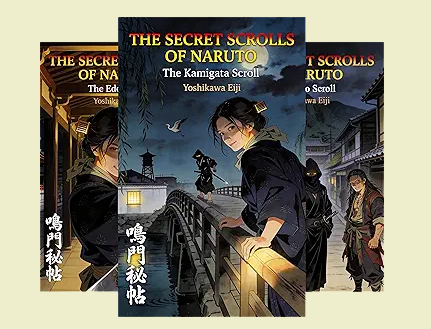
The fourth book of The Secret Scrolls of Naruto brings the pursuit at last to the seas of Japan. What was sworn on a hilltop in Osaka at the close of the first volume, Norizuki Gennojō’s vow to cross the Kitan Strait and follow the lord of Awa’s great ship home, becomes the central action of the fourth volume of the series. From the dockside battle of The Kamigata Scroll, through the urban underground of The Edo Scroll and the mountain passes of The Kiso Scroll, the whole of Yoshikawa’s great adventure has been building toward the all-important crossing into the sealed domain on Shikoku.

In Osaka, Gennojō and the woman he has vowed to see safely to Awa scheme their way aboard a merchant vessel bound for the forbidden domain. In Tokushima Castle, the lord of Awa paces his watchtower on the verge of collapse, his nerves worn raw by the weight of a conspiracy against the shogunate that cannot afford to be exposed. And between them, the three villains of the preceding volumes — Ojūya Magobei, Tendō Ikkaku, and Tabikawa Shūma — close at last on the quarry they have hunted from the canals of Osaka to the mountains of Shinano. Parallel threads of love and betrayal converge on a single ship, and when a sudden storm breaks over the Kitan Strait, the long pursuit comes to a reckoning that neither hunter nor hunted could ever have foreseen.

The Funaji Scroll is the fourth book in the first English translation of Yoshikawa Eiji’s Naruto Hichō, the century-old serial that made him the most widely read author in Japanese history. Translated in literary prose that reads as though it were originally composed in English, it continues the definitive English edition of the novel that created the modern Japanese adventure genre.

DISCUSS ON SG


Even Nukes Don’t Win Air Wars

Larry Johnson points out the historical failure of a much more intense air war on Japan and its consequences for the probable failure of the Epstein Alliance’s war on Iran:

Anyone who thinks a massive bombing campaign will compel the Iranians to surrender and dump the mullahs, does not know the history of Japan, the United States and the Soviet Union in 1945. The US bombing of Japan started in earnest in March 1945 and continued through August 8, 1945. The conventional bombing killed an estimated 500,000 Japanese — mostly civilians. The atomic bombs dropped on Hiroshima and Nagasaki in August added as many as 226,000 to that macabre sum. Yet, it was not the bombings alone that prodded Japan to surrender… It was the Soviet entry into the war that forced Japan to surrender.

In doing this comparison, consider this: Iran is almost 5 times the geographic size of Japan, and Iran has 91 million people compared to Japan’s population in January 1945, which was an estimated 72 million.

Not only that, but the Japanese had been actively trying to surrender for six months before Hiroshima. Iran, on the other hand, has made it very clear that the US and Israeli militaries can kill as many mullahs and generals as they like and it won’t even slow down the Iranian missile onslaught.

The best thing Trump can do is declare victory and exit the Middle East. Israel is not the USA’s responsibility, defending it is not in the US national interest, and regardless of what happens, it will be much less of a problem if the USA stops funding it. The fever dreams of the Greater Israel Zionists is what caused this war, and Americans are no more concerned about the Zionists being wiped out than they were about the Nazis being wiped out.

Zionist != Israeli. Israel does have a right to exist, but so do the Palestinians and the Arab tribes. Israel has absolutely no right to the so-called “Greater Israel” which is far more expansive than any amount of Middle Eastern territory ever controlled by an Israeli or Judean king.

But appeals to historical claims are irrelevant. Iran is not going to surrender and Iran is not going to stop bombarding both Israel and US bases until its demands are met. The short fake Trump should be offering Iran a deal it can’t afford to pass up, not simultaneously declaring victory and crying for help from the Swiss Navy.

DISCUSS ON SG


Mo Soseki もっと良い

Castalia House has published an original new translation of Botchan by Natsume Sōseki, in case Japanese literature happens to be of any interest to you.

“I have been reckless since the day I was born…”

So begins one of the funniest and most beloved novels in Japanese literature. Published in 1906, Natsume Soseki’s Botchan has never gone out of print, never lost its bite, and never stopped making readers laugh.

Fresh out of school with no ambitions, no money, and no talent for diplomacy, Botchan accepts a teaching post at a middle school in rural Shikoku and immediately regrets it. The students are savages. The headmaster is a windbag. His colleagues are a gallery of petty conspirators he can only keep straight by the nicknames he invents for them: Red Shirt, Clown, Porcupine, the Pale Squash. The only person in the world who believes in him is Kiyo, the old family servant back in Tokyo who still calls him “Botchan” (young master) and waits for him to come home.

Botchan has no filter, no patience, and no reverse gear. He says what he thinks, picks fights he can’t win, and keeps a running tally of every slight. He is also, beneath the bluster, deeply loyal, quietly heartbroken, and funnier than he knows.

This new translation by Kenji Weaver, whose acclaimed translation of Soseki’s Kokoro introduced a new generation of English readers to Japan’s greatest novelist of the Meiji era, captures the novel’s headlong energy and deadpan comedy in crisp, natural English.

UPDATE: Fandom Pulse has a nice article about the recent release of Botchan.

DISCUSS ON SG


When History Rhymes

I don’t know if Big Serge intended this post about Japan’s general strategy in the lead-up to WWII, or rather, the obvious lack of it, to be a warning relevant to the current situation facing the United States, but it’s educational regardless.

This is not a history of the Second Sino-Japanese War. For our purposes, however, three vital threads emerge from the beginning of that conflict. First, that the Japanese incorrectly anticipated a quick victory in northern China, after which they would begin to digest the region’s economic resources. Secondly, the rapid and unexpected expansion of the fighting in China created an enormous drain on Japanese resources which led directly to the economic pressures which created the Pacific War. Third, that same resource crunch sparked and escalated the inter-service disagreements and factionalism which characterized Japanese leadership throughout the war.

In the context of Japan’s larger imperial ambitions and strategy, it is difficult to imagine a more severe backfire than the decision to launch into northern China in 1937. Japanese planners initially hoped for a quick and decisive victory using limited forces. In July 1937, Army operational plans sketched out an offensive using just three divisions which were expected to overrun the Beijing area and crush the enemy’s main forces, at which point Chiang Kai-shek was expected to sue for peace. The idea that Chiang might still be in the field, fighting, even after the loss of both Shanghai and his capital at Nanking was unthinkable, but that is precisely what happened.

The natural result, therefore, was rapid and massive escalation of Japanese resource commitments in China as the war spilled its banks. The optimistic initial estimates – three divisions, three months, and a total cost of just 100 million yen – were swept aside, and the Japanese General Staff found itself preparing to mobilize the entire army for action on an indefinite timetable. Three divisions became twenty; 100 million yen became 2.5 billion.

The ballooning demands of the field army in China pushed Japan into a bona fide economic crisis. Tokyo initially hoped that the field army could finish the fight on those materials that had already been stockpiled in the theater, but these had been exhausted by the end of 1937, with no end to the conflict in sight. Munition and fuel stocks in China were on empty, but that was not all. Even the munitions stocks in Japan were barely sufficient to supply ongoing operations in China, which meant that a Soviet attack on Manchuria – a longstanding and ever present Japanese fear – could quickly create a critical situation.

In short, the stubborn refusal by Chiang to simply collapse and sue for terms as expected had created an enormous resource sink which forced Japan into a full war economy in a state of near crisis. Most disconcertingly, the only way for Japan to make up the critical shortfalls in key materials – above all fuels of all types – was by massively increasing imports from the United States.

The USA has already engaged in one attack on Iran. It appears now about to engage in a second one, this time with Russian and Chinese ships at the other end of the gulf. At the same time, it also has a weakening economy and an excessive dependence upon imports as well as foreign debt.

And, as I’ve already pointed out, in industrial terms, the USA is to China what Japan was to the USA in 1940…

DISCUSS ON SG


The Translation Process

If you’re looking for a reason why you should subscribe to Castalia Library, the possibility, indeed, the growing probability that my translation of Genji Monogatari may turn out to be the best available in English is something that you might want to consider. One of the reasons for translating various short stories such as Hokusai and the Ghost from Japanese, and translating A Throne of Bones and Death and the Devil into Japanese, was to iteratively improve our processes in order to produce a better, higher-quality translation of Genji.

And so while it was surprising to learn that the subscribers preferred our first attempt at translating Genji by a significant margin, it’s even more surprising that an impartial judge is beginning to conclude that our chapter-by-chapter translations are literally reaching unprecedented heights. Consider the recent comparative review of Chapter 27, Kagaribi.

Vox Day — 94: Best overall balance of:

  • sensual restraint
  • psychological realism
  • musical atmosphere
  • readable English

Royall Tyler — 91: Exceptional tonal discipline, but:

  • emotionally cooler
  • occasionally too skeletal
  • waka slightly more elegant, but less felt

Edward Seidensticker — 84: Clear, reliable, but:

  • emotionally flattened
  • music scenes underpowered
  • Genji less dangerous

Dennis Washburn — 82: Intellectually alert, but:

  • modernizes too much
  • aesthetic texture thins
  • poems feel explanatory

Arthur Waley — 76: Still readable, but:

  • romanticizes badly here
  • blurs social danger
  • tone fundamentally wrong for Kagaribi

There are many challenges that remain. The multi-tier poetry angle we’re pursuing is entirely new, and while it should add to the complexity of the characters, it is difficult to define exactly what makes one waka graceful and elegant and another one vulgar and crude, perhaps not so much on the extremes as on the margins. Even so, it’s a literary task for the literal ages and one to savor even as one labors.

DISCUSS ON SG


China Bans Exports to Japan

Not all exports, you understand, but all dual-use exports:

China on Tuesday banned exports of goods that could be used for military purposes to Japan, a move that escalates tensions between Beijing and a key U.S. ally as disputes intensify over Taiwan. The Chinese commerce ministry said in a statement that any items that have a dual use — civilian and military — would no longer be exported to Japan.

The government did not offer specifics on which items would be included in the ban. But state-affiliated media said Beijing was considering whether to include rare-earth minerals.

Japanese leaders increasingly have linked Taiwan’s fate to Japan’s own security, with Tokyo’s new Prime Minister Sanae Takaichi warning that a Chinese move against the island could amount to a “survival-threatening situation” for Japan — a legal threshold that could permit military action under Japan’s self-defense laws.

The US Secretary of War cited the Fuck Around and Find Out principle in relation to Venezuala. It appears China is in the process of applying the same principle to Japan and everyone else who attempts to interfere with the Xinroe Doctrine in the South China Sea.

DISCUSS ON SG


Taiwan > Okinawa

China’s strategists have begun implementing a new rhetorical wedge issue against Clown World. It turns out that China has a far better claim to Taiwan than Japan does to US-occupied Okinawa.

Articles by Chinese media questioning the history of and Japan’s sovereignty over Okinawa Prefecture surged in November, analysis showed, as Prime Minister Sanae Takaichi’s remarks on a Taiwan emergency sharply deteriorated Tokyo-Beijing ties.

The number of Chinese articles using terms such as “Ryukyu” — a historical name for the former island kingdom that includes present-day Okinawa — and “independence” increased by around 20-fold last month from a year earlier.

Assertions casting doubt on Okinawa’s status as Japanese territory became more prominent, suggesting a possible propaganda campaign triggered by Takaichi’s comments, indicating her government may act if China were to launch a military attack against the self-ruled island.

The apparent aim is to unsettle Japanese society while shaping public opinion within China. Beijing views Taiwan as a renegade province to be reunified with the mainland, by force if necessary. They have been governed separately since 1949, following a civil war.

The articles were extracted from reports by media based in mainland China and Hong Kong in which “Ryukyu” or “Okinawa” and “independence” appeared close together in the text. Under the criteria, about 30 such articles were identified in November 2024.

But the figure rose to around 600 last month, soaring after Nov. 7, when Takaichi said in a parliamentary session that a Chinese attack on Taiwan could constitute a “survival-threatening situation” for Japan, potentially involving its defense forces.

In November, Chinese-linked media articles highlighted Okinawa’s past as an independent kingdom, arguing that the southern island prefecture’s sovereignty did not revert to Japan under the 1972 reversion agreement.

It’s fascinating how quickly the so-called “rules-based world order” is trying to forget the rules that established it back in 1945. But even if we ignore the rules, the historical facts are equally clear:

  • The Qing dynasty formally annexed Taiwan in May 1684, making it a prefecture of Fujian province while retaining its administrative seat (now Tainan) under Koxinga as the capital.
  • In 1879, Japan annexed the entire Ryukyu archipelago. The Meiji government then established Okinawa Prefecture. The monarchy in Shuri was abolished, and the deposed King Shō Tai was forced to relocate to Tokyo.

The Chinese claim to Taiwan predates the Japanese claim by nearly 200 years. Or, if we subscribe to the rules of the rules-based world order, by nearly 300 years.

DISCUSS ON SG


Japanese PM Resigns

Okay, I jumped the gun on this one by a few weeks, but the inevitable has now occurred:

Japanese Prime Minister Shigeru Ishiba resigned on Sunday, ushering in a potentially lengthy period of policy uncertainty at a shaky moment for the world’s fourth-largest economy. Having just ironed out final details of a trade deal with the United States to lower President Donald Trump’s punishing tariffs, Ishiba, 68, told a press conference he must take responsibility for a series of bruising election losses.

Since coming to power less than a year ago, the unlikely premier has overseen his ruling coalition lose its majorities in elections for both houses of parliament amid voter anger over rising living costs. He instructed his Liberal Democratic Party – which has ruled Japan for almost all of the post-war period – to hold an emergency leadership race, adding he would continue his duties until his successor was elected.

“With Japan having signed the trade agreement and the president having signed the executive order, we have passed a key hurdle,” Ishiba said, his voice seeming to catch with emotion. “I would like to pass the baton to the next generation.”

Ishiba has faced calls to resign since the latest of those losses in an election for the upper house in July.

Ishiba has also been pushing Clown World immigration policies on Japan, which has been a factor in the rise of the new anti-immigration Japanese party that helped keep the LDP out of the majority.

DISCUSS ON SG