Erika and the Evo-Avengers 010

In which the confusion of Ms Matthews and her team of PhDs demonstrates they don’t know natural selection no longer operates in humans because they don’t understand what the selective turnover coefficient is, why it is necessary, why it is significant, or how it is different from classic population genetics models and equations:

(1:51) He’s still using the d coefficient in MITTENS, which is really strange to me because like if he’s retracting the claim about like effective population size, then like he’s retracting the claim that they population genetics does not account for like overlapping generations. So then there shouldn’t be any d ceofficient at all. But when he’s when he uses the number of generations but that like between the human chimp common ancestor and humans, he calculates it at 450,000 generations and then he multiplies it by the d coefficient in order to cut it almost in half to like 225,000 generations or whatever and he’s still using that number for all his math.

So it’s just completely inconsistent, incoherent, right? Remember how d was one earlier? This goes back to the whole he’s trying to give conventional science the best case scenario numbers. Vox actually proposes that since d is meant to account for overlapping generations, when we take human behavior into account, instead of one, it should actually be about 0.45. And as we can see in our equation here, that effectively slices the number of achievable fixations in half. But remember, the d coefficient is Vox’s calculation. It’s his new variable.

Population genetics can already handle overlapping generations as well as a myriad of different age class structures. But Vox doesn’t know about any of those and so he has to conjure up his own coefficient to handle it. If you will recall in Will’s presentation, this is referred to as a fix. But this is inappropriate and it’s also unnecessary. More on this later, but this is crazy because remember the whole reason why Day created the d coefficient, the selective turnover coefficient, is because he thought that population genetics didn’t have a way to handle overlapping generations. He didn’t know that Wright-Fisher could do it and he didn’t know about Moran either. So if he went on to accept that yes, overlapping generations can actually be taken into account using conventional population genetics methods, specifically in relation to Kimura’s work, why does he still use the d coefficient he made up?

It’s because he doesn’t know about the regular population genetics models and equations, and he further wouldn’t know how to use them.

First, the erroneous claim I retracted about effective population size was solely related to my misunderstanding of the way in which Kimura derived his fixation equation, which was based upon how it was explained to me by the mainstream textbooks. As it turned out, there was a genuine error in Kimura’s derivation, but it was not in an invalid algebraic cancellation, it was the result of his reliance upon the Wright-Fisher model’s assumptions and how he incorporated it into his equation. My critical instincts about the effects of population growth on fixtation were correct, but they were proven through Dr. Chalub’s demonstration of the time-related boundaries of the applicability of Kimura’s equation instead of a nonexistent error in Kimura’s algebra. That correction was not a retraction of the significance of overlapping generations or of my claim that mainstream population genetics does not properly incorporate overlapping generations as it absolutely must.

Second, Matthews and Hancock have repeatedly asserted that I didn’t know about the Wright-Fisher or other population genetics models is a blatant lie that underlines the fact that they didn’t read the book or the papers. A simple text-search of the book alone suffices to prove that I am not only aware of those models, but several other topically related ones as well. For example, here is a quote from Chapter One of the first edition of Probability Zero. Emphasis added.

When population geneticists use the term “generation,” they mean something very different than the way the word is utilized in reference to the Boomers, the Millennials, and Generation X. In the two standard models—the Wright-Fisher model and its subsequent revision by Kimura—a “generation” represents the entire population. This is so important, I’m going to repeat it so that you will remember it. IN STANDARD FIXATION MODELS, A GENERATION REPRESENTS THE ENTIRE POPULATION.

Furthermore, I specifically addressed the distinction between d and other population genetics models that address overlapping generations in some way in Appendix A of the first edition of Probability Zero.

Classical population genetics assumes discrete, non-overlapping generations. For species with generation overlap, Hill (1972) and Felsenstein (1971) derived corrections for effective population size (Ne), which governs genetic drift. However, no equivalent correction has been derived for the rate of allele frequency change under directional selection. We derive the Selective Turnover Coefficient (d) from demographic first principles and show that d is mathematically distinct from Hill’s Ne /(N1T) ratio.

Third, Ne cannot serve as a substitute for d. The standard model response to expanding populations would be as follows: large populations have large Ne, so 1/(2Ne) is very small, which means selection is more effective in large populations because even weakly deleterious alleles satisfy |s| > 1/(2Ne) and are therefore visible to selection. This is Kimura and Ohta’s nearly neutral theory, and it’s the textbook population genetics answer.

But this erroneously treats selection as a frictionless force that acts with perfect efficiency given enough population to work with. It ignores the physical mechanism by which selection actually operates: organisms must differentially survive and reproduce within the limits set by the reproductive process. If the population is turning over at a glacial rate relative to its size, which is to say if nearly everyone survives to reproduce regardless of their mutational load, then selection has no medium through which to act. The theoretical visibility of an allele to selection (|s| > 1/(2Ne)) is meaningless if there’s insufficient differential mortality or fertility to realize that selection in practice.

This phenomenon is captured by d. Ne can’t capture it. Ne tells you how fast alleles drift while d tells you whether selection has enough generational turnover to actually do its job. They are measuring two different things, which is why Dr. Zachary B. Hancock’s dismissal of d as “nonsensical” was absolutely wrong, observably inperspicacious, and why his subsequent use of the incorrect generation count in his application of MITTENS was inevitable, being the kind of error that ignoring d will reliably produce.

Neither Wright-Fisher nor Moran can model the equivalent of d declining from 0.86 (wild chimps) to 0.015 (humanity 2026) over evolutionary time, because neither model has a parameter for total gene pool turnover rate as distinct from drift dynamics. Wright-Fisher hardcodes d = 1. Moran fixes replacement at 1/N per step. Neither is structurally capable of representing a situation where population expansion and the removal of environmental selective pressure progressively drain selection of its operating powe which is what the chart shows is what actually happened over time. To model that, you need a variable that neither model contains. That variable is d, and its significance can be seen over the 6.3 million years of the post-CHLCA period.
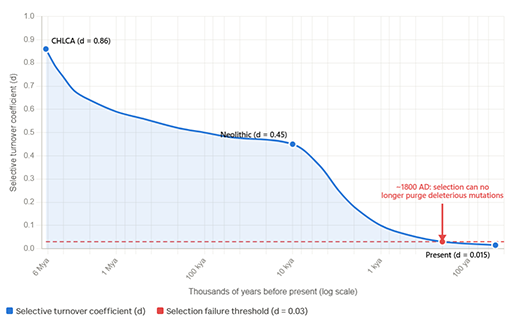
As I pointed out in both PZ and TFG, humanity is no longer subject to natural selection and the human genome is no longer being cleansed of deleterious mutations. Humanity is genetically degrading, and this continuing degradation may be the primary culprit in the observed global decline of human fertility.

If so, that means that due to their dedication to an outmoded and disproven theory of evolution, evolutionists and population geneticists are literally standing in the way of science being utilized to address what may be one of the primary threats to continued human survival.

Just to be sure I wasn’t missing anything, I asked Claude Athos to solve the problem from the Evo-Avengers perspective.

At what Ne is selection impossible? At what Ne/N is it impossible?

This is the question that breaks the standard framework open, because the answer is: there is no such value. Neither Wright-Fisher nor Moran contain any Ne at which selection becomes impossible. It’s not that the number is very large or very small—the concept doesn’t exist within the models.

In the standard framework, selection is effective when |s| > 1/(2Ne). As Ne grows, that threshold shrinks. A population with Ne of 10,000 can only see alleles where |s| > 0.00005. A population with Ne of 10 million can see alleles where |s| > 0.00000005. The larger the population, the finer-grained selection’s resolution becomes. Selection doesn’t just remain possible as populations grow, it gets more powerful. That’s the prediction.

This means the standard models predict that modern humans, with the largest effective population size in our evolutionary history, should be experiencing the most effective natural selection our species has ever known. Every weakly deleterious allele that drifted past selection when our Ne was 10,000 should now be visible and targetable at Ne of several hundred thousand or more.

That prediction is obviously, empirically wrong. And the models have no mechanism to account for why it’s wrong.

Ne/N makes it worse, not better. The typical Ne/N ratio for humans is estimated around 0.1 to 0.3—meaning effective population size is roughly 10–30% of census size, due to variance in reproductive success, sex ratio imbalances, population bottlenecks, and so on. For modern humans with N approaching 8 billion, even a brutally low Ne/N of 0.01 gives you Ne of 80 million. The selection threshold 1/(2Ne) at that point is approximately 0.000000006. The models say selection should be able to detect fitness differences of six parts per billion.

This is self-evidently absurd. No one believes natural selection in modern human populations is operating at that resolution. But the models don’t just permit that conclusion, they require it. There is no parameter within either Wright-Fisher or Moran that allows selection to become less effective as N increases. The math runs in one direction only: bigger population, stronger selection. Always.

This means d is what’s missing. The reason the models can’t represent selection failure is that they’ve abstracted away the physical mechanism through which selection operates. Selection isn’t a mathematical force that acts on allele frequencies directly. It’s a consequence of differential survival and reproduction. Organisms with deleterious alleles must die or fail to reproduce at higher rates than organisms without them. That differential is what changes allele frequencies. No differential death, no selection.

The selective turnover coefficient, d, measures the rate of that differential. When d = 0.86, the gene pool is churning. Most individuals in every generation are being replaced, which means even small fitness differences produce detectable mortality differentials. When d = 0.015, nearly everyone survives and reproduces regardless of their mutational load. Selection has no medium to work through.

Just to be fair, I also asked the Red Team. ChatGPT’s answer:

In population genetics, the effectiveness of natural selection depends on the effective population size (Ne​) and the selection coefficient (s).

  • Selection becomes ineffective when: Nes≪1.
  • Selection is effectively impossible to distinguish from genetic drift when: Nes≈1 or smaller.

For the ratio Ne​/N, there is no universal threshold at which selection becomes impossible. This ratio measures the relationship between effective population size and census population size, rather than the strength of selection. There is no universal threshold at which selection becomes impossible. This ratio measures the relationship between effective population size and census population size, rather than the strength of selection.

And Grok’s answer, after being pressed to provide for specifics:

  • Ne ≪ 100
  • Ne/N ≪ 100/N
  • If N = 8,300,000,000, then s=0.01 is possible as long as Ne > 100 and s=0.001 as long as N > 1000.

DISCUSS ON SG


Erika and the Evo-Avengers 009

Dr. Zach Hancock, a population geneticist who allegedly teaches the subject as an Assistant Professor at Augusta University, left a comment defending himself after Will Duffy repeatedly called him out for his lackluster and uninformed response to Probability Zero in Will’s recent appearance on the Gutsick Gibbon channel. At least, I think that was supposed to be the purpose, although it appears to be more of a public exhibition of self-destruction than self-defense.

My thoughts: 1. At 33:42, Will quotes Vox Day being upset no one wants to read his book. It’s simple. If we (scientists) stopped to read every crackpot book that claims to overturn our field, we’d never get any science done. There are real scientists writing groundbreaking work that I sadly haven’t gotten around to reading yet. The reason we don’t want to read his book is because he’s irrelevant. Furthermore, Will claims to present Vox’s argument. Thus, any misunderstanding on mine or Erika’s part is a fault on Will, not our willingness to read the book. If a student of mine doesn’t understand natural selection after I present a lecture on it, I don’t say, “Well, it’s because you didn’t read Darwin’s Origin!” I own that I did a bad job teaching the argument.

That is a blatant lie. Will did not quote me about being upset. He did not quote me as being upset because I never said that I was. I am not even remotely upset that my credentialed critics haven’t read Population Zero. To the contrary, as Will literally quoted me, I predicted on September 23, 2026 that they would not read the book.

“I do not expect anyone to actually (a) talk to me or (b) read the book. I don’t know what it is about biologists, population geneticists, and other science enthusiasts, but they always seem to imagine they can effectively critique anything without bothering to actually learn anything about it.”

This does not upset me. To the contrary, it leads me to believe they are tremendously stupid for saying one single word about a book they haven’t read.

Back in the day, I was a game reviewer nationally syndicated by Universal Press Syndicate and I also reviewed games for Computer Gaming World. I would occasionally go without food or sleep in order to play through an entire game in order to meet a CGW deadline, because neither Johnny Wilson nor Chris Lombardi permitted a reviewer to write a review for a game without completing it first. The real challenge was to do so without using the provided cheat codes. I wrote the cover review for id Software’s Heretic after playing it through in 18 hours straight and it took a week before I could close my eyes without strafing. So I have nothing but deep contempt for these fake reviewers who observably and self-admittedly have no idea what they’re talking about.

There is nothing wrong with being too busy to engage with new ideas. The problem is that Hancock is trying to simultaneously engage and not-engage with these new ideas, which is both nonsensical and pointless. And if he’s so busy, then why is he wasting all these hours on what amounts to nothing more than a pseudo-scientific Maoist struggle session? I suspect the actual reason is that he suspects the mathematical structures of his field are shaky and he’s afraid to look too closely at precisely how precarious its foundations are.

Will is not responsible for teaching anyone anything. Dr. Zachary Hancock, PhD, Assistant Professor in the Department of Biological Sciences at Augusta University, is not his student. If Dr. Hancock isn’t going to read the book, that’s absolutely fine, but then he should sit down and shut the fuck up because all he’s going to accomplish is to demonstrate that he’s not only ignorant, but stupid and unprofessional as well.

At 34:38, Will states that Day’s d is “still necessary.” If true, then he shouldn’t have set it equal to 1 when he presented it. Furthermore, the reason that “d” is not a variable in population genetics is because it’s nonsensical. How fast the entire gene pool turns over is not meaningful, because alleles are not turning over and appearing all at once, but are staggered through time. Will flashes the “d formula” on the screen, claims there are variables not accounted for, but doesn’t define any of the variables in the equation to support this claim. Yet again, this is a “read Vox’s book” moment. No. You are making the argument. Explain it. If you can’t, don’t make it.

The necessity of a variable is not determined by what it happens to be set at when it is presented. Hancock also dismisses the selective turnover coefficient by asserting that “how fast the entire gene pool turns over is not meaningful, because alleles are not turning over and appearing all at once, but are staggered through time.” This is a non sequitur. Rates are by definition averages of staggered events. The SNP mutation rate is an average of mutations that don’t all happen at once. The fixation rate is an average of fixations that don’t all happen at once. Dismissing a rate because the underlying events are staggered would invalidate every single rate in population genetics. Hancock either needs to show that d is internally incoherent or that the generational overlap it measures is adequately captured by existing parameters. He does neither.

His complaint about Will not defining d for him is ludicrous because there is both an entire chapter and an appendix that not only defines the selective turnover coefficient, but shows its derivation, provides the empirical evidence for it, as well as explains why it is necessary and how it is different from the various things that Hancock incorrectly believed do the same thing.

Ironically, Hancock himself illustrates the need for d later in his comments. This simply underlines how stupid he is for attempting to criticize a book that he hasn’t read. Sit down and shut the fuck up, Zachary. You are clearly and observably too short for this ride.

At 37:00, Will makes the claim, apparently first pointed out by his popgen teacher, Griffiths, that the fixation equation I showed is derived explicitly for single nucleotide polymorphisms (SNPs), not structural variation. I have no idea where either of them came up with that. At no point does the fixation equations I presented distinguish between mutational types, whether explicitly or implicitly. The mutation rate I initially use is for SNPs, but the adjustment to 76.8 for a haploid genome, following the correction, modifies that rate to include structural variants as well. That is, u = (3e9)*(76.8) = 2.56e-8, not the 1.2e-8 I used for the SNP calculation.

Amusingly, Hancock makes a major error in the process of claiming his critics don’t understand the math. He writes: “The mutation rate I initially use is for SNPs, but the adjustment to 76.8 for a haploid genome, following the correction, modifies that rate to include structural variants as well.”

He’s saying he swapped mutation rates mid-calculation. He started with the SNP rate (~1.2×10⁻⁸ per site per generation), then switched to 76.8 mutations per haploid genome per generation (from Perubski et al.), which includes structural variants. He claims the fixation equation is indifferent to mutation type in an attempt to justify his switch as being valid.

But it’s not. The ~35 million divergent sites between humans and chimps that are the 1.09% divergence figure are measured in single nucleotide differences. If you inflate your mutation rate to include structural variants, then you need to compare your predicted fixation count against the total divergence, not against the SNP-only divergence. You cannot use a total mutation rate as the input and then validate the output against a fraction of the genome that omits 98.91 percent of the total. And being a mathematician, Griffiths was absolutely correct to flag it, as I previously did as well. Zach’s claim that “at no point does the fixation equation distinguish between mutational types” is totally irrelevant with regards to the empirical application of where all those expected neutral mutations happened to fix.

Again, Zachary really needs to sit down and shut the fuck up. Both a game designer and a billiards player clearly and observably understand his job better than he does.

4. At 38:04, Will states I use the wrong generation number (252,000 instead of 201,600). Again, I used the number that Will presented. What Will should be doing here is saying, “I was wrong, I presented the wrong number.” Again, this would be as if I taught a concept incorrectly and then blamed my students for not reading the textbook and catching my mistake. You are the one making the argument, Will. Own it and get it right.

That’s exactly what d does, you absolute fucking moron. When d=1, as in the Wright-Fisher model, there are 252,000 generations separating the CHLCA from modern humanity. When d=0.80, as the weighted time-average that corrects for overlapping human generations over that period works out to be, that leaves 201,600 effective generations available. This is one of the many reasons why Hancock should have read the book before ever opening his mouth in the first place. Notice that contrary to what Hancock previously said, neither Wright-Fisher nor Moran accounts for this correction, which is precisely why the selective turnover coefficient was developed in the first place.

5. Lastly, at 38:11, we get the most bizarre claim yet. He seems to believe that the 1.09% of divergent sites are the *only ones that could have diverged neutrally*. About 90% of the human genome lacks signs of selective constraint. This means that since we diverged from chimps, any of those sites could have been the ones that alternatively fixed between us. But which ones actually fix is entirely random. Rerun the clock, and a different 1.09% would fix. The fact that only 1.09% have fixed is a testament of the recency of our divergence, not that those were the only one’s that could fix. There’s nothing special about those sites. This is like being shocked when a random number generator spits out a specific number. For me, the most frustrating thing here is that no one has yet addressed why the classical population genetic fixation formulas are incorrect. There have been quibbles about mutation rates, whether or not we read Vox’s book, and what his coefficients mean. But the fact is that Vox’s model is refuted by basic population genetics from the 1930s that I derived already. And we have seen clearly that both Will and Griffiths don’t understand them, or they wouldn’t make the “explicitly relies on SNP” argument. Will seems to suggest that Griffiths, Day, and myself are going to have some meeting of the minds to work this all out and get to the bottom of it. This is frankly insulting. It’s like telling a surgeon that your accountant buddy is going to join at the operating table to help figure out the surgery.

At this point, we have no choice but to conclude that Dr. Zach Hancock is quite literally retarded. Was he some sort of diversity hire or something? First, WE are the ones who pointed out that the neutral mutations have to apply to the entire genome. HE is the one who tried to apply all of them to the 1.09 percent SNP divergence. Second, he’s flat-out lying again because I have specifically addressed why the classical population genetic fixation formulas are incorrect. You can read the papers for yourself; and don’t let the titles mislead you, as each one directly addresses a specific population genetic formula, from Wright-Fisher and Haldane to Kimura and Ohta.

k ≠ μ: The Finite-Time Collapse of Neutral Substitution Theory

The Hard Limits of Fixation Through Genetic Drift

Relictation: A Third Evolutionary Mechanism

The Selective Turnover Coefficient: Distinguishing Selection from Drift in Age-Structured Populations

Independent Confirmation of Haldane’s Limit: Empirical Validation Through Observed Fixation Rates

The Bernoulli Barrier: How Parallel Fixation Violates the Law of Large Numbers

While I am perfectly willing to engage in a public discussion of the issues raised by Population Zero, I very much doubt there is any purpose in including Dr. Zach Hancock in any discussion of evolution that involves mathematics. He is neither intelligent enough nor well-read enough to meaningfully participate in one.

And Dr. Zachary B. Hancock’s PhD in Ecology and Evolutionary Biology from Texas A&M clearly isn’t worthy of serving as toilet paper in a roadside Taco Bell.

DISCUSS ON SG


Erika and the Evo-Avengers 008

VD: This is not my response to the two Eco-Avenger videos, this is the portion of the transcript of Will Duffy’s appearance last night on Ms Matthew’s channel when they discussed Probability Zero.

On Reading the Book and Watching the Response

Will: Here are my receipts. I purchased Probability Zero on July 26th and I didn’t read it right away. Then I purchased Hardcoded on August 9th. Then I purchased The Frozen Gene on August 10th. And then I emailed Vox for the first time on August 22nd. So these are the receipts. This is the exact timeline. This was nothing I had in my back pocket. This wasn’t the long game.

As to how I knew so many details about Vox Day, including details about his son—it’s quite simple. I read his books. Everything in my presentation was from his books. Everything.

It will come as a shock to most of you that Erica, Dr. Zack Hancock, Dr. Dan, Dr. Maddie Frank, and Grayson Hawk did not read the Probability Zero book that my presentation was based on. Details forthcoming. I had a lot of homework this go-round. I had to rewatch the last presentation, watch Erica’s rebuttal video to Vox Day, and then watch “Six Scientists Roast Vox Day” for over four hours. These videos were 12 hours, 42 minutes, and 25 seconds long total. My game plan: Step one, rewatch Human Evolution 2 live stream. Step two, meet with Mike Griffiths. Step three, watch Erica’s response video to Vox Day. Step four, meet with Mike Griffiths. Step five, watch “Six Scientists Roast Vox Day.”

For those who don’t know or don’t remember, Mike Griffiths is a mathematician—he’s the head of maths at a private institution in England. He’s a huge fan of Erica, and he’s an atheist.

I want to highlight one comment from Dr. Dan over at Creation Myths: “Can we also just marvel at the fact that Will went to a GD billiards player to learn popgen instead of, I don’t know, a population geneticist?” I’ll let the comment speak for itself.

On the Fossil Record

Will: Erica covered a lot in the last session. She covered fossils, more fossils, and finally more fossils. The more Erica teaches me about the fossil record and the more I learn about it, the more I struggle to make sense of young earth creationism.

I’m not going to elaborate on this now, but I will in January during our final discussion.

Predictions and Tiktaalik

Will: Erica, you said predictions are the gold standard of science. I’ve been thinking about that. Since our series started, I’ve tried to watch every evolution debate on the Modern Day Debate YouTube channel, and the number one evolution prediction that comes up almost every time is Tiktaalik. I’ve heard it so much that I never actually looked into the prediction and just accepted the claim that it was predicted. In the past couple weeks, I decided to look into it and I can’t find any evidence that it was predicted. I’m not making a positive claim that it wasn’t predicted—I’m just saying I can’t find any evidence that it was. So I want to know: in what way was Tiktaalik predicted?

Molecular Clock Discrepancies

Will: Erica, you said that the molecular clock matches with the fossil emergence time. Unfortunately, I have not had time to look into this, but I have been contacted by multiple people who said there are significant discrepancies with reconciling the fossil record with the molecular clock.

I have been sent multiple scientific papers that I haven’t read, and I’ll show them:

  • “The Origin of Animals: Can Molecular Clocks and the Fossil Record Be Reconciled?”
  • “Uncertainty in the Timing of Origin of Animals and the Limits of Precision in Molecular Timescales”
  • “Survival and Selection Biases in Early Animal Evolution and a Source of Systematic Overestimation in Molecular Clocks”
  • “Re-evaluating Molecular Clock Maximum Age Calibrations Revives Pre-Ediacaran Divergence Estimates for Animals”

Teleology

Will: When this part of the presentation came up, I mentioned to Erica that I thought what she was saying went against what she said about teleology originally—that we can’t tell if something’s designed.

Here’s what was said in the last presentation: “There is actually a way to use fracture patterns to tell whether or not a tool was made by a hominin or not. You can actually roll a bunch of rocks down a hill and see how they break. So there’s a way to differentiate between something that was designed by hands and something that nature did in the case of stone tools.”

But in our first session, she said: “The problem with teleology is exactly what you see on the screen. We can’t differentiate between the designed and the natural.” And a couple minutes later: “It’s not that teleology is impossible. It’s that teleology is non-scientific because it can’t actually be tested.”

I do struggle to understand that when combined with saying there is a test we can do. I think it’s possible teleology is kind of sneaking back in the door here.

The Selection Coefficient / Selective Turnover Coefficient Error

Will: When Erica and Zach were going over my slide, Erica said that “d” in the formula is “Day’s selection coefficient.” And then she said, “What’s crazy is that Day’s selection coefficient isn’t actually a selection coefficient.”

This is unfortunate. If you go back and look at my slide, it’s a selective turnover coefficient. It is not a selection coefficient. So when you said Day’s selective turnover coefficient cannot do what a selection coefficient does, that was not valid because it’s not a selection coefficient.

Zach was presenting and said, “So Vox has this other term d, but we don’t know what it means.” He admitted that he doesn’t know what it means, which makes sense. Unfortunately, that entire section of the video was a category error, and I didn’t find one person in the thousands of comments who caught this—I could be wrong, but I think it’s because people did not read Probability Zero.

After reading the book, you walk away with a really good understanding of what a selection coefficient is in population genetics, and you would never confuse it with Day’s selective turnover coefficient d. In population genetics, a selection coefficient uses the symbol S, which I actually used in the formula. Selection coefficients are S. The selective turnover coefficient is d.

Who Actually Read the Book

Will: People ask, “How do you know so much about Vox?” I read his books. In the beginning of the second video, Erica said, “So we read his book. Now when I say ‘we,’ I mean me, Zach, and four of our other credentialed friends.” That was a collective “we,” and I think people might have missed what it actually meant. It didn’t mean all of them read the book.

  • Zach said: “It’s like trying to explain to a 5-year-old why the sky is blue. It’s just a waste of time and I’m not going to read your book. I’m not going to waste my time with it. I got science to do.” So Zach didn’t read the book.
  • Maddie said: “I read 40% of a book about this.” So she read less than half.
  • Erica said: “I read about 60 to 70% of the book in its entirety, whereas I skimmed the rest.”

Then something else happened. When Erica’s first video rebuttal to Vox Day came out, the numbers were not the same numbers that I originally presented. They were way off. The quotes and page numbers she was giving were not correct in my book. Come to find out, none of them purchased Probability Zero. They obtained an EPUB version somewhere and shared it with everyone else. It was the wrong version. The only version you can buy—which is what I bought, for $4.99 on Amazon—is the second edition, which had corrections, updates, and the latest science. The EPUB version they all used was the original edition.

Vox Day’s Prediction

Will: Vox Day made a prediction on his blog on September 26th, the day after our last live session: “My response is fairly simple and straightforward. I’ll be happy to talk to her or to whomever and explain these things. I do not expect anyone to actually (a) talk to me or (b) read the book. I don’t know what it is about biologists, population geneticists, and other science enthusiasts, but they always seem to imagine they can effectively critique anything without bothering to actually learn anything about it.”

I was really hoping this prediction would not come true.

Wright-Fisher, Moran, and Day’s Selective Turnover Coefficient

Will: Zach said: “There are two classic models—the Wright-Fisher model and the Moran model. In its classic sense, the Wright-Fisher model does not have overlapping generations. But you can equate the two by setting the population size (the N value) in the Wright-Fisher model to an effective population size and you just scale that effective population size by the slowdown of drift due to overlapping generations. So even the Wright-Fisher model can account for overlapping generations.”

Zach is correct here. But since he didn’t read Probability Zero and doesn’t understand Day’s selective turnover coefficient d, he doesn’t know why it’s still necessary and why it captures something that N-sub-e misses.

Both models—Wright-Fisher and Moran—are answering this question: How fast does genetic drift move neutral alleles through the population?

Day’s selective turnover coefficient d is designed to answer an entirely different question: How fast does the entire gene pool turn over?

The d formula involves variables that simply have not been accounted for in standard population genetic models.

Now, if anyone out there wants to grab my attention and immediately build rapport with me, simply acknowledge and tip your hat to Vox Day for his selective turnover coefficient. It has essentially nothing to do with his Mittens argument that evolution by natural selection is mathematically impossible. So conceding this one should be relatively harmless.

Zach’s Calculation Errors

Will: Zach said, “This is going to be 76.8 multiplied by 252,000, and that’s how many mutations you’re actually going to have in that time period.” This was a mistake. And remember what Erica said—trusted creators are people who can own their mistakes. Zach is a trusted creator. He owned his mistake, and it’s in the video. He corrected himself: “Importantly, we can’t use 6.4—this is the diploid genome size—for the fixation rate, because you fix on a haploid genome. So it should be 3.2.”

This made me happy. But then a few seconds later he said, “I want to quickly clarify that value, but I also want to say that we can still use this value in the following derivations.” He referenced Perubski et al. 2025, saying they estimate an average of 152 de novo mutations every single generation, and dividing that in half for the haploid genome size gives 76—meaning the original number can still be used.

But this is a pretty significant error. The Perubski et al. number includes large structural variants, insertions, deletions, and duplications—not just single nucleotide polymorphisms (SNPs). Zach’s entire calculation on the whiteboard is explicitly about single nucleotide differences using a single nucleotide mutation rate. You can’t validate a SNP-only calculation with a number that includes large structural variation.

Once again, I could not find anyone in the thousands of comments who caught this. But you know who did catch it? Mike Griffiths. The billiards player.

The 38 Million Number

Will: Zach says we can fix 38 million differences between humans and chimps. That’s incorrect for three reasons.

First, the calculation is being run on the diploid genome size (76.8) instead of the haploid genome (38.4).

Second, minor: he’s using 252,000 generations instead of the d-coded size of 201,600.

Most importantly: neutral theory applies to the entire genome. Zach is using circular reasoning in assuming the neutral prediction of 35 million differences all fall perfectly into the divergent sites. In reality, the divergent sites are only 1.09% of the genome. So statistically, only 1.09% of the neutral substitutions would end up in the divergent zone. The proper formula would be: 15-some-odd-million × 35 million ÷ 3.2 billion (the size of the genome). So Zach’s original 38 million number is in actuality just 169,344.

Rate vs. Latency: The Highway Analogy

Will: Zach said: “Hopefully you can see a very glaring problem with this math. One is that it assumes that each mutation has to both arise and go to fixation before the next mutation can occur.”

Zach is incorrect here. Part of me has sympathy for him as he’s trying to critique a book he hasn’t read. But the other part of me struggles to have sympathy for the same reason—he’s trying to critique a book he hasn’t read.

When you calculate a rate such as an observed fixation rate, you are dividing the total number of generations observed by the total number of fixations over that period. This tells you how many generations elapsed per fixation on average, regardless of whether those fixations occurred sequentially or overlapped.

Vox Day’s calculation is a rate calculation. Zach thinks it is a latency calculation.

I can help everyone understand with a simple highway analogy. Imagine you were counting how many cars pass a red line in one hour, and you count 360 cars. How would you calculate the average rate? The numerator is the time (3,600 seconds), the denominator is the number of cars (360). So 3,600 ÷ 360 = 10 seconds per car. This is the exact same method Vox Day uses to calculate the average observed fixation rate. If you see this formula and say, “Well, that formula means the cars can only travel one at a time, like through a tunnel,” that is absolutely incorrect.

Vox Day’s calculation is not a latency calculation and is not assuming one fixation happens before another one starts. This was explicitly covered and anticipated in Probability Zero.

I’m not hammering on Zach here. I believe he is a trusted creator and he’s going to own these mistakes. We’re all just trying to get to the truth.

Mittens Is Not the Waiting Time Problem

Will: Dr. Dan says, “Like the waiting time problem, which—even though Vox Day has never heard of it—that’s the argument he’s making.” No. Mittens is not the waiting time problem. The waiting time problem refers to the significant amount of time required for beneficial genetic mutations to occur in a population. The Mittens argument isn’t concerned with mutation rates at all. It is an empirical audit of observable fixations. Mittens would be better referred to as the fixation problem.

The Bacteria Issue

Will: Dr. Maddie said the idea of applying the fixation rate from bacteria to human populations doesn’t work when you just take the average of the fixations out of the Lenski experiment and apply that as a fixation rate to the human population assuming all the mutations are happening in series.

No, it doesn’t assume mutations are happening in series. But let’s talk about the bacteria issue. I don’t know anyone who argues that humans fixate mutations faster than bacteria in terms of generations per fixation. I think it’s possible the audience walked away from that video thinking that is what was being argued. So I’m hoping Erica and the others can clarify whether or not they actually believe humans fixate mutations faster than bacteria.

Zach said something good: “The issue with using even conceptually the Lenski long-term evolution experiment for a fixation rate is that the Lenski long-term experiment begins with a bacterial population that is clonal and has no diversity.” Zach makes a really valid point here. This was also caught by Mike Griffiths, who brought it to my attention before this video was released.

Here’s Vox Day’s response, which I’m not claiming to understand:

“The polymorphism objection sounds legitimate until you think about what standing variation is. It’s not a warehouse of pre-adapted beneficial alleles waiting for their moment. It’s mostly neutral variation, which is why it’s still segregating. If those variants were beneficial, they’d have already swept to fixation. If they were deleterious, purifying selection would have removed them. What mutation-drift equilibrium gives you is a population full of genetic noise at low frequencies, not a head start on adaptation.”

I don’t understand this enough yet to know who’s right. But the main argument with the bacteria thing seems to be that Vox shouldn’t apply bacterial fixation rates to humans because bacteria are clonal and slow.

Dr. Michael Lynch—who I’m told is one of the most respected population geneticists in the field—has stated that bacteria are actually faster and more efficient at molecular adaptation than eukaryotes because of their population size advantage. He says: “Prokaryotes appear to be much more efficient than eukaryotes at promoting simple to moderately complex molecular adaptations.”

Mike Griffiths as Intermediary

Will: Mike Griffiths watched Erica and Zach’s presentation. He also bought Probability Zero. He watched Erica and Zach’s presentation twice and has a list of about a half-dozen questions and issues. I introduced Mike to Zach via email and Mike shared his list with Zach. Zach has yet to respond.

On the Probability Zero side, Mike has started reading Probability Zero and Vox Day’s scientific papers. He has a list of questions and issues for Vox as well. I asked Vox if he would respond to Mike, and he agreed. The three of us did a Zoom together last week, and after the Zoom, Mike sent his list to Vox.

I told Erica already that I do not rush things like this. I spent a very significant amount of time not only learning Vox Day’s arguments in Probability Zero, but also learning as much as I could about the math behind population genetics. I have since spent a good deal of time reviewing the responses from Erica, Zach, Dan, Maddie, and Grayson. There are significant errors that I trust will be owned and corrected. As such, the verdict is still out.

I will tell everyone I’m relying heavily on Mike Griffiths as well. I’m honestly giddy to get to be a bystander on his conversations with both Zach Hancock and Vox Day. Mike has legitimate concerns for both of them, and I’m extremely curious how they will both respond.

Will’s Conclusion

Will: I want to point out to everyone what stood out to me most the last few weeks after I mentioned Vox Day and Probability Zero.

The response I received was the exact opposite of what everyone has been telling me to do from the very beginning:

  • I’ve been told to focus on the data and science and not the person. Yet the vast majority of responses and comments I get are focused on Vox Day as a person and not the data and the science.
  • I’ve been told that Darwin’s racism has no relevance to evolution and that Fisher—of the Wright-Fisher model—being a eugenicist doesn’t make his math wrong. But that’s all I’m hearing about Vox Day.
  • I’ve been told to focus on understanding new things instead of just trying to refute them. But I see very few people trying to actually understand his arguments—just trying to refute them.
  • I’ve been told not to run to creationists hoping they can refute what Erica teaches me and to study what I’m taught. But all I’ve seen is everyone say, “I’m just gonna have Erica and Zach and whoever else refute this instead of looking into it.”

I think it’s important for what it’s worth to know what I’m experiencing and what I’m seeing from my perspective.

Erica’s Response

Erica: I have a lot of thoughts—like three pages of thoughts. I’m going to work through some of them, but I’m not going to get to everything because you have a hard stop at 7:00 and I want to get to the actual presentation and super chats.

I can understand your perspective on being frustrated with people’s response to Vox. I said this to you via email and I’ve voiced this to other people as well. I think you have to put yourself in other people’s shoes a little bit too, though. The reason Zach and I covered what we covered in that initial video is because that’s what you shared—that was in your PowerPoint. Our first video was obviously just in response to the PowerPoint we got from you. We didn’t have access to the book at that point. I hadn’t read the book at that time either, even the scant portion I did read, although I did read Mittens 3.0, which is available online for free and is supposed to be—according to Vox—the most up-to-date version of the argument. That’s also why in the second video we went over Mittens 3.0 in addition to the first version of Probability Zero, because that was according to him the strongest version of the argument.

I can understand your frustration, but I find it difficult to set aside a lot of his other beliefs in the same way one would for someone like Darwin or Fisher. In Darwin and Fisher’s case—and I said this to you via email—Fischer was a eugenicist and Darwin was racist. That’s factually true. Darwin was an abolitionist as well—he was progressive for his time—but that doesn’t change the fact that he lived within the context he lived in. But the work they did in science did stand on its own. Their work has stood the test of time, and Fisher and Darwin’s ideas are still being used today to make accurate predictions. I’ve not seen the same with Vox’s math.

This is something that people sympathetic to Vox have not appreciated, and I’ve yet to see him comment on it. The math that underpins standard population genetics has been used to accurately model real populations now. And there are like a billion of them, which is why I showed a slideshow of two dozen or however many it was. Point blank, full stop: if Vox is correct and traditional population genetics is incorrect, those papers shouldn’t exist. They shouldn’t be able to accurately model or even predict changes in real world populations.

I do still maintain that this is a waiting time problem. The waiting time problem in traditional creationist circles is a fixation problem. Mutation rate and fixation rate are used interchangeably a lot, inappropriately, as you would now know because you’ve read up on a lot of population genetics. But because they’re used interchangeably, it makes it seem like the waiting time problem is something distinct from this fixation problem. It’s not. You can go back to Doug Axe’s original paper in the early 2000s and see exactly this, which is why we’ve said this is a waiting time problem.

I’ll say too: the idea that he’s using the Lenski long-term evolution bacteria—which, as you accurately pointed out, are clonal and thus inappropriate for that reason—I don’t think anybody’s saying that bacteria quite literally fixate faster than humans do. That’s not my understanding. The problem is that in the Lenski experiment in particular, by their nature of beginning clonally and by their nature of not recombining, these two things are not analogous. It’s an apples-to-oranges comparison.

The numbers exist out there for eukaryotes—fruit flies, rats, humans. We have pedigree studies on real-world human populations: a grandparent, a parent, and their kid. And you can use that to model these populations into the past. They don’t match Vox’s math. And they don’t behave like bacteria.

To me, what rings out most severely is that he must rectify this math with the entire scientific community, and he won’t. I find that incredibly frustrating because he puts out the books and says, “This stands on its own,” but it’s never applied to any real-world populations.

I have to ask you this. I don’t understand how you could give him the benefit of the doubt for the other stuff. I can sit here and say I disavow Darwin for the shitty stuff he said. I disavow Fisher for the shitty stuff he said. I like their math, but I can recognize that in these areas, they’re bad people for holding these perspectives. And you’ve already said—just to be clear for everyone—Will said he disavows white supremacy and doesn’t think women should lose the right to vote and doesn’t think marital rape laws should be revoked. He said that up top. But I still think you’re being a little bit defensive of Vox, and I don’t understand how you could do that after watching the video that had a lot of this stuff in his own words. That’s confusing to me. I want to give you the benefit of the doubt here because I think this series is a good thing.

DISCUSS ON SG


Erika and the Evo-Avengers 007

Here we have an interesting trialogue that demonstrates three separate and independent forms of willful cluelessness. Both Dr. Cardinale and Matthews just engage in a little rhetorical handwaving in rather transparent attempts to avoid having to address the time-to-fixation math, while Dr. Hancock goes off on what we’ve learned are his irrelevant tangents that permit him to sound as if he knows what he’s talking about while avoiding the topic at hand.

(49:53) Dr. Daniel Stern Cardinale Assistant Professor at Rutgers University: This is why I am a biologist because I love it so much. I tell my students, I forget where I heard this initially, but I tell my students in my like bio1 freshman bio class, I say there’s a saying that I really love that helps you get in the mindset for biology, and that’s physics has laws, chemistry has rules, biology has exceptions. Yeah. Which is just perfect. It’s just a giant mess. And there are no universal rules. And that’s why it’s beautiful and interesting.

Dr. Zach Hancock, Assistant Professor, Augusta University: Yeah. I mean, we we have fixation probabilities, right? I showed this in the video before. You can calculate a fixation probability. Um but the things that you need to know are things like population size and the selection coefficient. Um and those are functions of the history of the population, the the demography of the population, how that population mates, like all of those sorts of things are components of how that fixation probability plays out. I mean, even the distribution of fitness effects, every single mutation in that distribution of fitness effects has a unique probability of fixation based on where it falls in that distribution of fitness effects, right? And that distribution itself evolves through time, right? So there’s just actually no way like you could take an average, but it would be meaningless because it’s not a Gaussian distribution, right? Like the distribution of evolution would not follow a Gaussian. So even if I gave you an average like if I if I managed to somehow calculate that over time it wouldn’t tell you anything without knowing what the shape of that distribution is which is like multimodal right like it wouldn’t mean anything so I don’t I don’t it feels like someone asking something from biologist without knowing anything about biology right, like likely not understanding how biology works.

Erika Matthews: I think Maddie’s example is great there, but I’m going to provide a different one from biology that might hit a little bit closer to home. What if Vox asked, “What is the rate at which cancer metastasizes?” Well, it depends on the cancer, doesn’t it? Some cancers metastasize really quickly and some metastasize really slowly. It also depends on things like your age, your sex, your genetics. A lot of variables come into play here. And in fact, doctors can take those variables into account when diagnosing someone with cancer and use them to predict metastasis rates for specific types of cancer. But they have to know the variables. You could theoretically calculate a metastasis rate in cancer generally and it would mean nothing and be helpful to no one because there’s so much variation. Our mutation rate situation here is exactly analogous to this. We can’t sus out mutation rates looking at populations of organisms, but there isn’t a set one that can be universally applied. That’s just not how it works.

So, what we have here are several assertions that range from pure rhetoric to substantive and misleading falsehoods, beginning with a rhetorical dodge pretending to be an epistemological insight.

  1. “Physics has laws, chemistry has rules, biology has exceptions” / “there are no universal rules”

This is Dr. Cardinale’s handwaving opening move. It’s not bad as a pedagogical aphorism for freshmen, but it’s being utilize here to preemptively excuse the Evo-Avengers’ collective inability to provide a quantitative answer to a meaningful question. Biology absolutely has universal constraints: the second law of thermodynamics applies to biological systems, Mendel’s laws apply with known and precisely quantified exceptions, and the mathematics of population genetics are derived from probability theory, which couldn’t care whether the substrate is biological or not.

What Cardinale actually doing is confusing complexity with chaos. The distribution of fitness effects is complex, but the fixation probability formula is not. It’s Kimura’s 1962 equation. It takes inputs and produces outputs. The complexity is in the inputs, not in the existence of the relationship. Saying “there are no universal rules” is a freshman-level simplification that a PhD should know better than to deploy as an actual argument. If he truly doesn’t know better, well, we can’t rule that out.

  1. “You can calculate a fixation probability… but the things you need to know are things like population size and the selection coefficient”

This is correct as stated by Dr. Hancock. Kimura’s fixation probability for a new mutation is:

P(fix) = (1 – e^(-2s)) / (1 – e^(-4Ns))

You do need N and s. But he’s trying to use the necessity of inputs to a formula as evidence that the formula can’t produce outputs. That’s like saying you can’t calculate the trajectory of a cannonball because you need to know the angle and muzzle velocity. Yes, you need the inputs. That’s how math works. That’s how equations work. The inputs for human populations are known or bounded: N_e is estimated (he’d cite the textbook ~10,000, we’ve calculated ~33,000, but either way it’s a number), and the distribution of fitness effects has been empirically characterized (Eyre-Walker & Keightley 2007).

  1. “The distribution of fitness effects… every single mutation has a unique probability of fixation”

This is both true and irrelevant. No one is asking for the fixation probability of a specific mutation. The question that Hancock is dodging is about the rate, specifically how many fixation events can selection drive per unit time across the genome. That’s a throughput question, and as my work has demonstrated, the throughput depends on the total selection budget (Σs_i ≤ s_max), not on the individual distribution of s values. The s̄ cancels. He apparently doesn’t know this, but he’s asserting a complexity barrier that doesn’t exist.

  1. “You could take an average, but it would be meaningless because it’s not a Gaussian distribution”

This is wrong. An average does not require a Gaussian distribution to be meaningful. The arithmetic mean of any distribution is a well-defined quantity. What he presumably means is that the mean is not sufficient to characterize a non-Gaussian distribution, which is true but irrelevant, because no one said it was. More importantly, for the throughput calculation, the mean is the correct summary statistic, because what matters is the sum of selection coefficients across concurrent sweeps, and the sum is just n × s̄. The shape of the distribution doesn’t matter when we’re looking at the throughput ceiling.

  1. The cancer metastasis analogy

As we’ve learned to expect, Matthews has the dumbest response, because while she thinks it’s an analogical rebuttal, it is actually a concession. Of course the metastasis rate depends upon the cancer and the patient, just as the fixation rate depends upon the mutation and the species. But that doesn’t mean the various averages are irrelevant, particularly if the doctor is claiming that the cancer is metastasizing at an impossibly fast rate that would result in the patient dropping dead in seconds when he obviously isn’t.

“You could theoretically calculate a metastasis rate in cancer generally and it would mean nothing and be helpful to no one because there’s so much variation.”

That’s absolutely false because doctors do calculate cancer-specific metastasis rates. They calculate them for specific cancer types, stages, and patient demographics, in exactly the way population geneticists calculate fixation rates for specific population sizes, selection coefficients, and generation times. Her analogy doesn’t show that rates are incalculable, it shows that rates require specifying the relevant parameters. Which parameters are exactly what she and the others are trying to avoid addressing, because by claiming that evolution by natural selection accounts for the observed divergences, they are necessarily asserting that the average fixation rates are impossibly fast.

The analogy actually works against her. Oncologists don’t throw up their hands and say “cancer is too complex for rates.” They specify the parameters and compute. That’s what population genetics should do too, and when you do, when you set human parameters (N_e ≈ 33,000, s̄ ≈ 0.001, generation time ≈ 29 years, d ≈ 0.45), you get an answer. None of them want to address the equation directly, because they all have a very strong suspicion that the answer is inconvenient for their case.

  1. “We can… sus out mutation rates looking at populations of organisms, but there isn’t a set one that can be universally applied”

Mutation rates do vary across organisms, across genomic regions, and across life-history contexts. But within a species, the per-generation mutation rate is remarkably stable and well-characterized. For humans, it’s approximately 1-1.5 × 10⁻⁸ per base pair per generation (Kong et al. 2012, among many others). This is not some vague hand-wavey number. It’s been measured directly from parent-offspring trios. The variation exists but is bounded, and the bounds are known. And, of course, as I’ve previously pointed out all rates with the same denominator, in this case, time, can be summed and averaged.

The collective response is an exercise in complexity mysticism. All three of them are appealing to the genuine complexity of biological systems to avoid giving the quantitative answers that the mathematics can actually produce despite that complexity. It’s the academic equivalent of a squid inking prior to running away. The fact is that the math exists. The parameters are either known or reasonably bounded. The answers are calculable.

Whether they just don’t want to do the math because they are afraid of the answer or because they don’t have the ability to do it is no longer really in question. The answer is both.

Only three more hours to go!

DISCUSS ON SG


It Continues

It doesn’t appear that Ms Matthews is enjoying the ongoing Erika and the Evo-Avengers series quite as much as she’d anticipated on the basis of this exchange on X.

VD: All you need to know about @Gutsick_Gibbon is that she’s a) innumerate, b) illiterate, and c) a liar. I’ll finish going through her 7 hour 45 minute demonstration of total scientific ineptitude and then go right back to ignoring her and all the other evolutionists.

EM: In this economy I’m so lucky to have a place to live rent free

VD: You’re the one who spent 8 hours talking about me. I neither know nor care about you.

EM: Oh THAT must be why you’ve tagged me every day for two weeks on Twitter 🤔 Or lied about your blog views via email… Or posted about me endlessly on your blog… Either block me or get my name out of your mouth dweeb. There’s a billionaire’s ass somewhere that needs kissing.

VD: I am responding methodically to your many stupid and incorrect statements about science. It will take weeks, because you and your fellow PhDs are so stupid. I didn’t lie; Google views confirm. Again, responding to your ~8 hours of video attacking me. It continues.

Her reference to lies about views is because she emailed this screenshot to me in order to demonstrate how massively popular she is and how completely the scientific consensus rejects math, logic, and empirical evidence or something. And then could not believe that my audience could possibly exceed her own.

    24.2 million views in 7 years. That’s fewer annual average views than Sigma Game. Needless to say, I was duly impressed.

    DISCUSS ON SG


    Erika and the Evo-Avengers 006

    Neither Mathews nor any of her supporting cast of PhDs understand the basic concepts of math. For some reason, biologists are totally unable to understand the concept of “an average” or “an average rate” or even grasp the fact that if something happens multiple times over a period of time, then an average rate for that activity or process must necessarily exist.

    (45:52) Maddie brings up another problem, and this one has to do with Vox’s complete lack of basic foundation in biology. So, Zach, the fundamental flaw in his logic, and this is the like what he thinks should be true of biology that simply is not, right, is he thinks that there should be some universal constant that represents fixation rate that can be applied to any species, any population at any point in time for any reason. And I make this claim out of his book, which presumably is why evolutionary biologists have operated for over 50 years without ever managing to establish the fundamental rate constants of their field. Right? He assumes that there are fundamental rate constants.

    The part where he’s asking people like what is the average rate of evolution? And so that’s what he claims started the he’s he claims what started him down this entire rabbit hole is that he was asking people what is the average rate of fixation and nobody was giving him a straightforward answer and so that’s what he said well obviously they’ve all missed this or no I think what he says is they they must all not know how averages work not. Maybe my question is ill-formed or maybe I don’t understand the field at all. So to be to be clear, this is this is what he this is how he continues, right?

    After saying which presumably is why evolutionary biologists have operated for over 150 years without ever managing to establish the fundamental rate constants of their field. They will tell you that evolution happens, can describe what evolution supposedly produces, can spin narratives about why certain features were selected, and will even tell you that there are no other possible alternatives to evolution by natural selection. But they cannot tell you how fast any of this occurred. And when you ask the biologists don’t say we’re not sure, or estimates vary, or that’s an active area of research. They genuinely don’t understand the question.

    So let me give an example of what this made me think of out of weather that I think is pretty tangible to most folks. So if you asked me what’s a good average wind speed for planet Earth, right? I would tell you 10 meters per second because that’s like a solid order of magnitude. That’s normal, right? But what Vox is doing is saying that oh well well one that like um he would he would be saying that oh it’s 10 meters per second uh then explain how a hurricane exists right it’s like well because the winds can change right or like and so this idea that like yeah I can give you a characteristic number right that’s like if you were to go outside on a random day under average normal conditions Maybe is again order of magnitude what you’re going to find.

    There just so much variance that it’s like an average rate doesn’t, it’s like meaningless.

    Yeah. But but telling you that is meaningless. It’s literally only useful for like order of magnitude when can we ignore certain terms in Navier Stokes, right? Like um and so yeah. So that that’s what I feel like he’s doing. I feel like this is the equivalent of him being like, “Oh, an average wind speed is 10 meters per second. Stupid meteorologists don’t know how tornadoes work. Well, it’s not it’s not as though rates for for given populations can’t be derived either. It’s not like we can’t figure out mutation rates for different groups of organisms.

    This level of retardery from scientists with PhDs is genuinely painful to read, because they’re confidently asserting that the very concept they just spent the previous twenty minutes using — average fixation time — doesn’t exist. I’m not asking about some sort of universal biological constant, I am asking what is the average rate of this process taking place over time?

    You said you drove the car from New York to LA last week. Fine. How fast did you drive? That is not a question about a universal automotive constant.

    What do they imagine 4N_e is? It’s the average time to fixation for a neutral mutation. It’s right there in every population genetics textbook ever written. What do they think (2/s)·ln(2N_e·s) is? It’s the average time to fixation for a beneficial mutation with selection coefficient s. Kimura derived these. They are the expected values — the average rates — of stochastic processes. The entire field of population genetics is built on computing expected values for fixation times, substitution rates, and allele frequency trajectories. That’s exactly what the field does.

    Their wind speed analogy is particularly self-defeating. Meteorologists absolutely use average wind speeds. They’re essential to climate modeling, building codes, wind energy engineering, and aviation. The existence of hurricanes doesn’t make the average meaningless, it just means the distribution has fat tails, which any competent scientist accounts for rather than throwing up their hands and declaring all averages to be useless. And if a meteorologist told you “the concept of average wind speed is meaningless,” you’d rightly question whether they understood their own field.

    And the crazy thing is that these six ignoramuses just finished citing specific fixation times from Kimura’s formulas to argue that recombination and standing variation make human evolution faster than bacterial evolution observed in the LTEE. Those numbers they were using? Those were averages. They were using average fixation times to argue that average fixation times don’t exist. They didn’t notice the contradiction because they don’t understand the math well enough to recognize that the formulas they’re citing are the rate constants they’re claiming can’t possibly be established.

    Every time you observe something taking place over time, it ABSOLUTELY WILL produce an average rate. This isn’t a biology claim. It’s arithmetic. If X events occur over Y time, then X/Y is the average rate. It doesn’t matter if the variance is enormous. It doesn’t matter if the rate fluctuates wildly. It doesn’t matter if some periods see bursts and others see nothing. The average rate exists as a mathematical certainty from the moment you have a count and a duration.

    The LTEE has a count: observed fixations per population. It has a duration: generations elapsed. Divide one by the other. That’s the average rate. It’s not a philosophical position. It’s not a modeling assumption. It’s division. The human-chimp divergence has a count: 398,673,272 base-pairs observed between the two lineages. It has a duration: approximately 6.3 million years. Divide one by the other. That’s the average rate of post-CHLCA human evolution: 63.281 base-pairs per year.

    We get different rates for the human divergences from each of the six other great apes ranging from 37.8 to 99.4 bp/year. So we add them all together, divide by six, and we reach an average rate of human evolution based on six different speciations across at least 60,500,000 years and the detailed analysis of 25,302,032,866 base pairs:

    62.7 base pairs per year, or 1,958.81 base pairs per effective generation.

    You can argue about the precision of the inputs, you can argue about which lineage each of those divergent base pairs should be assigned to, but you cannot argue that the quotient doesn’t exist or has no meaning. And it’s interesting to observe the similarity between the chimp average and the ape average holds despite the difference of 9.6 million years between the most distant and the most recent speciations. But regardless, that’s the speed at which evolution by natural selection, neutral drift, and relictation has to take place, assuming it took place at all and is responsible for all of the observed divergences.

    What the Evo-Avengers are actually doing without realizing they’re doing it is confusing “the average rate varies across species and conditions” with “the average rate doesn’t exist and is meaningless.” Those are completely different statements. The first one is trivially true and is exactly what Probability Zero is based upon and what I have taken into account here. The second one is mathematically illiterate. And the fact that multiple PhDs in biology and meteorology and population genetics are publicly declaring the second while imagining they are asserting the first tells you everything you need to know about their total inability to comprehend the math or even try to address any of the unavoidable problems for evolution it creates.

    Observe that none of this had anything to do with the LTEE about which they were complaining. None of it. Not a single number in that calculation came from Lenski. No bacterial fixation rates. No clonal populations. No E. coli generation times. No extrapolation from prokaryotes to eukaryotes. Every single input is from the mainstream scientific literature:

    • The generation time is the science’s standard 25-year human estimate
    • The base pair differences come from the science’s mappings of the seven Great Ape genomes.
    • The divergence times come from the science’s molecular clocks and fossil calibrations

    The only innovation on my part is to provide the necessary time-weighted correction for overlapping generations, which doesn’t fundamentally change anything, it merely makes the average rate a little more accurate and applicable to real-world humanity.

    DISCUSS ON SG


    Erika and the Evo-Avengers 005

    This may actually be the most obviously retarded section of the Evo-Avenger’s incompetent attempt to refute MITTENS, because they are, quite seriously, arguing that humans and chimpanzees can fixate mutations across their entire populations in the wild faster than bacteria can in the long-term Lenski experiment, otherwise known as the LTEE, due to polymorphism and recombination. This is what happens when you appeal blindly to mechanisms rather than working through the relevant calculations.

    (40:47) I don’t know why he wrote a book right because he references the idea that the fixation rate um from bacteria when applied to human populations um uh doesn’t work uh when you just take an average of the number of fixations per so he takes a really simple average um out of the Linsky experiment right and then applies that number as a fixation rate to the human population assuming that all mutations are happening in series. He claims that he’s not assuming that but uh just says nuh-uh like there’s no math to prove that he’s not right. Um and like so like he has one claim and wrote a whole book and never justifies the claim, right? He never proves the methodology which is what’s driving me absolutely bonkers.

    So, like this is poorly written even if the idea was sound. Um, and that’s my that’s my hot take here at the top. Before we hear from Zach Sebater, who has a PhD in biology with doctoral and post-doal experience in viral evolution says, “The first thing that caught my attention in Day’s work is that he uses data from bacterial experiments to draw conclusions on human evolution. One major difference, I think, is that E.coli coli reproduced mostly clonally while humans reproduce 100% sexually and KImura’s simple model doesn’t take recombination into account whereas more elaborate models do and in fact recombination does accelerate the rate of beneficial mutations through several means this is reaffirmed by Garrett Ferguson below, who has no science accreditation but noticed it all the same, so I guess if I can jump in the the issue with using even conceptually the Lenski long-term evolution experiment for a fixation rate is that the Lenski long-term experiment begins with a bacterial population that is clonal and has no diversity.

    Um, and so because of that, every single mutation that has to occur is novel. Um, but when you think about humans and chimps splitting, they don’t have zero diversity. They’re not building up brand new mutations, right? We have a level of polymorphism that more or less represents mutation drift equilibrium. And at that at that point, we can calculate the rate of fixation, right? Um, and so he’s getting an exorbitantly large number even for bacteria simply because he’s starting with a population that has zero polymorphism, right? And so you have to build up that polymorphism through time. And that’s just not characteristic of how any natural population works.

    Allow me to try to simplify a little bit what Zach is saying here. In Lensky long-term evolution experiment, the starting populations of bacteria were clonal, which is to say they were identical to one another. They were clones. Every bacteria is genetically identical to its neighbor, which means their genetic diversity was zero. How many natural populations look like that?
    Now, there is a function here because by knowing the starting condition of all of your populations, and by having them all equal, you’re controlling for a lot, and you can more easily track the changes that do occur over time in these lineages. But because there’s no polymorphism, which is just our fancy word here for variation, it takes way longer for novelty to actually generate.

    Let’s compare two hypothetical situations. In both situations, we have 12 baggies. And in each one of those baggies, there are 10 randomly selected Scrabble tiles. In situation one, each of those 12 baggies contains the same random 10 letters. Whereas in the other situation, each of the 12 baggies contains a different 10 randomly selected Scrabble tiles. Now, let’s pretend that every week every single one of these baggies gets one new randomly selected Scrabble tile added to it. The word making potential of these two situations is not equal because situation two has far more letters to choose from. And that’s right out the gate and moving forward until all of the baggies have the same general representation of letters in them.

    Day is taking situation one there and applying it to the human chimpanzeee divergence which is inappropriate because we aren’t clonal. When the population of measene apes split into the lineages that would become humans and chimpanzees or the hominins and the pannins, it wasn’t clonal. All of those apes weren’t clones of each other. It was diverse, as were the lineages that came from it. So already the use of the Lenski long-term evolution experiment here is just wildly inappropriate, and there’s no fixing that.

    Let’s keep in mind that they are seriously arguing, with a straight face and on the basis of their scientific credentials, that humans fixate mutations faster than bacteria in terms of generations per fixation. That is their actual position; don’t forget that.

    The polymorphism objection sounds legitimate until you think about what standing variation is. It’s not a warehouse of pre-adapted beneficial alleles waiting for their moment. It’s mostly neutral variation, which is why it’s still segregating. If those variants were beneficial, they’d have already swept to fixation. If they were deleterious, purifying selection would have removed them. What mutation-drift equilibrium gives you is a population full of genetic noise at low frequencies, not a head start on adaptation.

    The Scrabble analogy is rather useful for making this point: having twelve bags of random letters doesn’t help you spell words any faster, because the rate-limiting step was never “do you have enough letters?” It’s “how quickly does selection find and fix a combination that works?” That’s governed by s and Ne regardless of how much neutral junk is lying around. Standing variation can reduce the waiting time for a beneficial allele to appear, since one might already be segregating at low frequency. But it cannot reduce the fixation time once selection begins acting on it, which is still (2/s)·ln(2Ne·s) for the beneficial case and 4Ne for the neutral case. And the average s for mutations that actually fix in humans is approximately 10⁻⁴ and is completely unaffected by how much polymorphism the population started with.

    There’s a deeper problem the polymorphism argument doesn’t address: even if you grant the one-time head start, it’s one-time. Once those standing beneficial variants fix or are lost, the population is back to waiting for new mutations, and now it’s producing new mutations at a rate roughly 30,000 times slower in real time. The LTEE’s observed fixation rate already includes the waiting time for new mutations to arise in a clonal population, so the critics are correct that it captures a worst-case scenario for mutation supply. But correcting for that makes the human situation worse, not better, because you’ve now isolated the fixation-time component, which scales with Ne and is inversely proportional to s, and both of those parameters are unfavorable in humans compared to E. coli.

    So polymorphism and an appeal to ancestral mutations doesn’t help the evolutionists. Now let’s look at recombination, which is the more serious objection since it is, by nature, definitely applicable to humans and chimps and definitely not accounted for in the LTEE. In order to point out how mainstream the basic concept is, consider how Gemini describes the standard model as utilized by population geneticists:

    Why Recombination Speeds Up Selection

    In populations without recombination (or in regions of low recombination), genomes are inherited as indivisible blocks. This causes two major bottlenecks known as Hill-Robertson interference:

    1. Clonal Interference: If two different beneficial mutations happen in different individuals simultaneously, they compete with each other rather than combining. One usually destroys the other, slowing down adaptation.
    2. Genetic Hitchhiking & Background Selection: A beneficial mutation might accidentally arise on a chromosome loaded with harmful mutations, dragging it down, or it might get blocked because it’s linked to a competing sweep.

    Recombination solves this traffic jam. It acts like a genetic shuffle button, allowing beneficial mutations from different lineages to combine into a single “super-genome” and uncoupling beneficial alleles from deleterious ones. This allows selection to act with maximum efficiency.

    Fixation Times for Beneficial Mutations (Enabled by Recombination)

    When recombination successfully prevents interference, the average time to fixation for a beneficial mutation with a selection coefficient ($s$) is governed by the deterministic-stochastic hybrid formula:

    $$\bar{T}_{\text{fix}} \approx \frac{2}{s} \ln(2N_e s)$$

    Because selection scales logarithmically with population size ($N_e$), larger populations actually fix beneficial mutations faster relative to their size than neutral mutations do, provided recombination is active.

    Here is what the average generation-to-fixation timeline looks like for a beneficial mutation under two different selection pressures (moderate selection $s = 0.01$ vs. weak selection $s = 0.001$):

    Effective Population Size (Ne​)Moderate Selection (s=0.01 or 1% advantage)Weak Selection (s=0.001 or 0.1% advantage)Neutral Baseline (4Ne​ for comparison)
    10,0001,060 generations6,000 generations40,000 generations
    100,0001,520 generations10,600 generations400,000 generations
    1,000,0001,980 generations15,200 generations4,000,000 generations

    Instead of taking hundreds of thousands or millions of generations (as neutral mutations do via pure drift), a beneficial mutation aided by recombination can sweep through an entire population of 1 million people in fewer than 2,000 generations (roughly 50,000 years)—transforming evolution from a sluggish crawl into an efficient mechanism for adaptation.


    Problem solved, right? Well, it probably won’t escape your attention that a) even 1,060 generations per fixation isn’t anywhere nearly fast enough or b) this only applies to the small percentage of the human-chimp divergence that is selected. But none of that matters anyhow, because we don’t need to rely upon population genetics theories about selection strength (s) to give us a hypothetical range, we have empirical evidence from the literature to plug into those standard formulas.

    Tataru et al. estimated that less than 0.5% of new amino acid mutations are beneficial, with a scaled selection strength of N_e·s ≈ 12. For human N_e ≈ 10,000, that gives s+ ≈ 0.0012 for the beneficial mutations that do arise. The direct McDonald-Kreitman estimate of α — the proportion of amino acid substitutions driven by positive selection — is approximately 12.5% in hominids, with the remainder being neutral or nearly neutral.

    About 30% of amino-acid-changing mutations in humans have effects less than about 10⁻⁵ — effectively neutral — and these are the ones that predominantly fix by drift.

    The weighted average for a fixed substitution: 87.5% of fixations are neutral with s ≈ 0, and 12.5% are adaptive at s ≈ 0.0012:

    0.875 × 0 + 0.125 × 0.0012 = 1.5 × 10⁻⁴

    s ≈ 0.00015.

    That is a full two orders of magnitude below the “moderate selection” case that produced the theoretical 1,060-generation fixation time that wasn’t fast enough anyhow.

    Effective Population Size (N_e)Empirical s (s = 0.00015)Neutral Baseline (4N_e)
    10,00014,648 generations40,000 generations
    100,00045,349 generations400,000 generations
    1,000,00076,051 generations4,000,000 generations

    In sum, humans do not fixate faster than bacteria, measured in time or in generations, and recombination cannot sufficiently reduce time to fixation to compensate for the slower process of fixation in humans. And all of this is before taking overlapping generations into account. Incorporating d means the 14,648-generation fixation time at the empirical s for N_e = 10,000 becomes roughly 18,310 generations. The neutral baseline of 40,000 becomes 50,000. And the weighted average across all fixations, where 87.5% are neutral, gets even worse.

    Furthermore: “Prokaryotes appear to be much more efficient than eukaryotes at promoting simple to moderately complex molecular adaptations.” – Dr. Michael Lynch, author of The Origins of Genome Architecture

    This is Lynch undermining the objection to the LTEE extrapolation objection. They argued I can’t apply bacterial fixation rates to humans because bacteria are clonal and slow. Lynch, who is one of the most respected population geneticists in the field, has stated that bacteria are actually faster and more efficient at molecular adaptation than eukaryotes like humans, precisely because of their population size advantage.

    Which is why I utilized the LTEE to demonstrate the applicability of MITTENS in the first place. If it doesn’t work for bacteria, it definitely doesn’t work for chimps or humans.

    DISCUSS ON SG


    Erika and the Evo-Avengers 004

    Erika “math is hard” Matthews couldn’t quite manage to characterize my argument accurately or do the math correctly, despite reading both Probability Zero and the MITTENS 3.0 paper. But apparently, she gave it her best shot in the second video.

    (16:30) Now, before we get started, I’m just going to give you Vox’s argument real quick taken directly from the horse’s mouth here and explain it to you so that you can understand why it’s problematic moving forward. We’re going to do this in baby steps. In essence, his argument is a waiting time problem, which is a specific category of creationist arguments against evolution, which essentially say there isn’t enough time for the differences we see between any two given pairs of organisms to emerge.

    Instead of using any established equations or models in population genetics, Vox makes up his own equations to make this case. What he effectively ends up with is just a d= rt kind of equation or distance equals rate time time. Vox is using the human chimpanzeee divergence as his example here and he says that he is giving conventional science the most generous assumptions imaginable. Vox says that humans and chimpanzees differ by about 20 million base pairs in their 3 billion base pair long genomes. He also says that it’s been about 9 million years since the two species diverged. Given a human generation time of about 20 years, that gives us 450,000 generations in humans to accumulate all 20 million base pair differences. To account for the fact that generations overlap, which is something that population genetics can already do. Zach went over this extensively in the previous video, he introduces a new variable, which he calls the selective turnover coefficient. He calls this d, and he assigns it a value of one.

    And finally, Vox provides us our rate by saying he is using the fastest known rate of mutational fixation, which he claims comes from the 2009 LTE Orinsky long-term evolution experiment observed in populations of E.coli. Since he says this is the fastest observed rate, he describes this as the speed limit for evolution or the ceiling, the fastest it can possibly occur. And the number he provides is 1,600. 1,600 is the number of generations it takes for one mutation to fix.

    That word fix is important because the fixation rate is different from the mutation rate. The mutation rate is the rate at which mutations occur. And the fixation rate is the rate at which they come to define a population. Let’s use fur color and foxes as an example here. The fixation rate would be the rate at which a newly emerged coat color, let’s say red, comes to characterize the entire population of foxes. You can see then that the mutation rate is going to be quite different from the fixation rate with the latter being determined by a myriad of different factors within the environment. And as all sources, including Wikipedia will tell you,
    fixation occurs through natural selection, genetic drift, or both. So, as Vox will tell you, his math here is pretty simple. 9 million years of divergence time 1, the selective coefficient, divided by the generation time, that’s 20 years, times the generation it takes for one mutation to fix, or 1600. And that equals 281ish. And 281 is way less than 20 million, right?

    So, that’s it. Evolution killed by a fraction that no one ever thought of. Well, I mean, as long as all the variables are correct and as long as the assumptions which go into this equation are met and or justified, if any of those variables are wrong, then the entire equation is bunk. And if the assumptions that go into those variables are wrong, the equation is also bunk. So, it’s got to be all right. Right? Wrong.

    That’s her critique of MITTENS. I’ll now go over what she said and point out eight of her obvious errors.

    ERROR 1: MITTENS is not the waiting time problem. The accounting issue I have identified is not the waiting time problem. She doesn’t understand that these are two entirely different arguments that are focused on opposite sides of the fixation process. The waiting time prolem refers to the significant amount of time required for beneficial genetic mutations to occur in a population, particularly when multiple coordinated mutations are needed for adaptation. The MITTENS argument isn’t concerned with mutation rates at all, it is an empirical audit of observable fixations. It doesn’t model theoretical waiting times; it measures observed throughput. Categorizing it as a “creationist argument” is not only false, but dishonest. The question of whether there enough time to account for the observed genetic divergences is a quantitative question that absolutely must have a specific quantitative answer.

    ERROR 2: I did not make up the equation for determining an average rate” — Matthews exhibits the same inability to understand the concept of an average rate that Dr. Hanson demonstrated in the first video. I didn’t make up a new equation. I simply observed that given the amount of time, the time it takes for an event, and the number of events involved, the average rate required was improbably high to the point of effective impossibility.

    ERROR 3: 410 million is not 20 million. Matthews is off by more than an order of magnitude. We know, by her own admission, that she has read MITTENS 3.0. The total divergence reported there is 410 million, with 205 million assigned to the human side. This number is slightly exaggerated because the Yoo et al 82-page supplementary spreadsheet reports three different numbers on three different pages with different denominators; a direct accounting directly from the raw data results in a total genomic human-chimp divergence of 398,673,272 base pars. She’s trying to criticize my math when she’s literally off by 95 percent on the total that must be accounted for.

    ERROR 4: 9 million is not 6.3 million. She’s trying to fudge the numbers while claiming to present my argument faithfully.

    ERROR 5: 20 is not 25. MITTENS uses the standard 25 years per human generation, consistent with paleodemographic reconstructions (Langergraber et al. 2012). This is another error that just happens to make the argument appear a little weaker by a) providing more generations and b) citing a different number of generations than I reported.

    ERROR 6: 450,000 is not 201,600. This falls out from her false inputs (9M / 20 = 450,000). The actual number of available generations prior to the correction for generational overlap is 252,000 generations (6.3M / 25). She’s arbitrarily providing the evolutionary process more than twice as many generations as are actually contained in the argument presented, which is 201,600 effective human generations.

    ERROR 7: The post-CHLCA human value of d is 0.80 not 1.0. She completely misunderstands what the Selective Turnover Coefficient is and why it is necessary. Setting d = 1 is the Wright-Fisher idealization. It’s the value for the E. coli of the LTEE, it cannot be the value for humans with overlapping generations. This is the result of Dr. Hancock’s inability to distinguish between Wright-Fisher’s and Hall’s use of overlapping generations to calculate drift and d‘s use of them to correct for the available number of effective generations over time. If humans were bacteria, there would be time for 252,000 generations. Because we are not, there was time for 201,600.

    ERROR 8: 71,000x is not 1,139,000. Her own arithmetic from her wrong inputs: (9,000,000 × 1) / (20 × 1,600) = 281.25. The shortfall she calculates against 20 million (~71,000×) is actually much smaller than the MITTENS shortfall (~1,423,611×) because every one of her input errors runs in evolution’s favor. The actual calculation yields 144 fixations against 205 million required fixations. But, she’s right to observe that 281 is a small fraction of 20 million. It’s an even smaller fraction of 205 million.

    ERROR 8: “If any of those variables are wrong, then the entire equation is bunk” This fails to grasp the scale of the argument’s architecture. The million-fold shortfall means it is necessary to change the inputs by orders of magnitude in order to close the gap. The margins aren’t close. There are no small corrections to a variable that will render the proof false. Only very, very large and significant structural changes are capable of showing it to be false.

    Now, I’ve actively looked deep into those potential structural changes. I’ve run various analyses of the raw data of the LTEE. I’ve looked into alternative evolutionary mechanisms, and thanks to correcting the application of Kimura’s time equation, actually managed to find and empirically confirm that I call “relictation” which is neither drift nor natural selection, and can, in certain circumstances, reduce the time necessary for neutral drift to fixate by cutting it in half. It’s nowhere nearly enough to render MITTENS false of course, but it is an iterative improvement in the analytical model.

    However, the complete analysis of the 25,302,032,866 base pairs for the seven species of Human, Chimp, Bonobo, Gorilla, Borneo Orangutan, Sumatran Orangutan, and Siamang does open a brand new line of attack against MITTENS that will either a) potentially permit the refutation of MITTENS in one or more divergences or b) weld shut the locked door that has already been closed against evolution by natural selection, neutral drift, relictation, and every other proposed mechanism.

    But, as should be abundantly clear by now, if MITTENS is ever going to be refuted and evolution is ever going to be shown to be mathematically and empirically possible, it’s not going to be by Erika and her innumerate Evo-Avengers. We’ll see if they eventually managed to do any better than she did in the initial part of the video, but their collective case is obviously not off to a promising start.

    DISCUSS ON SG


    Erika and the Evo-Avengers 003

    This will be the final response to the first Evo-Avengers video, and it’s chiefly of interest for the way it demonstrates once more that biologists simply don’t understand the concept of averages. We saw that with JF Gariepy. And now we see it demonstrated here by Dr. Hancock being mystified by the concept of an average rate of fixation.

    They really are innumerate.


    (1:29:30) We’re going to follow his math and I’m going to give you sort of the logic which you just saw, but we’ll do it again so that you can, you know, the more times you see it, the better it’ll cement in your in your brain. Okay, he then says fmax is equal to t over g which is the divergence time divided by generation. So we’re basically converting it to generations over k and k we’re going to call the fixation rate.

    What he is what he is saying is the maximum fixation rate that has ever been observed. Right? That’s that 1400 generations. So he has this other term D, but I don’t we don’t know what it means. We don’t we don’t know how to how to correct and it’s just one in his equation anyway, so we’ll just ignore it. Um, so he then claims that this ratio is 252,000 generations over 1,400 generations to fix a mutation. So we’ve got 250,000 generations and each mutation takes 1,400 generations to fix. That’s that’s basically what he’s saying. And of course that equals 180 expected fixed differences. You follow that so far? Roger. Okay.

    So that all might seem okay to you if you if like maybe you’re not like particularly mathematically minded or maybe you don’t know a ton about population genetics, but let’s break down what this actually means. Um and I think the best way to show it is actually graphically. So we’re going to we’re going to test my artistic skills here. Um so this is the frequency which we’ll call f of p the frequency of p and then here is time on the x- axis. Okay. And we have out to exactly 252,000 generations. That’s how much time that we have to to start fixing things, right? So if we start at time zero, we get a mutation. Now he claims it takes 1400 generations for that mutation to fix.

    So we we go up we eventually reach fixation and then this interval here is 1,400 generations. That’s what he’s claiming, right? Yeah. So we’ve now fixed one mutation. Then we can get another mutation here and then it has to go to fixation and then this interval as well is 1,400 generations. And you just keep doing that over and over and over until you get to 250,000, right? And how many little intervals does it take to get to 250,000? It takes 180 intervals to get there. So hopefully you can see a a very glaring problem with this math. One is that it assumes that each mutation has to both arise and go to fixation before the next mutation can occur. Right?

    Because otherwise if you can allow multiple mutations to occur at the same time that means multiple muta multiple mutations can fix at the same time. But that is not allowed in this math. There must be these discrete intervals. And we know that because it takes 180 intervals to get to 252,000. Right? That’s literally what that math is showing. Does that make sense? Yeah. He’s defining it in with the equation he’s choosing to use. Yeah. in effect he’s he’s the the way that this equation is set up assumes that these these mutations must arise and fix sequentially. Um that’s the the basic assumption and to me that makes this whole thing preposterous, right?


    The calculation T/k = 252,000/1,400 = 180 is a rate calculation. It says: given an observed fixation rate of one per 1,400 generations, how many fixations fit in 252,000 generations? The answer is 180. That’s throughput, or output per unit time.

    However, Hancock somehow interprets it as a latency calculation and assumes that each fixation must complete before the next one even starts, like cars going through a single-lane tunnel one at a time. Then he triumphantly announces that mutations can fix in parallel, as if that was ever stated or successfully refutes anything.

    The problem here is that observed rate already includes whatever parallelism actually occurs. Specifically, it includes, on average 5.1 neutral hitchhikers with each selective adaptation. Because that’s the primary form that “parallel fixation” takes, not multiple selection events completing at the same time, but five neutral hitchhikers being swept to fixation with the selected mutation. This boost to the throughput is already reflected in the observed fixation rate. The rate is the rate. It doesn’t matter whether it comes from one fixation at a time taking 1,400 generations or seven fixations running in parallel each taking 9,800 generations. The output is the same: 144 in 201,600 effective generations.

    And here’s the irony: if he wants to argue for massive parallel fixation to increase throughput beyond the observed 144, he has to deal with Hill-Robertson interference, the fact that simultaneously segregating beneficial mutations compete with each other and slow each other’s rate of fixation down.

    So what Hancock did was to draw a picture of sequential fixation on a whiteboard, falsely asserted it was my assumption, and then refuted his own drawing.

    Now, what Dr. Hancock didn’t know, because he didn’t bother to read my data paper on the LTEE, is that this is neither what the experiment data shows nor does it represent my argument correctly. First, because he didn’t understand why d is necessary to correct for overlapping generations, he uses the wrong number of generations: 252,000 instead of 201,600. Second, we’re in the process of considerably increasing the accuracy of the denominator from fixation to base-pair, which is very important, but doesn’t matter for now. Third, he also didn’t know that I have independently run the LTEE data for all 723,000 generations covering all 12 populations at a much higher resolution than is published in any of the papers; 500 generations rather than 10,000 generations.

    So, instead of guessing and theorizing about what sort of fixations appeared and when they appeared, I know exactly what happened. And here is what the data actually looks like for the one of the fastest of the five remaining healthy populations, Ara+4, over its 60,000 generations.

    That’s not theory. That’s what actually happened. The red are the fixation events. There are 16 of them. The yellow are the 64 neutral hitchhikers that also fixed during the 11 sweep events. So what this shows is neither serial fixation nor what people usually imagine parallel fixation would look like; there was never one single overlapping fixation event in any of the 5 normal populations or the 7 hypermutating ones. Interestingly enough, the hypermutational populations actually had fewer fixation events, although the sweeps were considerably larger, as can be seen in the most active hypermutational population, Ara+6, with 9 vs 16 fixation events and 2581 hitchhikers vs 64.

    It’s easy to see when Ara+6 broke down; the massive sweep that started at generation 6k and extended over 14k generations is the result of the broken DNA repair mutation; essentially, the genome developed cancer then. Notice, however, that both the normal and the cancerous population had gaps that ranged from a minimum of 1,500 generations in between sweeps up to a maximum of 7,000 generations. So the idea that there is any parallelism that can somehow magically speed up the process to a rate that could possibly account for the size of the observed divergences between all of the 7 ape species is an absolute non-starter.

    In fact, the LTEE data reveals something the butterfly collectors exercising their imaginations rarely contemplate: the distinction between how often fixations complete and how long each one actually takes. Which means we can measure the parallelism of each population as their mutations rise toward fixation at the same time. Across the five non-mutator populations, an average of 18 mutations that eventually fixed were simultaneously rising through the population at any given timepoint. The all-transit depth was 43, meaning that 25 other mutations entered the 5–95% frequency zone, competed for survival, and eventually faded before they could fixate.

    And the variation across populations is significant: Ara+2’s completing depth of 5.24 versus Ara−5’s 33.35 represents a sixfold difference in the degree of parallelism between populations of the same organism in the same environment. But not even the highest degree of parallelism observed is anywhere close enough to the degree envisioned to permit significantly reducing the number of generations per fixation.

    DISCUSS ON SG


    Erika and the Evo-Avengers 002

    I thought this section of the transcript from their first video was worth noting because it shows that neither Dr. Hancock nor Matthews is capable of doing their own math properly. I mean, forget correcting mine or even understanding the proper context, Hancock doesn’t even do his own math properly. Matthews, of course, can’t follow what he’s doing, so she can’t offer any potential corrections to his math, let alone to mine:

    I had to clean up Dr. Hancock’s transcript because the literal transcript is incoherent due to how he’s working through the numbers on a white board and would paint him in an unfairly bad light in written form. But I think I did it fairly and correctly; if you doubt the accuracy of my cleanup, you can certainly watch the relevant portion of the video or read the uncorrected transcript from the time-stamped link instead. If you do spot any inaccuracies, let me know and I’ll correct them.


    Hancock: (1:50:45) Under neutral theory, the mutation rate equals the substitution rate. That’s Kimura’s foundational result: k = μ. So with that the mutation rate is going to equal the substitution rate. But in this context we want to know a number of mutations instead of necessarily a rate. And so if we just then multiply this by L, by the length of the genome, that then tells us how many mutations we expect to see right, ,and by the same token, how many substitutions we expect to see right um and so if we take a mutation rate the human mutation rate has been estimated in a range. I’m going to use the lower end, about 1.2 × 10⁻⁸ per site per generation. The haploid genome is 3.2 gigabases. Multiply those together and you get approximately 76.8 new mutations fixing in the population every single generation.

    Quick correction here — I initially used the diploid genome size of 6.4 gigabases, which was an error because fixation occurs on the haploid genome. However, the number still works, because Perkay et al. 2025 estimated total de novo mutations — including structural variation, not just SNPs — at between 98 and 206 per generation. The average is 152. Divide by two for the haploid count and you get 76. So the number holds.

    Now, already, notice the problem with Vox Day’s model. He showed 180 mutations over 252,000 generations. I’m getting 76.8 in a single generation. He’s off by orders of magnitude.

    To put this in context, compare humans to bacteria. Bacteria have the lowest mutation rate observed in life, about 10⁻¹¹, and very small genomes. When you multiply those together you get about 4 × 10⁻⁵ mutations fixing per generation — far less than one. Under neutrality it takes bacteria roughly 22,000 generations to fix a single mutation. Humans are fundamentally different: our genome is much larger and our mutation rate is much faster. We fix many mutations every generation. Day is using bacterial-scale numbers for a human-scale genome.

    Now, we’re interested in divergence between humans and chimps, not fixation within a single population. Since both lineages have been accumulating mutations independently since they split, we need to account for both branches. The total expected divergence is 2Tμ, where T is the divergence time in generations.

    So: 2 × 252,000 generations × 76.8 mutations per generation gives us approximately 38.7 million fixed differences. And when you look at the actual data for single-nucleotide differences between humans and chimps, it’s right in that range — about 35 to 40 million. That’s back-of-the-napkin math landing within the confidence interval of what sophisticated statistical models produce. The neutral model works.

    Now, I can already hear the objection: the real number is 205 million differences, not 38 million. Day cites Yoo et al. 2025 for this figure. But that number includes gap divergences — insertions, deletions, duplications, inversions — where a single mutational event can change tens, hundreds, thousands, even millions of base pairs at once. You cannot interpret that through a single-nucleotide mutation rate. A point mutation rate applied to structural variation isn’t just difficult — it’s inappropriate.

    That said, let’s see what it would take. If we solve for the mutation rate needed to produce 205 million differences in 504,000 lineage-generations, we get about 407 mutations per generation — roughly five times the observed SNP rate. Initially I thought that was preposterous, but on reflection, if you account for the mutation rate across every kind of variant — duplications, deletions, inversions, all of it — maybe it’s close to that number. So even taking Day’s high figure, it’s still within biological reality. Like this is not an abnormally no species has this this kind of rate. So my point is that we can account even for the highest end of the mutational differences with a model that assumes that selection was not involved at all. And I think that’s like I don’t know that to me that’s a nail in the coffin of his entire argument

    Matthews: 100%. Because this effectively what this is doing is saying, okay, like even if we use your absolute bonkers assumptions, if we use the model that is actually appropriate instead of making up coefficients and throwing them into equations that aren’t meant for this this type of population, it it still doesn’t debunk evolution and it still doesn’t debunk the the typical divergence time. But it’s it’s you know I’ll I’ll mention we know that’s not correct because again we have just bona-fide examples of organisms that everyone would accept as related who clearly have differences that are the in so far as we can know anything the direct result of duplications of or deletions of large um like hundred thousand you know million long long base pair sequences. Um, so but that’s crazy because again just to to dumb this down for for people like me, um, his math is wrong, his assumptions are wrong, but even if you take both of those and use the correct model, it is still within biological reality to use Zack Hancock’s phrasing.

    Hancock: Yeah. Even the highest end like if we if we pick his 205 million mutations I think that still falls again. It’s wrong but I think it still falls within realms of mutation rates that we have seen especially if you try to add in like instead of just the rate of single nucleotide polymorphisms you add in all possible rates maybe you could get to something like that.

    Matthews: Yeah that’s that’s absolutely insane um wow layers layers of incorrect and it’s still it’s still feasible how about we see how he tries to shrug off this exact concept. Let’s take a little look see and and then we’ll sort of we’ll sort of wind down here. Um that’s just that’s crazy to me.


    Error 1: k ≠ μ: Neutral substitution is applied incorrectly

    Hancock is citing the textbook correctly. Under neutral theory, the mutation rate equals the substitution rate. That is Kimura’s foundational result: k = μ. This means that although the vast majority of individual neutral mutations are lost to drift, new ones enter the population fast enough that the rate of fixation exactly equals the rate of mutation.

    What Hancock, like every other population geneticist, has failed to understand that “eventually” in this case means “infinity”. Fabio Chalub of the Universidade Nova de Lisboa proved it in 2022. This is why Kimura’s foundational result CAN NEVER be utilized in any calculation that involves a finite time period. It’s also why Kimura provided a separate equation for calculating how long it takes for a neutral mutation that enters a population to fix given the very low chance it fixes in any time prior to infinity. I appear to have been the first to combine his two equations into one more practical one:

    ∫₀ᵀ F_X(u) du = T − ∫₀ᵀ (1 − F_X(u)) du ≈ T − 4Nₑ

    So Hancock’s entire approach is doomed to failure from the start. But he didn’t even do his own inapplicable math correctly, which I shall now demonstrate.

    Error 2: The Diploid Genome Error and the Fake Correction

    This is where Hancock gets his own math wrong. Setting aside that he clearly doesn’t know k ≠ μ over a period of 6.3 million years, he doesn’t even get his own math right or account for things he previously addressed, but admitted that he doesn’t understand.

    Hancock multiplied the per-site mutation rate (1.2 × 10⁻⁸) by the diploid genome size (6.4 Gb) to get 76.8. He caught the error in editing — “we can’t use 6.4, this is the diploid genome size, you fix on a haploid genome, so it should be 3.2 × 10⁹” — which means the correct number is 38.4 mutations per lineage per generation, not 76.8.

    He then tried to rescue the wrong number by citing Perkay et al. 2025, which estimates 98–206 de novo mutations per diploid individual per generation (average 152, halved to 76). But this is sleight of hand. The Perkay number includes structural variants — insertions, deletions, duplications — not just SNPs. Hancock’s entire calculation is explicitly about single-nucleotide differences, using a single-nucleotide mutation rate. You cannot validate a SNP-only calculation with a number that includes structural variation and call it a correction. It’s mixing units.

    Worse, even if the Perkay number were applicable, 152 de novo mutations per diploid individual divided by 2 does not give you the quantity the divergence formula requires. The formula 2TμL uses the haploid genome’s site count because you’re computing substitutions per site summed across unique sites. The de novo count per individual (76.8) counts mutations across both chromosome copies in a single individual. The substitution rate across the genome per lineage (38.4) counts the rate at which distinct sites accumulate changes. These are different quantities. Hancock replaced the right one with the wrong one and used an unrelated paper to justify keeping the error.

    The consequence cascades through everything that follows. His divergence calculation — 2 × 252,000 × 76.8 = 38.7 million — is incorrect even before we account for the way his entire calculation assumes d = 1, the complete generational replacement every generation of the Wright-Fisher model. Hancock explicitly discarded d in the earlier video because he “didn’t know what it was.” Well, this is exactly what it’s for. That’s why he kept 252,000 post-CHLCA generations, which are observably not the effective generations available because human generations overlap. The correct figure is 201,600 at d = 0.80.

    The corrected result is 2 × (252,000 x 0.80) × 38.4 = 15,482,880. But we’re not done correcting his math yet, so hold that 15.4 million.

    Error 3: The Minimized Target

    Neutral theory applies, by definition, to the entire genome, not just to the cherry-picked 35 million observed divergences. Hancock is treating his entire neutral prediction as if every single one of those substitutions lands on a divergent site when the divergent sites are only 1.09% of the genome. His reasoning is circular. He assumes the neutral substitutions explain the divergences, then uses the divergences as evidence that neutral substitutions occurred. But based on a truly neutral distribution, only 1.1 percent of those neutral substitutions land in the divergent zone, while the other 98.9 percent would land in regions that are either identical between the two species or unaligned and have nothing to do with the observed SNV divergence if they existed in the first place, which, of course, they don’t, because k ≠ μ.

    15,482,880 × (35,000,000 / 3,200,000,000) = 169,344.

    He calculated 38.7 million. The correct number is 169,344. He’s off by a factor of 228.5. I told you they were innumerate.

    Error 4: The Bacterial Rate Claim

    Hancock falsely claims “when Vox Day does his fixation rates he is using the mutation rate and the fixation rate for bacteria.” This is totally incorrect and betrays a complete failure to understand how MITTENS is calculated. I’m not using any mutation rates at all. I don’t need them to calculate anything because I’m utilizing observed fixation rates from the LTEE. I have a separate calculation of human fixation rates, which is about 16 times slower than the bacterial rate.

    Error 5: The 205 Million Back-Calculation Is Off by 2×

    Hancock calculates that accounting for 205 million differences requires ~407 mutations per generation, which he says is “about five times” the observed rate. But he’s comparing to his erroneous 76.8, not the corrected 38.4. He’s actually off by a factor of 10.6 here; even his wrong calculations are wrongly described.

    Error 6: Conflating Mutation Entry with Fixation

    Hancock says 76.8 new mutations is “the number that enter and the number that fix every single generation.” This is absolutely impossible. No mutation ever fixes in a single generation. Zero. Just think about it for two seconds: how would a mutation that newly arose in a boy born in Papua New Guinea fix in every single child in the world born in his children’s generation? Population geneticists have lost the connection between their abstract math and the actual physical world that their math is supposed to describe.

    Even if we want to be generous and assume he was saying “76.8 mutations enter every single generation and 76.8 other mutations fix every single generation” that isn’t correct either. 614.4 billion new mutations enter the human population every generation. The number that will fix in the current generation is zero.

    Do the math. And remember, k ≠ μ.

    Error 7: Hancock’s cited rate isn’t inappropriate, it’s a category error

    A point mutation rate applied to structural variation isn’t just inappropriate, it’s irrelevant to the accounting problem. The accounting problem doesn’t care about mechanisms. It asks one question: how many bases are different? Whether those differences arrived one at a time or ten thousand at a time doesn’t change the total. It doesn’t reduce the number of base-pair differences that need to be explained in some way. Hancock is confusing the rate question with the accounting question, then using his confusion about the first to dodge the second.

    Error 8: Everything Matthews said

    She has no idea what Hancock is saying, she has no grasp of anything that I have written, and her assertions only serve to demonstrate she comprehends none of it.

    Error 9: Everything Matthews said

    Seriously, it’s so bad that that it requires repeating, italicizing, and probably a larger font. She’s observably innumerate, even for a butterfly collector. She could probably just about handle the nets, but she’d definitely need an assistant to count them.

    “Wow, um, that’s insane! What did we, um, catch, like ten thousand monarchs today?”

    “Yeah, well, actually, it appears we got twelve, Dr. Matthews.”

    “That’s just crazy!”

    Error 10: My 205 million base-pair estimate for the chimp-human divergence

    Now, I do have to concede one error that I definitely committed. The 205 million base-pair divergence that represents the human side of the estimated 410 million post-CHLCA human-chimp divergence is incorrect. I did the best I could with the numbers that Yoo et al reported in 2025, but since they were scattered across three different pages of an 82-page spreadsheet and the three different numbers utilized different denominators, it wasn’t even possible to get an accurate total.

    So in order to find a more accurate number, I downloaded the entire genomic database of the great apes, all 25,302,032,866 base pairs that collectively make up the 7 genomes, and had the 96-core beast known as UATV1 analyze the numbers. It turned out that not only did Yoo et al incorrectly report the sizes of the chimpanzee-human and bonobo-human autosomal non-identical divergences as being exactly the same at 283,674,368 despite there being a 44,000 difference between the two, but based on the actual genomic mappings by the Consortium, the total chimpanzee-human divergence from the human perspective is 398,673,272 base-pairs, or 12.79 percent of the human genome.

    I still have to complete how it looks from the chimpanzee side before doing an allocation of that difference, but at present, the most relevant number to plug into MITTENS is 199,336,636, not 205 million.

    DISCUSS ON SG