You didn’t see this one coming. WE certainly didn’t see it coming. Apparently Castalia House isn’t merely disrupting the entire book distribution system, we’re throwing out pretty much all the rules for how a reasonable publishing house is supposed to operate. Which is the only rational way to explain our latest book, COMPOST EVERYTHING: The Good Guide to Extreme Composting by David the Good.
You know I will not lie to you. I do not know a single damn thing about gardening, composting, or pretty much any activity that involves getting my hands dirty with anything other than human blood or gunpowder. Nor do I have any interest in growing fruit, vegetables, or anything beyond green grass in the yard. That being said, COMPOST EVERYTHING is actually a surprisingly entertaining read, mostly due to the fact that the author, David the Good, is quite clearly insane. I mean, this man not only knows more about gardening than I do about games, he experiments with his garden in ways that would cause any reasonable wife to not only leave, but file a restraining order and move to the barren land of Mordor where nothing green ever grows.
After reading the book, one thing was very clear: this man’s wife deserves a medal and an on-call therapist for life. The only reason I gave it the subtitle “The Good Guide to Extreme Composting” was because “The Good Guide to Certifiably Insane and Quite Possibly Prohibited in All 50 States Composting” didn’t fit. Extreme doesn’t even begin to describe it.
That being said, the man definitely knows his business, and any book that can actually hold my attention about freaking gardening is one that is well worth publishing. I have absolutely no idea if there is even a single reader here who is interested in growing orange trees in asphalt parking lots in the Arctic, but I am convinced that if you follow the directions given in this book, you can probably do it.
This is just my personal list of favorites from Volume I and Volume II. I’m only considering the fiction here, not the essays, articles, or poems.
“Cincinnatus”, Joel Rosenberg, Volume II. This story about a retired, possibly traitorous general brought back for one last command is probably my favorite-ever mil-sf story. As excellent in conception as execution, it has had a distinct influence on the world of Quantum Mortis.
“On the Shadow of a Phosphor Screen”, William F. Wu, Volume II. The series features several stories from this world where wars are settled by professional gamers. It reads like a prophecy of Sega’s Total War series, but has a haunting edge to it that gives it a timeless feel.
“Superiority”, Arthur C. Clarke, Volume II. A clever and amusing exercise in explaining how technological superiority can be a weakness. Particularly interesting if you’ve read van Creveld’s Technology and War. It’s more relevant than the average general would like to think.
“Ender’s Game”, Orson Scott Card, Volume I. “Ender’s Game”. The original novella. Enough said.
“In the Name of the Father”, Edward P. Hughes, Volume II. This is possibly the most light-hearted post-apocalyptic tale ever told. I like the stories of Barley’s Crossing.
“Time Lag”, Poul Anderson, Volume II. A tribute to the significance of female steadfastness in times of war, as well as an illustration of how time and distance factor into the martial equation.
“His Truth Goes Marching On”, Jerry Pournelle, Volume I. As Tom Kratman once called it, “the Spanish civil war in space”. Philosophically deeper than you might think at first.
“‘Caster” by Eric Vinicoff, Volume II. A little longer than it needs to be, not quite as artfully written as the others, but an inspirational and optimistic war story.
“Ranks of Bronze” by David Drake, Volume I. Drake does Roman legions playing mercenary for aliens. A little short, but it’s a good battle scene.
“Call Him Lord” by Gorden R. Dickson, Volume I. Less about war than the price of leadership. A bit artificial, but it comes to an emotionally powerful close.
As far as the non-fiction goes, while the articles on High Frontier are fascinating for their historical significance, my favorite is “Proud Legions” by T.R. Fehrenbach, which appears in Volume II. In fact, I have to confess that of the nine volumes of THERE WILL BE WAR, Volume II is my favorite. That is the very high bar that Volume X will attempt to clear.
From The Year’s Best Science Fiction to Thieves World, I have always been a fan of anthologies. I find it interesting to read the work of various authors as they address similar topics; in some ways, appearances in anthologies allows the reader to better distinguish the true masters from the journeymen, the stunt writers, the formulaists, and the one-trick ponies. It’s also intriguing to see the difference between authors who are adept with the short form and novelists who really need more textual space within which to work. And of all the anthologies I ever read in my youth, my absolute favorite was THERE WILL BE WAR, created by none other than the science fiction great Dr. Jerry Pournelle himself.
To me, Jerry Pournelle was a near-mythic name that appeared on the shelves of B. Dalton’s like an omnipresent demigod. I enjoyed his non-fiction essays even more than most of the fiction for which he was most famous, and looking back, he probably had as significant an impact on my intellectual development as Milton Friedman, Joseph Schumpeter, or Camille Paglia, not only as a writer, but as an editor. When I first read the first volume of THERE WILL BE WAR, with the unforgettable cover of a white-helmeted spotter calling in orbital artillery, I was deeply impressed by the way in which the essays informed the short stories as well as how the short stories tended to bring the essay subjects to life and make them more relevant to the reader.
And the names! Gordon R. Dickson. Philip K. Dick. Arthur C. Clarke. Poul Anderson. Joel Rosenberg. Robert Silverberg. Joe Haldeman. Niven and Pournelle. What was most impressive, however, was the way in which even the stories by the biggest names were occasionally trumped by then-unfamiliar names like Orson Scott Card, Edward P. Hughes, and above all, William F. Wu. THERE WILL BE WAR ran from 1982 to 1990, and finally came to an end around the same time as the Soviet Union, which had often served as a primary topic in the nine-volume series. It seemed apropos, after all. The Berlin Wall had fallen, an end to history had been reached, the long-warring nations of Europe were heading for monetary union, and, everyone assumed, peaceful political union as well, and many presumed that an end to war as we knew it was in sight as well. There would be no more war.
Being, as readers here know, somewhat of a pessimist when it comes to such utopian claims, reviving THERE WILL BE WAR was one of my first ideas when Castalia House was founded. I contacted Dr. Pournelle about it, but although he generally favored the idea, we never really got around to discussing it very seriously. I went with Plan B and created RIDING THE RED HORSE with LTC Tom Kratman instead. But I still wanted Dr. Pournelle to be involved, as I considered RED HORSE to be the spiritual successor of THERE WILL BE WAR. Upon being asked for a contribution, Dr. Pournelle graciously permitted me to include two of his pieces, a well-known short story set in the CoDominium universecalled “His Truth Goes Marching On” and an article on wargame design that I found to be particularly interesting. Tom also obtained a contribution from John Carr, the associate editor on several volumes of THERE WILL BE WAR, including the first one. RIDING THE RED HORSE was published last December and it has been very well received. Five months after its release, it is still one of the top ten bestsellers in Military Strategy and more than one reviewer has even referred to it as a virtual “tenth volume” of THERE WILL BE WAR.
But the most significant response came from Dr. Pournelle, as after looking over the new anthology, he asked me if Castalia House might be interested in republishing his own out-of-print anthology series. I allowed that, yes, perhaps Castalia might have some modest interest in considering a discussion of the possibility, immediately put it on top of our priority list, and after a few months of hard work from the ad hoc THERE WILL BE WAR team, I am very, very, very pleased to be able to announce not only the republishing of THERE WILL BE WAR Volumes I and II, but also the revival of the THERE WILL BE WAR anthology series with an actual Volume X, edited by Jerry Pournelle, as well. Volume I and Volume II of THERE WILL BE WAR are now available in ebook at Amazon and Castalia House for $4.99 each, and as the following reviewer of Volume I noted, despite being 33 years old, they have a lot to offer the younger generations who never had a chance to read them before. It was very rewarding to read the first review of Volume I from a reader too young to have encountered the original paperbacks.
This book is astonishing. A collection of short military science-fiction and essays put together in the early 80s by Jerry Pournelle, the book is older than I am and yet somehow manages to avoid seeming dated at all. The book was extremely well-regarded when it came out, and spawned a nine volume series, but for years has languished in semi-obscurity. How good is it? It’s got the original “Ender’s Game” novella by Orson Scott Card, and that’s not even the best story in the book!
If you’re a younger reader, odds are you’ve never even heard of half of these writers. And they’re all good. The stories are diverse, with everything from post-apocalyptic shootouts to huge sci-fi space battles. Sometimes the heroes win, and sometimes they don’t. But every time I found myself rooting for them.
But the real prize of the book is the non-fiction essays, which give a window into how scary the world was back when the Soviet Union was still a threat. One of the essays, ‘The Soviet Strategic Threat From Space”, discusses the end of the world in a cold, scientific manner that’s more chilling than any fiction could ever be.
“There Will Be War” introduced me to a ton of great new authors, and entire series that I had no clue even existed. For someone who’s just getting into science fiction, it’s a wonderful starting point. For veterans, it’s a way to revisit some of the old greats.
I will post later today at Castalia House about some of my favorites from these first two volumes, but I can assure you that if you enjoyed RIDING THE RED HORSE in any way, shape, or form, you will be find Volume I and Volume II of THERE WILL BE WAR to be very well worth reading. I very highly recommend both volumes.
Will these be released in print versions as well? Yes, in two-volume case laminated omnibus hardcovers. The first will probably appear in the July-August timeframe.
When will the next volumes be released? We expect to release Volumes III and IV in company with the VI+VII hardcover.
Does this mean the end of RIDING THE RED HORSE? No. RIDING THE RED HORSE Vol. 2 will focus on entirely new fiction. THERE WILL BE WAR Vol. X will consist primarily of Dr. Pournelle’s selections from the best and most significant military fiction published between 1990 and 2015.
Who did the covers? Jartstar and Chris came up with the title layout and a new artist, Lars, did the updated 3D images that are homages to the original painted covers. He’ll be doing the entire series.
Can we review the books on Amazon if we bought them from Castalia or read them previously? By all means, please do.
Jerry Pournelle’s There Will Be War series is returning to print. All nine volumes will be reissued by Castalia House in ebook and two-volume omnibus hardcovers.
I’m glad to see that Dr. Pournelle, who I have now known over 40 years, will have his iconic titles back on the market.
Jerry commented on the project’s history for File 770:
I am very pleased that we were able to revive, in both hardbound and eBook, the There Will Be War anthology series. The series was conceived during the Cold War, but most of the stories take place in other eras. I am not astonished that they hold up well long after the collapse of the Soviet Union ended that conflict. We will be releasing the original 9 volumes over the next year and revive the series after that. However much international politics may change, it remains likely that There Will Be War.
There is more, so read the rest there. As you can imagine, I am a tremendous fan of the anthology series, and indeed, Riding the Red Horse was created in conscious imitation of its ground-breaking blend of fact and fiction. Volume I is already ready to go and we are just putting the final touches on Volume II, after which we will release both of them. If you’re not subscribing to the Castalia House New Release mailing list yet, you’re probably going to want to do so soon because we will be announcing a very good new release offer in the next newsletter. There Will Be War was a tremendous influence on my own intellectual development, and not only are the books not conceptually outdated, they often feel remarkably prescient despite the end of the Cold War and the passing of the events upon which they are nominally focused. The reality is that the forces leading to war run much deeper than any of the national or societal differences that are usually blamed for it, which is why Dr. Pournelle is correct to observe that history has not ended, the secular utopia has not arrived, and there will indeed be war. I have highly recommended the books for decades, which is why getting them back into print was one of my top priorities for Castalia House.
We will publish the Volume I and II ebooks before the end of this month. Later this year, we will publish Volumes III and IV in ebook, and Volumes I and II together in an omnibus hardcover edition. We expect to publish all nine volumes, as well as the new tenth volume, before the end of 2016.
A new reader wonders where the best place to start reading my fiction is:
I’ve been enjoying your blog, and wanted to know – what would be the best book of yours for a new reader to start with? I’m a big sci-fi fan, but haven’t actually read your fiction yet. If it matters, my tastes are a bit older – Orson Scott Card, William Gibson, Arthur C. Clarke, etc. Terry Brooks and Tolkien when it comes to fantasy. Might be good to have a “new reader” link.
My first instinct is to say QM: AMP for those who lean SF and AMB, followed by ATOB, for those who lean fantasy. But I also think the author is among the least reliable authorities in this regard, so I’ll leave it up to the Ilk to sort it out in the comments. If you all can reach a consensus, I’ll post it here and create a New Reader link in the sidebar.
I’m going to go out on a limb and assume no one thinks that either REBEL MOON or THE RETURN OF THE GREAT DEPRESSION is the optimal starting point.
And on the Sad Puppy front, Mad Genius Dave Freer just asks the question that I did about the Toad of (formerly) Tor, only he asks it about the Guardian as well.
The chances of a ‘hit’ piece, intended to denigrate, on an American populist author with little impact on his British scene, in a publication that tends to Ahrt, are slim. The chance of it happening the very day that the Hugo Nomination shortlist is released, targeting an audience who might possibly go to LonCon, but probably would not have heard of Larry Correia? In other words, to poison minds well before they saw their voter packets…
The chance that this happened purely by accident – about the same as a fully armed nuclear missile turning into a Sperm whale a few seconds before impact.
Let’s get to a second fact. Just the facts. A year later, TNH launched a furious tirade on her blog, ‘Making Light’… attacking the Sad Puppies for sweeping the Hugo Noms. Threatening to bring down retribution for being nominated. Now coming from such a powerful person in Traditional Publishing, and one with… shall we say wide influence (the links are… telling) this is fairly serious bullying. Abuse of power.
But the important thing is WHEN IT HAPPENED.
It happened BEFORE the embargo was lifted.
These facts lead inexorably to a question so simple and so obvious I can’t see how anyone can miss it asking it:
HOW DID DAMIAN WALTER AND TERESA NIELSEN HAYDEN KNOW LARRY AND THE SAD PUPPIES HAD BEEN NOMINATED WHEN IT WAS EMBARGOED?
I think this pair of tweets from 2013 will explain a lot. Notice the connection between David Barnett, John Scalzi, and Damien Walter. And then notice who publishes David Barnett. Still dubious about a quiet circle of conspiracy centered around Tor Books?
Martin van Creveld ranks high among military historians, and given the changes in technology since Napoleonic times, his work is a necessary supplement to Clausewitz. His reflections have influenced strategists and grand tacticians since his first books appeared, and as an Israeli historian, he has been in a unique position to observe the changing nature of modern warfare on both the grand strategic and tactical levels, particularly with regards to asymmetric warfare. Scholars and military planners ignore his thoughts at their peril.
I don’t entirely agree with him on the effectiveness of guerilla operations absent a sanctuary, or with his conclusions concerning Viet Nam, which I consider to be a victory won, then given up. And while the Iraq War was certainly unwise, I don’t believe that it was necessarily unwinnable, as the U.S. military was given an impossible mission, then undermined by political errors made above their pay grade. That being said, if winning is defined as a nation being better off after the war than it was before, it is hard to see how winning in Iraq was ever possible. So perhaps we agree after all.
But whatever your position on modern conflicts might be, Martin van Creveld’s writings are worth reading and they are vital to reaching informed conclusions about the art of war.
Jerry Pournelle Studio City, California
Castalia House has published a lot of books over the last twelve months. I’m proud of those books and I believe all of them are worth reading by at least one specific group of readers or another. But most books, even the excellent ones, are not what I consider to be absolute must-reads by everyone of sufficient intellect to comprehend them. Such books are very few and far between; the last one we published that I personally felt this strongly about was AWAKE IN THE NIGHT LAND by John C. Wright.
I feel much the same way about A HISTORY OF STRATEGY: From Sun Tzu to William S. Lind by Martin van Creveld, although for very different reasons. Most of you are aware that I am very well-read in strategic matters. I read Caesar and Mahan and Oman for entertainment, I rely heavily upon Frontinus, and to a lesser extent, Onasander and Vegetius, in my fiction, and I am no stranger to the great works of military strategy and tactics from the ancients to the moderns.
And yet, in A HISTORY OF STRATEGY, van Creveld not infrequently cited military thinkers of whom I’d never even heard before, let alone read. This is not a history of war, but a history of thinking about war, and it is arguably one of the most masterful summaries of a single millennia-spanning train of thought ever written. It’s not long, it’s not deep, and it’s not hard to follow, but it is an education in 116 pages. Read this and you will be better-informed on the subject of war than 99.99 percent of the human race.
Better still, you will be in a position to dive deeper into any one of a hundred areas and to understand where you are diving as well as the historical significance of that area. Van Creveld begins at the beginning, with the ancient Chinese, and proceeds methodically through time, crediting each cognitive breakthrough to its author before explaining its significance as well as its consequences.
I highly recommend this book, especially to parents who are homeschooling teenage boys. Featuring the foreword by Dr. Jerry Pournelle quoted above, it is available for $4.99 at Castalia House in both EPUB and Kindle formats and at Amazon.
Stephen Hicks considers the implications of Germany permitting the publication of Mein Kampf for the first time in decades.
German authorities will allow the republication of Adolf Hitler’s Mein Kampf, after decades of censorship. Decent people can argue that the book is too dangerous to be published. But the fact is that Mein Kampf is too dangerous not to be published.
The great fear is that Hitler’s ideas are not dead and that his book could trigger another horribly pathological social movement. Nationalism and socialism still appeal to many, and combinations of the two ideologies attract new adherents every day in Europe and around the world.
Mein Kampf is available in many editions, in many languages and online. So the furor over its republication is about the Germans in particular: Can they handle it?
One of many old jokes has one German ask another, “How many Poles does it take to change a light bulb?” The other German replies, “I don’t know. Let’s invade Poland and find out!”
Always fun to poke at the Germans’ historical reputation. But it has been three generations since the end of World War II. There have been major cultural shifts in German attitudes towards militarism, authoritarianism, anti-Semitism, and other elements in the National Socialist package. There is plenty of evidence that today’s German are well above the average in civility and decency. So the post-Nazi cultural training wheels can come off.
Yet beyond the specifics of the German debate, there is a more important general point about prohibiting even the most repulsive of ideas: Censorship weakens our ability to combat them.
Levi Salomon, speaking for the Jewish Forum for Democracy and Against Anti-Semitism based in Berlin, opposes republication of Mein Kampf: “This book is outside of human logic.”
Salomon’s statement is more outrageous than anything Hitler wrote in the book. National Socialism is not only human logic, it is considerably more logical, and truthful, than Communism, feminism, or secular Zionism. That was part of the tragedy of Germany’s descent into it. Unlike the first two ideologies, it actually functioned effectively.
National Socialism is also cruel, pitiless, and militaristic, but those are undeniably human failings.
Indeed, one of the most striking things about Mein Kampf is that it is not, as one would tend to imagine, a wild-eyed, frothing-at-the-mouth sort of text. Perhaps the most disturbing thing about it is how reasonable Hitler often sounds throughout. And that is possibly the best reason of all that it should be published; it is a vivid reminder that far from being “outside of human logic”, every rational man is capable of choosing between good and evil, and choosing between setting himself to achieving great good and committing great harm.
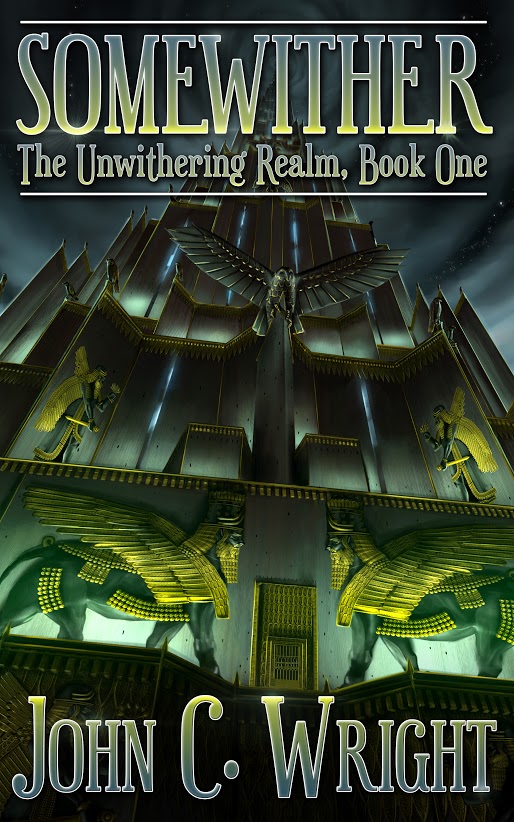
John Wright is pleased with Jeremiah’s artwork for the first volume in his Unwithering Realm series, Somewhither, which will be coming out in April. And if you’re interested in supporting an esoteric, but worthwhile project, Castalia House blogger Ken Burnside and Ad Astra game developer needs just $2k more in order to fund his AVID Assistant via Kickstarter.
Speaking of Castalia, we’ll have a new offer going out to the New Release Subscribers next week, but for various reasons I’m not going to bother going into, we will be releasing not just one, but TWO new books the week after that. I’d like to find 10 volunteers to review both of them, so if you’ve got the interest and the intellectual chops to handle either Equality: The Impossible Questor The Art of War: The History of Military Strategy, both by Israeli military historian Martin van Creveld, email me with EQUALITY or WAR in the subject. UPDATE: have all 10 for both books, thank you.
The former is conceived as the third in a conceptual trilogy with Plato’s work on Justice and J.S. Mill’s work on Liberty, whereas the latter features a foreword by none other than Dr. Jerry Pournelle himself, who describes van Creveld’s work as “a necessary supplement to Clausewitz.” It’s a short, but as you can probably imagine from that description, brilliant history, and anyone who has appreciated Mr. Lind’s work is going to find it fascinating and educational. Thanks to Chris Kallini, who did both of the van Creveld covers.
Pratchett never won a Hugo or Nebula award. Neither awards have ever known what to do with humorous/satirical SFF. Both awards failed to live up to the imagination that Pratchett showed in his best work: it’s easier to celebrate the serious and prestigious than the fantastic. Our field should have done better. Pratchett did receive Nebula nominations late in his career, in 2006 (Going Postal) and 2009 (Making Money). Neither are among his best books. Mort, Guards! Guards!, and Small Gods all would have been worthy winners, but I’d draw your attention to 2003, the year that Robert Sawyer won the Hugo for Hominids. Pratchett published The Night Watch in 2002, a twisty time-travel caper, that would have been an outstanding winner for that year.
I am proud to be able to say that I am among those SFWA members who were responsible for both the 2006 and 2009 Nebula nominations. (I also used to regularly nominate Charles Stross for awards, to little avail, back when he actually deserved them.) The fact that Terry Pratchett wasn’t even being NOMINATED when the likes of Catharine Asaro were WINNING was one of the things that first led me to believe there was something very, very rotten in the state of SF/F awards. Here is the review of Going Postal I posted on this blog in September 2004. In case you’re wondering how the review could have been posted in 2004 while the nomination was in 2006, it was because a) the Nebula schedule was bizarre back then, and b) I received a pre-release review copy of it.
In fairness to the Hugos, Pratchett also received a belated Hugo nomination for Going Postal, but he declined it. It’s hard to believe he didn’t even receive a nomination for his best book, Night Watch, in a year when the likes of Picoverse, The Other Wind, Solitaire, Passage, The Curse of Chalion, The Chronoliths, Cosmonaut Keep, and The Bones of the Earth did.
British fantasy author Sir Terry Pratchett has died aged 66 after a long battle with Alzheimer’s disease, his publisher said today.He sold more than 85 million books worldwide in 37 languages, but also waged a very public struggle with Alzheimer’s disease in recent years – and was a vocal campaigner of the right to die.
The author is best known for his satirical fantasy novels set in Discworld, a flat planet resting on the back of four elephants, themselves perched on the back of a vast turtle moving through space.
After avoiding them for years, I eventually came to enjoy many of Mr. Pratchett’s books and consider him to have been rather underrated as a writer. I hope, for the sake of his literary legacy, that his death will be sufficient to prevent him from writing any more books.