The Federal Reserve is wrong again

I don’t mean wrong in the sense that they have announced that the economy is recovering, but it really isn’t. Well, yes, they’re wrong in that regard too, but I have something a little more specific and immediately verifiable in mind:

The Fed’s forecasts, released as part of the minutes from its April meeting, show that its staff now expects the unemployment rate to rise to between 9.2% and 9.6% this year. The central bank had forecast in January that the jobless rate would be in a range of 8.5% to 8.8%, but the unemployment rate topped that in April, hitting 8.9%.

Mish notes the fact of two Fed forecasts, one in January and one in May. Each declared a maximum U-3 unemployment rate, first 8.8 percent, then 9.6 percent. Today, the BLS announced that U-3 unemployment hit 9.8 percent, with U-6 unemployment at 17 percent.

Note that the Fed’s vast team of academic economists armed with PhDs can’t get to within 98 percent precision in two tries, the latter only four months out, while I was able to forecast U.S. housing prices at 99.3 percent accuracy eleven months in advance. (The mid-range of their nine-month forecast was only at the 88.8 percent level!) Now, bearing in mind that I have absolutely no idea what the price of money or the size of the money supply should be, why in the name of the netherest nether Hell should anyone believe that they do?


Reading List

1. We are Doomed by John Derbyshire

2. Ilium by Dan Simmons

3. Cool It by Bjorn Lomborg

End the Fed by Ron Paul: 10/10. I’ll be reviewing this in more detail soon and have requested an interview with him. A fascinating book; it significantly surpassed my expectations.

The Empire series by Conn Iggulden: 6/10. Lightly alternative historical mind candy. It was entertaining enough and the man clearly did his homework, but I still don’t see the point of trying to turn Brutus and Caesar into David and Jonathan just to get a bit more dramatic bang out of that final “et tu, Brutus?” The relationship was never really convincing and it weakened Caesar’s character significantly. Caesar winds up coming off a bit schizophrenic, as Iggulden is forced to juggle between portraying the historical Caesar capable of his astounding actions and the kinder, gentler romantic that Iggulden wants him to be in order to serve the story. Brutus, on the other hand, would be convincing if only he wasn’t the bestest blade in the West… I mean, Rome.

The Painter of Battles by Arturo Perez Reverte: 8/10. A brutal book by a very good writer. Introspective and sparse, it paints an intriguing portrait of the narcissistic and unintentional evil of the compartmentalized intellectual. Shows definite flashes of greatness which are countered by occasional periods of textual tedium. The sort of book that leaves you staring at the ceiling afterward, contemplating Man’s capacity for pointless depravity.

The Mind of the Market: Compassionate Apes, Competitive Humans, and Other Tales from Evolutionary Economics by Michael Shermer: 7/10. I reviewed it at WorldNetDaily.


After the storm, or eye of it?

The Economist assumes the former. The facts suggest the latter:

Despite a welcome return to growth, the world economy is far from returning to “normal” activity. Unemployment is still rising and much manufacturing capacity remains idle. Many of the sources of today’s growth are temporary and precarious. The rebuilding of inventories will not boost firms’ output for long. Across the globe spending is being driven by government largesse, not animal spirits. Massive fiscal and monetary stimulus is cushioning the damage to households’ and banks’ balance-sheets, but the underlying problems remain.

Auto sales collapsed to the level of previous lows as soon as the government funding was withdrawn. The same thing is going to happen to the rest of the economy, especially since most of the recorded “growth” in GDP is actually the result of a decline in imported goods sold. In the second quarter, the $71.2 billion fall in imports contributed more to GDP than the $41.4 billion increase in government spending.


Post demand-pull

And this is what happens when the demand curve snaps back. As soon as C4C ended, Ford and GM sales both dropped 37 percent. Credit-fueled demand never lasts once the money spigot is turned off.

Jun: Ford 153,210, GM 174,850
Jul: Ford 165,279, GM 188,156
Aug: Ford 182,149, GM 246,479
Sep: Ford 114,655, GM 155,679

According to Reuters, Ford had a 17.3 percent market share in June, prior to C4C, which suggests a September total of 660,000. GM had a 20.4 market share, indicating 760,000. Taken together, it comes to an estimate of 710,000 monthly sales and an 8.5 million annual rate.


Ron Paul on The Daily Show

Once again, an excellent performance by Dr. Paul. It was almost flawless, as the only thing he missed was to point out, in answer to one of Stewart’s questions, that corporations are government entities created by governments. I just received my copy of End the Fed from his publisher and will be reviewing it soon.


Not the best start

Gene Quinn, a defender of patent law and IP, lays down an impressive challenge:

I challenge anyone to a debate on this topic anywhere, at any time, to be moderated by a mutually agreed panel or moderator. I know as well as everyone here that I will never be taken up on that offer. I wonder why? If I am so stupid and irresponsible and ignorant then someone take me up and prove to the world I am as such. Of course there will be no takers because in a true debate none of the nay-sayers stand any chance and would be exposed for what they truly are. Nevertheless, the challenge is made. I am sure the silence will be deafening. Or wait, even better… the response will be “there is no point in debating you because you are .” We all know that is what they are going to say, and rational people will understand that to be nothing more than cowardice.

Really? In order to disabuse Mr. Quinn of his belief in the cowardice of IP opponents, I sent him an email inviting him to a debate on the matter in Europe next spring. It will be interesting to see if he genuinely meant what he wrote or if it was mere rhetorical bluster. Being the holder of some IP myself, I’m far from a militant on the issue and am quite willing to be convinced if Mr. Quinn can present a compelling case, but at present I am deeply, deeply skeptical of the economic benefit of intellectual property protections by government.

Stephen Kinsella of the Mises Institute also didn’t hesitate to dispel Mr. Quinn’s doubts about the willingness of IP skeptics to take him on. Kinsella is far more versed on the subject than I am, but since I have more actual experience creating IP than he does, I expect our approaches would vary greatly.

UPDATE – The gentleman is well up for the challenge. We’ve exchanged email and if we can manage to coordinate things next spring in the venue I have in mind, will debate the issue then. I’ll be sure to arrange that either a transcript or a video will be made available.


2nd Letter to Vox Day

Luke responds. Read the rest of his letter at Common Sense Atheism.

Vox,

Thanks for your reply. I’ll break this letter into sections for easier reading. I wish we had fewer differences to write about!

1. Research and discussion
You asked me why so many atheists want to discuss religion with you before reading your book on the subject. But that’s not an atheistic tendency. It’s a human tendency. We are all short on time. But I know how you feel. Every week I am barraged with questions about ethics that are answered in my short and well-organized Ethics F.A.Q., which is linked from above the fold on every page of my site!

I have skim read your book, enough to know that you and I agree about much of what the New Atheists have written. But no, I did not read every word. I have not browsed your blog archives. And I wouldn’t expect you to read my book or blog archives, either. I think we can clarify our views for each other well enough as we go along.

This was written in reply to my previous letter.


The approaching precipice

Lest you wonder why I was confident enough to take such a firm position with the title of the new book:

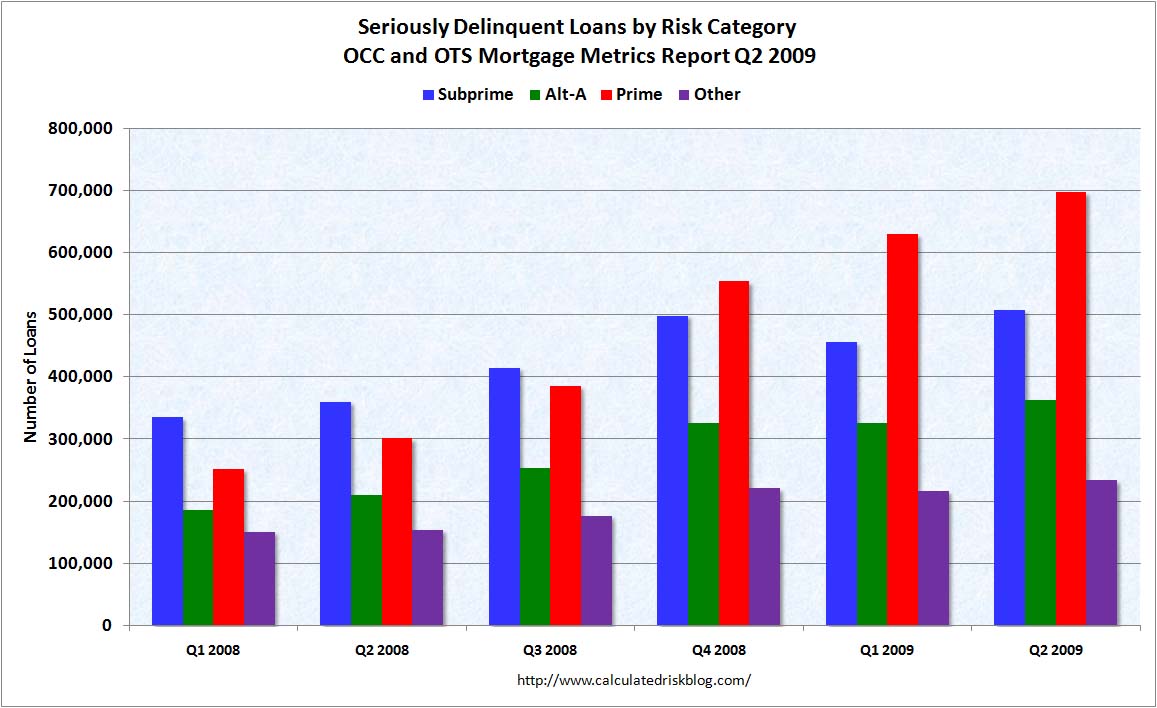
This OCC and OTS Mortgage Metrics Report for the second quarter of 2009 provides performance data on first lien residential mortgages serviced by national banks and federally regulated thrifts. The report covers all types of first lien mortgages serviced by most of the industry’s largest mortgage servicers, whose loans make up approximately 64 percent of all mortgages outstanding in the United States. The report covers nearly 34 million loans totaling almost $6 trillion in principal balances and provides information on their performance through the end of the second quarter of 2009 (June 30, 2009)….

The percentage of current and performing mortgages in the portfolio decreased by 1.4 percent from the previous quarter to 88.6 percent of all mortgages in the portfolio. All categories of delinquencies increased from the previous quarter, with serious delinquencies—loans 60 or more days past due and loans to delinquent bankrupt borrowers—reaching 5.3 percent of all mortgages in the portfolio, an increase of 11.5 percent from the previous quarter. Foreclosures in process reached 2.9 percent of all mortgages, a 16.2 percent increase.

First, keep in mind that “The subprime losses of $150 billion in 2007 required US government aid of $13.2 trillion as of 19 June 2009”. Now, do the math reported above. 88.6 percent of the $6 trillion in mortgages are current. 11.4 percent representing $684 billion are not. Some of those late mortgages will cure, but most will not. Assuming that the 36 percent of mortgages not represented in the report reflect similar percentages, that indicates potential defaults in the realm of $1.1 trillion dollars assuming that the default rate does not continue to rise. The chart below indicates that this is unlikely. Since average losses on foreclosures are reported as $45,000 (Banker & Tradesman) and $60,000 (Freddie Mac), this indicates an average loss per mortgage of around 30 percent, which means that the banking system will have to absorb at least another $330 billion in losses, of which $81 billion is already in process even if no more homeowners fall behind on their mortgages!


Friedman addresses the wrong audience

But why let a chance to wax dramatic about the possibility of an assassination go by?

Sometimes I wonder whether George H.W. Bush, president “41,” will be remembered as our last “legitimate” president. The right impeached Bill Clinton and hounded him from Day 1 with the bogus Whitewater “scandal.” George W. Bush was elected under a cloud because of the Florida voting mess, and his critics on the left never let him forget it.

And Mr. Obama is now having his legitimacy attacked by a concerted campaign from the right fringe. They are using everything from smears that he is a closet “socialist” to calling him a “liar” in the middle of a joint session of Congress to fabricating doubts about his birth in America and whether he is even a citizen. And these attacks are not just coming from the fringe. Now they come from Lou Dobbs on CNN and from members of the House of Representatives.

Again, hack away at the man’s policies and even his character all you want. I know politics is a tough business. But if we destroy the legitimacy of another president to lead or to pull the country together for what most Americans want most right now — nation-building at home — we are in serious trouble. We can’t go 24 years without a legitimate president — not without being swamped by the problems that we will end up postponing because we can’t address them rationally.

The only questions about Obama’s legitimacy are those result of Obama hiding his records. Obama could end the questions about his legitimacy in about five minutes; if Friedman is genuinely worried about the issue, he should join Joseph Farah and Lou Dobbs in demanding the complete release of all records that are even remotely relevant to it.

The cold reality is that despite all their hand-wringing about potential dangers to Obama, there are few things the American Left would like better than to see him become a martyr to the cause. It’s already apparent that as president, Obama will be an ongoing series of political disasters for the Left for another three years and possibly seven. But as a martyr, he would be useful for generations.

Friedman’s disingenuousness is highlighted by Jonah Goldberg, who points out the irony of a fan of Chinese communist autocracy feigning concern about American liberal democracy.


The FDIC can’t borrow solvency

I’ve been repeatedly asserting that the FDIC’s Deposit Insurance Fund has run dry, while most economic sites have been insisting that the running DIF balance doesn’t actually matter because the FDIC has access to the $500 billion credit line with the Treasury established in May. That argument never quite made sense to me. Someone who is bankrupt is still bankrupt even if someone else promises to lend him more money, because taking that loan would only increase his liabilities and put him in a worse position than before.

This statement from the FDIC yesterday should settle the matter:

An alternative—borrowing from the Treasury or the Federal Financing Bank (FFB)— would also increase the liquid assets available to fund future resolutions but would not increase the Fund balance as there would be a corresponding liability recorded. Nevertheless, the FDIC has several options for returning the reserve ratio to the statutorily mandated 1.15 percent and meeting its liquidity needs.
Restoration Plan and Assessment Rates Staff projects that failures will peak in 2009 and 2010 and that industry earnings will have recovered sufficiently by 2011 to absorb a 3 basis point increase in deposit insurance assessments. Adopting a uniform increase in assessment rates of 3 basis points now, effective January 1, 2011, should ensure that the prepaid assessments would address current liquidity needs without materially impairing the capital or earnings of insured institutions. Advance adoption of the rate increase also should help institutions plan for future assessment expenses….

In staff’s view, requiring that institutions prepay assessments is also preferable to borrowing from the U.S. Treasury or the Federal Financing Bank (FFB). Prepayment of assessments ensures that the deposit insurance system remains directly industry-funded. Additionally, staff believes that, unlike borrowing from the Treasury or the FFB, requiring prepaid assessments would not count toward the public debt limit. Finally, collecting prepaid assessments would be the least costly option to the Fund for raising liquidity as there would be no interest cost.

In other words, the FDIC is doing essentially the same thing as Cash for Clunkers and every other federal stimulus program by spending tomorrow’s cash today in the hopes that it will allow them to survive long enough until the recovery magically begins. They’re gambling that $77 billion in cash and liquid assets will be enough to get them through 2009 and 2010.

Of course, this strategy is predicated on the worst case being the “jobless recovery” scenario. These reserve ratio projections from mid-2007 should demonstrate the precision and reliability of their forecasts – their worst case scenario for 2009 was 1.18 percent vs 0.27 percent for last quarter. And given that they’ve already blown through at least $45 billion in the first half of 2009 alone, (they admit to $25 billion in the report, but the FDIC Quarterly shows otherwise), I expect that even with three years of pre-paid assessments, the DIF will run dry again before the third quarter of 2010. Notice that the requirement to return the DIF to the statutorily mandated minimum reserve ratio of 1.15 percent has been increased twice in seven months, giving them eight years just to get back to normal. And notice that they’re announcing their intention to hide the data henceforth because the DIF as previously calculated is empty and the reserve ratio is negative.

Near the end of the third and fourth quarters of 2009, if there is a reasonable possibility that the reserve ratio has declined to a level that could undermine public confidence in federal deposit insurance or to a level which shall be close to or below zero, staff will estimate the reserve ratio for that quarter from available data on, or estimates of, insurance fund assessment income, investment income, operating expenses, other revenue and expenses, and loss provisions (including provisions for anticipated failures).

On a tangential note, there’s some evidence that the loss-share deals the FDIC is striking with banks that are acquiring the asserts of failed banks are driving up foreclosure rates, thus putting more downward pressure on housing prices. And if that’s not bad enough, Denninger is now calculating that the entire banking system is insolvent, since it faces the absorption of a conservatively estimated $869 billion in single-family mortgage defaults alone.

“The entire banking system and likely The Fed, given the quantity of Fannie and Freddie paper it has been and is “eating”, is insolvent. These facts are why the government is lying – they’re well-aware of the near-zero cure rates and know that these facts mean that the banking industry has nowhere near sufficient capital to withstand these losses without folding like a paper cup getting stomped on by an elephant. (Remember that these numbers do not include any commercial real estate losses and we have found that banks are frequently over-stating their claimed values for these loans by 50% or more – as was seen with Colonial.)”