Evil globalist fights nationalism

George Soros is spending big to try to overturn Brexit:

Billionaire George Soros has handed £400,000 to a campaign fighting to stop Brexit, it was revealed today. The investment mogul is one of the biggest donors behind the Best For Britain group launched by Gina Miller.

The scale of the financial backing will raise alarm among Brexiteers, with fears running high that the process of leaving the EU could be watered down or even halted altogether.

Former Ukip leader Nigel Farage said people were starting to ‘wake up’ to the danger of the referendum vote being reversed.  Mr Soros previously said it was possible that the UK would apply to rejoin the European Union soon after Brexit.

Hungary has it right. Any organization that Soros funds or controls should be outlawed. These evil people are straight out of 1984, attempting to subvert the clearly expressed will of the people in the name of “democracy” and “the open society”.

I note that the Fake Right opposes Brexit and nationalism too. It’s just a coincidence, right?

Meanwhile, nationalism is rising again in Ireland.

Luke O’Connor applauded and cheered with gusto and occasionally leapt to his feet during speeches at the Irexit conference for those opposed to Ireland’s membership of the European Union. The 21-year-old Kilkenny student warmed to the praise lavished by former Ukip leader Nigel Farage on US president Donald Trump and the Brexit-like political earthquake he unleashed in 2016. O’Connor wore a Trump-campaign “Make America Great Again” red baseball cap to the Saturday conference at the RDS in Dublin.

“I honestly get a great reaction. I would wear it on nights out,” he told The Irish Times. “I am hoping something comes of this, if not a party that we can get candidates to run in the European elections, that we even have a voice.”

The DCU student was typical of most attendees at the event, organised by Hermann Kelly, spokesman for the Ukip-led Europe of Freedom and Direct Democracy group in the EU Parliament. O’Connor is young, male and felt like his was a voice not heard in Irish politics or the media.

Their time will come. Their great-grandfathers fought to be free from Great Britain. They will fight and their children will be free of the European Union. I expect Irexit to take place within 10 years, assuming that the European Union hasn’t collapsed by then.


EXCERPT: Mutiny in Space

Mutiny in Space, by Rod Walker, is an excellent coming-of-age tale in the tradition of the Heinlein juvenile.

Ducarti produced an envelope, an expensive-looking thing embossed with the official seal of the Social Party. “One of the Party’s projects has been to circulate a petition demanding an increase in the estate tax to seventy-five percent. We now have adequate signatures to require a referendum. It should be one hundred percent, but sometimes it is better to eat the steak in small bites than to choke on the entire thing.” He offered it formally to Sergei in both hands. “I want you, as the youngest member of the Social Party on New Chicago, to present this petition at the appropriate government office.”

“Me?” said Sergei, his eyes widening. “That’s… that’s a really big honor, sir.”

“Oh, it is,” said Ducarti, still grinning. “It most certainly is. As the face of the Social Youth, as a true son of the Revolution, I think you are the perfect man to deliver our message.”

“I will go at once,” said Sergei.

“Good man. Also, as our official representative and voice, I insist you take one of the Party’s vans, emblazoned with the red hammer of the worker raised against the spiral of the galaxy. Think of what a sight it will make when the van pulls up, and every eye turns towards you, and you stride forth to present our petition to the corrupt, illegitimate authorities of New Chicago. We shall, of course, alert the media, so that the moment will be recorded.”

“Absolutely,” said Sergei proudly. “I’ll do it.”

“I’ll go with you,” said Mom. She smiled at Ducarti. “I would like to see my son take his first steps in service to the Revolution.”

“As you wish, Professor. And you, Nikolai?” said Ducarti, the cold eyes turning back towards me. “Will you accompany your brother as he assumes his birthright among the men of the Social Party?”

“No,” I said, stepping back. “I’m going home. I’ll walk. I don’t want to ride in a Party van.”

“As you wish, boy,” said Ducarti, still smiling, although it now struck me as more cruel than sardonic. “Go home. Go play with your engines. The Revolution does not require you yet.”

A gale of laughter went up from the Party members, and even Mom and Sergei joined in with the others. That hurt more than I would have thought. I whirled around so they could not see my burning eyes and I stalked from the warehouse without another word.

My defiance, combined with Ducarti’s contempt, saved my life.

I went home, but because I wasn’t watching the news, I didn’t see what happened. As soon as Sergei and Mom left in the van, Ducarti returned to his ship and immediately launched. From his ship safely in orbit, he monitored the progress of the van, watching until it reached the central planetary administration building fifteen miles from the spaceport.

Once the van reached the offices, in full view of the cameras that had been alerted, the fusion bomb hidden within the van was triggered.

Sergei and Mom were killed instantly, of course.

The forensics techs finally found some of Sergei’s teeth and a piece of Mom’s femur, but nothing else. Five thousand, six hundred and ninety-two people were killed in the explosion and the resultant collapse of the nearby buildings, and over eighteen thousand were hurt or wounded. The minute the bomb went off, Ducarti left the system, escaping to hyperspace before the system defense ships could close in on him. But before he hyperjumped away, he sent out a broadcast announcing that the bomb was an act of revolutionary justice against the planetary government and people of New Chicago for failing to embrace the principles of Sociality.

The reaction was as swift as it was violent.

The next day, the planetary government of New Chicago by an executive order of the emergency commission outlawed the Social Party. A lot of people were arrested over the next month, including most of the non-science faculty of the University. Pretty much every official in the local Social Party leadership was executed without trial as a co-conspirator, whether they had actually known about it or not, and a lot of other people were charged with various crimes.


Mailvox: the deadly high end

Just to be clear, I’m most definitely NOT singling out L’Aristokrato here. He is very, very far from the only person to blithely suggest going out and hiring other artists for our various comics, he just happens to be the individual to whom I responded on the subject. This is actually an important lesson in entrepreneurship concerning a very common misapprehension, so there is no need to get defensive or argumentative, just pay attention and think through what I’m telling everyone. My original response is in italics.

More importantly, however, I believe you need to look into getting at least one, or two high level artists as part of your crew.

Your beliefs are absolutely wrong and indicate a complete lack of business experience. No one ever successfully disrupts a market from above. As a matter of fact, there is a new company that is going about it your way. Top artists, paying them all top page rates. I will bet they’re gone within 18 months of their first publication. Sure, you get more attention. Lots of critical praise. But it only lets you hit a double instead of a single, and you need to hit a home run just to stay afloat.

I’m not sure why you’ve taken my comment so personally as to feel the need to add a baseless jab at me, instead of simply pointing out why you think I’m wrong. Though your observation is amusing, considering both that you know nothing about me, and that I’ve created and owned several successful businesses for sixteen years. More to the point though, it’s true, I don’t know much about “disrupting a market”; That’s not an angle I’ve ever tried, or had to try, given the areas I work with, so it’s entirely likely my observation is incorrect.

However, I didn’t take it personally. He just said something very, very stupid that I have heard dozens of people say since October. It is irritating and unasked-for advice, and it is frequently offered in a smug, knowing tone: “You know what you need to do…” No, I don’t fucking need to do that. To the contrary, following that idiotic advice would be fatal.

I have seen more than a few people, including my father, try to start a new business aimed at the high end of the market. Every single one of them failed. Not most of them, ALL of them. Every single one.

Now, L’Aristokrato may never have disrupted a market personally, but he has certainly seen new companies enter new markets throughout his life. When Honda entered the US car market, did they aim at the high end or the low end? How about Kia? When Diamond entered the video card market, did they come in as a low-cost provider or a high-end one? This is basic Business 102 stuff.

If you want to succeed in entering an existing market, the first and foremost objective has to be staying alive to play in the next round. And your ability to stay alive depends upon your resources. Sure, Mercedes can enter at the high end. So can Samsung. But a startup? No. See, we could have spent all the money from the Alt-Hero kickstarter on a single, beautiful, gold-plated 24-page issue using the most expensive artists we could hire. It would have been talked about and critically praised… and we would have gone out of business almost immediately.

Do you know how many pages of top-quality illustration $250,000 buys? 200 pages. And that’s without script, without color, without lettering, without print charges and without shipping. We are committed to producing 576 pages (990 with Will Caligan’s comics), and we have already finished the illustrations for about 80 of them.

Do. The. Math.

Look, I’m not at all sensitive about this and I’m not trying to be harsh. The problem is that this advice is not merely ill-considered and ignorant, it is downright lethal. If we were clueless enough to follow it, we would almost certainly fail. Unlike most people, I’ve actually seen this approach play out up close and personal. My father briefly published a magazine called People & Politics in the 1980s. He spent lavishly on it. It was beautiful, it was the highest-quality political journalism anyone had ever seen at the time, it featured in-depth interviews with every major political player from both parties, and it was universally praised for its ruthlessly even-handed approach. It even sold well, remarkably well for a brand new local magazine.

But it didn’t sell enough to break even. Not even close. I don’t think it even lasted a year.

And then, I saw one low-end Taiwanese company after another enter the graphics board business. None of their products were even close to as good as my father’s cards. We kept retreating to the high end, from 1024 to 1280 to 1600 resolution. And our market share kept shrinking, until in desperation they tried to make a move into the chip market before the boards were replaced entirely by GPUs on the motherboard. It failed, for reasons that I’ve mentioned before. That company, once an $80 million company, has been dead for 20 years. That is why I know all about how markets are, and are not, successfully disrupted.

So we’re not trying to compete with Marvel, DC, Image, and everyone else on the art. We don’t have the resources for that yet. Sure, we want the art to be as good as we can make it, and that’s why I’ve hired a number of industry vets like Chuck, Frank, and others whose names you would recognize. But we’re not going to compete on the art, we’re going to compete on a) the characters, b) the storytelling, c) the worldbuilding, d) the price, and, e) discount and availability.

And, of course, we’re not going to shove the latest SJW Narrative in your face, unlike Batgirl, Superman, Thor, and whatever other comics have been converged lately. Will we succeed? Only time will tell. But if you want to give me advice, please have the courtesy to know what you are talking about, understand what the logical consequences are, and at the very least, be sure that your numbers add up.

In answer to some related questions from Scotty:

Why handicap a book with less appeal? Isn’t this part of the problem with SJW comics? Why not give it every strength and every advantage to increase success? You want to compete with Batman and Spider-man, right?

  1. Cost vs expected sales.
  2. No, that’s a totally different issue.
  3. Because maximizing strengths and advantages means maximizing cost and maximizing risk. That is not how to maximize one’s chance of success.
  4. Hell no! We absolutely don’t want to compete with Batman and Spider-man yet. We know we can’t. We want to compete with the comics that are in the #200 range, not the top 10.

Progress and polarization

An interesting analysis of the death of the American newspaper:

Traditionally, a U.S. newspaper relied upon three revenue streams, roughly one-third each: subscriptions, commercial advertising, and classifieds. First, the Internet ate the classifieds (see Craigslist), then moved on to some of that display stuff. It is this which is blamed for the decline of the industry and the associated calls that Google and or Facebook should cough up some money to revive it.

Much more important, though, is geography. The U.S. is a big country. You could drop the average European country into it and not really notice. A result of this is that U.S. newspapers were, largely speaking, a series of regional monopolies. This was down to the same network effects that people use to complain about Facebook today. Once you’re getting the majority of the classifieds in an area, for example, you’ll end up getting almost all of them. People read the section because that’s where the ads are, people advertise there because the readers are there, and so on. And as above, classifieds were a very important part of newspaper financing.

But note my point here about those regional monopolies. Apart from the very largest cities, there was usually only the one major paper. And there was another one of those every … well, that’s the geography-dependent part. The U.S. rail network has never been very fast at the distribution of either goods or people. It’s optimized for bulk commodities like coal, iron ore, and the like. But getting something printed this evening to somewhere 400 miles away before breakfast? Not so much. Thus, each major urban center, perhaps some hundreds of miles from the next, had its own newspaper ecology.

Now along comes the Internet. Our local monopolies created by geography are now broken. It’s that, much more than the loss of one or more revenue streams, which is leading to the change. We simply do not need 50 or 200 major newspapers all trying to tell their readers about everything. It can be, and therefore will be, managed with very much fewer than that.

In other words, journalists now in the position of the buggy whip manufacturers they always used to enjoy mocking as people whining about inevitable progress. And here I thought journalists were supposed to be progressives!

This means that we’re not actually seeing a development of an Alt-Media so much as we’re simply seeing the centralization and polarization of the media play out as it has in Britain. Whoever makes the shift to be the national conservative newspaper will survive, almost all of the others will eventually be devoured by the Left Opinion Leader paper (The New York Times), the Establishment Government paper (The Washington Post), and the Establishment Business paper (The Wall Street Journal).


The NFL cheerleaders are next

Formula One abolishes its grid girls:

Walk-on grid girls were axed from Formula One today as the motorsport followed the move within darts to get rid of glamour women. F1 bosses said they will no longer use grid girls from this current season which starts in Australia in two months’ time because it is not in keeping with their ‘brand values’.

The move mirrors the Professional Darts Corporation’s decision last week to end the long-established practice of women escorting male players to the stage. The changes will also apply to other races which take place on grand prix weekends and will come into play from the Australian Grand Prix in Melbourne on March 25.

Sean Bratches, F1 managing director of commercial operations, said: ‘Over the last year we have looked at a number of areas which we felt needed updating so as to be more in tune with our vision for this great sport. While the practice of employing grid girls has been a staple of Formula 1 Grands Prix for decades, we feel this custom does not resonate with our brand values and clearly is at odds with modern day societal norms. We don’t believe the practice is appropriate or relevant to Formula 1 and its fans, old and new, across the world.’

London-based charity the Women’s Sport Trust had previously put pressure on F1 to drop its walk-on girls along with boxing and cycling, after the decision in darts. It tweeted last week: ‘We applaud the Professional Darts Corporation moving with the times and deciding to no longer use walk-on-girls. Motor racing, boxing and cycling… your move.’

It doesn’t matter who you are, how successful you are, or what you do. Sooner or later, SJWs are coming for you and your job.

Given that the NFL is even more converged than F1, can you really doubt that the league will be forcing the teams to get rid of their cheerleading squads soon?  After all, they are at odds with what we are reliably informed are modern day societal norms.

Note that as with GamerGate and ComicsGate, it is the SJWs in the media who are driving this effort to disemploy pretty women. And you know ESPN is going to be all over this next season; it’s going to be the next great cause for them.

I think the girls are great, they get paid and it’s a job for them. I haven’t got a problem. But I do have a big problem in the age we live in – I’ve got the BBC, ITV and Sky, my three UK broadcasters, saying to me this is not part of their editorial policy any longer. They do not want to show the walk-on girls on television.
– PDC Chairman Barry Hearn


Castalia House signs Chuck Dixon

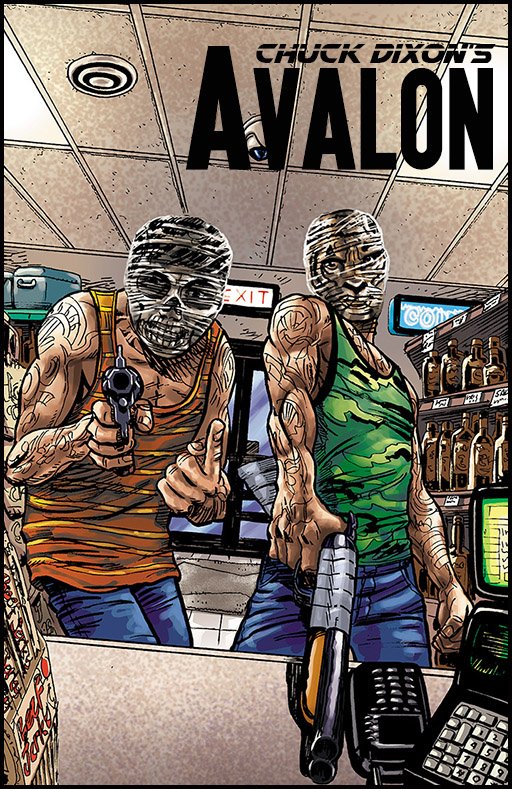
Comics legend Chuck Dixon is a man of action. And in addition to writing more comic book pages than anyone else outside of Japan, he has also written a number of novels, including the Bad Times series. It has been both a pleasure and a professional learning experience working with him on Alt★Hero and Avalon, so I’m very pleased to announce that Castalia House will be publishing nine of his books in paperback and audio editions this year.

And since I mentioned Avalon, I would be remiss if I didn’t give you a look at how the interior art for Avalon #1 is coming along. Needless to say, as befits his reputation, Chuck doesn’t waste any time before diving headlong into the action. We anticipate Avalon #1 being launched in both digital and print editions in March.


Anti-sports are perma-spammed

Just to be clear, I am no longer permitting any comments by the sports-hating Gamma crowd. Every anti-sports comment will be spammed on sight. Neither I nor anyone else cares why you don’t watch pro football, women’s badminton, men’s beach volleyball, or anything else, and we don’t appreciate your SJW-like attempts to interfere with what we happen to play, watch, and enjoy.

It was bad enough when the spaghetti-armed soyboys were littering every NFL thread with repetitive explanations of why they didn’t watch sports. (We already knew they didn’t ever play them.) But lately, they’ve been spamming unrelated threads with information about their non-watching habits and revealing far more than anyone ever wanted to know about their bizarre sexual obsessions.

I don’t care what people like or don’t like. And I am not interested in anyone’s opinions about what they don’t like and what they don’t follow. If you want to preach the gospel of hating sports for one reason or another, that’s fine, but do it on your own platform.

UPDATE: This was the fifth comment on this post: “Fat Boomers are giving up the NFL but not Vox “True Alt-Right” Day lol” So, I have turned off anonymous commenting on the blog because I have better things to do than clean up after the Fake Right. You will now have to be registered in order to comment here. You can thank the Alt-Retards for that. And they are so socially clueless that they will almost certainly hail this as a victory.

After all, nothing spells success like convincing people that you can’t be trusted not to shit all over the carpet.


The money drain

Immigration is more than just war. It is also a very expensive form of foreign aid.

According to a recent Pew Research report, records from The World Bank show that migrants residing in the U.S. sent a staggering $138,165,000,000 (USD) to family members in their home countries in 2016 alone. To name the top three countries that received the most in remittances, funds flowed out of the U.S. in the amounts of $1,754,000,000 to Mexico, $655,000,000 to Canada, and $459,000,000 to the United Kingdom. $28,126,000,000 to Mexico, China $15,418,000,000 to China, and $10,657,000,000 to India.

Keep in mind that the estimated annual economic effect of immigrants, whether positive or negative, is generally considered to be less than one percent of GDP. Since US GDP was 18 trillion in 2016, and since these remittances are NOT included in those estimates, that means that these remittances either a) cancel out the positive effects or b) double the negative effects.

There is no longer any question that immigration is not only bad for the nation and bad for society, it is bad for the economy too.

UPDATE: The author of the article confused incoming remittances with outgoing. Corrected from the original data.


EXCERPT: Hitler in Hell

This is an excerpt from HITLER IN HELL by Martin Van Creveld. We expect the hardcover edition to be available in March.

If the years 1919-22 were bad for Germany, 1923 in many ways was much worse. Our poor country was reeling from the aftereffects of the largest, bloodiest war in history until then. To top it all, our enemies were plundering our exhausted people for all they were (not) worth. In December 1922 the German government, forced by necessity, defaulted on a payment of 135,000 meters of telegraph poles. That, nota bene, is almost enough to cover the entire distance from Magdeburg to Berlin or from Philadelphia to New York. In the next month the French and Belgian governments used this fact as an excuse to send in troops to occupy the Ruhr, our most important industrial district by far. On their way they killed approximately 130 German civilians who dared protest. Military resistance was impossible; after all, we no longer had an army. Instead, a general strike was proclaimed.

The occupation did not pass without impacting the rest of the country. Before the war, the mark had been valued at 4.20 to the dollar. By the end of 1919 the figure stood at 32, rising to 800 two and a half years later. With the occupation of the Ruhr all attempts to slow the fall came to a halt. In November 1923 4,210,500,000 marks were needed to buy a single dollar. Countless decent people who had worked and saved all their lives were ruined. So fast did the cost of living index rise that, as noon came, weekly wages paid in the morning no longer sufficed to buy a loaf of bread at noon. People used bank billets to cover their walls or to kindle their hearths. Unable to trust the Reich, many communities started printing their own Notgeld, or emergency money. It took the form of printed bills and cardboard “coins” (many were quite humorous, by the way).

But there was nothing funny about large numbers of people who lost their jobs, froze, starved, and were forced to resort to barter in order to survive. Amidst all this misery a few souls were fortunate enough to have foreign currency. Native or foreign, they spent pennies while living like kings at the expense of all the rest.

Economic collapse was accompanied by artistic degeneration. The so-called avant-gardists of 1914 had become the heroes of the day. They called themselves rebels. Rebels, that is, against everything wholesome, healthy, and clean. They attacked the existing social order, covering both Munich and other cities with their filth. Sculptors, dramatists, and musicians, who imitated the American Negro “music” known as jazz, participated in the orgy. Decent citizens, decent Germans, could no longer recognize their own cities. It made me feel sick then just as, looking at the hordes of criminal “refugees” who are again flooding Germany, it does right now.

That, in turn, contributed to, though it certainly did not cause, the prevailing civil unrest. Wherever one looked troops were being made ready, arms stored, and conspiracies hatched. Some originated on the Left, others on the Right. What ought to be done no one knew. That something would have to be done everyone knew or thought he knew. The man to whom most people looked in this context was, once again, Ludendorff. As early as February 1919 he was able to return from Sweden, where he had gone after the armistice. Now he lived in Munich, where every sort of right-wing movement did its best to harness him to its cart. It was Hess who, in 1921, introduced me to him. He was, however, no longer the man he had been. One problem was his friend, and subsequent second wife, Mathilde. A feminist she was (she believed the future would prove that men and women were equal, intellectually), as well as a trained mad-doctor and self-appointed philosopher. Dressed in a sort of chiffon tent, she made a strange spectacle. But that did not prevent him from accepting her and allowing her to (mis)lead him into all sorts of bizarre directions.

Another more important one was that Herr General Ludendorff, like so many German officers, was very bad at politics. He was too rigid and too concerned about his personal honor as a one-time Feldherr. His name was useful and brought us some supporters. But not many. After all, he was a Prussian. And in Bavaria Saupreussen, “Swinish Prussians,” were not exactly beloved.

Ludendorff or no Ludendorff, amidst the general chaos our Party flourished. By the end of 1923 we had 55,000 registered members. Early in September, joining forces with some veteran organizations, we were even able to hold a rally attended by 100,000 people, no less. Scant wonder I was becoming known, quite rightly, as “the king of Munich.” Then and later, we differed from the traditional parties in that we turned to, and succeeded in attracting, people from every class of the population. By my estimate, about a third were workers. They were rough men—I shall say more about the women later—equipped with hard fists they were quite ready to use when necessary. About half came from a petite bourgeoisie background; craftsmen, shopkeepers, teachers, white-collar employees, and farmers. And somewhat more than a tenth belonged to the upper middle and professional classes.

Prominent among the last-named was Herman Göring. Göring was the son of the first governor of German West Africa. He had grown up in a castle, Burg Mauterndorf, not far from Salzburg. Ex-fighter pilot, war hero, and holder of the Pour le Mérite, he had ties with “high society” that proved very useful to us. Later on he became my deputy in all but name. We even had a few real blue-blooded aristocrats. If there were proportionally fewer of them than in the general population, then that was due to the fact that, as a rule, I did not like them much. The best-known one was our future youth leader and Gauleiter of Vienna, Baldur von Shirach. Another was Count Wolf-Heinrich von Heldorf, the Berlin chief of police who was later involved in the plot of 20 July 1944 and whom we hanged for his pains.

Who first suggested the idea of mounting a Putsch I can no longer remember. Nor does it matter since in the end it was I, and I alone, who took responsibility and gave the relevant orders. The Bavarian Prime Minister at this time was Eugen von Knilling, a civil servant and parliamentarian who had long served the Wittelsbach Dynasty. He, in turn, appointed Gustav von Kahr General State Commissar with near dictatorial powers. Those powers he could, and intended to, use to put down any kind of civil unrest. To help him do so the government in Berlin put the Reichswehr units in Bavaria, with General Otto von Lossow at their head, at his disposal. Colonel Hans von Seisser, who commanded the powerful Bavarian State police, was the third member of the unholy trio.

Lossow had a reputation for being a “strong man” who would mercilessly crush any opposition he met. True to his image, one of the first things he did was to ban fourteen meetings we had planned for the evening of 27 September. This was a move we National Socialists simply could not take lying down. My close collaborators, including both Scheubner-Richter and the commander of the fledgling SA, Wilhelm Brückner, told me their men were calling for action. But they might also, if nothing was done, turn their back on the Party and slink away. They might even go over to the Communists, who were very active at the time. Given the terrible economic climate, who could blame them if they did?

Our first plan, proposed by Rosenberg, was as follows. On Memorial Day, 4 November, a parade was going to be held. Among the participants would be an SA battalion, which was more or less all we had. To take the salute there would be Kahr and Crown Prince Rupprecht, who had commanded an army group during the war and was considered Bavaria’s number-one soldier, as well as several other high-ranking officers. We were going to make our faithful SA men assemble early so as to seize them. Next, it would be my task to approach them and persuade them to join us in marching on Berlin, toppling the government there, and setting up a new one. The SA men did in fact show up, only to find the guests of honor protected by a strong police force. There was nothing we could do except withdraw with our tails between our legs. So bad was the fiasco that our would-be targets never even realized that they had been targeted.

We fixed the next attempt for the night of 10 November. The date was chosen because it was a weekend when all officials would be at home and government would come to a halt. Again, however, our plans were frustrated when Kahr announced that he was going to hold a major speech two days earlier. Rumor had it that he was about to declare Bavaria’s independence from the Reich. That was something we could not allow to happen. So we moved the date forward to the night of 8 November.

The final meeting was held in Rosenberg’s house, but this time we took care not to let him participate in the planning. Instead, we had Captain Ernst Röhm. Röhm was a rough but very competent officer who had fought at Verdun, among other places. In one of those battles he had the upper part of his nose shot off. In 1923 he led a paramilitary organization known as the Reichskriegsflagge (Reich-War Banners).

Röhm’s connections in the Reichswehr proved invaluable to us. Cajoling and tricking his colleagues, he succeeded in obtaining sufficient arms and ammunition for his men and ours. We were even able to set up a heavy machine gun company under Göring. The total number of fighters was about 4,000, of whom 1,500 were SA men. The rest were provided by other organizations. Kahr’s speech was supposed to start at 20:00. The location was the Bürgerbräukeller, the largest of its kind in Munich. It offered enough room for 3,000 people.

When the evening came, the hall was packed to overflowing. In addition, many people, feeling that something dramatic was about to happen, gathered in the nearby streets. Kahr had been speaking in his lackluster way for half an hour when my special bodyguard, with Göring in charge, burst into the hall. Pandemonium broke out, and ere I could reach the podium, I had to mount a chair and fire my pistol into the air. That got their attention and quieted everyone down.

Making use of every ounce of drama at my disposal, I announced that the National Revolution had broken out.

Hit piece incoming!

Buzzfeed is taking up the baton from Bleeding Cool and intends to take the next crack at noted comic artist Ethan Van Sciver. Bounding Into Comics has both the loaded questions as well as Van Sciver’s responses.

BuzzFeed News looks to take the attacks on DC Comics artist Ethan Van Sciver to the next level. Reporter Rachael Krishna informed Ethan Van Sciver he would be the subject of an upcoming piece on BuzzFeed News.

She elaborated the piece would be “about ‘comicsgate’, more specifically accusations that [Ethan has] used [his] influence and power in the industry to encourage far-right harassment campaigns online and thet you have relationships with accounts involved in the targeted harassment of people in the comics industry.”

Krishna then goes on to say she’s “been told a number of anecdotes about [Ethan’s] behavior from other writers, illustrators, and people involved in comics.”

Those anecdotes include a number of debunked stories as well as instances that Ethan Van Sciver has already addressed. But since these attacks continue, Ethan spoke with us and addressed each of her supposed pieces of “evidence” against him. We will go through each of BuzzFeed’s allegations word for word and show Ethan’s response to each of the allegations. Each of the allegations are directly quoted from BuzzFeed News reporter Rachael Krishna.

BuzzFeed Allegation: By asking Darryl Ayo to appear on your show, then continuing to tweet about this, you opened him up for abuse from trolls and encouraged this.

Ethan’s Response: “Darryl Ayo is a stranger to me, and yet since last May, he has been sending tweets out that I am a White Supremacist and a Nazi. I am NOT a White Supremacist or a Nazi. I find racism deplorable, I find bigotry disgusting, and I have never engaged in racial politics or “Naziism”. My children are Jewish!!!

I am a moderate Republican.

Darryl’s tweets circulated, influenced other twitter users, confused my fan base and made their way back to me. This caused me and my family intense stress, to the point where we were afraid to travel because of personal threats we were receiving, all of them using the word “Nazi.”

I ignored Darryl, as he continued tweeting lies about me through August.

Soon, after having established a successful and growing YouTube page called ComicArtistPro Secrets, in which I endeavored to present left wing creators to my audience in a cooperative, conversational light, I grew brave enough to invite Darryl Ayo, who I believed was an intellectual left winger who simply didn’t know me at all, to my show to interview him, and hopefully humanize myself to him.

There would have been an enormous audience. Had I abused him in any way, I would have been condemned, dead to rights, on video. I wouldn’t have…I have a history on my channel of conducting interviews with viewpoints as diverse as Mark Waid and Vox Day. I allow them to speak, I let the audience decide.

Darryl declined to be on the show. He said it was midnight, which it was, but he was up tweeting, which is how he saw my tweet.

He then began to tweet horrible things about me, wanting to attack him, etc. I responded, incredulously, and we had a short spat in which I realized I wasn’t going to accomplish anything. I blocked him, he continued cursing my name…and continues to. My fans see my name, and they try to defend me. He tells them all, no matter how polite, to go f*** themselves. But the more he name drops me, the more my fans defend me, and the more his fans attack ME.

I quietly left twitter under the harassment.”

If you remember Ethan Van Sciver has been threatened with physical violence on multiple occasions. He was first threatened before an upcoming fan signing at Gotham City Pizza in Florida and then most recently if he happened to show up at Emerald City Comic Con.

And Ayo definitely referenced or called Ethan Van Sciver a white supremacist and a Nazi on several occasions.

You know, it is evident that by demanding that Ethan Van Sciver answer these questions, then continuing to write about this, Rachael Krishna opened him up for abuse from trolls and encouraged this.

This is obviously yet another case of SJW journalistic corruption, helping other SJWs guilty of harassment and online abuse deny their actions by reversing victim and offender. They do this because there are few things that SJWs hate and fear more than people who demonstrate their ability to effectively defend themselves against SJW attack.

Read the whole thing. All of Krishna’s very loaded questions are posted there.