Hair of the dog?

In which a vaccine for autism is posited:

A first-ever vaccine created by University of Guelph researchers for gut
bacteria common in autistic children may also help control some autism
symptoms. The groundbreaking study by Brittany Pequegnat and Guelph chemistry professor Mario Monteiro appears this month in the journal Vaccine.

They developed a carbohydrate-based vaccine against the gut bug Clostridium bolteae. C. bolteae is known to play a role in gastrointestinal disorders, and it often shows up in higher numbers in the GI tracts of autistic children than in those of healthy kids.

More than 90 per cent of children with autism spectrum disorders suffer from chronic, severe gastrointestinal symptoms. Of those, about 75 per cent suffer from diarrhea, according to current literature.

Thus raising the obvious question, how does C. bolteae manage to inordinately get itself into the intestinal tracts of autistic children?  It’s customary, at this point, to ritually denounce Andrew Wakefield and Jenny McCarthy. But ask yourself this question: if as much as 50 percent of the studies published in academic science are, to put it kindly, flawed, what are the chances that the oft-cited surveys funded by the vaccine manufacturers, (who, you will recall, are one of the very few industries that are not legally responsible for their products), are not?

To reiterate, I am not a “vaccine denier”.  Based on past discussions, I appear to understand the science and financial issues involved considerably better than most vaccine enthusiasts, including some medical doctors. I even got a tetanus vaccination myself only a few years ago. However, to understand that some vaccines are appropriate in some situations is very different than blithely assuming that all vaccinations are safe and appropriate in all circumstances.

It certainly fits with the break it and charge to fix it model that is presently so popular in the big business of modern medicine.


Mailvox: that which cannot survive won’t

Who Nose asks a pertinent question:

“If you want to understand why women are not permitted serve in Church
leadership, and why human societies do not survive more than a few
generations of young women being permitted to choose their own spouses”

It begs the question: Who ought to choose their spouses?

The Church?
The Father?
The Mother?
The State?

The question is further begged: What kind of law would need to be passed to enforce the choosing of a spouse.

Finally,
another question is begged: What would you do with the 99% of women who
responded to the suggestion or the law with, “F*ck Off”?

  1. The Father, with the advice of the Mother.
  2. No law is necessary. Simply informing their daughter that a woman who is capable of choosing her own spouse is clearly also capable of paying for her own college education and supporting her own lifestyle decisions will suffice for most parents. If a woman is independent enough to insist on paying her own way in order to pursue a career, she’s probably not wife-and-mother material anyhow and would likely end up a reproductive dead end regardless the options she is afforded.  We can always hope that instead of children, such a woman will contribute some revolutionary Powerpoint slideshows to society, produce a cure for cancer, or introduce some truly ground-breaking HR policies that will change the world for the better.
  3. I would simply wish them the best of fortune in their future endeavors.  But the number won’t be anywhere nearly that high because women are, first and foremost, the practical sex.

Demographic patterns make it perfectly clear that societies where women are not only permitted, but encouraged, to make their own mating choices are not sustainable.  I find it deeply ironic that so many people who claim to firmly believe in evolution by natural selection demonstrate that they do not understand the basic concept of fitness as soon as the issue of societal demographics is raised.

One of two things will happen. The society will collapse or be overrun, or the government will pass laws to prevent the demographic collapse from taking place. There are no other alternatives; if Who Nose or anyone else should like to suggest one, I’m quite willing to add it to the list.  It should be kept in mind that a government which has the power to conscript men to die for the security of the nation quite clearly has the power to force women to marry and bear children for the same purpose.

Many would-be critics here don’t seem to understand the implications of my being a libertarian. I don’t believe that laws are the answer to undesirable human behavior, not because they are wrong or evil, but because they are ineffective. Customs and traditions are much more powerful; laws only tend to function if they are reasonably in line with them. Laws don’t shape society, they tend to follow it instead.


Retirement celebration = Holocaust

The Volokh Conspiracy contemplates what may be an impressive new achievement in Jewish self-pity:

“Jews Are Again Faced with a Reality in Which They Don’t Belong, and That Is Painful”  So reports the Dutch chief rabbi, because Queen Beatrix’s retirement celebration is happening Sept. 14, which will be Yom Kippur. (“Beatrix, who celebrated her 75th birthday on Jan. 31, announced in January that she was abdicating and handing the crown over to her oldest son, Prince Willem-Alexander. The abdication officially takes effect this Tuesday.”)

Let me offer a somewhat different perspective: There are about 30,000 Jews in the Netherlands, which is about 0.2% of the population. I think religious minorities deserve not to be singled out for persecution. I think it may often makes sense to exempt religious objectors from generally applicable prohibitions or job requirements, when such an exemption would impose virtually no burden on others: For instance, if headgear is banned in courtrooms for reasons of tradition and symbolism, it may makes sense to exempt religious headgear. Likewise, if a college can let people take makeup exams when the main exam falls on some people’s religious holiday, that’s good.

But I don’t think that governments or institutions have an obligation — even an obligation of good manners — to change their own schedules in a way that accommodates every religious minority, including the 0.2% religious minorities.

So, Rabbi, whatever happened to that whole “next year in Jerusalem” thing anyhow? Are all the El Al flights from Amsterdam booked?


The Gospel according to St. Macklemore

If you want to understand why women are not permitted serve in Church leadership, and why human societies do not survive more than a few generations of young women being permitted to choose their own spouses, this fatuous attempt of a foolish young woman to speak for her idiot generation is a pretty good place to start:

The Church keeps scratching its head, wondering why 70% of 23-30 year-olds who were brought up in church leave. I’m going to offer a pretty candid answer, and it’s going to make some people upset, but I care about the Church too much to be quiet. We’re scared of change. We always have been. When scientists proposed that the Earth could be moving through space, church bishops condemned the teaching, citing Psalm 104:5 to say that God “set the earth on its foundations; it can never be moved.” But the scientific theory continued, and the Church still exists.

I’m saying this: we cannot keep pitting the church against humanity, or progress. DON’T hear me saying that we can’t fight culture on anything. Lots of things in culture are absolutely contradictory to love and equality, and we should be battling those things. The way culture treats women, or pornography? Get AT that, church. I’ll be right there with you. But my generation, the generation that can smell bullshit, especially holy bullshit, from a mile away, will not stick around to see the church fight gay marriage against our better judgment. It’s my generation who is overwhelmingly supporting marriage equality, and Church, as a young person and as a theologian, it is not in your best interest to give them that ultimatum.

My whole life, I’ve been told again and again that Christianity is not conducive with homosexuality. It just doesn’t work out. I was forced to choose between the love I had for my gay friends and so-called biblical authority. I chose gay people, and I’m willing to wager I’m not the only one. I said, “If the Bible really says this about gay people, I’m not too keen on trusting what it says about God.” And I left my church.

She swallowed the progressive lies, and as a result, chose abomination over Jesus Christ.  Unsurprisingly, given her grasp of theology and science history, she has it precisely backward. Her apostasy isn’t the result of Church intolerance and rejection of humanity and progress, it is the direct result of her church, and her family, tolerating progressive nonsense.

Women are dynamic. They follow the strong horse, they do not lead. Her behavior is no different than the young woman who married the Muslim who bombed the Boston Marathon, she is simply following the lead of the most forthright influence with whom she is in contact. If she lived in Victorian Britain, she’d be a prudish Christian. If she lived in Saudi Arabia, she’d wear hijab. In modern secular America, she piously puts a priority on all the St. Gays of her acquaintance and imagines that homogamy is an issue of genuine, rather than symbolic, import. 

And so she finds religion, in all places, at a Macklemore concert.

During the song, almost every person at the concert had their hands up and their eyes closed…it reminded me of church. The whole crowd spoke every word with Macklemore. We were thirsty for those words. We want to hear about equality and love in a gentle way. We’re sick of the harsh words of both sides. Say what you want about my generation, but we can smell fake from a mile away. This rapper from Seattle had brought us truth in song form, and we all knew it. I live in such a conservative bubble that I couldn’t believe the crowd’s positive, thankful reaction.

The Bible has a few choice words about those who call good evil and evil good. There is no equality in the Bible except in Jesus Christ.  Jesus himself said that he did not come bearing peace, but a sword, and that he would divide friends and families, divide the wheat from the chaff, divide sheep from the goats.

This ridiculous young woman worshipping St. Macklemore in a high school auditorium is the end result of all the campfire kumbayas, the compromises, and the watered-down attempts to be of the world rather than merely in it. It will end in tragedy, but we will be witness to a considerable amount of farce first.  The irony is that she genuinely believes her generation can smell fake from a mile away even as she regurgitates the ludicrous lies she swallowed without blinking.


The end of Tebow Time II

The Jets finally release Tim Tebow:

The Jets have released Tebow, the New York Post first reported and the team has officially announced. He will now pass through waivers, meaning every NFL team will have a chance to claim him.

Tebow was widely expected to be on the way out for months, and the only surprise is that the Jets waited until now to do it. The arrival of rookie quarterback Geno Smith in the second round of the NFL draft may have been what it took for the Jets to decide that there was simply no room for Tebow on the roster anymore.

Now the question is whether there’s any room for Tebow anywhere in the NFL.

I think he’s got to go to Canada to prove he can play quarterback. The entire New York interlude was a disaster for everyone involved, although it’s hardly fair to blame the self-implosion of Mark Sanchez on Tebow.

Despite his success in Denver, I just don’t see how he can be successful in the modern NFL. Tebow is a throwback to a time when accuracy wasn’t necessary to have success in the league. He’s basically a bigger, slower, less accurate Michael Vick, which isn’t exactly the ideal quarterback.

On the other hand, he might actually make some sense for the Vikings, since he throws a better deep ball than Christian Ponder and is perfectly capable of handing off the ball to AD.


Coming shortly

I just finished writing THE LAST WITCHKING, which actually consists of three stories, the title story, “The Hoblets of Wiccam Fensboro”, and “Opera Vita Aeterna”.  All three are rather peculiar stories in their own way, but they are all set in Selenoth and each color in different little areas on the map.  Unlike most prequels, I’ve attempted to avoid the tendency to have them reduce the scope of the story; I hope I’ve learned from the lesson of Star Wars in this regard.

Anyhow, as before, if you’re willing to commit to reading and reviewing The Last Witchking before May 8th, please send me an email with WITCHKING in the subject and indicate whether you prefer EPUB or MOBI.  I will send review copies to the first 25 respondents. I have all 25 volunteers, thanks very much, everyone. This will be the last of the shorter Selenoth works for at least a year, as I’m now concentrating solely on AODAL Book Two.

Also, don’t forget that the end of the preorder time for the hardcover of Summa Elvetica and the collection of other stories is rapidly approaching.  The preorder price is only $17.99 and comes with a free ebook copy of THE LAST WITCHKING.  In addition to the title novel, the book includes all eight novellas and short stories set in Selenoth.  It should run about 465 pages or thereabouts.


Death of the Republican blogosphere

Instapundit, John Hawkins, and a number of right-wing bloggers consider why some consider the right-wing blogosphere to be on the decline:

[A] funny thing happened in 2002-2003 — the left side of the
blogosphere took off and eclipsed the Right side of the blogosphere.
Liberals ferociously loathed George W. Bush, just as conservatives had
detested Clinton, and they went online to congregate and get the
information they needed to fight back. Soon, the liberal blogs were
considerably bigger than the conservative blogs….although, and this is
an often overlooked caveat, there were still a number of significant
conservative websites, with large audiences, that many people don’t
consider to be “blogs:” Lucianne, The American Spectator, WorldnetDaily, Newsmax, etc.

So, since that was the case, when Barack Obama got into power, you’d
have expected that traffic on the Right side of the blogosphere would
have surged just as it did on the Left side of the blogosphere in the
early Bush years.

That didn’t happen.

Sure, there were a few outliers that took off: Hot Air, Redstate, and the Breitbart empire
for example, but most conservative blogs have either grown
insignificantly, stayed the same size, or even shrank. Most bloggers on
the right side of the blogosphere haven’t increased their traffic
significantly in years. Moreover, the right side of the blogosphere as a
whole is definitely shrinking in numbers as bloggers that have had
trouble getting traction are quitting and fewer and fewer bloggers are
starting up new blogs.

And Legal Insurrection laments the link-stinginess of the corporate blogs that have largely taken over both Left and Right alike.

I wish the reality weren’t so true that the days of collaboration and mutual support are waning. It’s nearly impossible to get a link out of the new big names in
conservative media.  It’s not even a conservative blogosphere anymore,
it’s for-profit and non-profit corporate media which are protective of
eyeballs.

I think there are several problems.  The first is the increased amount of corporatization among the blogosphere. Pajamas Media is the primary culprit here, but Gawker Media is also to blame. Once Nick Denton and Roger Simon showed that it was possible to monetize a blog or ten, pecuniary interests rapidly came to the fore. Suddenly everything had a price tag, links were worth money, and everyone’s behavior naturally became just a bit more self-centered and mercenary.  The H/T soon went the way of the dodo.

And everyone became increasingly afraid of offending the bigger dogs and getting cut off from the all-important link flow. For example, I used to be a regular guest on the Northern Alliance Radio Show. That stopped not long after I criticized Michelle Malkin for her shoddy research failure and thereby offended the Powerline guys, even though I remained on good terms with the Fraters Libertas.  I suspect this desire to curry favor is why the outliers that took off in terms of popularity have so little chili; they’re basically the blogosphere equivalent of the mainstream media whores.  Face it, Dana Loesch isn’t any smarter now that she’s a Breitbart bimbo than she was when she called herself Mamalogues(TM) and I was kicking her around in response to her various lunacies.

An even more important factor is the sapping of right-wing energy by thirteen straight years of relentless betrayal of conservative principles by the Republican Party. Libertarian realists like me are still going strong, since we never expected any better, but how much enthusiasm can conservatives expect to muster in support of nominal leaders like George W. Bush, John McCain, and Mitt Romney?  The political enthusiasm simply isn’t there anymore.  It’s not so much the right-wing blogosphere that is dying as the Republican one.

It may be worth noting that the Right also tends to fear controversy and mainstream criticism far more than the Left, not always without cause.  I’m a bit more controversial than the average blogger, and as a result, have an unusually small number of incoming links in relation to the readership.  Consider this fact: McRapey’s Whatever has between 30 to 40 percent less traffic than VP+AG these days, but Alexa shows 4,713 incoming links there, nearly 3,500 more than VP’s 941 and AG’s 315.  I’m not complaining. I’m  clear that readers will find their way here whether they are encouraged by others to do so or not. But the difference is noticeable.

Being an aggregator, Instapundit is one of the few bloggers who still links religiously to others. I’ve attempted to follow his example and I never cite any information from any blog without linking directly to it. But I don’t really bother with a blogroll per se anymore, because I have neither the time nor the interest to keep track of them as they spring up, post for a few months, or even a few weeks, and then fade away. 

These days, if someone sends me an email enthusiastically informing me that they have just launched a new blog and would love to exchange links, I don’t even bother to reply anymore.  I’ve seen far too many new blogs begin with a few enthusiastic posts, followed soon after by an apology for not having the time to post but promising that will change real soon now, then a last hurrah, after which comes the void. Blogging isn’t for everyone, but it usually requires trying it in order to learn whether it suits you or not… but I would recommend not requesting links from anyone until you’ve proven that you can do it for at least one year.

I think the corporatization of blogs makes independent that much more important, even if it is less common and less popular than it once was.  Otherwise, we might as all sit around and watch the three television stations permitted to us by our masters in the media.

From SF/F to R(SF/F)

A female SF/F writer explains the mediocrity of the modern female SF/F writers:

New York Publishing by definition has got the rat of Marxism in their
heads.  They always treated writers as widgets anyway.  Round the mid
seventies, early eighties they realized that they had more widgets with
outies than innies, and they decided to correct it the usual way.  “Buy
more women” the cry went out.  And in came not only a barrage of women
who had an easier time breaking in than men, but of women who were told
what kept them out had been discrimination.  And who, therefore, hated
the field they were getting into, because those meanies had kept them
out.  Out came an outpouring of “poor me female” writing.  Which in the
early nineties caused me to snarl at a Barnes & Noble, “I wish
someone would pass a law forbidding women from writing.” After I’d
walked up and down a fantasy shelf and found NOT ONE novel that wasn’t
about some abused high-magic chick whose father was a monster.

Here we digress from writing in general to genre writing.  It will
shock you to realize that different genres appeal to different people,
right?  In general romance – by and far the blockbuster of genres –
appeals to women.  I know this shocks you, since women are not at all by
evolution designed for being fascinated with relationships.  This
doesn’t mean men don’t read it.  I know several men who read Romance
(and no, it has nothing to do with their orientation) but the
proportions are so grossly skewed that if you see someone in public with
a romance novel and can’t see what gender they are, you can take a safe
bet it’s a woman.  At the other end of this, military fiction is read
mostly by men.
Fiction is no different than anything else. If one artificially lowers the barriers to entry, one is going automatically to reduce the quality of entrants one accepts. When it was decided, presumably by female editors and executives, that an insufficient number of female authors were being published in the SF/F genre, many women were given publishing contracts primarily on the sole basis of their being better writers than other female wannabes.

Now, I disagree with Sarah in that I don’t believe the female writers who entered the genre hated the field or even necessarily wanted to change it much.  I think, to the contrary, that they loved fantasy and science fiction, they merely wanted to “improve” it and make it just a little bit more to their liking.  Hence the shifting focus from ideas, plots, and worldbuilding towards characters and relationships… and romance!

This shifting focus didn’t have to be a bad thing. It wasn’t an intrinsic negative. There was certainly some room for considerable improvement with regards to characters, relationships, and style; one cannot read Asimov, Heinlein, Vance, or any of the lesser SF/F authors from the 1950s through the 1970s without being conscious of a certain clunkiness to the prose and a shallowness to the characters.

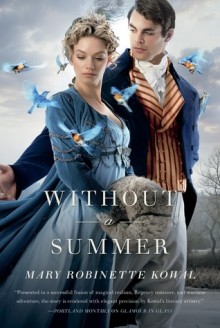
The problem was that in far too many cases, the ideas, plot, and worldbuilding aspects were simply thrown out, to such an extent that now, the average “fantasy” novel is little more than a thinly disguised romance novel. In many cases, the “SF/F” publishers aren’t even bothering to disguise it any longer. What is broadly described as “paranormal” fiction actually belongs to the romance genre, not the SF/F genre, as any reasonable examination of its tropes will swiftly reveal.  And the romantic transformation isn’t limited to the necro-bestial sub-genre of fantasy either. Consider the cover of Mary Robinette Kowal’s new novel, Without A Summer. Kowal is the current VP of SFWA. She’s nice, she’s talented, and she’s an award-winning writer. She was even nominated for the Best Novel Nebula in 2010.

What she isn’t is an SF/F writer.  She’s a romance writer. The marketing department at Tor Books clearly knows that. Both the Handsome Prince and the Pretty Princess with her bluebirds on the cover are straight out of Disney.  Giving a Nebula award to a book like this would be akin to giving Joe Abercrombie the Golden Tea Cosy or whatever award it is the RWA gives out because one of his mentally unstable killers happens to tenderly rape a female captive during a momentary interlude between bloody battles.

As for me, the last female writer I read was Dr. Helen Smith and her forthcoming book Men on Strike.  The last female novelist I read was Naomi Novik, whose fantasy novels, as should surprise absolutely no one, manage to reduce the broad human tragedy of the Napoleonic Wars to a pretty good tale about a relationship between a man and his accidentally acquired dragon.

It is due to this transformation from SF/F to R(SF/F) that despite there being more female “SF/F” authors than ever before, none of them compare favorably with the likes of Madeleine L’Engle, Susan Cooper, Ann McCaffrey, Tanith Lee and Lois McMaster Bujold, women who were always more than capable of competing with the men on pure merit alone.


Public intellectual = godless intellectual

In his speculation on whether public intellectuals matter, AC Grayling somehow manages to avoid noticing the giant elephant voiding its bowels in the room.

Can one give a catch-all definition of what it is to be a “public
intellectual”? Consider this list: Bertrand Russell, Albert Einstein,
Edmund Wilson, Lionel Trilling, Stephen Jay Gould, Norman Mailer, Susan
Sontag, Noam Chomsky, Richard Dawkins, indeed anyone on Prospect’s
list of people who merit or are thought to merit the label. They have
very little in common other than intelligence and engagement, and the
fact that they speak out. Those three things, accordingly, might be
taken to capture the essence.

Very little in common other than intelligence, engagement, and the fact that they speak out?  I don’t know, my highly developed pattern recognition skills suggest to me that there just might be something else these notable public intellectuals all have in common. Let’s look over his list one by one and see what the Internet has to say about their religious beliefs.

Bertrand Russell = atheist
Albert Einstein = agnostic
Edmund Wilson = atheist
Lionel Trilling = agnostic
Stephen Jay Gould = atheist-leaning agnostic
Norman Mailer = atheist (during his years as a public intellectual)
Susan
Sontag = atheist
Noam Chomsky = atheist
Richard Dawkins = atheist

My goodness, isn’t that an astonishing surprise! It goes without saying, of course, that A.C. Grayling is himself an atheist.  This failure to note this common point is so massive, and so glaring, that it is either intentional, or worse, an indication of the very small scope of the so-called public intellectual’s perspective. Of course, we should probably keep in mind that Grayling is known for his convenient memory lapses, having once falsely accused William Lane Craig of a false claim to have debated him.

This leads me to conclude that the correct answer to Grayling’s question is that public intellectuals matter very much to other public intellectuals.  As to their importance to the vast majority of the rest of the world, who don’t give a damn what a few self-important, self-promoting, godless individuals may happen to think about anything, they clearly don’t matter at all.

As I have previously shown, despite the statistical overrepresentation of the irreligious among the highly intelligent, there are still far more highly intelligent religious individuals than there are highly intelligent irreligious individuals.  To be precise, the ratio of theists with +2SD IQs to atheists with +2 SD IQs is more than 10 to one. The more significant question, therefore, is why are all of these much more numerous highly intelligent religious individuals so few and far between on this year’s list of celebrated world thinkers?  Why are so few of them invited to give TED talks?

Do their religious beliefs somehow negate their intelligence? Or could it be that there some other mysterious factor at work? This is all so very inexplicable in light of the fact that GSS studies over the past 40 years show that the MAJORITY of atheists have IQs of 100 or less.


The business of progressive science

The Left is forever attempting to cloak its evil lunacies in the veil of scientific authority.  It has been doing so since Marx first claimed his socialism was “scientific”. That is why they so ferociously defend St. Darwin and his holy theorum, why they try to portray political opposition as mental illness, and why, in the end, so many of the scientific studies to which they point turn out to be pure fabrications.

Stapel was an academic star in the Netherlands and abroad, the author of
several well-regarded studies on human attitudes and behavior. That
spring, he published a widely publicized study in Science about an
experiment done at the Utrecht train station showing that a trash-filled
environment tended to bring out racist tendencies in individuals. And
just days earlier, he received more media attention for a study
indicating that eating meat made people selfish and less social….

Stapel’s fraud may shine a spotlight on dishonesty in science, but
scientific fraud is hardly new. The rogues’ gallery of academic liars
and cheats features scientific celebrities who have enjoyed similar
prominence. The once-celebrated South Korean stem-cell researcher Hwang
Woo Suk stunned scientists in his field a few years ago after it was
discovered that almost all of the work for which he was known was
fraudulent. The prominent Harvard evolutionary biologist Marc Hauser
resigned in 2011 during an investigation by the Office of Research
Integrity at the Department of Health and Human Services that would end
up determining that some of his papers contained fabricated data. 
Every year, the Office of Research Integrity uncovers numerous
instances­ of bad behavior by scientists, ranging from lying on grant
applications to using fake images in publications. A blog called Retraction Watch
publishes a steady stream of posts about papers being retracted by
journals because of allegations or evidence of misconduct. 
Each case of research fraud that’s uncovered triggers a similar response
from scientists. First disbelief, then anger, then a tendency to
dismiss the perpetrator as one rotten egg in an otherwise-honest
enterprise. But the scientific misconduct that has come to light in
recent years suggests at the very least that the number of bad actors in
science isn’t as insignificant as many would like to believe. And
considered from a more cynical point of view, figures like Hwang and
Hauser are not outliers so much as one end on a continuum of dishonest
behaviors that extend from the cherry-picking of data to fit a chosen
hypothesis — which many researchers admit is commonplace — to outright
fabrication. Still, the nature and scale of Stapel’s fraud sets him
apart from most other cheating academics. “The extent to which I did it,
the longevity of it, makes it extreme,” he told me. “Because it is not
one paper or 10 but many more.” 
On a Sunday morning, as we drove to a village near Maastricht to see his
parents, Stapel reflected on why his behavior had sparked such outrage
in the Netherlands. “People think of scientists as monks in a monastery
looking out for the truth,” he said. “People have lost faith in the
church, but they haven’t lost faith in science. My behavior shows that
science is not holy.”

What the public didn’t realize, he said, was that academic science, too, was becoming a business.

Science, particularly academic science, is now a big business, and it is an unusually corrupt one that is primarily dependent upon the media and government funding.  It has no practical external limitations upon it holding its businessmen accountable. As Stapel’s example demonstrates, there is absolutely nothing – nothing – reliable about it.  This point should be driven home every single time anyone makes the absurd claim that science is the best, or the only, arbiter of truth and reality.

Here is how bad the corruption is: Stapel was actually teaching a graduate seminar on research ethics. Notice too that all of the established academics who caught wind of the fraud not only looked the other way, but advised others to do so as well.

We have a word for real and genuine science that is reliable enough to be trustworthy.  Engineering.

“At the end of November, the universities unveiled their final report at a joint news conference: Stapel had committed fraud in at least 55 of his papers, as well as in 10 Ph.D. dissertations written by his students. The students were not culpable, even though their work was now tarnished. The field of psychology was indicted, too, with a finding that Stapel’s fraud went undetected for so long because of “a general culture of careless, selective and uncritical handling of research and data.” If Stapel was solely to blame for making stuff up, the report stated, his peers, journal editors and reviewers of the field’s top journals were to blame for letting him get away with it.”