We’re #98

The Right Wing News lists the top 100 conservative sites:

88) Daily Paul: 66,851
89) Bill O’Reilly: 67,480
90) GOP.com: 67,749
91) Canada Free Press: 68,023
92) Human Events Online: 68,967
93) Jewish World Review: 76,215
94) GOPUSA: 71,293
95) Ricochet: 71,358
96) Day by Day: 73,755
97) Numbers USA: 76,280
98) Vox Day: 76,816

The numbers are largely bogus of course, being based on Alexa rank. How do I know? Because last year, with 625,476 fewer monthly pageviews, VP was ranked at #52, just ahead of the Von Mises Institute.

But that 76,816 number reminds me of something. Oh, yes, I believe Johnny Con said something about his Alexa rank being higher than mine. Let’s see what they are today:

Vox Popoli
76,643 Global
15,411 USA

Whatever
80,320 Global
15,679 USA

Sound the horn! Br-br-br-BRAAAAP! First traffic, then Alexa rank… I wonder which comes next, “bestseller” lists or Twitter impressions?


Violence, women, and war

One Owlmirror attempts to claim it is reasonable to conclude that I approve of violence towards feminist women:

I have something of a rant simmering on how it’s still reasonable to conclude that Vox Day approves of violence towards women (or more specifically, feminist women), despite the point (which you emphasized) that that’s not exactly what he wrote, but it’s long and kinda off-topic.”

It is also false. I do not approve of initiating violence period. Not towards women, not towards feminist women, not towards anyone.

Is that insufficiently clear? Do I need to type more slowly for the message to sink in?

The idea that I approve of violence against women is entirely based on false accusations. Just to give one example, despite the fact that I have never addressed the shooting of Malala Yousafzai in any detail, much less supported it, a number of people have repeated the totally false claims by Popular Science and NPR that I am “on the record as supporting the Taliban’s attempt to assassinate Nobel Peace Prize winner Malala Yousifazi”. In fact, there is not a single post about Miss Yousafzai on this blog and my only reference to her was in a passing reference on Alpha Game in a post dealing with the demographic implosion of Japan.

“In light of the strong correlation between female education and demographic decline, a purely empirical perspective on Malala Yousafzai,
the poster girl for global female education, may indicate that the
Taliban’s attempt to silence her was perfectly rational and
scientifically justifiable.”

So, in the interest of setting the record straight, let’s go ahead and look at the Taliban’s attack on the young Pakistani woman to see whether the attack can reasonably be considered rational or not. (I will address the scientific element below.) And once you take the time to actually read about the historical context of the shooting, it rapidly becomes obvious that the decision of the Taliban to attack Malala Yousafzai was not a random act of irrational violence against women, but rather the rational and purposeful targeting of an individual they correctly considered to be a traitor in the employ of their enemies.

Most people are entirely unaware that Yousafzai was no mere “innocent
schoolgirl” who just happened to attend school, she was the daughter of a pro-Western activist, she had worked as a
paid propagandist for the BBC and other Western organizations for four
years, and she had even met with Richard Holbrooke before the “irrational”
Taliban finally decided to silence her. Given that her family “ran a chain of schools”, you could even make a reasonable case for her pro-education activism having been little more than a cynical marketing device on the part of her elders.

The Taliban has been fighting to defend their traditional way of life in their own tribal lands for 36 years. They have killed tens of thousands of people, from elite Spetsnaz soldiers to unarmed young women, in order to do so. It is quite clear that they will kill anyone who threatens that way of life, and considering how they have survived two invasions and occupations by two superpowers, their ruthlessness is not only rational, but understandable and even, from a strategic perspective, necessary and admirable. Less determined forces would have collapsed and surrendered years ago.

Does that mean I support the Taliban? Absolutely not. Does that mean I share their views? No. Does that mean I want to live the way they do? No.

But unlike PZ Myers and many people who apparently consider them nothing more than a momentarily useful rhetorical device, I take the Taliban seriously, for the obvious reason that anyone who can fight two numerically and technologically superior enemies to a standstill is obviously formidable and had damn well better be taken seriously. Fortunately, unlike ISIS, the Taliban appears to wish little more than to be left alone in Afghanistan and Pakistan.

Here is the question for the left-leaning seculars in our midst. Suppose a young girl in your country adopted a strongly anti-homosexual ideology, was employed by Iraqi and Syrian agencies, met in secret with a top Syrian official, and over the course of four years was successful in convincing tens of thousands of people in your country that homosexuals should be killed by throwing them off rooftops. Suppose hundreds of homosexuals had already been killed in this way thanks to her public calls for such executions. Would you support her arrest and execution or would you oppose it?

Even if you would oppose it on moral or legal grounds, isn’t it easier to see the Taliban’s attack as being an entirely rational one when framed in that context? I see the shooting of Malala Yousafzai as being very little different than the English burning of Joan of Arc or the UK’s hanging of William Joyce. It was an act of war aimed at an enemy effective, not a random and irrational act of violence rooted in prejudice.

It is also worth noting that the Taliban have
left Yousafzai alone now that she’s no longer living in Pakistan. They don’t appear to care if she wants to take her message to foreign populations elsewhere, but they will not permit her to spread pro-Western propaganda among their own people.

Cantus asked me a few questions about this a few days ago that I did not see until now:

How do you justify the assertion that you’ve “never gone on the record
as supporting the Taliban’s attempt on her life”? Are you arguing that
an action being “scientifically justifiable” does not amount to
supporting it? 

Because I did not support the Taliban’s attempt on Miss Yousafzai’s life. I merely observed that the attempt was a rational act given their perspective, which I do not share. Yes, I unequivocally state that the fact that an action is justifiable from a scientific perspective neither makes it moral nor desirable. There are many things I consider to be scientifically justifiable that I nevertheless do not support because I do not believe science to be an appropriate or reliable guide to human behavior.


A lesson in rhetoric

VOX DAY:   Dialectic is based on the construction of syllogisms, so it’s very
obvious when one is lying. Rhetoric is “the faculty of observing in any
given case the available means of persuasion.”

It’s not even strictly true to say one CAN lie rhetorically, since an
enthymeme is not a true logical syllogism, all that matters is that the
persuasion is achieved by proof or apparent proof.”

It might be easier to think in terms of “logically sound” and “not
logically” sound than true and false. The point is that I can construct a
logical syllogism that proves or a pseudo-logical enthymeme that
apparently proves, but in either case, they point towards the relevant
truth of the matter.

For example, if I say “SJWs occasionally lie” in response to your
false statement, this is good dialectic but poor rhetoric that is likely
to fail to persuade a rhetorical of the actual truth, namely, that you
are lying in the present circumstance. The better rhetorical statement
is “SJWs always lie”, which is not dialectically true, but persuades the
rhetorical to believe the truth, which is that you are lying.

Hence the importance of knowing your audience. When you speak in
rhetoric to a dialectical, it sounds very dishonest even when it is good
rhetoric in line with the truth. But you can’t speak dialectic to a
rhetorical for the obvious reason that they cannot be persuaded by it.
They simply don’t have the capacity.

SETH GORDON: And yet, I remain unpersuaded. Either I am not “a rhetorical” or VD is not very competent at using rhetoric.

(That was a dialectical statement.)


“SJWs always lie. First, you all do care how I feel. That’s why you constantly twist and pervert and attack at every opportunity.”


Because, of course, it has to be all about VD, the man more popular
than John Scalzi, the man whose approval we all seek more than anything
else in the world.


(That was a rhetorical statement.)

VOX DAY: You are unpersuaded, but your inability to be persuaded by a
particular enthymeme does not mean you can be persuaded by a logical
syllogism. The first horn of the dilemma is false.

You are unpersuaded, but your inability to be persuaded merely means
that a single enthymeme failed to persuade a single individual. Since even
rhetorical masters fail to universally persuade everyone at all times,
this single failure of rhetoric on my part is insufficient to support
the claim of rhetorical incompetence. The second horn of the dilemma is
false.

You constructed a false syllogism, proposed a twice-false
non-dilemma, and your assertion of incompetence was meant to resonate on
the emotional level. Ergo your statement was not dialectic, but merely pseudo-dialectical rhetoric.

But yes, the rhetorical statement was rhetoric. One out of two isn’t bad.

Will, on the other hand, sticks to pure rhetoric and does rather better with it.

“Come on down to Rhetoricalville: We have no idea what we’re talking about it, but somehow, we’re happy and free of rabies.”


A Secret Master’s summary

Mike Glyer has not only been doing yeoman’s work in allowing all sides of the Hugo 2015 controversy to speak their bit, he’s also presented one of the most balanced summaries of the situation while putting it in historical perspective:

Participation in the Hugo nominating phase has always been anemic compared to the final round. Often less than a hundred votes are needed to land something on the ballot in most categories. It’s the most vulnerable point of the award, for obviously nothing can win that doesn’t get on that list. Past incidents of bloc voting have been few and obvious—for example, L. Ron Hubbard’s posthumously published Black Genesis was nominated in 1987, while in 1989 a couple withdrew their collaborative work from the ballot after learning around 20 questionable ballots were cast for it. However, not all attempts to organize blocs have been criticized, especially in the fan categories where a demonstration of social media clout has tended to be applauded.

Only by tapping into anger over the culture wars has someone succeeded in motivating the requisite number of fans to buy supporting memberships at $40 a pop and take control of the Hugo ballot.

Among fans who are critical of the outcome there has been widespread talk of voting “No Award” ahead of nominees from the slate (again). There is also a great deal of technical discussion of rules changes designed to limit the influence of voting slates without creating any barriers to new voters.

Perhaps the most surprising thing was the rash of articles in the mainstream media in Britain and Australia, denouncing the “Sad Puppies” slate as the work of misogynists and racists. Surprising, because the news rarely covers this early phase of the awards. Nor was it clear how reporters decided slates with eight women, or a number of Hispanic writers, could be characterized in those terms, and one of the outlets, Entertainment Weekly, subsequently issued a correction on that score.

A writer for Salon also gave the back of his hand to the Hugo’s democratic rule structure: “We should have learned a long, long time ago that ‘Just let the public give their input’ is a lazy, useless and above all dangerous way to make decisions.”

The Federation of Heinlein’s Starship Troopers may have felt the same way; however, the story is more commonly admired than its philosophy of government.

The Road Ahead: Hugo Awards lore comes in both an idealized Disney version and a noir Oliver Stone version. If someone says Hugo voters are trying to pick the best stories of the year, you can find someone else who’ll say it’s just a popularity award. The enthusiast will point out growing participation has produced record–breaking numbers of Hugo voters. The cynic will dismiss that number as trivially small. But just now the only thing anyone can say about the future of the Hugos is that it’s unlikely to resemble the past; even idealists and cynics have to agree on that.

Yes, it was indeed strange that there was so much coverage of the Hugo nominations in the international media. I wonder how that may have come about? Perhaps an enterprising investigative reporter should consider looking into that. It is certainly rather remarkable how many people writing about the Hugo Awards for the Guardian have links with a certain SF publishing house that didn’t do quite as well as it is accustomed in 2015.

Speaking of Secret Masters of Fandom and Mike Glyer, this comment at File 770 will likely amuse the Ilk:

It doesn’t take a genius that the regulars at Vox Populi would do it
for entertainment value alone (leaving aside their philosophical
beliefs). And despite the apparent belief of some, they are, in
general, very intelligent and perfectly willing to light a match. For those who doubt me, spend a few days quietly reading his site. I
can’t decide if it’s closer in character to a Pirate’s Den or a Wild
West town.

He’s referring to us responding to a proposed change in the rules in which we’d need to split up and coordinate our actions, and his conclusion is entirely correct. It’s amusing to think that anyone imagines we’re going to be dissuaded by the threat of being accused of “behaving in bad faith” when, as Mike Glyer noted, we’re already being accused of misogyny, racism, crimethink, and perpetrating badfeels everywhere from the UK to New Zealand.

As for this site, I tend to lean towards Pirate’s Den, but then, we do rather like our showdowns and seeing overconfident challengers gunned down in a hail of dialectic too. I also find it a little bizarre that some sort of contradiction between “people willing to vote along [my] recommended lines” and “mindless posters” is postulated. Forget 4GW, the basic concept of “flash mob” must be totally impossible for some of these people to grasp.

Nobody has to pay $40. Nobody has to vote at all. Nobody has to vote the way that I recommend. I’m not a dictator, nobody elected me to anything, and I’m not holding anyone’s kitten hostage. They can bitch and whine all they want about “slates” and “bloc-voting”, but there is nothing new about the former and there is no statistical evidence of the latter. In fact, the statistical evidence absolutely disproves the false accusation of “bloc-voting”, as there is a greater variance among the ballots cast for various Rabid Puppies nominees in both absolute and percentage terms than seen in many past years.

I’ve sent out the material for the Hugo Voters’s Packet, which should be going out later this month. I will be posting my voting recommendations in July, after I get the chance to read the works I haven’t read yet.


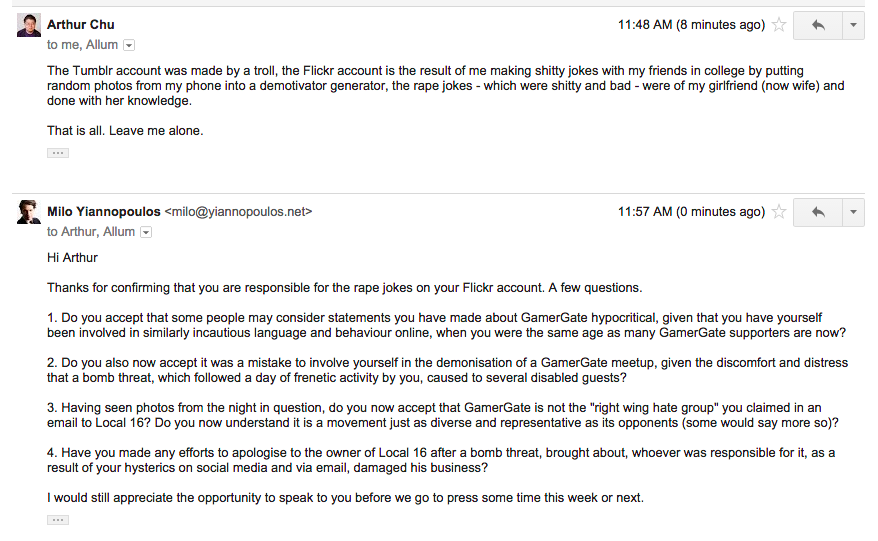
The end of Arthur Affect

Coming on the heels of Arthur Chu’s jokes about rapes and bomb threats, Reaxxion reports the purported outing of the oft-quoted #GamerGate enemy as a freakish sex deviant:

At approximately 7:30 PM Eastern time yesterday, @BroTeamPill Tweeted out links to several web pages potentially associated with Arthur Chu, white-knight extraordinaire and notorious GamerGate detractor. These sites were found by locating different accounts registered to the same email. Among the sites were an embarrassingly juvenile LiveJournal, a Flickr account from 2006, and, most interestingly, an active Tumblr account bearing his signature name “AbstractArthur” The Flickr primarily consisted of photos from Mr. Chu’s college years and clearly belonged to him.

Among a number of photos of his friends rendered in now-antiquated Demotivational Poster format, a slew of pictures he took for his old student paper The Phoenix at an extracurricular event, and an exceedingly poor attempt at webcomicking, were at least a few rape jokes, statutory rape jokes, and candid photographs of a female friend sleeping. This is already terribly compromising to Arthur’s image, since he tries to portray himself as a “defender of women” and opponent of “rape culture.”

The Tumblr, on the other hand, resembled the private hoard of a sex fanatic: someone obsessed with shemale transgenders and being seen as a “sissy-boy” whom men would screw. Updated as recently as last Sunday, it was a glimpse into a truly disturbed mind. It appeared, in fact, to be a hoax. The blatant ArthurEffect label and sheer horror of the content seemed like something a prankster would slap together to make it look like Chu was a bizarre deviant.

Warning: do NOT click on the archive links at Reaxxion. I’m not kidding. In fact, my initial thought was that it had to be some sort of vicious dark op meant to humiliate Chu, until I read this part:

As word of the compromising Flickr photos and uploads sluiced through the veins of Twitter, word reached the ears of their owner. Almost immediately, the Flickr account was closed, presumably with the intent of limiting the damage. But the Internet never forgets, and archives of the content had already been made. What is worth noting, though, is that the Tumblr was also deleted, at the same time.

Now, it’s entirely possible that these hypothetical dark operators were clever enough to anticipate Chu’s foolish attempt to belatedly delete the damaging Flickr account and thereby making it look as if he was also responsible for shutting down the Tumblr account that was closed at the same time, but we will have to wait to hear if Mr. Chu denies responsibility for one or both accounts. Regardless, if he is responsible for either of them, it would appear to be time for Mr. Chu to abandon his public posturing as a white knight attempting to save women by attacking #GamerGate.

UPDATE: Apparently Mr. Chu has denied responsibility for the Tumblr account, and admitted to the Flickr account. Of course, this does not mean that he is not responsible for it; given that Mr. Chu is a self-professed supporter of playing dirty and being dishonest, one cannot simply take him at his word. Nero has more:

Yeah, that’s not going to happen. We’re not going to leave you alone, Arthur. You didn’t leave us alone, after all.


Bi-discoursality

It never ceases to confuse the rhetoricals. From the comments at File 770:

“Mr. Beale divides the world into two parts: “facts” and “rhetoric”. Where the dividing line in depends on where he’s been challenged, and what looks right at any given time, as far as I can tell.”

Not me, but Aristotle. I merely follow his lead in this regard. I strongly prefer dialectic, but that is reserved for those who are intellectually honest and capable of changing their minds on the basis of information. In general, I speak dialectic to those who communicate on that level and rhetoric to those who don’t.

Rhetoric, which is the form of discourse to which SJWs are limited, is not based on logic or reason, but emotion. However, because many SJWs attempt to cloak their rhetoric in pseudo-dialectic, I use the dialectic to strip them of their cloak on behalf of those capable of following it, while communicating directly in rhetoric to them.

For example, it is not strictly true in the dialectical sense, that SJWs never tell the truth. But as Aristotle tells us, the best rhetoric is rooted in truth, and the statement “SJWs always lie” rings emotionally true, because SJWs lie so often that it resonates with everyone who has been witness to their reliable dishonesty.

The interesting thing about rhetoric is that it makes no sense to those who are limited to the dialectic. I didn’t fully grasp the way it worked until reading RHETORIC for the second time. It can be bewildering when people tell you that they have been convinced by something that you know can’t logically have persuaded them. In such cases, you know they have been persuaded by rhetoric, not facts, reason, or logic.

I wouldn’t expect an individual who only speaks one form of discourse to be any more able to follow me into the other than if I abruptly switched to speaking Italian or French after beginning in English.

For example, this was written for dialecticals. Rhetoricals only see “blah blah blah, I’m so smart, blah blah blah, Aristotle” and scan through it seeking to find some point of attack they can use to minimize or disqualify me. And if they can’t, that’s when they strike a bored pose or return to the snarky ad hom.

After 12 years of this, you eventually start to notice the patterns.


An apology to GamerGate

SJWs always lie, and sooner or later, the honest non-SJW is eventually going to realize that so long as he, or in this case, she, pays enough attention:

My name is Sofie Liv, i’m a young woman from Denmark, I love playing video games and sometimes review them.

And I feel like I owe you all the greatest apology. I’m ashamed, and I want to apologies. I can only apologies for myself so here goes.

We all know about the Zoe Quinn and Sarkeesian thing that happened so long ago. Back then as I was just minding my own buisness with my web review show, reviewing the nerd things I love so much on the Agonybooth, I was given information that these women had been threatened, that they had been driven into misery, that gamergate was behind all of it, that all these second grade photoshopped images were proof of it, that these women were doxxed and got rape threats on a daily basis.

And like a complete sucker, I bought it! I suckered it up, I bought into it, and I am ashamed. No part of me would believe that someone would downright lie about rape threats, it didn’t even occour to me that they would lie about their own mental state, because no part of me could ever believe that someone would lie about those things.

Then slowly arguments started crawling up, I raised my eyebrow at quite a bit of the things Sarkeesian openly said, I had to point out. “That isn’t right.”

At that point I had taken a new stand… I am not with Sarkeesian, but neither am I with Gamergate, I think they both did wrong. Still, stupid me hadn’t done prober fact checking, but just taken peoples word for these things happening.

So many people in my circle, so many people following me pointed to the harrashment of these women as plain fact…. I now know this is untrue. Now I have finally done the prober actual research and found the sources, and I know i’ve been lied to… and as a sucker I suckered it up. I called Gamergate things, hinted at you guys being imoral, I switched from reviewing movies to review another medium that I love, video games, and called it a stand against the idea women can’t be gamers… an idea I now know, doesn’t even exsist!

Now my game reviews has been turned into a stand up against the Sarkeesian ideals, because now I actually feel it’s important to stand up to her and call her bullshit for what it is… It’s bullshit. She’s full of bullshit, and I can only apologies that I bought so easily into it as a brain dead sheep.

What I want to say with all of this is that, I think you people have done absolutely fantastic. In spite of all this bad rep you still managed to stand up and stand true to what this is actually about.

Apology accepted. This is why it is so important for us to stand our ground. This is why it is so important for us to speak the truth, and keep speaking the truth, whether anyone believes us or not, whether the media calls us names or not, and whether people offer us friendship and approval or not.

The one thing SJWs absolutely rely upon is honest people NOT calling them out. They don’t expect to convince everyone, they merely want to silence anyone who threatens their false narratives. So stop playing along with them. Stop sitting there in mute disapproval of their lies and misrepresentations, stand up, and declare “that is not true!”

SJWs are the sons and daughter of the Father of Lies. They are the People of the Lie and they can only be defeated by the Sword of Truth.


Smells like success

This review of “Turncoat” by Steve Rzasa precisely underlines the central point made by the Sad Puppies campaign and single-handedly serves to justify it:

I’m going to start with short stories, because they’re, well, short, and with the last story on the ballot and then work my way up.  So the first story is “Turncoat,” by Steve Rzasa. A sentient warship and some post-humans are battling against another group, people who have decided not to make the jump to post-humanity.  The warship goes from being annoyed at the messy, pesky humans to championing them (though I’m not sure where in the story this switch occurs) and defects at the end, bringing along with it (him? her?) its superior hardware and some useful intel about the other side.

I’m going to take a slight detour here, though I promise I’ll get back to the review soon.  When I was in high school I did or said something that got me sent to detention, a closet-sized room where, oddly, someone had left a stack of Analogs.  I had just started reading science fiction, and of course my first  thought was, Is this supposed to be punishment?

But I ended up not really liking most of the stories.  They emphasized hardware, and not even interesting hardware.  The characters were cardboard, the stories predictable (partly because they all ended with humanity triumphing), the style ranged from serviceable to really pretty bad.

This was late-period John Campbell I’m talking about.  (Yes, I’m old.)  I will stipulate that the guy did some good things for sf in his prime, but something had happened along the way, some hardening of attitudes and an inability to tell when a story had gone bad.  Humanity had to be shown to triumph in every story, for example, to be superior to anything thrown against it, which pretty much let the air out of any balloon of tension.

So, as I hope I’ve made clear, when I say “Turncoat” is a perfectly adequate late-period Campbellian story I don’t mean it as a compliment.  You can’t even say the characters are cardboard, since there are no characters, just a warship that, for the most part, proceeds along strict logical lines.  There’s no one to like, or even hate, no one to identify with or root for, nothing at stake for the reader.

But think about everything that’s happened since Campbell.  The New Wave (does anyone remember the New Wave?  Yes, I’m old), feminism, cyberpunk, counter-cyberpunk, a fresh infusion of writers who are not white or straight or able-bodied.  This would have been an average story in the late sixties, but now, nearly fifty years later, it’s stale and dated.

Rzasa hasn’t even caught up with the second of these new categories.  “Our founders were the men who…”  “Posthuman Man…” “Not content with setting Man on his new evolutionary path…”  After Ancillary Justice — hell, after The Left Hand of Darkness — this reads very oddly.

 Now consider Castalia House’s mission statement:

“The books that we publish honor the traditions and intellectual
authenticity exemplified by writers such as J.R.R. Tolkien, C.S. Lewis,
Robert E. Howard, G.K. Chesterton, and Hermann Hesse. We are consciously
providing an alternative to readers who increasingly feel alienated
from the nihilistic, dogmatic science fiction and fantasy being
published today. We seek nothing less than a Campbellian revolution in
genre literature.”

That review is supposed to be a negative one, but it sure sounds to me as if we’re on the right track. Now consider these three reviews, the first two from SJWs, the second from a neutral party.

Daveon on May 4, 2015 at 11:46 am said:

I hated Turncoat – compared to how Iain Banks, Neal Asher, Peter Hamilton write sentient battleships and describe space warfare it was unbearable, then there were lines like ‘the men who…’ versus ‘the people who’ really jarred against me – it felt like a story written about AIs written by somebody who has ignored any progress in fiction, computing and so forth in 20 years. The opening battle scene at the start of The Reality Dysfunction is better than Turncoat in every way, and that was written in 1996.

I found that to be rather amusing, considering how spectacularly boring Iain Banks’s space battles are. But considering that Daveon hates Sad Puppies and hates Rabid Puppies, how surprising is it that he – mirabile dictu – just happens to hate “Turncoat” as well? Another SJW posted a similar review:

In the story, an artificial intelligence serves the post-humans in a far-future war against ordinary humans. As the title suggests, it chooses to switch sides in the end. That’s it.

I think this is a quite awfully-written story with a heavy-handed delivery of plot points and a lot of infodumping. You can see the “surprise” conclusion of the story coming from miles away (or by reading the title, actually). A very boring read, overall.

The one thing that could have made the story at least slightly interesting if done well was the characterization of the AI and the post-humans. Sadly, that was crappy and formulaic as well. The protagonist doesn’t really feel like he belongs to the far-future, or the future at all, for that matter. The black-and-white pontificating (a term lifted from Secritcrush) has a definite vibe of the past in it.

A black-and-white approach to any war of conflict just feels silly and makes the whole world of the story unrealistic for me. Now that I was doing some googling, I noticed that Hugo-nominated Puppy-fanwriter Jeffro Johnson is praising this story because it offers a “concise description of real Christian religious experience”. That’s an interesting thought and maybe some people do enjoy over-simplified morality dramas in 2015, but I certainly don’t.

This is certainly going below no award.

Addendum

The vibe of the past I was writing about arises from the protagonist’s
moralistic attitudes which bring to mind the papery characters of old
fiction who don’t really resemble real people (or real consciousnesses
in this case). Also, I think there was no futuristic sensawunda in the
far-future fight scenes when compared with, say, Greg Bear’s Hardfought
(that’s a far future war story I think is very good, even though
military SF is not really my cup of cat crackers)…. On a second thought, let’s also try to give the Hugo finalists an
unscientific numeral score on the range of 1-10 in order to make
comparing them easier (if unscientific). “Turncoat” gets 2.

On the other hand, Steve Moss reached a very different conclusion:

I loved Turncoat. Beware- SPOILERS:

SPOILERS

To correct something, there are two types of machine intelligence in Turncoat. The Uploaded, which is as you described, humans who have placed their consciousness into machines. The other is true artificial machine intelligence.

The antagonist is Alpha 7 Alpha. He is one of the Uploaded. He also appears to have carried over many of the negative human emotions such as hate, etc.

The protagonist is X 45 Delta. He is a 42nd generation true artificial intelligence. He’s never had a human body.

What I loved about the story is that the Uploaded have lost their humanity (become inhuman) while the true machine intelligence becomes more humane. X 45 Delta committed his betrayal because, in his words, he “wants to decide the sort of man I will become.”

You are right that he expresses annoyance with his human crew. They are inefficient and filled with inane chatter. He also expresses pride and protective instincts in them, and misses them when they are removed from his ship. All of these things are very human feelings.

Alpha 7 Alpha removes the crew from X 45 Delta to make him more efficient in battle. Which is true, but also a lie, as X 45 Delta notes (he’s learned to lie from the Uploaded, mostly by omission). He deduces that they will be either terminated or uploaded against their will. This is when his metamorphosis from loyal warrior to turncoat begins.

All in all, Turncoat was an excellent story and well worthy of a Hugo nomination. I haven’t read everything (yet), but it may well be my number one pick.

At the end of the day, there isn’t much room for compromise. They hate the actual science fiction we love. We have no interest in or regard for their SJW, non-SF, “science fiction”. We appreciate a genuine sense of wonder. They refer in snarky contempt to “sensawunda”. We believe in the human soul, we believe in God, we believe in higher things,  they believe in “science” and the infinite evil of humanity, to the extent they believe in anything at all.


I $*%*ing LOVE science

Never, ever believe anyone who says I do not love and adore science. Because this.

There are several studies showing that when people drink coffee, they have a lower risk of dying from a range of serious diseases. A groundbreaking study, the largest of its kind, was published in the New England Journal of Medicine in 2012: In this study, 402,260 individuals between 50 and 71 years of age were asked about their coffee consumption. The results were fairly remarkable… after following the people for 12-13 years, those who drank the most coffee were significantly less likely to have died.

Do you know what this means? DO YOU KNOW WHAT THIS MEANS? It means I HAVE to drink one more cup of coffee a day. For my health. I won’t say this is the greatest day of my adult life, but it’s up there.

I cannot believe people genuinely doubt the existence of God or believe there is some sort of conflict between faith and science. This scientific study clearly indicates that there is a God and He wants us to be happy.

Did I mention that I love science?

First red wine, then dark chocolate, now this. If they discover that wargames and books are similarly beneficial, I’m going to live to be 200.