Anti-Europeanists

This celebration of Islamic expansion in Europe may explain why the French and British people haven’t been shedding many tears over Jews targeted by Muslims in Europe:

Rabbi Baruch Efrati, a yeshiva head and community rabbi in the West Bank settlement of Efrat, believes that the Islamization of Europe is actually a good thing.

“With the help of God, the gentiles there will adopt a healthier life with a lot of modesty and integrity, and not like the hypocritical Christianity which appears pure but is fundamentally corrupt,” he explained.

Rabbi Efrati was asked to discuss the issue by an oriental studies student, who inquired on Judaism’s stand toward the process Europe has been going through in recent years. Following the election of a hijab-wearing Muslim woman as the mayor of the Bosnian city of Visoko for the first time in continent’s history, the student asked the rabbi on the Kipa website: “How do we fight the Islamization of Europe and return it to the hands of Christians and moderates?”

Efrati wrote in response that the Islamization of Europe was better than a Christian Europe for ethical and theological reasons – as a punishment against Christians for persecuting the Jews and the fact that Christianity, as opposed to Islam, is considered “idolatry” from a halachic point of view….

“Europe is losing its identity in favor of another people and another religion, and there will be no remnants and survivors from the impurity of Christianity, which shed a lot of blood it won’t be able to atone for.”

One would have thought the Jews might have learned from the Granada Massacre and the Reconquista that betting on the Mahometans isn’t the smart thing to do. Meanwhile, David Goldberg declares that he has nothing to say to anyone in Europe:

It’s been so long since Europeans took their own national identity
seriously that it’s hard for them to remember why it is that they can’t
stand the sort of Jew who represents the Jewish future. One has to put
them on the proverbial couch and coax it out of them: Europeans hate
Jews because European national identity from the outset was a dreadful
parody of Jewish identity…. I speak three European languages apart from English and have nothing to say to anybody in any of them.

I used to like reading Goldberg back when he was Spengler. Now… what is he even trying to say?


Corruption in New York

The other New York assemblymen were shocked, shocked, to learn that the Speaker of the Assembly, Sheldon Silver, was arrested on corruption charges:

The speaker of the New York State Assembly, Sheldon Silver, was arrested on federal corruption charges on Thursday and accused of using the power of his office for more than a decade to secure millions of dollars in bribes and kickbacks and then covering up his schemes, according to court documents.

Mr. Silver, a Democrat from the Lower East Side of Manhattan who has served as speaker for more than two decades, is accused of a range of corrupt dealings that capitalized on his official position. They include using his position to obtain corrupt payments misrepresented as referral fees from a law firm; funneling state research funds and other benefits to a doctor who in return referred asbestos claims to the law firm where the speaker worked; and secretly helping real estate developers win tax breaks.

In recent years, a steady parade of lawmakers in Albany has been charged with corruption, and the complaint against Mr. Silver outlines a capital culture rife with back-room dealing, where money and influence shape public policy for the benefit of private agendas.

I’m sure the Senators and Congressmen in Washington D.C. are much, much cleaner.


Evolution is a random process

Mindstorm wrote:

Selection is not random, because it eliminates what is locally worse and leaves what is locally better. Mutations
without selection – that would be pure randomness. Good luck finding a
biologist that would believe in such ‘evolution’.

This is a point frequently made by the evolutionarily faithful. It is also completely and utterly wrong; one need only consult a dictionary to see that it is, without question, “random” in the primary sense of the word. 

1. proceeding, made, or occurring without definite aim, reason, or pattern 

2. of or characterizing a process of selection in which each item of a set has an equal probability of being chosen. 


Evolution by natural selection absolutely fits the first definition of random. I should be very amused to see anyone attempt to claim otherwise and cite the “definite aim, reason, or pattern” involved. As for the second definition, it falls to the evolutionist to demonstrate that the probabilities of being chosen are unequal without resorting to circular logic.

That being said, I think it is fair to state that logic indicates evolution by natural selection is not a statistically random process simply because it is not credible to insist that all mutations have an equal probability of being chosen. However, it’s not consistent to make such a probability-based argument while simultaneously rejecting a more calculable probability-based argument against the occurrence of the phenomenon.

In my opinion, the correct way to describe TENS in this regard is as a random, hypothetical process that is probably not statistically random. However, it should be noted that the selection process postulated is a logical construction, and a circular one at that, and has not been reliably observed or demonstrated.


Next year in New York

A Dutchman believes he has the key to world peace:

A Dutch former cabinet minister reportedly said that world peace would be achievable if Israel’s population was forced to move to the United States. The statement was attributed to Herman Heinsbroek, who served as the Netherlands’ minister of economic affairs in 2002, in an article that appeared Thursday in the online edition of the prestigious financial monthly Quote, based on an interview with Heinsbroek.

“It was a historical error to give the Jews their own country in the middle of Islam,” he is quoted as saying. “You’ve had nothing but war ever since and you’ve had anti-Semitism resurging, too. My idea: Give the Jews their own state somewhere in the United States and 25 years to move their state over there.”

Heinsbroek is also quoted as saying that, if implemented, his solution “will finally create, perhaps, peace in the world.”

Well, it has to be admitted that half the world’s Jews do appear to prefer the East Coast of the USA to Israel anyhow. And it’s mildly amusing to anticipate the outrage this will likely inspire among the very people who are also outraged by the notion that Jews should move to Israel.

Actually, I think it would be a cataclysmic mistake for the West to pull the Jews out of Israel, even assuming that a nuclear power would be entirely amenable to the geographic relocation. If nothing else, Israel is a second front (or to be more accurate, fourth front), in the ongoing Clash of Civilizations between Islam and the West. Does Heinsbroek imagine that Islam will stop aggressively expanding into Europe, Asia, and North America simply because it is no longer distracted by a small piece of real estate in the Middle East? That’s absurd.

Even if you are a confirmed anti-semite, you cannot rationally deny that the continued existence of the State of Israel is absolutely in the interests of the West. That doesn’t mean that Israel’s interests are US interests, much less Dutch interests, but its existence is.

ADDENDUM: With the King of Saudi Arabia now reported dead at the age of 90, I tend to doubt that the Wahhabists are going to become more moderate or that tensions in the Middle East are going to cool significantly any time in the near future.


Probability and the Problem of Life

Yesterday, I observed that most biologists and believers in evolution have a poor grasp of probability. In the subsequent discussion, the otherwise perspicacious wrf3 demonstrated that he is not entirely clear on the difference between math and philosophy, two fields it is rather important to distinguish between despite their occasional overlap:

If you’re going to claim that the occurrence of low probability events is evidence of behind-the-scenes tampering in nature, then you’re going to have to show how the math for that works without assuming your conclusion. Otherwise, you’re a fraud.

That is incorrect and is is an indication of subscribing to the conventional fetish-myth of math. Logic does not require math or even any quantification. A correct syllogism holds true regardless of whether it contains any quantities or not.

Consider the following two syllogisms:

  1. All cats are named Tom.
  2. I have a cat.
  3. Therefore, my cat’s name is Tom.
  1. Mike is shorter than Alan.
  2. Zeke shorter than Mike.
  3. Therefore, Alan is taller than Zeke.

Both syllogisms are impeccably correct, without having any need to show how the math for them works. Sure, in the case of the latter we could treat the names as variables, retroactively assign some quantities to them, and thereby confirm the correctness of the logic with math, but that would be redundant. It’s not necessary. We already know that the syllogism is correct because its logical construction is correct. The conclusion follows correctly from the propositions.

Here is the relevant syllogism:

  1. No low-probability event has been observed to take place without tampering in nature.
  2. A low-probability event has taken place.
  3. Therefore, nature was tampered in.

There is nothing fraudulent about that. There is no need for any math, or even any precise measurement of how low the relevant probability is in order to correctly conclude that nature has, in fact, been tampered in. Indeed, that is the only possible conclusion that is dictated by the logic.

Now, one can argue either of the first two propositions. One can claim either a) a low-probability event has been observed to take pace without tampering in nature or b) a low-probability event has NOT taken place to reject the conclusion. Only in the case of evolution, argument b) cannot possibly apply. We are here, after all.

 This leaves argument a) a low-probability event has been observed to take pace without tampering in nature. Very well. That is the only correct objection to the argument, so the burden thus falls on wrf3 or anyone who wishes to argue that there has not been any tampering with nature, be it Divine, divine, or merely alien, in the origin of the various species. I do hope no one is so haplessly midwitted that they fall into the obvious and incorrect trap for the intellectually careless here.

Furthermore, for the stubbornly pedantic, I will note that impossible is NOT a synonym for zero probability. Yesterday’s pedantry was not only foolish and irrelevant, it was technically incorrect and didn’t even rise to the level of Wikipedia.

Imagine throwing a dart at a unit square (i.e. a square
with area 1) wherein the dart will impact exactly one point, and imagine
that this square is the only thing in the universe besides the dart and
the thrower. There is physically nowhere else for the dart to land.
Then, the event that “the dart hits the square” is a sure event. No other alternative is imaginable.

Now, notice that since the square has area 1, the probability that
the dart will hit any particular sub-region of the square equals the
area of that sub-region. For example, the probability that the dart will
hit the right half of the square is 0.5, since the right half has area
0.5.

Next, consider the event that “the dart hits the diagonal of the unit
square exactly”. Since the area of the diagonal of the square is zero,
the probability that the dart lands exactly on the diagonal is zero. So,
the dart will almost never land on the diagonal (i.e. it will almost surely not
land on the diagonal). Nonetheless the set of points on the diagonal is
not empty and a point on the diagonal is no less possible than any
other point, therefore theoretically it is possible that the dart
actually hits the diagonal.

The same may be said of any point on the square. Any such point P
will contain zero area and so will have zero probability of being hit
by the dart. However, the dart clearly must hit the square somewhere.
Therefore, in this case, it is not only possible or imaginable that an
event with zero probability will occur; one must occur. Thus, we would
not want to say we were certain that a given event would not occur, but
rather almost certain.

Or to put it another way: “Consider selecting a point x from the uniform distribution with p.d.f. f over the unit circle D. P(x = r) = int_{{r}}f = 0 for all r in D. However, clearly x is in D.”

In other words, quibbling over the difference between impossible and very highly improbable is totally pointless, because the sufficiently intelligent can also manage to do so over the difference between impossible and zero probability. It’s all beside the point anyhow, as the aforementioned logical syllogism should suffice to demonstrate.

Now, one can, if one wishes, attempt to quibble over the precise level of probability that defines “low-probability event”, but here it suffices to cite Borel’s Law of Chance (which is actually more of a Heuristic of Chance) that states: “Phenomena with very small probabilities do not occur”. However, Borel also directly addressed the Problem of Life directly in Probability and Certainty, p. 124-126:

The Problem of Life.

In conclusion, I feel it is necessary to say a few words
regarding a question that does not really come within
the scope of this book, but that certain readers might nevertheless
reproach me for having entirely neglected. I mean the problem of
the appearance of life on our planet (and eventually on other planets
in the universe) and the probability that this appearance may have
been due to chance. If this problem seems to me to lie outside
our subject, this is because the probability in question is too
complex for us to be able to calculate its order of magnitude. It
is on this point that I wish to make several explanatory comments.

When we calculated the probability of reproducing by mere chance
a work of literature, in one or more volumes, we certainly observed
that, if this work was printed, it must have emanated from a human
brain. Now the complexity of that brain must therefore have been
even richer than the particular work to which it gave birth. Is it
not possible to infer that the probability that this brain may have
been produced by the blind forces of chance is even slighter than
the probability of the typewriting miracle?

It is obviously the same as if we asked ourselves whether we could
know if it was possible actually to create a human being by combining
at random a certain number of simple bodies. But this is not
the way that the problem of the origin of life presents itself: it
is generally held that living beings are the result of a slow process
of evolution, beginning with elementary organisms, and that this
process of evolution involves certain properties of living matter that
prevent us from asserting that the process was accomplished in
accordance with the laws of chance.

Moreover, certain of these properties of living matter also belong
to inanimate matter, when it takes certain forms, such as that of
crystals. It does not seem possible to apply the laws of probability
calculus to the phenomenon of the formation of a crystal in a
more or less supersaturated solution. At least, it would not be
possible to treat this as a problem of probability without taking
account of certain properties of matter, properties that facilitate
the formation of crystals and that we are certainly obliged to verify.
We ought, it seems to me, to consider it likely that the formation
of elementary living organisms, and the evolution of those organisms,
are also governed by elementary properties of matter that we do
not understand perfectly but whose existence we ought nevertheless
admit.

This is often cited as evidence that it is not possible to apply the laws of probability calculus to the question of evolution. John Stockwell wrote: “In short, Borel says what many a talk.origins poster has said
time and time again when confronted with such creationist arguments:
namely, that probability estimates that ignore the non-random elements predetermined
by physics and chemistry are meaningless.”

However, the elementary properties of matter that Émile Borel, who died in 1956, did not understand are better understood today. We now know that the probability of the beneficial mutations required for the theory of natural selection are very low; we have also observed that the number of generations needed for even fairly small selective changes to spread across a population are too great to fit the timescales required. So, Borel’s arguments for the inapplicability of probability calculus to the problem of life is outdated, leaving us with one more logical construction to consider.

  1. The Law of Chance states that phenomena with very small probabilities do not occur
  2. We do not understand the elementary properties of matter that govern the formation
    of elementary living organisms and the evolution of those organisms. 
  3. Therefore, we cannot apply the Law of Chance to the Problem of Life.

That may have been true in the 1950s. But in 2015, we possess considerably more information and we sufficiently understand those elementary properties of matter in order to estimate enough of the probabilities concerned to characterize them as “very small”. This falsifies proposition two, leaving us with the inescapable conclusion that the Law of Chance does apply to the Problem of Life, and therefore evolution by natural selection has not occurred. Which then brings us back to the original point and forces us to conclude that if evolution has taken place, it is the result of artificial selection.

How convenient

You know, I think we might have the chance to roll this one out one of these days….

“That said, if you tell people my books are awful but have in fact never read them, you might suck as a human being.”
– John Scalzi, 22 January, 2015

It could come in handy, don’t you know? That being said, I’ve read three of McRapey’s books and I didn’t think they were awful, with the exception of The Android’s Dream. They were mediocre, derivative, and monocharacteristic (which is to say that the characters all tend to speak with the same snarky voice), but they’re not, on average, awful.

They’re not good either, of course. I didn’t stop reading Scalzi’s books due to the author, but due to the books themselves. They simply weren’t of any interest to me. No big deal, I don’t have any interest in the books by Stephanie Meyer or whoever wrote The Hunger Games either and plenty of people seem to like them. In not entirely unrelated news, this comment amused me.

“It’s always easy to spot the new midwits showing up on the blog as they come in with pseudo-intellectual swagger, appeal to authority and credentialism, the inability to admit they are wrong on anything, and unfounded belief in their own intelligence.”

One would think the mere use of the term “midwit” would give an intelligent individual pause, but then, they’re only midwits. It’s not their fault that they’re unaccustomed to an environment where a +1.5 SD is nothing special. Everyone has to learn sometime.

I wish everyone could undergo the humiliation I went through, along with every other Dragon, at my dojo. Our sensei mastered the art of breaking down the individual’s ego and rendering him aware of his own ignorance and ready to learn. There is nothing like getting beaten down by someone you couldn’t imagine was even capable of standing up to you to make you realize that your perception of reality was intrinsically false.


More evolutionary absurdity

It still amazes me that anyone can take the theory of evolution by natural selection and various other forms of selection seriously anymore. No matter how many of their hypotheses are demonstrated to be wrong, nothing falsifies it.

In 1890 Belgian palaeontologist Louis Dollo postulated that evolution could not run backwards – something widely accepted by the scientific community. But now a study has claimed that the changes induced by evolution can be reversible, meaning certain animals can return to an earlier biological trait. The remarkable discovery was made by finding birds had regrown a bone previously discarded by dinosaurs millions of years ago.

They found that 230 million years ago, two-legged dinosaurs no longer required the strong wrists of their four-legged brethren, and thus they became weak. The number of bones in wrists shrank from 11 to three, with one in particular of interest to disappear being the pisiform.

But according to research by Dr Vargas, the bone reappeared when dinosaurs evolved into birds and took flight. The new bone, called the ulnare, appears in the same place as the pisiform once did.The pisiform allowed bird wings to remain rigid on the upstroke. The study found it disappeared in bird-like dinosaurs, but modern birds later evolved to once again use this tiny bone.

So now we have parallel evolution, backwards evolution, and presumably soon circular evolution. Amazing what a RANDOM process – yes, contrary to what Richard Dawkins keeps telling everyone, beginning with a random element such as genetic mutation means that the process is random; the genetic mutations required precede the environmental pressure and are not a result of it – is supposed to be able to produce.

What this tells me is that biologists don’t understand how probability works. At this point, it is becoming obvious that if life was found on every single planet in the Solar System, they would claim that we simply happened to hit a very, very unlikely biological jackpot.

At this point, given their rejection of falsification, I don’t see how evolution can possibly be considered science anymore. Can you detect the flaw in the logical syllogism?

1. Evolution can’t run backwards.
2. A supposedly evolutionary change is reversed.
3. Therefore, evolution can run backwards.


An endorsement from the Dean of Mil-SF

Jerry Pournelle approves of Castalia’s new mil-SF anthology:

Riding The Red Horse has a number of stories and essays, and is worth your buying. My non fiction contribution is an essay on simulation I did for Avalon Hill in the 70’s –and it is still pretty good. They found and asked my permission, and I am told I’ve already earned a good dinner out of it… Next I think comes a revival of There Will Be War.

It’s good to see Dr. Pournelle recovering so rapidly from his stroke. As a wargamer and game designer, I very much enjoyed his game design essay in The General; I found it by pure happenstance and we added it at literally the last moment. It was fascinating to learn that he was the inventor of the “matchbox” concealment system, which uses a single unit to stand in for several, a concept that is incorporated in most wargames these days in one way or another.


Strangling the golden goose

The US economy will continue to decline even after the credit bust because it is actively disincentivizing entrepreneurs and driving them out of the country:

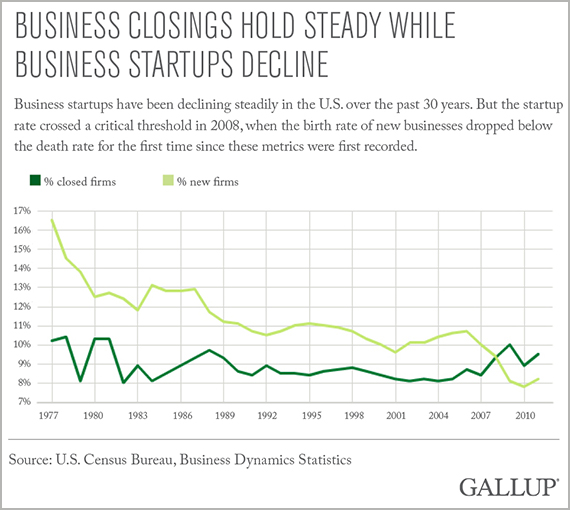
The U.S. now ranks not first, not second, not third, but 12th among developed nations in terms of business startup activity. Countries such as Hungary, Denmark, Finland, New Zealand, Sweden, Israel and Italy all have higher startup rates than America does.

We are behind in starting new firms per capita, and this is our single most serious economic problem. Yet it seems like a secret. You never see it mentioned in the media, nor hear from a politician that, for the first time in 35 years, American business deaths now outnumber business births.

Just look at my family. The USA has already have lost over 50 jobs, and based on past taxes paid, more than $100 million in state and federal taxes after jailing my father for 11 years for his failure to pay around $2 million in taxes it claimed he owed. It also lost the benefit of any new businesses he would have started in the last ten years. And it has lost whatever benefit it would have gained from several opportunities in the USA I would have pursued in the past, but instead elected to leave fallow because the regulatory and compliance headaches were too high when piled on top of the usual risks and time commitments involved. I was never as successful as my father, of course, but my business did reach a respectable size and employed a dozen people.

It’s so bad these days that the USA is not only disincentivizing both its resident and expatriate entrepreneurs, but is even causing the latter to give up their citizenships in record numbers. Eduardo Saverin, one of the Facebook co-founders, is far from the only U.S. citizen to renounce his citizenship over tax-related business matters. For years, the American instinct has been to say “good riddance” to such renunciates, but the country is past the point where it can afford to do so, especially when most other countries are very actively courting the small minority of people who are capable of creating new businesses that will provide new job opportunities for their citizens. At this point, foreign entrepreneurs would have to be either stupid or very short-sighted to pursue a green card that will serve as a financial anchor for the rest of their lives.

The tragic thing is that the USA is no longer the land of opportunity for entrepreneurs. It was only 20 years ago that the young guys who started id Software moved from Wisconsin to Texas because the opportunities were better there. But the ids of tomorrow are now leaving the USA for other countries, and are increasingly starting them in places like Eastern Europe, the Nordic countries, and Israel. The last five big game startups have come out of Russia, Finland and Sweden; one of the biggest mobile game successes is in Serbia. This means that even aside from its macroeconomic problems, the USA is very unlikely to possess the long-term potential for growth it once took for granted anymore.

The effects of these negative developments concerning entrepreneurial activity are somewhat obscured by the fact that New York is still the financial capital of the world; four of the six game companies mentioned either went public in the USA or were acquired by US companies. But it doesn’t change the fact that innovation is increasingly taking place outside the USA.


That is, admittedly, remarkably dumb

Matt Taibbi is underwhelmed by American Sniper:

Eastwood, who surely knows better, indulges in countless crass stupidities in the movie. There’s the obligatory somber scene of shirtless buffed-up SEAL Kyle and his heartthrob wife Sienna Miller gasping at the televised horror of the 9/11 attacks. Next thing you know, Kyle is in Iraq actually fighting al-Qaeda – as if there was some logical connection between 9/11 and Iraq.

Which of course there had not been, until we invaded and bombed the wrong country and turned its moonscaped cities into a recruitment breeding ground for… you guessed it, al-Qaeda. They skipped that chicken-egg dilemma in the film, though, because it would detract from the “human story.”

Eastwood plays for cheap applause and goes super-dumb even by Hollywood standards when one of Kyle’s officers suggests that they could “win the war” by taking out the evil sniper who is upsetting America’s peaceful occupation of Sadr City.

Look, I get it’s a movie. Movies end. They need an ending, and the sort of 4GW morass into which Iraq has ever so predictably descended isn’t suitable. So, it’s understandable that Eastwood turns it into a story with a coherent ending, right down to the dramatic mano-a-mano that is conventional in these sorts of war movies. And it is refreshing to see Hollywood take the side of an American soldier for a change.

But that doesn’t make that line any more intelligent. It just doesn’t.