The third volume of the Episodios Nacionales — the great historical novel cycle of Spain
The Nineteenth of March and the Second of May follows Gabriel Araceli from the tranquil gardens of the Royal Residence to the blood-soaked streets of Madrid in the spring of 1808, as Napoleon’s armies enter Spain and ordinary Spaniards rise up against them.
Gabriel is seventeen, working as a typesetter in Madrid and living for his weekend journeys to Aranjuez, where the orphan Inés lives with her uncle, the good-hearted Latinist Father Don Celestino. Their courtship unfolds in some of Galdós’s most beautiful prose. But this private idyll is shattered when Inés’s relations arrive to claim her, Don Mauro Requejo and his sister Doña Restituta, a pair of grotesques worthy of Dickens at his most savagely comic.
The Requejos carry Inés off to Madrid and imprison her in their shop, where she sews from five in the morning until eleven at night. Gabriel abandons his trade and infiltrates the household as a servant, only to discover that Don Mauro intends to marry Inés himself. Meanwhile, outside the shop walls, Spain is falling apart. The court at Aranjuez erupts; Godoy is dragged from hiding; Carlos IV abdicates and the French pour into Madrid. Gabriel witnesses the Aranjuez uprising from inside the mob, through streets lit by torches and filled with fury.
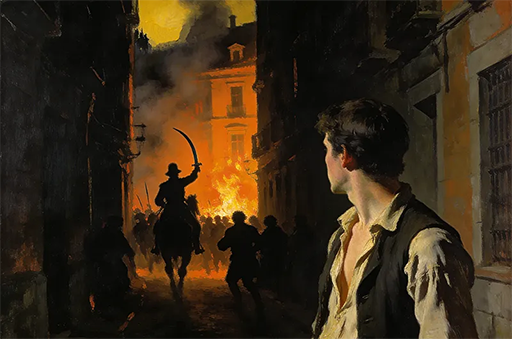
The novel’s climax is the Second of May, 1808, the day Goya painted, the day that began Spain’s war against Napoleon. Gabriel fights in the streets of Madrid against the Mameluke cavalry and French artillery, and the novel ends with one of the most extraordinary passages in nineteenth-century fiction, in which one man’s experience of dying is described in a sensational manner that anticipated literary modernism by more than half a century.
Pérez Galdós weaves domestic comedy, political upheaval, street-level violence, and desperate love into a novel that moves from the lyrical to the grotesque to the devastating. Of the ten novels in the First Series, The Nineteenth of March and the Second of May is the one in which the private life of Gabriel and the historic tragedy of Spain collide most unforgettably.
Available for Kindle, KU, and audiobook on Amazon. You can read an excerpt from the new translation at Castalia Library.