
Connected to other manufactured creatures. CHECK!
#Arkhaven INFOGALACTIC #Castalia House
Fawlty Towers is rightly considered one of the greatest television shows in the history of television. So it’s interesting to learn this little detail about it from the man married to the actress who played Sybil Fawlty.
It wasn’t just the lines that Pru and the cast had to familiarise themselves with.
‘In the case of Fawlty Towers, the devil was in the detail.
In addition to writing the dialogue, John and Connie had gone to great pains to explain exactly what was happening in each scene and why. Put it this way: the script for a 30-minute episode of a sitcom would normally be around 60 pages long, but for Fawlty Towers they were something approaching 140.
In other words, the reason Fawlty Towers so often resembled the synchronized perfection of an oft-shown play or musical is because it was essentially written as a play, with the script containing the choreography and the character motivations as well as the dialogue.
While it doesn’t rise to the level of Tolkien’s invented histories and languages, or Umberto Eco’s recreation in string of his monastery in order to time the length of the conversations properly, it does serve as a spur to the creative mind to up his creative game.
But it really doesn’t have much to do with chance or anything random. A team of Italian scientists tests the connection between the distribution of various attributes and the distribution of wealth.
What factors, then, determine how individuals become wealthy? Could it be that chance plays a bigger role than anybody expected? And how can these factors, whatever they are, be exploited to make the world a better and fairer place?
Today we get an answer thanks to the work of Alessandro Pluchino at the University of Catania in Italy and a couple of colleagues. These guys have created a computer model of human talent and the way people use it to exploit opportunities in life. The model allows the team to study the role of chance in this process.
The results are something of an eye-opener. Their simulations accurately reproduce the wealth distribution in the real world. But the wealthiest individuals are not the most talented (although they must have a certain level of talent). They are the luckiest. And this has significant implications for the way societies can optimize the returns they get for investments in everything from business to science.
Pluchino and co’s model is straightforward. It consists of N people, each with a certain level of talent (skill, intelligence, ability, and so on). This talent is distributed normally around some average level, with some standard deviation. So some people are more talented than average and some are less so, but nobody is orders of magnitude more talented than anybody else.
This is the same kind of distribution seen for various human skills, or even characteristics like height or weight. Some people are taller or smaller than average, but nobody is the size of an ant or a skyscraper. Indeed, we are all quite similar.
The computer model charts each individual through a working life of 40 years. During this time, the individuals experience lucky events that they can exploit to increase their wealth if they are talented enough. However, they also experience unlucky events that reduce their wealth. These events occur at random.
At the end of the 40 years, Pluchino and co rank the individuals by wealth and study the characteristics of the most successful. They also calculate the wealth distribution. They then repeat the simulation many times to check the robustness of the outcome.
When the team rank individuals by wealth, the distribution is exactly like that seen in real-world societies. “The ‘80-20’ rule is respected, since 80 percent of the population owns only 20 percent of the total capital, while the remaining 20 percent owns 80 percent of the same capital,” report Pluchino and co.
That may not be surprising or unfair if the wealthiest 20 percent turn out to be the most talented. But that isn’t what happens. The wealthiest individuals are typically not the most talented or anywhere near it. “The maximum success never coincides with the maximum talent, and vice-versa,” say the researchers.
So if not talent, what other factor causes this skewed wealth distribution? “Our simulation clearly shows that such a factor is just pure luck,” say Pluchino and co.
First of all, this science, such as it is, should suffice to end, once and for all, the absurd insistence by American Jews that their statistically inordinate amount of wealth and power amassed in a matter of decades has anything to do with their imaginary average 115 IQ.
However, “just pure luck” is not a variable. While this method is sufficient to demonstrate the lack of correlation between talent, IQ, hard work, and other specific variables with wealth, to simply assign the causation to random chance is incorrect. The much more reasonable answer is that the team failed to test the variable that is most strongly correlated with wealth, which is positive connection to the central societal distributors of wealth.
There is no way such a model could account for ticket-taking, and yet we repeatedly observe that mediocre ticket-takers succeed while much more talented independents “experience unlucky events”. Is there one single person in the world who believes that Ben Shapiro is better behind the microphone than Milo Yiannopoulos or Owen Benjamin, and that he is also a more talented writer than Bruce Bethke, Chuck Dixon, and me?
Color me dubious.
Is there anyone who genuinely believes CNN can’t do better than hire a CEO and Chairman who was fired as the Director-General of the BBC for covering up the Jimmy Saville scandal?
I am of the color dubious.
It will be interesting to see what happens when these researchers discover that what they call “serendipity” fails to produce the results they are expecting, and when “serendipity” suddenly begins to cause them to experience unlucky events.
A useful term, that “serendipity”.
You can put this one squarely in my list of failures. This morning, I relinquished all of the development and publication rights to the excellent fantasy wargame Divine Right, nine months before our rights to it expired, due to my inability to get Divine Right reprinted or get the computer game developed. The project wasn’t a complete failure, as we did manage to get Minarian Legends published, but I didn’t have the bandwidth to oversee the other aspects of the project and the volunteer project leaders didn’t have the ability to complete either the boardgame or the computer wargame.
Anyhow, as a fan of the game and its creator, I wish the next group of developers great success with the updated Divine Right, and eventually, one hopes, Scarlet Empire. Sadly, it will not be featuring this excellent cover, based on the original artwork, that we had produced for our now-cancelled edition.
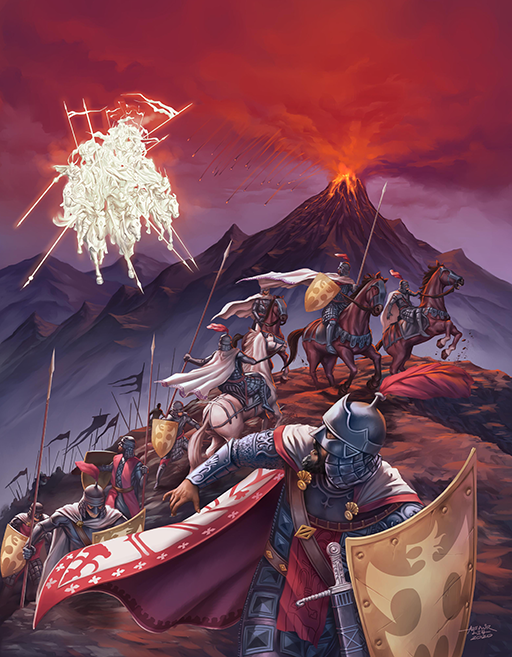
For some reason, it appears that gaming volunteers are reliably less able to get a job done than those who volunteer in various other areas of development, from print books to open source office projects. I was very briefly involved in what was supposed to be a Linux distro dedicated to games, and I have never, ever, observed a more useless horde of worthless gammas, all of whom had multiple, often contradictory, opinions, and none of whom were willing to lift a finger to actually do anything at all. I quit the project three weeks after being given responsibility for overseeing the development of the first demo game for the distro.
Despite being 21 years old, The Battle for Wesnoth is still the flagship for open source game development.
My theory is that those who are actually willing and able to successfully develop games are mostly already doing it on their own, as the thriving independent game scene demonstrates. That leaves a lot of people who very much like the idea of game development, but are more interested in the trappings than in actually dealing with the decidedly less-romantic reality of it. The same is true of those who want to be a writer more than they want to write anything; it was surprising to observe how many of the members of a much-accomplished Minnesota writers’ group of which I briefly was a guest never actually wrote anything at all. However, it’s important to keep in mind that one can’t actually know if one has the ability to do something new until one tries; volunteers must always be respected for being willing to try rather than criticized for an inability to do.
That being said, it’s still rather remarkable that the Arkhaven, SocialGalactic, and UATV teams have been able to accomplish bigger and more difficult tasks in less time than the various groups of game volunteers have. I have some ideas as to why, but nothing concrete enough to state an opinion on them.
So, if you want to know why we’re not planning to pursue anything in the game space beyond finishing the ALT-HERO RPG for the backers and possibly licensing various properties to other game companies, now you know why. I’m not blaming anyone but myself here; that experience with the Linux project was 14 years ago, and I should have reached the correct conclusions at the time.
This doesn’t mean I won’t do any game design, but in the future, I’ll do the development myself or we’ll hire a proven professional team to do it. And let’s face it, it’s not the worst thing to give up the Divine Right license, as this means we’ll own all the rights to whatever fantasy wargame I end up designing in the future.
The Mayor of New York City turns anti-immigrant.
Mass immigration will “destroy” New York City unless something is done about it, Mayor Eric Adams has warned. Speaking at a meeting in Manhattan, Adams said the city was being overwhelmed by migrants from all over the world and faces a $12 billion budget deficit.
“Never in my life have I had a problem that I did not see an ending to – I don’t see an ending to this,” Adams explained at a town hall-type meeting on Wednesday evening. “This issue will destroy New York City.”
The most populous US city is taking in more than 10,000 migrants a month, according to Adams.
But how can the city be overwhelmed by immigrants when they strengthen the economy and bring much-needed vibrancy and diversity to the city?
Sounds a little racist to me. And definitely anti-semitic. Mayor Adams should lose his job, his bank account, and his access to social media, don’t you think?
It’s always fascinating to see how direct and personal experience with immigration tends to change even the most liberal individual’s mind on the subject.
ALT★HERO Episode 88: Self Defense
FAIRY DOOR Episode 41: Thresholds
TATTERS Episode 14: Come Kea
CHATEAU GRIEF Episode 287: Some Assaulting
CHUCK DIXON PRESENTS: ADVENTURE Episode 91: The Brigand
BEN GARRISON Episode 115: The Squatter in Your House
STONETOSS Episode 222: Prisoner of Conscience
ALICE IN WONDERLAND Episode 1: Discovering Wonderland
The Arktoons production team has launched a new spin on an old children’s classic, Alice in Wonderland.
Clay Travis explains why ESPN is sinking fast, why the free ride that sports fans enjoyed at the expense of everyone else with a cable subscription has come to an end, and the inevitable implications for everyone in the media business
ESPN knows that their cable and satellite business is collapsing but, and this is key, they’ve also done the math and realize that streaming is going to destroy their existing cable business. Because, and this is what no one seems willing to say, ESPN doesn’t just have one bad business now — the cable and satellite bundle — they have the streaming business too, which is an even worse business. And, and this is very key, each business is accelerating the demise of the other. Streaming isn’t making ESPN stronger, it’s making ESPN weaker because it’s hastening the destruction of a profitable business — cable and satellite — for a money-losing business — streaming.
And that’s what many are still missing — as the cable and satellite bundle boat takes on water and sinks, the streaming bundle is also taking on water and sinking too. ESPN has tried to sell people on the idea that at the exact moment that the cable and satellite bundle collapses they are going to step to a brand new business, the streaming business, and it’s going to be a sturdy and successful lifeboat that carries them to richer waters.
But the reality is, streaming is a way worse business than the cable and satellite bundle. Because the only people who pay for ESPN will be sports fans. The free ride is over, your Aunt Gladys is never signing up and subsidizing your sports viewing again.
Let’s say ESPN makes $8 billion a year now in subscription fees. ($10 a month x 70 million subscribers they has before Charter cut this by 15 million). Toss in another two billion in advertising and let’s say ESPN presently nets around $10 billion a year. Okay, how many people will sign up for ESPN as a direct to consumer streaming service? If they could get 70 million subscribers we’d all have to pay $120 a year for ESPN streaming by itself. (This assumes advertising will still be the same, which it won’t, but let’s just be generous and pretend it will.) But, as I noted above, many of these people paying for ESPN now as part of their cable and satellite package never watch ESPN.
So how many people will actually subscribe to a direct to consumer ESPN streaming service? Turns out there are some early test cases.
The NFL Sunday Ticket is the most desirable direct to consumer product on the planet. Do you know how many households subscribe for NFL Sunday Ticket? Around three million.
Uh oh.
Wait a minute, you’re telling me that the NFL can only get around three million households to sign up for actual NFL games, all of the out of market games, in the entire country?
We’ve got a major math problem here for ESPN.
In other words, even if we’re generous and we assume all the other sports combined generate as much television interest as the NFL, we’re looking at a decline from 100 million at peak to six million. That’s a decline of 94 percent in households. In monetary terms, if we use a single-season, single-team MLB subscription as a stand-in for all other sports, that’s an 88 percent decline in revenue from $10 billion to $1.23 billion… with $45 billion in rights fees owed through 2027.
No wonder the Saudis are licking their lips and looking to buy up more sports leagues instead of teams. It also explains why Bob Iger is desperately casting around for anyone who wants to buy pieces of the collapsing Devil Mouse empire. But it’s not just Disney that is facing the precipice.
TNT, Turner, AMC, Nickelodeon, you name the channel, all of them are basically being held together by the cable bundle. And ESPN is the most important channel in the cable and satellite bundle, it’s the linchpin, the anchor store. ESPN is your neighborhood shopping mall’s anchor tenant — the Macy’s, the Nordstrom, the Dillard’s the JC Penny. When a mall’s anchor tenant leaves the mall is often dead for, the rest of the shopping mall collapses around it. That’s why the best analogy for ESPN isn’t Blockbuster, it’s Sears, a big mall anchor tenant that collapsed and went bankrupt.
Okay, if you’ve read to this point, you might be thinking, “This feels like it’s going to be really bad, Clay.”
Uh, yeah, it is, that’s why I called it a media extinction level event.
And yet, the alternative media will survive this unscathed, because we’re already accustomed to being entirely dependent upon our direct supporters. No free riders, no advertisers. And so, as it happens, the great media extinction may be the best possible thing for the future growth of Arkhaven and UATV.
Den Blonde Ulven performs an experiment on the size and shape of the Earth:
My father and I performed some optic experiments near Virginia Beach in Norfolk, Virginia. The goal of this event was to check the hypothesis: can objects be seen further than they should be able due to the curvature of the Earth?
We were standing on Ocean View Beach close to East Ocean View Beach- coordinates 36.933410, -76.201875. Three pieces of equipment were utilized- a Nikon P1000 camera, a tripod, and an SD memory card for the camera. This camera was capable of recording while shooting a video and simultaneously zooming in great distances. The P1000 is what captured the videos shown.
The weather was partly cloudy, no rain, and slightly hazy. These are not ideal conditions due to the haze. Yet even under these non-ideal conditions, objects that have been zoomed in upon are distinguishable.
We used a website to determine the location of cargo ships on a map in near real-time. This allowed us to estimate where the ships were. We then used a feature on Google Maps called “measure” to connect our location with the ships’. This gave us an approximate distance of which I estimate is accurate within a range of (+-)0.2 miles.
The obvious rebuttal, as DBU anticipates, is “refraction”. However, there is no extant model for refraction that is sufficient to account for the difference between what the curvature model predicts and the observable results obtained.
This does not suggest the Earth is flat. It does, however, suggest that the official story about the specific size and shape of the Earth is unsupported by the observable evidence.
Now, I am not a Flat Earther. Neither am I an Oblate Spheroidian. I have no dog in this hunt, except that it would not surprise me in the least to learn that the Official Story, once more, has been proven false. My fundamental position on such celestial matters can best be described as Holmesian to the core.
My surprise reached a climax, however, when I found incidentally that he was ignorant of the Copernican Theory and of the composition of the Solar System. That any civilized human being in this nineteenth century should not be aware that the earth travelled round the sun appeared to be to me such an extraordinary fact that I could hardly realize it. “You appear to be astonished,” he said, smiling at my expression of surprise. “Now that I do know it I shall do my best to forget it.” “To forget it!” “You see,” he explained, “I consider that a man’s brain originally is like a little empty attic, and you have to stock it with such furniture as you choose. A fool takes in all the lumber of every sort that he comes across, so that the knowledge which might be useful to him gets crowded out, or at best is jumbled up with a lot of other things so that he has a difficulty in laying his hands upon it. Now the skillful workman is very careful indeed as to what he takes into his brain-attic. He will have nothing but the tools which may help him in doing his work, but of these he has a large assortment, and all in the most perfect order. It is a mistake to think that that little room has elastic walls and can distend to any extent. Depend upon it there comes a time when for every addition of knowledge you forget something that you knew before. It is of the highest importance, therefore, not to have useless facts elbowing out the useful ones.” “But the Solar System!” I protested. “What the deuce is it to me?” he interrupted impatiently; “you say that we go round the sun. If we went round the moon it would not make a pennyworth of difference to me or to my work.”
That being said, I applaud those who do care about such things taking the time and effort to actually investigate for themselves the assertions of what is said to be science. It is telling, to me, that those who claim to be completely dedicated to science so often decry those who dare to engage in real scientody to replicate the current state of scientage.
The G20 has obviously been spooked by anti-colonial developments in Niger, Gabon, Burkina Faso, and Mali, to say nothing of the recent expansion of BRICS, as it has unexpectedly offered an invitation to the African Union that offers it equal status with the European Union.
Leaders of the G20 group of advanced economies have agreed to grant the African Union permanent membership of the organization, according to multiple media reports ahead of this week’s summit in New Delhi. The bloc of 55 African countries, which is currently classified as an “invited international organization” by the G20, would have the same status as the European Union within the group. Indian Prime Minister Narendra Modi, whose nation currently holds the rotating G20 presidency, reportedly urged other leaders to accept the African Union into the group in a letter in June.
I very much doubt that allowing a toothless would-be superstate to have a very limited voice in the least of the globalists’ two public institutions is going to accomplish anything significant; how many of the 55 states that make up the bloc can actually be said to have “advanced economies”? By this expanded definition, who doesn’t have an advanced economy, Papua New Guinea and a small sovereign tribe of 37 people living in the Amazon?
However, it is another sign that the African front is in the process of opening, even though no one is actually fighting there yet. No doubt massive bribes will be offered in an attempt to keep the African governments in line, which will likely inspire additional military coups and more anti-corruption revolutions.
It’s become clear that a lot of readers are very interested in contemplating what is likely to come next in WWIII. As a wargamer and game developer, it’s also of particular interest to me.
Here’s the deal. If there are 10 new Premium subscriptions or 25 new Basic subscriptions in the next 24 hours, I will broadcast a supersized Darkstream dedicated to reviewing in detail the 165-page report on the CSIS summary of the 24 US vs China wargames conducted in January, entitled The First Battle of the Next War: Wargaming a Chinese Invasion of Taiwan.
By the way, there are now 5,463 videos available on UATV, with 3-6 more being added every single day. The duplicate set of servers has already been installed at the European data center and is expected to go operational before the end of the month.
UPDATE: Apparently there is considerable interest in WWIII. The 24 hours aren’t even close to being up and BOTH targets were blown away. So it’s on. I’m up to page 30 already, and I’m also working on seeing if I can obtain the rules of the wargame. They’re not necessary for the detailed analysis as I should be able to glean their assumptions from the results, but I like to read wargame rules.
Also, in order to express my appreciation for the high degree of interest indicated and support provided, I’m going to add a second review of the CNAS wargame conducted in June 2022.