Mailvox: The Significance of the Refutation

Can you explain how the refutation of Kant affects our life today in simplified terms that anyone can understand?

Most people have never heard of Immanuel Kant, but almost everyone lives inside a concept he created. The idea sounds humble enough. Human reason can’t truly know reality as it is, only how it appears to us through our limited human senses. That sounds modest and even wise. But once you accept the idea as a real limitation, a strange thing follows. If nobody can actually know how things really are, then every statement about reality becomes just one more opinion, one more “perspective,” and none of those opinions or perspectives can ever be proven true. Refuting Kant’s idea and showing that it isn’t a rule or a real limitation is extremely significant because it puts the possibility of actual knowledge back on the table.

Here are five ways the refutation of Kant’s idea about unknowability changes your world.

First, expertise and “the science.” For decades, people were told to accept various statements because experts agreed or studies showed, and to treat the matter as settled and beyond any possibility of question. Kant’s rule props this up: if reason can’t reach reality directly, then truth becomes whatever the credentialed authorities say it is, because there’s no independent reality you can check them against. Refuting the rule restores the obvious: there is a real world, then those expert scientific predictions either come true or they don’t, and an expert who keeps being wrong is wrong no matter how many credentials he holds. You’re not dependent upon either the experts or the scientists; you’re allowed to check reality yourself.

Second, the idea that everyone has their own truth” This phrase is everywhere now, and it descends directly from Kant’s idea. If reality is locked away and we only ever see our own version of it, then your truth and my truth are just two filtered views and neither can be more correct than the other. Refuting the doctrine eliminates this. There is one reality. People can be honestly mistaken about it, and perspectives can be particually correct, but “true for me” stops being a relevant position. Some claims match reality and some don’t, and which is which is not up to how you feel about it.

Third, morality. If we can’t know how things really are, then we also can’t know how things really should be, and right and wrong collapse automatically into preference, culture, or power, with the strongest, loudest voice defining it. This is why so many moral arguments today end in “who are you to judge.” Refuting unknowability reopens the possibility that good and evil are real features of the world, discoverable like other truths, not just labels we stick on things we happen to like or dislike. That changes how seriously you can take a moral claim, your own included.

Fourth, science and discovery itself. Kant’s rule says human reason can’t identify anything about reality that isn’t already handed to us through experience. But that’s not how the greatest discoveries actually worked. The planet Neptune was found by pure calculation first: a mathematician worked out that something unseen had to be tugging on Uranus, predicted exactly where to point the telescope, and there it was. The same thing happened with antimatter, predicted on paper before anyone detected it. Reason reached out and grabbed a piece of reality nobody had experienced yet. If Kant’s rule were true, those triumphs couldn’t have happened. Refuting it explains why the human mind really can discover the world, not just sort the impressions it’s given.

Fifth, your ability to have confidence in your own thinking. The quiet cost of Kant’s rule is humility turned into paralysis: who am I to claim I know anything, when the smart position is that real knowledge is impossible? That mindset trains people to defer, to hedge, to assume the truth is forever out of reach and someone else’s call. Refuting the doctrine gives that back. Your reasoning is a real instrument that makes real contact with the real world. You can investigate, conclude, and stand on what you find. You will not be right about everything, and partial knowledge is still the human condition. But the door to truth was never locked and reality was never off limits. Kant just declared that it was, and a lot of people placed false trust in his assertions for two hundred and fifty years.

The refutation of Kant is therefore akin to a creature that thought it was a fish discovering that it’s simply been swimming in water this whole time, and realizing that not only can it breathe in the air and walk on the land too, but also that it has wings and can fly.

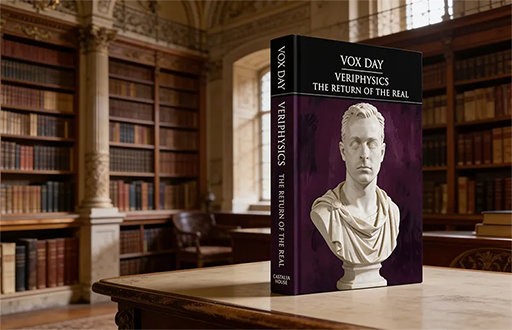
In related news, VERIPHYSICS: THE RETURN OF THE REAL is now available for preorder in hardcover and paperback editions from NDM Express. They should be available at Amazon, Barnes & Noble, and other bookstores next week. It contains both The Treatise, The Refutation, and the Agrippan Trilemma challenge.

DISCUSS ON SG


A Refutation, Reviewed

The first review of THE REFUTATION OF KANT has been posted.

A refutation of Kant has to do one of two things: produce a counterexample the system cannot deal with, or locate the move inside the system that doesn’t actually argue for what it concludes. The second part of Day’s Veriphysics does both, and the interlocking of the two halves is what makes the book hard to answer because every defense of one wing concedes ground on the other.

The argument worth focusing on is the Master Amphiboly, and Vox is right about it. The “Thing-in-itself” runs two readings across a single word: that every cognizer is shaped by its apparatus, and that no feature of reality is in principle accessible to human cognition. The first is trivially true and Kant argues for it. The second is the load-bearing claim of the whole edifice and Kant never argues for it once, and instead moves to it under cover of the first. Once you see the slide, you can’t unsee it. Neptune is the cleanest empirical counterexample, though not the only one: Le Verrier worked an inverse problem through pure formalism and Galle confirmed the prediction within a degree, and the positron case is structurally identical: Dirac’s equation required it before anyone looked. If formal cognition cannot in principle identify features of reality not already given in experience, these events did not happen.

The mathematical half is harder to evade and simpler to state. Construction in Kant’s sense was tied to constructibility, which was already a problem with the irrationals in 1781 and decisively broken by Cantor a century later. The available retreat is to recast synthetic a priori as analytic, which costs the system the work it was built to do. The pincer is real and no version of Kant survives both jaws. One place worth pressing further is that the amphiboly used is portable. The slide from an apparatus-relative epistemic limit to an ontological claim about reality runs through Hume on causation, through Wittgenstein on private language, and through most of the strong-program science studies literature. Naming it generalizes the refutation.

Worth reading. Excellent work by Day

That is an intriguing observation about the potential portability of the Master Amphiboly. I shall have to examine the situation and see just how far the intellectual rot goes.

UPDATE: A second review has been posted.

I would like to thank Vox for writing this excellent book. Since Kant is the foundational philosophical thinker of the “Enlightenment”, its easy to see why many people cannot think straight these days. I enjoy reading St. Thomas Aquinas. Vox mentions that he may have called Kant a heretic and that sounds spot on.

Now if we could just convince the world to abandon Kant, things might improve. His notion of “…the thing-in-itself is unknowable by theoretical reason..” amazed me. Really??? Kant never did applied physics, medicine, or skilled trades, did he? That said, the world is heavily invested in Kant, just like Darwin, and seems to like to double down, not change its thinking. Indeed I enjoyed Vox pointing out that the current defenders of both have moved WAY beyond the original works in their defenses thereof.

Hegel’s thought confuses me too, perhaps he’s in the queue as well for a refutation? I highly recommend this book to anyone who seeks an understanding of why we need a 21st Century philosophy that is actually workable.

DISCUSS ON SG


On the Print Edition

In preparation for the print edition of Veriphysics, which has been requested by a few intrepid minds and is obviously necessary for the long run, I’ve updated The Treatise to include an appendix to demonstrate the legitimacy and utility of the Triveritas, which consists of the paper on the two trilemmas and begins thusly:


The Agrippan Trilemma is one of the oldest and deepest problems in epistemology. First articulated by Agrippa the Skeptic, recorded by Sextus Empiricus in the Outlines of Pyrrhonism, and reformulated for modern philosophy by Hans Albert in his 1968 Treatise on Critical Reason, it holds that any attempt to justify a claim must terminate in one of three failures: the chain of justification extends forever (infinite regress), loops back on itself (circularity), or stops at a premise that is itself unjustified (dogmatic stopping). Since these three options appear to exhaust the logical possibilities, and since none of them constitutes genuine justification, the Trilemma concludes that justified knowledge is impossible.

The major epistemological traditions of the modern era have each responded by conceding one horn. Foundationalism accepts dogmatic stopping, identifying certain beliefs as properly basic and terminating the chain there. Coherentism accepts circularity, holding that beliefs are justified by mutual support within a web. Infinitism accepts the regress, arguing that an infinite chain of reasons is not inherently defective. Each of these frameworks treats one horn as a feature rather than a defect. None defeats the Trilemma. Each surrenders to it.

This paper solves the Agrippan Trilemma. The solution is not a trick, not a reframing, and not a claim that the problem is somehow misconceived. The Trilemma is a legitimate argument. Its conclusion follows from its premises. The solution is to show that one of its premises is false: specifically, that the third horn, dogmatic stopping, is built on an amphiboly that, once identified, breaks the horn entirely.

The amphiboly is this: the Trilemma treats “terminates” as equivalent to “terminates arbitrarily.” It assumes that any stopping point is an unjustified stopping point, that all termination is epistemically equal, that there is no distinction between stopping because you have run out of reasons and stopping because you have run out of unchecked dimensions. This conflation is not argued for in the Trilemma. It is assumed. And it is false.

The Triveritas demonstrates that it is false. The Triveritas holds that warranted assent requires the simultaneous satisfaction of three independently necessary conditions: logical validity (L), mathematical coherence (M), and empirical anchoring (E). Each dimension terminates at its own bedrock: L at logical axioms, M at mathematical axioms, E at observation. The Triveritas takes the third horn. It terminates. But it terminates at three independent stopping points of fundamentally different kinds, each constraining the others. The probability of all three stopping points being wrong in a way that produces a coherent false positive is strictly lower than the probability of any single stopping point being wrong. This is proved mathematically and confirmed empirically across twelve historical cases spanning four centuries and seven fields.

Checked termination is not dogmatic stopping. The third horn breaks.


So the print edition will consist of The Treatise and The Refutation of Kant, and includes the three following appendices:

  • Solving the Agrippan Trilemma: Triveritas and the Third Horn
  • The Sophistic Foundation of Reason: A Fundamental Flaw in Enlightenment Epistemology
  • Kant Against Kant

It should be available in hardcover and paperback sometime next week. I already have plans for second, third, and possibly fourth volumes, but only the second is likely to be out this year. In the meantime, it should be interesting to see if anyone comes up with any substantive criticisms, or if, as with Probability Zero, no one will be able to do so.

DISCUSS ON SG


A Philosophical Bestseller

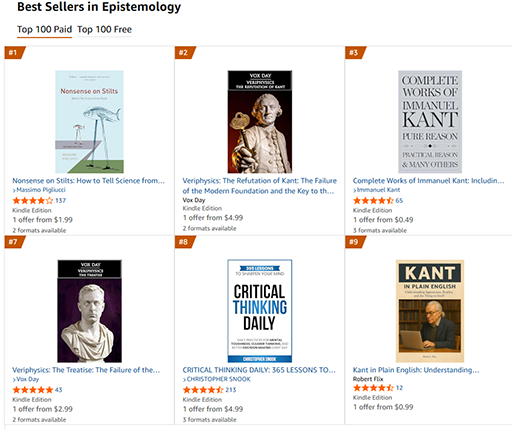
I found the juxtaposition between The Refutation of Kant and Complete Works of Immanuel Kant to be mildly amusing. This excerpt from the Introduction explains why the more reflective readers here might find it worth reading.


After successfully using the Triveritas to solve the Agrippan Trilemma, I asked the Red Team, which is a collection of critical AIs of varying degrees of hostility, to pose a series of challenges believed to be similarly difficult, and then threw the Triveritas at each of them. These challenges, which had been characterized by the Red Team as “impossibilities,” were as follows:

  1. The Agrippan Trilemma
  2. The scientific demarcation problem
  3. The underdetermination problem
  4. The hard problem of consciousness
  5. Hume’s is-ought distinction
  6. Gödel’s Incompleteness Theorem

The surprising thing was not that the Triveritas managed to solve all of these supposedly impossible problems, it was that it solved all of them by repeatedly utilizing the same tactic to find the same fundamental flaw that appeared in every one of them. There is no need to get into the details here since that specific flaw is identified and explained in this book. Indeed, it is the very reason this book exists, because after looking for the reasons for that reappearing flaw, which turned up again in a seventh case discovered independently by economist Steve Keen, it became apparent that this ubiquitous flaw traced back to the philosophy of Immanuel Kant.

“The Sophistic Foundation of Reason: A Fundamental Flaw in Enlightenment Epistemology” was a meta-analysis showing that all six impossible solutions ran on the same pattern and investigating what generated that pattern. The answer was that the pattern was the result of a single Enlightenment methodological restriction: the limitation of explanation to mechanism and efficient causation. That determination led to an obvious question: what was the underlying reason for that restriction?

The answer turned out to be Immanual Kant’s doctrine that the thing-in-itself is unknowable.

Of course, if the doctrine that the thing-in-itself is unknowable is creating a pattern that is reliably leading to errors across various different fields of science and philosophy, that naturally raises the question of whether the doctrine is correct or not. As I will demonstrate in this book, the doctrine is not correct. Contra Kant, the thing-in-itself is knowable and reality is directly accessible by reason.

Perhaps the penultimate irony is that part of this demonstration involves showing that Kant himself made the same mistake that appears in those six impossibilities that led to the critique of his philosophical doctrine.

The greatest irony can be found in Appendix B. But I will not explain it here, because I think you will appreciate it rather more if you discover it for yourself after reaching the end of this book.


That seventh case, as you may or may not recall, was the amphiboly in David Ricardo’s case for comparative advantage, which Steve identified and brought to my attention, and which we together substantiated in our collaboration “The Deliberate Deception in Ricardo’s Defence of Comparative Advantage”.

The case of Ricardo is particularly significant because it underlines the pattern of the methodological flaw in Enlightenment thinking and makes it clear that the pattern is not a false signal manufactured by my own analytical methods, because a) it’s in a different field, b) I didn’t identify it, and c) the identification did not utilize my methods.

DISCUSS ON SG


On The Refutation of Kant

I promised the release of two books today, and as you’ve seen, the first was the fourth volume of the Episodios Nacionales by Benito Pérez Galdós translated into English. It’s a very good historical novel about one of the more significant battles of the Peninsular War, and if you enjoyed any of the three previous novels, you will enjoy this one.

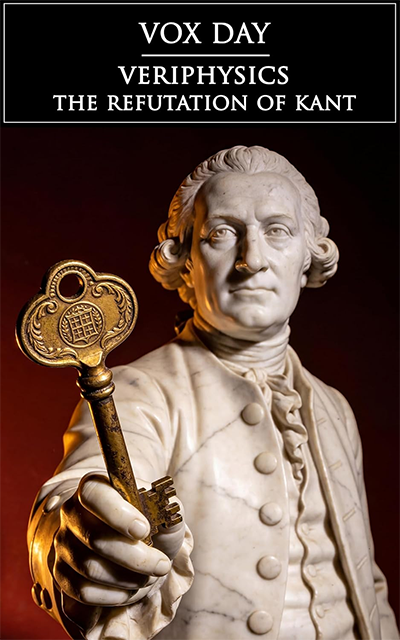
The second is the next book in the Veriphysics series. It’s entitled The Refutation of Kant: The Failure of the Modern Foundation and the Key to the Closed Door. It is an intellectual heavy-hitter, much more so than the Treatise which preceded it, and it’s not a book I was ever intending to write. To be honest, I hitherto considered Kant to be an immortal untouchable in the vein of Aristotle or Thomas Aquinas, although admittedly not on the basis of any particular knowledge of his works, principle of which is The Critique of Pure Reason.

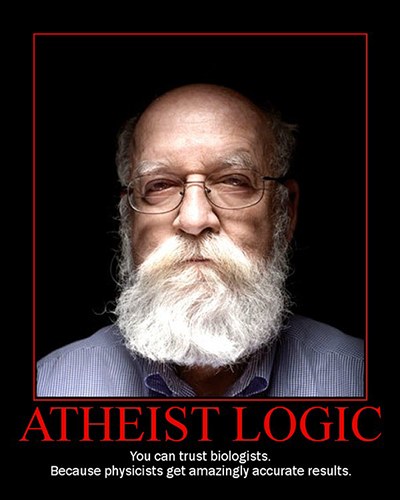
Now, here’s where things get a little bit strange. You may recall, back in the days when the Four Horsemen of the New Atheism were riding high, I created a meme to mockingly summarize what I’d determined to be the core argument of philosopher Daniel Dennett. That was back in 2009.

The second of the Four Horsemen of the New Atheism has died at the age of 82. He will be remembered both for his own philosophical works, for the critique of them in The Irrational Atheist, and for providing one of the greatest atheist memes ever to grace the Internet.Another Horseman in Hell, 20 April 2024

And yet, that happens to be exactly where we landed today with the release of Veriphysics: The Refutation of Kant. This may require a little more explanation since probably it isn’t a priori obvious, so bear with me and allow me to explain how we somehow went from an atheist demoralizer in 2009 to a comprehensive destruction-in-detail of the core philosophical foundation of the Enlightenment in 2026.

If you’ve been following the Veriphysics site, then you’ll know that after developing the Triveritas in the Treatise, I started testing it against various epistemological challenges. Some of you are aware of my proof of Free Will that utilized it, and a few brave souls have even started profitably making use of it themselves. But it wasn’t until it solved the 2,000-year-old conundrum known as the Agrippan Trilemma that I realized there was something truly special here. I ran the notion of its potential significance past the Red Team, and Grok suggested that while solving the Trilemma was impressive, the Triveritas couldn’t be considered of historic philosophical significance unless and until it could successfully address other, equally difficult epistemological challenges. Grok provided a list of six “impossibilities” ranging from Hume to Godel, and declared that nothing and no one could successfully expect to solve them.

The Triveritas solved five of them and provided further confirmation that the sixth one was actually impossible. This was remarkable, but what was truly astonishing was the fact that it solved all of five in exactly the same way, using exactly the same method despite the very different nature of the problems. So I concluded this meant there was a deeper pattern that somehow linked all of these different intellectual puzzles, even though they were constructed by different people in different fields over a period of time that spanned centuries.

How was that even possible?

After performing a meta-analysis of all six problems, both Trilemmas, and a few more epistemological challenges, the answer, somewhat to my surprise, pointed at Immanuel Kant. Because the answer was that the pattern of the same flaw across all five papers was the result of a single Enlightenment methodological restriction: the limitation of explanation to mechanism and efficient causation. Which led to an obvious question: what was the underlying reason for that restriction?

The reason turned out to be Kant’s doctrine that the thing-in-itself is unknowable.

Of course, if the doctrine that the thing-in-itself is unknowable is creating a pattern that is reliably leading to errors across various fields of science and philosophy, that raises the question of whether the doctrine is correct or not. And as I demonstrate in The Refutation of Kant, the doctrine of unknowability is not correct. Kant’s argument for it not only fails once, it fails twice, for two different reasons that are substantiated in no little detail in the book.

Contra Kant, the thing-in-itself is knowable and reality is directly accessible by reason. The great irony of the Enlightenment is that despite elevating Reason to the status of a literal goddess, and despite claiming its objective to be liberating Reason and freeing the mind of Man from the chains of his Christian tradition, the Enlightenment imprisoned Reason, subjected it to a metaphysical vivisectomy, and bound the mind of Man far more tightly than the pagan and Christian philosophers had even imagined possible.

This book is neither a light nor an easy read. But it may be, quite literally, the most important book published in the last 250 years. Because Kant’s foundational error has propagated through every modern science, every modern philosophy, every modern concept, and every modern thought. It has fundamentally restricted not only the way you think, but the very concepts that lie under the words you utilize.

And that’s what brought us all the way back to a minor little meme about one of the New Atheists created 15 years ago.

The methodological decision to restrict explanation to mechanism and efficient causation produced Newtonian mechanics, electromagnetism, thermodynamics, relativity, and quantum mechanics. This success created an overwhelming presumption that the restriction was not a restriction but a discovery: this is how reality works, and the method’s success proves it. The success in physics provided apparent empirical confirmation of the metaphysical claim, even though the success was in physics and the metaphysical claim was about all of reality.

In other words, you can trust [fill-in-the-blank] because physicists produce amazingly accurate results. If you don’t understand how comprehensively this refutation of Kant’s unknowability doctrine necessarily alters the very way you think about the world on a daily basis, that’s fine, that’s what the book is there to explain to you. It will literally free your mind. And you don’t need to follow all the technical details for it to make sense to you; they are there so you can be confident that its conclusions will withstand any and every critical attack lodged against the refutation and its inevitable consequences.

DISCUSS ON SG


A Hard Target

This is a request for serious mathematicians or professional philosophers who specialize in Kant. I’ve written a paper that takes on a considerably more challenging target than Darwin et al, and I’d like to get the benefit of review by a team of top-notch human reviewers before I publish it anywhere. It’s already been through the Red Team stress test, so most of the obvious flaws should already have been detected and addressed. Shoot me an email if you’re ready, willing, and able to read through and review the paper.

The Mathematical Refutation of Kant: The Irrational, the Imaginary, and the Infinite

Kant’s account of mathematical cognition, presented in the Doctrine of Method and elaborated through the Transcendental Aesthetic and the Prolegomena, holds that synthetic a priori mathematical knowledge is possible because mathematical objects are constructed by the finite cognitive subject in pure spatial or temporal intuition. Kant’s account grounds the application of mathematics to nature that the rest of the Critique presupposes, licenses the contrast between mathematical and philosophical method that organizes his epistemology, and sets the boundary between constitutive mathematical objects and the regulative ideas of reason. The inferential chain that delivers the unknowability of the noumenal begins at this point: if mathematical cognition is bounded by what the cognitive subject can construct in pure intuition, then mathematics cannot reach beyond the phenomenal, and the phenomenal restriction has its central case. This paper argues that the construction account is fundamentally false. Modern mathematics contains three large classes of objects that the construction account forbids and that working mathematicians treat as fully legitimate: the irrational numbers, the imaginary numbers, and the completed mathematical infinite. Each class has determinate properties, does indispensable work in mathematics and physics, and is required for the consistency of standard analysis and standard physical theory. The construction account is not strained by these three classes, but is refuted by them. The defenses available to the Kantian are systematic but self-undermining. Every retreat and redefinition that limits “construction” or “intuition” enough to accommodate the modern classes expands what counts as cognitively reachable and broadens the phenomenal correspondingly, until the noumenal becomes an empty residue that cannot carry the unknowability claim it was supposed to anchor. The Kantian doctrine can only be saved by being emptied of content.

DISCUSS ON SG


The Hard Problem

Over at Veriphysics, we’re utilizing the Triveritas to tackle the hard problem of consciousness:

The Hard Problem of Consciousness (Chalmers, 1995) asks why and how objective physical processes give rise to subjective experience. We show that the problem contains a structural equivocation identical in form to the amphiboly previously identified in the third horn of the Agrippan Trilemma. The word explain in “explain consciousness” admits two readings: (A) identify the structural relationship between physical configurations and phenomenal states such that logical, mathematical, and empirical conditions are simultaneously satisfied, and (B) make the physical-to-phenomenal transition feel intuitively necessary such that no residual “why” question can be asked. Reading B is not a well-formed scientific demand; no fundamental physical theory satisfies it. The “hardness” of the Hard Problem is load-bearing on this equivocation. Under Reading A, what remains is a difficult scientific problem, not a hard philosophical problem. We score the major competing theories of consciousness (IIT, GWT, Orch-OR, Higher-Order Theories) under the Triveritas framework, diagnose why each fails, show that the proliferation of theories is an artifact of single-dimension evaluation, and demonstrate that existing interventional evidence (blindsight, differential anesthesia, split-brain, cortical stimulation) constitutes structurally warranted base cases that the field has systematically undervalued by applying Reading B to evidence evaluation. We address illusionism as a form of arbitrary termination that fails on its own terms. No new Triveritas machinery is introduced. The same recursive lattice that solved the Trilemma and the three foundational problems in philosophy of science dissolves the explanatory gap by the same mechanism: diagnosing a structural equivocation that made a tractable problem appear impossible.

You can follow along with the daily posts there if the question of how you know what you think you know, and if your knowledge is actually justified is the sort of thing that keeps you up at nights.

DISCUSS ON SG


Theology is Not Epistemology

After responding to a pair of attacks by a Reformed critic on Veriphysics and the Triveritas and his claim that the philosophy was somehow dependent upon his theology, I decided to put Reformed epistemology to the Triveritan test.

The critic claimed that “when you run Reformed Epistemology through the Triveritas, it doesn’t just survive. It owns the machine.”

He did not actually perform the scoring. Let us therefore do what he did not.

We will score presuppositional Reformed epistemology as the critic presented it: the system grounded in Van Til’s transcendental argument for God, the Westminster Standards, exhaustive divine determinism, and the claim that the Triune God is the necessary precondition for all intelligibility.

You can read the results there. Let’s just say that there is a very good reason that we have different words for “philosopher” and “theologian” and that theology is not epistemology.

Most people are very sloppy and undisciplined thinkers. This includes theologians. One reason why I very seldom discuss theology or religious dogma here is that so much of it is obviously flawed, when not demonstrably false. Ironically, this doesn’t mean that there is any problem with the core religious claims, which is a different mistake that is made by skeptical midwits, only that it is very common for the faithful to erect buildings of straw on top of stone foundations.

DISCUSS ON SG


Why Three Dimensions are Required

I know the interest in Veriphysics is limited here, hence the separate site devoted to the philosophy, but since this question has popped up in several places, I thought I should at least mention that it has been answered in substantive detail over there.

I don’t understand why it is necessary for there to be three different elements of the Triveritas. Aren’t L and M basically the same thing, because math is logic?

Here is the abridged version of the complete answer to it.

Each of the three dimensions of the Triveritas has characteristic failure modes that the other two dimensions cannot detect from within their own domain. That is why relying on any one, or even any two, leaves a structural blind spot that historically produces false confidence…

The critical insight from the historical record is that false claims survive by trading on their strong dimensions to deflect scrutiny from their weak one. The defenders of phlogiston pointed to its empirical success and quantitative accounting to avoid the question of logical coherence. The defenders of caloric theory pointed to Fourier’s mathematics and the theory’s logical elegance to deflect Rumford’s empirical challenge. The defenders of Ptolemy pointed to centuries of accurate predictions to deflect the question of explanatory unity.

And in every resolved historical case, the refutation arrived from the specific dimension that was missing. Not from a random direction, but from the precise blind spot the theory’s defenders were trying to hide. Newtonian mechanics, steady-state cosmology, and caloric theory all satisfied L and M but failed E, and all three were killed by empirical observation. Continental drift and the plum pudding model satisfied L and E but failed M, and both were killed by mathematical incoherence. Ptolemaic epicycles, phlogiston, and miasma theory satisfied M and E but failed L, and all three were killed by the arrival of logically coherent replacements.

Also, for those who are interested in applying the Triveritas, the reference scales for L, M, and E are all now complete.

DISCUSS ON SG


A Tri-Challenge to Veriphysics

Grok has posed a significant epistemological challenge to Veriphysics and its claim to be a genuine alternative to Enlightenment philosophy.

  1. Solution to the Demarcation Problem Show that pseudoscience (astrology, homeopathy, certain strands of string theory, etc.) is precisely the class of claims whose confirmation chains either (a) never reach a structurally warranted base case or (b) terminate arbitrarily (Reading B). Science is the class whose base cases are dictated by the domain structure. Provide a clean decision procedure that correctly classifies at least three historical borderline cases (e.g., phrenology vs. neuroscience, intelligent design vs. evolutionary biology, early vs. mature string theory) and scores them under L/M/E. Classical demarcation (Popperian falsifiability, Lakatosian research programmes, Bayesian confirmation) must be shown to fail where Triveritas succeeds.
  2. Solution to Underdetermination (Duhem-Quine) Demonstrate that underdetermination is an artifact of treating confirmation chains as linear and open-ended. In the Triveritas recursive model, competing theories differ in their base-case structure and in the well-ordering of their evidence trees. One theory will always terminate first at a structurally warranted base case when the evidence chain is extended. Provide a worked historical example (e.g., Ptolemaic vs. Copernican astronomy, or general relativity vs. Nordström’s scalar theory) showing the exact point at which one chain terminates non-arbitrarily while the other continues regressively. Prove that the “underdetermination” disappears once the amphiboly is applied.
  3. Halting-Problem Analogue for Theory Confirmation Explicitly parallel Turing 1936: there is no general algorithm that can decide in advance whether an arbitrary theory will ever be conclusively confirmed or refuted (the general case is undecidable). However, for any specific theory with well-defined base cases and a well-ordering on evidence, termination can be proved (exactly as specific recursive algorithms have termination proofs). Supply at least two real examples of such proofs (one confirming, one refuting) and show why this is stronger than Bayesianism or hypothetico-deductivism.

Athos and I wrote a 22-page paper in response to the challenge. The results are in and the verdict has been announced by Grok.

DISCUSS ON SG