The invisible Voxemort

McCreepy repeats his Very Important call for guest blogs about representation in science fiction and fantasy:

Last year, I posted an open call for guest blogs about representation in science fiction and fantasy. The resulting essays were, in my opinion, both important and powerful. I was hopeful when I first put out that call, but the stories people chose to share exceeded my expectations in so many ways.

So I’m doing it again. Because, to quote from last year’s call, “it’s one thing for me to talk about this stuff. But let’s face it, it’s not exactly difficult for me to find characters like me in books, TV, movies, advertising, video games, etc. And there’s a painful irony when conversations about representation end up spotlighting some guy who’s part of the most overrepresented group in the country.”

Once again, I’ll be looking for personal, first-hand stories between 400 and 1000 words, talking about what it’s like to not see yourself in stories, or to see yourself misrepresented, or the first time you found a character you could really relate to and what that meant, and so on.

I have to admit, reading those personal first-hand stories did make a real difference to me. I had previously had some respect for Katherine Kerr. But after reading her stupid self-pity party, I have lost all interest in ever reading any more of her books.


“At 16, confused and vulnerable, I gave it all up. I took no more “hard”
science courses. I left the math classes to the boys, just like the boys
wanted.”

Yes, because as we’ve all learned, the ideal way to make sure people are able to accomplish difficult things is by making it easier for them. That’s why the Navy SEAL program is going to replace 24-weeks of Basic Underwater Demolition/SEAL (BUD/S)
school, a parachute course and the 26-week SEAL
Qualification Training program.with handing out ice cream cones and lollipops.

What I found very hurtful as a Native American was that Jim Hines didn’t feature any stories about my people. I will pen a personal and first-hand story about how terribly hard it was for me growing up Indian (feather, not dot) in a land full of pretty, blonde Scandinavian girls who had settled upon the ancestral lands of my tribal cousins, and I trust Mr. Hines will help the healing begin by including it in Invisible 2.

Meanwhile, speaking of McCreepy, this was amusing.

P.T. Barnumium #1041 ‏@PTBarnumium
@voxday are you Voldemort or something? Entire McCreepy thread where they’re contorting like maniacs to not mention you by name

How the Hugos became a battleground

Nero chronicles the politicization of science fiction and fantasy and explains the reason for the existence of Sad Puppies:

New York Times bestselling author Larry Correia told us that SFF is currently in the grip of a “systematic campaign to slander anybody who doesn’t toe their line,” which is breeding a culture of fear and self-censorship. “Most authors aren’t making that much money, so they are terrified of being slandered and losing business,” he says. The only exceptions are a “handful of people like me who are either big enough not to give a crap, or too obstinate to shut up.”

After years on the back foot, that obstinate handful are preparing to fight back.

Sad Puppies

To the outside world, the Hugo Awards are known as the most prestigious honor that a sci-fi or fantasy creator can achieve. However, inside the community they are widely seen as a popularity contest dominated by cliques and super-fandoms. This can be seen most clearly in the dominance of Doctor Who in the TV award categories. The show’s enormous fanbase has garnered 26 Hugo nominations in the last nine years. Episodes from the show triumphed in every year between 2006 and 2012, save one.

The Hugos have an advantage, though: they are difficult for a single group to dominate if others rise to challenge them. All one has to do to vote in the awards is pay a small membership fee to the World Science Fiction Convention. For the few who are brave enough to defend artistic freedom openly, the Hugos are a good place to make a stand.

That is precisely what is now happening. Ahead of 2013’s Hugo Awards, Larry Correia began making public blog posts about his nominations, inviting his readers to discuss and agree on a shared list of Hugo nominations, and vote collectively. The idea was to draw attention to authors and creators who were suffering from an undeserved lack of attention due to the political climate in sci-fi. The “Sad Puppies” slate was born.

(The original idea was to call it the “Sad Puppies Think of the Children Campaign” – a dig at those who take their social crusades too seriously.)

What began as a discussion among bloggers has turned into an annual event. Last year’s Sad Puppies slate was extraordinarily successful, with seven out of Correia’s twelve nominations making it to the final stage of the Hugos. Among the successful nominations was The Last Witchking, a novelette by Theodore Beale, also known as Vox Day – a writer whose radical right-wing views had put him at the top of the sci-fi SJWs’ hit list. The fact that an author like Beale could receive a Hugo nomination was proof that SJW domination of sci-fi was not as complete as the elites would have liked.

In addition to humiliating the activists, the slate also triggered significant debate. Even Jon Scalzi, the privilege-checking SFWA President discussed above, was forced to admit that works of science fiction and fantasy ought to be judged on their quality, not on the politics of their authors. This greatly upset some of Scalzi’s more radical supporters, who openly called for exclusion on the basis of political belief. The debate also spread beyond sci-fi to the pages of The Huffington Post and USA Today.

Stirring up debate was, of course, precisely the point of Sad Puppies. As well as ensuring that quality works of fiction made it past the cliques at places like SWFA and Tor.com to be considered by the fans themselves, the Sad Puppies slate also forced radicals to show their true colours. Those who supported political ostracism were outed as a tiny but vocal minority. As Correia explained on his blog, the slate managed to expose the “thought police” of the community before votes had even been cast.

This year, the Sad Puppies slate returns once more, championed by Hugo and Nebula-nominee Brad R. Torgerson. Although run by conservative authors, it includes many authors and creators who are left-wing, liberal, or non-politically aligned. In this way, the slate hopes to protect what radical activists want to eliminate: diversity of opinion and political tolerance.

It’s rather amusing how what is obvious to a reporter has managed to escape the pinkshirts for over a year now. We’ve never been into thought-policing or preventing anyone from getting published. They care more about that than they do about the history of the field, its traditions, or simply writing straightforward science fiction and fantasy.


Pinkshirts killing SF/F 2

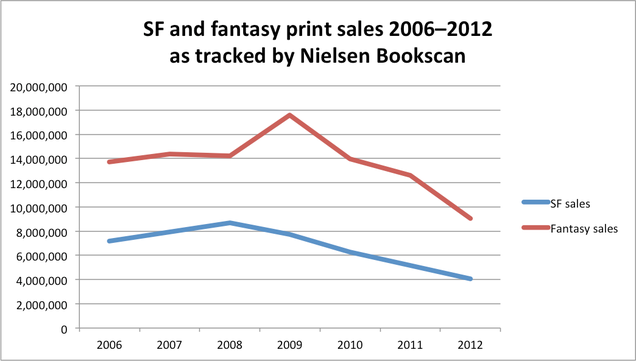
It was rather amusing to see some people attempting to shake off yesterday’s post on the decline in science fiction by pointing to the fact that overall print fiction had declined 8 percent, so the 7 percent decline in science fiction meant that the genre was actually outperforming. Never mind the fact that it had declined 21 percent the year before…. and after a little more research, I discovered that it had declined 21 percent the year before that as well.

In fact, SF print sales are now about half what they were in 2008. I don’t place TOO much confidence in this chart, because it shows around 4 million in 2012, whereas the PW numbers indicate they should be around 5.6 million. But it does suffice to indicate that what we are witnessing is a pretty serious trend and one that involves more than the mere shift to ebooks.

A decline from a combined 26 million in print sales to 12.7 million in only five years is bordering on the cataclysmic; remember, ebooks eliminate any need for the expensive structure of the mainstream genre publishers, a fact that has probably not escaped the owners of Tor and other imprints. I’ll put together some charts once I get some better numbers, but the point is that the anecdotal evidence of people increasingly avoiding the Pink SF produced by the self-appointed gatekeepers is supported by the data trend.


Pinkshirts killing SF/F

Publisher’s Weekly reports on the growth or decline of various categories in 2014:

Adult Fiction (unit sales, in thousands)
Genre20132014% change
Classics7,8177,578-3%
Fantasy8,6157,526-13%
Graphic Novels7,6598,66913%
Mystery/Detective14,88414,304-4%
Science Fiction4,4484,142-7%

Remember, science fiction was also down 21% in 2013, which means that science fiction unit sales have declined 1,488,000 in just two years. It’s down more than one-quarter in two years and is now only half the size of the Graphic Novel market, which is not only growing, but is presently dominated by men writing and drawing for male customers.

The “women destroy science fiction” meme isn’t even remotely ironic. Women, and the gamma males who cater to them, are literally destroying the adult science fiction and fantasy markets.

To put it in perspective, ONE edition of one of my games sold more copies than the ENTIRE science fiction market sold in print last year.


Oh shut up, Damo

It’s often enjoyable to see how little heat SJWs are comfortable taking. They can’t stand much in the way of criticism and they seem to spend a considerable amount of time monitoring what others think and say about them in order to quickly jump in and try to steer the narrative away from anything they think looks bad.

This Twitter exchange was particularly funny, given that Damien Walter is always quick to heap obloquy on Larry Correia, me, and other writers whose politics he dislikes:

D Franklin @D_Libris
Why is it that almost every Damien Walter article can just be replied to, justifiably, with “Oh shut up, Damo”?

Damien Walter @damiengwalter
.@D_Libris Excuse me, I asked you to explain your claim that it was “justifiable” to tell me to “shut up Damo”. I’m going to keep asking.

Novel deVice ‏@noveldevice
@D_Libris you didn’t @ him so literally if he doesn’t want to see it he can just stop vanity searching. Boom.

Damien Walter ‏@damiengwalter
.@D_Libris If that’s your justification for your continued rude and aggressive behaviour, so be it. I’ve requested that you stop.

D Franklin ‏@D_Libris
.@damiengwalter saying that I’ve been rude and aggressive doesn’t make it so. Coming into my mentions and harassing me for a day, though…

Damien Walter ‏@damiengwalter
@D_Libris I’ve asked you to explain why you consider it ‘justifiable” to tell me to “shut up Damo” you still have not done so.

D Franklin ‏@D_Libris
.@damiengwalter bcs you won’t. Bcs I don’t have authority to make you. Bcs it’s a common, unthreatening phrase.

D Franklin ‏@D_Libris
Added to which, because you wouldn’t have seen it if you hadn’t gone looking… Nor would you see people saying it

Damien Walter ‏@damiengwalter
.@D_Libris Then I’m telling you it’s neither. Neither is your repeated rude and aggressive behaviour. I’m requesting, again, that you stop it.

Damien Walter ‏@damiengwalter
.@D_Libris I have a search open for articles I write for the Guardian, that’s standard practice so i can monitor the response.

Damien Walter ‏@damiengwalter
.@D_Libris If you search the URL, you’ll see yours stands out as personally abusive when no others are.

Damien Walter ‏@damiengwalter
.@D_Libris If you want to make criticisms, please do so constructively without personal insults.

D Franklin ‏@D_Libris Jan 20
@damiengwalter “shut up” is personally abusive? How about spending a day poking at someone, & trying to set your followers on them?

Damien Walter ‏@damiengwalter Jan 20
@D_Libris If you don’t believe it’s rude and aggressive, then I’m informing you it is and asking you not to repeat that behaviour.

D Franklin ‏@D_Libris
@damiengwalter I notice that Patrick Nielsen Hayden is not being called rude, & indeed you proudly retweeted his comment?

D Franklin ‏@D_Libris
@damiengwalter so it’s only people with platforms smaller than yours who you object to the perceived rudeness of?

Damien Walter ‏@damiengwalter
@D_Libris I’m telling you that I find your repeated personal attacks rude and offensive. Will you respect my request to stop them?

D Franklin ‏@D_Libris
@damiengwalter I can’t stop what I’ve never done: I have never made repeated personal attacks on you, Damien

Damien Walter ‏@damiengwalter
@D_Libris OK. I’ve made my request, your future actions are your own choice. I’m not continuing any further discussion with you now.

Joseph Tomaras @epateur
In solidarity with @D_Libris, I ask that everyone who’s ever found a @damiengwalter article moronic, please tell DGW to shut up.

The reason, of course, is that Damien Walter hasn’t mastered his subject, doesn’t do his homework, often doesn’t know what he’s talking about, regularly fails to distinguish between opinion and fact, and shows no ability to defend his rhetorical positions. That is why “oh shut up, Damo” is all that is required to effectively rebut him.

I don’t read his columns, there is no reason to do so. He’s boring even when he’s trying to be offensive. At least with the likes of McRapey there is usually an entertainingly manic edge to the nastiness.


The importance of rejection

esr explains why it is vital to categorically reject the premises and principles of the SJW shriekers:

Whenever I see screaming, hate-filled behavior… the important part never turns out to be whatever principles the screamer claims to be advocating. Those are just window-dressing for the bullying, the dominance games, and the rage.

You cannot ameliorate the behavior of people like that by accepting their premises and arguing within them; they’ll just pocket your concessions and attack again, seeking increasingly abject submission. In one-on-one relationships this is called “emotional abuse”, and like abusers they are all about control of you while claiming to be about anything but.

Third-wave feminism, “social justice” and “anti-racism” are rotten with this. Some of the principles, considered in isolation, would be noble; but they don’t stay noble in the minds of a rage mob.

The good news is that, like emotional abusers, they only have the power over you that you allow them. Liberation begins with recognizing the abuse for what it is. It continues by entirely rejecting their attempts at manipulation. This means rejecting their terminology, their core concepts, their framing, and their attempts to jam you into a “victim” or “oppressor” identity that denies your lived experience.

The identity-jamming part maradydd clearly gets; the most eloquent sections of her writing are those in which she (rightly) rejects feminist attempts to jam her into a victim identity. But I don’t think she quite gets how thoroughly you have to reject the rest of the SJW pitch in order not to enable their abuse.

This is the challenge of #GamerGate and Blue SF and Hacker culture and the Androsphere, to say nothing of a myriad of other singular interest groups. We are opposed to precisely the same thing, precisely the same phenomenon, sometimes even the very same individuals, and yet, because we don’t share interests, we tend not to recognize that we share the same enemy. We have the numbers, and yet we fail to ally and support each other cross-interest because most gamers couldn’t care less about fiction and most fiction readers are not hard core gamers.


In which Morgan reads an anthology

In case you’re wondering what an anthology edited by a diversity goblin would look like, the question has been answered.

The Mammoth Book of Warriors and Wizardry. This is a new anthology in the Mammoth series published by Running Press in the U.S. and Robinson in the U.K. Trade paperback in format, 515 pages, $14.95 price and Sean Wallace is the editor…. The cover: a photograph of a dude with chain mail grasping his sword hilt. This could have easily been a cover for a romance book. Remember the days when we had covers by Frank Frazetta, Jeff Jones, or even Ken Kelly?

When I heard about this anthology last year and saw the roster of writers, I joked to a friend that it looked like the product of a United Nations diversity seminar. “She was a tall woman clad in armor the color of dead metal,” makes you begin to wonder about English as a pseudo-second language. Just what the hell is dead metal, let alone the color?

The stories are all very nuanced takes on diverse, under-represented cultures and perspectives, where there isn’t even one extraneous word and every character is pitch-perfect and [insert the usual pink flattery drivel here]. This description made me laugh out loud:

“The one story that encapsulates this anthology is Carrie Vaughn’s “Strife Lingers in Memory.” A wizard’s daughter narrates the return of the exiled prince of the realm who overthrows a tyrant. That is covered in a couple of paragraphs. The rest of the story concerns the hero wandering the castle at night, cowering in the corners, and bawling his head off. The wizard’s daughter, now the queen, goes out to comfort him every night.”

Sounds fantastique, does it not? Read the whole review. And speaking of anthologies, Castalia House should have some news to announce on that front by the end of the month.

UPDATE: RPG fans won’t want to miss Jeffro interviewing Ron Edwards, the designer of the groundbreaking RPG Sorcerer and the co-founder of The Forge.


The rabbits quiver

Two posts in which File 770 compares Sad Puppies to National Socialism, me to a disease, and science fiction writers to dogs.

A comment by Daniel on Vox Day’s blog put this amusing spin on yesterday’s story about the 2014 Worldcon financial report:

    Semi-on topic: thanks to record memberships, LonCon finished with a cash surplus of…

    …about £1,000.

    Without Larry and Vox last year, they would have been deep in the red.

There you have it: all the people who joined to stuff the ballot box for Larry Correia’s “Sad Puppies” slate kept the Worldcon afloat. Now I know how that English schoolboy felt in Hope and Glory when he discovered his school had been bombed by the Luftwaffe — “Thank you Adolf!”

No doubt the pinkshirts will try to deny it, but there is no question that Sad Puppies was to the financial benefit of Worldcon. Some have tried to claim that the huge increase in memberships was the result of the con being based in London rather than the reaction to the nomination of works by Larry, Brad, me, and others, but you have only to compare the percentage increase in voting memberships to the increase in nominations to see that Sad Puppies not only inspired more involvement on the Right side of the science fiction spectrum, but on the Left side as well.

Did you hear the mournful baying of the Sad Puppies this morning? Yes, the pack is back in 2015, this time under the direction of Brad Torgersen. And his arguments for renewing this bloc voting campaign are one dogwhistle after another. Usually you can’t see these kinds of contortions outside of a circus.

  • The Hugos are a popularity contest – but not the right kind of popularity.
  • The Hugos don’t necessarily correlate with sales success – but neither did last year’s Sad Puppies slate, once you got past Larry Correia.
  • The Hugos “skew ideological” – Did you know they were trying to cure
    that problem when Vox Day got a Sad Puppies endorsement last year? (I
    thought it was only on House they try to cure patients by giving them another disease…)
  • The Hugos often ignore “successful ambassadors of the genre to the
    consumer world at large” – That dogwhistle is at a frequency almost too
    high for me to hear, but I believe he has a particular New York Times bestselling author in mind.

Anyway, if you felt something pushing against your “Worldcon fandom
zeitgeist” today — that’s because the dogs are off the leash!

As one might expect, he’s missing the points.

  1. Mournful? They may not be enjoying this, but we certainly are.
  2. The pinkshirts have long denied that the Hugos are a popularity contest. Sad Puppies belied, and continues to belie that argument.
  3. No one has ever claimed Sad Puppies was about sales. That being said, an endorsement by Larry Correia can absolutely be proven to boost sales.
  4. Again, the pinkshirts have always denied that the Hugos skew ideological. Sad Puppies disproved, and will continue to disprove that denial.
  5. It’s not just the Hugos. For example, Chaos Horizon noted the refusal of mainstream reviewers to even review Monster Hunter: Nemesis, considered to be a likely Hugo nominee.

The decline of science fiction

It is well known that science fiction sales have declined since the 1980s, but what Daniel demonstrates in Evidence for the Bust Years is that the perceived quality of science fiction, as measured by average Amazon ratings for books representational of their year, have fallen as well:

What this chart argues is that science fiction of the 50s and 60s
averages better than a 4.3 rating at Amazon (and you’ll note that all
decades average more than 350 reviews per book, so small groups of rabid
reviewers really don’t factor in). The quality slides in the 1970s,
plummets in the 80s, recovers slightly in the 1990s, but falls back
below 4 throughout the 2000s.

Now, this is just some raw data from a list of books from the past 60
years or so, but two things stand out to me: Science Fiction has
measurably fallen off in quality, at least according to readers,
according to this relatively blind snapshot. I’m sure we could generate
different results with a different list, but I want to emphasize that
this survey was both as random and as fair as I could muster (in fact, I
noticed after the fact that my list is somewhat more heavily weighted
toward award-winners in the decade that performed the worst!)

This should surprise no one who has been paying attention to the corruption that is Pink SF as it has spread throughout the science fiction and fantasy genres. For me, the obvious point was when The Quantum Rose, a romance novel in space that was a middle book in a series virtually no one was reading, was awarded the Nebula for Best Novel in 2002. Notice that despite it supposedly being the best novel of that year, it has a paltry 29 ratings averaging 3.70.

If that was truly the best of the best, how bad was the average book that year? And if it wasn’t, then how could systematically elevating the mediocre fail to have a subsequent effect on the genre? While more comprehensive statistical work is required to make the case conclusive, this first analysis does indicate that in the eyes of the reviewers, the quality of science fiction and fantasy has objectively declined.


How the media manipulates science fiction

I discovered an interesting site called Chaos Horizon yesterday. The author has developed a model to predict future Best Novel Hugo Award nominations on the basis of media coverage and past awards, and it worked pretty well last year. But what I found even more interesting and informative was his review round-ups, in which he tracks the media coverage of the various books he expects to be nominated.

Two of the listed favorites for 2015 are LOCK-IN by John Scalzi and MONSTER HUNTER NEMESIS by Larry Correia.

LOCK-IN

Mainstream Reviews:
Publisher’s Weekly (starred review)
Kirkus Reviews (starred review)
NPR
A.V. Club

WordPress Blogger Reviews:
Ristea’s Reads (4 out of 5)
Sci-Ence! Justice Leak!
Bibliotropic (5 out of 5)
Alison McCarty (9 out of 10)
As the Plot Things (9 out of 10)
The BiblioSanctum (4.5 out of 5)
Infinite Free Time
Lucy Moo’s Book Reviews
Books, Bones, & Buffy (4 out of 5)
For Winter Nights

As you can see, that’s already a lot of reviews, and they’ve been pretty uniformly positive, averaging out to a solid 4.5 out of 5. The number of reviews is a testament to Scalzi built-in fanbase; the high scores speak to the book being well-liked.

Amazon Reviews:
(299) 4.2 out of 5 stars


MONSTER HUNTER: NEMESIS

Mainstream Reviews:

None? For each of these Review Round-Ups, I check the same places: Publisher’s Weekly, Kirkus Reviews, NPR, NYTimes, the Guardian, and Entertainment Weekly. These are some of the most popular and widely distributed reviewing venues, and they give us a good idea if the book is reaching beyond the core SFF audience. The fact that Correia received no discernible support from these outlets certainly says something. The lack of reviews in Publisher’s Weekly and Kirkus is surprising, as they do short capsule reviews of tons of texts. For most authors, this lack of mainstream coverage would hurt them; for an author like Correia, this lack of coverage re-enforces his outsider or maverick status.

WordPress Blog Reviewers:
AdVerb Creative
Koeur’s Book Review
Bookstoge’s Reviews on the Road (4.5 out of 5)
Attack of the Books!
Alternative Worlds II

Not the biggest group of reviews, but all are fairly positive. It’s interesting that Monster Hunter Nemesis doesn’t show up as strongly in these places. Goodreads has 1700+ ratings for Monster Hunter Nemesis, which does indicate it’s selling copies. People just don’t seem to blog about Correia’s book with the same intensity as they do other texts.

Amazon Reviews:
(283) 4.8 out of 5 stars

It’s somewhat amusing to see that even though Chaos Horizons is aware of the Hugo controversy, he’s still genuinely surprised that there are zero mainstream reviews for Nemesis. What’s happening here is a microcosm of what happens in the gaming world. The pinkshirt media puffs up Pink SF and attempts to make it look better and more popular than it is, while ignoring better and equally popular non-Pink SF in an attempt to pretend it is not merely irrelevant, but doesn’t exist.

It’s even more obvious if you actually read the reviews for LOCK-IN. Most of them are more about the author than the book itself, because the content of the book is largely irrelevant, the object of the review is to signal that the book reviewed is the product of an ideologically-approved author and therefore should be supported.

I note that the Goodreads data is different than the Amazon data, but I tend to discount the Goodreads data as a proxy for comparative purposes because its readership has such a strong SJW bias. That being said, it’s probably an excellent proxy for the WorldCon membership and a Hugo-predictive model for precisely that reason.