The lead singer of Soundgarden, Temple of the Dog, and Audioslave has died at 52:
Chris Cornell, lead singer of American hard rock bands Soundgarden and Audioslave, has died aged 52. In a statement to the Associated Press, his representative, Brian Bumbery, said Cornell died on Wednesday night in Detroit.
Bumbery called the death “sudden and unexpected” and said his wife and family were shocked. The statement said the family would be working closely with the medical examiner to determine the cause, and asked for privacy.
Cornell had been touring with Soundgarden, and was tweeting upbeat messages about a sold-out concert the band played in Detroit just hours before his death.
I never met him, but our band was scheduled to play on the second stage after Temple of the Dog at the Chicago Lollapalooza in 1992. Our singer got lost, so we didn’t play, but it was a great day for music in the sun, with Soundgarden and Pearl Jam playing the main stage prior to Ministry and the Chili Peppers.
But when I think of Chris Cornell and Soundgarden, I think mostly of playing Road Rash on the 3DO. What a perfect soundtrack for that game!
In last night’s Darkstream, I addressed the question of whether it is acceptable for a man to wear a shirt with another man’s face on it. Considering that my CERNOVICH shirt is on the way to me, my position is pretty obvious. And as far as I’m concerned, Boh settled the matter once and for all by playing this solo while wearing a shirt with Takayoshi Ohmura’s face on it while standing right next to Takayoshi Ohmura.
No matter how cool you might think you are, you are not as cool as the God of Bass. Not even close.
There is an important lesson here. Same four guys that took the stage together with Su, Moa, and Yui two months before at the Tokyo Dome. Same mind-blowing talent… and in fact, Boh’s bass solo is a little more relaxed, but is longer and even more impressive than the one he plays for Twilight of the Metal Gods on Red Night.
And there are about 54,000 fewer people in attendance.
This should dismiss the notion, once and for all, that mere talent ever suffices.
It’s difficult to describe just how weird this band is, but let’s give it a try: Three young Japanese women dressed in matching black frilly party dresses, doing choreographed dance moves and singing — in Japanese — in front of a hard metal band, all of whom are dressed in ankle-length white robes and wearing white face paint. Someone described the resulting sound as Elmo fronting Metallica, but that doesn’t quite capture the weirdness of Babymetal. When the band broke into a couple bars of “Sweet Home Alabama,” maximum weirdness was achieved. Oh yeah, the Red Hot Chili Peppers were there, too.
JACKSONVILLE
Light shows aside, did the Chilis get as weird as they used to back in their punk-funk heyday? Nah. These are older, gentler Chili Peppers, distinguished elder statemen of rock, men who cordially invited former drummer Jack Irons to kick off the night with a 20-minute solo set. The group that really brought the battiness was opening act Babymetal, a Japanese pop-metal phenomenon combining an assembly-line girl group with white-robed thrash metal demons. Technically engrossing, in terms of both metal musicianship and ritualistic choreographic discipline, it was exactly the sort of fantastical freak show that might’ve accompanied the Chilis on some sweaty Lollapalooza back in the day. The heck if they didn’t have the arena lit up and singing on their anthemic Karate.
CHARLOTTE
On the subject of opening acts, Irons’s solo drumming didn’t leave much of an impression on me… but Babymetal? I don’t think I’ll ever forget them. You should do your own poking around about this Japanese girl group/(very) heavy metal band, but let’s just say it’s like Dr. Frankenstein stitched together parts of Britney Spears, Megadeth, Nintendo’s stupidest games, “The Ghost in the Shell” and “Saturday Night Live.” I scratched my head, a lot. I laughed, a lot. But I couldn’t take my eyes off of them, and on the drive home after the show, it was Babymetal I was listening to on Spotify, not the Chili Peppers. Mostly, I think, because I needed to make sure I hadn’t dreamed the whole thing.
MIAMI
You think it can’t get any crazier? Babymetal picked up four new additions: Nate-METAL, J-METAL, Flea-METAL and Chad-METAL.
AKASAKA – TOKYO – NAGOYA – OSAKA
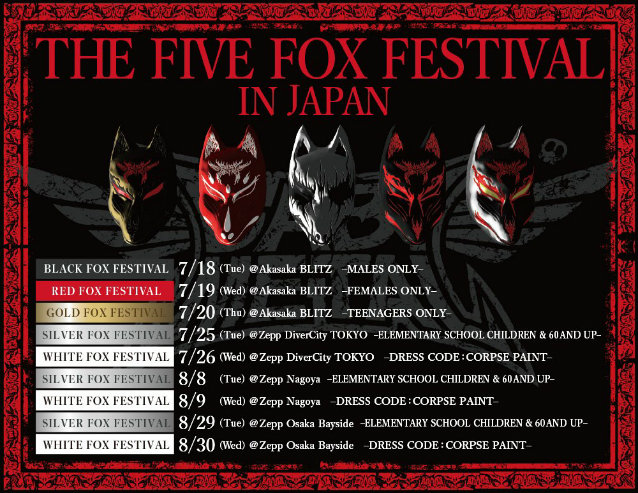
J-pop metal group BABYMETAL have parlayed their meteoric rise into tour dates alongside Metallica, Guns N’ Roses, and Red Hot Chili Peppers. Now, they’ve announced plans for their very own Five Fox Festival set to take place in Japan over nine days this summer. In an interesting twist that could only come from BABYMETAL, there are strict conditions required to attend each of these dates. Specifically, the festival is broken down into categories by age group, gender, and dress code. For example, one date is reserved exclusively for males, another for females, and another for teenagers. Even more randomly is the day when only elementary school children and people over the age of 60 (um, what?) will be granted admittance.
I have to admit, this is the most tempted I have been to return to Nagoya in decades.
So, I was watching Red Night from the Babymetal concert at the Tokyo Dome when suddenly they broke into an excellent song that I’d never heard before. It turns out that Syncopation is only on the Japanese version of Metal Resistance. The guitars are great and the drumming is out-of-control, even for Babymetal.
And it is good. I don’t know that I’d be willing to give up From Dusk Till Dawn for it, but it is really good. Also, I found that I liked Yava! rather better after seeing it live. But while Red Night was excellent, kicking off with Road of Resistance and peaking with Karate, I think I would rather have gone to Black Night, as that’s when they featured Megitsune, No Rain No Rainbow, Twilight of the Metal Gods, and, appropriately enough, Onedari Daisuken.
BLACK BABYMETAL!
I don’t think anyone has ever been as deliriously happy on stage as Moa. She’s beaming pretty much the entire show on both nights. And Su has developed into a bona fide rock star. It’s also kind of awesome to see 55,000 Japanese erupt in exactly the same way everyone did in the small club in which we saw them. Soiya soiya soiya soiya! One, two, one, two, three, let’s go!
The best live performance I ever saw was Ministry at the 1992 Lollapalooza in Chicago. But even in a small club, Babymetal came suprisingly close. I tend to imagine that these two nights at the Tokyo Dome may well have been even more spectacular.
You almost feel sorry for the two little girls. As if it’s not enough that Yui and Moa have to sing and dance and play guitar, now the Fox God has got them doing 60 meter windsprints. Between flamethrowers. Except, of course, the fact that I’m not sure anyone has ever looked as if they’ve been having more fun on stage than the two of them at the end.
I was talking to a young girl who intensely dislikes rap the other day. When I asked her why she disliked it, she said, “it’s so boring”. And, despite being a fan of Public Enemy since the “Sophisticated Bitch” and “98 Oldsmobile” days, and having been one of the very few non-Africans at the PE/NWA concert at First Avenue in 1988, I had to admit that she is absolutely right. Rap simply hasn’t gone anywhere musically since NWA’s innovation of posing as modern gangsters and dropping f-bombs every fourth word; how can anyone who has ever heard Chuck D bear to listen to Jay-Z ruining yet another lovely song with his inept, droning monologues?
Seriously, is there a bigger pop music abomination than the massive steaming dump that Jay-Z inexplicably slathers all over Alphaville’s “Forever Young”?
But when I got to thinking about it, I realized that this musical dead end was inevitable. It was always going to be the case. Most of the early “rap is crap” critics were committing a category error when they complained about “rap music”. Their instincts were right, but their sneering arguments were mostly off base and therefore unconvincing. The fact is that rap is not, technically speaking, music at all. To call it music is akin to describing “scatting” or “falsetto” or “rhythm” or “electric guitar” as music. It is, rather, a non-melodic vocal styling; it is an element of music, or if you prefer, a musical tool, rather than a form of music in itself.
And while that vocal styling can be utilized in a broad variety of music, from metal to ambient, it is not music in itself. What is often known as “rap music” is a degraded, primitive form of music created mostly by non-musicians, which is necessarily going to be either sample-based (Public Enemy), childishly simple (Dr. Dre), or an additional vocal track added to existing music (Puff Daddy, Jay-Z).
In other words, “rap music” was never anything more than a proto-SJW seize-and-ruin operation and an exercise in branding. That’s why it hasn’t gone anywhere. It can’t go anywhere because there is no actual vehicle to do so.
This isn’t to say that rap hasn’t contributed anything to actual forms of music as a vocal styling. Dave Draiman does not rap, but his staccato delivery and multi-syllabic lyrics made Disturbed a better, more interesting metal band. I also suspect that the move from one bass drum to two, such as one sees in bands like Disturbed and Babymetal, represents a real advance in rock drumming that stems in part from the influence of faster, more complicated vocal stylings.
And who hasn’t enjoyed Beck or twentyonepilots making use of the various possibilities presented by it? But as a musical form in itself, it simply does not exist.
People occasionally ask me why I am such a Babymetal enthusiast. All I have to say is that they are, quite literally, one of the very best bands in the world, from technical and songwriting perspectives, even if one ignores the awesome Japanese theatrical elements. They’re uniformly excellent.
One thing I like about twentyone pilots is the way they can move effortlessly between musical lanes. What most people don’t realize is that Babymetal’s range is even greater. It’s not just the signature combination of J-Pop and power metal of Doki Doki Morning, or even the big chord, big chorus metal of Karate, that is chiefly of note in this regard, but the fact that Babymetal has the ability to do everything from X-metal-tribute power ballads to metal-infused Deep Forest. This is what you can do when you assemble exceptional talent under a unique vision; I view it in some ways as a conceptual model for Castalia House.
Consider the heavily emotional No Rain, No Rainbow, which features a guitar solo that reminds me more than a little of my favorite anthem, My Chemical Romance’s Welcome to the Black Parade. Su-metal is absolutely no joke as a vocalist, and I love the fitting, if uncharacteristic, restraint of the Kami band here.
English speakers will probably not understand why Su-metal is on the edge of crying at the end, so a translation might help.
Even the despair becomes the light. Though an endless rain continues to fall. Even the despair becomes the light. A sad rain throws a rainbow far far away.
We shall never meet again, But I want not to forget you forever. If the dream continues, I wish I’ll never wake up from it.
An endless rain fills my heart forever.
However, my favorite Babymetal song is one of the less well-known songs from Metal Resistance, From Dusk Till Dawn. Some compare it to Enigma on steroids, but I think Deep Forest is the more accurate comparison. It really shows off Koba-metal’s skill as a producer.
And if you don’t believe these guys can do anything they want musically, and do it better than most, have a listen to the Kari band, which is the fusion jazz project of three of the Kami band members.
I wouldn’t have thought anything could top NIPPON MANJU, and then came Babymetal. But this… this is just something else entirely. It is three minutes and twenty-five seconds of unmitigated awesome.
It is being reported that George Michael died peacefully at home today. He was 53.
The star, who launched his career with Wham in the 1980s and later continued his success as a solo performer, is said to have “passed away peacefully at home”.
Thames Valley Police said South Central Ambulance Service attended a property in Goring in Oxfordshire at 13:42 GMT.
Police say there were no suspicious circumstances.