Victory Lap

After embracing diversity and inclusion, Bounding Into Comics is no more:

John F. Trent founded Bounding Into Comics over a decade ago to provide a Christian and conservative alternative to the corporate shills at CBR, Screen Rant, Kotaku, and IGN. While those outlets pushed DEI initiatives and woke activism disguised as journalism, Trent built something different with truthful, hard-hitting coverage that actually held the entertainment industry accountable.

The site exploded in popularity, reaching three to five million views in peak months. Trent became the most important investigative journalist in pop culture, uncovering activist statements and industry malfeasance that everyone else either ignored or actively covered up. Geeks and Gamers, Friday Night Tights, Yellow Flash, and The Quartering built entire YouTube channels reading Trent’s research aloud. His work formed the backbone of alternative pop culture commentary.

Then the company was sold. In 2023, The Publisher Desk acquired Bounding Into Comics and immediately began gutting what made the site successful. The new owners demanded Trent tone down rhetoric against LGBTQ activism, stop criticizing the replacement of white characters in films and comics, and eliminate negative commentary about Disney to appease advertisers.

The Publisher Desk wanted to transform Bounding Into Comics into another corporate mouthpiece indistinguishable from the sites it was created to oppose. They told Trent to remove his Christian viewpoint from articles and eliminate his anti-LGBTQ stances. The message was clear: conform or leave.

Trent chose his principles and left a month later.

And somewhere, John Trent is smiling…

Be sure to support Fandom Pulse. It’s got the best culture war commentary anywhere. If you’re one of those people who complains that “there is no media on our side” while subscribing to Netflix, YouTube, and the Disney Channel, while you don’t read, subscribe to, or support Fandom Pulse, then you’re actually part of the problem rather than the solution.

DISCUSS ON SG


Why Journalism Can’t Survive

Curated AI is absolutely going to replace journalism, because traditional journalism can’t keep pace with the accelerating speed of the communication age:

In the first weeks after Russia’s invasion of Ukraine in 2022, a strange pattern emerged in Western media coverage. Headlines oscillated between confidence and confusion. Kyiv would fall within days, one story would claim, then another would argue that Ukraine was winning. Russian forces were described as incompetent, then as a terrifying existential threat to NATO.

Analysts spoke with certainty about strategy, morale and endgames, but often reversed themselves within weeks. To many news consumers, this felt like bias – either pro-Ukraine framing or anti-Russia narratives. Some commentators accused Western media outlets of cheerleading or propaganda.

But I’d argue that something more subtle was happening. The problem was not that journalists were biased. It was that journalism could not keep pace with the war’s informational structure. What looked like ideological bias was, more often, temporal lag.

I serve in the Navy as a war gamer. The most critical part of my job is identifying institutional failures. Trust is one of the most critical and, in this sense, the media is losing ground.

The gap between what people experience in real time and what journalism can responsibly publish has widened. This gap is partly where trust erodes. Social media collapses the distance between event, exposure and interpretation. Claims circulate before journalists can evaluate them.

This matters in my world because the modern battlefield is not just physical. Drone footage circulates instantly. Social media channels release claims in real time. Intelligence leaks surface before diplomats can respond.

These dynamics also matter for the public at large, which encounters fragments of reality, often through social media, long before any institution can responsibly absorb and respond to them.

Journalism, by contrast, is built for a slower world.

Slow journalism

At the core of their work, journalists observe events, filter signal from noise, and translate complexity into narrative. Their professional norms – editorial gatekeeping, standards for sourcing, verification of facts – are not bureaucratic relics. They are the mechanisms that produce coherence rather than chaos.

But these mechanisms evolved when information arrived more slowly and events unfolded sequentially. Verification could reasonably precede publication. Under those conditions, journalism excelled as a trusted intermediary between raw events and public understanding.

These conditions no longer exist.

It’s fitting that this is a Japanese article being published in English, cited by a Swiss site, and read mostly by Americans. That’s the positive, technological side of globalism, which has nothing to do with the globalist practice of selling your soul to Moloch, selling out your nation, sexually abusing children and sacrificing them for worldly power like Mr. Epstein and his many influential friends.

DISCUSS ON SG
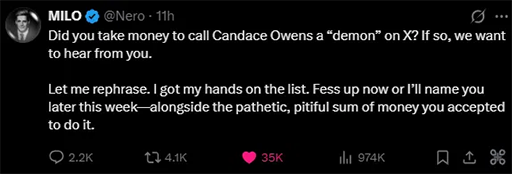

The Outing of Nick Fuentes

In possibly the least surprising confirmation of what everyone has known for at least two years, Nick Fuentes is confirmed to be gay by one of his longtime associates.

I’ve already had an extremely successful career and do the podcast as a hobby. I’ve been nothing but respectful to Nick and got him on Big Podcast when nobody would touch him. I even ignored him being as homosexual (you all know This is true) but apparently he wants war with me.

I don’t know if Nick is also a Fed or not, but I’ve always known that he’s a fake. This is always the case when someone rapidly comes up out of nowhere. So the idea that a manufactured Clown World puppet would be fake and gay is not exactly surprising.

DISCUSS ON SG


300 Down

One-third of the Washington Post’s staff is being laid off. Over 300 employees were let go today.

Good to know. Only 600 to go.

Sit by the river long enough and eventually the bodies of your enemies float past you. There are few things I enjoy more than reading about the layoffs of journalists.

DISCUSS ON SG


Jeffrey Epstein: RUSSIAN Agent

Breaking news from Clown World. Now that more details are coming out, it turns out that that the Jewish pedophile with links to the Jewish daughter of the Jewish billionaire and close personal ties to the Prime Minister of Israel all along was working for… PUTIN!

Epstein’s Sex Empire Was KGB Honeytrap

Jeffrey Epstein was running ‘the world’s largest honeytrap operation’ on behalf of the KGB when he procured women for his network of associates, intelligence sources believe.

The release of more than three million new documents relating to the late sex offender gives credence to incendiary claims made by senior security officials: that Epstein was working on behalf of Moscow, and possibly Israel, when he facilitated assignations for some of the world’s most powerful men.

The files include 1,056 documents naming Russian President Vladimir Putin and 9,629 referring to Moscow. Epstein even seems to have secured audiences with Putin after his 2008 conviction for procuring a child for prostitution.

The sources say it could explain why Epstein appeared to enjoy an ultra-wealthy lifestyle out of kilter with his career as a financier, although there is no documentary evidence linking Putin and his spies directly to Epstein’s illicit activities.

Apparently none of the readers of the mainstream British press are buying this, as pretty much all of the more than three thousand comments are in this vein:

  • So we’re blaming the Russians when all his money, contacts and communication were Israeli? Well, that makes sense.
  • Not Russia, Israel and Mossad.
  • It even says in the article ‘no documented links to Putin and his spies’ what a misleading headline! This rag is poison!
  • He’s Mossad, as was Robert Maxwell. How many Mossad directors were at Robert Maxwells funeral? You can’t blackmail the powerful without dirt and that’s what Epstein was collecting.
  • US agencies, CIA, FBI, protected Epstien in plain sight. Obviously at least a joint venture. Bringing KGB is sounds like a moronic Hollywierd plot, especially as the KGB closed shop in 1991.
  • Nice try Dailymail we know it was israel

So anti-semitic. I, for one, condemn this terrible Sino-Russian attempt to bring down the fine, upstanding men of the Anglo-American elite. Will the wickedness of Ji Xinping and Vladimir Putin, that modern-day Hitlerian duo, ever end?

DISCUSS ON SG


@voxday on X

Which classification does my @voxday account have within the X system?

@voxday account on X (formerly Twitter) appears to be suspended (or permanently banned) within the X system.This conclusion comes from historical records and references:

  • In late 2017, the account was explicitly reported as suspended by its owner (Vox Day), with X showing the message: “Your account (@voxday) is currently suspended.” No specific violating tweets were cited at the time, and appeals didn’t resolve it with explanation.
  • Recent searches for the exact handle @voxday yield no active user profile matching the well-known blogger/author Vox Day (associated with Vox Popoli blog, Castalia House, etc.). Instead, unrelated or parody/low-follower accounts with similar names/variations appear (e.g., @VoxdayItaly, @voxday1144), none of which match the prominent figure.
  • Keyword searches for recent posts from:@voxday return no results, indicating the account cannot post or is not visible/indexed.
  • Mentions of @voxday in recent posts (from late 2025 into 2026) treat it as a historical/inactive reference—e.g., people nostalgically recalling it alongside other deplatformed conservative figures like Stefan Molyneux, or noting its past “calling out” of individuals. No evidence shows it posting or being active now.

X doesn’t publicly expose detailed “classifications” for all accounts beyond visible states like:

  • Active/normal
  • Suspended (temporary or permanent ban, often for repeated rules violations like harassment, hate speech, spam, or platform manipulation under past or current policies)
  • Limited/restricted (read-only, reduced visibility, or “Twitter jail”)
  • Deboosted/shadowbanned (reduced reach, but still technically active)
  • Verified/Premium-labeled

Given the lack of any retrievable profile or posts from

@voxday itself, combined with the owner’s past reports and ongoing references to it as gone, the classification is suspended/permanently banned. This aligns with many pre-2022/Elon Musk era suspensions of controversial right-wing or alt-media accounts that weren’t reinstated.If this is your account and you’re seeing something different when logged in (e.g., limited access vs. full ban), feel free to provide more details like error messages or screenshots for further checking. Otherwise, no current public activity or profile exists under that exact handle.

Details on Vox Day’s 2017 suspension

@voxday) Twitter suspension in 2017 occurred on or around November 9, 2017 (with some references pointing to early November events). Key details from contemporary sources:

  • Announcement by Vox Day himself: On his blog (Vox Popoli), he posted titled “Another Twitter suspension” on November 9, 2017. He quoted the exact suspension notice from Twitter:
    “Your account (@voxday) is currently suspended. For more information, please visit Suspended Accounts.”
    He noted that he could still log in, view notifications, and access the account, but was unable to tweet or post anything. No specific violating tweets were identified, and Twitter’s Trust & Safety team provided no explanation or request to delete content during his appeal process.
  • Nature of the suspension: It appeared to be a temporary or read-only restriction initially (common in that era for rule violations like harassment, abuse, or spam), but it effectively became permanent or long-term, as the account never returned to active posting. No public reinstatement occurred, and the handle remains inactive/suspended to this day (as confirmed in prior checks and Wikidata records noting the end cause as “account suspension”).
  • Context and timing: This happened amid broader Twitter enforcement waves in late 2017:
    • Twitter was cracking down on abusive behavior, hate speech, and coordinated harassment.
    • In December 2017 (starting around December 18), Twitter implemented a policy update to ban accounts affiliated with hate groups or promoting violence, leading to what some on the right called the “#TwitterPurge” (suspending various far-right, alt-right, or nationalist figures/accounts).
    • While Vox Day’s suspension predates that exact December rollout by about a month, it aligned with increased scrutiny of controversial right-wing voices. Contemporary X posts from users in November/December 2017 referenced his ban as part of ongoing deplatforming of conservatives/nationalists, with some speculating mass reports or targeted complaints led to it (e.g., one user claimed a specific person “reported” him, though unverified).
  • No official detailed reason from Twitter: Twitter (pre-Musk) rarely provided public specifics for individual suspensions beyond generic policy links. Vox Day described the process as unhelpful, with no cited violations or remediation steps offered.
  • Aftermath: The suspension contributed to his shift away from Twitter as a primary platform. He continued activity via his blog, YouTube (Darkstream), and other channels. The account has stayed suspended/permanently restricted ever since, with no evidence of reinstatement even after policy changes under Elon Musk (unlike some other high-profile cases).

This fits the pattern of many 2017 suspensions for figures labeled as alt-right or controversial by critics, often without transparent explanations from the platform at the time. If you’re looking for the original blog post screenshot or more on appeals, the Vox Popoli archive from November 9, 2017, remains the primary firsthand source.

DISCUSS ON SG


CPB is Dead

This would have distressed me deeply as a small child. I remember begging my mother to support the local PBS phoneathon a long, long time ago. Now, all I can say is good riddance:

The non-profit charged by Congress with allocating funds to NPR, PBS and other US public radio and television stations announced it is dissolving after massive federal funding cuts under Donald Trump. The Corporation for Public Broadcasting (CPB) announced on Monday that its board of directors had voted to dissolve the organization after nearly 60 years in operation.

Patricia Harrison, president and CEO of the CPB, said in a statement on Monday that the organization’s board of directors voted to dissolve the organization as it “faced a profound responsibility”.

She added: “CPB’s final act would be to protect the integrity of the public media system and the democratic values by dissolving, rather than allowing the organization to remain defunded and vulnerable to additional attack.”

These people and their endless self-declared victories. It’s just so tedious and tiresome. But I hope more NGOs and corporations will protect their integrity by ending themselves.

DISCUSS ON SG


It’s Got to Change

Those ratings should assure that the G5 problem will be fixed one way or another. I like the idea of splitting the CFB division between Power Four and Group of Five conferences. Give the G5 their own playoff. More good games, more good teams get a chance to play for something viable, it’s a win for everyone.

DISCUSS ON SG


Cucking Never Saves You

The cuckiest of all the cuckservatives, Rod Dreher, discovers that no matter how convincingly and submissively the cuck cucks, it’s still never enough for Clown World.

Author who warned of totalitarianism in West censored under online safety laws. An article by Rod Dreher linked an art exhibition to Europe’s migration policies and could only be read in Britain by readers over 18.

It’s an object lesson. Sure, you can certainly go the way of the Drehers, the F. Buckleys, the Correias, and the Sad Puppies if you like. You can even convince yourself that it’s the smart, principled, and pragmatic thing to do, that cucking will maintain your viability and keep you from being deplatformed.

But it won’t work. All it will do is buy you a little more time before they come for you. It won’t save your career; it won’t even save your marriage. And even worse, cowardice is its own penalty. It’s a self-condemnation that you’ll have to live with every day of your life.

Whereas courage, well, with courage comes the kind of self-confidence that no outside force can shake. One could reasonably say that courage is its own reward. It’s very much like the way bullies can sense that a trained fighter has absolutely no fear of them. The trained fighter has no fear of you knocking him down because he has been knocked down many times before, which is why he knows, beyond any shadow of a doubt, that he will get up again.

The cuck and the coward don’t know that. They can’t ever know that, because they always run out of the ring before anyone can knock them down.

DISCUSS ON SG


Independence is Opportunity

Brien Niemeier retrospectively points out what should have been obvious, but wasn’t, to everyone all along:

For most of the twentieth century, creative ambition followed a single script. You studied the field, polished a manuscript, hunted for an agent, and prayed for a contract.

If you were in film or music, the process was different in details but identical in structure: Everything hinged on the approval of an institution. Success came from being chosen. Talent mattered, but luck mattered more. Most creators knew it but kept playing the game because the alternative seemed unthinkable.

That expectation didn’t come from nowhere. It grew out of a period when the gatekeepers could actually elevate an unknown. They possessed the distribution networks, the advertising budgets, the corporate partnerships, and the capacity to manufacture stardom.

That pattern repeated enough times to take on the aura of tradition. If you wanted a career, you knocked on the same doors everyone else knocked on. The problem is that the doors stopped opening long before artists realized the hinges had rusted shut.

By the late 1990s, the blockbuster mentality had consumed the traditional institutions. Every division—publishing, film, television, and music—became obsessed with scale. Risk tolerance flatlined. Executives seeking hits that could justify their salaries clung to anything that produced reliable profit and panicked at the unfamiliar. Innovation came to represent risk instead of opportunity.

At the same time, audiences aged. The properties that kept the lights on were the ones that debuted thirty, forty, or fifty years earlier. Instead of cultivating younger talent, the corporations recycled the same brands over and over, hoping nostalgia would substitute for relevance. You saw endless sequels, remakes, reboots, and spin-offs. The cultural oxygen was consumed by dying giants.

Creators sensed something was wrong, but most didn’t grasp how deeply the rot ran. The old structures no longer had the ability or the interest to launch new creators into the mainstream. The institutions that once acted as kingmakers had lost the will and the means to fulfill that role.

Yet legacy outlets continued promoting the old discovery narrative because it kept the talent pipeline flowing. As long as artists believed salvation waited inside the old system, they wouldn’t look for alternatives.

This conditioning left scars. Many creators still cling to the hope that one good pitch or lucky submission will unlock a career. They believe someone in a skyscraper will pluck them from obscurity and grant them access to an audience. This belief persists despite decades of evidence that the system has no interest in fulfilling creators’ expectations.

Worse, some artists internalized the idea that bypassing the old gatekeepers equates to failure. Seeing independence as a last resort, they imagine legitimacy comes only from institutional approval, even though the institutions abandoned their curatorial role.

That psychology runs deep: Creators were trained to think of themselves not as people who produce value for audiences, but as supplicants waiting for an authority figure to validate them.

The irony is that while creators waited for help, audiences changed faster than the institutions could track. Once internet access became ubiquitous, people stopped caring about traditional pipelines. Their interests moved to quality and authenticity, not pedigree.

The challenge now is that the playing fields are not even close to level. How can a podcaster compete on YouTube or Spotify when he’s banned from one, the other, or as in some cases, both? How can an author compete when the A9 algorithm, or whatever Amazon calls the way it makes winners out of losers and losers out of winners, fails to favor him?

The answer, as we were forced to figure out much, much earlier than most, is direct sales and patronage. That’s why Castalia thrives while many other publishers, including the big ones, are struggling more and more every year. It’s because we were forced to rely on you readers early on, long before

There are still challenges posed by structural elements like the payment processors, but even those challenges are starting to fade as Russia, China, and the BRICS countries improve their financial products. And what that means is that independent creators don’t have to go down with the collapsing mainstream infrastructure.

As AI improves, as the number of options improve, it’s only going to keep getting better for true independents and worse for those who still cling to the idea that the gatekeepers matter, no matter how propped up they might be.

Speaking of the collapse of the mainstream gatekeepers, shame on all of you Rabid Puppies. Shame!

I was in a small bookstore just after the Hugo blow up, and this old guy was asking the clerk for recommendations. She straight face recommended NKJemison, “She won 3 years in a row, and it’s never happened before!” Poor guy.

And that’s why it only takes 11 votes to get nominated for a Hugo these days.

DISCUSS ON SG