Let’s try this again

I think it’s better this time. I’m getting more familiar with Camtasia, which tends to help, and the volume is significantly louder. I also managed to utilize the full screen this time instead of inadvertantly leaving a black rectangle around the perimeter. I also introduced minor errors into two of the graphs; the CPI recalculated for the 0.6% annual error only shows a line including a recalculation for the last ten years and the labels for the dollar devaluation chart were cut off, but I’ve decided to leave it as is so that I can move on to the next one. I found a better font to use for the pop-up notes as well, or “call-outs” as Camtasia calls them.

As before, suggestions for improvement would be welcome. The next video will address why inflation has to include outstanding debt; after that I plan to do videos examining the two conventional definitions of inflation. If you’re interested in being notified when new videos are uploaded, you can subscribe to the Voxiversity Channel.


And the media is right on time

You may recall that in RGD, I wrote that the mainstream media would begin seriously throwing around references to the Great Depression before the end of 2010:

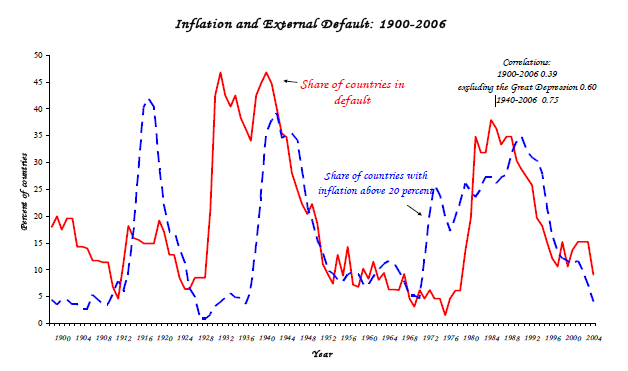
This is starting to throw off more echoes of the Great Depression, where you have a sequence of crises, each touched off by the ones that came before, like dominos falling into some diabolic design. Europe and America thought they’d seen the worst of things by the end of 1930, only to be knocked back down even harder by the contagion of the Creditanstalt crisis. In the US, the crisis ultimately triggered a string of bank failures worse than those sparked by the initial stock market crash, and the worst two years of the Great Depression were 1932-3.

I don’t want to lean too hard on this, as economic commentators (maybe including me) have started seeing Creditanstalt everywhere–in Dubai, in Greece, now in Ireland and maybe Spain. It’s entirely possible that we’ll eventually muddle through without a second major event. But it’s worth remembering that these things take a long time to unfold, and that we are often most vulnerable just when we think we have time for a breather.

The difference, of course, is that the Great Depression 2.0 is going to be much wider, and probably somewhat deeper, than its predecessor. The main reason is that the last time, only the USA attempted to fight it with major government intervention. This time, practically all the governments around the world are doing so. I’m a little off in terms of the timeline since the depression has not been publicly recognized yet, but I have no doubts that we are in it already.


The opportunity cost of sex

Since Spacebunny mentioned that the previous post was of the sort to cause most people to feign death rather than risk inadvertantly entering into the discussion, I thought I’d post Susan Walsh’s rather different take on the opportunity cost study. I suspect it is much more likely to prove interesting to the non-economists in our midst. Not that pedantic debates over opportunity cost versus net utility calculations aren’t stone cold sexy, you understand.

One of the most valuable key economic concepts is that of opportunity cost. It’s the cost of not choosing something, the benefits left behind on the road not taken, and it’s an important component of any choice you make. Sometimes the tradeoff is obvious – if you choose to date Brad, you’re giving up the opportunity to date Jonathan, for example. Often times, though, opportunity costs can be hidden, which can lead to making irrational decisions….

Women often figure they have nothing to lose by staying in a disappointing arrangement until something better comes along. This is a terrible strategy for three reasons:

It’s not just women who make this mistake. As I’ve told some of my male friends time and time again, women should not be confused with jobs. While the best way to find a new job is to have a job, the best way to find a wife is not to have a wife. If you want to meet women, you are much better off being out, about and unattached than caught up in a half-hearted relationship with a girl that you plan to trade in for someone better on the off-chance that you happen to meet them on one of the nights that you’re not sitting at home watching re-runs of Sex in the City with a woman you don’t even particularly like. It’s not fair to her and it’s not utility maximizing for you.

UPDATE: We’re not talking about pre-selection here. We’re talking about the sort of man who is in a “serious relationship” but doesn’t want to be and is simply waiting around for someone else to come along before he can break it off with her.


An incompetent economist at the NYT

It’s little wonder they can’t figure out that we’re in a depression.

Virtually all economists consider opportunity cost a central concept. Yet a recent study by Paul J. Ferraro and Laura O. Taylor of Georgia State University suggests that most professional economists may not really understand it. At the 2005 annual meetings of the American Economic Association, the researchers asked almost 200 professional economists to answer this question:

“You won a free ticket to see an Eric Clapton concert (which has no resale value). Bob Dylan is performing on the same night and is your next-best alternative activity. Tickets to see Dylan cost $40. On any given day, you would be willing to pay up to $50 to see Dylan. Assume there are no other costs of seeing either performer. Based on this information, what is the opportunity cost of seeing Eric Clapton? (a) $0, (b) $10, (c) $40, or (d) $50.”

The opportunity cost of seeing Clapton is the total value of everything you must sacrifice to attend his concert – namely, the value to you of attending the Dylan concert. That value is $10 – the difference between the $50 that seeing his concert would be worth to you and the $40 you would have to pay for a ticket. So the unambiguously correct answer to the question is $10. Yet only 21.6 percent of the professional economists surveyed chose that answer, a smaller percentage than if they had chosen randomly.

This is completely wrong and the 27.6 percent of economists who answered (d) $50 were correct. Remember, the question posed states that the opportunity cost is the total value of everything you must sacrifice to attend the Clapton concert. The total value of the Dylan concert to you is $50. In attending the Clapton concert, you do not attend the Dylan concert which you valued at $50. Therefore, the opportunity cost to you is $50 even though not going to see Dylan meant that you didn’t have to pay the $40 you would have otherwise had to pay for a ticket. Opportunity cost is a cost, it is not the net of cost minus implied savings.

In order to incorrectly claiming the correct answer is $10, Robert Frank has to change his definition of opportunity cost from “the total value of everything you must sacrifice” to a nonsensical one that factors in things that you might have otherwise had to sacrifice but didn’t. Based on the example given, it doesn’t matter what the cost of the Dylan ticket is. Whether the Dylan ticket costs $5 or $500, the opportunity cost of going to see Clapton for free is still $50 because that is the value that you place on seeing Dylan and you did not see him. The fact that you didn’t spend $40 on a Dylan ticket is irrelevant; why not throw in $5 for the pizza you didn’t buy and another $150,000 for the Lamborghini you didn’t buy either as well: by Frank’s bizarre reckoning, the opportunity cost of seeing Clapton will leave you with a profit of $150,015!

To put it in terms that even non-economists should be able to understand, let us consider Archie’s Dilemma. When contemplating choosing Veronica (who is on the pill) over Betty (who isn’t), the opportunity cost of nailing the brunette is NOT not banging the blonde less the price of a condom, it is simply not banging the blonde.

Like most Keynesians and monetarists, (and most mainstream economists are one or the other), neither Frank nor the authors of the study understand that value is subjective, not objective, and so they make their usual mistake of running arbitrary numbers through meaningless formulas and ending up with a result that is not so much inaccurate as indefensible and irrelevant. I strongly suspect that a basic mistake was made in formulating the question, since a more meaningful way of structuring the question would be to attach a price to the Clapton ticket.

If, for example, both concert tickets cost $40, then the opportunity cost of going to the Clapton concert would have been $90, $40 for the Clapton ticket and $50 for the sacrificed value of the unattended Dylan concert. Either the study’s authors meant to trick the AEA economists by posing an incredibly simple question or they made a rather stupid mistake. Regardless, Tyler Cowen of Marginal Revolution ends up with the right answer although I don’t think he quite grasped the precise problem with the question and Mr. Frank, the study’s authors, and 21.6 percent of the AEA economists are wrong.

If Paul Krugman had posted this conundrum, the correct answer would have been (e) opportunity cost and the limits of the space-time continuum are barbarous right-wing relics so borrow $40 and attend both concerts.

UPDATE: Since various people are tripping all over their various attempts to define “opportunity cost” instead of paying attention to how it was defined in the question, I will highlight the relevant portion of the question posed by Frank here.

“The opportunity cost of seeing Clapton” is the total value of everything you must sacrifice to attend his concert – namely, the value to you of attending the Dylan concert.”

The value of attending the Dylan concert to you is $50. This means the value of the discount on the ticket is $10. Now, it’s vital to note that Frank assigns TWO distinctly different definitions to “the opportunity cost of seeing Clapton” in his question, thus conclusively proving his point that economists, especially economists writing in the New York Times, don’t understand opportunity cost. Naturally, there are two different answers to the two different questions-in-the-question. The answer to question (A) the “total value of everything you must sacrifice”, is $60 since you’re giving up both the value of the Dylan concert and the value of the discount in order to see Clapton. The answer to question (B) the “value to you of attending the Dylan concert” is $50. However, the four multiple choices provided make it clear that Frank is looking for an answer to question (B) rather than question (A), which is why the correct answer is (d) $50.


A first whack

Don’t expect too much out of this little video on inflation and the CPI. It’s a first effort and I’m not shooting for professional quality or auditioning for a radio show here. The point is simply to transmit information in an alternative medium to the written text. I made a mistake in setting the screen capture size too low and I think I also neglected to spend enough time discussing what the CPI-U is; anyhow, I would welcome suggestions for improvement.

The Voxiversity YouTube channel is located here.


Krugman dabbles in Austrian theory

Needless to say, he doesn’t do so consciously nor does he show any signs of having learned the relevant empirical lessons. But in this particular situation, he is correct in placing the blame for the present Irish debacle on a credit bubble and in recommending the right economic policy:

The Irish story began with a genuine economic miracle. But eventually this gave way to a speculative frenzy driven by runaway banks and real estate developers, all in a cozy relationship with leading politicians. The frenzy was financed with huge borrowing on the part of Irish banks, largely from banks in other European nations.

Then the bubble burst, and those banks faced huge losses. You might have expected those who lent money to the banks to share in the losses. After all, they were consenting adults, and if they failed to understand the risks they were taking that was nobody’s fault but their own. But, no, the Irish government stepped in to guarantee the banks’ debt, turning private losses into public obligations….

In early 2009, a joke was making the rounds: “What’s the difference between Iceland and Ireland? Answer: One letter and about six months.” This was supposed to be gallows humor. No matter how bad the Irish situation, it couldn’t be compared with the utter disaster that was Iceland.

But at this point Iceland seems, if anything, to be doing better than its near-namesake. Its economic slump was no deeper than Ireland’s, its job losses were less severe and it seems better positioned for recovery. In fact, investors now appear to consider Iceland’s debt safer than Ireland’s. How is that possible?

Part of the answer is that Iceland let foreign lenders to its runaway banks pay the price of their poor judgment, rather than putting its own taxpayers on the line to guarantee bad private debts. As the International Monetary Fund notes — approvingly! — “private sector bankruptcies have led to a marked decline in external debt.”

Where Krugman goes awry is in stating that the Irish are “bearing a burden much larger than the debt — because those spending cuts have caused a severe recession so that in addition to taking on the banks’ debts, the Irish are suffering from plunging incomes and high unemployment.”

It’s not the spending cuts that have caused the severe recession, it is the debt-deflation that inevitably followed the end of the credit bubble that caused it. And while Krugman is correct to note that the Keynesian solution to “restore confidence” is not working, he doesn’t realize that is because it is irrelevant and cannot work. He does, however, recognize that his usual recommendation of currency devaluation (printing away the debt) is not an option due to the financial straightjacket imposed by the Euro, which leaves the correct option of the Irish government defaulting on the bank debts, which is exactly what Austrian theory dictates should have been done in the first place.


Mailvox: the currency circus

DMM queries my forex views:

You wrote on Oct 19th the following: “This should also mark a surge in USD strength contra nearly everyone’s expectations.” I am curious if you still feel that there will be a strengthening of the dollar? With the latest actions of the FED many are claiming we will see a 20% loss in value. You have also stated that the debt deflation is overwhelming the attempted inflation of the dollar but does the FED’s actions yesterday make you think differently or are you still of the same opinion?

Given that the Euro has fallen from 1.39 to 1.34 against the dollar in the last month despite the brief spike courtesy of the Fed’s quantitative easing announcement, I think my contrarian position has been generally supported by events so far. I see no reason to change my opinion. I find it remarkable that so few see that the way in which these massive money pumps are not driving the dollar down anywhere near the depths it was in 2008 indicate that the USA is in a deflationary environment, not the inflationary one that almost everyone presently believes is the situation.

At $80, oil is much less expensive than it was in 2007. Housing prices continue to fall. And while the Federal Reserve is frantically pumping as much money through the US Treasury as it can, it’s going to run up against the debt limit soon and it cannot hope to create enough debt to make up for the $2.8 trillion in nonexistent assets presently held by the four largest U.S. banks alone. They have run extend-and-pretend longer than I’d imagined they could, but they’ve had to run it longer than they’d thought they’d have to and they cannot run it indefinitely. Either the economy turns around or something gives, and I see little sign of the former.

The important thing to remember is that the massive amounts of money being created by the central banks to bail out loans made to Greek and Irish debtors are only meant to replace money (debt) that has already gone up in smoke with the defaulted loans.


The Dread Ilk, causing trouble

Okay, this made me laugh. A lot. Scooter posted this comment at National Review in response to a call on The Corner for the Wall Street Journal to feature an economics writer to counter Paul Krugman’s influence:

He’s a bit outside the mainstream for the Wall Street Journal, but Vox Day is an excellent voice for the Austrian school and regularly rebuts Krugman and Keynesian theory in general on his blog, Vox Popoli.

Spacebunny asked what I was laughing at. When I told her, she laughed and wanted to know if Vox Day appearing regularly in the Wall Street Journal was the 5th or the 6th sign that the Apocalypse was nigh.


Credit contagion

Well, three of five isn’t bad as the Eurozone is on the verge of melting down again:

The EU authorities have begun to vent their fury against Ireland over its refusal to accept a financial rescue, fearing that the crisis will engulf Portugal and Spain unless confidence is restored immediately to eurozone bond markets…. A simultaneous bail-out for both Ireland and Portugal might run to €200bn, depleting much of the EU rescue line. The European Financial Stability Facility (EFSF) can raise up to €440bn on the bond markets but only two thirds of this would be available. The IMF is expected to loan a further €3 for every €8 from the EU under the bail-out formula.

The great concern is that the crisis could spread to Spain, which has a far bigger economy that Greece, Portugal, and Ireland combined. Foreign banks have €850bn of exposure to Spanish debt.

In RGD, I correctly identified Ireland and Spain as the likely culprits for the modern version of 1931’s Creditanstalt collapse. But I have to admit, I did not see Greece or Portugal being a probable issue; Estonia doesn’t count because it is not part of the Eurozone until 2011, assuming that there is still is Eurozone in 2011. But Greece was faking its economic statistics – they released yet another and increasingly bad debt/GDP report yesterday and I only looked at Portugal’s real estate sector, so presumably their excessive debt was concentrated elsewhere.

“According to Austrian theory, the effects of the housing bust on the overall economy should be much greater in countries like Estonia, Spain, and Ireland than in Austria, Germany, and Poland, and to the extent that inexpensive debt was made available to that and other sectors of the economy, we would expect to see that signs of the resulting economic contraction are similarly greater as well. Therefore we should see unemployment rising faster, prices falling further, GDP contracting more, and government deficits growing larger in the three housing boom countries than in the three non-boom ones. Due to the Austrian doubts about the reliability of macroeconomic data, greater credence should be given to historical statistics that are less easily manipulated, such as government deficits and interest rates, rather than GDP, unemployment, and inflation.”

Ireland is right to refuse the EU-IMF bailout. Notice that the bailout is not, as it is improperly characterized, a bailout of Ireland per se. It is actually a bailout of the banks that invested in Irish government debt and it is intended to put the people of Ireland on the hook for it in much the same way that Americans were put on the hook for the cost of the TARP bailouts.

Although it isn’t mentioned in the article, I noticed that Australia’s bond spreads have risen even higher than Portugal’s in the two-year. Australia has had a serious housing bubble too, one that continued into 2010, so don’t be surprised if there is news of a Australian crisis in the near future.


A shot across the bow

And the much-expected monetary war begins… the Market Ticker reports that China has downgraded US debt:

Chinese rating agency Dagong Global Credit downgrades US credit rating due to QE program

– Cut long term US sovereign rating one notch to A+ from AA, with a negative outlook.

– “The serious defects in the U.S. economy will lead to long-term recession and fundamentally lower the national solvency. The credit crisis is far from over in the United States and the U.S. economy will be in a long-term recession. In essence, the U.S. government’s move to devalue the dollar indicates its solvency is on the brink of collapse”

The status of the U.S. dollar as the dominant international reserve currency determines that its depreciation gives an inevitable impact to the interests of all creditors. In addition to the shrinking of creditors’ assets, the utter chaos in the international currency system triggered by the depreciation of the U.S. dollar will definitely damage the interests of all the creditors in the world at various levels. Together with the possibility of inflation in the future, the wealth of creditors will be plundered once again by the malicious act of currency devaluation conducted by the U.S. government after it suffered the losses during the financial crisis since 2007.

The value fluctuation of the world’s major currencies caused by the continuous devaluation of the U.S. dollar will push the adjustment in world interest pattern through the value comparison of the monetary system. The essence is to transfer the interests of the creditors to the debtor free of charge, and that will fundamentally destroy the international credit system and global economic system comprised of the creditor system and debtor system, resulting in an overall crisis around the world.

Translation: you’re not going to rescue the big banks on our dime, Ben. By the way, notice that USD has been moving higher since the initial dive following the QE2 announcement. It’s not always as obvious as it looks. Anyhow, this could end up marking a historic moment in the struggle for 21st century supremacy. And if the pattern of history holds true, the real winner will be a third party that doesn’t get involved until throwing its weight in will close the deal.

In other words, bet on India.