Book Review: Lights in the Deep I

CL provides the initial take on Brad Torgersen’s anthology, Lights in the Deep:

The SF/F genre is one I’ve enjoyed for years and am a fan of Larry
Niven.  Stories like ‘Ringworld’ and ‘Neutron Star’ captured my
imagination.  So, after reading Torgersen’s self-described style being
like Niven’s, and the hope of finding a great-read in a genre I enjoy, I
took the plunge and volunteered to provide a review.

Lights in the Deep is a compilation of 10 short stories, all previously published.  It begins with 3 glowing reviews of Torgersen’s writing and story telling ability by veteran publishers/editors he has worked with.  After reading these introductory reviews, my hopes for an enjoyable experience were raised even further.

What could there be not to like?  Niven-type Sci-Fi.  Praise from veteran Sci-Fi publishers and editors.  Short stories, which make for quick reading and lots of variety.  Sounds like the perfect setup for either the discovery of a new treasure or deep disappointment.

It is with sadness that the verdict is ‘deep disappointment’. The disappointment stems from three issues and one ironic observation.  The issues: pointless stories, the inclusion of ‘the story behind the story’ after each tale, and rampant political correctness.  The ironic observation will be summarized later.

Having reviewed the disappointments, it must be noted there are positive aspects of the book.  Torgersen writes very well.  Story pace, literary elements and vocabulary are all really superb.  I kept thinking, “This guy writes well.  Maybe the next story will have a message, meaning, challenge, etc.”  But the next story failed to deliver and then it was on to the next.

Of the 10 tales, there are a couple stories that are somewhat engaging.  The issue of “pointless stories” infected every tale.  Whether the story is pure Sci-Fi or alternate history, there is not an underlying moral challenge, message, belief explosion or anything that made me sit back and ponder or question or exclaim.  Each telling concludes and its just over.  No surprises, no deus ex machina, no anger or relief, just an end to the words.

Unfortunately, the words didn’t really end.  After each tale, Torgersen then tells another tale about how the story came to be and who published it.  This was like rubbing salt in the wound.  As I was scratching my head asking why I spent 30-60 minutes reading the just concluded story, I then had to endure the history of how the story came to be.

The ‘story behind the story’ can be interesting, if the story itself leaves one: moved, pondering, angry, motivated, enlightened, etc.  But here, I left with the same feeling one gets after watching the vacation slide show of a family you don’t know, “That must have been nice for you, but I don’t really care.”

Next was the rampant Political Correctness.  These ranged from Black-American male and a Soviet-Jewish woman astronauts in the ‘60’s, to female commanders, a female President of the U.S., female battle marines, Asian business owners, etc., etc., etc.  I can take the occasional challenge to stereotypes, especially when it is backed with an underlying purpose, but when most characters are an anti-stereotype it seems to be attacking your basic perception of things as racist or bigoted, for no reason at all.

This feeling arose because there never was a reason why each person had to be identified in the anti-stereotypical way.  There was no background, benefit or reason why the heroine in the first story or the astronaut in the second had to be black.  Why a Jewish woman astronaut in the ‘60’s? How did knowing the businessman was Asian in a later story add anything?  Why a female base-commander?  Because these are short stories, the addition of the anti-stereotypical characteristics seemed forced in simply for the purpose of being P.C. not because they were relevant to conveying a point.

I was left with the impression that either Torgersen majored in women’s studies or feels anti-stereotypes are necessary in order to be published by today’s liberal publishing houses.  Either way, too much PC in any story, but especially in a short story, makes it seem silly.  In one very short story we have a female president, female base commander and female marine.  Rather than Sci-Fi, it felt like Fem-Fi instead.

This brings us to the final point, the ironic observation.  In the middle of the book, Torgersen writes an essay on why he believes Sci-Fi readership is dwindling, even as Fantasy readership remains strong.  He cites two reasons: our technological advances make Sci-Fi less ‘fantastic’ and the secularization of Sci-Fi has resulted in most Sci-Fi lacking an underlying morality or purpose for the story.

What makes this ironic is the lack of an underlying purpose or morality in the stories contained in this book!  There are several attempts to mention God, but they seemed thrown in, rather than meaningful additions to the plot.  So, Torgersen is correct.  One reason Sci-Fi is dying is because many formerly avid readers are longing for purpose and meaning to be conveyed in a story.

However, Torgersen missed another major reason for the failure of modern Sci-Fi.  Namely, Political Correctness, of which these stories are supporting evidence.  Too often today, Sci-Fi authors are constrained by PC to take the story to its logical PC conclusion.  Their worlds are turned upside down, where warriors are women, back-stabbing politicians are women, the random support character has to be gay or a kid with a middle-eastern mother and a Polish father.  The fact the author has to add these character descriptions are proof they are forced.

I submit the real reason Sci-Fi is dying on the vine, is because Sci-Fi has become the realm in which the liberal vision of how humanity ‘should be’ is presented to the public and the public rejects it.  Based on these stories Torgersen has fallen into the same PC failure trap.  If he can escape, and then add the purpose and meaning he notes is missing from Sci-Fi today, then he definitely has the literary prowess to become an excellent author.


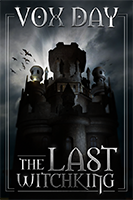
Book Review: The Last Witchking

Lagrandil reviews The Last Witchking:

When I started The Last Witchking (which I chose in part
because it was free from Amazon.com for the Kindle) I didn’t know much
about Vox’s fantasy world.  I had heard vague rumors that he was writing
a Christian reply to the superbly-crafted and spiritually toxic Game of Thrones series.

I couldn’t have been more wrong.

The short stories in The Last Witchking have nothing to do with Martin’s crime against fiction.  Witchking
is not directly derivative of any single voice in the fantasy genre. 
Instead, much like Jordan before him, Vox draws richly on the expansive
fantasy lore of the western tradition while avoiding some of the more
common pitfalls of the current writing generation….

“Opera Vita Aeterna” was a fascinating insight on what I believe to be
one of Vox’s oldest ideas in this world: the interplay between
Christianity and non-human races.  In this case it’s the story of a
master sorcerer elf who spends a paltry few years in a humble Christian
monastery.  This was easily my favorite piece of the three.  It also
illuminates a relevant point about Vox Day’s style.  The man is
educated, and while he doesn’t waste time rubbing anyone’s nose in that
fact, neither does he write for the lowest common denominator.

NB: If you liked the covers for the three Selenoth novellas, they were all produced by JartStar, who is now open for business. Click on the banner below if you’re a writer who is in need of a good cover for a book at a reasonable price.


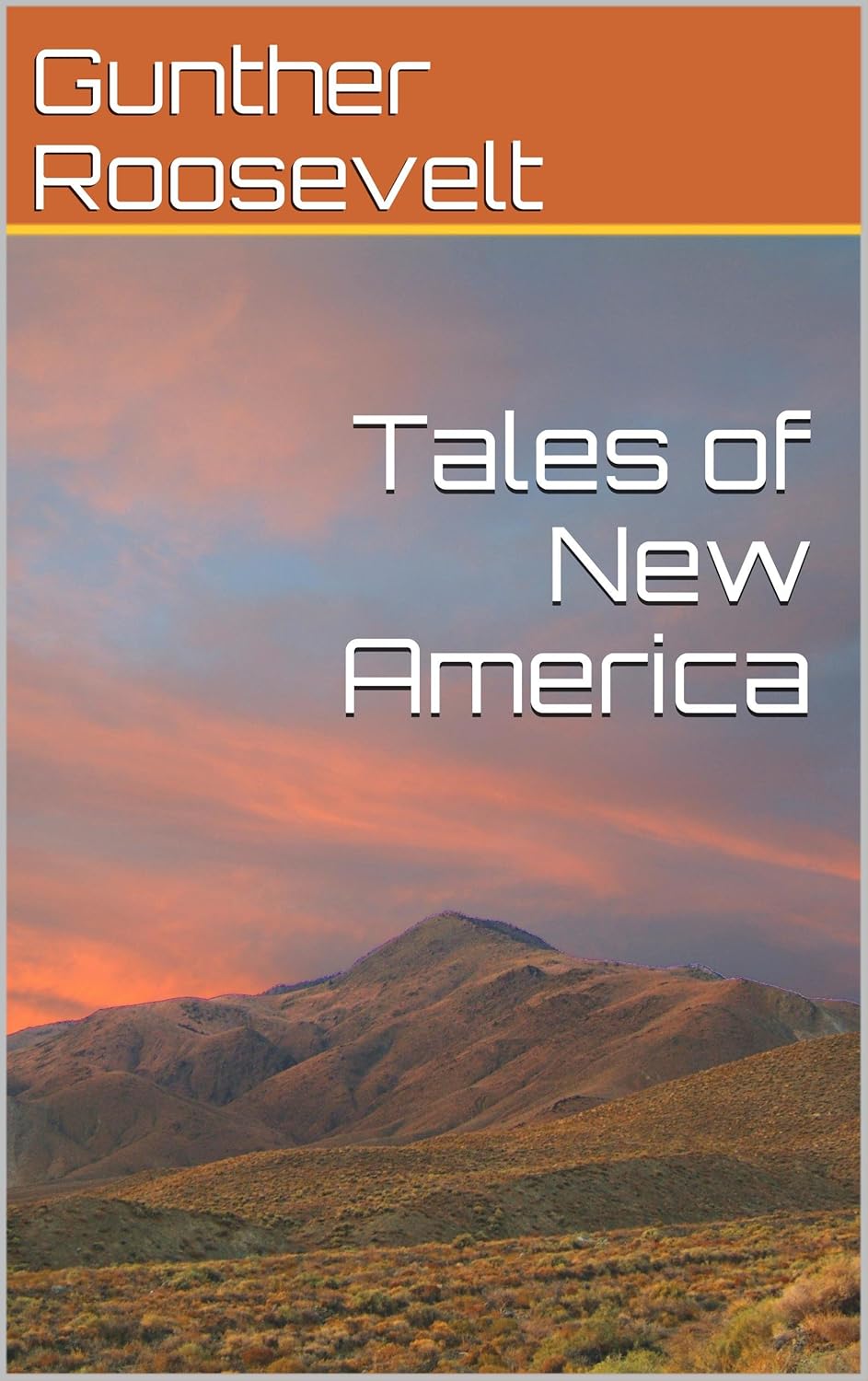
Book Review: Tales of a New America II

DL provides a second look at Gunther Roosevelt’s Tales of a New America:

Tales of New America by Gunther Roosevelt is a
collection of short stories/vignettes set in a post-economic collapse
America where too many decades of an expanded welfare state and cultural
decline have taken it’s toll. The stories contain several recurring
characters, but they’re not intended to follow the stories of a set
group of individuals, but rather to communicate the process of the
transition from the USA to the NAR, or New American Republic. For me,
this fast paced style, and my own interest in the subject, made
compelling reading and I finished the book in short order.

The book is set far enough in the future to avoid the
conflict that will arise when the government can’t pay for all of the
post-retirement benefits it’s promised to employees. As a resident of
Illinois, this is something that is of great concern to me. I work in
the private sector, but I wonder what the reaction will be from all of
those public employees who have not saved for their own retirement will
be when their employer can’t make good on promises made during boom
times.

I couldn’t help but compare this to another
post-collapse novel I’d recently read, Flashback, by Dan Simmons, an
excellent book by the author of Hyperion. Tales of New America charts
out what I would consider to be an absolute best case scenario for the
collapse of Progressive American Culture and the start of a new
culture–a culture aware that the previous culture was suicidal.
Flashback
on the other hand charts a much more pessimistic, and I’m
afraid to say, realistic scenario.

“Tales” charts the fall of the old and birth of the new
by a rich industrialist who is tired of dealing with the regulation
involved in the oil business. His circumvention of the law, and the lack
of reaction from the clapped-out regulatory agencies gets the ball
rolling. Others follow his lead by “going Galt” and the NAR is
established. It was quite easy to imagine this scenario based upon the
quite common concept of Diminished Responsibility that’s so common
amongst government workers.
Themes of the US Government in free fall are common, with
a good sense of “the body’s dead, but the head doesn’t know it yet”,
The old bureaucracies are established, nominally running, but they’re
running on fumes, only still moving at all because the personnel
involved are doing their work as part of a routine and not much else.

Scenarios of non-NAR citizens becoming aware of
untenable nature of how they lived in the past, and lessons being
learned are common, but not to the detriment of the story.

Some
of the things that touched me the most were the way this novel handled
race relations. It pointed out my own preconceived notions that in many
cases I didn’t know I had. My own life involved growing up in a tough
part of the south side of Chicago, followed by a move to a working class
suburb. My subsequent life has been a career in IT, and because of my
hard work I’ve always been able to live in areas that were safe, stable,
and less than vibrant. Virtually all of my contact with Vibrant
Americans has been work related, and positive. If I didn’t still live in
the Chicago area, with constant reminders of the dangers of vibrant
culture, my knee jerk reaction to this novels take on race relations
would have been “Racism!!”, but I was able to remember that this was a
novel, and within the confines of this novel and our current culture,
what was portrayed was understandable. I’m also familiar with the
concepts, which I first encountered in Peter F. Hamilton’s Night’s Dawn
trilogy when he introduced the concept of “Ethnic Streaming” for
off-world colonies.

I did have some issues with the novel. It appeared to me
that every personality connected with the NAR was beyond temptation and
bribery–something I know never to be the case when human beings are
involved. As the NAR conquest of the west coast moved forward, there
were no major setbacks, no huge obstacles, and at every turn NAR
technology provided an almost magical advantage. The concept of “no
battle plan survives contact with the enemy” just never reared it’s ugly
head. All the NAR forces were good, incorruptible Boy Scouts, and the
enemy were simply rabble propped up to be knocked down. A semi-competent
enemy would have been nice.
Some of the characters stories were left to wither and
die, some went on in too much detail for my taste. A good editor might
have been helpful in this and other areas.

Overall, I
enjoyed the book, and it was compelling enough for me that I pretty much
read it straight through. Using the Amazon scale, I’d give it 3 stars.
I’d certainly be willing to give something by this author a try in the
future. If you’re going to read this, I’d also recommend picking up
Flashback
to compare and contrast life in Post-Obama America.