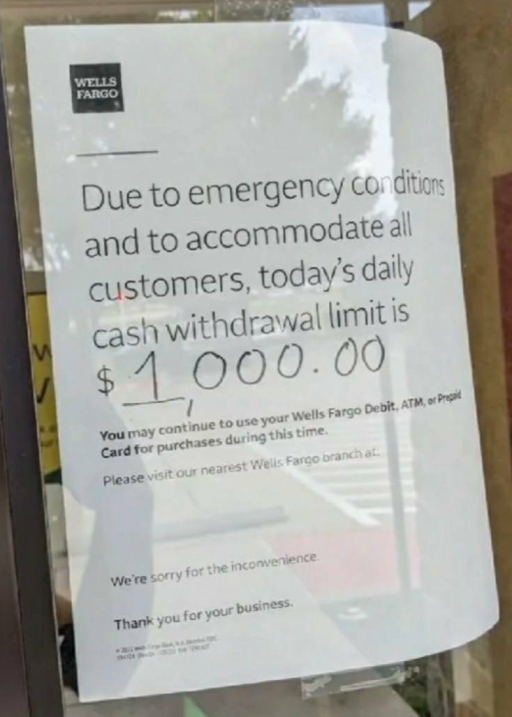
Better make sure you’ve got less than the Federally-guaranteed amount in Wells Fargo. I’m sure it’s fine, though. It’s not as if any banks have been failing recently, right?
#Arkhaven INFOGALACTIC #Castalia House
Better make sure you’ve got less than the Federally-guaranteed amount in Wells Fargo. I’m sure it’s fine, though. It’s not as if any banks have been failing recently, right?
Banks are now closing the accounts of people whose “publicly-stated views are at odds with their positions as inclusive organisations” and using spurious excuses to do so.
The 40-page file shows that the bank cited his retweet of a Ricky Gervais joke and his friendship with Novak Djokovic to raise concerns he was ‘xenophobic and racist’.
The extraordinary documents obtained by the former Ukip leader and handed to MailOnline revealed the 331-year-old bank decided to ‘exit’ him after making reference to his friendship with former Wimbledon champion Djokovic.
The tennis player, who lost in the men’s singles final in SW19 on Sunday, made headlines over his decision not to have the Covid-19 vaccine during the pandemic.
The dossier also shows the bank’s discussions considered 13 tweets, including a retweet by Mr Farage of a video of a Ricky Gervais sketch posted by Laurence Fox satirising the transgender movement. In the scene Gervais made a joke about ‘old-fashioned women – the ones with wombs’.
Mr Farage had retweeted the clip in May last year with the phrase ‘this is brilliant’ – but the document described it as a ‘transphobic comedy sketch’.
The officials noted that closing his accounts could not be justified on the basis of his wealth as his ‘economic contribution’ was ‘sufficient to retain on a commercial basis’.
But the minutes state: ‘The Committee did not think continuing to bank NF was compatible with Coutts given his publicly-stated views that were at odds with our position as an inclusive organisation.’
This is why all of the liberal “civil rights” and “freedom of speech” has been nonsense all along. As some of the earliest supporters of these fraudulent concepts admitted nearly 100 years ago, they only exist in order to permit those whose evil beliefs had been repressed to take power and begin repressing traditional views, nationalist beliefs, and the Christian faith.
And it is why every effort to create “central bank digital currency” should be opposed, and why you should stop using credit cards and debit cards for every little purchase, because the more you utilize the control system, the easier it is for the control freaks to force everyone else to do so.
Start small. Use cash at the supermarket and the gas station. Delete the financial apps from your smartphone. Wait patiently in the lines instead of using self-checkout. Don’t make it easy for them.
Because if you don’t, you’ll soon find yourself being ejected from the system anyhow, just like Niles Farage and other individuals deemed undesirable by those in control of the banking system due to a joke on social media or something similarly trivial.
What can the Fed do in the face of the growing list of bank failures? Absolutely nothing, according to Karl Denninger.
How’s PacWest doing?
Oh, not so good. Let’s see…oh, looks sort of like an impending zero.
But wait — First Republic was it, right?
Sure it was.
There’s no real problem here, right? The TNX was down a full percent yesterday because….. the Fed will save it all, right?
No they won’t.
Not because they don’t want to.
They can’t this time.
Oh, you think not eh? How’s your homeowner’s insurance premium? Your car insurance? Your food bill? You know, all that stuff you have to buy? Yeah, you’re reading this and you’re probably middle class or better. You’re doing mostly ok. You’re on the right side of the bell curve, right?
Half the people are on the left, and they’re not ok. For them that 20% increase means they are taking payday loans to buy food, effectively and sometimes literally.
That ends the game folks.
If The Fed tries it we get government and social collapse.
The Federal Reserve has surprised us before with its resiliency. It has certainly kicked the can a lot further down the road than I’d anticipated it would be able to in 2008. But sooner or later, no matter how skilled the magician, the hat runs out of rabbits.
UPDATE: The short-term anecdotal evidence tends to support the hypothesis.
Two more US regional banks saw trading of their shares suspended on Thursday, amid the worst crisis to hit the country’s financial sector since 2008. Regulators halted trading in Los Angeles-based PacWest and Arizona’s Western Alliance after their share prices fell dramatically. PacWest Bancorp said late Wednesday it was in talks with potential partners and investors about strategic options after its shares dropped by as much as 60%.
In fact, you might do well to be downright terrified. When it comes to economics news, it doesn’t get much more grim than this.
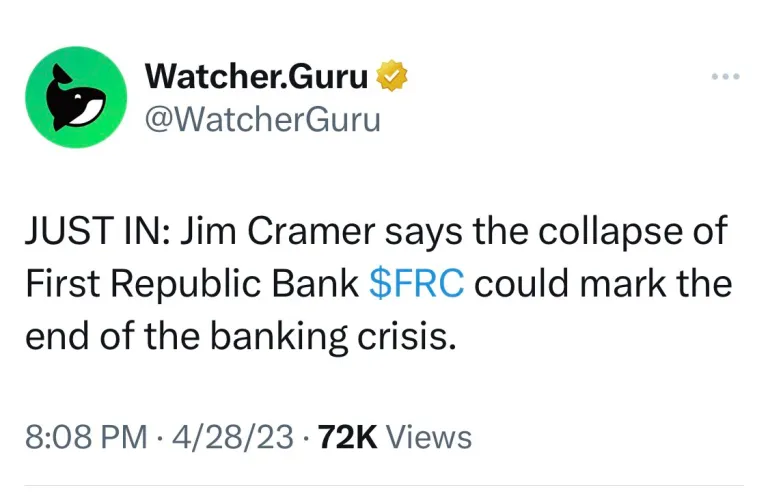
Fortunately, he only said “could mark”. He didn’t actually declare that the banking crisis had ended. So hope yet remains. It might only be that this is a sign of First Republic Bank’s survival.
Jesus said debts should be forgiven. So did the ancient Greeks, as Rev. Matt points out.
One of the most consistent arguments made against the policy of society wide debt forgiveness is this: “You need a Christian or believing (in the sense of ancient Israelite) nation for it to work. It cannot work in a nation like ours because it is non-Christian, so either people will not go for it, or they will abuse it and it will not work.” Almost every time I have made a case for debt forgiveness somebody makes this argument. But it is a fallacious one, both historically and logically.
It is fallacious logically because there is nothing inherent to many pagan philosophies saying that debt cannot be forgiven. Forgiveness, liberty and debt cancellation were all concepts that existed before either Israel or Christianity had graced the face of the earth. Indeed, the most ancient usage of words that can be translated as “liberty” were pagan words referring to debt forgiveness.
It is fallacious historically, because we have countless examples throughout history of ancient societies practicing debt forgiveness. From the ancient Sumerians, Akkadians, and other Near Eastern societies, on through to Greek city states and the Roman public, we see that debt forgiveness was either practiced, debated, or offered in various contexts. In fact, many ancient pagan leaders saw it, correctly, as an effective means of shoring up popular support for their reign, and limiting the damage their nobles could do to both their reign and their society.
Many examples of debt forgiveness in pagan societies can be given, here is one from ancient Athens,
“Now later writers observe that the ancient Athenians used to cover up the ugliness of things with auspicious and kindly terms, giving them polite and endearing names. Thus they called harlots “companions”, taxes “contributions”, the garrison of a city its “guard”, and the prison a “chamber”. But Solon was the first, it would seem, to use this device, when he called his cancelling of debts a “disburdenment”. For the first of his public measures was an enactment that existing debts should be remitted, and that in future no one should lend money on the person of a borrower.”
Debt enforcement and the refusal to cancel fraudulent debts such as student loans is neither moral nor Christian. Precisely how is it “progress” for a modern society to be observably less moral and less forgiving than ancient pagan societies?
Of course, it has been ever since the end of the semiconductor era.
Faking it is over. That’s the feeling in Silicon Valley, along with some schadenfreude and a pinch of paranoia.
Not only has funding dried up for cash-burning startups over the past year, but now, fraud is also in the air, as investors scrutinize startup claims more closely and a tech downturn reveals who has been taking the industry’s “fake it till you make it” ethos too far.
Take what happened in the past two weeks: Charlie Javice, the founder of the financial aid startup Frank, was arrested, accused of falsifying customer data. A jury found Rishi Shah, a co-founder of the advertising software startup Outcome Health, guilty of defrauding customers and investors. And a judge ordered Elizabeth Holmes, the founder who defrauded investors at her blood testing startup Theranos, to begin an 11-year prison sentence April 27.
Those developments follow the February arrests of Carlos Watson, the founder of Ozy Media, and Christopher Kirchner, the founder of software company Slync, both accused of defrauding investors. Still to come is the fraud trial of Manish Lachwani, a co-founder of the software startup HeadSpin, set to begin in May, and that of Sam Bankman-Fried, the founder of the cryptocurrency exchange FTX, who faces 13 fraud charges later this year.
Taken together, the chorus of charges, convictions and sentences have created a feeling that the startup world’s fast and loose fakery actually has consequences. Despite this generation’s many high-profile scandals (Uber, WeWork) and downfalls (Juicero), few startup founders, aside from Holmes, ever faced criminal charges for pushing the boundaries of business puffery as they disrupted us into the future.
It’s not over. It won’t be over as long as venture capitalists can inflate fraudulent businesses living off their angel and VC money long enough to either a) go public or b) get acquired and let the VCs cash in. Because the Patreons and the Substacks of the world are just as fake as the Franks and the FTXs, as were the Bloggers, Twitters, and Pajamas Medias before them.
None of these businesses actually make money. None of them will ever make money.
Now that the big banks have been given a no-ceiling deposit guarantee, the smaller banks need to be given the same guarantee before all their big deposits are transferred to the guaranteed banks. And so the contagion spreads.
Another 50 regional banks in the US could fail in the US banking crisis if authorities do not take immediate action to resolve structural issues in the sector, according to former vice-president at Lehman Brothers Lawrence McDonald, in an interview with RIA Novosti.
He said, “Policy-makers will most likely be forced to introduce a much larger withholding to maintain outflows of deposits from bank accounts that significantly exceed $250,000.”
The global financial crisis of 2008 began with the collapse of Lehman Brothers, which seized up funding markets, and prevented global lenders from getting ahold of US dollars.
McDonald says the problems today are very similar to the problems which preceded the collapse of Lehman and triggered the 2008 financial crisis.
He added that now it is expected US regional banks will lose “hundreds of billions of dollars” in deposits, as those funds are moved out to larger lenders believed to be “too big to fail,” as well as more secure US Treasuries.
He noted US authorities will have to massively increase the guarantees to US deposits over the present guarantees.
They can methodically merge all the banks that fail with the survivors until there is only one massive bank. But what will they do when that one final bank finally, and inevitably, fails. Because the problem is systemic, no credit system can survive indefinitely as the math guarantees its eventual failure.
The economic tide is rapidly going out and it is exposing the utterly false foundations of the Enlightenment-based societies in the process. Switzerland was once known throughout the world for its serious dedication to law, order, and direct democracy. Now, only a few months after throwing away centuries of historic neutrality on behalf of the losing side of the NATO-Russian War, even the Saudis are openly mocking the government’s false pretensions to “law” and “democracy” in the aftermath of the government shenanigans forcing the UBS-Credit Suisse merger.
On Wednesday, the so-called “trinity” of the Swiss National Bank, regulator Finma and minister of finance summoned Credit Suisse chair Axel Lehmann, who was in Saudi Arabia for a conference, and chief executive Ulrich Körner for a call.
In the same meeting where they authorised the CHF50 billion backstop, they also delivered another message: “You will merge with UBS and announce Sunday evening before Asia opens. This is not optional,” a person briefed on the conversation recalls…
“You make fun of dictatorships and then you can change the law over the weekend. What’s the difference between Saudi Arabia and Switzerland now? It’s really bad,” says one person close to one of the three major shareholders.
The international business community is not impressed.
“Switzerland’s standing as a financial center is shattered. The country will now be viewed as a financial banana republic. The Credit Suisse debacle will have serious ramifications for other Swiss financial institutions. A countrywide reputation with prudent financial management, sound regulatory oversight and, frankly, for being somewhat dour and boring regarding investments, has been wiped away.”
— Opimas CEO Octavio Marenzi
The worst thing is that it was totally unnecessary too. But the two big banks wanted to go play in the shark-infested waters of the US financial markets, and unsurprisingly, they were eaten alive. And yet, the government is still kowtowing before US and EU demands out of fear of being left out. But left out of what, terminal financial cancer?
It’s not as if any of the European governments are any better. Many are considerably worse. France is openly disregarding the fury of its people over pension changes. The UK and Italy are actively replacing their native populations and criminalizing all dissent.
Everything you were ever taught about “liberal democracy” was a complete and utter lie. Literally everything. Don’t forget that the next time any government mouthpiece tries to tell you about anything.
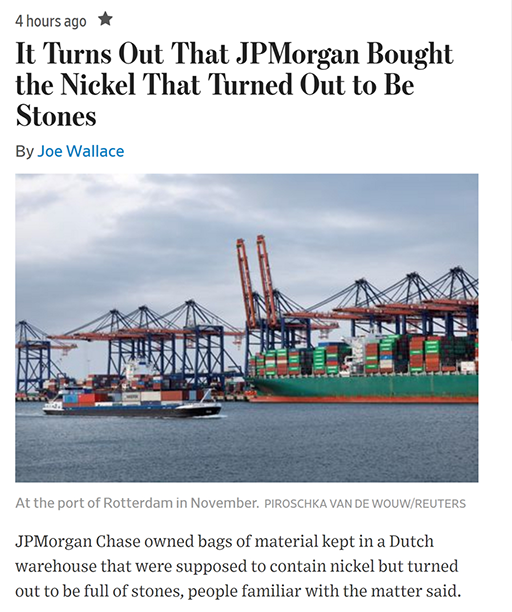
Yeah, but what if they’re MOON rocks? Then the fake nickel is even more valuable than the real stuff would have been. Problem solved. Contact me for any future economic confidence-related problems.
Anyhow, it’s a cool story. Now do all those “gold reserves” being held by the Federal Reserve.
The failure of Credit Suisse vaporized $17 billion in corporate bonds and another $31 billion in market cap in the last year. That means the Swiss government would have to find nearly $50 billion in new debtors just to stay even:
Credit Suisse said 16 billion Swiss francs ($17.24 billion) of its Additional Tier 1 debt will be written down to zero on the orders of the Swiss regulator as part of its rescue merger with UBS (UBSG.S), angering bondholders on Sunday.
FINMA, the Swiss regulator, said the decision would bolster the bank’s capital. The move reflects authorities’ desire to see private investors share the pain from Credit Suisse’s troubles.
Chair Marlene Amstad said FINMA had stuck to the country’s “too-big-to-fail” banking framework in making the decision.
It means AT1 bondholders appear to be left with nothing while shareholders, who sit below bonds in the priority ladder for repayment in a bankruptcy process, will receive $3.23 billion under the UBS deal.
Engineered in the wake of the global financial crisis, AT1 bonds are a form of junior debt that counts towards banks’ regulatory capital. They were designed as a way to transfer risks to investors and away from taxpayers if a bank gets into trouble.
This is why “printing money” doesn’t work in a credit economy. Yes, it’s easier to generate the meaningless digits on a balance sheet than it is to print paper, but it’s not so easy to produce new borrowers. And mass immigration has completely failed to provide the answer it was intended to be, because the immigrants are far less inclined to service their debts.
Now do you see why the failure of the Clown World economy was always inevitable?