A review of the PA Supreme Court decision

I asked the lawyer who previously reviewed Sidney Powell’s GA filing to look at the recent PA Supreme Court ruling. He graciously consented to share his thoughts, which follow.

So here’s my brief take on the Pennsylvania Supreme Court Decision. The usual disclaimers in this case are that I do not practice in Pennsylvania State courts, nor is election law my typical case. Nonetheless, several things stand out to me.

Before addressing those issues, let me clarify a few things. Court decisions must be interpreted in light of several factors, not least of which is: 1) what is the court that is issuing the opinion; and 2) what is the relief sought?

In this case, it is a Pennsylvania state court and the plaintiff were seeking an order prohibiting certifying the results of the election. Both of these are significant. It is significant that it is a state court because state courts generally are not viewed as intellectually rigorous as federal courts. Further, federal courts are viewed, rightly or wrongly, as less partisan than state courts. Federal courts also can address federal and state issues while state courts are typically limited to state issues. There are exceptions but I’m not going to go into them now.

The remedy at this point is also significant. Generally speaking, there are two types of remedies: legal and equitable. Legal remedies are usually monetary damages after something has occurred. Equitable remedies are court orders to make someone act in a certain way, either to do something or refrain from doing something. At common law, legal and equitable courts were different. In most US courts, whether federal or state, they are merged.

So the original PA complaint starts by saying, “The amendments to the mail-in voting rules were not lawfully passed. So, this court should not allow mail-in votes that were authorized under those statutes.” There was a flurry of filings and activity at the beginning of this week about that. In the middle of it, the PA Secretary of State ‘certified’ the ballot. Once that was done, the defendants tried to claim that the case was moot, or that there was no need to go further. The trial court said, “No, there are several other things the Secretary of State has to do before the certification is proper so it is not moot.” 

The trial court judge is a Republican. PA as a state allows partisan elections for judges. The PA Supreme Court has 2 Republicans and 5 Democrats. The trial court judge ultimately found that the laws amending the mail-in ballots were not approved according to the rules for modifying PA statutes. So, she said, “You cannot count those votes.” The defendants appealed.

Here is where it gets interesting. At common law, equitable cases had a variety of doctrines and defenses that did not apply for legal remedies. As one example, one who seeks a suit in equity must come with ‘clean hands.’ So if you can show that the plaintiff engaged in illegitimate behavior, you can argue that the plaintiff should not get an equitable decision even if that decision might otherwise be justified.

Another equitable doctrine is ‘laches,’ which means that you have to timely act. It is a defense that essentially says, “Plaintiffs took too long to make their claim.” Note that a laches defense does not address the merits of the underlying argument. It is solely a procedural claim.

The Pennsylvania Supreme Court relied upon laches and said, “This law went into effect a year ago and none of the Plaintiffs did anything about it.” The opinion notes that the plaintiffs did nothing upon the law’s passing. The PA Supreme Court says, “They waited until millions cast their vote” so they will not allow the suit to go forward.

However, there is another legal doctrine, one called ‘standing’. Standing simply means that you yourself have to suffered an injury. Think of environmental groups that try to stop the Navy from using sonar to map the ocean floor because the use of sonar damages whales and dolphins. Courts typically say, “Even if you are 100{3aedcb51dac2fbb83a885d32b07950f3050377138d02430f831f0a3ede84357a} right, you aren’t being injured. And you do not have the capacity to sue for the whales and dolphins. You do not have standing to bring suit.” And they then dismiss the suit. No joke. There are several reported decisions about this.

The key to laches it that the delay has to be unreasonable. So if you learn that your city is going to bulldoze a public playground where you take your children, you cannot wait until the playground is razed and they start putting up the apartment complex to file your suit. The PA Supreme Court, without any discussion of the merits, just said, “You’re too late. You lose.” The PA Supreme Court has 5 Dems and 2 Rs. The Rs concurred but said there should be a hearing about the problems with the votes. They essentially said, “Voiding every mail in ballot is too much right now so we would void the trial court order, but we would let the claims go forward and see where that leads.” Put another way, if the evidence shows that X{3aedcb51dac2fbb83a885d32b07950f3050377138d02430f831f0a3ede84357a} of the mail-in ballots were fraudulent, we would not oppose striking those ballots, but we aren’t going to grant a blank check at this stage of the game.”

Realistically, given current standing doctrine, there is no way Plaintiffs could have succeeded if they raised this challenge prior to this election. Any potential injury would be too speculative. That is, if they filed suit in December, 2019, the ruling from the court would have been “Plaintiffs challenge how this became law but Plaintiffs do not allege that they are injured in any way. Some of the Plaintiffs announce their intention to run for office but it is not clear whether they will or if they will succeed in the primaries or if any votes would go their way or not. Because they cannot point to an actual injury, they lack standing to assert these claims. Case dismissed.”

Further, if a law is unconstitutional for whatever reason, it can be challenged at any given time. Constitutionality is like jurisdiction: one does not need to assert it to preserve it. So even if a case is tried and lost, you can raise jurisdiction on appeal and argue for the first time that the lower court had no jurisdiction. Not likely the best way to argue a case, and might have the courts thinking that such an argument is just a Hail Mary that won’t go anywhere, but arguing that the statute is unconstitutional will not be dismissed with a blithe “You’re too late” opinion from the court. 

So where does this leave the Plaintiffs? There is now nothing preventing them from seeking Supreme Court review. This does not mean that the Supreme Court will take it but it does mean that there are enough opinions that the Supreme Court can take it. Will they?

Maybe. It comes from a state Supreme Court on an incomplete record. The trial court had issued an order and was anticipating hearings that would develop evidence. That did not happen and the PA Supreme Court certainly did nothing to develop a factual record. But the trial court did consider the evidence before it (primarily affidavits) and relied upon that evidence to issue an injunction. The Supreme Court could pass on this case. That does not mean they agree with the PA Supreme Court. It could just mean that there is an insufficient factual record for them to adequately rule.

The U.S. Supreme Court could revive the injunction, send it to the trial court with an order for further evidence and delay a final ruling until the evidence is developed so the parties can know which ballots are a real problem and which cannot be verified. The Supreme Court could also issue a ruling that problematic ballots cannot be counted and remand the matter to a trial court to determine what mail-in ballots did not comply with PA laws prior to the enactment of their new mail-in-balloting scheme. 

There is a Third Circuit opinion that denied the Trump campaign’s petitions. That could be appealed as well. It could be that the Third Circuit case and this case are combined with directions on how to handle the PA issues.

Given the number of cases that are pending, I would bet that the USSC would take some type of case if for no other reason that it would give guidelines to lower courts, including appellate courts, for how to decide these cases in the future. In 2000, Bush v Gore was just the state of Florida. Here, we are dealing with Georgia, Pennsylvania, Michigan, Wisconsin, Arizona and Nevada. Those states have differing election laws and criteria. Realizing the challenging occurring elsewhere, it might be worthwhile for them to take PA now to issue rulings to guide other courts.

And if those other states are still in contention by December 8, those elections could be referred to their state legislatures for the legislature to appoint a board of electors.

I make no claim about what will happen. I know courts prefer to make as narrow ruling as possible, everything else considered. If the USSC can say, “PA’s rules about mail-in-ballots are not legitimate and so those votes cannot be counted,” that is far more limited than throwing out the whole election and they would prefer that if at all possible. Such a ruling could guide any number of states, including GA. Time is rapidly dwindling for courts to make a decision about whether they will decide the dispute or whether they will declare that state elections have not been decided and it goes to the state legislatures.

Until then, nunc pugnamus.


Unconstitutionality has a time limit?

Or so the Pennsylvania Supreme Court declares:

The Pennsylvania Supreme Court on Saturday rebuffed a long-shot election challenge Saturday from one of President Trump’s top boosters in Congress, balking at his suggestion that it throw out every ballot cast by mail or designate the state’s legislature to decide who won the state.

In a unanimous decision, the justices declared that U.S. Rep. Mike Kelly (R., Butler) and the seven Republican plaintiffs in the suit had waited too long to bring their lawsuit alleging that the 2019 law, passed by the state’s GOP-controlled legislature, which created no-excuse mail voting in the state for the first time was unconstitutional and “illegally implemented.”

Instead of filing it shortly after the passage of the bill, which was required in the statute, they waited until their candidate lost to challenge the mechanism by which some 2.6 million Pennsylvanians voted this year, the court wrote in a terse, three-page order.

I very, very much doubt that this is a surprise to the Trump team. Remember, wait two days…. It’s a bit strange, though. If the law flies in the face of the state constitution, then it presumably continues to do so regardless of when it is formally challenged. Does unconstitutionality really have a time limit?


A Democrat’s view of the GA filing

It is becoming apparent that the average Democrat is not necessarily inclined to buy the media’s Three Monkey approach to the fraud-related lawsuit filings, as this longtime Democrat and state election official’s review of the Powell lawsuit filed in GA indicates.

I’ve finished reviewing the Georgia filing and I have a few comments to share with the socialverse in my capacity as a 30-year registered Democrat, former Oregon state elections official (with policy and admin experience), and former CIO. 

I will not comment on the legal claims because, while I have familiarity with the law and court filings, I’m not a lawyer. I am also going to mostly stay away from alleged behaviors, too, as I wasn’t there and, anyway, they add color but are more open to dispute.

The original intent of the software code (acc’d to affidavits) was to manipulate votes without detection. When you start with one goal in mind, it’s tough to pivot to the opposite goal later—not matter how hard you might try. Not that it seems anyone tried … Absence of secure audit log (to record every action in the software) is so indefensible that I LOL’d when I read it. This fact alone should be enough to negate the results when there is ANY question about fraud because it cannot be proven that fraud DIDN’T occur.

Elections administration. Lawsuit alleges that many procedures required in state law—for good, common sense reasons to ensure the one voter, one ballot rule is adhered to—were not followed, including:

  • Receipt of absentee ballots in their return envelopes was not recorded (this reduces risk of ballot box stuffing, i.e., to ensure that only one real ballot has been submitted by one real voter)
  • Signatures were not verified against voter registration on return envelopes. There might be missing envelopes, too; it wasn’t clear to me in my reading or I missed it.
  • 8/12 Ballot processing is not allowed before Election Day in Georgia; in this election, by rule inconsistent with state law, SecState allowed counties to start 3 weeks early. Absent a rigid accountability processes, this risks double or counterfeit voting. Conducting one election with INTEGRITY is hard enough; when you overlay what is, in effect, a 2nd election (by mail) that has to be reconciled with what happens at the polls … this is very high risk … this “2 concurrent elections” risk was a primary argument for all elections being conducted by mail in Oregon, which was adopted after 20 years of practice with dual polling/mail elections—practice that none of these states whose elections are in question have had … 
  • Observers were not allowed during the original count or the recount. There is no defense for this and intrinsically implies that elections officials had something to hide.

There are other things to pick on, but these I cannot think of a way to defend and probably are sufficient to meet the apparent (according to the lawsuit) standard of “preponderance of the evidence” to “doubt the result.” 


From dream to reality

Yes, Virginia, the 2020 edition of the Junior Classics is real at last. While we normally don’t bother printing samples before we ship orders to backers or flip the switch to activate release into the distribution channel, the large number of moving parts involved plus the sheer volume of books to be shipped inspired us to take an uncharacteristically safe approach to the process. Fortunately, our caution turned out to be unnecessary, which is why we have today begun placing the first orders to ship out the initial three volumes to the original backers of the project.

We are very appreciative of the incredible support that made it possible to turn this dream into reality, and also of the patience that allowed the production team to ensure that the project was done right.

The 2020 Edition of the Junior Classics features dozens of stories, even more classic illustrations, and the original artwork of Arkhaven’s Lacey Fairchild, and we are confident that this edition will come to be considered the definitive edition.

From the Preface to the 2020 Edition

For more than one hundred years the Junior Classics have been one of the great resources for teaching children to love reading and providing them with a lifelong taste for the Western literary canon.  These handsome books, containing short stories and selections from classic Western literature, have been passed down through the generations in many families, introducing boys and girls to Aesop, Homer, Bulfinch, and Virgil, and to Cervantes, Dickens, Poe, and Twain.

Wrapping time-honored tales in bright-colored covers, the Junior Classics proved irresistible to young readers over the years, reaching their aesthetic peak with the 1958 edition. Unfortunately, it was also then that the intellectual rot began, leading to the eventual demise of the series. A comparison with the 1918 edition reveals a methodical excision of the elements of Christianity and Americana that established the Junior Classics so firmly among God-fearing American families in the early part of the 20th Century. This process of secularization and intellectual enervation culminated in the 1992 edition, a literary abomination that further eviscerated the content and lowered the reading level to that of the barely literate. The title of the first volume, Let’s Read Together, amply demonstrates how a set of books intended to be read by children to inspire in them a love for quality literature devolved into books meant to be read to children to indoctrinate them.

Having witnessed the effect of the traditional Junior Classics on the reading habits of our own children, and observing the lengths to which homeschooling parents were willing to go to obtain the older books, we launched a crowdfunding campaign for the creation of a new edition of the Junior Classics, one that recaptures the spirit and purpose of the original.


“A likelihood of success on the merits”

There will be no rapid certification of the PA election results and the attempt of the Governor and the Secretary of State to ram through the election fraud there will not be permitted. From the ruling issued by Judge Patricia McCullough:

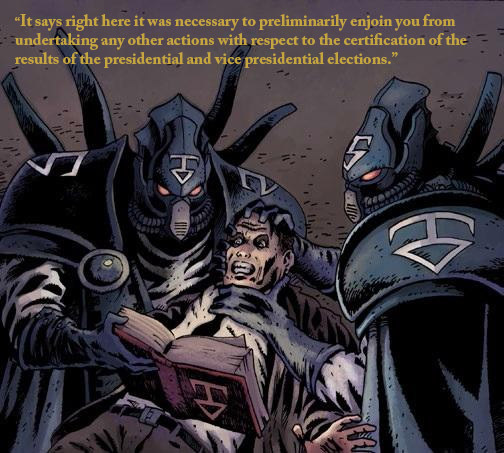
In careful consideration of the exigencies and time constraints in this matter of statewide and national import, and the longstanding constitutional mandate that every citizen of this Commonwealth is entitled to no less than a fair and free election, it was necessary to preliminarily enjoin, on an emergency and temporary basis, Executive Respondents from undertaking any other actions with respect to the certification of the results of the presidential and vice presidential elections, if indeed anything else needs to be done, pending an evidentiary hearing to ascertain the facts of this matter and to determine if the dispute is moot. Inasmuch as the Secretary had not certified the remaining results of the 2020 general election, it was also necessary to enjoin, on an emergency and preliminary basis, any attempt to certify these results as well….

 There is no harm to Respondents by the relief fashioned by this Court. The “Safe Harbor” provision of 3 U.S.C. §5 does not expire until December 8, 2020,and the Electoral College does not vote for president and vice president until December 14, 2020. Additionally, Petitioners appear to have established a likelihood to succeed on the merits because Petitioners have asserted the Constitution does not provide a mechanism for the legislature to allow for expansion of absentee voting without a constitutional amendment. Petitioners appear to have a viable claim that the mail-in ballot procedures set forth in Act 77 contravene Pa. 11 Const. Article VII Section 14 as the plain language of that constitutional provision is at odds with the mail-in provisions of Act 77. Since this presents an issue of law which has already been thoroughly briefed by the parties, this Court can state that Petitioners have a likelihood of success on the merits of its Pennsylvania Constitutional claim.

Notice, in particular, that the petitioners, who are a proxy for the Trump campaign, have been officially ruled to have “a likelihood of success on the merits” because the corrupt elected politicians, described here as “Executive Respondents” violated the Pennsylvania constitution by illegally applying the unconstitutional expansion of mail-in ballot procedures.

Translation: many, if not all, of those mail-in ballots for Biden are illegal and will not count. #bidenlost

There shouldn’t be much doubt about how the PA legislature is going to vote, now that the Republican legislators have been shown at least an amount of the true extent of the fraud:

President Donald Trump on Wednesday summoned Republican members of the Pennsylvania legislature to the White House after a GOP hearing in Gettysburg in which Trump phoned in to reassert his false claim that he “won Pennsylvania by a lot.”

But on Thursday, no one wanted to talk about the meeting.

The White House did not issue a public statement about the visit, and lawmakers who made the trip to Washington were silent.


“Biggest sting op in US history”

It’s been revealed that investigating 2020 election fraud is part of John Durham’s mandate. If this thread by Paul Furber is accurate, the aftershocks of exposing the vote fraud may actually exceed my expectations in some regards:

“It’s been finally approved to disclose that John Durham’s scope investigation wasn’t limited to what occurred in the 2016 election but has occurred in 2020 election.” 

“This isn’t limited to investigators at the FBI/DOJ but Investigation of all IC agencies in criminal meddling and conspiracy to commit fraud. This includes past government officials and past politicians.” 

“There’s several contracted government companies and NGO’s included. The point was to not allow this to happen again to any future Presidential elections.” 

Anon: what happens next?

“Trap was set. Biggest sting op in US history.” 

Anon: post proof.

“Over 20K operators mostly military sworn in and deputized and undercover. Full FISA approval down to a janitors communication.” 

“The architect to this coop was actually hatched at very prestigious ivy league university (heavy IC ties) that will soon be in the news embroiled by funding by a foreign hostile country.

First clue!” 

“We have the source code for dominion software. Algo is designed to add, subtract and switch votes remotely and locally. Meta data is stored and purged but kept embedded in stick drives.” 

“Teams of 4-8 operators at every major polling location. Embedded cameras and fully recorded communications.”

When?

“17 days before Trump gets sworn into office the biggest head will roll. Sound waves!” 

Will trump do a second term?

“100{3aedcb51dac2fbb83a885d32b07950f3050377138d02430f831f0a3ede84357a} yes. One major news network will fold because of it.” 

And some of you wonder why we do not despair? Look at Trump. Look at Biden. Who strikes you as more confident of what is to come? Is every aspect of this thread true? We don’t know, we simply can’t know yet, but the bit about FISA approvals makes it sound as if the poster knows what he’s talking about. Those approvals are what allow the NSA to conduct hop surveillance on people in a three-degrees-of-separation style.

This could be glorious. And for those who are afraid to hope, for those whose lower lips quiver at the increasingly remote possibility that this might be a trap constructed in order to embarrass them into expressing even a modicum of optimism, do try to keep in mind that one of the greatest things that Jesus Christ gives us is hope. And what could be more appropriate this Christmas season than that?

Hope is not bad. Hope is not weakness. Hope is not cope. To the contrary, hope is what gives us strength and fortitude. Hope is what generates morale, and morale is what wins wars and every other form of conflict that requires endurance. That’s why those who seek to defeat you always attempt to frighten you and destroy every last vestige of your ability to hope.

Hope does not put us to shame, because God’s love has been poured out into our hearts through the Holy Spirit, who has been given to us.

– Romans 5:5


The PA House steps in

A RESOLUTION

Declaring the results of statewide electoral contests in the 2020 General Election to be in dispute….

THEREFORE, be it RESOLVED that the Pennsylvania House of Representatives—

1. Recognizes substantial irregularities and improprieties associated with mail-in balloting, pre-canvassing, and canvassing during the November 3, 2020 election; and

2. Disapproves of the infringement on the General Assembly’s authority pursuant to the United States Constitution to regulate elections; and

3. Disapproves of and disagrees with the Secretary of the Commonwealth’s premature certification of the results of the November 3, 2020 election regarding presidential electors; and

4. Declares that the selection of presidential electors and other statewide electoral contest results in this Commonwealth is in dispute; and

5. Urges the Secretary of the Commonwealth and the Governor to withdraw or vacate the certification of presidential electors and to delay certification of results in other statewide electoral contests voted on at the 2020 General Election; and

6. Urges the United States Congress to declare the selection of presidential electors in this Commonwealth to be in dispute.


Scientist murdered in Iran

Before you start running to cast blame – or give credit, I suppose, depending upon your perspective – keep in mind that no one actually knows who was responsible for killing Iranian scientist Mohsen Fakhrizadeh today.

Head of Iran’s nuclear program Mohsen Fakhrizadeh, 59, was assassinated in Damavand, east of Tehran, local Iranian news reported on Friday.

Iran later confirmed the reports. “The nuclear scientist Mohsen Fakhrizadeh was assassinated today by terrorists,” the Iranian Defense Ministry wrote in a statement, while not blaming any specific entity for the incident.  

Fakhrizadeh was a senior Iranian Revolutionary Guards Corps (IRGC) officer and headed Iran’s nuclear weapons project. He was a professor of physics at the Imam Hussein University in Tehran and was former head of Iran’s Physics Research Center (PHRC).

The semi-official Fars News Agency, affiliated with Iran’s elite Revolutionary Guards, stated that Fakhrizadeh was injured in the attempted assassination and later died in the hospital. 

“News sources say a scientist has been the victim of an assassination attempt in an armed attack by unknown people on his team of bodyguards,” Iranian state television said in rolling coverage of the incident.

“Unfortunately, the medical team did not succeed in reviving him, and a few minutes ago, this manager and scientist achieved the high status of martyrdom after years of effort and struggle,” a statement by Iran’s armed forces carried by state media said.

Pictures from the scene show two vehicles, one blown up and one shot at from the front. Several local reports in Iran indicated that a suicide bomber was involved in the attack, but that has not yet been confirmed.

I’ve always been curious where the dividing line between assassination and murder is. It’s not merely about military targets, because when low-level soldiers are targeted and killed, they are seldom described as being assassinated. Perhaps the distinction is between strategic and tactical targets?


Last chance to upgrade

This weekend is the last chance to order the Junior Classics Backer Edition Vols. 1-3 and to upgrade to the leather set. There will be the opportunity to purchase a leather set in the future, but no more upgrades from the hardcover sets will be available. We will leave the order pages active until midnight Sunday evening.

We don’t have time to arrange for a digital backer upgrade, so if you’re a digital backer and you buy a leather set before the deadline, email me and we’ll send you your choice of a) $30 via Paypal or b) $40 credit for Arkhaven/Castalia books.

In Castalia Library news, the cowhides for Divine Comedy and both Plutarch volumes just arrived at the bindery despite the former having been ordered more than a month before the latter. All three books are scheduled to be bound as soon as possible and will probably be shipped together. While we can’t guarantee they will arrive before Christmas for everyone, there is a reasonable chance that subscribers in the USA will receive them before December 25th.

The threat of Section 230

President Trump is finally – and correctly – targeting the elimination of Section 230:

Donald Trump today accused Twitter of “conservative discrimination” while once again criticizing how topics trend on the platform.

In a series of tweets, the outgoing president also suggested a law that gives the social media companies a degree of legal immunity against illegal content uploaded by their users—Section 230—should be revoked on grounds of national security.

“Twitter is sending out totally false ‘Trends’ that have absolutely nothing to do with what is really trending in the world,” Trump wrote on Friday. “They make it up, and only negative ‘stuff’. Same thing will happen to Twitter as is happening to @FoxNews daytime. Also, big Conservative discrimination.”

In a second post doubling down on previous threats against the law, he added: “For purposes of National Security, Section 230 must be immediately terminated!!!”

You’ll see some sites like Gab clinging to the idea that Section 230 should be preserved for smaller organizations, but it’s a ridiculous argument. The elimination of Section 230 doesn’t meant that anyone is going to be punished for the actions of their trolls, it just means they’re not going to continue to be able to avoid taking responsibility for their own licensed content.

And it is their own content. Quite literally and legally. Read the fine print of any social media site. If a site doesn’t claim outright ownership of the content, it will at least claim a license to it. For example, this is the license Gab holds for its user content.

By providing any User Contribution on the Website, you grant us and our affiliates and service providers, and each of their and our licensees, successors, and assigns an irrevocable, perpetual, royalty-free right to use, republish, reproduce, modify, perform, display, distribute, and otherwise disclose to third parties any such material for any purpose.

The point is, Gab cannot reasonably disavow any and all responsibility for the content that it licenses in perpetuity, nor should it, or any other social media company, be able to do so.