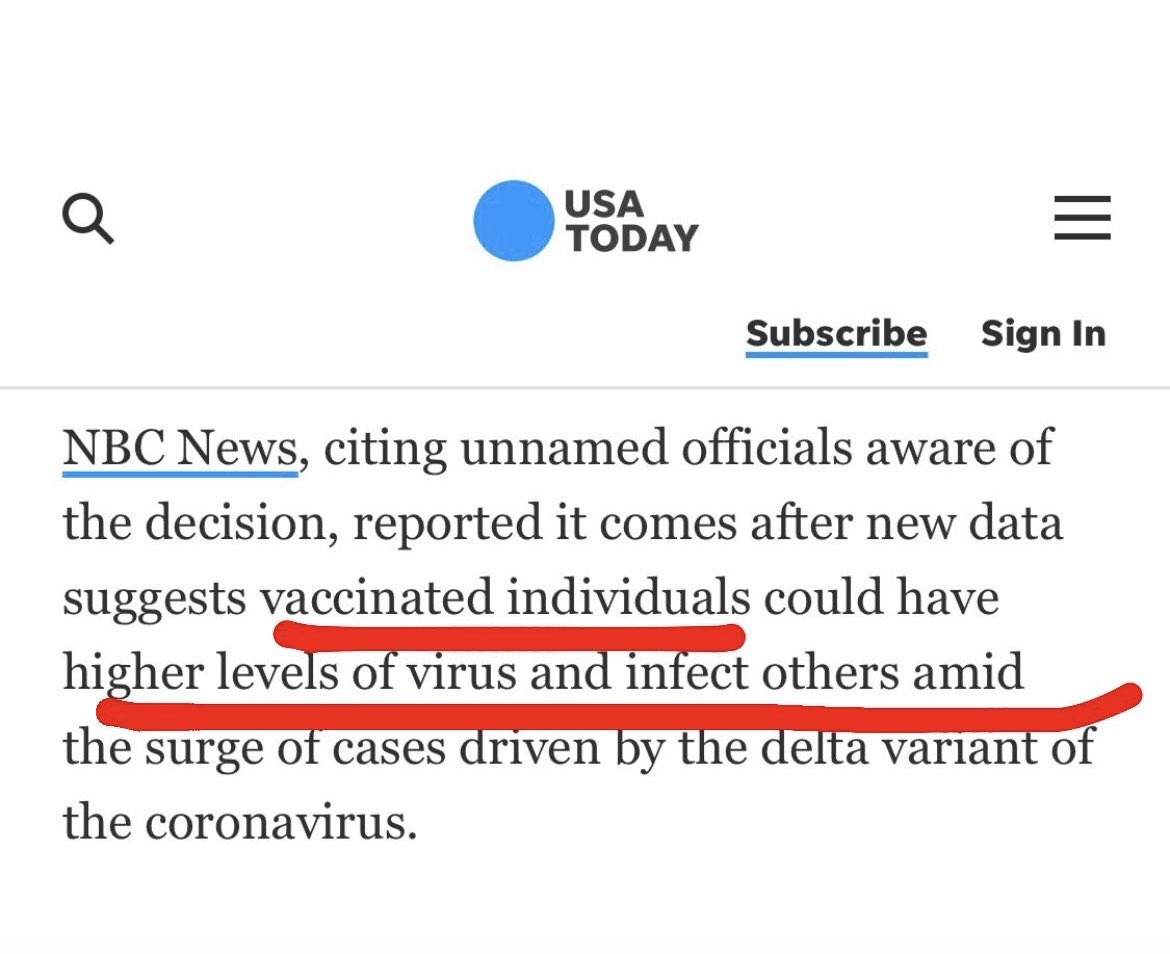
There is no “could have” about it

Vaccinated people carry a much higher load than unvaccinated people. This was predicted and is part of the ADE breakthrough problem. As the educated skeptics have been correctly pointing out from the start, Covid vaccines are literally worse than useless.

Karl Denninger has been pointing this out for months.
The data is that these jabs do not prevent disease.  They also do not prevent transmission of disease.  In fact they appear to, if you get a breakthrough case, make transmission more likely in that the Ct data from these miners shows equal or lower values on balance in the vaccinated cohort with one sample at Ct22!  Reminder: The lower the Ct the more virus you have in your body.
Now granted this is a small group — very small.  But it is extremely concerning that the lowest Ct recorded among these cases was a fully-vaccinated person.  Where is the data from the state labs and CDC on these “breakthroughs” and their Ct numbers generally?  It’s not being reported.  I bet you can guess why not without needing more than one guess.


The silver lining

There may be a considerable amount of good coming out of the pandemonium in the long run:

The rate of households homeschooling their children doubled from the start of the pandemic last spring to the start of the new school year last September, according to a new U.S. Census Bureau report released this week.

Last spring, about 5.4{cc08d85cfa54367952ab9c6bd910a003a6c2c0c101231e44cdffb103f39b73a6} of all U.S. households with school-aged children were homeschooling them, but that figure rose to 11{cc08d85cfa54367952ab9c6bd910a003a6c2c0c101231e44cdffb103f39b73a6} by last fall, according to the bureau’s Household Pulse Survey.

The survey purposefully asked the question in a way to clarify that it was inquiring about genuine homeschooling and not virtual learning through a public or private school, the Census Bureau said.

Before the pandemic, household homeschooling rates had remained steady at around 3.3{cc08d85cfa54367952ab9c6bd910a003a6c2c0c101231e44cdffb103f39b73a6} through the past several years.

Based on the previous statistics, that implies that around 8.5 million American schoolchildren are being homeschooled. That is absolutely massive and bodes well for the future.


Why people don’t believe in “science”

An explanation of why the public doesn’t trust science anymore underlines the importance of distinguishing between scientody and scientistry:

From climate to Covid, politics and hubris have disconnected scientific institutions from the philosophy and method that ought to guide them.

The Covid pandemic has thrown into sharp relief the disconnect between science as a philosophy and science as an institution.

If you think biological complexity can come about through unplanned emergence and not need an intelligent designer, then why would you think human society needs an ‘intelligent government”?

Science as an institution has a naive belief that if only scientists were in charge, they would run the world well.

Perhaps that’s what politicians mean when they declare that they “believe in science”.

As we’ve seen during the pandemic, science can be a source of power, but conformity is the enemy of scientific progress, which depends on disagreement and challenge.

There’s a tension between scientists wanting to present a unified and authoritative voice, on the one hand, and science-as-philosophy, which is obligated to remain open-minded and be prepared to change its mind.

The pandemic has, for the first time, seriously politicized epidemiology.

It’s partly the fault of outside commentators who hustle scientists in political directions, but it’s also the fault of epidemiologists themselves deliberately publishing things that fit with their political prejudices or ignoring things that don’t.

Scientists, by and large, are relatively stupid. Even worse, they’re accustomed to being more or less unaccountable. They’re high-level midwits, for the most part, which is why so many epidemiologists failed to note the obvious: if you make an incorrect prediction that costs people a considerable amount of time, money, or freedom, you will not get a second chance to tell them what to do.

For example, no one in the UK cared about SAGE’s third wave doomsday predictions or paid any attention to its demands for a lockdown because its predictions for the first two waves were off by a factor of more than 10.

Furthermore, everyone with an IQ over 115 understands that science is corrupt now, so they correctly view any “study” or recommendation with extreme skepticism.


Americans are the Indians now

The inability of the Indians to band together against the invading Europeans presages the inability of the posterity of the American Revolution to stand together against the multiple waves of immigrants that have invaded, transformed, and even disappeared the very concept of the American nation:

King Philip had one extraordinary advantage as war raged in the autumn of 1675: The settlers did not know how to fight an Indian war. They couldn’t cross a swamp, they couldn’t travel silently in woods, they couldn’t keep warm outdoors. Indians won battle after battle.

But the victories were Pyrrhic. Plymouth and its allies in Massachusetts Bay, Rhode Island, and Connecticut were connected to global trade networks and could import food, while the Indians were an agricultural people a long way from their fields and stores. King Philip’s troops may have been winning. But they were also starving. The English controlled the technological platform of the war. However formidable Indians were at firing guns, they could not manufacture them. The best hope of the Wampanoags and their Nipmuck, Narragansett, and Abenaki allies was to enlist the ferocious Mohawks of the upper Hudson, with their thousands of fighting men. But the Mohawks’ ferocity (and independence) rested on arms obtained from Albany merchants whom they could not afford to alienate. They entered the war against King Philip, suddenly and to devastating effect.

Finally, the English had cohesion, however you choose to name it: solidarity, like-mindedness, uniformity. The Indians had diversity. That meant some fought with Philip and others fought against him. The Christians among them were an important source of intelligence to the English. War split up not just families but, among the tribal leaders, marriages. King Philip was driven eastward, back across Massachusetts, to his homeland and his fate.

“If the Wampanoags are as much our fellow Americans as the descendants of the Pilgrims,” Silverman asks, “and if their history can be as instructional and inspirational as that of the English, then why continue to tell a Thanksgiving myth that focuses exclusively on the colonists’ struggles rather than theirs?” The answer, as noted, is that we no longer do tell that myth, and haven’t for years. Once we have dismissed the Puritans’ religious claims, once we lose interest in the way their democratic intuitions, from the Mayflower Compact onward, anticipate our own democratic institutions, then we are left with a tale of increasing tensions between two ethnic communities that eventually exploded into war. Every prejudice that has been schooled into Americans over the past half-century would prompt them to root against the Pilgrims.

But that is no longer the only reason we don’t look at Plymouth from a Pilgrim perspective. Of the two communities that confronted each other in New England 400 years ago, it may now be the Indians, not the Pilgrims, who most resemble today’s Americans. The Wampanoags were divided between, on one hand, cosmopolitans like Massasoit, who believed that there was room for a mosaic of peoples in southeastern Massachusetts, and, on the other, skeptical provincials like Philip who lost faith in that ideal. They lacked the cohesion to stand up against a resolute rival.

A remark often bandied about today is Adam Smith’s to the effect that “[t]here is a great deal of ruin in a nation,” by which he meant that it takes a much greater set of misfortunes to destroy a nation, and over a much longer period of time, than we commonly realize. It is not actually true. The Wampanoags went from dominance and confidence to a point of no return in about 55 or 60 years. Suddenly they were losing population, and abandoning old values, too. Each problem fed on the other in a dangerous process. Once a people begins debating how much ruin there is in a nation, that process is already well underway.

This is why it is so pointless for conservatives to babble about “they’re trying to divide us” and other nonsensical civnatteries. There is no longer one single “us”, there are only multiple nations negotiating and jockeying for power over everyone else. 

Perhaps Americans will preserve a rump state amongst the ashes of empire. Or perhaps the conquerors of the US empire will permit whites a few reservations out in North Dakota and Idaho.


When vaxxing makes it worse

I wish I could say that it’s astonishing how after a) coming down with Covid despite being vaccinated twice with the Pfizer not-vaccine and b) infecting his seven-year-old daughter, an NFL analyst somehow concludes this means it’s really important for everyone to be vaccinated. But I can’t, because it’s just more evidence that Most People Are Idiots.

NFL Network’s Rich Eisen got COVID earlier this month despite being fully vaccinated with the double Pfizer shot early this year. He and his wife were in Boston on July 12, about to leave for a week’s vacation in Italy, when he felt a tickle in the back of his throat. Nothing serious. But he had to be tested to travel to Italy, and the test came back positive. A second test came back positive. Eisen had to quarantine in a Boston hotel room for 10 days. His wife, who tested negative, flew back to California—where their 7-year-old daughter was newly positive for COVID. Within a couple of days, Eisen told me, “The symptoms presented like a freight train—night sweats, chills, loss of appetite,” he said. “It hit me pretty hard for three or four days.”

Many would look at Eisen and say, What good is the vaccine if you get the disease after being vaccinated? Eisen looks at it this way:

“The vaccine is not 100 percent effective in preventing COVID,” he told me Saturday. “But it is very effective in keeping you out of the hospital—or worse. I believe getting the vaccine kept me off a ventilator. And getting the vaccine will not only improve your chances of not being infected, but if you’re infected, decrease your chance of dying.

“All I’ve heard from the unvaccinated is it’s time to just live with it and get back to normal. Well, I tried that, and I ended up in quarantine with COVID, and most likely I passed it to my 7-year-old daughter. So you not getting the vaccine makes COVID more prevalent in society, and could cause the next variant to be worse, and to pierce my immunity.”

Eisen’s voice was rising. “My wife and I, as parents, are supposed to protect our children. My 7-year-old gets it, probably from me, after I was vaccinated,” he said. “So now . . . it’s personal for me.”

These utterly ignorant idiots don’t understand that it is the flawed vaccines that are causing the next variant to be worse, not the unvaccinated. If it had been left to progress naturally through the population, the virus would have become more infectious and less harmful, like every other virus in history. It’s already doing that, which is why the Delta variant is estimated to be 10x less lethal than the original one.

However, due to the Antibody Dependent Enhancement problem that is derived from how the mRNA vaccines operate, even these less lethal variants will be dangerous to the vaccinated. This is a problem that scientists were concerned about when the vaccines were first released; read this selection from an article published in February 2021 very carefully, then think about its implications in light of the Eisen case.

The Moderna and Pfizer/BioNTech vaccines have been rolled out in many parts of the world, along with the AstraZeneca/Oxford, Gamaleya, and CanSino adenovirus vector vaccines. Those look to be joined soon by J&J’s adenovirus vector and Novavax’s recombinant protein subunit vaccines, and likely more after that. So here’s the key question: did any of these show ADE hints during their development? And are any of them showing signs of it now?

The short answers: they did not. And they are not. Antibody-dependent enhancement was specifically tested for in the animal models as these candidates were being developed (re-exposure of vaccinated animals to coronavirus to see how protective the vaccine was). And no cases of more severe disease were seen – I’ve gone back through the reported preclinical studies, and I don’t think I’ve missed one, and what I’m seeing is not one single case of ADE for any of them. Indeed, as mentioned above, if something like that had shown up, it would have immediately released a bucket of clin-dev and regulatory sand into the gears of the whole project.

How about the human clinical trials? Again, no signs of ADE were seen. This is a bit less definitive, since we did not run deliberate “Here, have another blast of virus” challenges on the human participants the way we did in the preclinical studies. But at the same time, these trial participants were out there in the real world being monitored for signs of infection. The dramatic plots of the data after even one dose of the vaccines speak for themselves: the trials did hardly saw people getting infected at all after vaccination, and most certainly not with even more severe disease. To the contrary: one of the big features of the vaccines is that across the board they seem to almost totally wipe out the appearance of severe coronavirus symptoms. We’re still collecting data on transmissibility after vaccination and so on (things are looking good, though), but what seems to be beyond doubt is that the vaccinated subjects, over and over, show up with no severe coronavirus cases and no hospitalizations.

That is the opposite of what you would expect if ADE were happening. Remember, the bad thing about antibody-dependent enhancement is that it leads to more severe disease when you’re exposed again to the pathogen (or when you’re exposed after being vaccinated for it). And we’re just not seeing that. At all. 

They weren’t seeing it back in February. But they certainly are starting to see it now. The best case is that it’s just variant cases against which the vaccines are no good, like getting the flu after getting a flu shot designed for a different flu strain. The worse case is that the increasing number of vaccinated subjects being hospitalized with Covid is evidence of ADE. The worst case, of course, is CASE NIGHTMARE KITTY, which would result in the death of everyone who is infected by Covid after being vaccinated, but fortunately, that does not appear to be the situation.

However, an older article by the same author, from December 2020, described the main worry as something that is confirmed to have been observed.

I would say that the main worry for any ADE effects would be if the coronavirus mutates to the point that the antibodies generated by the current vaccines become non-neutralizing. And honestly, I don’t see that happening.

Except it already has.