Mailvox: “You are my Dawkins”

Samuel J. Scott reviews RGD:

The aver­age reader could prob­a­bly be for­given for pass­ing Vox Day’s “The Return of the Great Depres­sion” with­out giv­ing it a sec­ond thought. After all, the author is a weekly colum­nist for World­Net­Daily, a far-right, news web­site that is as biased as it is sen­sa­tion­al­is­tic.

But the reader would be miss­ing one of the poten­tially most-important eco­nomic reviews in recent times.

Con­trary to what some might have pre­dicted from a writer for WND, Day’s sec­ond non-fiction book — the first was his cri­tique of the so-called “New Athe­ism” of Richard Dawkins, Sam Har­ris, and Christo­pher Hitchens in “The Irra­tional Athe­ist” — is not a polemic in favor of end­ing the Fed­eral Reserve, return­ing to the gold stan­dard, or other such issues that dom­i­nate among fringe con­ser­v­a­tives and lib­er­tar­i­ans. Rather, it is largely a cold, ratio­nal, even-handed assess­ment of the eco­nomic his­tory of the past twenty years from the rise of Japan in the late 1980s to the finan­cial tur­moil of today.

Beware of spoilers! Chris Bechtloff posts reviews Summa Elvetica:

Could not put it down. This is one of the best fantasy books I have read in a while.

And finally, Mr. B.A.D. takes me to task for sticking to the literary formats:

To be blunt, you and your buddies are intellectual snobs. Which is fine if all you ever want to do with your great think tank is circle jerk each other about how much smarter you are than the dummies who are running the world.

However if you aspire to make the world a better place with your great minds, which is the only choice of use in a great mind that does not result in total waste, you ought to learn the value of the idiot. The key element of my favorite movie of all time, Conan the Barbarian, is that Will alone is the true power behind anything. Once you have the will of the mob, who are all idiots, you have the means to change the world. This is why Hitler’s number 2 guy was in charge of propaganda, this is why transformers 2 was a box office hit, this is why those red handed atheists found it easier to just kill people than change their minds, this is why Liberals pander to the poor and welfare crowd, and this is why you ought to format your great thoughts and books into something the idiot can enjoy/ comprehend: Documentaries with pretty colors, animations, zingy noises, and humor.

Now I’m no idiot on an all inclusive scale, but I am a far cry from you and your friends in mental capacity. I’ve never had an actual IQ test but…..I scored 136 on one of those Internet tests 8 years ago. I drank a lot back then, and have since enrolled in college. I bet I can squeak in the last few points on a real IQ test and qualify as a genius. I’ll wait till you stop laughing….

Now, my only point was that I am more intelligent than the average human, and I feel I was able to comprehend your books, but they certainly gave my brain a stretch. I am certainly not as sharp as you, and lack the ability to see through the multiple layers of BS spoon fed us by the media each day. In a way you can say that I am the Christian version of the atheists who take science and the unholy trinity as gospel truth, except you are my Dawkins. I do not have the capacity to see the big picture the way you do, nor the reasoning ability to weigh what is bullshit and what is not. On the grand scale I’d actually be on the same level as Dawkins intellectually, I can remember facts, and reason fairly well, but not as well as I think I can, and probably have huge gaps in my logic. Watch Dog of the big picture being your gift, you should use it in a manner that will benefit all, not just the intellectual elites that your blog caters to. If your books were at the far end of my ability, than the people I run across on a daily basis who are barely literate have no hope of grasping the vital truths that you are shining a light upon. So please, draft up some cartoon characters, saddle up with your power point, and put something together for a limited theatrical release with a broad DVD release. If the Lord was able to pass down his higher thoughts to us, than I’m sure you can figure a way to do something similar.

I am his what? Anyhow, I suppose the criticism is not entirely invalid. I have been looking into putting together some sort of bi-monthly YouTube deal with the intention of permitting those who prefer video to follow some of the economic matters I’m writing about. However, it’s important to keep in mind that some subjects can only be dumbed down so far. I mean, if someone genuinely cannot understand that 8.3% annual credit growth over the same time period as 3% annual GDP growth means that the increase in GDP is wholly dependent upon increasing credit, or grasp the significance of what it means when that 8.3% credit growth is replaced by a 6% contraction even when I point it out to him, then there’s really not a whole lot I can do even if I spell everything out with pretty pictures and monosyllabic words.

Of course, Mr. B.A.D. also has to keep in mind that I simply don’t care all that much about the rest of the world except for my desire to stay away from it. I tend to follow my intellectual interests as they happen to evolve; I’m certainly not attempting to save Man from himself.

And returning the subject to RGD, those who have read it should be amused by this inadvertant, but telling confession by Paul Krugman in today’s NYT column:

As you read the economic news, it will be important to remember, first of all, that blips — occasional good numbers, signifying nothing — are common even when the economy is, in fact, mired in a prolonged slump…. Such blips are often, in part, statistical illusions.

You don’t say…. In case you don’t understand the significance of what Krugman is saying here, it is a straightforward admission by a Neo-Keynesian Samuelsonite that macroeconomic statistics are insufficiently reliable for macroeconomic policy making. Which, of course, is the very point I was making in the chapter entitled “No One Knows Anything”.

Bernanke and the housing bubble

In which Ben Bernanke throws Barney Frank under the bus. Even if you’re not an economist, Ben Bernanke’s attempt to excuse the Federal Reserve for any responsibility in creating the housing bubble really has to be read to be believed. Here’s the one of the more damning paragraphs in the 36-page PDF:

First, the cumulative increase in housing prices shown in Slide 5 is quite large. Can accommodative monetary policies during this period reasonably account for the magnitude of the increase in house prices that we observed? If not, what does account for it? Second, house prices rose significantly during this period in many industrialized countries, not just in the United States. If monetary policy was an important source of house price appreciation in the United States, it seems reasonable to expect that, in an international comparison, countries with easier monetary policies should have been more likely to have significant rises in house prices as well. Is that the case?

With respect to the magnitude of house-price increases: Economists who have investigated the issue have generally found that, based on historical relationships, only a small portion of the increase in house prices earlier this decade can be attributed to the stance of U.S. monetary policy. This conclusion has been reached using both econometric models and purely statistical analyses that make no use of economic theory.

This is extraordinarily deceptive on several levels. Bernanke is first leaving out the fact that regulation of the banks is the specific responsibility of the Federal Reserve and is an inherent part of monetary policy given the fact that most of the money in the system is created by bank loans under the fractional-reserve system. He is, of course, limiting his implicit definition of “monetary policy” to interest rate targets, which is acceptable in general economic discussions but not in a specific one of this sort.

Second, it should be no surprise that Bernanke feels justified by the use of econometric models based on the Taylor Rule because the Taylor Rule is the very rule that was used to justify the Fed’s actions in the first place. As Mike Shedlock shows using Case-Shiller housing prices in the place of Owner-Equivalent Rent to calculate CPI-U, the Taylor Rule is fundamentally flawed because it is based on CPI-U. In RGD, I demonstrate a few of the many ways CPI-U considerably underestimates the real rate of price changes; the fact that it doesn’t even take real housing prices into account renders it entirely useless as a basis for defending the Federal Reserve’s actions or comparing the U.S. housing market with international housing markets.

No doubt there will be a lot of detailed critiques of this paper in the coming month. I may even write one myself. But in summary, “Monetary Policy and the Housing Bubble” is a shameless and deceptive attempt by a failed economist to justify his spectacular failure by using the very models that failed him in the first place.

I recognized the housing bubble in 2002; that is a matter of public record. Bernanke, on the other hand, was still denying it existed in October 2005, less than a year prior to its 2006 peak! “House prices have risen by nearly 25 percent over the past two years. Although speculative activity has increased in some areas, at a national level these price increases largely reflect strong economic fundamentals, including robust growth in jobs and incomes, low mortgage rates, steady rates of household formation, and factors that limit the expansion of housing supply in some areas.”

Calculated Risk points out two more things that Bernanke conveniently avoided mentioning:

“Bernanke used data from other countries to suggest monetary policy was not a huge contributor to the bubble … however, Bernanke didn’t discuss if non-traditional mortgage products contributed to housing bubbles in other countries. This would seem like a key missing part of the speech.

Bernanke didn’t discuss how the current regulatory structure missed this “protracted deterioration in mortgage underwriting standards” (even though many people were pointing it out in real time). And Bernanke didn’t discuss specifically how the new regulatory structure would catch this deterioration in standards.”

The truth is that the Fed knew about the “protracted deterioration in mortgage underwriting standards” prior to the start: “Even before economic prophets of doom such as Marc Faber, Nouriel Roubini, and Peter Schiff became famous for their correct warnings of imminent crisis, Edward Gramlich, a governor at the Federal Reserve, told Fed Chairman Alan Greenspan that making home mortgages available to low income borrowers would lead to widespread loan defaults having extremely negative effects on the national economy. This extraordinarily specific warning was given in 2000, amidst the wreckage of the dot-com bomb and before the housing bubble even began. Those possessed of a mordant sense of humor may appreciate how Greenspan rejected Gramlich’s recommendation to audit consumer finance companies on the basis of his fear that it might undermine the availability of subprime credit.”
– Vox Day, The Return of the Great Depression, x.


WND column

Trust Not in Republicans

They abstain from interference, because they fear that, if it fail of good effect, their own safety or reputation may be damaged or destroyed; not because they see that their preservation and good name are needful, that they may be able to influence those who need their instruction, but rather because they weakly relish the flattery and respect of men, and fear the judgments of the people, and the pain or death of the body; that is to say, their non-intervention is the result of selfishness, and not of love.
– St. Augustine, City of God, Chapter 9

In the chapter of his magnum opus entitled “Of the Reasons for Administering Correction to Bad and Good Together,” St. Augustine explains that those who have neither sinned themselves nor opposed the evil deeds of the wicked merit the consequences that invariably arise from those evil deeds on the basis of their refusal to interfere with the rampant sin surrounding them. St. Augustine was referring to Christian morality and the sack of Rome by Alaric in 410 A.D., but the principle applies equally well to economics and the ongoing financial devastation of the United States.

Karl Denninger makes a tangentially related point at the Market Ticker:

It is a fact, whether we like it or not, that we cannot have and sustain the sort of “economic growth” we have been sold over the last 30 years on an indefinite forward basis, as you cannot continually take on debt at a rate that exceeds productive output – eventually you will default. Instead of facing the truth – a long-term growth rate roughly approximating the growth in population, or about half of what we have allegedly “enjoyed”, we have used debt pyramiding – that is, serial Ponzi schemes, to produce the illusion of dramatically higher economic growth.

There is no evidence that [Ben Bernanke], or anyone in Congress, has yet had their “Come to Jesus” moment with the blunt mathematical facts. Attempting to blow another bubble – which is the inherent path you are attempting to take – risks destruction of our nation’s political system and economic future. There are hard choices to make and economic adjustment to the realities of our debt load and what this portends for economic growth on a forward basis will not be easy. It is, however, both inevitable and necessary. The longer we continue to try to deny the math the worse the ultimate outcome.

Given that both Alan Greenspan and Ben Bernanke were Republican appointees and that a Republican White House, Senate, and House of Representatives presided over the most inflated period of “the so-called ‘modern era’ of Central Banking”, it defies both reason and history to assume that economic sanity will be provided by Republicans.


GDP and recession

A total of 157.5 million persons worked at some point during 2008, the U.S. Bureau of Labor Statistics reported today. The proportion of workers who worked full time, year round in 2008 was 65.6 percent, down from 68.4 percent in 2007. The number of persons who experienced some unemployment in
2008 increased by 6.1 million to 21.2 million. This sharp increase reflects weak labor market conditions due to a recession that began in December 2007.

I found that last sentence to be interesting. Here are the latest GDP numbers from Q407 to Q308: 2.1, -0.7, 1.5, 2.7. Now, if the recession began before Q408, while the average quarterly GDP was 1.4 percent, how does 2.2 percent GDP growth indicate economic recovery? Especially when it is known that between two-thirds and three-fourths of that “growth” was related to the Cash for Clunkers program.


NFL Week 17

No fantasy, so I’ll just point out that The Thunder defeated the AZ Hammeroids for the VP-AFL championship. Congratulations to the Thunder and they will be joining new VPFL champion Clay, Nate, the White Buffalo, and me next season.

The NFL games will be weird this week, as they always are, but here’s hoping the Vikes can get their act together and finish off the Giants while the Cowboys take care of the Eagles. I’d like to see the Vikings draft a QB prospect while keeping Brett Favre around for one more year.


The decline of the liberal arts

A college president explains why the English Department and other liberal arts institutions are on the way out:

Here is how the numbers have changed from 1970/71 to 2003/04 (the last academic year with available figures):

English: from 7.6 percent of the majors to 3.9 percent
Foreign languages and literatures: from 2.5 percent to 1.3 percent
Philosophy and religious studies: from 0.9 percent to 0.7 percent
History: from 18.5 percent to 10.7 percent
Business: from 13.7 percent to 21.9 percent

What are the causes for this decline? There are several, but at the root is the failure of departments of English across the country to champion, with passion, the books they teach and to make a strong case to undergraduates that the knowledge of those books and the tradition in which they exist is a human good in and of itself. What departments have done instead is dismember the curriculum, drift away from the notion that historical chronology is important, and substitute for the books themselves a scattered array of secondary considerations (identity studies, abstruse theory, sexuality, film and popular culture). In so doing, they have distanced themselves from the young people interested in good books.

His thesis makes sense: throw out the canon and what do you have except heavily biased opinion? I never recommend an English major for those interested in pursuing any form of literary career; English majors were already quite clearly useless when I was in college two decades ago. It is a pity to see fewer history majors, as knowing what has happened in the past is one of the best guides to recognizing what is happening in the present. As for the “business” majors, I’ve yet to meet one who knew the first thing about business after obtaining such a degree; you’d be much better off to spend four years actually working in a business, or better yet, starting one of your own.


Why The Rules don’t work

A perusal of the basic Rules set quickly shows why women who rely upon them to secure a man and/or marriage are likely going to fail. As is often seen in social networking profiles and advice columns, women usually think that what works with women must also work with men. This is not true. Consider:

Rule 1: Be a “Creature Unlike Any Other”

Given that Playboy has spent five decades proving the near-universal male predilection for a slender, pretty, large-breasted, blue-eyed blonde, this rule is obviously insane. In fact, most men have distinct preferences that anyone who knows them well can easily identify. One of my college roommates always tended to date short, hippy women with long, dark, naturally curly hair named Mary. Unsurprisingly, he ended up marrying a tall, hippy woman with long, dark, naturally curly hair named Mary. Women are naturally attracted to outliers for the sheer sake of their novelty. Men aren’t.

Rule 2: Show Up to Parties, Dances, and Social Events Even if You Do Not Feel Like It.

This makes sense, but you probably shouldn’t bother if you’re just going to be a tiresome bitch. Unless it’s a Goth party, then feel free to mope and whine all you like, Lady Dolorous.

Rule 3: Don’t Stare at Men or Talk Too Much

The first part is completely wrong, the second part is completely right. Staring at a man is the primary way a woman lets him know she wants to be approached. On the other hand, about 90 percent of what women like to talk about is considered by heterosexual men to be inconsequential babble, so the less a woman expresses her opinion, the better. On the other hand, intelligent, topical, and unopinionated speech will win respect simply because it is so rarely heard. It may be useful to know that when men imitate women for other men, they often do it by beginning a sentence “Well I think….” in a high-pitched, clueless voice.

Rule 4: Don’t Meet Him Halfway or Go Dutch on a Date

Establishing an unwillingness to compromise right from the start is a very effective way of convincing intelligent men that you’re going to be a major pain in the posterior and convincing him you’re more trouble than you’re worth. Very hot girls can get away with such intransigence with most men, but if you’re a Rules Girl, then you are obviously not a very hot girl or you wouldn’t think you needed them. As for paying for the date, it depends. If he asked you out, then he should pay. But keep in mind that the “who pays” question is not anywhere nearly as big a deal to men as women seem to think. Consider the contrast between the way groups of men and women approach paying the bill at a restaurant. Men take half a minute to throw in a roughly equal amount and include a healthy tip, while women spend half an hour itemizing who ordered what, then stiff the wait staff. The salient point is that men seldom give a damn one way or another.

Rule 5: Don’t Call Him & Rarely Return His Calls

That’s fine. He’ll be busy having sex with the woman who calls him at 11 PM to see if he happens to be free at the moment and you’re just another haughty bitch who can’t be bothered to call him back anyway. This is easily the worst Rule, as it is designed to ensure that the only men who will continue to call you are terminally obsessed stalkers.

Rule 6: Always End Phone Calls First

This Rule is fine, because there isn’t a single man on the planet who keeps track of who hung up first. Besides, he’s either reading his emails, surfing the Internet, or playing video games while you’re rambling on and on about who said what to whom anyhow.

Rule 7: Don’t Accept a Saturday Night Date after Wednesday

I have no idea what the point of this is supposed to be. But it is correct insofar as it is always a horrendous mistake to attempt leaving your options open instead of simply accepting or rejecting a weekend date during the week. It’s really not that hard for men to tell that you’re looking for something better but are willing to use them as a fall-back option in case nothing more interesting comes along in the next few days. This puts you squarely in the “bitch who merits being treated as badly as I want” category in most men’s books.

Rule 8: Close the Deal – Do not date a man for more than two years.

Okay, this is actually a good one, although I’d cut it down to 12 months since it’s usually possible to at least see where things are going after a year. If a man doesn’t show any sign of being interested in marrying you within a year, he’s probably not going to want to marry you unless nothing better happens to come along in whatever his long-term time frame happens to be. And if he tends to groan, roll his eyes, or smoothly change the subject whenever the topic of marriage is broached, he simply isn’t the marrying kind and the sooner you move on, the better. Remember, most men have very, very good reasons to avoid marriage under the present legal regime and a refusal to take the risk is a sign of intelligence, not personality flaws.

Rule 9: Buyer Beware – Observe his behavior so you do not end up with Mr. Wrong

This is sensible. No objections. Of course, keep in mind that if he has half a brain, he’ll be doing the same.

Rule 10: Keep doing The Rules even when things are slow

Alternatively, one could consider applying that pesky male logic and correctly conclude that things are slow BECAUSE of The Rules. Now, here are some alternative guidelines – not rules – that are far more likely to produce positive results.

1. If you find a man attractive, smile at him and meet his eyes. If he returns the smile, he is attracted and will approach you if he is interested. Don’t be bothered if he smiles but does not approach, this usually signifies that he is either polite but uninterested or is not interested even though he finds you attractive. This lack of interest may be for a very good reason, such as marriage and children, so just let it go and find someone else at whom you can smile.

2. Don’t play stupid games. Men are goal-oriented and while some may enjoy the chase, that’s really not the point. The reason men ditch women after scoring them isn’t because the chase was too short but because they’ve achieved their objective and are now making the logical next step of pursuing a new one. Prolonging the chase isn’t likely to alter the ultimate result once the objective is attained, however long that takes.

3. Learn to distinguish between a man who genuinely seeks a companion and a man who simply wants to have a good time. If you are seeking the former sort, then waste absolutely no time on the latter type.

4. Men don’t love drama. We don’t watch it, we don’t read it, we don’t play it, and we certainly don’t want to live it. The less you can create, the better. If you crave excitement, go jump out of an airplane or find a way to test your skills against others. It works fine for us.

5. Bad boys play hard and they leave their mark. You might not think your emotional scars show, but they do and they are seldom flattering. Also, it’s difficult to “make the most of your youth” with the bad boys for five or ten years and then be happy settling for a nice, respectable beta provider.

6. Above all, don’t try to be a mother. He survived without you before so he knows he can survive just fine without you now. There are plenty of girls on the girl tree and moreover, there is nothing less sexually attractive to the psychosexually normal adult male than a woman playing Mommy. Men find it aggravating, irritating, and emasculating to have a woman attempting to order them about like a child. And note that silent toleration does not indicate acceptance.

7. If the man isn’t 30 pounds overweight, sex is always a more important priority than food. This will be true until McDonalds opens a drive-through brothel or the first Victoria’s Secret line of sexbots becomes available.

8. Never, ever, talk about anyone with whom you work. Don’t even talk about anyone he hasn’t met unless it’s a genuinely funny story and you are one of the rare women who are able to tell a story without stopping in the middle and restarting, forgetting the punchline, or otherwise blowing it. To put it in perspective, men care less about your faceless coworkers, family, and friends than you do about the Tuck Rule or the Bling Pro perk. And yes, I know you don’t know what they are… how much do you care about them? Exactly….


2010: economic predictions

“We are seeing early evidence of that recovery: Real gross domestic product (GDP) in the United States rose an estimated 3-1/2 percent at an annual rate in the third quarter, following four consecutive quarters of decline. Most forecasters anticipate another moderate gain in the fourth quarter…. My own view is that the recent pickup reflects more than purely temporary factors and that continued growth next year is likely…. As the recovery becomes established, however, payrolls should begin to grow again, at a pace that increases over time.”
– Ben Bernanke, November 16, 2009

“Nobel Prize-winning economist Paul Krugman said he sees about a one-third chance the U.S. economy will slide into a recession during the second half of the year as fiscal and monetary stimulus fade. ‘It is not a low probability event, 30 to 40 percent chance,’ Krugman said today in an interview in Atlanta, where he was attending an economics conference. Survey of Economists Krugman’s forecast is more pessimistic than the median estimate of 58 economists surveyed by Bloomberg News in early December, which called for a 2.6 percent expansion this year following a 2.5 percent contraction in 2009.
– Paul Krugman, January 4, 2009

“I think the U.S. will avoid a double dip recession, and 2010 GDP growth will be in the 2% to 3% range.”
– Calculated Risk, January 1, 2010

“Based on my reading, here is what I conclude the consensus views are as we head into 2010: Muted recovery, but positive growth, for sure! No risk of a ‘double dip’…. So here we are with a glorious opportunity to reintroduce Bob Farrell’s Rule 8: “When all forecasts and experts agree, something else is going to happen.”
– David Rosenberg, December 17, 2009

“Yun predicted that home prices will rise by 4 percent, while home resales, which are expected to reach 5 million this year, will surpass that level in 2010, hitting 5.7 million. Average mortgage rates will average roughly 5.7 percent, he said.”
Lawrence Yun, National Association of Realtors, November 13, 2009

“The U.S. economy next year will turn in its best performance since 2004 as spending perks up and companies increase investment and hiring, says Dean Maki, the most-accurate forecaster in a Bloomberg News survey. The world’s largest economy will expand 3.5 percent in 2010, according to Maki, the chief U.S. economist at Barclays Capital Inc. in New York.”
– Dean Maki, Barclays Capital, December 28, 2009

“Jan Hatzius, chief U.S. economist at Goldman Sachs Group Inc. in New York, who was No. 1 among forecasters of GDP during the 12 months through June 2009. Hatzius, 41, estimates the economy will expand 2.4 percent in 2010…. Hatzius and the economists at Goldman Sachs project the unemployment rate will average 10.3 percent next year, compared with a median estimate of 10 percent for 58 responses in this month’s survey.
-Jan Hatzius, Goldman Sachs, December 28, 2009

“Neal Soss, 60, chief economist at Credit Suisse in New York projects the economy will grow 3.3 percent next year.”
– Neal Soss, Credit Suisse, December 28, 2009

“John Lonski, 58, chief economist at Moody’s Capital Markets Group in New York, was No. 3. He sees a 2.7 percent expansion.”
– John Lonski, Moody’s Capital Markets Group, December 28, 2009

“Robert MacIntosh, chief economist at Boston-based Eaton Vance Management forecasting growth of 3.5 percent, and that the jobless rate will average 9.5 percent.”
– Robert Macintosh, Eaton Vance Management, December 28, 2009

“Roubini sees a greater chance of a U-shaped economic recovery in developed economies, with a 20 percent to 25 percent chance of a double-dip.”
– Nouriel Roubini, October 11, 2009

Here are seven predictions concerning economic-related events I expect to see by December 31, 2010:

1. The BLS will report U-3 unemployment to be in excess of 11 percent. The actual number of unemployed workers will be much higher.
2. The BEA will report real GDP to be less than 12,973 in billions of chained 2005 dollars.  A “double-dip recession” will be the official description, but rumors of a “second great depression” will be increasingly heard as the evidence mounts that a single large scale economic event is taking place.
3. The Federal budget deficit for 2010 will exceed the projected $1.17 trillion.
4. More than 200 banks will be seized by the FDIC. Their deposits will represent more than two percent of all U.S. bank deposits.  (Specific calculation: 305 banks and 5.2% of total deposits.)
5. Commercial bank loans and leases (TOTLL) will fall below $6.3 trillion.
6. All sectors credit market debt outstanding, which is published in the Fed’s quarterly Z1 Flow of Funds Accounts, will fall below $52 trillion.  This will mostly be the result of continued deleveraging by the financial sector, and to a lesser extent, the housing sector, which between them will decline by more than $1 trillion.
7. The national median existing-home price will not rise 4% from $172,600 to $179,500 as predicted by NAR’s lead economist Lawrence Yun, but will fall below 165k instead.  And if there is the sort of crash that is implied by the preparations for SuperTARP, existing home prices will collapse below $140k.

I also expect an increase in Sitemeter-recorded visits to the blog to increase from 1,942,640 in 2009, (161,887 per month) to 2,250,000, primarily as a result of an increased interest in economic matters. The 1.9 million visits, (3,115,071 page views), was up 19.6% from the visits 1,566,254 in 2008. I still find it astonishing that so many people continue to be interested in my various thoughts and opinions, but thank you for stopping by and please feel free to do so throughout the year.


Three book reviews

A new Summa Elvetica review by JS on Amazon:

In any other fantasy novel the question of whether elves have souls would be silly, but in Beale’s world it is profound question which has lasting repercussions. The question works because the medieval Roman Catholic Church is the one asking.  Most fantasy worlds have a facsimile of the Roman Catholic Church without the Roman and Catholic part. Outside of the addition of the RCC the fantasy world is very familiar to anyone who knows the genre. Tough, taciturn, stoic dwarfs and tall, beautiful, arrogant, magical elves live a world with orcs, goblins, lycanthropes, and demons. Beale succeeds in combing these elements into a lively and believable land.

Jason Clark reviews RGD on Amazon:

When considering the matter of how the world went into its economic meltdown people have many explanations, and many solutions.  In this informative and easily digested book, World Net Daily columnist, blogger and Austrian economist Vox Day applies his own expertise to analysing the problem and offering his solution.  Vox introduces us to the different economic schools that have weighed in on this issue, and details how their take on the matter generally fails to address the issue, and how their solutions will only make matters worse.

Bart Fuller reviews RGD on his blog, Liberty vs Leviathan and adds “It’s a most excellent book and joins Hazlitt and Bastiat on my short list of recommendations to friends wanting to learn about economics.”

This is a book for anyone and everyone wanting to make sense of the economic turmoil of the last two years.

One of my minor goals for 2010 will be to finish the sequel to Summa Elvetica. If I’m fortunate, it’s even possible that it might be published in 2010. But I’m not promising anything, as there are other projects which demand priority.


2010: the economic situation

As the new year kicks off, I’ve been trying to think of a way to explain the present economic situation in a simple and graphical manner that would not only illustrate the precarious nature of the US economy, but also explain my negative perspective on its prospects as well as the positive GDP reports and expectations on the part of mainstream economists. After wasting a fair amount of time poring over the usual BEA and BLS reports, I realized that because my analyses are primarily predicated upon debt, the only thing that made sense was to go back to the Fed’s quarterly Z1 report and look more closely at the sector data.  I have to confess that when the third quarter report came out a few weeks ago, I was surprised it did not show more contraction in the third quarter; total credit market debt only declined a further $113 billion from the revised Q1 2009 peak of $52.9 trillion.  The net contraction to date has only been 0.53%, which seemed weirdly small when the 8.7% contraction in commercial bank loans over the same period was taken into account.

But a look at the various credit sectors usefully clarifies this apparent dichotomy.  As the chart below shows, household debt reached its peak in the third quarter of 2008 and is down 1.75% since then.  The financial sector began reducing its outstanding debt a quarter later than the households, but is deleveraging much faster as its debt has fallen 5.93% from the Q408 peak.  Corporate debt has remained essentially flat since 2008, but the Federal government has, for the time being, been able to fill in the entire credit gap by increasing its outstanding debt by nearly one-third, 30.1%, in the four quarters since Q308!  State and local government debt has also increased, but by close to an order of magnitude less at 3.25%.  So, the reason we have not yet seen any significant effects of the debt-deleveraging in the household (-$242.8 billion) and financial (-$873.7 billion) sectors in the wider economy is because the Federal government has taken on an additional $1,743.4 billion of debt plus another $72.4 billion from the state and local governments to counter that contraction of credit.

So, the questions raised by this analysis are:  a) can the various levels of government continue to increase their outstanding debts faster than household, corporate, and financial debts decline, b) how long can the various levels of government continue to increase their debts, c) when will household, corporate, and financial debt stop contracting?  As of today, January 1st, 2010, the answers appear to be: a) No, the disparity of debt levels renders this impractical, if not impossible, especially since the early data indicates that household and financial debt is still declining. b) Probably not beyond the second quarter of 2010.  State and local tax revenues fell precipitously in 2009, many state and local governments are already on the verge of bankruptcy and the White House is already talking about attempting to reduce the 2010 deficit. c) given the growing number of mortgage and credit card payments reaching 60 and 90 days late, there is no sign of this happening in 2010.  In fact, much of the 2009 contraction that should have happened due to foreclosures and defaults has not yet been recorded on the books thanks to the extend-and-pretend policy presently in place.

The White House and the Federal Reserve are gambling that the contraction of household and financial sector debt will end before time runs out on their ability to increase Federal debt enough to compensate for that contraction.  But despite a panoply of credit-creation programs, changes to accounting laws, and regulatory easing, they are running out of time and there are still no signs of any further appetite for debt on the part of consumers or financial institutions.  The brief uptick in total bank loans from the middle of October to the middle of November has already given back its gains; TOTLL was still down 8.01% as of the most recent report on December 16th.  Therefore, I conclude that the White House already knows it lost its credit gamble, which is why it is now preparing the $4 trillion SuperTARP bill known as HR 4173.

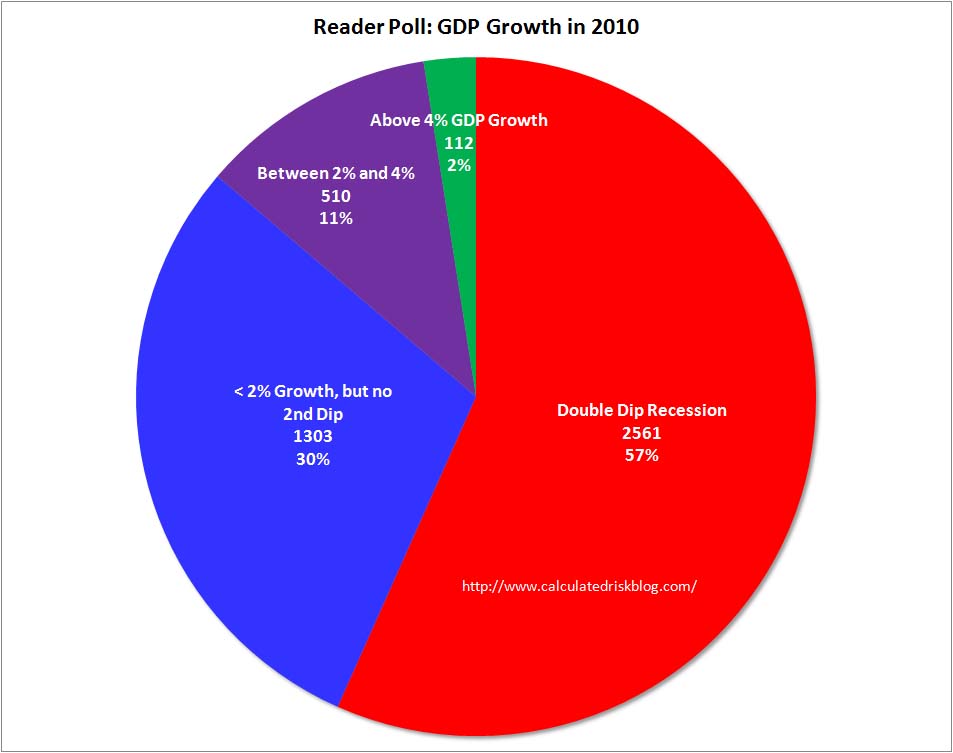
Calculated Risk’s readers would appear to share my pessimism regarding the 2010 outlook, as 57% expect the economy to fall back into contraction.