The new battle cry

Repatriation. Some of you may recall that I have predicted this for some time now:

Lynes’s growing group of protestors in Murrieta has been organizing and plans to continue their protests until something is done. Their message is support Border Patrol, stop illegal immigration, enforce existing U.S. laws at the border, and repatriate those here in the U.S. illegally to their home countries.

They’re focused on illegals now. But, just as we’ve seen in the larger immigration debate, the shift from illegal immigrants to all immigrants will take place soon. It’s already happened in most European countries. Because it’s not about the legality of the entry, it’s about who is where.

This is a literal invasion of the country. And given the growing indications that the Executive Branch helped it take place, it is without question an impeachable offense.


Hugo recommendations: Best Novel

I see people are starting to make their Hugo Award voting recommendations, so I shall begin mine. I’ll do individual posts on the major categories, then provide a summary of all of them when I am done. Let’s start with the award for best Novel, where I intentionally chose from among the worst Amazon reviews for each book in order to highlight the weaknesses of the various nominees:

Ancillary Justice by Ann Leckie. 286 reviews. 4.3 average rating. The Nebula and Arthur C. Clarke winner, and the prospective first three-award winner in SF history. It must be something truly incredible, right? No, it’s just the usual pinkshirts talking up the usual Pink SF/F sewage, albeit with the innovative concept of playing games with pronouns, which was a new and exciting idea back in 1971 when Robert Silverberg did it in his Nebula-winning A Time of Changes. A recent puff piece on Leckie asked the question: Is Ann Leckie the Next Big Thing in Science Fiction? On the evidence of this first novel, the answer is a resounding “no”.

Amazon review: Characterization is non-existent: the main character never changes or
learns, and the author only pays lip service to the AI going from
hundreds of individuals under its control to one. That could be enough
for its own story right there, but it’s wasted. Instead, we have the
main character taking on two different big goals or quests. Her reasons
for the first are totally unexplained, and she even asks herself every
so often why she’s doing it. But there’s never an answer or even any
exploration of this. She just asks herself a few times and that’s it.
It has no effect on the story whatsoever.

The second is literally
pointless. We know this because she tells us that completion will make
zero difference. So why do we care? I suppose it’s just as well since
there’s no real universe to speak of. The culture of her society is
vague and bland, and doesn’t really do anything new. Oh, their language
doesn’t have gender-specific pronouns, meaning the main character uses
“he” and “she” interchangeably. It’s not done as a way to demonstrate
how her own language works, either, as she admits that she can’t tell
people’s genders a lot of the time. We’re supposed to believe that an
AI that is thousands of years old and capable of carrying on hundreds of
conversations simultaneously can’t figure out whether a person is male
or female? Meanwhile a space station’s AI at one point is so sensitive
she’s afraid it will figure out her motivations just from observing her.

The Wheel of Time by Robert Jordan. 2,358 reviews, 4.2 average rating. I’ve only read the first five or so books in the series. I’m not reading any more. Other than the length, the one notable thing about the books is that it introduces the most irritating protagonist in the history of epic fantasy, Rand al’Thor. The one way I might be able to force myself to read SFWA Grand Master’s epic torture-rape extravaganza, Hogg, is if I did a word replacement in Sigil that substituted “Rand al’Thor” for all the little kiddies that Delany fantasizes about raping, torturing, and killing in various excruciating ways. That’s how much I hate the whiny little bastard.

Amazon reviewThe best word to describe his writing is “trite”. Everything about the book, aside from the world-building, is trite beyond words; this is juvenile, unimaginative, amateurish writing. In over 30 years of pretty much continuous reading, this is unquestionably the worst-written novel I’ve ever seen published.

The characters are shallow beyond words; the ridiculous and incredibly irritating Nynaeve (don’t ask me how that’s supposed to be pronounced), for example, has a permanent scowl on her face, and never varies her tone at all; every sentence that comes out of her is negative, angry, and sour, and she almost never says anything without an exclamation mark at the end. She’s as one-dimensional as a character can be, and she ends up being nothing more than a caricature. The rest are almost as bad.

Warbound by Larry Correia. 120 reviews. 4.7 average rating. I very much like The Grimnoir Chronicles and Warbound is a satisfying conclusion to the trilogy. It’s more intelligently developed than X-Men, its use of history is more sophisticated than the casual observer will realize, and it incorporates Japanese warrior culture in a manner that is both interesting and respectful. Those who focus obsessively on the functional style of the writing are completely missing both the point as well as a smart action story.

Amazon review: Enjobale read – great end to series. Like the end – surprise for me Wonder what he will do next

Don’t look at me. THAT is the only one-star review of the 120 reviews on Amazon. And the two 2-star ratings are similarly complimentary.

Neptune’s Brood by Charles Stross. 119 reviews. 4.2 average rating. Orbit didn’t bother to include the novel in the packet. If the publisher doesn’t give a damn, why should anyone else? Charlie lost his fastball a few years ago anyhow. That being said, I would have considered one of his Bob Howard novels, those are still pretty good. Not this one.

Amazon review: I am a longtime and ardent fan of Charles Stross books. I’ve read nearly every one and I look forward to new ones. I am not, however, a fan of Neptune’s Brood. The premise was sound – great potential for some funny bits, a good launching pad for sniping at convention. And all that’s in there. But what one has to slog through to get there simply isn’t worth it. Mr. Stross, I imagine you have a pretty intelligent audience overall – you don’t need to explain, then explain again, then needlessly overexplain yet again throughout the book. We get it. I was determined to finish the book in spite of the feeling that I was wasting my time after just having gotten through a third of it. And I did – to no avail.
 

Bottom line: I recommend each and every one of his books… except this one. 

Parasite by Mira Grant. 179 reviews. 3.7 average rating. Orbit didn’t bother to include the novel in the packet. If the publisher doesn’t give a damn, why should anyone else?

Amazon review: The concept for the story seemed appealing and I was excited to read it.
Unfortunately the writer couldn’t manage to move past how the main
character felt about the prolific minutiae of her daily life, to
actually tell the story. Another thing I found disappointing about this
unquestionably boring attempt is, the writer spent the entire length of
the story building up to what I’m sure she thought was a profound
revelation. Only this revelation was glaringly obvious within the first
few paragraphs. This book was not completely devoid of interest and had
several fleeting moments of watered down intrigue that kept me
soldiering on to the end. The ending “shocker” that was sadly
predictable was followed by “to be continued” which to me is a let down
squared. Overall this book is like an expensive meal served cold with
poor and clumsy service. I will not be reading the next installment in
this series as well as anything else written by Mira Grant.

My vote for Best Novel, and my suggestion to others, is Warbound by Larry Correia. My vote will go as follows:

  1. Warbound
  2. No Award
  3. The Wheel of Time

I recommend leaving the three Orbit books off the ballot.


Eastasia has always been the hottest month

Anthony Watts busts The National Oceanic and Atmospheric Administration fiddling the historical data again:

The National Oceanic and Atmospheric Administration, criticized for manipulating temperature records to create a warming trend, has now been caught warming the past and cooling the present.

July 2012 became the hottest month on record in the U.S. during a summer that was declared “too hot to handle” by NASA scientists. That summer more than half the country was experiencing drought and wildfires had scorched more than 1.3 million acres of land, according to NASA.

According to NOAA’s National Climatic Data Center in 2012, the “average temperature for the contiguous U.S. during July was 77.6°F, 3.3°F above the 20th century average, marking the warmest July and all-time warmest month on record for the nation in a period of record that dates back to 1895.”

“The previous warmest July for the nation was July 1936, when the average U.S. temperature was 77.4°F,” NOAA said in 2012.

This statement by NOAA was still available on their website when checked by The Daily Caller News Foundation. But when meteorologist and climate blogger Anthony Watts went to check the NOAA data on Sunday he found that the science agency had quietly reinstated July 1936 as the hottest month on record in the U.S.

If you still buy into the “global warming” myth being pushed by these proven, documented, confirmed liars and self-interested charlatans, at this point, you’re just an idiot.

Notice how the Left always attempts to avoid owning up to its own history? Even when they’re blatantly caught out, they just quietly correct their misinformation and try to pretend it never happened.


The Age of Men is over

John Scalzi @scalzi Jun 30
Let it be known that my daughter can lift more than I do. Because she’s on her school’s weightlifting team, and also because she’s awesome.

It’s hard to decide what is funnier:

  1. John Scalzi proudly and publicly announcing that his daughter can lift more weight than he can.
  2. John Scalzi’s apparent surprise at the fact that he is mocked and considered less than a man for this fact.
  3. John Scalzi promptly attempting to hide behind his daughter.
  4. The reactions of the rabbits rushing to assuage his wounded feelings.

John Scalzi @scalzi Jul 1
ME: Some dudes online are making fun of me because you lift more than I can. DAUGHTER: That’s because they’re pathetic losers, dad. #point

Bo Bolander ‏@BBolander
@scalzi I’ll bet she could snap them over her knee like so much kindling.

Jonathan Sick ‏@jonathansick
@scalzi Parenting #win

Michael Jewell ‏@MichaelJewell78
@scalzi two points for good parenting!

Rafe B. ‏@etcet
@scalzi *fistbump of strength prowess for the young one*

Scott S ‏@QkslvrSailor
@scalzi wait the point is to be able to lift more than others. Here I thought it was to be healthy.. My mistake

@scalzi Silly gamma rabbit, don’t you know that your entire worth as an alpha male is directly proportional to your bench press?

@scalzi How ever will you be able to provide for your family without being able to lift massive weights in extremely artificial situations?

Christina D ‏@akasha111182
@scalzi Parenting: you’re doing it right.

Catherine Coffman ‏@thinkingcatblog
@scalzi parenting win all around!

Jim Schmidt ‏@zaren
@scalzi My daughter outran me in a 5k last month. No big. She’s had actual training, and that whole “springiness of youth” thing.

A.B. ‏@ballewal
@scalzi Good kid. Good parenting.

Kelly Sedinger ‏@Jaquandor
@scalzi Ha ha, you’re weak AND you’re seeking emotional validation from your kid! 🙂

Erik Noble ‏@CrossbowROoF
@scalzi She probably lifts more than they do too.

Nick Lester Bell ‏@lebkin
@scalzi You’ve raises a very smart daughter. Be proud.

raphael ‏@shun_geki_satsu 16h
@scalzi proof that it is not only muscular force that is strong in @AScalzi98

@scalzi the fastest runner at my nephew’s school is a girl. She has shirt that says “I run like a girl. Try to keep up.” Love it!

What’s not funny is the way in which the male Gamma delusion perpetuates itself and is propagated through the women. The little gamma’s automatic reaction to social disapprobation is still to seek reassurance from his Mommy substitutes. As one “pathetic loser” observed:

Puzzle Privateer ‏@PuzzlePrivateer
@scalzi Just like the popular kids in high school didn’t invite him to their parties because they were jealous

Notice how there are multiple references to “parenting” and none at all to fatherhood. This is not a coincidence. Scalzi, having been raised without a father and being without sons, has no functional conception of what it is to be a man or a paterfamilias. And he has consciously rejected the masculine model in favor of the feminine one with which he is more familiar and comfortable. But such rejections always come at a price.

As for me, I’ve got to go with option (3). Because I don’t think that being unable to lift more weight than one’s daughter NECESSARILY makes one less of a man. That’s just not a fair assumption. There are alternative explanations. After all, one might have simply happened to marry an orc.

Half-Orcs

These orc–human crossbreeds can be found in either orc or human society (where their status varies according to local sentiments), or in communities of their own. Half-orcs usually inherit a good blend of the physical characteristics of their parents. They are as tall as humans and a little heavier, thanks to their muscle.

    +2 Strength, –2 Intelligence, –2 Charisma.

For, as you surely know, no particular reason at all.


Switzerland v Argentina

The Swiss have never beaten Argentina, and Shaqiri is no Messi, the hat trick in the group stage notwithstanding. So an upset here would be even more unlikely than for the USA against Belgium.

Two serious underdogs, but both capable of pulling off an upset. Both games should be entertaining.

FIRST HALF 0-0. Switzerland could easily be up 2-0, but a great save and a poor shot leave it tied. Argentina definitely has the edge on talent, but the Swiss have been the better team so far. The defenders are living on the edge, however, by repeatedly attempting to dribble the ball out under pressure rather than simply clearing the ball from the top of the box.

SECOND HALF 0-0. Argentina took over the game and had several decent chances, but tough defending and a great pair of saves in succession by Bernaglio kept Switzerland in the game.

It’s interesting to be watching the game with little girls.

Little Girl 1: Who is the guy with the green shirt?

Me: He’s the assistant referee.

Little Girl 1: He runs up and down a lot.

Me: He has to stay even with the ball. It’s his job to watch for offsides.

Little Girl 1: What’s offsides?

Little Girl 2: It’s when the ball goes off the side of the TV.

Little Girl 1: Oh, okay. (In a tone indicating “that makes sense”)

Me: (nods

EXTRA TIME: Argentina 1 Switzerland 0. Looked like it was going to penalties, but Lichtsteiner got careless, Messi pulled the Swiss defense to him, and laid a perfect pass to Di Maria, who finished nicely. Di Maria deserved the goal, as he was the only player on either team that was actually trying to win the game for the second extra period. Switzerland then hit the post on a corner in extra injury time, but that was as close as they got.

USA v Belgium

FIRST HALF 0-0. Shaky start for Team USA, but they settle down and finally begin counterattacking. They gradually take control and start getting great runs down the right side, but just don’t have the technical ability to finish off the chances they’re creating. Belgium owns its own right side; DaMarcus Beasley is working hard but he’s a bit overmatched. Belgium is the more skilled side, but contra the pre-match reports, the US is more than matching their athleticism.

The challenge will be when the players start to tire; that’s when the more skilled team usually starts taking advantage of the extra time and space created. Johnson went out with a hamstring, but his replacement has been more than adequate, and remarkably, is even more attack-oriented.

SECOND HALF 0-0. Belgium wins 16 corners, but ferocious US defense and outstanding goaltending by Howard keeps the USA in the game. Yedlin, the right back, is somehow the entire US attack. Dempsey has two opportunities to send someone through, but he’s got tunnel vision and takes two nothing shots instead.

Belgium is controlling the game and the USA looks beat, but they manage to make it to extra time with a little help from the Belgian attackers shooting wide.

EXTRA TIME: Belgium scores once quickly, then again near the end to seemingly put the game away. But a great drop-in by Bradley puts the US back in it. USA wins a lot of respect for refusing to quit and go quietly, but they just don’t have the technical ability to match their spirit. 2-1 Belgium.


Portrait of a predator

This article about a brush with Rolf Harris caught my attention because I have been told (although I have no direct knowledge myself) that this description of Harris’s behavior more closely fits that of an affable, well-known science fiction figure than most people would be inclined to believe.

Until I met Harris personally, I was a massive fan. I’d seen him doing Two Little Boys at his first Glastonbury and, like most of the audience, had shed a tear for my lost childhood. So when the chance came to interview him around the time he was doing Animal Hospital, I could scarcely wait to meet my hero.

That “Jekyll & Hyde” personality that was mentioned in the court case: this was exactly the impression I got. Before the interview, I’d seen him on camera being sweet as pie. But once the camera was off, he was cold and prickly and remote.

He didn’t want to talk about his time compering the Beatles (for 16 nights in 1963, after befriending George Martin who produced his early records), nor about playing didgeridoo on Kate Bush’s The Dreaming, nor about any of the other things he had done in his extraordinary career. There was no joy, no enthusiasm, no warmth, just an empty husk with a familiar beard.

But I’m sure I said nice things about him when I wrote up the interview all the same. It’s how these bastards get away with it. 

I’ve spent a fair amount of time around a sociopath for more than two decades, which may be why I have a reasonably developed sense for spotting them in much the same way that some straight individuals have high-functioning gaydar. There is something about the false effect they broadcast for general consumption that I pick up on as not being quite normal.

What I notice most often is that predators are always watching people, always scanning, and always testing people’s reactions to their every word and action. They are hyperaware, which state is often mistaken for intense personal interest by normal people. They perform, and often the performances are entirely convincing to those who can’t see the artificiality of the movements. And they react very, very badly to being watched themselves; one of my red flags is when someone overreacts to discovering that I am dispassionately watching them.

It’s important to understand that predators come on a spectrum. Most are not criminally inclined. But criminal or not, they all exhibit certain similar patterns of behavior. Anyone who wears a physical mask is going to show signs of it, and those who wear false emotional and psychological masks do as well.

Now, it’s entirely possible that a Jekyll & Hyde personality is merely an ambitious suck-up who has no time for his lessers because he is too occupied with trying to find another posterior to smooch. But any time you encounter a false effect of the sort described in the case of Harris, there is a reasonable chance you’re dealing with a predator.

One simple test is to allow them to catch you staring at them. If they overreact, or worse, if they go cold and expressionless, you’ll have a pretty good idea you’ve identified one.


Atheism and authority

Theos considers the history of atheism:

Nick Spencer is research director of the (excellent) “religion and society think tank” Theos, and so he views the subject with a quiet Christian scepticism. But it is not his purpose to attack atheism. Instead, he wants to tell its history as it has developed, chiefly in Europe, in the past 500 years.

He points out that atheism often starts in disputes about authority. In a thoroughly Christian society – and indeed, in some Muslim societies today – rejection of God was seen as a threat to public order. Quite recently, a British judge said that the law of England has nothing to do with Christianity. He may wish that to be true, but, historically, it isn’t….

Gradually, “atheisms” – there was never a single form – advanced to challenge authority. Some arose from questioning Scripture (“a heap of Copie confusedly taken”, wrote one brave man at the end of the 16th century). Some, often stemming from priests who had seen appalling abuses themselves, concentrated on the wickedness of church power rather than on metaphysics.

Other non-believers, usually among the grandest in society, saw themselves as bathed in the light of reason. David Hume wrote of “the deepest Stupidity, Christianity and Ignorance”. Percy Bysshe Shelley linked atheism with intellectual superiority: “Let this horrid Galilean [Jesus] rule the Canaille [the rabble]… The reflecting part of the community… do not require his morality.” In the current era of Richard Dawkins and the New Atheism, many atheists call themselves the “Brights”, pleased to make the rest of us out as dullards.

Some atheists – Dawkins, Sigmund Freud, AJ Ayer – resemble, in essence, that clever young schoolboy. They believe they have brilliantly proved religion to be a load of hogwash. In their minds, it seems an advantage that their creed does not appeal as much to women or the poor and ignorant. Indeed, Friedrich Nietzsche saw more deeply how European society’s moral order would collapse with the destruction of faith – but welcomed it. Christianity was a “slave morality”, he said, celebrating weakness and preserving “too much of what should have perished”. People such as Lenin, Stalin, Mao and Hitler took up such thoughts with deadly enthusiasm.

But precisely because religion, though theologically grounded, is much deeper than an intellectual theory, it tends to regenerate when attacked. The author quotes one Soviet persecutor of Christianity: “Religion is like a nail, the harder you hit, the deeper it goes in.” Spencer believes that the New Atheism is an expression of anger at the curious phenomenon that all over the world, except among white Westerners, God is back.

I find it informative to observe that Western society is visibly collapsing, by a wide variety of objective metrics, even prior to the proclaimed triumph of atheist secularism and the advent of post-Christianity. One of the primary assumptions of atheist thought – the Enlightenment idea that Western civilization did not depend upon Christianity, but was inhibited by it – is rapidly being understood to be as false as the Christian apologists warned it was two centuries ago.

The choice cannot actually be reduced to: if you want to keep your flush toilets, refrigerators, and television, go to church. But that’s more or less what it amounts to in the end.

UPDATE: For those atheists too slow to follow the logic, perhaps this illustration might help:

A Nigerian man has been sent to a mental institute in Kano state after he declared that he did not believe in God, according to a humanist charity. Mubarak Bala was being held against his will at the hospital after his Muslim family took him there, it said…. Kano is a mainly Muslim state and adopted Islamic law in 2000. 

In fairness to Kano, there is genuine scientific evidence that atheists are neurologically atypical, if not necessarily “mentally ill” per se.


France v Nigeria

Two games of nominal interest. Neither France nor Germany should have to go to penalties to win. I think Algeria is the more likely upset, but it would be a huge shock to see either of the two European powers lose here.

Nigeria had a goal disallowed, but the midfielder was definitely a step off. Pogba has a brilliant side-volley, but hit it right at the keeper.

The two games going to penalties yesterday shows one of the core structural flaws of the rules. Just take off one man when it goes to extra time, and another man every five minutes. That will guarantee a winner and reduce the overall time it takes.

UPDATE: France wins and deservedly so. They’ve hit the post or the crossbar six times in four games!

UPDATE 2: Giorgio Chiellini accepts Luis Suarez’s apology in an admirably gracious manner:

Giorgio Chiellini @chiellini
@luis16suarez It’s all forgotten. I hope FIFA will reduce your suspension. 

GERMANY 2 ALGERIA 1: Really impressed with the Algerians, particularly the keeper. He probably earned himself $20 million+ tonight and a move to Seria A or La Liga. The German quality is too much in the end, but Algeria played harder than any team in the tournament to date.


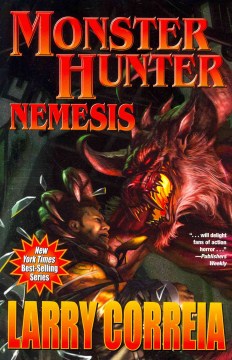
Book review: Monster Hunter Nemesis

I am not a Monster Hunter International fan. Or perhaps it would be more accurate to say that I WAS NOT a Monster Hunter International fan before this, the fifth book in the Monster Hunter series. While I stand second-to-none in my respect for their intrepid best-selling author, I found the first four books in the series to be a little too vanilla urban fantasy for my tastes. Violent vanilla, to be sure, even XXXtreme vanilla, but vanilla nonetheless. Which isn’t to say that they are not fun and entertaining; they are, in fact, exactly the sort of books that harbor great appeal to red-blooded men who like big guns and pretty women with big breasts, and who are willing to defend civilization and society as the hard men standing between the monsters and the innocent.

Translation: I liked Mack Bolan back in the day too. This doesn’t mean I ever confused it with great literature. Or even interesting literature.

I found Correia’s Grimnoir Chronicles to be of considerably more interest. Unlike most Western authors, Correia is able to write a respectful portrayal of the Japanese warrior culture without coming off as the sort of obsessed round-eye who puts on a red kimono to drink ocha every afternoon. (I am an East Asian Studies major who spent a semester abroad in Tokyo, and I still speak a smattering of Japanee. So I knew a few guys like that.) I also found that the Grimnoir characters, despite their superhuman abilities, were more fully developed and interesting than their MHI counterparts.

So, what was fascinating about reading Monster Hunter Nemesis was to see the way Correia upped his game and took the book to a higher level. The way in which he did so was rather remarkable, because he somehow managed to improve the depth and scope of his writing without sacrificing even one iota of the violence-fueled action of the previous books.

In the first four books, Agent Franks is little more than a superweapon and an repetitive joke: “Oh shit, it’s Franks!” As with most street drugs and urban fantasy series, Correia finds it necessary to keep raising the oppositional ante in order to maintain the reader’s interest, which might seem a little conceptually challenging considering that the big boss at the end of the third book was an extradimensional Elder God and the collateral damage involved a considerable portion of the city of Las Vegas.

And so he raises the ante, but not in any of the cheap and obvious ways so common to lesser authors. Instead, Correia provides a backstory to his take on Frankenstein’s monster that is both more interesting and comprehensive than the customary one. This backstory, which is directly integral to the plot, is deftly revealed in vignettes as the current story plays out.

For the first time, Larry Correia draws upon his religious background, and in doing so he brings both intellectual depth and emotional poignancy to the world of Monster Hunter that it previously lacked. Franks is revealed to be far more than monstrous construct, he is shown to be a complex, noble being whose inhuman sociopathy is the logical consequence of his alien values, motivations, and restrictions.

Larry Correia may not win the Hugo Best Novel Award in 2014 for Warbound. But his Monster Hunter Nemesis is likely to be a contender for next year’s award. This is a very good book by a best-selling author who is confident in his ability and is beginning to hit his stride.

Characters (9/10)  Correia fleshes out existing characters both major and minor; his use of Heather the red-headed werewolf as a reluctant government agent desperate to earn her PUFF exception is particularly adroit. One of the major antagonists is well-portrayed, the other remains more than a bit of a mystery, and is alarmingly convincing in his ruthlessly efficient use and abuse of the bureaucratic power struggles between the various federal agencies.

Prose (7/10) One doesn’t read Correia for the stylistic pyrotechnics or the obscure literary allusions. It’s akin to contemplating the fuel-efficiency of a Lamborghini. That being said, his prose is smooth and easy, regardless of whether he is describing the splattering of a reanimated collection of corpses by a large, fast-moving vehicle or lovingly detailing the chambering action of a Glock* pistol. As an adept storyteller, Correia’s style serves as simple lubricant for the story, just as it should be. He does have a certain lamentable habit of throwing in the occasional conversational rimshot, all of which will no doubt one day appear verbatim in the television series. Hey, if it works for Richard Castle….

Plot (10/10)  A centuries-old contract between Franks and the U.S. government is being jeopardized by a grasping bureaucrat with a savior complex who rejects the idea that people in the past had legitimate reasons for doing as they did. Adroitly ties everything from Milton and Mary Shelley and Ben Franklin into the Monster Hunter mythos.

Ideas (8/10)  Correia is moving well beyond the usual werewolves and vampires of generic urban fantasy. He is drawing effectively upon history, his tactical training experience, and his religious background, to say nothing of his accountant’s eye view of government bureaucracy. Monster Hunter Nemesis is more than a mere action novel, it is an intelligent and occasionally thought-provoking action novel.

Text Sample:  There was a commotion on the other side of the tent flap. Guards gave challenges, IDs were presented, and then there was a rush of apologies. The flap opened and several men entered the giant command tent. The first through were members of the MCB’s elite mobile strike team. They were hardened warriors who Franks had served with many times, and behind them was an innocuous looking, middle aged man in a cheap suit.

Franks’ arms were chained to the chair, so he dipped his head slightly. “Sir.”


“Why is my second in command tied up?” Dwayne Myers, Strike Team SAC, demanded. “What’s the meaning of this?”


Foster’s response was about as belligerent as could be expected. “Agent Franks is charged with disobeying direct orders, violating security protocols by taking a civilian witness into a monster containment area, and then breaking into the Nevada storage facility to steal seized evidence.”


“Is that true?” Myers asked.


Franks nodded. That sounded about right, but Myers already knew most of the details, since it had secretly been his idea to begin with. Franks had taken Owen Pitt to Dugway because he’d thought the Monster Hunter’s psychic powers could help their investigation. He’d taken three ancient arcane weapons from Area 51 in order to fight the Nachtmar; Lord Machado’s ax, the Attilius gladius, and the Black Heart of Suffering. That last one had done the trick, and destroyed the creature.


“When he was confronted about his actions, Franks attempted to kill MCB Director Douglas Stark.”


Franks snorted. The five men covering him with drawn weapons backed away nervously. They were only following orders, but all of them had worked with Franks at some point, so they were aware that shooting Franks might upset him.


“I’ve known Agent Franks for twenty years. He doesn’t attempt to kill anyone. Holster those side arms and unchain him. Franks is coming with me.” Myers had recently been demoted, but had been the Acting Director before that, and he was still probably the most respected senior agent in the Bureau.


“Hold on,” Foster demanded. “Franks is in STFU custody.” It was almost like Foster thought that invoking the name of the ultra-secret Special Task Force Unicorn would strike fear into the federal agent’s hearts.


Myers glanced around theatrically. “Really? Because these appear to be MCB men, and last I checked sworn MCB agents don’t take orders from an operation that doesn’t exist.” The MCB didn’t officially exist either, as it was just a line item on the Department of Homeland Security’s budget, but in this business there were levels of not existing.


“Director Stark is—”


“Hiding from this giant clusterfuck caused by his lack of leadership,” Myers said. “Our good Director must have forgotten that is against regulation 72 dash B to turn MCB handling of a level five containment to another entity, such as yours, without authorization from the President. So in the meantime I’m the highest ranking member of the MCB available, and I’m making the call. Cut Franks loose. I’m going back outside to try and contain the unholy mess you amateurs made out of one of America’s most popular tourist attractions, before every news agency in the world records video of a street full of ectoplasm and dragon parts. Is that understood, Mr. Foster?”


It was clearly understood, but not particularly liked. “We’re not done, Myers.”


“Oh, I believe that we are.” Myers glanced over and confirmed that the men had put their weapons away. “Remove Mr. Foster from my command tent.”


“I’ve got it,” Franks said. One of the men had been looking for the key to the padlock, but Franks simply took up the chain in his bare hands and twisted until a link snapped. By the time anyone realized what was happening, the chains had already hit the floor and Franks had caught Foster by the arm and effortlessly lifted him off the ground. Foster winced in pain as Franks carried him to the nearest flap, and hurled the Unicorn operative into the street.

*Let no one henceforth say Larry Correia is homophobic. No doubt the LGBT community appreciated the little shout-out.


SFWA still harbors child molesters II

It’s rather remarkable, but SFWA continues to associate with known child molesters while pretending that they are deeply concerned about me doing things I have never done even AFTER they purged me from the organization. Bud Webster wrote this in October 2013, two months after the SFWA Board informed me that it had voted unanimously for my expulsion:

This is partly my fault because I’ve only just now looked at the “Authors Estates” pages, but why were those estates handled by family members or other private individuals listed with their full contact information? That’s exactly what we DON’T want, and its why I wish i’d had a chance to proof those pages before the Directory went live.

All we need is for someone outside the organization (or even someone inside, for that matter) to use that information to harass the heirs of an author they don’t like, or who represents a race, gender or nationality they find offensive (don’t shake your head – remember Vox Day?) to start sending abusive emails or worse, phone calls.

I had to laugh at his bizarre appeal to SF’s Voldemort. First, recall that SFWA members such as John Scalzi, Teresa Nielsen Hayden, and NK Jemisin have been publicly attacking me since 2005. Second, be aware that I have had the entire membership’s personal contact information for more than 14 years and have never once made any use of the SFWA directory to send emails or make phone calls, abusive or otherwise. And third, note that John Scalzi was lying, and knowingly lying, when he tweeted: “@jimchines The Naive Idiocy of Not Checking Your Facts Before Making Accusations Online”

Prior to posting the information about Ed Kramer last week, I checked the 2010 directory. I also checked the online membership list. Ed Kramer, the convicted child molester, appeared in both of them. I did not check the 2013 directory for an obvious reason: I was expelled from SFWA and did not have a copy of it. Why didn’t I check the 2011 and 2012 directories? Well, as Michael Capobianco wrote in March 2013:

I know a bunch of handbooks were sent out at some point a couple of years ago, but the Directory is a principal part of the new member packet, and there hasn’t been a new Directory since spring of 2010.

Who was responsible for this failure to produce a new Directory between spring 2010 and March 2013? None other than John Scalzi, President of SFWA from July 2010 to July 2013. Which means that Mr. Scalzi knew perfectly well that there was no failure to check any facts on my part before I observed that Ed Kramer was a member of SFWA (and remains eligible for SFWA membership today). Also note that during those three years as the president of the organization, John Scalzi did absolutely nothing about Ed Kramer’s membership even though he threatened to leave SFWA in 2013 if the newly elected Board did not remove mine. He had no problem at all associating with rapists, sexual deviants, self-described savages, and child molesters. Nor did SFWA member and Tor.com editor Patrick Nielsen Hayden, who, nearly one year after threatening to leave SFWA if I was not expelled, published the tribute to MZB entitled “Marion Zimmer Bradley Gave Us New Perspectives”.


I recently obtained a copy of the 2013 directory. It is true that Ed Kramer is not in it. One therefore concludes he failed to pay his dues sometime between 2011 and 2013. But that doesn’t mean SFWA ended its association with him or with other child molesters. For example, consider page 102 of the current directory and note the highlighted estate. Fortunately, seeing as the directory is in print, it will be considerably harder for those who deceitfully implied that I was inventing Kramer’s SFWA membership to deny the organization’s continued association with another, now-deceased child molester.

Thanks to the SFWA Forum, we know that SFWA has known about Ed Kramer since at least 2004.  Thanks to SFF.NET and SFWA member Stephen Goldin, we know SFWA has known about Marion Zimmer Bradley since at least 1999. SFWA still has not ended its association with either of those two known child molesters. And those are merely the two members whose criminally aberrant activities are already known to the public; they are not the only two deviants with whom SFWA is continuing to associate and celebrate.

Jason Sanford, an SFWA member who is neither a friend nor ally of mine, wrote this about “science fiction and fantasy’s Woody Allen” in February:

I’ve heard no apologies from any of Kramer’s other extremely vocal defenders in the genre. Just like Hollywood, many in the SF/F community are too willing to look away from sexual abuse and child molestation when it is inconvenient to either themselves or the genre. However, doing this actually weakens the genre and harms all of us, as it encourages a culture of silence and allows predators like Kramer to continue harming new victims.

Mr. Sanford said it, not me: “Many in the SF/F community are too willing to look away from sexual abuse and child molestation.” But it is absolutely true. Still, it’s hard to blame SFWA when they have so many other, much more pressing concerns with which to deal, such as policing the political opinions of its members, reviewing convention policies, denouncing nonexistent award campaigns, and writing 80-page reports about the potential misuse of a non-official Twitter account. The more SFWA tries to deny that it has a problem with criminal deviants in its midst, the more its members attack those who expose the problem instead of addressing it, and the more silent and inert its leadership remains on the subject, the more questions this raises about the moral degradation of the organization and its members.

A few days ago, Mr. Sanford wrote this:

The Marion Zimmer Bradley revelations shocked me when I first learned of them a week ago. But what shocked me more was that the actions of MZB and her pedophile husband were an open secret in the genre for decades. Many people even defended MZB and attacked anyone who dared speak the truth about her.

The same thing happened with Ed Kramer, who recently pleaded guilty to child molestation charges. The same veil of silence surrounded Kramer. People who dared speak the truth were attacked….

How many times must our genre go through this? How long must our silence protect those who use that silence to prey upon others?

Support me or despise me, I am speaking the plain and simple truth. Attack me for it if you wish. Question my motivations if you like. All of that is entirely irrelevant. Nothing will change the readily confirmable facts. I didn’t create this cancer in science fiction and I cannot excise it from a community to which I do not belong and with which I have never cared to personally associate. Only the people who dwell inside that strange little community can do so, and if they do not, if they continue to look the other way while celebrating and honoring their deviants, they will be rightly condemned for it by every decent person of any political stripe.