Mailvox: Christian book ratings

CM asks if we can put together a rating system for Christian books. I think this is a good idea, although I think it bears some discussion on the best way to do that.

We are an ultra-conservative homeschool family with 8 children. Two of my older sons and I love SF books, table top games, and movies. My 12 year old is reading through the Monster Hunter series of books now. I do not mind the occasional curse word or sexual innuendo here and there. But if it gets any racier than Correia’s works I will not let them read it until they are a little older. We’ve enjoyed some of your novellas, too. Keep up the good work.

Anyway, I do not have time to keep up and read new SF works to screen them for my sons (12 year old blasted through the first Monster Hunter in one day). Is there a possibility in the future that your blog and/or Castalia House could have a sort of SF book rating or review site that would inform Christian families like mine? Just FYI, the Hollywood movie rating would be inadequate. Many PG-13 rated movies are considered nearly XXX to us.

My thought is something similar to the SJW review of games system might be useful, with zero being the perfect score of containing nothing that would be objectionable to the Christian AND containing genuine and explicit Christian elements. There is a difference, after all, as Misty of Chincoteague is entirely unobjectionable, but it has no Christian content per se.

Let’s consider some possible point factors, beginning with those that would likely be more or less acceptable to most Christian parents, but are potentially indicative of religious or ideological problems:

  • contains no genuine and explicit Christian element +1
  • exhibits unconventional Christian theology +1
  • characters demonstrate disrespect for peers or parents +1
  • an animal or major character dies +1
  • contains suggestions of physical violence +1
  • features strong independent female +1
  • contains squishy Disney-style “moral” messages +1
  • Features fairies, unicorns, or creatures from classical mythology +1
  • Features the open use of magic by the characters +1

Then there are the elements that will be objectionable to the more conservative families:

  • contains direct descriptions of physical violence +2
  • features indirect sexual themes +2
  • contains egregious or saintly minority characters +2
  • features aggressively “pro-science” themes +2
  • contains euphemistic swearing +2

Followed by those elements to which most parents will not want to expose their children:

  • contains openly atheist characters +3
  • contains detailed portrayals of physical violence +3
  • features PG-13 sex scenes +3
  • advocates left-liberal political or ideological positions +3
  • contains light and occasional swearing +3
  • Features emotionally devastating scene +3
  • Features demonic aliens or magic-based societies +3

And then the completely unacceptable:

  • contains openly atheist or anti-theist messages +5
  • mocks Christianity +5
  • sadistic horror and physical violence +5
  • features pornographic sex scenes or romanticizes adultery +5
  • features homosexual and other sexually deviant characters +5
  • contains a considerable quantity of vulgarities and obscenities +5 
  • contains openly occultic elements indicative of actual practices +5

Now, it is important to keep in mind that a novel can contain absolutely every element here and still be a Christian novel. What makes a novel Christian or not depends upon its intrinsic recognition that Jesus Christ (or some fictional facsimile therein), is the Lord and Savior of Mankind.

A Throne of Bones scores a lot of points, Book Two will score even more. But they are not books for children; I haven’t let my own children read them. Every parent has to draw their own line, but it would certainly be useful to have a large database at Castalia House where books could be rated. For example, The Lord of the Rings would rate about a 8 of 75. A Throne of Bones would rate 40. A Game of Thrones would rate 65. I think anything over 15 should be considered unacceptable to most parents.

There is considerable room for improving the system, and I would welcome suggestions as well as the rating of various books.

Stealing honor

Now, I’m not privy to the details of either Captain Matt Golsteyn or the investigation of him, but this revoking of a Silver Star stinks of perfumed princes and their aversion to public criticism as well as the Obama administration’s hatred of the US military:

In 2011, shortly after a book by author and Marine Bing West came out that detailed Golsteyn’s heroism and quoted him making critical remarks about the American strategy in Afghanistan, I learned that the Army had launched a criminal investigation into his actions during the battle. (Again, full disclosure: I was also interviewed for that book, The Wrong War, and make a brief appearance in it.)

The investigation, apparently, had nothing to do with the acts of bravery that earned Golsteyn his medal. Instead, according to the Washington Post, which cited officials familiar with the case, it concerned “an undisclosed violation of the military’s rules of engagement in combat for killing a known enemy fighter and bomb maker.” The investigation stretched on for nearly two years, during which time the Army effectively put Golsteyn’s career on ice. In 2014, Golsteyn and his lawyer were informed that the investigation was finally complete. No charges were filed, but Golsteyn still wasn’t released from administrative limbo.

Alerted about the controversy by another Army officer, Captain Will Swenson, Congressman Duncan Hunter wrote last year to John McHugh, the secretary of the Army, asking about the status of Golsteyn’s seemingly endless career freeze. Apparently the secretary did not take kindly to the inquiry, as he responded in a letter last November that not only would he not be upgrading Golsteyn’s Silver Star to a Distinguished Service Cross, but would be revoking Golsteyn’s Silver Star entirely, a fact that Hunter revealed publicly in an article for the Daily Beast published on Tuesday.

The revocation of an award such as the Silver Star is extraordinarily rare, and typically would happen in the case of the recipient being convicted of a serious crime that in some way dishonored his service. But not only has Golsteyn not been convicted of a crime—he hasn’t even been charged with one.

McHugh would not reveal to Hunter specifically why he was taking his action beyond submitting the innuendo that he was privy to “derogatory information” regarding Golsteyn’s record. What could this information be? Who knows? Having, according to Hunter, spent years threatening Golsteyn’s men, searching for and failing “to find one piece of evidence to corroborate the allegation” that launched the investigation, the Army clearly decided to punish Golsteyn anyway, through publicly dishonoring him in a manner that allows him effectively no recourse or due process.

 It is remarkable that the US military can still find anyone willing to serve under the recent Commanders-in-Chief.


The biggest science scandal ever

And yes, as we AGW/CC skeptics have been saying since the beginning, the world is not getting warmer and you cannot trust corrupt scientists anymore than you can trust corrupt bankers or corrupt politicians. Global warming is a fraud and a scandal of global proportions:

When future generations look back on the global-warming scare of the past 30 years, nothing will shock them more than the extent to which the official temperature records – on which the entire panic ultimately rested – were systematically “adjusted” to show the Earth as having warmed much more than the actual data justified.

Two weeks ago, under the headline “How we are being tricked by flawed data on global warming”, I wrote about Paul Homewood, who had checked the published temperature graphs for three weather stations in Paraguay against the temperatures that had originally been recorded. In each instance, the actual trend of 60 years of data had been dramatically reversed, so that a cooling trend was changed to one that showed a marked warming.

This was only the latest of many examples of a practice long recognised by expert observers around the world – one that raises an ever larger question mark over the entire official surface-temperature record.

Following my last article, Homewood checked a swathe of other South American weather stations around the original three. In each case he found the same suspicious one-way “adjustments”. First these were made by the US government’s Global Historical Climate Network (GHCN). They were then amplified by two of the main official surface records, the Goddard Institute for Space Studies (Giss) and the National Climate Data Center (NCDC), which use the warming trends to estimate temperatures across the vast regions of the Earth where no measurements are taken. Yet these are the very records on which scientists and politicians rely for their belief in “global warming”.

Homewood has now turned his attention to the weather stations across much of the Arctic, between Canada (51 degrees W) and the heart of Siberia (87 degrees E). Again, in nearly every case, the same one-way adjustments have been made, to show warming up to 1 degree C or more higher than was indicated by the data that was actually recorded.

There has been some discussion about the discrepancy between the post-1979 satellite data and the surface-temperature record, as the former shows no sign of global warming while the latter has recently begun to do so. Now we have the answer explaining that discrepancy; the surface-temperature record has been corrupted and is false.

Notice that intrepid scientists went to the trouble of falsifying the data in places where it would be relatively difficult to check what they were reporting. This is genuinely a massive scandal, and if scientists don’t quickly denounce what has taken place, all scientists are soon going to lose even more credibility with the public once people see what a tremendous scam has been perpetrated by scientists operating on the public dime.


Brain-hacking the rabbits

It’s really rather remarkable how much rabbit behavior is explained by the r/K model. It puts into perspective so much of what looks completely inexplicable to the sane and more conservative mind that is neither ruled by rhetoric nor dependent upon social status.

The Anonymous Conservative has cogitated upon the matter and thinks he may have come up with a means of helping the poor, frightened rodents escape the limits of their failed ideology through hacking their brains.

When John Scalzi claimed 50K unique visitors per day on his blog, it
didn’t matter whether he had that accomplishment or not. What mattered
from the rabbit perspective is if he could create that impression. As in
all of rabbitry, the reality flows from the impression, which itself
need not flow from any tangible reality. Scalzi claimed it, it was
parroted in an article, people got the impression that he had social
status, and as a result, social status flowed from the impression.

This offers the prospect of creating interesting brain hacks, if the
K-strategist can train themselves to operate within the liberal
cognitive framework. Presently Conservatives concern themselves with
reality, and ignore social status. We assume that success is Thomas
Edison, and not Kim Kardashian, and our arguments are formed around that
assumption.

Instead, the Conservative should focus more on creating memes which
socially diminish and denigrate liberals, making them appear impotent
and inferior. Since to the leftist, reality flows from impression, and
social dominance is all important, you must create memes which tie an
anchor of inferiority and impotence to leftists, and let the reality
flow from that.

As an example, what the rabbit meme Vox created does at its core is
create an impression of inherent inability, unfitness, weakness, and
social inferiority, and attach it cleverly to those who embrace the
r-strategy of liberalism. Once those circumstances are created, and the
meme’s permeation is great enough that the rabbit cannot escape it, it
will prove amazingly unsettling to the rabbits, for whom impression is
reality, and reality is impression. Here is a popular impression saying
liberals are weak and impotent. Since to the rabbit truth is what other
people think, if they self-identify as a liberal, then they will be
accepting that people will think they are weak and impotent, and this
will make them weak and impotent. (In many ways the rabbit’s perception
is actually an accurate read of the reality in a r-selected world.)

At that point, a liberal brain will have only one pathway to
alleviate the amygdala angst generated by the social damage it sees
flowing from that meme – the rabbit can only tell itself that it isn’t a
rabbit. To divorce itself from rabbitry, it must abandon every issue
that is a part of the rabbit’s r-selected reproductive strategy, and
then turn its back on the rest of the warren of rabbits.

No wonder they so hate being called rabbits. What I find remarkable about what AC is doing here is the way he is articulating and putting into practice some of the principles that Aristotle first elucidated in his Rhetoric. After all, of whom do you think Aristotle was writing when he described those whose minds cannot be changed by information?

Speaking of rhetorically limited minds where reality flows from the impression, I found this comment by a rabbit to be all too typical”:

David W. on February 6, 2015 at 7:16 am said:
Sorry, but a DNA test result doesn’t make one a “Native American”, but
the writers of this horsecrap couldn’t care less about fact, obviously.

Fascinating. One wonders what would suffice to make one a “Native American” if not DNA, particularly when it says “Native American” on the DNA results and the Bureau of Indian Affairs issues Certificates of Indian Blood.


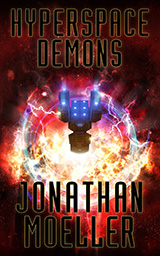
Hyperspace Demons

In space, the demons can hear you scream.

Space travel has always come with risks. But hyperspace travel comes with one particularly frightening hazard, namely, the non-corporeal dark energy-based macrobiotic entities that inhabit the void and are insensibly drawn to the presence of human minds. Once penetrated by a macrobe, the infected human mind rapidly devolves into raving insanity, which usually presents in a homicidal manner. Fortunately, hyperspace-capable ships are protected by a dark energy resonator that keeps the macrobes away and thereby permits safe interstellar travel.

But what happens when a ship’s resonator is sabotaged while it is traveling through hyperspace? And who would be so insane as to unleash a demonic infection of mutating madness on an entire ship’s crew?

Hyperspace Demons is a novella by Jonathan Moeller, one of the most prolific self-published authors of science fiction and fantasy today. Featuring a cover by JartStar, Hyperspace Demons is his first publication with Castalia House. And in respect of Anonymous Conservative’s newly announced free days (about which more after the jump), we’re extending the New Release newsletter offer for two more days, which means that if you buy Hyperspace Demons from Castalia House today or tomorrow, you will also receive a free copy of Jonathan’s Frostborn: The Gray Knight. If you would like to sign up for the New Release newsletter to take advantage of similar offers in the future, you can do so here.

I’m also looking for ten volunteers to review Hyperspace Demons. If you’re interested, please email me with HYPER in the subject and specify MOBI or EPUB.

Now about those free books. Anonymous Conservative writes:

For those interested, The Evolutionary Psychology Behind Politics,
How to Deal with Narcissists, and The Altar of Hate by Vox Day will all
be free in ebook form at Castalia House on Monday and Tuesday.  The Altar of Hate is a compilation of ten great stories ranging from fantasy to military fcience fiction. As one reviewer wrote, “Each
offering contained in The Altar of Hate tickles or provokes the mind
with salacious ‘what ifs’ and glances behind the veil of reality. The
stories move along, but one feels the uneasy eyes of the abyss staring
back as you progress, as it were, through a darkened ancient forest.
Only an author of the first rank could achieve this.
” While I don’t have that big of a readership compared to Vox, I’m
hoping those here who haven’t yet stopped by Castalia’s website and
partaken of their incredible titles will maybe find a great new source
for all their high quality
sci-fi/fantasy/military-theory/educational/non-fiction needs, and in so
doing help establish our foothold on this great new beachhead in the
publishing world. If we can get Castalia to the point it is the new
Simon and Schuster, we will have helped alter the very terrain on which
our future battles will be fought. It is an exciting time in Conservatism. The theories beneath
political science are shifting, the cultural tides in publishing are
changing, and maybe the very natures of our citizens are becoming more
K-selected. It feels like we are approaching a turning point rapidly,
and just at the right time. Until the turning point comes, take some free books, then tell your
friends about r/K, and rave to your friends about how awesome Castalia House is. We are making a difference with every person we tell.

In other words, if you buy Hyperspace Demons today, you can pick up as many as four free books for $2.99. Not a bad deal. And speaking of “how awesome Castalia House is”, if you have any interest in fantasy and science fiction and haven’t already bookmarked the Castalia House blog, you are really missing out on some excellent and intelligent content. One of our newest bloggers, Morgan, is rapidly demonstrating that he’s capable of hanging with Jeffro, Daniel, and Scooter with his detailed anthology reviews; you’ll want to read his post on The Sword & Sorcery Anthology, with an introduction by David Drake, complete with a comment by David Drake himself:

A couple of years back, if you searched for Tachyon Publications’ The Secret History of Fantasy on Google Books, this is what would come up:

“Tired of the same old fantasy? Here are nineteen much-needed antidotes to cliched tales of swords and sorcery. Fantasy is back, and it’s better than ever!”

The lure of filthy lucre must have proven to be too much as Tachyon published The Sword & Sorcery Anthology in 2012…. The 1970s entries are dependable. Karl Edward Wagner’s “Undertow” is
one of the most memorable Kane stories. The Ramsey Campbell story has
never been reprinted to my knowledge.

Some of the seven post 1980 stories get dodgy. There was sword and sorcery in the 1980s in Fantasy Book and Space & Time. The 1990s were lean and grim but still you had Shadow Sword and Adventures in Sword and Sorcery. The editors did no deep excavation.

I never thought of Jane Yolen as a sword and sorcery writer. I used to read her stories in The Magazine of Fantasy & Science Fiction
decades back and liked them. Her story is good if not a bit clichéd.
Does anyone find it disturbing there was an anthology entitled Warrior Princesses? That is where “Become a Warrior” originally appeared.

Two stories are from Marion Zimmer Bradley’s Sword and Sorceress
anthologies. My view is Bradley’s anthology series quickly created a
new category that can be called femizon fantasy that is distinct from
sword and sorcery. The Charles Saunders story was a highlight of the
original Sword and Sorceress and the highlight of the chronological later stories. Why was Rachel Pollack’s “The Red Guild” included (Sword and Sorceress #2)? You can stamp generic femizon story on this one.


Trust the news

Sure, Brian Williams may not have been shot at, or seen any dead bodies, but when he tells you that vaccines are perfectly safe, the economy is growing, and Vladimir Putin is about to invade France, you can have absolute confidence that what he is saying is true:

On Wednesday night, the world we live in became a confusing and unfamiliar place and most of us wandered the land not knowing what to believe when Brian Williams admitted that he was never in a chopper that was hit by RPG fire in Iraq in 2003. Brian was actually safely traveling in a different chopper. How can we believe anything now that Brian Williams has dribbled out lies to us? When Brian Williams says, “Good evening, I’m Brian Williams and this is the Nighty News,” do we know for sure it’s the evening and that it’s a good evening and that his name really is Brian Williams? Is that picture of Brian Williams’ supposed bulge a picture of his actual bulge or did he just stuff his khakis with the sack he keeps his lies in? Everything is squint-worthy now!!!

After getting called out on the lie he told, Brian said in Wednesday night’s broadcast of the NBC Nightly News that he “misremembered” the whole thing. Here’s Brian Williams’ apology in case you missed it:

Since Brian Williams admitted to “misremembering” the events of that day in Iraq, the media has been digging up and looking for other possible lies told by Brian Will-lie. The New Orleans Advocate says that while reporting in New Orleans during Hurricane Katrina, Brian claimed to have seen a dead body floating in the French Quarter. But apparently, the French Quarter did not flood during Hurricane Katrina and remained pretty dry. Brian also claimed he got sick with dysentery after accidentally drinking floodwater, but a local health expert doesn’t remember anyone coming down with that shit. Basically, everything is a lie. Was Brian Williams even in New Orleans and Iraq? He was probably just reporting in front of a green screen. Has he even been in a helicopter? Riding in a helicopter while playing Call of Duty doesn’t count. Is Brian Williams real? Are we sure he’s not just a hologram made by NBC?

An NBC News source tells Page Six that he’s not going to be suspended or punished in any way.

Williams can’t even tell the truth about things that he experienced directly. So why would you believe anything that he, or any other talking head, reads to you off a teleprompter?


More measles facts

The US goverment reports more killed by measles vaccinations than by measles in the USA:

While those opposing mandatory vaccination for measles are widely portrayed as ignorant and even dangerous by some officials, pundits and even news media accounts, Centers for Disease Control records reveal a startling truth – while no one has died of measles in the U.S. in the last 12 years, 108 have died as a result of the adverse effects of the vaccine in that same time period.

The death statistics are recorded by Vaccine Adverse Event Reporting System, or VAERS, which captures only a small percentage of the actual number of deaths and other adverse reactions to the vaccine. In addition, 96 of the 108 deaths in that 12-year time period were a result of the MMR vaccine, now the preferred shot for measles immunization.

Now, it’s important not to exaggerate the relative risks involved. Nine deaths per year is still considerably less than the 248 per year I estimate would result from a completely unvaccinated situation. However, given the fact that some countries, such as the UK, have historically seen LOWER rates of measles incidence at moderate levels of vaccine coverage, it is entirely possible that the optimal risk-minimization level of vaccination for measles is considerably below 100 percent.

This may sound counter-intuitive, but a vaccination regime that prioritized testing for vaccine susceptibility and excluded those children deemed likely to experience an adverse reaction would almost certainly meet considerably less virulent opposition than the present one, let alone the more oppressive regime envisioned by some of the more rabid pro-vaxxers. Providing an alternative delayed schedule and stretching it out would almost surely help in this regard as well. The fact is that if you’re genuinely concerned about the falling vaccine uptake, the very last thing you should support is doubling-down on the public pressure and propaganda approach. It not only isn’t working, it is observably backfiring.

No amount of propaganda is going to convince anyone who has seen, with their own eyes, an adverse reaction, or had one described to them. And adverse reactions most certainly do happen. That’s a fact, and the sooner the pro-vaccine community accepts it and stops trying to hide it, the sooner a more effective solution can be found.

Nothing creates more fear, uncertainty, and doubt than shaded truths and a blanket refusal to answer obvious questions. Rhetoric is no answer for serious doubts, be they reasonable or unreasonable. And as for increasing the pressure via legal means, it shouldn’t take a vast amount of foresight to anticipate what sort of adverse reactions are going to occur if doctors begin forcibly administering vaccines to children without parental consent and a child subsequently experiences a fatal adverse reaction.

One unanticipated outcome of forced vaccinations could well be the complete refusal of medical professionals to administer them.


In support of Puppies

Amal El-Mohtar bravely supports Rabid Puppies and Sad Puppies 3:

We need to have a serious talk about awards and eligibility and the
awkward eggshell-dance people feel obligated to do every time this year.

Recently I went on a tear on Twitter because I saw women for whom I have tremendous admiration and respect
speak up about how difficult they find it to overcome shyness and low
self-esteem enough to talk about their work, and what an ongoing
struggle it is for them to find value in their art, to think of it as in
any way contributing anything to the world.

There’s a peculiar, unbearable, vicious smugness in sitting back and
talking about how tacky it is of people to list their publications and
that of course YOU won’t do so because while winning awards is nice
naturally YOU don’t really care about them. I find that behaviour
several orders of magnitude more repellent than asking for votes.
Requests for votes I can ignore; what I can’t ignore is the real toll
taken on brilliantly talented people by this kind of rhetoric —
brilliantly talented people who already think themselves unworthy of any
kind of positive attention.

Can we please just accept — and make widespread the acceptance! —
that making lists during Awards season is fine? That it’s standard?

There you have it. Making lists is fine. It is standard. People like Amal expressly want our lists. So what on Earth can the pinkshirts possibly be complaining about? Is it, perhaps, the fact that our lists are not the same as their lists?

I have tremendous admiration and respect
for Larry Correia and Brad Torgersen, especially in light of how they have courageously overcome shyness and low
self-esteem enough to talk about their work.


Ruh-roh

Sad Puppies is starting to go viral.

Voxemort the Malevolent. Yeah, that works. I only insist upon being addressed as Supreme Dark Lord for formal occasions and in all Evil Legion of Evil-related correspondence.

Speaking of Sad Puppies, I have removed “The Jenregar and the Light” from the Novella category and replaced it with “Pale Realms of Shade” by John C. Wright, The Book of Feasts & Seasons. You may wish to update your ballots accordingly.

Sadly, it appears the author, Dave Creek, is a racist who says he is made “uncomfortable” being linked to Latinos and “wouldn’t want to be in the same room” as Native Americans.


Literary infidels

Scooter explains why movies so often part dramatic company from the story of the book upon which they are nominally based:

Poor Tolkien – he thought Hollywood just misperceived his intentions. What Hitchcock so frankly reveals is that filmmakers do not necessarily fail to apprehend ‘where the core of the original lies’; they aren’t even trying to apprehend it in the first place! By and large, they do not aim to be faithful. They are literary infidels – and they aren’t the only one.

Shakespeare famously borrowed plots — Hamlet was based on 12th century author Saxo Grammaticus’ Gesta Danorum (“Deeds of the Danes”). In Saxo’s version, Hamlet lives, and goes off to other adventures. Shakespeare, of course, opted for a slightly more downbeat ending.

‘Hey man’, an arrogant film director might say, ‘If Shakespeare borrowed plots and even changed them around too, what’s so wrong with that? Why can’t I add a little elf-dwarf romance to The Hobbit?’

First, because he is Shakespeare and you, Mr. Filmmaker, are not. Have a little humility. Yes, you can put your stamp on the material, just don’t stamp on it with your Orwellian boot; it’s not a face to be kicked in.

Second, because while in the process of adaptation you may end up borrowing plots, characters, and on rare occasions even the mysterious original ‘core’ of the material, what you are really wanting to borrow is the built-in fanbase of the book.

This is precisely why I have turned down multiple inquiries about acquiring the film options on my books. I have no interest in seeing Hollywood do its usual number on them. From Lloyd Alexander and Frank Herbert to Susan Cooper, CS Lewis, and JRR Tolkien, I have seen Hollywood repeatedly botch the translation and re-telling some of my most-cherished books. Whether it is small or large, I’m not going to let them borrow my base; if the visual editions are going to be made, then I will make them myself one day.

While I very much enjoyed seeing The Lord of the Rings and appreciated how Peter Jackson brought Middle Earth to visual life, I failed to place sufficient importance on was an observation of Spacebunny’s concerning the way in which Jackson insisted on showing what Tolkien had only implied. That minor element only expanded over time, until Jackson’s story entirely took over Tolkien’s.

The one exception that merits being pointed out is A Game of Thrones, which despite its occasional flaws bids fair to surpass the books of A Song of Ice and Fire, perhaps as soon as this coming season. Of course, there GRR Martin appears to have done Hollywood the service of ruining his books in advance with his own sequels, so it could be a matter of a better choice of medium – the miniseries rather than the movies – or perhaps it is merely a matter of lowered expectations.