Shut Up, He Explained

I put up a post on Gab attempting to explain to Boomercons that eliminating student loan debt was not inflationary. I was unsuccessful, on the basis of the 193+ replies.

Dear Boomercon,

Eliminating student loan debt is not inflationary. It cannot be inflationary, because in a credit economy, cancelling debt reduces the quantity of credit money in the system.

This is intrinsically deflationary.

Love,
Vox

So, because I am a kinder, gentler Dark Lord, I decided to helpfully explain to this woefully ignorant souls the nature of credit money and how it relates to the monetary phenomena known as “inflation” and “deflation”.

Dear Gab commenters,

The undeniable fact is that I know considerably more about economics, debt, and credit money than you do. Not only am I an economist by training, but I correctly predicted the 2008 financial crisis and I am the author of the labor mobility refutation of free trade.

Frankly, most of you appear to be functionally retarded where economics are concerned. So, I will type very slowly in order that a few of you might be able to follow along.

Most money is debt and it comes from nowhere. It is not printed by the government, it is literally created from nothing when a loan is taken out. This is inflationary. When a loan is cancelled, forgiven, or written off, the debt literally vanishes. This is deflationary, since it reduces the amount of money in the economy.

If the loan is paid off, either by the debtor or by a third party, then no money leaves or enters the system. It is a neutral action. If interest is paid on the loan, this is mildly inflationary but trivial at current interest rates.

That’s literally how debt money works, and if you don’t understand why L.1 is bigger and more important than the M1 money supply, then please stop sharing your opinion on the subject of student loans because you have absolutely no idea what you’re talking about.

Love,
Vox

DISCUSS ON SG


WW3 Mobilization Math

The Tree of Woe contemplates WW3 from a historical and statistical perspective, and reaches precisely the same conclusions I have.

Today, Russia spends 4.1% of its GDP on its military; America spends 3.5%; and China spends 2.1%. (Saudi Arabia, at 10.4%, and Israel at 5.2% are the two biggest spenders by ratio.) They are essentially on pre-war footing, demobilized.

To what extent could today’s superpowers match the mobilization of the WWII-era US and USSR?

According to the Center for Economic Policy Research (CEPR), about one-third of military spending is on personnel. The remainder is on equipment and operations, both of which are highly demanding on the economy’s manufacturing and energy sectors. At the outbreak of World War II, manufacturing and energy accounted for approximately 30% of the American GDP. From that basis, America spent 40% of its GDP on war. As a first approximation, therefore, the maximum extent to which an economy can be mobilized for defense spending might be 133% of its manufacturing and energy GDP.

At present, manufacturing and energy make up 41% of China’s GDP, 30% of Russia’s GDP, and 20% of America’s GDP. Therefore, the maximum mobilization we would expect their economy to achieve would be 54% for China, 40% for Russia, and 27% for America.

Wait, you ask — Why can’t we just “build more factories?” Because it’s very difficult to rapidly grow manufacturing. The fastest large-scale improvement I have found in looking at data is a 3% increase in the share of manufacturing per year for a major economy. Achieving this during wartime, when manpower is diverted into uniform and infrastructure is under attack seems unlikely. A nation can rapidly convert its peacetime manufacturing to wartime manufacturing, but it cannot rapidly build manufacturing capability where none existed. I assume that maximum mobilization might increase by at most 1% per year from their present level.

Even when taking advantage of pre-existing industrial infrastructure, mobilization is never instantaneous. In its best year, the US was able to mobilize from 10% to 35% (1941 to 1942), and the USSR was able to mobilize from 20% to 55% (1942 to 1943). That suggests the absolute best possible mobilization is a 3.5 increase annually. It’s not clear to me that any of today’s great powers could match those, due to the vastly increased complexity and fragility of our supply chains. Therefore I assume that actual mobilization can at most double yearly, until the maximum mobilization is reached. Therefore I estimate the following:

In one year, America could achieve 7% mobilization; in two years, 15% mobilization; in three years, 30% mobilization; in four years 31%; in five years 32%.

In one year, China could achieve 5% mobilization; in two years, 10%; in three years 20%; in four years 40%; in five years 60%.

In one year, Russia could achieve 8% mobilization; in two years, 16%; in three years, 33%; in four years 44%; in five years 45%.

Now, in considering what mobilization as a percentage of GDP means, we need to be sure we are comparing apples to apples. A comparison of nominal GDP won’t do. At a minimum we need to use Purchasing Parity Power (PPP) adjusted GDP. But even that might understate the relative capabilities.

In a July 2017 white paper by the Heritage Foundation called “Putting Defense Spending in Context: Simple Comparisons are Inadequate,” the authors found:

For the equivalent investment in terms of U.S. dollars, China and Russia respectively have 1.7 times and 2.5 times the purchasing power within their domestic markets… Due to differences in purchasing power across economies, then, two countries could hypothetically field the same size and quality force at dramatically different spending levels.

For example, the Chinese Yuzhao-class landing platform dock (LPD) costs approximately $300 million to build and is most similar in terms of displacement and capability to the U.S. San Antonio-class LPD. However, the purchase price of the San Antonio-class LP exceeds $1.6 billion per unit…

In the March 2015 article “China’s Military and Growing Political Power,” the CEPR notes:

Using exchange rates comparisons significantly understates the Chinese military spending. A much more realistic assessment is obtained using PPP terms… China’s military budget was 18% of that of the US using market exchange rate comparisons, but 33% of the one of the US using PPP exchange rates…

The correct exchange rate with which to compare military spending would be a price or unit cost ratio of military services in each country… We use market exchange rates as a measure of relative military equipment costs facing each country… For relative operations costs, however, we use PPP exchange rates as a reasonable proxy… Finally, relative personnel costs are obtained using manufacturing wages, either gross or net of on-costs, since this represents the social opportunity cost of military employment.

This low relative military costs exchange rate implies a real value of China’s military spending of 40% of the US in real terms – larger than the level implied by using PPP rates of 33%, and much larger than the market exchange rate based figure of 18%.

Thus the best estimates are that in relative terms, we have to scale up China’s GDP by (40%/18%) = 220% in order to get an accurate picture of its potential mobilization. Unfortunately CEPR did not provide a similar ratio for Russia, but we can approximate it by multiplying Russia’s PPP multiplier (250% of nominal GDP) by (40%/33%) = 120%, for a total multiplier of 300%.

This is not a pretty picture if you like the Star-Spangled Banner. China’s military-effective GDP is already almost 200% the size of America’s military-effective GDP, and its effective military spending is 130% of our own! Meanwhile, Russia — currently mocked in the mainstream press as an economic weakling — is maintaining an effective military budget of 30% of America’s. Given that the US tries to maintain military power across the entire globe, while Russia only needs regional dominance, this should make us very uneasy about our relative capabilities.

It gets worse when we consider mobilization over time. Much, much worse. US deindustrialization has virtually crippled our large-scale mobilization, while China has become an Arsenal of Authoritarianism. Below I have tabulated each nation’s expected Mobilization Ratio and used that to calculate its Effective Military Spending (EMS) per year of World War Next.

The longer the war goes on, the worse it looks for America. In year one, America is able to spend 64% of China and Russia’s defense budget. By year five, America can only spend 26% of its rivals’ defense budgets.

The Tree of Woe’s detailed research backs up the previously observed historical analogy, which is to say that the USA and its European allies today are in much the same position that Germany and its allies were during WW2. Neither the superior quality of German and Japanese manufacturing nor the superior quality of German troops were sufficient to even begin to make up for the massive advantage in manpower and manufacturing enjoyed by the USA-USSR-UK alliance.

The Sino-Russian alliance alone dwarfs the manpower and manufacturing capacities of the NATO alliance, even if NATO’s prospective allies in South Korea, Japan, and Israel are included. And if the rest of the BRICSIA nations – who are already aligned with Russia in this global conflict – are included in the equation, the conclusion is even more heavily stacked against the Were-West.

The key is this: manufacturing capacity can be repurposed during wartime, but it cannot be constructed from scratch.

This mobilization math explains why the neocons and their pets presently presiding over the European nations have been so desperate to “win the war in Ukraine”. The Empire That Never Ended’s chances in the proxy war between Kiev and the Donbass republics were considerably better than its odds in either a regional war or a global war, although as we’ve seen, the proxy war has already been won by the two former Ukrainian republics.

DISCUSS ON SG


A Good Start

Fake President Biden announces the first step in what we can hope is a path to forgiving all student debt and banning all student loans.

The president will forgive debts of up to $20,000 dollars for students who went to college on Pell grants and $10,000 for students who did not receive Pell grants. Debt forgiveness only applies to individuals earning less than $125,000 or couples filing joint earnings of $250,000.

Don’t make the mistake of defending the wrong thing because bad or stupid people happen, for whatever reason, to be doing the right thing for a change. Student debt is a scam, it should never have been legal in the first place, and the law preventing student debt from being discharged.

Make no mistake: if you’re on the side of the bankers and the Boomers and the universities here, you are absolutely and without question choosing the side of evil. And there is no amount of solipsistic argumentum ad personalem is going to make your argument any more convincing or moral, or any less economically ignorant and churlish.

Don’t forget the Parable of the Unmerciful Servant either.

Then the master called the servant in. ‘You wicked servant,’ he said, ‘I canceled all that debt of yours because you begged me to. Shouldn’t you have had mercy on your fellow servant just as I had on you?’ In anger his master handed him over to the jailers to be tortured, until he should pay back all he owed.

And FFS, discharging debt is not inflationary, so don’t even think about trying to cite that sort of media ignorance at anyone. In a credit money economy, debt-forgiveness is literally deflationary.

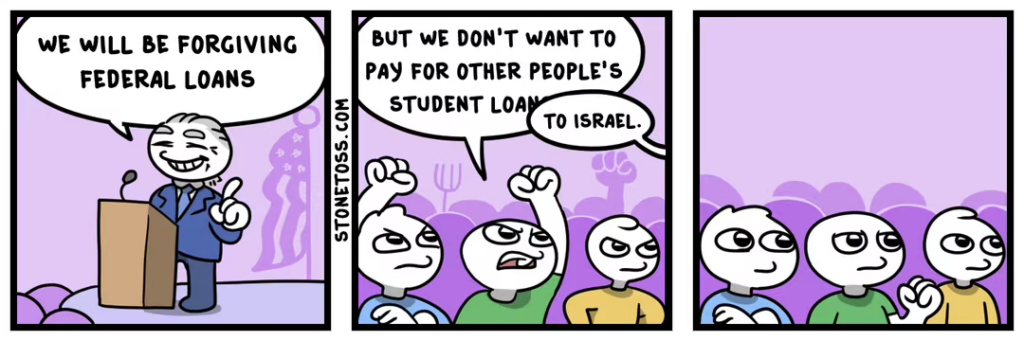
UPDATE: Stonetoss shows how to silence the Boomercon critics.

DISCUSS ON SG


Doubling Down on Ukraine

The US military is now reportedly disarming its own forces in order to continue arming its proxy forces in Ukraine:

  • I’m getting word from team guys that they’re being forced to turn in their Carl Gs to send to Ukraine. This removes a very important item out of an operator’s kit.
  • Have your bravos prep your Carl Gs for turn in. I’ve fought back on it as long as I can. Grp CDR said tough shit. SECDEF is sending them to Ukraine.
  • Not just SF you didn’t hear it from me, but HIMARs systems slated for my regiment were sent there along with most of the ammo allotted to the regiment for training this year for both Tubes and Rockets. Apparently it’s also happened to the other Marine Corps Artillery Regiments.

On the down side, this is an abjectly stupid policy that cannot possibly end well. It will accomplish nothing but render the US military unable to perform its responsibilities. On the plus side, it looks like Russia will soon be in a position to force reasonable terms that the rest of the world can live with without ever having to invade Europe or engage directly with any NATO forces. This is an unusual form of attrition warfare that appears to be remarkably effective.

DISCUSS ON SG


Already in the Top 10

Screenrant lists the 9 best places to find comics on the Internet:

Arkhaven
An up-and-comer in comparison to Webtoon and Archive of Our Own, Arkhaven boasts nearly 8 million views to the website since it was launched, a respectable number that will no doubt continue to grow as long as the site remains active with compelling creators.

View counts vary between tens and thousands, depending on the comic, but lack of popularity isn’t always a marker of lower quality. Like most other user/creator-oriented comics websites, it’s built around engagement with the material. There are also preview images of each comic or comic installment that give viewers an excellent glimpse into what the style, and often the tone, of the comic involves.

9 Best Websites To Find Free Comics, Screenrant

And it’s only going to get better from here, as Marvel descends into absurdities that were literal jokes just a few years ago.

Lesbian-wheelchair-Spider…man(?). Or is it Spider-Wheelchair-Gay-Woman? Or SpiderTransMasculineFemale?

Oh, who the fuck can knows? They sure don’t!

I honestly, thought somebody was goofing on the fabulous Gay Spiderman but no, zhe’s real alright.

Zhe swings into action with her wheelchair webbed to zhr back, (I’m using English language pronouns from here on *out). And her web shoots from her walker crutches instead of her wrists because webs can be empowered too.

The creator of this Woke Frankenstein’s Monster of a Spider-Man is, naturally, a Woke Doctor Frankenstein herself. Ty Franklin proudly declaims herself to be a queer autistic black person, she also works on Harley Quinn. Yeah, I figured.

Apparently, this new hero is called Sun-Spider and her real name is Charlotte Webber.

Charlotte Webber. Like Charlotte’s Web, get it? And lest you think anyone is exaggerating, here is the exciting disabled lesbian spiderperson zherself.

DISCUSS ON SG


The Judeo-Christian War

Emmet Sweeney observes that the root cause of the NATO-Russian war indicates that it is actually one of history’s rare religion-inspired wars:

During the Communist era, Christianity was suppressed in Russia and throughout the Soviet block. At its worst, under Lenin and Stalin, the Communist regime massacred millions of Christians. Victims were mainly Orthodox, but Christians of every denomination suffered. Even after the death of Stalin and into the 1980s religion continued to be persecuted. All children were required to attend lessons in atheism, during which Christianity and religious faith in general was mocked. By the end of Communism, the Orthodox Church was a small remnant of its former self under the Tsars, but that soon began to change. Hardship birthed a spiritual revival; by the mid-1990s the Russian Orthodox Church, as well as other branches of Christianity, began to experience noticeable growth. It was not however until the first decade of the twenty-first century, and the presidency of Vladimir Putin, that this movement became really significant.

Putin had occupied a senior position in the Yeltsin administration, and he was no doubt viewed by the oligarchs, at that time the real rulers of Russia, as a safe pair of hands who could be relied upon to continue the policies which had allowed them to plunder the country for almost a decade. He was appointed Prime Minister on 9th August 1999 and, just four months later, in December, acting President of Russia, following the unexpected resignation of Boris Yeltsin. A presidential election on 20th March 2000 was easily won by Putin with 53% of the votes. One reason for Putin’s popularity was that he was seen as a strong leader during the Second Chechen War, which commenced on 7th August 1999, just two days before his appointment as Prime Minister. The war ended in April 2000, with Chechnya again part of the Russian Federation, a victory which enhanced Putin’s reputation as a strongman, willing and able to restore stability and enforce the law.

Over the next five years, Putin showed that the ruling plutocrats were very much deceived had they imagined him to be under their control and part of their team. On the contrary, the new president set about breaking their power. The next decade witenessed a series of legal cases and trials which left some of the oligarchs in prison and others forced to pay substantial compensation. Others, arguably the most criminal, fled the country and their assets were confiscated. The breaking of the oligarchs’ power, together with that of the “Russian mafia” which enforced their corrupt rule, began to restore some form of normality.

In parellel with his economic reforms, Putin oversaw a revival of the Russian Orthodox faith. In an act heavy with symbolic import, he made a visit to the great Orthodox monastic settlement of Mount Athos in Greece in 2001, just one year into his presidency. Although this attempt had to be aborted owing to a storm which grounded his helicopter, and a second attempt in 2004 similarly shelved when he had to return to Russia to deal with the Beslan School siege, he finally made it to the Holy Mountain in 2005. There he established a bond with the monks that transformed their community and impacted the lives of ordinary Russians. A major program of church-construction commenced, and the numbers attending church began to grow. Putin made it clear that he regarded Orthodoxy as Russia’s national religion and the Church was accorded a favored legal position. And such symbolic gestures were backed by new legislation which began to transform Russian society: the country’s abortion laws, hitherto some of the most liberal in the world, were tightened. In October 2011, the Russian Parliament passed a law restricting abortion to the first 12 weeks of pregnancy, with an exception up to 22 weeks if the pregnancy was the result of rape. The new law also made mandatory a waiting period of two to seven days before an abortion could be performed, to allow the woman to “reconsider her decision.”

During this period, the portrayal of Russia in the Western media moved from one of condescension to outright hostility. As early as 2005, scholars Ira Straus and Edward Lozansky remarked upon a pronounced negative coverage of Russia in the US media, contrasting negative media sentiment with largely positive sentiment of the American public and US government. As Russia displayed increasing signs of a Christian revival, so the media reporting in the West became increasingly hostile. Only rarely however did journalists openly attack Russia for its “Christianization”; normally, columnists, conscious of the fact that large numbers of people in the West continued to describe themselves as Christian, portrayed their anti-Russian commentary as a result of Russia’s “aggression,” “corruption,” or “lack of democracy.” All that however changed with the new abortion law of 2011. Now the attacks against Russia became explicitly ideological. The Russians, we were told, were oppressing women and turning their backs on “progress.”

It was not until 2013 however that the anti-Russian rhetoric went hyperbolic. In that year, the Russian parliament passed its so-called “Gay Propaganada” law. The bill, described as “Protecting Children from Information harmful to their Health and Development,” explicitly banned Gay Pride parades, as well as other forms of LGBT material, such as books and pamphlets, which attempted to normalize homosexuality and to influence children in their attitudes to homosexuality. In actual fact, since around 2006 many districts in Russia had been imposing their own local bans on such material, though these rules had no power outside their own jurisdiction. The bill, which was signed into law by Putin on June 30 2013, was extremely popular, and passed through the Russian Parliament unanimously, with just one abstention. But the impact upon the Western nomenklatura who form the gatekeepers of acceptable opinion, was immediate. Almost unanimously, Western media outlets now began to compare Putin with Adolf Hitler; he was a “thug,” a “fascist,” a “murderer.” Between bouts of seething rage, he became the butt of scathing satire. He was cast in the role of a caricature James Bond villain, routinely murdering and torturing those he held a grudge against. There is even evidence, admittedly somewhat circumstantial, that Western Intelligence bodies, such as the CIA and MI5, became actively involved in anti-Russian propaganda.

It is intriguing, although in hindsight comprehensible, that the real reason for the break between the ex-Soviet neocons and post-Soviet Russia was directly related to abortion and homosexuality instead of economics or, as I had always assumed, ex-Trotskyite bitterness over the loss of the Soviet Empire.

Now that we recognize the deeply satanic nature of what is called “judeochristianity” in the United States, a dark religion in which abortion, homosexuality, child-trafficking, and transgenderism are sacred rites, we can better understand why it is Putin’s embrace of the Russian Orthodox Church that has made him Global Enemy Number One of the US ruling elite.

DISCUSS ON SG


Enforcing the Beautiful

The Chinese government may, or may not, be devoted to the Good or the True, but unlike the corrupted and converged governments of the West, it still defends the Beautiful:

Twenty-seven people were penalized for weird-looking illustrations in school mathematics textbooks that had sparked a furor online.

Investigations by the Ministry of Education found that the illustrations in the textbooks, which were published in 2013 by People’s Education Press, were not in line with “public aesthetics,” and some of them were “ugly.” The illustrations “fail to embody the positive images of Chinese children.”

Some of the illustrations contain “inappropriate elements,” and are “not precisely drawn, which might lead to some misunderstanding.”

The response to the evils of what passes for “modern art” should have, at the very least, involved serious consequences, up to and including capital punishment.

If, at this point, you still believe “free speech” and “free expression” are Christian values, or even civilization-compatible values, you have not been paying attention. They aren’t even satanic values, they are simply anti-civilizational weapons.

DISCUSS ON SG