Discuss amongst yourselves.
Category: Uncategorized
Credit where credit is due
It’s always embarrassing when writers who have never worked a single day in their lives at any business that actually makes anything try to opine on matters related to management:
Conservative writer Roger Simon argues that all “remaining Never Trumpers” must apologize for being wrong about the president. He chalks up Trump’s “astoundingly successful” first year to the fact the president is a “quick study.”
But what evidence is there that Trump has actually learned the art of presidential management?
Aside from the mandatory flattery required of Republican elected officials, there’s remarkably little testimony that Trump has involved himself in the process of governing. Tax reform was carried across the finish line by the GOP congressional leadership. Net neutrality was repealed by independent Republicans at the Federal Communications Commission. Foreign policy is a more mixed bag. If the president deserves credit for the defeat of Islamic State, it’s because he let “the generals” do their thing. On the other hand, credit (or blame) for recognizing Jerusalem as the capital of Israel or pulling out of the Trans-Pacific Partnership and the Paris accord on climate change certainly goes to him.
In general, it seems to me that Trump’s success (such as it is) is less attributable to sudden mastery of the issues than to staying out of the way of rank-and-file Republican policymakers, activists, and bureaucrats.
What Goldberg fails to recognize is that staying out of the way of competent subordinates is the key to the art of all successful executive management. Donald Trump is the exact opposite of Richard Nixon Lyndon Johnson, who didn’t hesitate to get on the phone with a lieutenant in the field in Vietnam in setting a ridiculous new standard for micromanagement in foreign policy.
Micromanagers like LBJ reliably fail for the obvious reason that no one can know everything, master everything, prioritize everything, and be everywhere at once. Only Reagan had similarly developed delegation skills, but he did not choose his subordinates as well as Trump has, and more importantly, Reagan did not hold his subordinates accountable the way Trump does.
None of this should be a surprise. Back in November 2016, I observed, “The God-Emperor is absolutely ruthless when it comes to taking action on underperforming team members. He doesn’t care how it looks, he just shuffles the deck and draws.”
That’s why I expected, and continue to expect, the Trump presidency to be vastly more successful than anyone anticipated. It’s why I expect him to easily win re-election in 2020. The great CEOs have always been able to master the delicate balance between staying out of their subordinates’ way and stepping in to deal with matters themselves when personal intervention becomes necessary. And lacking business experience as he does, Jonah completely fails to understand Trump’s demonstrated mastery of this balance, as he absurdly credits the Republican establishment for Trump’s success.
To listen to Trump’s cheerleaders, the biggest obstacle to conservative victories is the party establishment, when in reality it looks more like it’s running the show.
Not only is the GOPe not running the show anymore, it has been largely broken to heel by Trump, as evidenced by the Republican Congress’s sudden ability to pass tax reform after repeatedly failing to do anything. The large number of pre-2018 retirements and resignations will further demonstrate that the GOPe is no longer in control, as will the success of Trump-endorsed candidates in the Congressional and Senatorial elections.
Jumanji beating Star Wars
AnecdThe men in our house went to see Jumanji. We got the the theater plenty early but it was sold out. This is a small town but we have a five screen theatre. Both jumanji showings were sold out with only two tickets left to a late night showing five hours later. The two star wars screens had nobody waiting in line or buying tickets. While we stood trying to decide if we’d bite the bullet and see the star wars movie several other groups came to buy tickets to Jumanji no one bought tickets to star wars nobody even considered it.
One group of women and girls briefly considered pitch perfect 3 but they decided not. No one bought star wars tickets or went in to those screenings while we talked over our plans. How bad is the drop off for star wars if it’s getting spanked by Jumanji?
Why THE LAST CLOSET matters
More young women than you would probably believe were heavily influenced by the twisted psyche of Marion Zimmer Bradley.
I still cannot imagine anything more perfectly aligned with my thirteen-year-old sensibilities than Marion Zimmer Bradley’s masterpiece. Bradley opened my eyes to the idea that, when we look at the past, we are only ever seeing a small part of it — and usually, what we are seeing excludes the experiences of women. Encountering the vain, self-serving, diabolical Morgan le Fay transformed into the priestess Morgaine compelled me to question other received narratives in which women are to blame for the failures of men. The Mists of Avalon also gave me a glimpse of spiritual possibilities beyond male-dominated, male-defined religions. In retrospect, I can see that it gave me ways of seeing that helped me find the feminine even within patriarchal systems while studying religion as an undergrad. The impact of this book lingers in my feminism, certainly, but it also influenced my scholarly interest in folklore, and it still informs my personal spirituality.
But my primary reaction to The Mists of Avalon, when I first read it, wasn’t intellectual; it was emotional. Like The Once and Future King, Bradley’s novel follows its protagonist from childhood into old age. I sympathized with the girl Morgaine, and her adolescent experiences hinted at frustrations I was just beginning to feel. The moment when Morgaine and Lancelet are, finally, about to become lovers — and then Gwenhwyfar, blonde and fair and lithe and helpless, stumbles into Avalon… No matter how many times I revisit this scene, it still crushes me. This isn’t a story about the pretty girl, the princess. It’s the story of the smart girl who becomes a powerful woman. Even so, Bradley brings nuance to these characters. She shows us Morgaine doing foolish, selfish things, and she shows us that Gwenhwyfar’s position is an impossible one. Doom hangs over Arthur’s glorious reign, just as fate rules many a legend and fable. There is no happy ending for anyone at Camelot — there never has been — but Bradley shows us real people struggling against their destiny, and she shows us that it’s not just impersonal fortune to blame for their inevitable downfall. Instead, it’s systems of oppression. By the time I left home for a women’s college in 1989, I’d reread The Mists of Avalon several times. I arrived ready to smash the patriarchy.
It’s easy to claim that the book is not the author, because that is true. But in cases such as this, it is impossible to separate the theme, and more importantly, the message, of the book from the beliefs of the author. There are those authors who are intellectually ruthless enough to accurately represent beliefs they do not hold, but there are not very many such others and Marion Zimmer Bradley was certainly not one of them.
Her personal ideosyncracies not only informed, they dictated the nature of her works, which amounted to pure feminist propaganda. This is readily apparent in even her earliest writings. You cannot read The Mists of Avalon without realizing that it stems from the bitterness of a plain little dark-haired woman who cannot attract the handsome warriors and hates the tall pretty blonde girls who do. It’s essentially a medieval female Revenge of the Nerds. No wonder it was popular in feminist and proto-feminist circles.
And it was popular despite its twisted sexuality and its infamous scene of ritualized child abuse, a scene that its fans still defend as “a description of people who have passed beyond the normal world and into the sacred time of a fertility ritual.”
But the abuse of children is no more justifiable in that context than it was at Greyhaven, especially when there is absolutely no anthropological basis for it. And that is why The Last Closet is important, because it exposes the lie behind which so much evil hides itself.
Redefining normal
Fake dossier used for FISA warrant
I very much doubt anyone will be surprised by this confirmation, but it is one more piece of the puzzle that will eventually lock up a number of the God-Emperor’s enemies:
Everyone suspected the sketchy Steele Dossier was what corrupt FBI and DOJ officials used to get the October 2016 FISA warrant against Trump. FBI and DOJ officials refuse to answer that question publicly.
Despite a hundred different ways congressional investigators have asked the question, and despite numerous on-camera questions to FBI and DOJ officials about the 2016 FISA process, no-one had definitively confirmed the Christopher Steele ‘Russian Dossier’ was the underlying evidence for the 2016 FISA application to gain wiretaps and electronic surveillance upon presidential candidate Donald Trump. UNTIL NOW.
Senator Lindsey Graham just confirmed the sketchy Steele Dossier was used to get the wiretap and surveillance warrant from the FISA court.
The collapse of the American nation
Selwyn Duke addresses the way in which the very concept of nation has been erased from American minds:
When hearing about invaders streaming across our border, often with a sense of entitlement, we should be filled with righteous anger motivating us to robustly defend the homeland. We’re not. Or not enough of us are. In fact, a good percentage of the country works against the common good, passionate about the wrong things and acting as traitors would. Too many of the rest are comfortably numb.
This is why invasion has been tolerated (and often encouraged), why we talk about amnesty for people who should be unceremoniously shipped south, and why there isn’t yet funding for a border wall despite a record Republican House majority.
The reason for this, sadly, is that we’re not a nation — properly understood. A nation is an extension of the tribe, which itself is an extension of the family; it’s defined by blood, faith, language and culture. For example, the Sioux Nation wasn’t a “country” or “state”; it was a very large family sharing the aforementioned elements.
This truth was once recognized and emphasized. It was mentioned among the Founding Fathers that we enjoyed the benefit of “consanguinity,” meaning, a relationship based on having the same remote ancestors. This became less of a reality after the waves of 19th-century immigration, yet emphasis was still placed on maintaining nationhood. For example, President Teddy Roosevelt said in 1907 that treating people with “equality” was not a given, but was “predicated upon the person’s becoming in every facet an American, and nothing but an American.”
He went on to say, “Any man who says he is an American, but something else also, isn’t an American at all.” Now consider how many people will describe themselves as a/an _________-American or, worse still, will say “I’m _________” (fill in, Polish, Irish, Greek, Italian, etc.). They may not be bad people; they may mean well. But they’re unwittingly strengthening the all-too-prevalent internationalist mentality and are acting contrary to the cause of nationhood.
Nationhood was defended legislatively in 1921 with the Emergency Quota Act and in 1924 with the enactment of the National Origins Act, which used immigration quotas to maintain our country’s demographic balance. This is called “racist” today, even though some Europeans had greater quotas than other Europeans (and they’re the same race), but demographic upheaval is precisely how you destroy a nation. Ask the Tibetans, American Indians or the Ainu in Japan (if you can find any) about that.
It is the conflation of “state” with “nation”, combined with the “proposition nation” nonsense that was created to sell “the melting pot” that has resulted in this state. Only aggressive and fairly ruthless nationalism has any chance of saving the American nation now, and the more time that passes, the less likely it becomes.
It’s understandable why Americans embraced civic nationalism after the horrors of the Civil War. But that doesn’t change the fact that they were wrong to do so, and that it has had consequences that have destroyed the Union far more thoroughly than the Confederacy ever could.
DC overtakes Marvel
Due to SJW convergence at Marvel:
DC Finally Overtakes SJW Marvel as Top Comic Book Company of 2017
Marvel recently fired its SJW Editor in Chief, and cancelled a slew of SJW titles in what butthurt SJWs are calling an apocalypse, but they’re still pumping out already-written-and-drawn SJW comics. It won’t be until the 2nd quarter 2018 that we’ll start to see if Marvel is still an SJW clownshow.
But as for 2017 — the damage was done. Looking at the entire year, DC beat Marvel.
Looking at the most-ordered comic books in the North American comic market, DC Entertainment had a particularly strong year, with seven of the top 10 issues of the year being published by the home of Superman, Batman and the Justice League. The numbers illustrate how much the market has changed in the past few years — in more ways than one.
Comparing this year’s most-ordered issues with the top 10 from 2014, the scale of DC’s success becomes more apparent; just four years ago, not one DC title made it to the list, with nine titles coming from Marvel alone.
No worries. Brian Bendis has arrived at DC to converge Superman. And if their television shows are any guide, there is no shortage of convergence already metastasizing at DC.
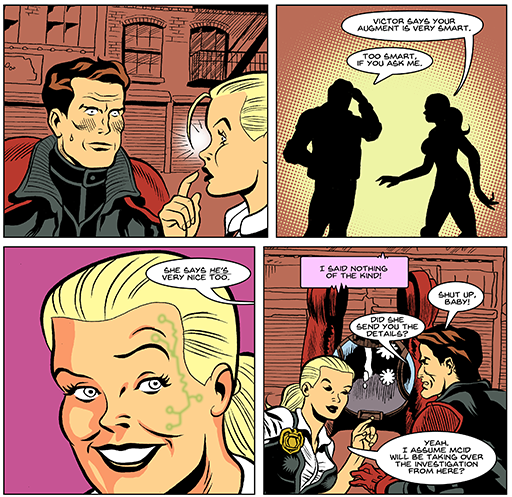
The timing is perfect, as far as I’m concerned. As it happens, we’ll be offering more than just Alt-Hero and Wodehouse in the first batch of 24-pagers in February. Some of you may recall this scene from a certain Castalia novel.
Lethal Gamma rage
It is always a problem when a Gamma delusion bubble intersects with reality:
On Twitter, more than a dozen people who identified themselves as being in the gaming community told The Eagle that a feud between two Call of Duty players sparked one to initiate a “swatting.”
“I DIDNT GET ANYONE KILLED BECAUSE I DIDNT DISCHARGE A WEAPON AND BEING A SWAT MEMBER ISNT MY PROFESSION,” said one gamer on Twitter, who others said made the swatting call. His account was suspended overnight.
According to posts on Twitter, two gamers were arguing when one threatened to target the other with a “swatting.” The person who was the target of the swatting gave the other gamer a false address, which sent police to Finch’s home instead of his own, according to Twitter posts.
Andrew Finch leaves behind two children – ages 2 and 7. He is from Virginia and the family moved to Wichita in the mid-1990s.
I doubt the idiot gamma who swatted the false address given to him by the other gamer has any idea that his ever-so-erudite reliance upon wordplay isn’t going to get him off the hook for the man’s death, which was a direct consequence of his ridiculous action.
This is the problem with the run-to-mommy generation. They don’t even hesitate to appeal to authority over even the smallest, most easily resolved issues.
EXCERPT: An Equation of Almost Infinite Complexity
Dean was brilliant, handsome, exotic, and accomplished. He had come from the Wharton school of business to do a doctorate in mathematics, something that was continually interrupted by consulting engagements during which some Fortune 500 company would fly him to an office in Texas or Washington DC or Seattle or Silicon Valley and pay him $75,000 for two months while he figured out some problem that, apparently, no one else could figure out for them. When he was not studying or working, he was a good enough trumpet player to substitute in the opera company orchestra (an aunt was on the board) and sometimes played professionally in theater pit orchestras. He was also the love of Thisbe’s short life.
 They had surprised each other. He was not interested in art or aesthetics or greatness, he did not seek the love of women. He was only driven to succeed in all he did. She was not interested in a new boyfriend or business or the second-tier musicians who hung about the edges of professional theater. In some ways, the attraction each held for the other was inexplicable. Yet for two years, they carried on a scorching love affair, Thisbe completely under the domination of this egoist. Dean’s friends and relations said, “A music student? He could do better.” But when they met her, they saw that she was alert and intelligent and lovely and admitted that there was nothing not to like if she was Dean’s choice. “She’s young,” they would say, “but so quick. And so charming.” For their part, Thisbe’s friends—musicians, students, bohemians—were fascinated and appalled by Dean. “Is he nothing but a success machine?” they would ask. Then they would meet him. He would turn his handsome sad-eyed intensity on them and listen carefully to everything they said, returning well-considered and interested replies, and they too found nothing to dislike.
With Dean, Thisbe felt she had found the other half of her own soul, someone who could complete her. Her life before him evaporated like a dream forgotten on waking. She had been living with Julius at the time, and she left all her things in his apartment and never went back for them. Even the friends who had warned her of Julius’s mediocrity and infidelity were surprised at how perfectly Thisbe forgot him. “He’s a nice guy,” they would say in defense of Julius, but someone used the word “irrelevant,” and that stuck too.
While everyone likes their friends to be lucky in love, Thisbe and Dean were too much. Their togetherness, their intensity, their indestructible delight in one another was hard to take. “When they invite me, I feel like they don’t really care if I say yes or no,” said Meghan Evans, and everyone knew what she meant. Abby Bruler, younger but sharper, said the same thing more precisely: “It’s as if no one else is in the world but them.” They were destined for marriage, or, if that was too old-fashioned for such an heroic couple, at least for some lifetime arrangement.
But as the first year waned and second waxed, there was a change. Where before the two had been inseparable, each seemingly made more gloriously themselves by the other, signs of a more ordinary love appeared. This was noted with approval. Thisbe and Dean might bicker; or Dean might decide not to cut his business trip short. He would spend an extra night in Seattle to avoid taking a redeye. Instead of two weeks in Bora Bora for Christmas, they stayed home so that Dean could work on his thesis. Thisbe’s friends began receiving phone calls from her again, sometimes even when Dean was in town. “It’s more realistic,” said Meghan Evans.
Because Thisbe’s friends believed that, after an initial peak, the love affair was subsiding into something more solid and steady. They had, they told each other, seen it before. The lovers lose the first overwhelming fascination and their relationship dwindles into something more regular. There was a certain satisfaction in this since no one likes to have their middling infatuations exposed to the unforgiving glare of real love. But in predicting for Thisbe and Dean the stability of an average love, they were all wrong.
Over the next months, everything crumbled away. Dean became distant and aloof with Thisbe. He refused to come out when her friends were going to be present. If he did run into her friends, he was openly contemptuous, calling chubby well-meaning Meghan Evans a “fat pinko parasite” and stylish Abby Bruler a “gold watch socialist” who “wouldn’t know a workingman if he raped her.”
Thisbe’s initial promise as a performance major evaporated, in part because the obsessive focus required for musical glory had transferred to Dean. There should have been no shame in this. As Julius had pointed out years before, practicing six or eight or ten hours a day, as violin majors are apt to do, smacks of an unbalanced mind. But as her friends realized, this was a disappointment to Thisbe, who had hoped for greater things and who, such a short time before, had shown promise of achieving them. It was therefore with a particular shivery thrill that they discovered that Dean, arguably the cause of her disappointment, mocked her in her decline. She fell out of the performance program and graduated with the commonplace cum laude in music education. At a party celebrating the end of Thisbe’s four years, Dean referred to her revised major as “the refuge of the talentless.”
Dean’s comments caused a sensation among her friends, who were delighted to think ill of the man who had aroused their suspicion all along. Their gossip, stifled by the perfect love in their midst, now burned up the phone lines. Dean was a control freak. Dean was an egoist. Dean was bipolar. Dean had deep psychological problems that manifested themselves in a desperate will to succeed and an initial charm, which later turned into bitter resentment against regular people for the normal, well-adjusted lives they led and he never could. Dean was a jerk, a goof, a nut, a screwball.
The breakdown came on a stormy night in June, when Thisbe waited two hours for Dean in a restaurant, leaving numerous messages on his cellular telephone. She gave it up and went home in the rain to shower and weep in front of an old movie on television. Dean called.
“Oh my God, I was so worried. Please don’t ever do that again. Don’t let me not know where you are like that…”
He cut her off. “Please don’t call this number again. My cell phone is for work.”
“I know, I know. It’s just that you hadn’t called and I was so worried…”
“I don’t know what you were worried about. I didn’t come because I don’t want to see you anymore. I would appreciate it if you would stop bothering me.”
She could not speak, for despite the difficulties of the previous months, she had not yet admitted that she was to lose him. His words stunned her. She felt a growing panic, but fought against it. She realized that he would hang up if she did not say something, so she quickly said, “Dean, wait.” She was surprised at her tone, which was commonplace and controlled.
She succeeded, because he did not hang up. He said, “Yes, what is it?” He was impatient.
“Are you having a bad day? I don’t want to put any pressure on you, you know that.” Without thinking, she had adopted the tone of a mother speaking to a peevish child. She was pleased, realizing as she spoke that any other tack—emotional appeals, anger, sarcasm—would have ended the conversation immediately. “I just want what’s best.”
“Hm,” he said in a way he had, thoughtful and amused. She felt her words had made an impression. “You may want what’s best, and then again you may not,” he said. She realized that he was mocking her: she wanted what was best, meaning him. “The fact is that I don’t want you. I would appreciate it if you would stop phoning. In fact, I would appreciate it if you left me alone completely.”
“Dean–” and now she could not stop the emotion pouring into her voice. Though the night before she had told Abby Bruler all about Dean’s recent inattentiveness and even cruelties, she realized that she did not care, that she loved him and wanted him no matter how he behaved. “Oh Dean, I–”
Again the brutal interruption. “Please stop this emotional nonsense. That sort of thing never helps. I have no time for you now.”
“Dean!”
“Nothing about you is of any interest to me. Please respect my wishes and leave me alone. Goodbye.”
“Dean!” she fairly shrieked.
He hung up.
When Meghan Evans heard about Dean’s final break with Thisbe, she said, “That man sold his soul to the devil a long time ago.” As we shall see, gentle reader, she was absolutely right.