The decline of the liberal arts

A college president explains why the English Department and other liberal arts institutions are on the way out:

Here is how the numbers have changed from 1970/71 to 2003/04 (the last academic year with available figures):

English: from 7.6 percent of the majors to 3.9 percent
Foreign languages and literatures: from 2.5 percent to 1.3 percent
Philosophy and religious studies: from 0.9 percent to 0.7 percent
History: from 18.5 percent to 10.7 percent
Business: from 13.7 percent to 21.9 percent

What are the causes for this decline? There are several, but at the root is the failure of departments of English across the country to champion, with passion, the books they teach and to make a strong case to undergraduates that the knowledge of those books and the tradition in which they exist is a human good in and of itself. What departments have done instead is dismember the curriculum, drift away from the notion that historical chronology is important, and substitute for the books themselves a scattered array of secondary considerations (identity studies, abstruse theory, sexuality, film and popular culture). In so doing, they have distanced themselves from the young people interested in good books.

His thesis makes sense: throw out the canon and what do you have except heavily biased opinion? I never recommend an English major for those interested in pursuing any form of literary career; English majors were already quite clearly useless when I was in college two decades ago. It is a pity to see fewer history majors, as knowing what has happened in the past is one of the best guides to recognizing what is happening in the present. As for the “business” majors, I’ve yet to meet one who knew the first thing about business after obtaining such a degree; you’d be much better off to spend four years actually working in a business, or better yet, starting one of your own.


Why The Rules don’t work

A perusal of the basic Rules set quickly shows why women who rely upon them to secure a man and/or marriage are likely going to fail. As is often seen in social networking profiles and advice columns, women usually think that what works with women must also work with men. This is not true. Consider:

Rule 1: Be a “Creature Unlike Any Other”

Given that Playboy has spent five decades proving the near-universal male predilection for a slender, pretty, large-breasted, blue-eyed blonde, this rule is obviously insane. In fact, most men have distinct preferences that anyone who knows them well can easily identify. One of my college roommates always tended to date short, hippy women with long, dark, naturally curly hair named Mary. Unsurprisingly, he ended up marrying a tall, hippy woman with long, dark, naturally curly hair named Mary. Women are naturally attracted to outliers for the sheer sake of their novelty. Men aren’t.

Rule 2: Show Up to Parties, Dances, and Social Events Even if You Do Not Feel Like It.

This makes sense, but you probably shouldn’t bother if you’re just going to be a tiresome bitch. Unless it’s a Goth party, then feel free to mope and whine all you like, Lady Dolorous.

Rule 3: Don’t Stare at Men or Talk Too Much

The first part is completely wrong, the second part is completely right. Staring at a man is the primary way a woman lets him know she wants to be approached. On the other hand, about 90 percent of what women like to talk about is considered by heterosexual men to be inconsequential babble, so the less a woman expresses her opinion, the better. On the other hand, intelligent, topical, and unopinionated speech will win respect simply because it is so rarely heard. It may be useful to know that when men imitate women for other men, they often do it by beginning a sentence “Well I think….” in a high-pitched, clueless voice.

Rule 4: Don’t Meet Him Halfway or Go Dutch on a Date

Establishing an unwillingness to compromise right from the start is a very effective way of convincing intelligent men that you’re going to be a major pain in the posterior and convincing him you’re more trouble than you’re worth. Very hot girls can get away with such intransigence with most men, but if you’re a Rules Girl, then you are obviously not a very hot girl or you wouldn’t think you needed them. As for paying for the date, it depends. If he asked you out, then he should pay. But keep in mind that the “who pays” question is not anywhere nearly as big a deal to men as women seem to think. Consider the contrast between the way groups of men and women approach paying the bill at a restaurant. Men take half a minute to throw in a roughly equal amount and include a healthy tip, while women spend half an hour itemizing who ordered what, then stiff the wait staff. The salient point is that men seldom give a damn one way or another.

Rule 5: Don’t Call Him & Rarely Return His Calls

That’s fine. He’ll be busy having sex with the woman who calls him at 11 PM to see if he happens to be free at the moment and you’re just another haughty bitch who can’t be bothered to call him back anyway. This is easily the worst Rule, as it is designed to ensure that the only men who will continue to call you are terminally obsessed stalkers.

Rule 6: Always End Phone Calls First

This Rule is fine, because there isn’t a single man on the planet who keeps track of who hung up first. Besides, he’s either reading his emails, surfing the Internet, or playing video games while you’re rambling on and on about who said what to whom anyhow.

Rule 7: Don’t Accept a Saturday Night Date after Wednesday

I have no idea what the point of this is supposed to be. But it is correct insofar as it is always a horrendous mistake to attempt leaving your options open instead of simply accepting or rejecting a weekend date during the week. It’s really not that hard for men to tell that you’re looking for something better but are willing to use them as a fall-back option in case nothing more interesting comes along in the next few days. This puts you squarely in the “bitch who merits being treated as badly as I want” category in most men’s books.

Rule 8: Close the Deal – Do not date a man for more than two years.

Okay, this is actually a good one, although I’d cut it down to 12 months since it’s usually possible to at least see where things are going after a year. If a man doesn’t show any sign of being interested in marrying you within a year, he’s probably not going to want to marry you unless nothing better happens to come along in whatever his long-term time frame happens to be. And if he tends to groan, roll his eyes, or smoothly change the subject whenever the topic of marriage is broached, he simply isn’t the marrying kind and the sooner you move on, the better. Remember, most men have very, very good reasons to avoid marriage under the present legal regime and a refusal to take the risk is a sign of intelligence, not personality flaws.

Rule 9: Buyer Beware – Observe his behavior so you do not end up with Mr. Wrong

This is sensible. No objections. Of course, keep in mind that if he has half a brain, he’ll be doing the same.

Rule 10: Keep doing The Rules even when things are slow

Alternatively, one could consider applying that pesky male logic and correctly conclude that things are slow BECAUSE of The Rules. Now, here are some alternative guidelines – not rules – that are far more likely to produce positive results.

1. If you find a man attractive, smile at him and meet his eyes. If he returns the smile, he is attracted and will approach you if he is interested. Don’t be bothered if he smiles but does not approach, this usually signifies that he is either polite but uninterested or is not interested even though he finds you attractive. This lack of interest may be for a very good reason, such as marriage and children, so just let it go and find someone else at whom you can smile.

2. Don’t play stupid games. Men are goal-oriented and while some may enjoy the chase, that’s really not the point. The reason men ditch women after scoring them isn’t because the chase was too short but because they’ve achieved their objective and are now making the logical next step of pursuing a new one. Prolonging the chase isn’t likely to alter the ultimate result once the objective is attained, however long that takes.

3. Learn to distinguish between a man who genuinely seeks a companion and a man who simply wants to have a good time. If you are seeking the former sort, then waste absolutely no time on the latter type.

4. Men don’t love drama. We don’t watch it, we don’t read it, we don’t play it, and we certainly don’t want to live it. The less you can create, the better. If you crave excitement, go jump out of an airplane or find a way to test your skills against others. It works fine for us.

5. Bad boys play hard and they leave their mark. You might not think your emotional scars show, but they do and they are seldom flattering. Also, it’s difficult to “make the most of your youth” with the bad boys for five or ten years and then be happy settling for a nice, respectable beta provider.

6. Above all, don’t try to be a mother. He survived without you before so he knows he can survive just fine without you now. There are plenty of girls on the girl tree and moreover, there is nothing less sexually attractive to the psychosexually normal adult male than a woman playing Mommy. Men find it aggravating, irritating, and emasculating to have a woman attempting to order them about like a child. And note that silent toleration does not indicate acceptance.

7. If the man isn’t 30 pounds overweight, sex is always a more important priority than food. This will be true until McDonalds opens a drive-through brothel or the first Victoria’s Secret line of sexbots becomes available.

8. Never, ever, talk about anyone with whom you work. Don’t even talk about anyone he hasn’t met unless it’s a genuinely funny story and you are one of the rare women who are able to tell a story without stopping in the middle and restarting, forgetting the punchline, or otherwise blowing it. To put it in perspective, men care less about your faceless coworkers, family, and friends than you do about the Tuck Rule or the Bling Pro perk. And yes, I know you don’t know what they are… how much do you care about them? Exactly….

2010: economic predictions

“We are seeing early evidence of that recovery: Real gross domestic product (GDP) in the United States rose an estimated 3-1/2 percent at an annual rate in the third quarter, following four consecutive quarters of decline. Most forecasters anticipate another moderate gain in the fourth quarter…. My own view is that the recent pickup reflects more than purely temporary factors and that continued growth next year is likely…. As the recovery becomes established, however, payrolls should begin to grow again, at a pace that increases over time.”
– Ben Bernanke, November 16, 2009

“Nobel Prize-winning economist Paul Krugman said he sees about a one-third chance the U.S. economy will slide into a recession during the second half of the year as fiscal and monetary stimulus fade. ‘It is not a low probability event, 30 to 40 percent chance,’ Krugman said today in an interview in Atlanta, where he was attending an economics conference. Survey of Economists Krugman’s forecast is more pessimistic than the median estimate of 58 economists surveyed by Bloomberg News in early December, which called for a 2.6 percent expansion this year following a 2.5 percent contraction in 2009.
– Paul Krugman, January 4, 2009

“I think the U.S. will avoid a double dip recession, and 2010 GDP growth will be in the 2% to 3% range.”
– Calculated Risk, January 1, 2010

“Based on my reading, here is what I conclude the consensus views are as we head into 2010: Muted recovery, but positive growth, for sure! No risk of a ‘double dip’…. So here we are with a glorious opportunity to reintroduce Bob Farrell’s Rule 8: “When all forecasts and experts agree, something else is going to happen.”
– David Rosenberg, December 17, 2009

“Yun predicted that home prices will rise by 4 percent, while home resales, which are expected to reach 5 million this year, will surpass that level in 2010, hitting 5.7 million. Average mortgage rates will average roughly 5.7 percent, he said.”
Lawrence Yun, National Association of Realtors, November 13, 2009

“The U.S. economy next year will turn in its best performance since 2004 as spending perks up and companies increase investment and hiring, says Dean Maki, the most-accurate forecaster in a Bloomberg News survey. The world’s largest economy will expand 3.5 percent in 2010, according to Maki, the chief U.S. economist at Barclays Capital Inc. in New York.”
– Dean Maki, Barclays Capital, December 28, 2009

“Jan Hatzius, chief U.S. economist at Goldman Sachs Group Inc. in New York, who was No. 1 among forecasters of GDP during the 12 months through June 2009. Hatzius, 41, estimates the economy will expand 2.4 percent in 2010…. Hatzius and the economists at Goldman Sachs project the unemployment rate will average 10.3 percent next year, compared with a median estimate of 10 percent for 58 responses in this month’s survey.
-Jan Hatzius, Goldman Sachs, December 28, 2009

“Neal Soss, 60, chief economist at Credit Suisse in New York projects the economy will grow 3.3 percent next year.”
– Neal Soss, Credit Suisse, December 28, 2009

“John Lonski, 58, chief economist at Moody’s Capital Markets Group in New York, was No. 3. He sees a 2.7 percent expansion.”
– John Lonski, Moody’s Capital Markets Group, December 28, 2009

“Robert MacIntosh, chief economist at Boston-based Eaton Vance Management forecasting growth of 3.5 percent, and that the jobless rate will average 9.5 percent.”
– Robert Macintosh, Eaton Vance Management, December 28, 2009

“Roubini sees a greater chance of a U-shaped economic recovery in developed economies, with a 20 percent to 25 percent chance of a double-dip.”
– Nouriel Roubini, October 11, 2009

Here are seven predictions concerning economic-related events I expect to see by December 31, 2010:

1. The BLS will report U-3 unemployment to be in excess of 11 percent. The actual number of unemployed workers will be much higher.
2. The BEA will report real GDP to be less than 12,973 in billions of chained 2005 dollars.  A “double-dip recession” will be the official description, but rumors of a “second great depression” will be increasingly heard as the evidence mounts that a single large scale economic event is taking place.
3. The Federal budget deficit for 2010 will exceed the projected $1.17 trillion.
4. More than 200 banks will be seized by the FDIC. Their deposits will represent more than two percent of all U.S. bank deposits.  (Specific calculation: 305 banks and 5.2% of total deposits.)
5. Commercial bank loans and leases (TOTLL) will fall below $6.3 trillion.
6. All sectors credit market debt outstanding, which is published in the Fed’s quarterly Z1 Flow of Funds Accounts, will fall below $52 trillion.  This will mostly be the result of continued deleveraging by the financial sector, and to a lesser extent, the housing sector, which between them will decline by more than $1 trillion.
7. The national median existing-home price will not rise 4% from $172,600 to $179,500 as predicted by NAR’s lead economist Lawrence Yun, but will fall below 165k instead.  And if there is the sort of crash that is implied by the preparations for SuperTARP, existing home prices will collapse below $140k.

I also expect an increase in Sitemeter-recorded visits to the blog to increase from 1,942,640 in 2009, (161,887 per month) to 2,250,000, primarily as a result of an increased interest in economic matters. The 1.9 million visits, (3,115,071 page views), was up 19.6% from the visits 1,566,254 in 2008. I still find it astonishing that so many people continue to be interested in my various thoughts and opinions, but thank you for stopping by and please feel free to do so throughout the year.


Three book reviews

A new Summa Elvetica review by JS on Amazon:

In any other fantasy novel the question of whether elves have souls would be silly, but in Beale’s world it is profound question which has lasting repercussions. The question works because the medieval Roman Catholic Church is the one asking.  Most fantasy worlds have a facsimile of the Roman Catholic Church without the Roman and Catholic part. Outside of the addition of the RCC the fantasy world is very familiar to anyone who knows the genre. Tough, taciturn, stoic dwarfs and tall, beautiful, arrogant, magical elves live a world with orcs, goblins, lycanthropes, and demons. Beale succeeds in combing these elements into a lively and believable land.

Jason Clark reviews RGD on Amazon:

When considering the matter of how the world went into its economic meltdown people have many explanations, and many solutions.  In this informative and easily digested book, World Net Daily columnist, blogger and Austrian economist Vox Day applies his own expertise to analysing the problem and offering his solution.  Vox introduces us to the different economic schools that have weighed in on this issue, and details how their take on the matter generally fails to address the issue, and how their solutions will only make matters worse.

Bart Fuller reviews RGD on his blog, Liberty vs Leviathan and adds “It’s a most excellent book and joins Hazlitt and Bastiat on my short list of recommendations to friends wanting to learn about economics.”

This is a book for anyone and everyone wanting to make sense of the economic turmoil of the last two years.

One of my minor goals for 2010 will be to finish the sequel to Summa Elvetica. If I’m fortunate, it’s even possible that it might be published in 2010. But I’m not promising anything, as there are other projects which demand priority.


2010: the economic situation

As the new year kicks off, I’ve been trying to think of a way to explain the present economic situation in a simple and graphical manner that would not only illustrate the precarious nature of the US economy, but also explain my negative perspective on its prospects as well as the positive GDP reports and expectations on the part of mainstream economists. After wasting a fair amount of time poring over the usual BEA and BLS reports, I realized that because my analyses are primarily predicated upon debt, the only thing that made sense was to go back to the Fed’s quarterly Z1 report and look more closely at the sector data.  I have to confess that when the third quarter report came out a few weeks ago, I was surprised it did not show more contraction in the third quarter; total credit market debt only declined a further $113 billion from the revised Q1 2009 peak of $52.9 trillion.  The net contraction to date has only been 0.53%, which seemed weirdly small when the 8.7% contraction in commercial bank loans over the same period was taken into account.

But a look at the various credit sectors usefully clarifies this apparent dichotomy.  As the chart below shows, household debt reached its peak in the third quarter of 2008 and is down 1.75% since then.  The financial sector began reducing its outstanding debt a quarter later than the households, but is deleveraging much faster as its debt has fallen 5.93% from the Q408 peak.  Corporate debt has remained essentially flat since 2008, but the Federal government has, for the time being, been able to fill in the entire credit gap by increasing its outstanding debt by nearly one-third, 30.1%, in the four quarters since Q308!  State and local government debt has also increased, but by close to an order of magnitude less at 3.25%.  So, the reason we have not yet seen any significant effects of the debt-deleveraging in the household (-$242.8 billion) and financial (-$873.7 billion) sectors in the wider economy is because the Federal government has taken on an additional $1,743.4 billion of debt plus another $72.4 billion from the state and local governments to counter that contraction of credit.

So, the questions raised by this analysis are:  a) can the various levels of government continue to increase their outstanding debts faster than household, corporate, and financial debts decline, b) how long can the various levels of government continue to increase their debts, c) when will household, corporate, and financial debt stop contracting?  As of today, January 1st, 2010, the answers appear to be: a) No, the disparity of debt levels renders this impractical, if not impossible, especially since the early data indicates that household and financial debt is still declining. b) Probably not beyond the second quarter of 2010.  State and local tax revenues fell precipitously in 2009, many state and local governments are already on the verge of bankruptcy and the White House is already talking about attempting to reduce the 2010 deficit. c) given the growing number of mortgage and credit card payments reaching 60 and 90 days late, there is no sign of this happening in 2010.  In fact, much of the 2009 contraction that should have happened due to foreclosures and defaults has not yet been recorded on the books thanks to the extend-and-pretend policy presently in place.

The White House and the Federal Reserve are gambling that the contraction of household and financial sector debt will end before time runs out on their ability to increase Federal debt enough to compensate for that contraction.  But despite a panoply of credit-creation programs, changes to accounting laws, and regulatory easing, they are running out of time and there are still no signs of any further appetite for debt on the part of consumers or financial institutions.  The brief uptick in total bank loans from the middle of October to the middle of November has already given back its gains; TOTLL was still down 8.01% as of the most recent report on December 16th.  Therefore, I conclude that the White House already knows it lost its credit gamble, which is why it is now preparing the $4 trillion SuperTARP bill known as HR 4173.

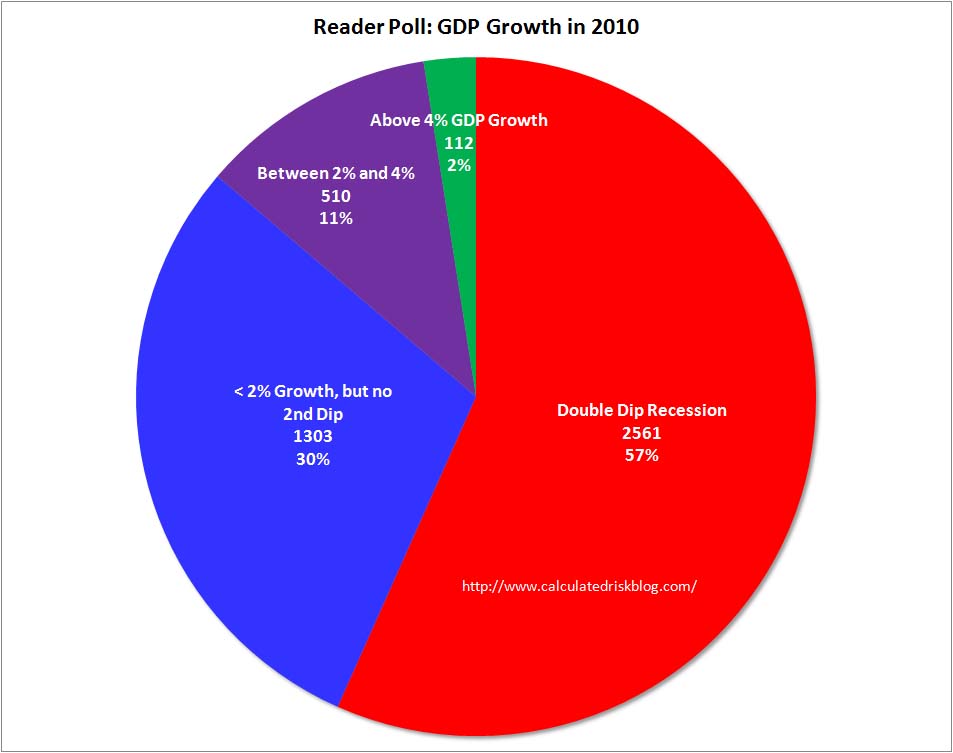
Calculated Risk’s readers would appear to share my pessimism regarding the 2010 outlook, as 57% expect the economy to fall back into contraction. 


Mailvox: defining science

BR emails to inform us that the definitions of the various elements of science in TIA have proven useful:

Vox, the definitions of science that you developed in TIA have been very useful. I recently described climategate to some friends like this: Fraudulent Scientistry was finally tripped up by established Scientage. Scientody takes a bow, and Science itself is none the worse for it. The discussion that followed was priceless.

Of course, I can’t take any credit for the development of the tripartite science definition. That was the Fowl Atheist’s work. I merely provided the nomenclature and publicized the concept, a Dawkins to his Darwin, if you will.


Creating a literary ghetto

To everyone’s surprise, Julianna Baggott blames sexism for the fact that women seldom write great or award-winning books:

I could understand Publishers Weekly’s phallocratic list if women were writing only a third of the books published or if women didn’t float the industry as book buyers or if the list were an anomaly. In fact, Publishers Weekly is in sync with Pulitzer Prize statistics. In the past 30 years, only 11 prizes have gone to women. Amazon recently announced its 100 best books of 2009 — in the top 10, there are two women. Top 20? Four….

What are the stereotypes that drive these biases? Over the years, I’ve developed many theories. Let me offer one here.

I often hear people exclaiming that they’re astonished that a particular book was written by a man. They seem stunned by the notion that a man could write with emotional intelligence and honesty about our human frailties. Women, on the other hand, are supposed to be experts on emotion. I’ve never heard anyone remark that they were surprised that a book of psychological depth was written by a woman.

That last sentence summarizes the writer’s problem; psychological depth != literary greatness. That being said, one wonders who she would propose as the female equivalent of Dostoevsky, or even Poe. Now, it’s worth pointing out that female writers often win awards in SF/F, but that’s partly because there are some very good authoresses such as Lois McMaster Bujold, Theresa Edgerton, and Tanith Lee active in the genre, and partly because the SFWA’s Nebula Award has a propensity to devolve into a popularity contest, (see Catharine Asaro, 2001). But I suspect the main reason women write fewer great books is because they simply don’t make the effort to do so.

There’s nothing wrong with rewriting Tom Brown in a fantasy setting, but greatness does not lie that way even if massive sales success does. There’s nothing wrong with writing silly vampire pre-porn for silly teenage girls either – although it would be illegal on aesthetic grounds and punishable by death by sugar overdose if I were ruling the universe – but it’s readily apparent that literary greatness is not on your list of objectives if you’re writing about sexy dead and/or furry things.

The problem isn’t that women don’t write “write with emotional intelligence and honesty about our human frailties”, it is that they don’t tend to write about much else. While there are an increasing number of 40-something male writers who are making a career of doing this sort of narcissistic writing – Dave Eggers and stunt writer A.J. Jacobs spring to mind – the fact is that great literature requires more than navel-gazing, sexual daydreaming and gossip, no matter how well written that navel-gazing, daydreaming and gossip might be.

In any event, the only award that truly matters is the one that time conveys upon an author. No amount of awards or sales are going to turn Harry Potter and the Banquet of Boredom, The Picasso Crossword into works of literary greatness. If you try to accomplish something original, you will probably fail to reach the heights, but if you don’t even try then you definitely will. Summa Elvetica probably hasn’t sold one-tenth as many copies as the worst-selling novel published by Tor last year; it didn’t win a single award or even receive a single review in any literary publication. Given the limitations of the author, it may not even be as good a novel as any of those published by Tor. On the other hand, can anyone argue with a straight face that any of those books attempted to do even half of what was accomplished, let alone attempted, in SE?

Now, note that I’m not complaining in the slightest. As evidence, I will point out that one can’t give a book a title like “A Casuistry of the Elvish Controversy” without knowing that practically no one is going to want to read it, to say nothing of throwing in all the untranslated Latin. I could not possibly care less what a literary world of readers who consider Dan Brown to have produced the best of the year’s best happens to think. I am simply observing the industry realities, not arguing that anything should be changed in order to accomodate my idiosyncratic preferences. The industry has already changed enough over the last three decades, as its increasing bias towards various elements preferred by female editors and readers continues to drive young men away from books and towards computer games that still respect the heroic tropes.

Baggott’s article indicates that we should expect to see the same pattern at work in literary awards that we are presently seeing in the awarding of university degrees. Female writers will eventually get their statistical due and make up the majority of literary award winners in time, but no one outside what will have then become a female-dominated literary ghetto will give a damn because the substantive value of the awards will have been destroyed by the very process of the desired transformation. As I predicted back in 1995 (this 2007 Ben Bella piece was simply a reworking of a proposed article for CGW that editor Chris Lombardi described as the most insane piece he’d ever read for the magazine), the next great art will not come from academia, Hollywood, or literature, but from the game industry. Imagine, for example, if Rob Pardo had been a genuine intellectual in the Tolkein mode and harbored ambitions of doing more than Warhammer Fantasy Battle meets Everquest.

I still like fantasy. I still write fantasy. In fact, SE fans may be pleased to learn that I’m presently working on a map for the next book. But I read very little of it these days because so much of it is derivative, predictable, trivial, and boring. There is more astonishment and daring in a single Call of Duty mission – and every MW2 player knows to which mission I’m referring – than there is in any twenty SF/F books published today.


Red flag waving

Given how Congress is already working to preemptively protect the big banks, it sure looks as something large and furry this way comes:

To close out 2009, I decided to do something I bet no member of Congress has done — actually read from cover to cover one of the pieces of sweeping legislation bouncing around Capitol Hill. Hunkering down by the fire, I snuggled up with H.R. 4173, the financial-reform legislation passed earlier this month by the House of Representatives. The Senate has yet to pass its own reform plan….

It authorizes Federal Reserve banks to provide as much as $4 trillion in emergency funding the next time Wall Street crashes. So much for “no-more-bailouts” talk. That is more than twice what the Fed pumped into markets this time around. The size of the fund makes the bribes in the Senate’s health-care bill look minuscule.

It would appear Barney Frank and the House Financial Services Committee are expecting Wave 3 in 2010 too.


Dinosaur science

The OC suggests a new theory that explains the disappearance of the dinosaurs. “I wonder how all those dinosaurs managed to get to Titan in order to die and leave those vast oceans of volatile liquid hydrocarbons?” But the answer is so obvious. Rockets. It’s dinosaur science and the global consensus of astrosaurinauticists is totally settled.

The bracing -180°C temperatures prevalent on Titan mean that water ice acts more the way rock does here on Earth, and the liquids filling the seas and lakes are hydrocarbons which would be gaseous here – methane, ethane and such – though of course we humans like to liquefy and store them under pressure to run our barbecues, patio heaters etc. Just as water does here, however, the patio-gas seas evaporate when conditions are favourable to form clouds and fog, which subsequently rain down as LPG elsewhere. Earth and Titan are thus the only bodies in the solar system with surface geology moulded by movements of liquid.

And clearly, Earth and Titan are the only bodies in the solar system to have been colonized by spacefaring dinosaurs; the Sea of Krakens must have been their sacred burial ground. But this discovery of dinosaur space travel is even more significant than the OC imagines, since it could have incredible ramifications for biology as well… my hypothesis is that Man was not only bred, but uplifted by these spacefaring dinosaurs as well, hence the sudden increase in cranial size that paleontologists find so puzzling. Because artificial selection is known to be so much faster than natural selection, the Dinosaur Science hypothesis offers the perfect solution for Young Earth Creationists, Evolutionists, UFOlogists and Pan-Spermians alike. As for the Chicxulub and Barringer sites, it is now apparent that those were the dinosaur equivalents of Cape Canaveral and Volograd.

And now we have finally have the answer to the nature of God. Saurian.

Now I’m just wondering if the Nobel Committee is going to have to hold off another year on awarding me the Physics prize for the discovery of Dark Vapor, since obviously establishing such a ground-breaking scientific theory of this multidisciplinary significance will have to take precedence.


Beautiful dessication

Given his penchant for discord and experimentation, I never, ever thought David Sylvian would again approach the music of Gone To Earth or the lyrics of Secrets of the Beehive. Rain Tree Crow was good, but it wasn’t the same. And yet, he somehow managed to combine elements of my two favorite albums in Atom and Cell on Snow Borne Sorrow.

Her skin was darker than ashes
And she had something to say
About being naked to the elements
At the end of yet another day
And the rain on her back that continued to fall
From the bruise of her lips
Swollen, fragile, and small

And the bills that you paid with were worth nothing at all
A lost foreign currency
Multi-coloured, barely reputable
Like the grasses that blew in the warm summer breeze
Well she offered you this to do as you pleased

And where is the poetry?
Didn’t she promise us poetry?

It’s simultaneously beautiful and harsh. I appreciate a reasonably wide range of music, but I don’t know that I really require anything these days but David Sylvian and Disturbed… and I’d do without Disturbed before Sylvian. The Banality of Evil is nearly as good, although it’s more sinister and smoothly superficial. I love the way he delivers the ominous-sounding “hello neighbor” line.

And the lives that you hold in the palm of your hand
You toss them aside small and damn near unbreakable
You drank all the water and you pissed yourself dry
Then you fell to your knees and proceeded to cry

And who could feel sorry for a drunkard like this
In a democracy of dunces with a parasite’s kiss?

And where are the stars?
Didn’t she promise us stars?