Euro 2012 Semifinal 1

Spain 1 Portugal 0 (4-2)

Spain was again pretty poor on the night and missed their first penalty, but then made four straight to go through to the finals. I don’t understand why Torres is on the bench when the Spanish can’t score, but then, Spain’s tactics are meant to be confusing.


German court finds Muslim guilty; Jews suffer most

I was pretty sure when I read this that we could count on some hysterical reactions from those who can detect anti-semitism in cloud formations:

German Court Declares Judaism A Crime

Hard to believe, but that’s what the decision handed down by the regional court in Cologne, Germany means: circumcising a child under the age of consent is a crime, notwithstanding the religious beliefs of the parents…. Jews believe that the circumcision of infants is a necessary act; the command to circumcise male children at the age of eight days is the first command that God gives Abraham to mark their covenant; for thousands of years this has been a foundation of Jewish life. To ban infant circumcision is essentially to make the practice of Judaism illegal in Germany; it is now once again a crime to be a Jew in the Reich.

First of all, no one seems to have any problem with ignoring the religious beliefs of the parents when it comes to circumcising girls, so it seems more than a little bit hypocritical for anyone to simultaneously claim that there is a religious right to chop off part of a boy’s body off, but not any part of a girl’s body. Does Mr. Mead support the right of female circumcision for those Muslims who practice that?

Second, there are severe restrictions on religious freedom in Germany. One cannot homeschool there, wear a headscarf, or be excused from classes on evolution for religious purposes, so it seems a bit much to expect to be able to cut pieces off other people’s bodies there on that basis. If you want to practice your religion in freedom, Germany is simply not the place for you. This is neither news nor rocket science.

Third, circumcision is not Judaism, as should be obvious given the fact that many Christians and Muslims are circumcised and are not Jews. So, it is simply false to claim that Germany has declared Judaism to be a crime. And fourth, why do Jews still want to live in Germany anyway? One finds it hard to imagine that the Germans have not made it sufficiently clear that they do not cherish living with Jews among them any more than Israelis enjoy living with Sudanese in their midst.

UPDATE: I have zero sympathy for Jews whining about this court decision. They have no grounds for complaining about finding themselves on the short end of the freedom of religion law this time given this previous German court case: “In 1973, a Jew complained successfully that his freedom of religion was violated by the obligation to speak in a German courtroom decorated by a cross.

Do you want your traditions to be respected? Then keep your nose out of everyone else’s.


The Globalist Propositions of Free Trade

If the free-traders cannot understand how one nation can grow rich at the expense of another, we need not wonder, since these same gentlemen also refuse to understand how within one country one class can enrich itself at the expense of another…. But, in general, the protective system of our day is conservative, while the free trade system is destructive. It breaks up old nationalities and pushes the antagonism of the proletariat and the bourgeoisie to the extreme point. In a word, the free trade system hastens the social revolution. It is in this revolutionary sense alone, gentlemen, that I vote in favor of free trade.
On the Question of Free Trade, Karl Marx, 1848

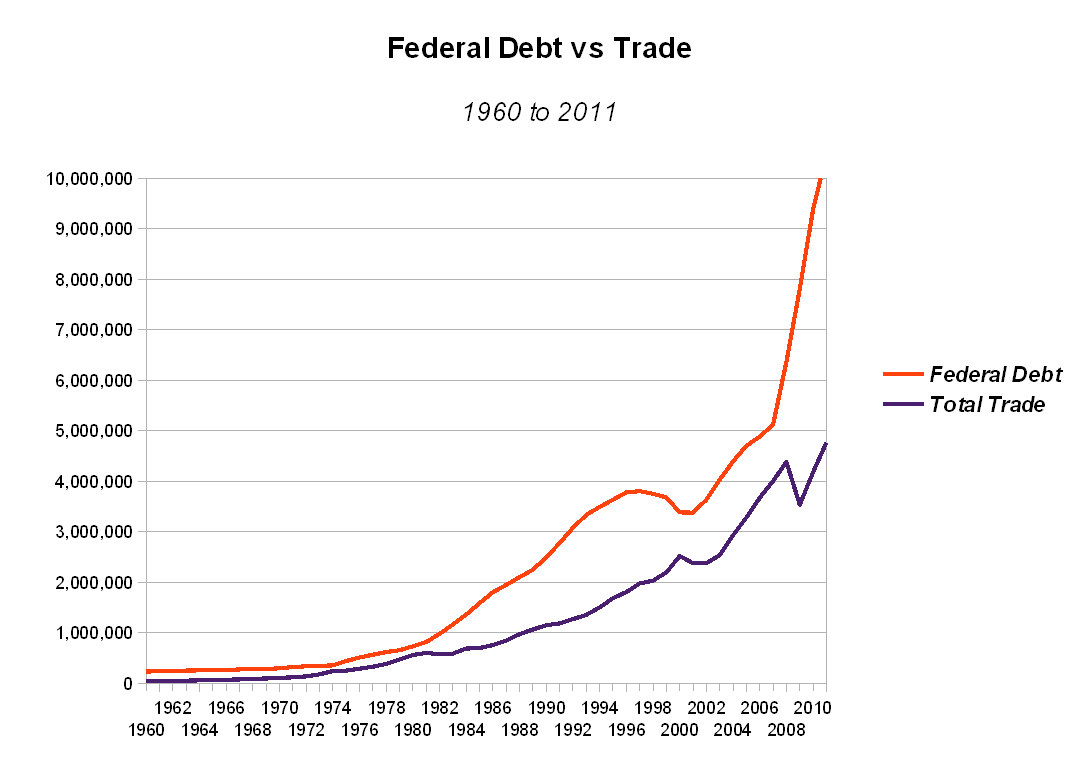
Mises may have never wavered from the view that free trade is a crucial economic policy in the program to restrict the growth of socialism. This does not alter the easily demonstrated fact that Mises was completely wrong on this particular issue, as can be seen by taking the position of Karl Marx into account, or examining the following chart, which shows the very strong statistical correlation, 0.95, between the increasing volume of international trade and the increase in the debt owed by the U.S. federal government.

It doesn’t matter if one prefers to utilize different measures of the expansion of the power of the central state, as they will show much the same result.  What this chart shows is a five-decade refutation of the Misean assertion that an increase in trade intrinsically inhibits the expansion of the scale and scope of state power, and particularly after 1994, it shows that a reduction of protectionism does not reduce the continued growth of the state in the slightest. To the extent that any claim of causation can be made, (and I am not making one here), we must conclude that it is arguments and policies in favor of free trade that “help to expand the power of the state” and “move in the direction of central economic planning.”

This should also not be mistaken for a claim that an increase in international trade, or even an increase in the trade deficit, is responsible for all, or even for most, of the growing amount of public and private debt. That would be impossible, since the $738 million in new debt required to pay for the 2011 balance of payments deficit in goods would barely cover two quarters worth of new federal debt alone, and obviously the federal government is neither purchasing nor financing the purchase of all foreign imports.

Mr. North claims that the central economic issue dividing the right wing movement is the issue of protectionism. This may well be true, I have no opinion on the matter except to say that I believe there is a much stronger right wing case against free trade than can be made for it. After all, the political right generally considers concepts such as national identity, culture, and tradition to be matters of serious and even vital import whereas the political left disdains them, and in some cases even denies their existence. So when Mr. North refers to “invisible lines known as borders”, it should be clear that although he is a man of the right, he is addressing this issue from a distinctly leftward position.

Where Mr. North appears to go fundamentally awry on this issue is his inability to distinguish between the state and the nation. He claims, correctly enough, that the statist equates the state and society and sees the state as the one true agent of the nation. He notes that some statists actually believe that the state is the same as the nation, and this is true. However, although North appears to understand that the state is not the nation, he clearly fails to appreciate that his arguments against the state do not necessarily apply to the nation. Indeed, the use of the term nation-state in a non-ironic manner is to reveal an outdated mindset that fails to recognize the way the laws and goverments of most Western states are openly anti-nationalistic.

North asserts the collectivist begins with the concept of the state as the final authority, while libertarian theory begins with the concept of the individual as the final authority. But as a Christian who claims that his view of economics begins with God as the final authority, North not only shows that he is no libertarian, but should recognize that nations do exist, that they are more than mere invisible lines, and that they are neither states nor individuals. A nation can be a state, but in most cases, nations are spread across two or more states, and many states encompass multiple nations. This adds a complicating factor to North’s case that he simply ignores in his attempt to create a false dichotomy between the libertarian free trader and the protectionist collectivist.

North clearly recognizes he has a problem here, as he acknowledges that conservatives say they don’t equate the state with the nation, but then promptly conflates the two into “the nation-state” before attempting to distract the reader by waving the red herring of mercantilism, which was a coherent historical system that has very little to do with modern protectionism except for also favoring the use of tariffs. He offers nothing but misleading  rhetoric combined with inept logic here, and promptly goes back to complaining about the state again without ever dealing with the legitimate problems raised concerning the material difference between the state and the nation. And in the end, he finally gives up and throws in the towel by attempting to deny the existence of nations.

“There is a true bait-and-switch operation going on here. Defenders of tariffs present themselves as defenders of the nation, when in fact the nation, from the point of view of economics, is not a collective entity. The nation, from an economic standpoint, is simply a convenient name that we give to people inside invisible judicial lines known as national borders.”

But the only bait-and-switch taking place here is by North, who is substituting “nation” for “state” and attempting to hide this by claiming that this substitution is justified “from an economic standpoint”. But the bulk of North’s case and most his complaints about protectionism, such as the oft-repeated “badges and guns” argument, have nothing to do with economics at all. This substitution leads North into a totally false claim about how the “entire concept of protectionism” depends upon a series of propositions that no protectionist needs to hold. North’s simplistic approach simply cannot account for the possibility that anyone might be aware of the potential divergence between the interest of the nation and the interests of the state, and favor the former without promoting the latter. And it is truly ironic that he accuses protectionists of “welfare statism” when his free trade argument amounts to nothing more than international welfare and the distribution of wealth from societies with high living standards to those with lower ones.

Of course, it should not be surprising that in what increasingly appears to be his dotage, North is incapable of grasping complex issues.  He even seems to have completely forgotten that 12 years ago he himself advocated the use of tariffs, with all those terrible badges and guns, in the interests of liberty. He complains that those who start their analysis with the nation and still seek to defend the free market suffer from intellectual schizophrenia and do not know how to think straight, but in doing so, only demonstrates his failure to understand that the nationalist argument includes economic elements but is not limited to them.

I strongly suspect that North’s refusal to recognize the link between free trade and revolutionary globalism identified by Marx is because, as a post-millenialist, he himself is a utopian globalist who favors the destruction of nations. This also explains his callous indifference towards not only the wealth of nations, but even their existence, as like Marx, he anticipates the Worker’s Paradiseliteral Heaven on Earth.

The Globalist Propositions of Free Trade are as follows:

  • The nation does not exist.
  • The state is defined by invisible lines.
  • The individual has no responsibility to anyone beside himself.
  • Everyone has the right to work and live anywhere in the world they want.
  • Free Trade organizations and agreements have nothing to do with free trade, even if they lower tariffs and result in increased international trade.
  • The state does not require funding.
  • All government is unnecessary and illegitimate.

Sheep for the shearing

There’s gold in them thar fools:

Orbitz Worldwide Inc. has found that people who use Apple Inc.’s Mac computers spend as much as 30% more a night on hotels, so the online travel agency is starting to show them different, and sometimes costlier, travel options than Windows visitors see. The Orbitz effort, which is in its early stages, demonstrates how tracking people’s online activities can use even seemingly innocuous information—in this case, the fact that customers are visiting Orbitz.com from a Mac—to start predicting their tastes and spending habits.

I’m going to go out on a limb here and guess that Mac users also have more debt than Windows or Linux users. Of course, one thing that Orbitz may not have learned in their research is that Mac users spend infinitely more than Linux users on hotels, since Linux users build their own shelters whenever they travel.

True science fact: there are no homeless people in America. Did you really think it was a coincidence that the standard “homeless” look is a strung-out, bearded, middle-aged white man?


Scientists claim vaccine fraud at Merck

It appears there may still be a few legitimate scientists working in the deeply corrupt vaccine industry:

This is the story of the MMR vaccine and two Merck scientists who filed a lawsuit in 2010 over Merck’s efforts to allegedly “defraud the United States through Merck’s ongoing scheme to sell the government a mumps vaccine that is mislabeled, misbranded, adulterated and falsely certified as having an efficacy rate that is significantly higher than it actually is.” Merck allegedly did this from 2000 onwards in order to maintain its exclusive license to sell the MMR vaccine and keep its monopoly of the US market….

In the complaint, the scientists outline in great detail exactly how Merck manipulated the efficacy results in order to be able to say they had a 95% effective vaccine so that they could meet the fairytale goal of vaccine-induced “herd immunity by 2010.” Well, it turns out that the vaccine could not meet the goal that CDC projected to eradicate mumps by 2010, BECAUSE the vaccine, in its current state cannot reliably confer immunity, and is in fact a dilute version of what it once was when Maurice Hilleman invented it using the virus of his five year old daughter. The same viral mumps strain has been in use in every mumps or MMR vaccine Merck has made since 1967. In order to make the live vaccine virus non-infective the virus has to be “passaged” through different cells or animals. In that passaging, mutations take place and have altered the antigenicity, or the antibody-stimulating capacity of the virus. When testing was performed to show the efficacy (neutralizing antibody provoking potential) of the forty-year-old virus strain, for use in the newer combination mumps vaccines, Merck’s scientists could not produce a 95% efficacy rate….

If what these scientists claim is true, the net result of Merck’s questionable activity was epidemics and outbreaks. It is known that the mumps component of all MMR vaccines from the mid 1990’s has had a very low efficacy, estimated at 69% (Harling 05). The outbreaks started in UK and Europe in 1998. USA’s outbreaks began in 2006.

These mumps outbreaks have already been proven NOT to be the result of failure to vaccinate, but vaccination failure … and now it looks to all be a result of Merck’s cooked books, used in order to maintain a commercial monopoly to generate increased revenue from increasing numbers of boosters.

Now isn’t this interesting? As I have long suspected, the science is not on the side of the vaccine manufacturers even though the scientists are well-paid to ensure that they are. Once more we see the utility of observation and pattern recognition versus published professional science, which due to its increasing corruption, is intrinsically unreliable. This is why the constant appeals to various statistical studies and the occasional experiment in defense of vaccine safety are logically invalid; absolutely none of it can be trusted.

And don’t fall for the defensive and deceptive claims of the vaccine apologists that the known corruption in their limited field of science means that all other fields are necessarily corrupted to the same extent. While the potential for the same problem certainly exists in other fields, few of them are as observably and demonstrably as corrupt as vaccine industry science.

Can anyone doubt that if this case is dismissed for some reason, the same people who claimed the Italian court’s finding that an MMR vaccine caused a case of autism were immaterial will loudly proclaim how it proves that Merck’s vaccines are safe? Or that even if the scientists’ case is confirmed, that those who have loudly accused the unvaccinated for causing the various outbreaks since 1998 will fail to admit they were wrong and point their fingers at the faulty vaccine?


The Austrian critique of force

Since so many free traders keep appealing to the supposed reliance of tariffs on force, or the “badges and guns” argument, as if it actually bolstered their case, I thought it would be a good idea to go to the source and examine in detail precisely what their case against force was. I was motivated to do so by Unger’s citation of George Washington’s famous analogy in which he warned about the dangers of government by comparing it to fire.

I believe the free traders, in their religious hysteria, are failing to grasp the obvious, which is that nations and governments exist, have always existed, and always will exist regardless of what utopian fantasies are concocted in order to imagine a world without them. Fire is dangerous, to be sure, but fire is also a very material element of the world and is necessary for a wide range of human activities. Washington did not make his point in order to encourage Americans to rid themselves of government entirely, but rather to remind them to be cautious in how they utilized it. Washington’s speech is not intrinsically anti-government, but rather speaks to the necessity and the utility of properly controlled government in the service of the nation.

So, let’s turn to Mises and see what he has to say about the matter in his Critique of the Doctrine of Force:

The champions of democracy in the eighteenth century argued that only monarchs and their ministers are morally depraved, injudicious, and evil. The people, however, are altogether good, pure, and noble, and have, besides, the intellectual gifts needed in order always to know and to do what is right. This is, of course, all nonsense, no less so than the flattery of the courtiers who ascribed all good and noble qualities to their princes. The people are the sum of all individual citizens; and if some individuals are not intelligent and noble, then neither are all together.

Since mankind entered the age of democracy with such high-flown expectations, it is not surprising that disillusionment should soon have set in. It was quickly discovered that the democracies committed at least as many errors as the monarchies and aristocracies had. The comparison that people drew between the men whom the democracies placed at the head of the government and those whom the emperors and kings, in the exercise of their absolute power, had elevated to that position, proved by no means favorable to the new wielders of power. The French are wont to speak of “killing with ridicule.” And indeed, the statesmen representative of democracy soon rendered it everywhere ridiculous. Those of the old regime had displayed a certain aristocratic dignity, at least in their outward demeanor. The new ones, who replaced them, made themselves contemptible by their behavior. Nothing has done more harm to democracy in Germany and Austria than the hollow arrogance and impudent vanity with which the Social-Democratic leaders who rose to power after the collapse of the empire conducted themselves.

Thus, wherever democracy triumphed, an antidemocratic doctrine soon arose in fundamental opposition to it. There is no sense, it was said, in allowing the majority to rule. The best ought to govern, even if they are in the minority. This seems so obvious that the supporters of antidemocratic movements of all kinds have steadily increased in number. The more contemptible the men whom democracy has placed at the top have proved themselves to be, the greater has grown the number of the enemies of democracy.

First, I think it is important to note that Mises is not talking about actual democracy, but rather the perverted form of it known as representative democracy. But regardless, he is entirely correct, as there are few better arguments against representative democracy than to point to the deficient character and ludicrous behavior of the current representatives of the American people. In this regard, little has changed since the days of the Weimar Republic, as the democracies of the West are still almost uniformly led by buffoons, charlatans, and the corrupt.

There are, however, serious fallacies in the antidemocratic doctrine. What, after all, does it mean to speak of “the best man” or “the best men”? The Republic of Poland placed a piano virtuoso at its head because it considered him the best Pole of the age. But the qualities that the leader of a state must have are very different from those of a musician. The opponents of democracy, when they use the expression “the best,” can mean nothing else than the man or the men best fitted to conduct the affairs of the government, even if they understand little or nothing of music. But this leads to the same political question: Who is the best fitted? Was it Disraeli or Gladstone? The Tory saw the best man in the former; the Whig, in the latter. Who should decide this if not the majority?

And so we reach the decisive point of all antidemocratic doctrines, whether advanced by the descendants of the old aristocracy and the supporters of hereditary monarchy, or by the syndicalists, Bolsheviks, and socialists, viz., the doctrine of force. The opponents of democracy champion the right of a minority to seize control of the state by force and to rule over the majority. The moral justification of this procedure consists, it is thought, precisely in the power actually to seize the reins of government. One recognizes the best, those who alone are competent to govern and command, by virtue of their demonstrated ability to impose their rule on the majority against its will. Here the teaching of l’Action Fran?aise coincides with that of the syndicalists, and the doctrine of Ludendorff and Hitler, with that of Lenin and Trotzky.

Here is where Mises begins to go astray. Who should decide “the best” except the majority? Based on the observable results of the last 100 years of representative democracy, almost any method would work better. Politicians have not improved any since the days of Weimar, indeed, on a number of measures they have declined dramatically. In a time when politicians hire others to write the speeches they then read awkwardly from teleprompters, it is clear that we are much closer to the days of President Dwayne Elizondo Mountain Dew Herbert Camacho than Cicero, or even Paul von Hindenburg. And furthermore, what is the moral basis for majority rule in the first place? Is it not simply the weight of numbers? Is it not simply the majority’s “demonstrated ability to impose their rule” on the outnumbered remainder of the population? What Mises fails to realize is that the doctrine of force he decries on the part of the minority relies upon precisely the same basis as his preferred doctrine of the majority, especially since we are not actually discussing the rule of the actual majority, merely the rule of a different minority which purports to claim the approval of “the majority”, whether that is actually the case or not.

I further note that the majority upon which the right of the representative minority to rule is claimed is in reality almost never an actual majority, but usually amounts to a mere plurality. So, Mises is actually doing nothing more than attempting to justify the rule by force of one small minority supported by a larger minority versus the rule by force of a different small minority.

Many arguments can be urged for and against these doctrines, depending on one’s religious and philosophical convictions, about which any agreement is scarcely to be expected. This is not the place to present and discuss the arguments pro and con, for they are not conclusive. The only consideration that can be decisive is one that bases itself on the fundamental argument in favor of democracy.

This is a naked assertion with absolutely no support in fact or logic. Mises doesn’t even attempt to show that it is conclusive, he simply pronounces that it is so, and the inaccurate way in which he is using the terms “democracy” and “majority” should suffice to give us cause, at the very least, to reject his assertion that the only decisive consideration is the “democratic” argument.

If every group that believes itself capable of imposing its rule on the rest is to be entitled to undertake the attempt, we must be prepared for an uninterrupted series of civil wars, But such a state of affairs is incompatible with the state of the division of labor that we have reached today. Modern society, based as it is on the division of labor, can be preserved only under conditions of lasting peace. It we had to prepare for the possibility of continual civil wars and internal struggles, we should have to retrogress to such a primitive stage of the division of labor that each province at least, if not each village, would become virtually autarkic, i.e., capable of feeding and maintaining itself for a time as a self-sufficient economic entity without importing anything from the outside. This would mean such an enormous decline in the productivity of labor that the earth could feed only a fraction of the population that it supports today. The antidemocratic ideal leads to the kind of economic order known to the Middle Ages and antiquity. Every city, every village, indeed, every individual dwelling was fortified and equipped for defense, and every province was as independent of the rest of the world as possible in its provision of commodities.

This is a red herring. The constant struggle for power is as easily settled by hereditary monarchy or aristocracy as representative democracy. Furthermore, Mises here points the way to the foundation of an argument against free trade and open borders, as nothing throughout history has ever created more war than the movement of peoples. If Mises genuinely considers peace and the division of labor to be paramount, then a heterogeneous population must be avoided at all costs, as such a population will be inherently divided and prone to the very civil wars that Mises wishes to avoid.

The democrat too is of the opinion that the best man ought to rule. But he believes that the fitness of a man or of a group of men to govern is better demonstrated if they succeed in convincing their fellow citizens of their qualifications for that position, so that they are voluntarily entrusted with the conduct of public affairs, than if they resort to force to compel others to acknowledge their claims. Whoever does not succeed in attaining to a position of leadership by virtue of the power of his arguments and the confidence that his person inspires has no reason to complain about the fact that his fellow citizens prefer others to him.

Translation: representative democracy is a supremely efficient way to ensure that society is always led by liars, con men, and sociopaths. The representative democrat is of the opinion that the best salesman ought to rule. Does anyone seriously doubt we’d be better off sticking with pianists?

To be sure, it should not and need not be denied that there is one situation in which the temptation to deviate from the democratic principles of liberalism becomes very great indeed. If judicious men see their nation, or all the nations of the world, on the road to destruction, and if they find it impossible to induce their fellow citizens to heed their counsel, they may be inclined to think it only fair and just to resort to any means whatever, in so far as it is feasible and will lead to the desired goal, in order to save everyone from disaster. Then the idea of a dictatorship of the elite, of a government by the minority maintained in power by force and ruling in the interests of all, may arise and find supporters. But force is, never a means of overcoming these difficulties. The tyranny of a minority can never endure unless it succeeds in convincing the majority of the necessity or, at any rate, of the utility, of its rule. But then the minority no longer needs force to maintain itself in power.

History provides an abundance of striking examples to show that, in the long run, even the most ruthless policy of repression does not suffice to maintain a government in power. To cite but one, the most recent and the best known: when the Bolsheviks seized control in Russia, they were a small minority, and their program found scant support among the great masses of their countrymen. For the peasantry, who constitute the bulk of the Russian people, would have nothing to do with the Bolshevik policy of farm collectivization. What they wanted was the division of the land among the “landed poverty,” as the Bolsheviks call this part of the population. And it was this program of the peasantry, not that of the Marxist leaders, which was actually put into effect. In order to remain in power, Lenin and Trotzky not only accepted this agrarian reform, but even made it a part of their own program, which they undertook to defend against all attacks, domestic and foreign. Only thus were the Bolsheviks able to win the confidence of the great mass of the Russian people. Since they adopted this policy of land distribution, the Bolsheviks rule no longer against the will of the great mass of the people, but with their consent and support. There were only two possible alternatives open to them: either their program or their control of the government had to be sacrificed. They chose the first and remained in power. The third possibility, to carry out their program by force against the will of the great mass of the people, did not exist at all. Like every determined and well-led minority, the Bolsheviks were able to seize control by force and retain it for a short time. In the long run, however, they would have been no better able to keep it than any other minority. The various attempts of the Whites to dislodge the Bolsheviks all failed because the mass of the Russian people were against them. But even if they had succeeded, the victors too would have had to respect the desires of the overwhelming majority of the population. It would have been impossible for them to alter in any way after the event the already accomplished fact of the land distribution and to restore to the landowners what had been stolen from them.

Mises makes another mistake when he attempts to convince the reader that force is “never a means” of overcoming temporary difficulties due to its asserted inability to prevail in the long run. This is obviously false, both logically and historically, as the Roman office of dictatura was limited to a period of six months, thus allowing extralegal force to be utilized to deal with short-term situations without creating the long-term problem that Mises cites. More importantly, Mises fails to notice that he disembowels his own argument intended in favor of representative democracy by noting that the Bolsheviks were able to stay in power, despite their initial reliance upon the use of force, due to the imputed consent and support of the Russian people despite the complete absence of any form of democracy, representative or otherwise. In doing so, he inadvertently justifies the very use of force that he intended to criticize, as by his metric, the right of a small minority to rule over the people is justified by its continued rule regardless of how it happened to take power.

Only a group that can count on the consent of the governed can establish a lasting regime. Whoever wants to see the world governed according to his own ideas must strive for dominion over men’s minds. It is impossible, in the long run, to subject men against their will to a regime that they reject. Whoever tries to do so by force will ultimately come to grief, and the struggles provoked by his attempt will do more harm than the worst government based on the consent of the governed could ever do. Men cannot be made happy against their will.

Given that representative democracies collapse on a regular basis, and in fact tend to have shorter lifespans than many hereditary monarchies, it should be clear from this failed critique that not only is the use of force justified so long as the force-reliant minority can maintain its rule, but that despite its pretensions, representative democracy is actually a very poor means of respecting the consent of the governed.

Now, I hope readers will not conclude that simply because I have shown von Mises’s critique of force is both inept and self-defeating, I am necessarily attempting to declare that the use of force is always justified. I am not. I am not even declaring that there is no valid Austrian critique of force. Nor should anyone conclude that I do not respect and admire one of the great thinkers of mankind simply because I am willing to point out the errors in his arguments. But this critique of a critique should suffice to show that this Austrian critique of force is invalid and that appealing to Mises with “badges and guns” rhetoric is indicative of a failure to seriously think through the topic in an intelligent manner.

Euro 2012 Quarterfinals C and D

Spain 1 France 0

This was a real snooze-fest of a game. France never seriously threatened the Spanish defense or the Spanish control of the midfield, while the “no striker” concept really doesn’t work well for Spain since it eliminates the only player on the field who is actually willing to shoot on goal without waiting for every planet in the solar system to come into the ideal alignment, Fernando Torres. If your only scoring is dependent upon a midfielder completely failing to track back with his man, then there is probably something wrong with your tactics. Spain will have to take it up a level to get past Italy, let alone Germany.

Italy 1 England 0 (4-2)

England played well. Italy was simply better, although I do not understand the choice to start Balotelli over Di Natale, let alone leaving the two-time leading scorer in Serie A on the bench for the entire game, unless he’s being saved for Germany. Italy had no shortage of decent chances, but the combination of a very tough English defense, some poor first touches from Balotelli, and the usual midfielder fever kept them from scoring.

I was impressed by the English, as John Terry was easily the best defender in the tournament. He certainly prevented more goals than anyone else. But Rooney should not have been starting. He simply wasn’t in shape to go 120 minutes, and the idea of having him attempt to mark Pirlo was disastrous. Due to the poor coaching decisions, Italy should have won 3-0, but even on a poor offensive night they weren’t afraid of going to penalties… and now the English have lost 6 of their last 7 shootouts.


WND column

The Religion of Free Trade

Let us suppose I told you of a certain doctrine in which millions of people believe without ever having read the book in which it is contained, which is predicated upon a situation that has never existed, and promises positive consequences that not only have never been delivered, but we are told cannot even be measured and cannot be realized without achieving something that has never been done before in the history of man. Furthermore, the doctrine was developed by a successful gambler and politician with absolutely no credentials or qualifications on the subject, which he had never even encountered before the age of 27, in tandem with a related theory that is so obviously insane that barely anyone has ever even heard of it.

So long as we are careful to set aside any reliance upon the genetic fallacy, does this sound like a doctrine that is not only infallible, but one that it would be crazy to even consider questioning? And yet, the fervor with which the advocates of the free-trade doctrine defend David Ricardo’s outdated, disproven theory of comparative advantage and decry those who question it is so ferocious as to indicate the nature of a belief that can only be described as religious.


Flowers of the Arab Spring

Ain’t democracy grand! It’s an interesting result, given that it means American Jews can no longer justify US subsidies to Israel on the basis of it being the only democracy in the Middle East.

Islamist Mohamed Morsy of the Muslim Brotherhood was declared Egypt’s first democratic president on Sunday by the state election committee, which said he had defeated former general Ahmed Shafik with 51.7 percent of last weekend’s run-off vote.

Of course, some of those democratic enthusiasms might prove to be just be a little problematic. “Egypt’s New President: Our Capital ‘Shall Be Jerusalem, Allah Willing'”


Breaking the silence

I found this report of vibrancy breaking out in Portland to be an interesting lapse. Either the media in Oregon failed to get the message or the mainstream media is beginning to give up in its futile attempts to conceal the race of blacks who are attacking whites on an increasingly regular basis throughout America:

Portland Police are investigating two “large-scale” fights that happened in Laurelhurst Park in Southeast Portland earlier this week. According to Sgt. Pete Simpson, both fights involved groups of black teenagers randomly attacking people in the park.

Simpson said the first incident happened on June 13 around 10:30 p.m. That’s when officers responded to reports of 150 drunken teenagers in the park.

Officers arrived and found several groups of teens leaving. As they continued through the park a young woman flagged them down and pointed out a 14-year-old boy who had been beaten up, Simpson said. He was lying on a picnic table. The boy had been hit in the face and paramedics were called to treat his injuries.

According to Simpson, the victim told officers he was with a friend in the park when he was punched from behind. He said his attackers were 5-10 black teenagers who were randomly attacking white teens in the park. He said they also attacked a homeless man. The victim said the attackers stole his cell phone, iPod, headphones and hat.

The second attack happened the next night, also around 10:30 p.m. In that case, officers got a report of a fight involving more than 20 people in the park.

They didn’t find the fight when they arrived but did find three men who said they were attacked by a group of 20-30 black teenagers, Simpson said.

Events such as these tend to suggest that segregation will eventually be reestablished in whatever remnant of the United States remains in the possession of European-Americans once the political breakup occurs sometime after 2030. It was possible for whites to flee Detroit, Los Angeles, and Rhodesia. But now that the inevitable consequences of vibrancy are being felt in former white redoubts such as Portland, Shakopee, Stockholm, and Oslo, there simply isn’t anywhere else to go. It hasn’t even been fifty years since the Civil Rights Act unleashed vibrancy on America; in another fifty years, American whites will be choosing between a violent return to the policies they previously rejected and dying out.

The great tragedy is that it never had to be this way. But periods of peace and prosperity inevitably give way to periods of war and hardship, and unfortunately, they are usually proportional to the scale of what has gone before. Don’t make the mistake of thinking that this is something anyone should eagerly anticipate, as it’s not going to be fun for anyone. I suspect it is going to be considerably worse than the forty-year period from 1910 to 1950, especially for Americans who were largely insulated from the global war. This time, they’ll be at ground zero.

The Portland police’s advice to parents to tell their children to avoid public parks at night even if they are open, dutifully repeated by the female reporter and seconded by the female news anchor, is rather amusing in light of the collective fainting fit that met John Derbyshire’s recommendation for parents to tell their children to avoid large gatherings of blacks. Thus we see, as has been described by Steve Sailer and others, that SWPL attitudes about race are no different than those of open white supremacists, they are simply concealed by one thin level of transparent pretense.