Satire and statistical misrepresentation

McRapey explains himself:

Call me old fashioned, but “satire” isn’t actually defined as “the excuse I use when I’m a racist, sexist asshole on Twitter.”

That’s true, it’s the excuse he uses when he’s a rapey, sexual assailant on Whatever. And because he’s still belatedly trying to cover the fact that I caught him out lying, yesterday he was spinning matters related to his site traffic again.

At some point yesterday the site passed the 30 million all time views, “all time” in this case defined as “visits recorded by the WordPress stats program since early October 2008,” which is when the site switched over to the WordPress VIP hosting service. Note that I would take all stat information with a grain of salt; here is my standard link to explain why. For all that, 30 million views in six years doesn’t suck.

This 30 million visit milestone happens whilst some folks out there are asserting foamily that I’m lying about my site’s visitorship; the bone of contention appears to be that I note the site gets up to 50,000 visitors a day, whilst the foamy folks complain that the daily traffic is in fact nowhere near that, so therefore, I am lying.

Let’s look at the numbers he reported. 30 million WordPress page views in six years is, indeed, impressive.  However, if we simply do the math, which apparently Mr. Family Tradition of Crushing Standardized Tests couldn’t manage, we can see that 30,000,000 / (6×365) equals 13,699 WordPress pageviews per day.  And since Mr. Scalzi’s readers read about 5 daily pageviews apiece, he has averaged a grand total of 2,740 readers per day since October 2008.

This is considerably short of his claim to get “50,000 readers per day”. Not “up to 50,000 readers”, but “50,000 readers per day”. 47,260 readers short, to be precise. It also shows that the numbers I previously provided concerning Whatever’s traffic were correct. So, it appears that he’s at least beginning to come clean.
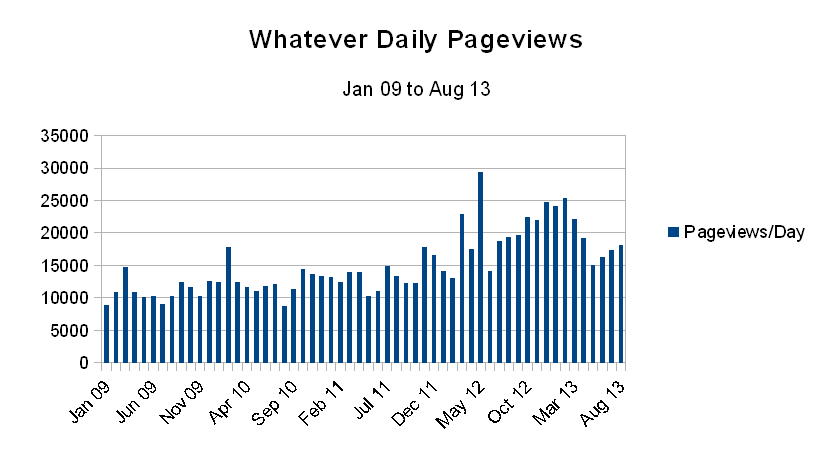
But not entirely. Note that Mr. Scalzi attempts to deceive his readers again as he falsely claims “the bone of contention appears to be that I note the site gets up to 50,000 visitors a day”, when I have repeatedly agreed that the claim of “up to 50,000 visitors a day” is true.  I even noted that he could correctly claim up to 100k visitors per day. Notice how Scalzi carefully uses the term “appears to be” when he knows perfectly well that the bone of contention is his false claim that “my site gets 50K readers a day” and “Promote your book to my 50K daily blog readers”.

There is no question that John Scalzi repeatedly lied about his traffic. He publicly lied about it by a factor of more than 18. And moreover, by choosing to repeatedly represent his traffic by its all-time highs rather than its averages, he is engaging in statistical misrepresentation in order to significantly exaggerate the popularity and influence of his blog.  And he is being risibly dishonest when he declares “I scale it down a bit because, you know. I don’t wish to oversell the site’s reach.”  If he didn’t wish to oversell the site’s reach, he wouldn’t hide his statistics and then selectively report them in a statistically misleading manner in the first place!

For those interested in the technical side of things, it’s worth noting that WordPress is modestly generous with its pageviews, about 5 percent more than Google. I tend to prefer Google’s metrics myself because they have smarter engineers and their business revolves around statistics. But regardless, if you click on the Sitemeter icon on the left sidebar, you’ll see that VP has had 25,464,336 pageviews. Adjusted for the 2013 WordPress/Sitemeter ratio, that corresponds to 49,464,473 pageviews.  Those 49.4 million pageviews date back to October 2003, so I have averaged 13,552 WordPress pageviews here since then and another 6,710 per day on Alpha Game since March 2011.  That’s a total of 20,062 daily WordPress pageviews, 46 percent more than Whatever. So I must have more readers, right?

Wrong. For various reasons, my readers average 10 pageviews per day. So, I’ve averaged 2,006 readers per day over the complete history of my sites, fewer than Mr. Scalzi’s 2,740 daily post-2008 readers.  The numbers more or less double on both sides if we limit the time period to 2013, but a similar ratio remains. I have more pageviews but Mr. Scalzi has more actual readers. That’s why, when you see people citing statistics without providing the raw data, you always have to consider them carefully in order to determine whether they are being used to mislead you or not.

It is informative to observe that despite his bestselling novels and his various literary awards, Mr. Scalzi is so insecure and relentlessly self-promoting that he still feels the need to lie, spin, and statistically misrepresent his site traffic. There are numerous widgets that allow him to display his traffic openly on his site, as I and many other bloggers have always done. (I don’t display the Google stats widget on this site as I do on AG because it doesn’t work with the old Blogger template utilized here.) Until Mr. Scalzi adds such a widget to Whatever, it will be readily apparent to everyone that promulgating a false perception of popularity is more important to him than personal integrity.

UPDATE: Scalzi is still dissembling even when called on it.

“I believe the problem several of your critics have with the
reporting of your site numbers was that you said you had 50k readers per
day, before you began saying you have ‘up to’ 50 k readers per day.”

Then several of my critics are either ignorant or mendacious trolls,
because I’ve had “up to” here for years, since at least the first post
on the subject in 2010, where I talked about the problem of accurate
stats reporting. If these folks are relying on the occasional comment on
the character-limited medium of Twitter as examples of me dissembling
when accurate, detailed information on the subject is easily accessible
on my personal site at all times, volunteered by me,
then we’re back into the “mendacious troll” category. Which is not at
all surprising, given the one particular dipshit who is the most
exercised about it.

Isn’t John clever, leaping to capitalize on the questioner’s mistake in saying “before”.  Yes, Scalzi did previously refer to his traffic utilizing the misleading “up to” method; in fact he began doing so almost as soon as he had reached that level once.  The point, which McRapey specifically lied about in his statement concerning “the bone of contention”, is that for a nine-month period beginning in late 2012, Scalzi stopped claiming “up to 50k daily blog readers” and switched to claiming “50k daily blog readers”.  He went from statistically misrepresenting his traffic to straight-up lying about it.

With regards to “the character-limited medium of Twitter”, I note that McRapey had 21 spare characters in the one tweet, and 36 spare characters in the other.  I also note that “up_to_” requires all of 6 characters.  It appears he’ll throw any excuse out there without even stopping to think how easily it is demolished.

After I called him out, he retreated to mere statistical misrepresentation again.  And notice that despite his claim to provide “accurate, detailed information on the subject [that] is easily accessible
on my personal site at all times, volunteered by me”, there is still no traffic widget or Sitemeter link being displayed on Whatever.  The information McRapy provides is accurate and detailed, but it is also incomplete, misleading and observably susceptible to self-promotional spin by Mr. Scalzi.

I am pleased McRapey is finally indicating his willingness to provide accurate and detailed information.  I’m sure we all support him in that. All he has to do is display the Analytics widget for WordPress and that will remove any reason to doubt his integrity concerning his site traffic in the future.  Of course, after he does that, he might want to consider getting a head start on coming clean concerning the historical “bestseller” status of “Fuzzy Nation”….

And for the benefit of Phoenician: “______ mancrush ______ obsession _______ laughing at _______ Dipshit
______ your father_______ jealous ________ self-made ______ lawn
______”



Mailvox: I want to homeschool, but….

WK has a problem getting his boy to listen and obey:

 I have a 5 year old boy in a private Montessori school
because I failed to produce results at home.  I and my wife worked with
him using a montessori type home method. We spent quite a bit of time
and money getting the tools and setup right for him.  What is obvious to
me now is that he listens and pays more attention to other teachers in
his life other than us, the parents.  For example, I had been trying all
summer last year and this year to teach hold his breath underwater.  I
signed him up for swimming lessons with the schools in August.  He met
his teacher, an 18 year old girl, for about a minute.  She jumped in and
had my son jumping in the pool and holding his breath underwater in
about 10 seconds.  Talking with other parents I know, what I experienced
appears to be fairly common.  I am not sure if there is word for what I
described above, but there should be for this concept.  I quick search
through the homeschool blogs looking for answers and the most common
answer appears to be a shaming of the parent that they can’t get their
child to listen to them.

I quote: “You are the parent and it is your responsibility to
train your children to listen to you. Whether you homeschool or not,
they should be respectful and attentive to you.”

That’s
all fine and dandy, but I can’t be accused of not putting enough time,
research, love and effort into getting my child to listen to me and
homeschool.  I don’t have results from my work with my son.  You can’t
help but notice that at his montessori school he listens to his teacher
and does his work great.  (The school has an open door policy with
parents to come and see how their kids are doing).  I think that the
above must be a common problem for homoeschooled kids based on my limited experience.  How am I to get my kids to homeschool effectively? 
Otherwise I am going to be school poor sending my kids to private
school to avoid the slaughter at public school.  Quite honestly, a
private montessori school will still have its problems too.

I’m going to have to turn it over to the Dread Ilk on this one. I have no problem getting my kids to listen to me and neither does Spacebunny. Of course, I never had any problem getting 35 kids between 6-8 to do exactly what I told them to do at soccer practice either.
Since the kid is only five, it seems unlikely that rebellion is the issue.  My guess is that the boy knows his parents love him and he has reason to believe that he has veto on anything they tell him. For example, if my kids had resisted jumping in the pool, I’d simply have thrown them in. I don’t know if WK tried that or not, but I find it hard to imagine that anyone could spend months trying, and failing, to get a kid to jump in the pool unless he never just threw the kid in.

In most cases, a parental inability to command obedience is a parental failure to demand it.  I say this, not to shame, but to point out that the problem is likely related to expectations and communication. As long as the father offers the child a choice, he can’t fault the kid for choosing the option that the father doesn’t want. If it’s not your intention to let the child choose, then don’t pretend to give him an option.

And the correct response to “But I don’t want to” is “I didn’t ask for your opinion, I told you what to do.  Now do it.”


Diversity and collapse

Most people who have paid any attention to the financial crisis know the Bush administration’s pathological fixation on expanding homeownership among Hispanics played a contributing role in blowing the housing bubble, but I didn’t realize that diversity dogma also played a part in the collapse of Lehman Bros. Steve Sailer quotes from A Colossal Failure of Common Sense, a book by an ex-Lehman executive, describing how the president of Lehman was more interested in diversity and inclusion than in risk management.

One of these was our corporate president, Joe Gregory, the right-hand
man of the reclusive CEO, Dick Fuld. … But Joe Gregory was a regular,
run-of-the-mill, ho-hum financial sycophant, devoted to his master,
Richard Fuld, … Joe’s fixation was a subject called diversity. He was
consumed with it. His aim was the mission of inclusion. He had an entire
department devoted to it, headed up by a managing director. Great
rallies were staged in New York’s auditoriums, with free cocktails and
hors d’oeuvres served for up to six hundred people, all listening to Joe
or one of his henchmen pontificating. “Inclusion! That must be our
aim!” he would yell, as if we were running a friggin’ prayer meeting.
… Which was all very well, but down in the trenches, where a trader
 might sweat blood to make a couple of million dollars, most of us were a
bit tetchy about Joe Gregory going off and spending it on a cocktail
party for six hundred people..

… Especially when it emerged that the top dog in diversity was earning
well over $2 million a year and that the diversity division had a
bigger budget and more people than risk management!

Joe’s mission for diversity drove [Christine Daley, head of
distressed-debt research] mad. She had no time for any of it, but Joe
Gregory had us all over a barrel: he had major control over our bonus
compensation, and he made it clear there would be extra money for those
who rallied to his cause. Most of us did not care about the cause, but
the prospect of this thirty-first-floor sycophant lopping a couple of
hundred thousand off our annual check because we weren’t in there
pitching for the cause of the day was seriously irritating. Harsher
judges than I considered Joe hid behind his unusual fixation,
appearing to fight the world’s woes while staying well clear of the
gundeck.

As go corporations, so go nations. The ongoing fixation of the USA’s politicians and body politic on diversity and inclusion means that the country is unlikely to sustain itself any more successfully than Lehman Bros. did.


Strength vs speed

Yesterday I was feeling pretty good. My elbow is back in order, so I was able to do heavy arms for the first time in nine months, topping out with 8 reps at 47 kg on the straight bar curls. My shoulder has recovered too, and while I’m not anywhere near my peak strength, that’s mostly the consequence of having to bench light for the last four months.

Today is another story. I didn’t like running into a few midfielders two weeks ago who could outrun me, and watching the national Under-15 team play recently was a reminder of how much of an advantage speed can be on the field.  So, I decided that running a few speed workouts might help me regain a bit of the speed I’ve lost over the two decades since I last ran track.

Back in college, our weekly speed workouts usually consisted of running 200 meters, walking 100 meters, jogging 100 meters, then doing it again. We ran them between 28 and 30 seconds; anything over 30 didn’t count and meant a do-over. An “easy” day was six, the worst was a punitive day in which we ended up running a hellish 15. That was ugly.

After jogging two warmup laps on the 400m track, I ran the first one.  It seemed okay, although I felt a bit heavy and was huffing and puffing a bit towards the end. Even so, I was a little shocked when I was informed that the time was 34 seconds.  So, after walking and jogging around to the far side, I decided to pick up the pace on the curve a little. 35 seconds. That one burned, both physically and psychologically. I tried to cruise the curve and kick on the flat for the third… and found I couldn’t finish without slowing down. I didn’t even bother asking for the time.

Now, it’s not like I’m utterly out of shape. I played 60 minutes in the midfield in last week’s game and was just starting to feel like I’m in game condition in our last practice. But I’m not sure that even if I had blocks, spikes, and the wind at my back that I could crack 30 now… and I used to do it in 22 seconds. Now it appears I can’t run three under 36 and it took about ten minutes for my glutes to stop burning.  About the only good sign was that my wind was fine; soccer appears to have helped in that regard.

We went home and told Spacebunny that I wouldn’t blame her if she wanted to trade me in on a newer model. Heck, I want to trade me in on a newer model.

Quote of the day: “It’s okay, Daddy. We can come back tomorrow and you can try again.”

I will try again. And again. I’m determined to get down to 30 seconds in the 200m (theoretically doable) and I’d like to get down to 12 in the 100m, (which may not be possible). But not tomorrow.  Most definitely not tomorrow.


NSA treason

It should be interesting to see how deeply the latest Snowden revelation concerning systemic Israeli spying on US citizens gets buried by the mainstream media:

Since 2009, the National Security Agency (NSA) has been sharing raw signals intelligence (SIGINT), including information about specific US people, directly with Israel’s counterpart to the NSA, The Guardian reported on Wednesday. The British newspaper’s revelation comes once again from the documents provided by former NSA contractor Edward Snowden to American journalists Glenn Greenwald and Laura Poitras.

According to the five-page memorandum of understanding, the agreement appears to be a one-way street. Israel, at least as far as this document is concerned, is not obligated to reciprocate….

The NSA knew that the Israelis might be looking at information about
US citizens—but they wanted to make sure that US government employees
weren’t snooped on. According to the document, Israel must immediately destroy any
communication that is “to or from an official of the US Government,”
including anyone from the executive, legislative, or judicial system,
“independent of seniority or position.”

Despite the cooperation, Israel is viewed as more of a “frenemey” than a close ally. The Guardian
also quoted from, but did not publish, what it described as “another
top secret document” from 2008, where a “senior NSA official points out
that Israel aggressively spies on the US.”

It should be informative to learn precisely who at the NSA was responsible for producing this memorandum of understanding. I expect it’s probably a group of Scots-Irish employees who are completely and singularly loyal to the American national interest.

And I’m certain the Israelis have been fastidious about destroying every email to or from a U.S. politician.


A casino called Dow Jones

This announcement demonstrates why it is the height of stupidity to imagine that it is meaningful to compare the Dow Jones Industrial Average from one year to the next as anything but a measure of social mood:

The Dow Jones industrial average is getting a new look, with one of Wall Street’s oldest and modest venerable names getting added to the mix. While the Dow tinkers with its 30 components periodically, often with only modest fanfare, this one will be noticed.

Gone are Alcoa (AA), the company that traditionally kicks off earnings season, along with Bank of America (BAC), which is the second-largest financial institution in the U.S., and Hewlett-Packard (HPQ), which has been in the blue chip index for 16 years.

In their place will be Goldman Sachs (GS), Nike (NKE) and Visa (NYSE:V). The changes take effect after the close of trading Sept. 20. The changes will cause alterations to the why the index is weighted. Visa and Goldman Sachs will have the second- and third-highest respective weightings, according to Bespoke Investment Group.

In addition to not accounting for inflation, the DJIAA simply doesn’t always measure the same thing from one year to the next.  It is like claiming the New England Patriots beat the Bills 58-21 last week because the NFL tinkered with the Patriots roster and replaced Tom Brady with Peyton Manning.

Notice that the unhealthy and dying companies are being replaced with much healthier companies that are being given much higher weightings than their importance to the economy would appear to indicate.  Don’t be fooled. It’s all a giant casino designed specifically to separate most common investors from their savings.

Can you win from time to time? Sure. That’s an integral part of the draw. But as the rejiggering proves, the odds aren’t what you think they are and the house always wins in the end.


Book Review: The Last Witchking

Lagrandil reviews The Last Witchking:

When I started The Last Witchking (which I chose in part
because it was free from Amazon.com for the Kindle) I didn’t know much
about Vox’s fantasy world.  I had heard vague rumors that he was writing
a Christian reply to the superbly-crafted and spiritually toxic Game of Thrones series.

I couldn’t have been more wrong.

The short stories in The Last Witchking have nothing to do with Martin’s crime against fiction.  Witchking
is not directly derivative of any single voice in the fantasy genre. 
Instead, much like Jordan before him, Vox draws richly on the expansive
fantasy lore of the western tradition while avoiding some of the more
common pitfalls of the current writing generation….

“Opera Vita Aeterna” was a fascinating insight on what I believe to be
one of Vox’s oldest ideas in this world: the interplay between
Christianity and non-human races.  In this case it’s the story of a
master sorcerer elf who spends a paltry few years in a humble Christian
monastery.  This was easily my favorite piece of the three.  It also
illuminates a relevant point about Vox Day’s style.  The man is
educated, and while he doesn’t waste time rubbing anyone’s nose in that
fact, neither does he write for the lowest common denominator.

NB: If you liked the covers for the three Selenoth novellas, they were all produced by JartStar, who is now open for business. Click on the banner below if you’re a writer who is in need of a good cover for a book at a reasonable price.


Book Review: Tales of a New America III

MC provides a third look at Gunther Roosevelt’s Tales of a New America:

Story (1 out of 5 stars): The concept of a “history” of the American continent fifty years hence is a subject that offers many potential avenues of exploration.  In the introduction to the work, we are promised twenty three “snapshots” of a “new society in the making”, a “panorama through time”.  Would that the work progressed in this direction!  Instead we are given loosely related and random vignettes showing nothing more than that the author knows how to quote St. Paul, and is very angry with leftists.  If we want to rightly mock the grievance-mongering heavily prevalent in modern fantasy/science-fiction, we should be careful that the works that we promote aren’t simply right-leaning paranoia/wish fulfillment.  In the first third of the work, when the author should be framing the story, we are instead treated to a seemingly endless list of the sins of liberalism.  For example, a general in the New American Army was orphaned at a young age, as his parents were raped and murdered by illegal aliens!  I imagine the author intended that only the mother was raped, but certainly Virginia could be a hotbed for homosexual illegal aliens. 

If one can stomach the tired airing of grievances, the work still confronts the reader with an array of jarring technical omissions and implausible leaps of faith.  In the third chapter, an intrepid border patrol agent at a crossing in the sleepy area of North Jackpot uncovers a Chinese spy (!?) through what has to be the most absurd made-for-crappy-TV interrogation in literary history.  Later on, when the plenipotentiary for the New American Republic is meeting the president of the (old) United States, the parties are able to immediately obtain a video conference with US weapons-inspectors conducting a tour of an NAR facility, and then after having providing the coordinates of hidden packages, sit back in satisfaction as the police forces across multiple cities IMMEDIATELY find the packages.  Keep in mind; these are the same police/government forces that couldn’t stop the creation of a billion dollar shale-oil drilling company a few chapters later.

Put simply, there is no story.  There is an endless array of complaints, biographical stubs, glossing over of inconvenient details, and just enough deux-ex-machina-ing to keep the story moving.  The work feels simultaneously too ambitious and too summarized.

Style (2 out of 5 stars): In addition to the issues detailed with story and character, the work is also a technical mess, full of typos, incorrect word usage and incorrect capitalizations.  The work screams for the attention of a competent editor.  One gets the sense that the reading quality of the work could be substantially improved through simple re-arranging of already existing sentences and phrases. 
Additionally, the very structure of the entire work misses quite wide of the mark.  A short story book should not try to be a novel.  Witness the approach of World War Z.  Similarly, a novel should not try to be a collection of short stories, as this work tries to be.  Instead of either a series of snapshots (as promised, but probably not intended) or a tightly scripted and unified plot, we get a story that bounces back and forth across twenty three chapters, trying to tell too many stories, and in the end, not telling much of a story at all. 

Characters (1 out of 5 stars): Perhaps the greatest weakness in Tales of New America is the atrocious development of characters.  There are no characters that are anything other than archetypes.  The “right-wing” characters are introduced, small biographies are provided, and they quote either St. Paul or Rochefoucald in convincing someone to work against their long-held beliefs before disappearing back into the ether until needed again.  The “left-wing” characters are similarly introduced, a few hideous character flaws are detailed or illustrated, they bemoan the suffering their own idiocy has pulled down upon their heads, and then they too vanish back into the ether.  Smooth talking pastors convince a council of Christian ministers that racial and religious discrimination is just hunky-dory.  The female government worker is of course single, and of course has three cats waiting for her at home (don’t worry about the fate of our forlorn feline friends, as they are saved when a community of neighbors who barely know each other spontaneously combine to organize a break-and-enter effort to feed the three of them).  The president of the (old) US can’t provide any defense for the policies of his country, because the NAR representative is just that much more forceful a personality than he.  A college football coach goes to a white recruit’s house and starts pontificating on how the NCAA is just a giant black conspiracy.

The endless quoting of historical figures quickly gets tiring; if there is a page with more than two sentences of monologue or conversation, you can bet your life that someone is quote-dropping.  St. Paul, Rochefoucald, Dylan Thomas, Bill Ayers (don’t ask), Jim Emerson, Abraham Lincoln and others make repeated appearances, peppering the otherwise drab dialogue with bon mots of historical significance. 

Creativity (2 out of 5 stars): The recent popularity of despair porn should tell against any work that attempts to tell the story of a collapse of the United States, but I’m not aware of any other work that blames the collapse on minorities, gays and the Star Wars program.  Kudos to the author for attempting what is, admittedly, an unconventional work.  The problem arises, as noted, when that explanation decays into clichés. 

Overall, Tales of New America falls short of the mark in every area.  Were it not for the commitment of writing the review, I might have quit this book around the third chapter (I see now, in reading Mr. Rhodes’ review that he has made the same point).  Tales of New America reads like a good rough-draft, a spark of genuine possibility in a pool of frustrating issues, rather than as the finished product it purports to be.  As an aspiring reactionary author who dreams of a work of popular fiction that could advance our ideas, I had such hopes for this upon reading the introduction.  Those hopes were quickly dashed by Mr. Roosevelt.


Listen to me

The NFL responds, weakly, to the politically correct opinion editorialists who deceptively call themselves “sportswriters”:

NFL Commissioner Roger Goodell softened his stance on the Redskins name on Wednesday when he said that the NFL had to listen to concerns about the team’s nickname even if only one person is concerned about it.

In an interview on 106.7 The Fan in Washington, Goodell, who grew up in the region as a Baltimore Colts and then Redskins fan, said, “I think what we have to do though is we have to listen.”

“If one person is offended, we have to listen,” he said.

Goodell’s remarks come after Sports Illustrated’s Peter King’s website decided to refer to the team as the Washington football team. Earlier in the year, in response to 10 members of Congress who wrote him demanding action, Goodell defended the name. Redskins owner Dan Snyder has said he will “NEVER” change the team name and does not intend to sell the franchise. 

Then listen to this, Mr. Goodell. I am offended, DEEPLY AND SINCERELY OFFENDED, that Christian Ponder is frequently referred to, in print, radio, and television media, as “the starting quarterback of the Minnesota Vikings”.

What is the NFL going to do about this insulting and offensive travesty that tarnishes the legacy of a proud franchise and a loyal, emotionally scarred fan base?  That’s what I want to know, Mr. Goodell.  THAT’S WHAT I WANT TO KNOW!

I’m also offended by all the hot pink. I have a solution, though. If the NFL wants to raise breast cancer awareness for a month, just have the cheerleaders go topless. That will raise considerably more awareness than all the ridiculous pink accoutrements.


Vladimir Putin on Syria

It is tragic when the ruthless leader of Russia makes considerably more sense, and better expresses American national interests, than the President of the United States:

No one doubts that poison gas was used in Syria. But there is every
reason to believe it was used not by the Syrian Army, but by opposition
forces, to provoke intervention by their powerful foreign patrons, who
would be siding with the fundamentalists. Reports that militants are
preparing another attack — this time against Israel — cannot be ignored.

It is alarming that military intervention in internal conflicts in
foreign countries has become commonplace for the United States. Is it in
America’s long-term interest? I doubt it. Millions around the world
increasingly see America not as a model of democracy but as relying
solely on brute force, cobbling coalitions together under the slogan
“you’re either with us or against us.”

But force has proved ineffective and pointless. Afghanistan is reeling,
and no one can say what will happen after international forces withdraw.
Libya is divided into tribes and clans. In Iraq the civil war
continues, with dozens killed each day. In the United States, many draw
an analogy between Iraq and Syria, and ask why their government would
want to repeat recent mistakes.

At least Mr. Putin has given us a head’s up on what could be the next international false flag: a highly improbable inflammatory attack on Israel by either Iran or the Assad regime that isn’t in response to a US assault on Syria.

Meanwhile, our elected leaders demonstrate that Idiocracy was, indeed, prophetic:

“I almost wanted to vomit,” Senate Foreign Relations Chairman Robert Menendez, (D-N.J.) told CNN. 

He so totally wanted to hurl. So, we should, like, TOTALLY invade Syria. Because Holocaust. Duh.

“Putin’s NYT op-ed is an insult to the intelligence of every American”
— John McCain (@SenJohnMcCain) September 12, 2013

No, Mr. McCain, your presidential campaign was an insult to the intelligence of every American. And the fact that you still have a political career at all is testimony to the corrupt nature of the U.S. political system.