Mailvox: Atheist Philosophy in action

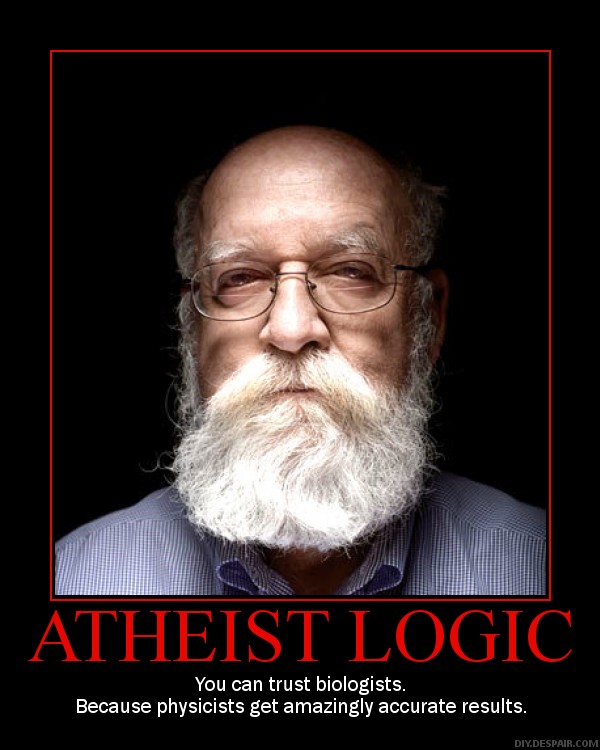
BH is bemused by a PhD’s resort to an amusing variant of the very atheist logic I mocked six years ago in TIA:

I’ve been parrying on FB with an honest-to-God PhD engineer at IBM who asserts “evolution must be true because GPS works.” His logic: because general relativity is learned from observing the stars, and the stars are billions of years old, therefore evolution is true.

Because I learned to eat crumbs that fall from the table of the most able Internet Cruelty Artist, I’ve been mercilessly pointing out his errors in reasoning, illustrating his absurdities, etc., while laughing at him.  He demanded acceptance with the premise that “ALL science requires that evolution be true.” (He repeated it over and over, comment after comment… gee, Aspergers much?)  So I asked him if my dentist needs to believe in evolution in order to clean my teeth.  ‘Yes, they need to understand that bacteria evolved 500 mya before they can clean teeth.’

I hadn’t personally encountered this level of idiocy before.

As I have occasionally noted, it takes a considerable amount of education to reduce a formerly intelligent individual to the level of a complete idiot. A PhD isn’t absolutely necessary, but it does appear to help. The IBM engineer is merely engaged in the usual bait-and-switch; he’s trying to defend evolution by cloaking it in the protective veil of real science that provides reliable results.


The new Marcher Lord Press

This should suffice to explain my rather cryptic post the other day. Marcher Lord Press has been sold:

Steve Laube has officially purchased Marcher Lord Press from Jeff Gerke. There will be a question and answer post on Monday, January 6th on Steve’s own site that we will link when the post is up.The official press is as follows:

STEVE LAUBE BUYS MARCHER LORD PRESS

(Phoenix, AZ) Steve Laube, president of The Steve Laube Agency, has agreed to purchase Marcher Lord Press, the premier publisher of Science Fiction and Fantasy for the Christian market. The sale was finalized on January 1, 2014. Laube has long been a champion of the genre, going back to his days as an acquisition editor at Bethany House Publishers. Jeff Gerke, the founder of Marcher Lord Press, said “I could not have found a better person to buy the company I started in 2008.”

Marcher Lord Press has a backlist of about 40 titles with many of them nominated or winning both Christy and Carol awards for being the best in their genre.

I certainly wish Mr. Laube great success with Marcher Lord. That being said, I will not be a part of it. I have reacquired all the publishing rights to the Selenoth and Quantum Mortis books and will be re-releasing them through the publishing arm of Alpenwolf.

Alpenwolf will continue to release hardcovers as well as ebooks and the books will continue to feature covers from the two artists who provided the six existing covers, JartStar and Kirk DuPounce.


Mailvox: The Fahrenheit Registry

Anang laments his inability to continue supporting authors who are his political enemies: 

As an author you
obviously want your works reaching the widest possible audience without
sacrificing your own creative vision. At the same time, I believe an
author’s ideology, his Weltanschauung is
reflected in his works. I’m a new and proud male American citizen. Why
should I pay my good money to read or watch something that ignores and
insults my gender, my politics or the things that made me want to be an
American?

 It’s
a little sad actually, having discovered I think this way. It means I
can never enjoy some of the most creative artists currently living. I
threw away my collection of Naomi Novik’s fantasy books after I realized
she was a local party volunteer for John Kerry’s 2004 election. All her
meticulous research into creating an alternate, fantastical history of
the Napoleonic Wars was just to insert leftist ideology and harp on
social justice/race theory/gender inequality.

It’s
a very lonely feeling, to know you are cut off from nearly every work
of popular entertainment and art if you wish to avoid propaganda-filled attacks on your existence. I suppose that is why most men watch
sports.

I knew Novik’s books fell completely apart upon the visit to Australia, (never managed to finish that one), but I didn’t realize there was a sound political reason for it. I think Anang forgets that there are actually many excellent writers who support and sustain the Western intellectual tradition; the fact that they have been exiled by the Left’s gatekeepers doesn’t mean their works don’t exist or can’t be found. In fact, increasing the exposure and awareness of Blue SF/F writers is one of my objectives in the coming year.

Perhaps it would be helpful to maintain a political registry of SF/F writers so we can permit those who don’t wish to financially support their enemies to avoid doing so. This doesn’t mean one has to avoid reading them entirely, of course, as The Pirate Bay, LibGen, and other sites have far more books that one can hope to read in a lifetime. For example, here is LibGen’s list of the current SFWA president Steven Gould’s books, in the unlikely event that anyone feels any pressing need to read them. As an added bonus, I can tell you that the SFWA absolutely hates and fears those sites; the idea that people can download their books for free seems to bother them considerably more than simply being ignored.

Never mind that there is no evidence indicating that pirated books actually harm an author’s book sales. As I’ve noted, about one in five free Amazon downloads turns into a purchase of A Throne of Bones, which is why I’d love to give away more than the 21,760 copies that were downloaded in 2013.

My thought is that one can rate an author in terms of “noviks”, in honor of Anang’s epiphany.  10 noviks would indicate an author that conservatives, Republicans, libertarians, and traditionalists should avoid at all costs on the basis of his anti-civilizational beliefs and activities. On the other side, 10 “kratmans” would indicate a staunch defender of Western civilization. Here are a few suggestions for the scale:

Naomi Novik: 5 noviks
China Mieville: 9 noviks
Charles Stross: 7 noviks
Larry Corriea: 8 kratmans
JRR Tolkien: 10 kratmans

I leave it to the rest of you to provide the ratings. I shall merely post them as they are added.


Searching everything for any reason

So much for security in one’s papers and effects. At this point, the federal courts aren’t even really trying to pretend the Constitution is still in effect:

A federal court today dismissed a lawsuit arguing that the government should not be able to search and copy people’s laptops, cell phones, and other devices at border checkpoints without reasonable suspicion…. In June, in response to an ACLU Freedom of Information Act request, DHS released its
December 2011 Civil Rights/Civil Liberties Impact Assessment of its
electronics search policy, concluding that suspicionless searches do not
violate the First or Fourth Amendments. The report said that a
reasonable suspicion standard is inadvisable because it could lead to
litigation and the forced divulgence of national security information,
and would prevent border officers from acting on inchoate “hunches,” a
method that it says has sometimes proved fruitful.

The absurd thing is that the reasoning that justifies the open abandonment of the Constitutional limitations on the federal government could be used to justify literally anything. Sure, a hunch could lead to stopping a terrorist attack, of course, it could just as credibly lead to stopping a demonic invasion by transdimensional god-aliens.

And yet, it strikes me that there is no “terrorist attack” or “demonic invasion by transdimensional god-alien” clause anywhere in the Constitution. It must be in one of those emanations or penumbras. This is why you can’t ever allow for “reasonable exceptions” in any organization. It never takes long for the reasonable exceptions to become unreasonable ones.

The rule of the game is now pretty simple. The federal government rules by a combination of force and fraud. They’re unwilling to openly throw out the Constitution, but the fig leaves they are using these days to cover their actions are growing increasingly small.


Rights roundup

Finding Climate Change

There are some who doubt that God exists. They obviously haven’t been
paying much attention to the events at the South Pole, where the MV
Akademik Schokalskiy was carrying a group of true believers in the
gospel of Al Gore to document environmental changes there. For we now
know beyond any shadow of a doubt that God not only exists, but has a
rather puckish sense of humor.

Racism in the Obama Regime

So it appears that despite my doubts, the so-called “Knockout Game”
exists after all. It turns out that it is a game of hate crime in which
young white thugs attempt to knock out innocent elderly black men.


Do-It-Yourself Police

It should surprise no one that a county government would prefer to see
people hand them money and permit them to oversee the spending of it
than take matters, and responsibility, into their own hands. The entire
concept of “big government” is a socialistic one that depends entirely
on the idea that centralizing decision-making will inevitably lead to
better societal outcomes. The fact that this is much more often false
than it is true never even slows down those who benefit materially from
the structure from shamelessly attempting to push it on everyone.


Traffic Report 2013

At this time last year I wrote the following: “By the end of 2013, I wouldn’t be terribly surprised to see the
occasional month pushing somewhere between 800k and 900k Google
pageviews.  And if the Alpha Game traffic eventually surpasses Vox
Popoli’s as I have always assumed it would, given the higher level of
interest in intersexual relations than in economics, SF/F, and my
personal ideosyncracies, the two blogs may well surpass 1.1
million/month next year without requiring any well-linked monster posts.”

As it turned out, the blogs surpassed 1.1 million pageviews per month by June. However, this wasn’t the result of Alpha Game surpassing Vox Popoli, as both blogs steadily gained readers even prior to the SFWA kerfluffle that led to more than 1.3 million pageviews in August. Traffic leveled off a bit once that situation was resolved, but remained strong as December marked the ninth straight month of more than one million combined Google pageviews.

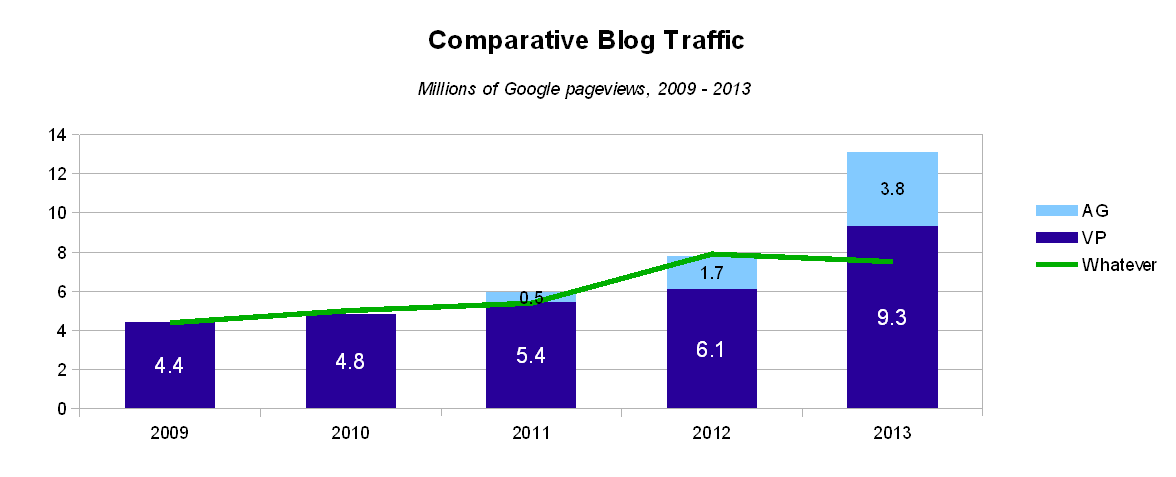
In 2013, Vox Popoli had 9,340,663 pageviews and Alpha Game had 3,771,032 for a grand total of 13,111,695 Google pageviews. To the left is a chart showing the monthly traffic for both blogs for the last three years. It’s fascinating to look back and see that in five years, Vox Popoli has picked up an additional six million annual pageviews without Alpha Game. And with Alpha Game included, the annual total is nearly ten million higher. Alexa ranks also improved considerably in 2013: Vox Popoli from 29,426
(153,650) to 5,227 (41,452) and Alpha Game from 73,183 (215,234) to
11,851 (78,888). This tends to confirm my skepticism of the survey
methodology and helps demonstrate why I prefer to track historical traffic in pageviews.

2008: 3,496,757
2009: 4,414,801
2010: 4,827,183
2011: 5,969,066
2012: 7,774,074
2013: 13,111,695

I would be remiss if I did not, for no particular reason at all, continue with a certain comparison that was repeatedly brought to my attention in previous years. This is, of course, the comparison with the hugely famous and massively popular Whatever blog. I find it both amusing, and all too typical, that while this comparison was originally cited as evidence of my inferiority, now that the comparison happens to have turned in my favor it is cited as evidence of my supposed insecurity and/or the number of evil people on the Internet. In any event, the following chart shows the comparative blog traffic over the last five years as measured in Google Pageviews.

Having done my part for charity and having successfully exposed the myth of Whatever’s claimed “50,000 daily readers”, I assume there won’t be as much occasion to reference Mr. Scalzi in 2014 as there was in 2013. I could certainly be wrong, of course, as who can possibly predict what surprises the Chief Rabbit of the Whatever Warren will have in store for us in the coming year. One way or another, I expect we will be provided with at least a modicum of continued entertainment on that front.

Whether you often agree with me or not, I appreciate that so many of you continue to take the time to stop by and peruse my idiosyncratic observations on various and sundry matters. I am also pleased that many of you take such an active part in the ongoing discourse here. We have lost some legends along the way, but the river of comments flows ever on. When I started this blog ten years and two months ago as a mailbag for my WND column, I had absolutely no idea that one day it would outlive the column. And yet, the column is gone and no one appears to have even blinked an eye, let alone missed it.

Considering my complete inability to foresee a 69 percent increase in traffic for the two blogs in 2013, I see little point in attempting to forecast anything. That being said, given the increased interest in economics in a slowing economy, in HBD in an unraveling society, and my continued expectation of AG eventually surpassing VP, it is not entirely unthinkable to imagine that next year could see a 2-million pageview month. But whether there are ten people or ten million people reading, this blog will continue to be here for your amusement and mine.


Reading List 2013

Of the 81 books I read this year, the one I enjoyed most was Jill Paton Walsh’s remarkably good revival of Dorothy Sayers’s famous characters in A Presumption of Death, followed by Haruki Murakami’s 1Q84 and Nassim Taleb’s Antifragile. The
worst book I read this year was, without question, Isaac Asimov’s Forward the Foundation,
which is one of those ill-considered prequels that makes one wonder how the author ever managed to write the books that inspired them in the first place. I couldn’t even bring myself to start the third book in the trilogy, which was so dreadful that it almost caused me to reconsider the merits of the original Foundation trilogy. The
most disappointing book was Umberto Eco’s The Prague Cemetery. It wasn’t bad or poorly written, (in fact, it was remarkably well-researched), but it was unpleasant, the protagonist was a cipher, the literary device employed was both irritating and unnecessary, and there was little point to the plot itself other than to provide a creative explanation for the authorship of The Protocols of the Learned Elders of Zion.

On the non-fiction side, I read a number of truly excellent books this year. Rothbard’s An Austrian Perspective on the History of Economic Thought: Vol I is an epic must-read for anyone with any interest in economics, (I’m halfway through Volume II now), and Nassim Taleb’s Antifragile articulated some very important concepts towards which I’d been fumbling over the last ten years. I finally got around to actually reading Kuhn’s The Structure of Scientific Revolutions in its entirety, and re-reading Mere Christianity was, as always, both thought-provoking and encouraging. However, PJ O’Rourke’s Don’t Vote It Just Encourages The Bastards read as if it had been phoned in; either O’Rourke has lost his fastball or his effervescent conservativism was fatally discouraged by the Bush ’43 administration.

Keep in mind these ratings are not necessarily statements about a book’s
significance or literary quality, they are merely casual observations of how much I
happened to enjoy reading the book at the time. 

FIVE STARS
An Austrian Perspective on the History of Economic Thought: Vol I, Murray Rothbard
Panzer Commander, Hans von Luck
My Name is Asher Lev, Chaim Potok 
A Presumption of Death, Jill Paton Walsh
Antifragile, Nassim Taleb
Mere Christianity, CS Lewis
The Structure of Scientific Revolutions, Thomas Kuhn
Dune, Frank Herbert
Children of Dune, Frank Herbert
Inherit the Stars, James Hogan
1Q84, Haruki Murakami

FOUR STARS
Norwegian Wood, Haruki Murakami
Il Cavaliere Inesistante, Italo Calvino
Scoop, Evelyn Waugh
King Rat, China Mieville
Lord of Light, Roger Zelazny
Officers and Gentlemen, Evelyn Waugh 
Red Country, Joe Abercrombie
Aunts Aren’t Gentlemen, PG Wodehouse
Cosmicomics, Italo Calvino
Five Red Herrings, Dorothy Sayers
Clouds of Witness, Dorothy Sayers
Spellbound, Larry Correia 
Warbound, Larry Correia
Monster Hunter International, Larry Correia
Defense of the Divine Revelation against the Objections of the Freethinkers, Leonhard Euler
The Art of Game Design, Jesse Schell
The Gentle Giants of Ganymede, James Hogan
Giant’s Star, James Hogan
In Search of Stupidity, Rick Chapman

THREE STARS
The Theory of Money and Credit, Ludwig von Mises 
Mostly Harmless, Douglas Adams
The Meaning of It All, Richard Feynman 
Vile Bodies, Evelyn Waugh 
Sharpe’s Battle, Bernard Cornwell 
Sharpe’s Company, Bernard Cornwell 
Sharpe’s Sword, Bernard Cornwell
The Desert Spear, Peter Brett 
Macroscope, Piers Anthony
Greenwitch, Susan Cooper
Down on the Farm, Charles Stross
Terms of Enlistment, Marko Kloos
Men on Strike, Helen Smith  
Looking for Jake, China Mieville
Hailstone Mountain, Lars Walker 
Tales of the Dying Earth, Jack Vance
The Jewels of Paradise, Donna Leon 
Lord Talon’s Revenge, Tom Simon
Jhereg, Stephen Brust 
Yendi, Stephen Brust 
Teckla, Stephen Brust 
Taltos, Stephen Brust
Hard Magic, Larry Correia
Monster Hunter Vendetta, Larry Correia 
Monster Hunter Alpha, Larry Correia 
Tour of Duty, Michael Z. Williamson 
The Gap into Conflict, Stephen Donaldson 
Lights in the Deep, Brad Torgersen 
The Hydrogen Sonata, Iain M. Banks 
Busman’s Honeymoon, Dorothy Sayers 
A Desert Called Peace, Tom Kratman 
The Prague Cemetery, Umberto Eco 
Big Boys Don’t Cry, Tom Kratman
Dune Messiah, Frank Herbert 
Frostborn: The First Quest, Jonathan Moeller
On Sophistical Refutations, Aristotle
The Ocean at the End of the Lane, Neil Gaiman

TWO STARS
 Victory of Eagles, Naomi Novik
The Daylight War, Peter Brett
Infinite Jest, David Foster Wallace
Imperialism & Social Classes, Joseph Schumpeter
Phoenix, Stephen Brust 
Athyra, Stephen Brust 
Songs of the Dying Earth, Dozois and Martin, ed.
The Gap into Vision, Stephen Donaldson 
The Gap into Power, Stephen Donaldson
The Gambler, Fyodor Dostoevsky

ONE STAR
Prelude to Foundation, Isaac Asimov
Forward the Foundation, Isaac Asimov
Tactics, Asclepiodotus
Don’t Vote It Just Encourages The Bastards, PJ O’Rourke

Speaking Engagements

I occassionally receive requests for appearances from various organizations and conferences. While I appreciate the interest, I only accept speaking engagements in continental Europe and the United Kingdom. I do not accept speaking engagements in Asia or the Americas.

I should probably mention that I do not do book signings anywhere.


No public domain until 2019

Thank Disney for the artificial and immoral expansion of “copyright”:

Current US law extends copyright for 70 years after the date of the author’s death, and corporate “works-for-hire” are copyrighted for 95 years after publication. But prior to the 1976 Copyright Act (which became effective in 1978), the maximum copyright term was 56 years – an initial term of 28 years, renewable for another 28 years. Under those laws, works published in 1957 would enter the public domain on January 1, 2014, where they would be “free as the air to common use.” (Mouse over any of the links below to see gorgeous cover art from 1957.) Under current copyright law, we’ll have to wait until 2053.1 And no published works will enter our public domain until 2019. The laws in Canada and the EU are different – thousands of works are entering their public domains on January 1.

What books and plays would be entering the public domain if we had the pre-1978 copyright laws? You might recognize some of the titles below.

    Samuel Beckett, Endgame (“Fin de partie”, the original French version)
    Jack Kerouac, On the Road (completed 1951, published 1957)
    Ayn Rand, Atlas Shrugged
    Margret Rey and H.A. Rey, Curious George Gets a Medal
    Dr. Seuss (Theodor Geisel), How the Grinch Stole Christmas and The Cat in the Hat
    Eliot Ness and Oscar Fraley, The Untouchables
    Northrop Frye, Anatomy of Criticism: Four Essays
    Walter Lord, Day of Infamy
    Studs Terkel, Giants of Jazz
    Corbett H. Thigpen and Hervey M. Cleckley, The Three Faces of Eve
    Ian Fleming, From Russia, with Love
    Ann Weldy (as Ann Bannon), Odd Girl Out
    A.E. Van Vogt, Empire of the Atom

These works will instead enter the public domain in 2053… unless Disney finagles another extension. The fact is that there is no such thing as “copyright”, it is nothing more than a government-imposed intrusion on real property rights. No one need have any qualms about copying digital goods – including my own music and ebooks – because it is cannot possibly be considered stealing if you leave the original owner in the full possession of his property.

I’m not opposed to a limited copyright in order to encourage innovation. But the original term of 28 years was more than sufficient. What we have now is unjust, immoral, and the result of corpocratic government.


“Fixing” the NFL playoffs

Someone needs to punch Mike Florio in the mouth for being so abjectly stupid and trying to break what isn’t broken:

Today, the NFC West has a trio of 10-win teams; the fourth-place Rams have the same record as the Seahawks did when they won the division in 2010. But winning the division, no matter how bad a division may be, continues to carry a playoff berth and a home game.  While it would be unfair and impractical strip a division winner from a berth in the postseason, why does the best of four bad teams deserve a home playoff game?

The league has shown no inclination to take the automatic home game away from the division winner, but there’s no reason to continue to reward the best of four bad teams with a home playoff game.  Home-field advantage in the postseason should be earned not via six divisional games but by all 16.

Fortunately, the NFL has shown in recent years that it understands what so many media idiots do not, and that is the value of the divisional rivalries. The single reason there have been so many good games at the end of the last two seasons is that the NFL has finally gotten wise to the notion of ensuring that teams play a divisional rival on Week 17. This increases the chances that a Week 17 game will matter; three of the four NFC divisional championships were determined yesterday.

Here are the two primary problems that all the “seeding” criers fail to recognize. First, it would absolutely not be more fair to ignore the division winners and seed each conference by record. Because each team plays each divisional rival twice while not playing some teams in the conference at all, the schedules are not directly comparable. Within the division, the schedules are much more evenly matched, since each team not only plays each other twice, but also plays against teams in the same division. Each of the division races are therefore qualitatively different.

Second, even if we ignore the schedules and decide that the regular season records are the only things that matter, then how can it be argued that conferences are important when divisions do not?  If it is unfair for San Francisco to have to play at Green Bay when the 49ers have the better record, how can it be denied that it is even more unfair for a 10-6 Arizona team to miss the playoffs when an 8-7-1 NFC North champion Packers and a 9-7 San Diego wild card team qualify? If records matter more than divisions and conferences, but “it would be unfair and impractical strip a division winner from a berth in the postseason” then shouldn’t Arizona not claim the last seed in the AFC playoffs?

In fact, if we stick with the logic being cited, it should be obvious that it is unfair to permit a single game to decide the NFL champion rather than 16 regular-season games. In addition to getting rid of divisions and conferences, record-based fairness demands getting rid of the playoffs. Sound ridiculous? That’s precisely how Serie A awards Lo Scudetto. That’s how the English Premier League settles the English championship, along with every other European and Latin American country.

The NFL isn’t broken. People like Florio should stop trying to fix it. There are legitimate some problems, such as the officiating and the concussion/tackling issue, but there is absolutely no problem with how teams qualify for the playoffs. The move to four divisions per conference was a good one and the importance of the divisions, and winning a divisional championship, should not be reduced.