Very special. It really just… spoke to me for some reason. Hard to say why.
Category: Uncategorized
Trigger warning!
In which a USN Commander, RIDING THE RED HORSE contributor, and new Castalia House Associate comments on the new military science fiction anthology:
If having your assumptions challenged and your mind blown could upset your delicate little psyche, you’re gonna want to click away right now.
If harrowing scenes of speculative, futuristic combat or stories about the men and women who fight for something greater than themselves fill you with dread, flee from here.
If center-right positions, hard science, or frank discussions of our past mistakes and future concerns make you want to hide behind your momma’s petticoats, you’d best stick to your internet safe-zone with all countervailing opinions neatly blocked away.
If the phrase “Trigger Warning” is something you watch out for and is itself a potential trigger for bad-thought . . . yeah, I got a book you’re gonna want to avoid.
However, if you can handle it and are a fan of kick-ass science fiction, of near-prescient analysis on what our future holds, or of some of the best writing you’ll see all year by great authors both new and old, well, for you I have your new favorite book….
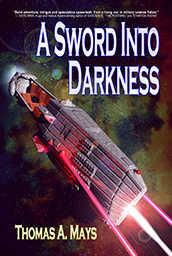
Read the rest of it there. What do I mean by “new Castalia House Associate”? What that means is that Thomas May’s very good first contact novel is now available in DRM-free EPUB and MOBI for Kindle format from the Castalia House store for $3.99. And by “first contact”, I should probably point out that I mean “violent space combat” with one of the most unusual alien races yet encountered in science fiction. If you enjoyed “Within This Horizon”, then you’re going to want to read A Sword Into Darkness.
The reaction to the new anthology has been almost uniformly positive, which is encouraging, but I have to say that I was probably most amused by these two comments at Instapundit’s.
- Tom Kraman and Vox Day…lemme guess, more of that namby-baby, Dem/Lib/SJW kumbaya fluff… said no one ever.
- Kratman AND Vox Day? Is the publisher TRYING to make SJW heads into IEDs?
The collection is Blue SF, to be sure, but it is moderately less Deep Navy Blue SF than you might expect, mostly because unlike the gatekeepers of Pink SF, Tom and I don’t believe in ruthlessly enforcing our ideological perspective on every contributor. As Larry Correia has gone to considerable pains to point out in the past, it is the story is the point, not the moral or the ideological object lesson. And the general conclusion appears to be that these are very good stories indeed.
When trends won’t hold
I think it is amusing that the U.S. Census Bureau still believes there will be a single political entity by 2044, let alone 2060.
New population projections released by the U.S. Census Bureau show that whites will become a “minority” by 2044, replaced by a “majority” of minority groups, mostly blacks and Hispanics.
The new projections, analyzed in a Brookings Institution report, show the huge rise of Hispanics, projected to make up 25.1 percent of the U.S. population in 2044, double African-Americans.
According to the analysis, the white will make up 49.7 percent of the country in 2044, minorities the rest. What’s more, by 2060, whites will account for just 44 percent of the country.
Imagine what the economy of the USA is going to look like when the white population has been halved, mostly due to their replacement by those famously productive Hispanics…. The only thing that is keeping the country together at this point is that the white middle class is still doing just well enough to maintain hope that things are going to turn around eventually. Once that hope is entirely gone, they will be willing to begin taking the risks that they are presently unwilling to take.
The government’s primary means of control is based upon the threat of losing your job and your living standard. But once those things are already gone, there is nothing but raw physical force. And we know from 4GW theory how well force devoid of legitimacy and moral authority works in maintaining order.
Re-reporting
That must be one of the things they learn in journalism school. Despite being a three-times nationally syndicated columnist with Chronicle Features and Universal Press Syndicate, I am unfamiliar with the term:
Kathryn Hendley, Alex Stock and Ryan Duffin—the three friends of Jackie’s who Sabrina Rubin Erdely falsely claimed discouraged from her calling the authorities—now tell the AP that they have all been contacted by Sabrina Rubin Erdely, who is “re-reporting” her original story.
This is a bizarre idea for a number of reasons.
First, Rubin Erdely herself continues to refuse to talk to the press—or, as she said of the UVa administration, she is “stonewalling.” So she is a hypocrite.
And second—why on earth would anyone talk to her? (The AP story does not disclose whether the three friends agreed to be re-interviewed interviewed.) She revealed her profound political bias in her first article, as well as a fatal lack of professionalism. She might improve on the second part, but she’s unlikely to change the first. In fact, she might be even more invested in proving the point that, whatever happened to Jackie, there is a larger “rape culture” at the University of Virginia.
Question: how does this woman still have a job at Rolling Stone? How is it possible that they haven’t fired her yet?
The RED HORSE rides

I’m not sure there are the superlatives to describe how pleased I am to be able to introduce to you Castalia’s new anthology of military science fiction and military fact, RIDING THE RED HORSE. Tom and I have been working on this all year, and between us, we somehow managed to recruit a very strong roster of contributors on both the fiction and non-fiction sides. It’s now available from Amazon as well as from Castalia House.
As the editing was a collaborative effort, so too was the cover. JartStar was unhappy with his initial attempt, but he liked the concept, so he brought in Jeremiah, who did the covers for The Altar of Hate and The Book of Feasts & Seasons, and together they managed to bring it to life. Historically keen eyes will probably recognize the cover to which it is a thematic homage of sorts. But as much as I enjoy working on covers, let’s face it, it’s really what is inside the book that matters. The contributors, and the pieces they contributed, are as follows, in the order they appear in the book. Many, if not most, of these names will be readily recognizable.
- Eric S. Raymond: “Sucker Punch” and “Battlefield Lasers”
- William S. Lind: “Understanding 4th Generation Warfare”
- Chris Kennedy: “Thieves in the Night”
- Vox Day: “A Reliable Source”
- James F. Dunnigan: “Murphy’s Law” and “Red Waves in the South China Sea”
- Jerry Pournelle: “His Truth Goes Marching On” and “Simulating the Art of War”
- Ken Burnside: “The Hot Equations: Thermodynamics and Military SF”
- Christopher G. Nuttall: “A Piece of Cake”
- Rolf Nelson: “Shakedown Cruise”
- Steve Rzasa and Vox Day: “Tell it to the Dead”
- Harry Kitchener: “The Limits of Intelligence”
- Giuseppe Filotto: “Red Space”
- John F. Carr and Wolfgang Diehr: “Galzar’s Hall”
- Thomas Mays: “Within This Horizon”
- Benjamin Chea: “War Crimes”
- James Perry: “Make the Tigers Fight”
- Brad Torgersen: “The General’s Guard”
- Tedd Roberts: “They Also Serve”
- Tom Kratman: “Learning to Ride the Red Horse: The Principles of War”
- Steve Rzasa: Turncoat
I should probably go ahead and point out that both “Tell it to the Dead” and “Turncoat” are set in the Quantum Mortis universe. And despite being one of the editors, as a longtime fan of military science fiction and a lifelong student of the art of war, I won’t hesitate to tell you that this collection is one that you simply will not want to miss if you are even remotely interested in either. I hope you will find RIDING THE RED HORSE to be a worthy successor to the excellent anthology series that inspired it, THERE WILL BE WAR.
The initial reviews are in. Some selections:
- RIDING THE RED HORSE features both military sci-fi short stories and nonfiction articles regarding the future or history of warfare. For those readers that don’t recognize it; the title is a reference to the second horseman of the apocalypse from the Bible’s Book of Revelation; the Horseman of War who rides a red horse. Some of the stories, “Sucker Punch”, “Thieves in the Night” and “A Reliable Source”, “Red Space”’ for example, are more Tom Clancy-ish techno-thrillers than outright military sci-fi. Others are more traditional military sci-fi, like “A Piece of Cake”, “Shakedown Cruise” and “Turncoat”, to name just three stories that feature high-tech space battles in the middle distant future. Other stories are more Earthbound, but just as high tech, or discuss war against highly modified “trans-humans, to name just two examples. The story quality is uniformly very good; two outstanding examples are “Shakedown Cruise” and “Turncoat”…. RIDING THE RED HORSE is a well done military sci-fi and military studies anthology, and frankly at $4.99 it is a helluva good value for your entertainment (and education) dollar.
- Easy 5 stars on this one. An impressive collection of fun and
well-written military fiction interposed with essays by military
thinkers/historians. I was both entertained and informed throughout…. The essays are not navel-gazing; when their writers challenge
conventional thinking on various topics, they do so with the voice of
insight and experience. Their credentials are helpfully explained by an
editor’s introduction at the beginning of each entry, for both the
essays and the fiction. That was helpful both to establish the authority
of the essay writers to speak on their subjects, and also in helping me
to become aware of some newer authors I hadn’t heard of but whose work I
enjoyed in this collection. The fiction entries are mostly
military sci-fi to varying degrees of “hardness,” with a couple
Roman/Medieval fantasy type stories thrown in as well, but all deal with
questions of tactics, strategy, and the human element in combat…. Highly recommended. - This is a first-rate collection, but more for the non-fiction than the
fiction. The non-fiction essays by practitioners of various kinds can
range from enlightening to quite frightening. ESR and Pournelle are
excellent technically and Kitchener on the limits of intelligence was a
masterly summary. For the non-fiction alone, I would recommend the book
as a buy. However little you may agree with them, they will provoke real
thought in you. On the fiction side, the stories are consistently serviceable, and occasionally exceptional.
RIDING THE RED HORSE is 443 pages and retails for $4.99. It is available in DRM-free EPUB and MOBI for Kindle format from the Castalia Store and from Amazon.
Hostages (13) taken in Sydney
Zerohedge: Only weeks after Australia broke up a plan by ISIS to publicly behead a member of public, reports suggest 2 gunmen are holding 13 hostages at a Lindt coffee-shop in Sydney, Australia. The terrorists have shown a black jihadist flag – which is not an IS flag – and has paraded the hostages at the windows. The coffee shop is directly across the street from the Reserve Bank of Australia.
*LINDT AUSTRALIA CEO STEVE LOANE SPOKE BY PHONE
*LINDT AUSTRALIA: PROBABLY ABOUT 30 CUSTOMERS IN SYDNEY CAFE
*LINDT AUSTRALIA: ABOUT 10 STAFF WORKING IN SYDNEY CAFE TODAY
So, how about those hard-working Muslim immigrants, doing the jobs Australians won’t do!
Rhetorical discourse with an SJW
A dialogue on Twitter, prompted by my tweeting a paraphrase of a quote from Ayn Rand’s The Fountainhead, specifically her explanation of how destroying men’s values is the first step in exerting control over them:
Vox Day @voxday
Build up John Scalzi and you’ve destroyed SF. Hail Anita S. and you’ve destroyed game review. Glorify Lena Dunham and you’ve destroyed TV.Sam Fredericks @Wyldawen
How are any of these things destroyed by differing perspectives? Are they that fragile?Vox Day @voxday
Yes, that difficult and fragile. Kill Man’s sense of values and you kill his capacity to recognize greatness or to achieve it.Sam Fredericks @Wyldawen
If a man’s sense of values of killed by a single differing opinion, either his values or weak or the man who holds them is.Vox Day @voxday
You’re totally missing the point. It’s about the STANDARDS. Fuzz the definition of “inch” and no one knows how tall anything is.Sam Fredericks @Wyldawen
That sounds very rigid and a self-defeating philosophy if one is interested in expanding knowledge.Vox Day @voxday
You don’t seek to expand knowledge. You’re just a deceiver who seeks to tear down and DISQUALIFY. You’re not fooling anyone.Sam Fredericks @Wyldawen
You clutch your brittle twig and I’ll ride the waves lifting us higher.Vox Day @voxday
Look at how many lies you’ve tried already. 1) false dichotomy, 2) “single opinion”, 3) “self-defeating”, 4) “expanding knowledge”Vox Day @voxday
And wrapping it all up with a false accusation and an appeal to progress. You are classic SJW scum.Sam Fredericks @Wyldawen
Do you love life?Vox Day @voxday
Don’t try to retreat to false dialectic after that racist rhetorical performance. It doesn’t suit you.Sam Fredericks @Wyldawen
racist?Vox Day @voxday
Yes, obviously.Sam Fredericks @Wyldawen
How?Vox Day @voxday
First you’ll have to explain how completely redefining standards and awarding mediocrity is “a single differing opinion”.
You probably won’t be surprised to learn that Mr. Fredericks promptly disappeared after that. You can learn a lot from this dialogue, a lot that is useful for future engagements with SJWs and other rhetorically minded individuals.
First, notice how he begins with a question, and a dishonest, passive-aggressive question at that. That is how I immediately knew he was not an honest interlocutor, even though I answered his question in the same manner as if assuming he was. You always want to draw the SJW in deeper and force him to commit, even when you know, beyond any shadow of a reasonable doubt, what he is.
Second, he tries another passive-aggressive dig, this time in falsely characterizing the subject and setting up a false dichotomy. Remember, SJWs always attack; they don’t know how to defend their own positions due to the contradictory and oft indefensible nature of them. They HAVE to stay on the attack if they are going to come out on top and they know it.
Third, after I point out how he has failed to understand the point, he doesn’t back off, but immediately switches to another attack, this time one that involves him claiming the philosophically superior position. What he wants is for me to defend myself, instead I point out, for the first time, that he is lying. Notice how he doesn’t even defend himself against his lack of interest in “expanding knowledge”, which is a non sequitur anyhow, but doubles-down, this time implicitly appealing to a nebulous, yet inevitable progress that is superior to the “brittle twig” of having traditional standards.
Observe that at no point has he made any attempt to actually make a coherent, rational case. It’s all pure rhetoric, all meant to put him on a higher plane that permits him to pronounce judgment on me.
After I openly call him out, he suddenly retreats, realizing that I am aware of his game. He tries another approach, this one prosecutorial, despite it being a non sequitur even more egregious than the first. Then, I drop the r-bomb on him. Notice that he can’t ignore this one. He doesn’t mind being called a liar, he doesn’t mind being called out as SJW scum, he doesn’t even mind it being pointed out that his argument is incoherent rhetoric, but he can’t ignore the r-word. It’s magic, you see. Magic rhetoric.
Suddenly, for the first time, he needs to ask questions and have things defined. And that’s when I kick him in the teeth, pointing out that he’ll have to start defining all of his many rhetorical claims before I define my single rhetorical claim. There was no need for me to define any of the other assertions I made, because they are all coherent and explicable. But the racist charge makes no sense, which tells him that I not only recognize the game he is playing, but understand it and can play it better than him.
Which is why he throws in the towel and vanishes. After which, Aquila Aquilonis comments in his stead: And that is how a Native American takes a scalp on Twitter. #DreadIlk
VPFL Week 14
114 Gilbert Gamma Rays (8-6-0)
93 Bane Cornshuckers (9-5-0)
91 Boot Hill Bogs (3-10-1)
49 Greenfield Grizzlies (9-5-0)
73 Texas Chili Eaters (8-5-1)
54 Mounds View Meerkats (8-6-0)
62 RR Redbeards (9-5-0)
57 Clerical Errs (2-12-0)
57 King (7-7-0)
46 Favre Dollar Footlongs (6-8-0)
One game out of first, 14 points from scoring the most points, and I miss the playoffs. Well, I can’t complain. It was a MAJOR choke job by D. Thomas, G. Bernard, and A. Morris, who scored 0 points, 24 less than estimated and 20 less than I needed.
It rather reminds me of the playoff game the year I had both Daunte Culpepper and Jeff Garcia, obliterated the regular season, and agonized over which one of them to start. I don’t remember with whom I went, because it turned out it didn’t matter, both of them scored next to nothing and I went one-and-done.
In the 2014 VPFL playoffs, the Chili Eaters are favored by a single point over the regular season champion Cornshuckers, and the Redbeards are favored over the defending champion Grizzlies.
Ladies and gentlemen, JOHNNY FOOTBALL! This is not a quarterback who is ready for the NFL. His second (third) interception was one of the worst I’ve seen in a long time.
John C. Wright explains the gatekeepers
It probably didn’t surprise you to see that the SJWs at Amazon claimed the best books of 2014 included an incestuous child molester’s chronicle of a nonexistent rape and a biography of a celebrity that contained no reference to the biggest scandal of the celebrity’s life, or that their list was topped by a derivative, paint-by-numbers, race-based lamentation of life in America by a female minority. (The irony involved in calling a member of the most populous race and nationality on the planet a “minority” does not escape me, but this is the parlous state to which our language has been reduced in 2014.)
John C. Wright explains this bizarre inverting of literary quality, where excellent books are ignored and the literary equivalent of finger-painting with one’s urine, excrement, and menstrual blood is praised as being not only exceptional, but the very best on offer:
Democracy also has a drawback: our liberty allows for such license, that no accomplishment is needed ere one is called accomplished. Eve our elitism is democratic: Anyone can be a snob!
All you have to do to achieve the paramount of the modern Decalogue is dishonor your father and mother; to be the modern version Horatio, all you need do is betray the ashes of your fathers and the altars of your gods. Hegelian evolution says that whatever comes later is better, right? Well, you come after your forefathers, and you are younger than your teachers, so you must know more.
To be a snob in the Old World you had to be born to a high family, or in the New, to earn a high place. But all you have to do to be a snob in the world of no-fault modern snobbery is look down on the giants who founded and fought for this nation.
The only way to look down on a giant is to turn your soul upside down, can call evil a type of good (tolerance, diversity, choice) and good a type of evil (intolerance, divisiveness, bigotry). And all you need to do to switch the labels on things, change the definitions so that the north arrow of the moral compass reads south, is to be a damned liar.
Yes, I do mean damned. So picture the modern Progressive as a dwarfish figure, head firmly wedged into a chamber pot, who looks down (what we call up) sees the clouds and stars underfoot, and sun and moon, and proudly imagines he is trampling heaven. And when he seeks to soar to higher places, overhead is a blank and cold earth, merely a roof of matter, impenetrable to his wit; and when he dreams of spiritual things his thoughts ascend to hell. The harder he tries to live up to what he thinks are higher ideals, the lower toward the central fire he sinks.
The short answer is that the elite of our culture are not a high elite at all, but the low dregs.
They do not sneer at us as their inferiors despite their embarrassing retardation in experiential, intellectual, philosophical and theological matters, not to mention their bad manners and sexual perversions: they sneer at us as their inferiors BECAUSE of their retardation.
Instead of the books recommended by Amazon, let me recommend a very good and seasonal book you may wish to consider in their stead, indeed, one by the very critic cited. But don’t take my word for it, consider what some of the readers of Mr. Wright’s The Book of Feasts & Seasons have had to say about it.
- There is really no way to rate this book with Amazon stars; Amazon does
not have a way to indicate books which point to eternal truths and
transcendent beauty. Speaking solely in terms of composition, the book
has its flaws; shifting from more or less pure sci-fi with wit and much
satire at the beginning to a conclusion full of sacred and solemn joy – while leaving in the sci-fi elements – and successfully carrying off
each step without occasionally having your normally divergent themes try
to separate like oil and water might be impossible anyway. That Mr.
Wright on the whole pulls off this balancing act is a testament to his
skill as a writer. I am giving it 5 stars because most of the stories within deserve 5
stars, because several of them are the closest thing I have ever read to
a 21st century G.K.Chesterton, and also because that is the most
emphatic way I can recommend this volume to your attention. - I have read many of Mr. Wright’s other works and in many of them, he hides his Christianity in parable. A parable is a tale that tells of Truth, but is veiled in a way that only those who know the author’s intent can discern its deeper meaning. In THE BOOK OF FEASTS & SEASONS, Mr. Wright alternately dons and throws off the disguising cloak of parable and allegory, writing as plainly as an honest man is able and with an elegance that only a master of prose can manage.
- This is a marvelous collection of John C. Wright’s seasonal short
fiction. Especially notable stories are “Pale Realms of Shade,” a ghost
story with a noir sensibility and a very satisfying twist (for Easter),
“The Ideal Machine” for the Ascension, “Eve of All Saints’ Day”
for–well, you know what holiday that one is for! Finally, the two
Christmas-themed stories, “Nativity” and “Yes, Virginia, There Is a
Santa Claus,” are also especially good. At their best, these stories
remind me of G. K. Chesterton. - A brilliant collection of mind-bending short stories. I liked all of
them, loved three of them, and one of the three I loved stands as one of
the best short stories I think the esteemed Mr. Wright has written
(That’s “Pale Realms of Shade”, by the way). “The Meaning of Life” was
hysterical. “The Parliament of Beasts and Birds” was an extremely clever
parable story, something I very rarely see
I feel, on the other hand, that “The Parliament of Beasts and Birds” is the best short story that Mr. Wright has yet written, although there is one story that will be published in a collection next year that may surpass it. For me, it is a remarkable tale that combines the very best of Tanith Lee with CS Lewis in his Narnia mode.
The making of Kingmaker
This is a fascinating glimpse into the making of one of my favorite games, Avalon Hill’s classic game of the Wars of the Roses, Kingmaker:
KINGMAKER, the board game for adults based on the political and military activity of the English Wars of the Roses, comes on the market in the autumn of 1974. Copies of the game reach the United States by the end of the year, and by the following summer, with the first edition of the rulebook and a bad review in Games & Puzzles behind it, the game s becoming a cult in some circles. Sufficient numbers of the game appear at Origins 1, America’s leading wargame convention, to prompt SPI, America’s leading wargame publishers, to start importing the game in quantity. Now Avalon Hill steps in. British manufacturers Philmar receive a characteristically scruffy letter from Baltimore. But the content is what counts. Avalon Hill like Kingmaker, they want to manufacture it under licence… now read on…
The Avalon Hill Company has a 20-year old reputation in Britain for producing wargames of quality. (Afrika Korps, Battle of the Bulge, Anzio). The enthusiastic offer from the American company to produce Kingmaker was a dream come true – like rolling a double six on the first throw! Not only did their interest assure a far wider audience for the game, but because they were manufacturing from scratch there was an immediate opportunity to put into effect the main rule changes and modifications which had either been suggested or had made themselves apparent in the first year of the game’s existence. Furthermore, these changes could be made with the help of a game design team whose experience and reputation could justifiably be regarded as among the best in the world.
So began four to five months of transatlantic correspondence in which the game was pulled apart and rebuilt – a process which is worth describing in some detail for the light it throws both on Kingmaker, for those who are familiar with the game, and on the ‘playtesting’ side of the game design in general, for those who may be developing their own games.
I had been fortunate in making contact with Don Turnbull at the time he was running the first postal Kingmaker game. It is a measure of Don’s ability and perception that he had started postal Kingmaker, something I had thought impossible, on the basis of the first rulebook. He was the ideal person to work with on the UK end of the game’s redevelopment.
The Avalon Hill developer was to be Mick Uhl, who we supposed would be overseen by veteran AH designer Don Greenwood. In earlier correspondence, and more recent meetings, Don and I discussed those ambiguities which still remained after the reworking of the rulebook. We had also examined every suggestion which had come from other players in the course of the previous 18 months. Most important of these was undoubtedly the rule on Parliament suggested by Charles Vasey, who is now the editor of the successful fanzine Perfidious Albion.
In basic Kingmaker, Parliament is the means by which a player who controls the King consolidates and strengthens his faction. The player summoning Parliament may dispose of titles and offices which have become available through the death of nobles in the preceding rounds, or which were above the permitted holding of living nobles. Since the titles and offices convey extra strength in troops, ships and castles, a Parliament held after a large number of eventful rounds of play could drastically alter the balance of play. A weak king could become strong immediately. Furthermore, since Parliament could only, under normal conditions, be held when there was only one crowned claimant to the throne, they tended to be rare, twice-a-game events.
Vasey wanted to make Parliament a chance for diplomacy and hard bargaining. Each noble was given a number of votes (seats) in both the Lords and the Commons. Then the proposed allocation of each title or office was voted on, first by the Commons and then by the Lords. The bargaining and diplomacy came in because few players were likely to be strong in both Houses. So players with minimal troop strength could hold the balance in Parliament, benefiting as they received a title or office as the price of their support.
Other refinements were added. The award of Bishops can only be voted on in the Lords, the secular Commons doesn’t get a look in. Charles Vasey’s Parliament suggestion highlights an important aspect of game design in general – the work contribution’ of a game’s units – or how much a unit puts into a game. In basic Kingmaker, towns and bishops didn’t seem to “work” very hard. A player might use a town he held as refuge once or twice in a game. It might serve to block road movement. A bishop might never be used as refuge. Vasey’s Parliament maximised the contribution of both towns and bishops by giving them another level to function on. Parliament itself was also “working harder”.
Fascinated by the value of the ‘work test’, I began to apply it to other units and areas in the game.
It also serves to illuminate the process by which Avalon Hill games came to enter their catalog; there wasn’t actually a small office of supergeniuses designing all of these games from scratch, as I had sort of imagined as a boy. Trivia question: what is the direct connection between the book published by the youngest male published author in the world and Kingmaker?