The racist SJWs of Making Light

It’s incredible, but now they’re trying to say I’m not a real Native American and Hispanics are just white people like everyone else. Because, after all, everyone knows that all Native Americans are good little Indians who stay on their intellectual reservations and only believe what the nice white liberals tell them what they can and cannot read, write, and think:

#942 ::: Alex R. ::: (view all by) ::: April 01, 2015, 10:32 AM:
Definitely spoiled white boys. Without ever having met one in person, it’s written all over their behavior. And paranoid too, in a particularly white and spoiled fashion. Please note that the word “boys” was chosen carefully. Boys self-nominate and involve their friends. Men (and women too) who want awards slog it out in the trenches and try to raise their game.

#948 ::: Matt ::: (view all by) ::: April 01, 2015, 11:01 AM:
I think the behavior you describe is pretty accurate, but I don’t think it’s a white boy thing as much as it is a rich, conservative boy thing. After all, the leader of sad puppies, Correia, isn’t a white guy (and I think that the lack of support by other other minorities in the field is part of his “persecuted for his political beliefs” narrative).

 #960 ::: Kelly Jennings ::: (view all by) ::: April 01, 2015, 12:03 PM:
Vox Day also claims to be a minority! An American Indian! Based on some genetic test he claims he took.

I mean, I’m sure no one would lie about something like that, for political reasons, or tactical reasons, or to bash liberals on his blog or twitter or whatever. Nah.

#961 ::: abi ::: (view all by) ::: April 01, 2015, 12:09 PM:
The footnote to my comment above notwithstanding, let’s tread lightly on the subject of whether any individual in this debate is or is not a member of any particular group.

Identity policing doesn’t tend to end well. Or start well. And the middle bits tend to stink, too.

There’s plenty to say that doesn’t go there.

#963 ::: Kelly Jennings ::: (view all by) ::: April 01, 2015, 12:12 PM:
Okay. Though VD’s use of that particular tactic has been a vexation to me, frankly. But okay.

#975 ::: Mike Scott ::: (view all by) ::: April 01, 2015, 01:23 PM:
Cat @950. If Correia’s ancestors come from Portugal, then he’s white. The Portuguese are white Europeans, the same as the rest of Europe. They doubtless have a bit more Arab and Berber than say the Swedish, but not enough to make any real difference. Remember, there’s no such race as “Hispanic”, which is mostly a mixture of white European and Native American in varying proportions.

It’s rather astonishing that these racist SJWs will openly assert that a genuine Native American simply cannot hold the opinions that I do. They may not like it, but I am a real Indian, complete with tribe, reservation, casino, and language. I even know a few words of the latter, although I am not one of the small number of people who speak it. And I can absolutely prove it.

They seem to think that minorities are pets who should be happy with whatever crumbs they deign to dole out to us. I say we take their thinning, greying scalps instead.


Post-trinitarian levels of war

I’ve been reading Martin van Creveld’s excellent Technology and War, and this struck me as pertinent in light of the discussion we’ve been having about whether the problem with the Western militaries is at the Physical, the Mental, or the Moral level:

Once the politicians and commanders decided to mobilize their male populations, in one sense they overshot the mark. In 1914, and to a lesser extent in 1939, the instinctive reaction of the military to the unexpected prolongation of hostilities was to put everything and everybody into uniform. As the war dragged on, it became increasingly clear that this was a mistake. The same technology that made military mobilization possible also demanded that it remain incomplete. It was not enough for machines to be deployed on the battlefield. For them to do useful service, it was first necessary to have them designed, developed, produced, and supplied with fuel and spare parts. War itself extended its tentacles deep to the rear, spreading from the trenches into the fields, the mines, and the factories. Not content with the mobilization of those, it reached further into the design bureaus and, ultimately, into peaceful university laboratories where the most esoteric work was done and the potentially most powerful weapons were developed.

As war expanded in this way, both the meaning of strategy and its scope underwent a subtle, and at first imperceptible, change. Instead of being merely a question of concentrating the maximum force at the decisive point at the front, as Jomini and Clausewitz had taught, strategy now acquired the added dimension of an exercise in correctly distributing one’s total resources, both human and material, between the fighting front and the rear. Instead of being concerned with waging military operations, it became occupied with the overall coordination and integration of a country’s military effort. To cope with the new reality, a new term—grand strategy—was coined by the theoreticians and sometimes applied by those in charge.

For a variety of reasons, both ideological and structural, grand strategy was a field where Germany lagged behind the Western Allies during both World Wars, and for this, of course, she paid the ultimate penalty of defeat.

The levels of war aren’t difficult to understand once you grasp that there is NO DIFFERENCE between “the military” and “the politicians” or “the brave soldiers” and “society”. This is not new, it’s the framework with which military strategists and theorists have worked since Clausewitz wrote his famous dictum: “War is a mere continuation of politics by other means.”

I provided the example of Fabius Maximus in the previous comments, apparently to little avail. But I will repeat it in light of the quote above and perhaps it will help shed some light on the matter. Now, after Hannibal slaughtered 50,000 Romans and Italians at Cannae, the first thing Fabius Maximus did in taking charge was go back to
Rome and shore up public support for the war against Hannibal.

When word reached Rome of the disastrous Roman defeat under Varro and Paullus at the Battle of Cannae, the Senate and the People of Rome turned to Fabius for guidance. They had believed his strategy to be flawed before, but now they thought him to be as wise as the gods. He walked the streets of Rome, assured as to eventual Roman victory, in an attempt to comfort his fellow Romans. Without his support, the senate might have remained too frightened to even meet. He placed guards at the gates of the city to stop the frightened Romans from fleeing, and regulated mourning activities. He set times and places for this mourning, and ordered that each family perform such observances within their own private walls, and that the mourning should be complete within a month; following the completion of these mourning rituals, the entire city was purified of its blood-guilt in the deaths. This decree effectively outlawed competitive outdoor mourning, which could have had a devastating psychological impact on the survivors.

Only after he had secured the Moral level did he change Roman strategy. And there we see the interaction of the
different levels of war.

1. Moral.
2. Strategic.
3. Operational.
4. Tactical.
5. Physical.

Because
Fabius Maximus took care of the Moral level first, he was able to adopt a better
Strategy, which he knew would require a considerable amount of time, hence his nickname Cunctator, or “delayer”. Because that superior strategy was designed to affect the Operational
level, he put himself in a superior Tactical position as Hannibal’s
supplies and reinforcements dried up, thereby forcing Hannibal to retreat to Africa.

This is an amusingly ignorant statement from Wikipedia: “Fabius’ own military success was small.”

Nothing could be further from the truth. In the end, thanks to his superior Moral and Strategic generalship, Rome found itself in a position
to win on the very Physical level that Hannibal had previously
slaughtered them on at Trebia, Lake Trasimene, and Cannae. Fabius Maximus drove Hannibal out of Rome despite never seriously engaging Hannibal on the Tactical or Physical levels, something Varro and Paulus were unable to accomplish with 86,400 brave, well-drilled, well-armed Roman legionaries.


How things have changed

Fresh from predicting the Sad Puppies conquest of science fiction, Jason Sanford uncovers this ironic gem from the past; a 1952 letter to Thrilling Wonder Stories from the infamous feminist icon and child molester.

UNTITLED STORY
by Marion Zimmer Bradley

Dear Sam:

A word with you anent the recent VIRGIN OF ZESH. First, let me get one thing straight; this is not the shrieking of an outraged prude, nor am I going to babble such adjectives as “filthy—disgusting.” I am only going to recall your own words, that sex for its own sake is not admissable.

I am all in favor of allowing characters in science—fiction stories to behave like real people. If they have to strip to the buff, use the john, or rumple up a bed or two, that’s all to the good. But may I ask wherein THE VIRGIN OF ZESH classifies as a science-fiction story? It isn’t. It is a sex sadistic story, laid in the future. It isn’t even fantasy. The only scientifictional element appears to be the Krishnan setting, as a background for a girl who spends most of the story either getting gorily beaten up, raped, or defending her virtue. Such episodes are cogent in a story written for the purpose of titillation— namely, in the legitimate sex-story. But in a science-fiction story, one isn’t looking for sensory adventures, and one finds ones-self thinking, during those long sexy descriptions of the girl being stripped, beaten, the naked men, the rapist, etc, etc.—“For gosh sakes, get on with the story.” Then, when you wind up, there is no other story at all—just a string of sexy adventures in what struck me as atrocious taste for this kind of a magazine.

If mass-produced science-fiction, and the threat of Mickey Spillane, are bringing TWS to this, I fear I’ll start reading Westerns. I don’t mind sex, when well-done and incidental or important to an otherwise good story. But when it is made the prime mover of a story—ANY story—then it ceases to be science fiction and becomes sex fiction. And when I want to read sex fiction, I’ll buy those novels with the shocking-pink negligees on the cover. I fail to see why I should have to wade through poor science in order to enjoy sex fiction, or conversely, why I should have to wade through red, raw and dripping sex to enjoy my science fiction.

Sam. PLEASE! I love you, and I’m begging you on my pink little dimpled knees! I like sex o-k, but NOT IN TWS AND NOT AS THE PRIME BASIS OF A STORY. THE LOVERS was fine; THE HELLFLOWER was fine. Both were full of sex. THE VIRGIN OF ZESH was pure, (or should I say_impure?) unadulterated, adulterous slop. There is a lot of difference! Box 246, Rochester, Texas.

As the innocent bystander may have gathered, Mrs. B. is a lady of some strong convictions, strongly expressed. Fact, we wonder at times whether the sheer joy of teeing off on ye ed doesn’t even outweigh the convictions. Perish the perfidious thought. So get up off those dimpled knees, they’re getting a dishpan look-we promise to consider your tender feelings the next time Sprague hauls into sight with a manuscript under his arm.

It’s a little ironic to see this SJW icon taking a position that almost runs in parallel with the Sad Puppies’ basic position on science fiction. There is a significant difference, of course, as 1952 MZB is calling for story, not sex, rather than story, not finger-waving ideological lectures. But I suppose there is nothing like marrying a pedophile, being surrounded by deviants, and indulging in a spot of child molestation and abuse to really open one’s mind in the SJW-approved manner.


Right rhetoric

Consider a few of the following reactions to Martin van Creveld’s article entitled “Pussycats” yesterday:

  • Mr. Van Creveld vastly misstates the issue. In none of the conflicts he lists have the soldiers on the ground suffered anything but the most glancing and isolated defeats. I’ve been there, I’ve seen what it looks like when western soldiers fight third-world tribesmen. It’s not pretty. And it is precisely the level of training which overrides the natural impulse to protect oneself that makes us so effective. When ambushed, you walk straight into it. Sounds daft until you see it in action. Face in, plates in front, front sight post up, and you walk in shooting. They can’t match our discipline, our equipment nor our skills. In every skirmish I was ever in, the iraqis or the afghans would hang their AKs out over the wall, empty the mag blind, and then run for the hills or curl up in a ball.Van Creveld mistakes or misstates the fact that it is the political leadership (officer corps included) which “loses” these wars after the soldiers win every objective. Or else the retards back home set ridiculous non-military objectives.
  • I call bullshit. If Western Forces have been unable to win since
    Clinton was in office because our troops have been personally unwilling
    to fight, our enemies would have trumpeted our mutinies, routs,
    desertions and cowardice in battle. Extravagent assertions for which the proponents admit there is no empirical evidence inspire no credibility.
  • There is no other reasonable interpretation of van
    c’s words and he’s dead fucking wrong. If it is a language barrier or
    translation problem, he should fix it or find a competent interpreter.
    Otherwise, perhaps the strategist should stick to writing about
    strategy.
  • The most charitable explanation for van c’s hissy fit that I can see is
    either Vox’s interpretation that he’s really talking about the lack of
    political will to prosecute the war in a manner calculated to win along
    with a corresponding lack of will among the flag ranks (and possibly
    field grades) to take risks or he’s simply projecting an end game level
    of morale onto the troops. Yet words have meaning and I cannot fully
    reconcile van c’s words with either of those interpretations. Nor am I
    willing to accept a, shall we say calvinistic, position of “that’s what
    he said, but what he really meant was…”

What I found amusing about reading these attempted criticisms is that they are all examples of the right behaving in a rhetorical manner similar to that of the left’s customary form of response. They might appear to be based on dialectic, but they’re not. They are primarily emotional responses written in instinctive reaction to trigger words. It’s easy to identify when someone who is normally capable of dialectic descends to rhetoric out of emotional distress because they suddenly become dishonest; van Creveld may be wrong, but there is absolutely no way the article can reasonably be described as a “hissy fit”. Or for nonsensical claims, such as the idea that assertions the proponents have not made have anything to do with the credibility of the author or the article.

As for the appeal to personal experience, that’s not invalid, it’s just irrelevant. As strategists have noted going back to Maurice at the very least, one cannot judge Eastern military performances by Western standards. Shoot-and-scoot is their conventional tactic and it’s no more indicative of individual cowardice than the West’s convention of everyone dutifully lining up and bashing into each other is indicative of individual stupidity.

Furthermore, there is considerable evidence that the Western militaries are psychologically weaker and less willing to fight than they once were that don’t rely upon what is going to be dismissed as enemy propaganda anyhow. Look at pregnancy and suicide rates, for example:

  • A study published in February in the journal Obstetrics and Gynecology found
    that about 11 percent of active-duty women ages 18 to 44, from all
    branches of the military, said they had had an unplanned pregnancy
    within the past year…. according to a 2010 survey, two of every three enlisted female sailors
    became pregnant during their tenure in the Navy.
  • Navy SEALs, Army Rangers and other elite troops from the military’s
    secretive Special Operations community are also killing themselves at
    record rates. Our all-volunteer military reflects the society in which its soldiers were raised, and any problem that affects the country also affects those troops. Suicide is one of those problems. Indeed, troops who take their own lives have often been heavy drinkers or suffered from mental health issues such as bipolar disorder — the same factors linked to suicide in the civilian world. Although the military suicide rate recently eclipsed the rate among civilians of similar age and background, the civilian rate has also soared.

As to some of the other suggested metrics, there is good reason to doubt that the US military is entirely reliable when it comes to reporting anything that might be considered to reflect badly upon it.

  • Thousands of U.S. service members are believed to have deserted their units during the wars in Iraq and Afghanistan, but Bergdahl’s case is uncommon because he allegedly did so while on the battlefield. Some have escaped while in the United States and remain beyond the reach of the military in Canada, parts of Europe and other locations…. Many of those in his unit have been waiting years to see the Army acknowledge potential wrongdoing by Bergdahl, said Nathan B. Bethea, 30, a former Army captain in New York who was deployed with Bergdahl’s battalion when he went missing. “I think they’re pleased because this comes as a surprise,” Bethea said of the overall reaction. “I think that, given how long this has taken, it comes as a shock. The Army never made a statement on what happened. There was always just obfuscation and smoke and mirrors.”

However, there is an important difference between the left’s emotional rhetoric and the right’s. And that is the right’s ability to return to the dialectical level after the initial emotional reaction dies down. One of the above-quoted authors subsequently commented:

  • “I retract my criticism of van c. The “man for man” comments most likely translate poorly given the fact that he correctly diagnoses the problem and places blame squarely where it belongs for failures of western militaries. I engaged in a knee jerk reaction even though I know better. Mea culpa.”

I can only applaud the gentleman’s ability to re-read, rethink and recant. This is the hallmark of one capable of surmounting the rhetoric; Aristotle would observe that he has a mind capable of being changed by information. I suggest that in the future, it will be useful for him, and others, to understand that this kneejerk instinct to react emotionally  and descend into the rhetorical when the bravery or efficacy of the American soldier is called into question exists.

Now, the thing to keep in mind that we all have triggers that will cause us to respond rhetorically rather than in a dialectical manner. And while there is nothing intrinsically wrong with rhetorical responses, they are inappropriate responses to dialectic, especially when they are presented as dialectic. Here are some clues that your emotions have been sufficiently triggered to cause your response to be pseudo-dialectical rhetoric.

  1. You use passive-aggressive language or launch passive-aggressive attacks.
  2. You incorrectly characterize what you are criticizing.
  3. You use loaded words or unnecessary vulgarities.
  4. You utilize dismissive language or strike a dismissive pose without providing any justification for it.
  5. You ignore any and all evidence of alternative explanations.
  6. You rely upon a pedantic exegesis of a very small part of the text.
  7. You offer justifications that are nonsensical.
  8. You attack the character or competence of the author.

If you find yourself doing any of those things, that is a sign that you need to step back, re-read, and reconsider. You may well be right, but I suggest the chances are that you’re not.


Prepare to be disappointed

The Western media’s blind faith in democracy and magic negroes would be almost touching if it wasn’t so… blitheringly stupid:

Nothing invigorates democracy more than an incumbent’s defeat. In that and other respects, challenger Muhammadu Buhari’s win over President Goodluck Jonathan represents a potentially transformative moment for Nigeria — a victory by the opposition in Africa’s biggest economy. It may begin Nigeria’s first peaceful transition of power between political parties since independence from the U.K. in 1960.

The aftermath of Nigeria’s last presidential election, also between Buhari and Jonathan, was marred by violence that tapped divisions between north and south and Christians and Muslims. Thankfully, this time, President Jonathan has already called Buhari to congratulate him. That said, the first task facing Buhari, a former Muslim general from the north who had taken power after a military coup in the 1980s, will be to persuade Jonathan’s supporters that his campaign pledges to fight corruption and crime and restore growth are not a cover for settling old scores. One of Buhari’s former critics, the writer Wole Soyinka, believes Buhari when he says that he has shed his authoritarian past and become a “born again” democrat. Let’s hope they’re both right.

This reads as if it’s written tongue-in-cheek. A country with a Muslim insurgency just elected a Muslim who formerly led a military coup and we’re supposed to anticipate a positive outcome here?

I’m not saying it’s impossible, merely that it is unlikely. After all, the violence after the last election was because Mr. Buhari lost.


John C. Wright contemplates the meltdown

Tor and Castalia House author John C. Wright calmly contemplates the Toad of Tor’s public meltdown, in which she insults literally dozens of excellent and well-regarded science fiction authors and libels at least one notable Tor author:

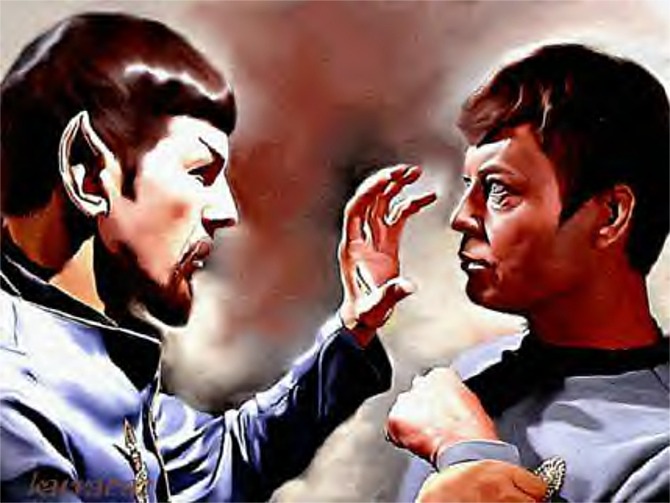
If my accustomed Vulcan calm could be perturbed, no doubt it would be by the allegations Teresa Nielsen-Hayden, late of Tor Books, is leveling against myself and the other members of the Evil Legion of Evil Authors. But since I am imperturbable, I merely raise one eyebrow and wonder on what evidence, or one what chain of reasoning, she makes her outrageous allegations.

I am motivated, she says, not by what I have publicly, notoriously
and repeatedly stated my motives are, but by some unworthy form of spite
or resentment. I see. Any protestation to the contrary is dismissed as
an unconvincing lie. Accusing me, of all people, of dishonesty certainly
has the advantage of being a novel and unexpected accusation.

But on what is it based? No written word of mine can lead an honest
onlooker to draw this conclusion. Did she speak to me and deduce this?
She did not. Does she have my strange Vulcan power of the Mind Meld, that she can read the secret workings of my green-blooded heart? She does not.


Is it her claim that I am some interloper, some newcomer, who has
been reading science fiction since the days when the moonlanding was
still science fiction, been a Tor author since before the turn of the
millennium, nominated for a Nebula for one of my Tor novels, been
insulted by Harlan Ellison like an old hand, been to mass with Gene
Wolfe, and wrote the authorized sequel to AE van Vogt’s work, the author
whose first story in 1939, back when ANALOG was still ASTOUNDING,
heralded the Golden Age of Campbell? It seems she does.

Indeed, the fact that the estimable John C. Wright did not have so much as a single Hugo nomination for his excellent The Golden Age trilogy or his brilliant novellas collected in Awake in the Night Land is one of the most damning rebuttals to any anti-Sad Puppy complaints.

They put forward Scalzi and Swirsky. We put forward Wright and Butcher. And really, that’s all you need to know. Meanwhile, the Evil Legion of Evil’s International Lord of Hate, Larry Correia, also turns his baleful eye upon the Toad of Tor and points out that in her remarkably stupid meltdown, she has revealed something the SJWs have denied for years.

A few years ago I told the truth in public, and said that SMOF insiders usually knew who all the award nominees were going to be for the year, based upon how popular the authors were to the tiny insular cliques, and they usually knew this before the books came out or had been read by anyone. (hell, that even wound up in our Sad Puppies video!)

I was called a liar. There is no insider info like this! The Hugos are a sainted, pure process. They’re not predictable or manipulated by politics! There are no suggested slates or campaigns behind the scenes! How DARE you?!

Uh huh… So I did in public, in the open, with a bunch of outsiders, what they’ve been doing for years with insiders. Outrage ensues.

So here we are now, a few days away and Teresa is worried. Why? Because as an insider, the people she already knew were SUPPOSED to get Hugo nominations haven’t been contacted…

But if there wasn’t insider info and insider cliques, and most of the noms aren’t predestined forgone conclusions, how does she even know she’s supposed to be so worried and upset?

He also adds an inspiring personal note that everyone who has supported Sad Puppies or Rabid Puppies, even if only in spirit, needs to remember:

Wrath is all you people have.

Well, Teresa, no matter what we do,  no matter what the results, we know we’re going to feel your wrath. Luckily, I’ve demonstrated to the world that your wrath is impotent. For years, authors have lived in fear of angering these Social Justice mobs. They’ve moderated their speech, self censored their art, and walked on eggshells to avoid getting burned at the stake… That’s why I hate you people, and that’s why I’ve loved exposing you for the petty, petulant, and ultimately powerless little bullies that you are.

Your angry mobs only have as much power as the person you’re attacking is willing to grant them. I stood up to you last year, and all it did was bring your antics to the attention of more, good, decent, regular fans. 

The wrath of the enemy is not to be feared. They hate us for simply existing and living as free men. And that gives any man, any woman, with the courage to stand up to them complete carte blanche.


That’s not funny!

Satire isn’t satire if it’s the wrong satire:

31-year-old comic Trevor Noah was hired to replace Jon Stewart yesterday, and the backlash has already arrived with a vengeance. Noah has a large following in his native South Africa, and has toured extensively abroad, but he isn’t so well-known in the U.S. — to date, he has three Daily Show “correspondent” appearances under his belt — and it’s looking like some of his comedic sensibilities might not find such a warm audience Stateside.
Other stories recommended for you

Noah is mixed-race, with a half-Jewish Xhosa mother and Swiss father, and much of his material centers on the issue of race. However, people have noticed that a slew of of Noah’s tweets — mostly posted in 2012 and prior — include unfunny, questionably offensive jokes about Jews and women.

Clearly Mr. Noah will require a remedial consciousness-raising session or two conducted by professional SJWs instructing him which topics and subjects are acceptable and which are not.


The Toad tries to walk one back

The Toad of Tor, Teresa Nielsen Hayden, belatedly realized she’d shown the true face of SJW gatekeeper privilege to the world because she’s desperately trying to walk back her words. But it’s much too late; we’ve already impaled her upon them. She even alarmed her fellow SJWs.

“I will admit to having been in kind of an unsettled state since
Teresa’s “this is the Worldcon award, and others can go do their own
thing” post. But then I may well not be the only one in that state, too.”

Compare and contrast this statement:

“The Hugos don’t belong to the set of all people who read the genre; they belong to the worldcon, and the people who attend and/or support it. The set of all people who read SF can start their own award.”
– Teresa Nielsen Hayden, March 29, 2015, 03:43 PM 

 With this one:

“I should have been clearer. Those of us who love SF and love fandom know in our hearts that the Hugo is ours. One of the most upsetting things about the Sad Puppy campaigns is that they’re saying the Hugo shouldn’t belong to all of us, it should just belong to them.”
– Teresa Nielsen Hayden, March 30, 2015, 10:15 PM

Like all SJWs, the Toad of Tor is a shameless liar. First, the Sad Puppies have NEVER said the Hugos should just belong to us. We haven’t said it, we haven’t implied it, and in fact, none of us have ever even thought it. It’s not even remotely credible to claim that a group of “outsiders”, of “thugs” and “reavers” and “nobodies” who aren’t “part of the community” have ever believed that something that has been under Tor’s control for 30 years just belongs to us. Teresa Nielsen Hayden is not only lying, she is insulting the intelligence of every single person who reads her words.

What we have said, what we continue to say, and what we will continue to prove, is that the Hugo Awards do NOT belong to the small group of SJWs led by Tor Books, who for the last 15 years have been handing awards to mediocre diversity lit written by SJWs and their pet minorities. In their eyes, it’s a good thing to be celebrated when minorities such as Saladin and Jeminsin are nominated for awards. It’s a bad thing to be decried when minorities such as Correia and Day are nominated for them.

The only people who have claimed ownership of the Hugos is Teresa Nielsen Hayden and the SJWs. They are already clamoring for rules changes before the nominations have even been announced. The Toad is one of those affiliated with Tor who have, somewhat successfully, turned the Hugos (and the Nebulas, for that matter), into the Best SJW-Endorsed Writers of the Year award. The Toad obviously knows how badly she screwed up because she’s resorting to a ridiculous technicality in order to rewrite the narrative and deny that she said what she quite clearly said:

“When I say the Hugos belong to the worldcon, I’m talking about the literal legal status of the award. But I also know that one of the biggest reasons the rocket is magic is because it spiritually belongs to all of us who love SF.”
– Teresa Nielsen Hayden, March 30, 2015, 10:15 PM

Sure you were. It “spiritually belongs” to everyone, so they can fuck off “and start their own award”. That makes sense. Sad Puppies 3 leader Brad Torgersen responds in his own inimitable fashion:

We. Matter. In fact, we have always mattered. Everyone who ever
came to love and cherish SF/F in ways not vetted and approved by you, by
TruFans, or by SMOFs.

And we’re not going away. Not this year. Not next year. Not the year after that.

We’re not here to destroy the field, nor the Hugos.

We’re here to keep you from greedily clutching the award to your chest, while the field sinks beneath the waves.

That is precisely what Sad Puppies is about. As for Rabid Puppies, we don’t want to destroy the field or the Hugos either. We want to destroy the SJWs. We want to crush them into dust. And we will.

If you’re not already marching with the Evil Legion of Evil under one Puppy banner or another, I encourage you to join us. We can always use the reinforcements, and as other Sad and Rabid Puppies can testify, it is invigorating to crush your enemies, see them driven before you, and hear the croaking lamentations of their women.

As Brad said, we’re not going away next year. And with Kate the Impaler holding the black standard, we’re not going to be inclined to show any mercy to the liars and the con artists. Nor, I suspect, will GamerGate.

I want the Justice Department to declare them a criminal organization and hit them with felony charges. It would not be an excessive response to their actions.
– Teresa Nielsen Hayden, March 30, 2015, 11:25 PM

UPDATE: And here Larry and I were repeatedly accused of gaming the Hugos last year. I told them I didn’t, that I had nothing to do with it, but they didn’t believe me. If Jason Sanford is correct, perhaps they will now admit the accusation was false.


Why Western troops can’t win

Martin van Creveld, the author of The Transformation of War, Technology and War, and the newly published Castalia House books A History of Strategy: From Sun Tzu to William S. Lind and Equality: The Impossible Quest, explains how the technological transformation of war has ruined the effectiveness of modern Western militiaries despite their massive technological advantages over their opponents. From his essay entitled “Pussycats”:

For several decades now, Western armed forces—which keep preening themselves as the best-trained, best organized, best equipped best led, in history—have been turned into pussycats. Being pussycats, they went from one defeat to the next. True, in 1999 they did succeed in imposing their will on Serbia. But only because the opponent was a small, weak state (at the time, the Serb armed forces, exhausted by a prolonged civil war, were rated 35th in the world); and even then only because that state was practically defenseless in the air. The same applies to Libya in 2011. Over there, indigenous bands on the ground did most of the fighting and took all the casualties. In both cases, when it came to engaging in ground combat, man against man, the West, with the U.S at its head, simply did not have what it takes.

On other occasions things were worse still. Western armies tried to create order in Somalia and were kicked out by the “Skinnies,” as they called their lean but mean opponents. They tried to beat the Taliban in Afghanistan, and were kicked out. They tried to impose democracy (and get their hands on oil) in Iraq, and ended up leaving with their tails between their legs. The cost of these foolish adventures to the U.S alone is said to have been around 1 trillion—1,000,000,000,000—dollars. With one defeat following another, is it any wonder that, when those forces were called upon to put an end to the civil war in Syria, they and the societies they serve preferred to let the atrocities go on?

By far the most important single reason behind the repeated failures is the fact that, one and all, these were luxury wars. With nuclear weapons deterring large-scale attack, for seven decades now no Western country has waged anything like a serious, let alone existential, struggle against a more or less equal opponent. As the troops took on opponents much weaker than themselves—often in places they had never heard about, often for reasons nobody but a few politicians understood—they saw no reason why they should get themselves killed. Given the circumstances, indeed, doing so would have been the height of stupidity on their part. Yet from the time the Persians at Marathon in 490 B.C were defeated by the outnumbered Greeks right down to the present, troops whose primary concern is not to get themselves killed have never be able to fight, let alone win.

Thanks to many of you, A History of Strategy: From Sun Tzu to William S. Lind is the #1 bestseller in History>Military>Strategy. The reviews are excellent; even the single 3-star review concludes: “Belongs of the shelf of every person who is interested in the theory and practice of warfare.” 

Another review says: “A History of Strategy: From Sun Tzu to William S. Lind earned five stars from me for being so readable and packed with content, despite being so brief. This is the first book of Martin van Creveld’s I have read and I look forward to delving into his catalog. In addition to being a good read, Martin van Creveld’s svelte A History of Strategy: From Sun Tzu to William S. Lind is a wonderful way for those not well read in military strategy to begin their self-directed study. Martin van Creveld discusses all the notable war theoretician authors more or less in accord with their significance as well as some of the war artisan authors. Creveld also provides a “Further Readings” section to aid those so inclined. Given the limitations imposed on him (low page count) Creveld does a fine job covering the material.”

I’m in the middle of reading van Creveld’s Technology and War myself, and I can say with confidence that the reviewer will find delving into that catalog more than worthwhile. As for the “Pussycats” essay, the observation by a military historian should cause some serious strategic rethinking on the part of those who insist on repeatedly sending unmotivated troops unsupported by popular enthusiasm into unwinnable military conflicts. It won’t, but it should.