This is the initial volume of the first complete English translation of Eiji Yoshikawa’s Sangokushi. The reason his retelling of the Chinese classic tale of the Three Kingdoms has taken so long to appear in English in its entirety despite its massive popularity in Japan is an accident of publishing economics, not any lack of literary merit.
Yoshikawa is the most widely read novelist in Japanese history. His Musashi has sold an estimated 120 million copies. His Sangokushi, which has sold over 80 million copies, not only shaped how modern Japan understands the classic Chinese story, but also, through the various manga, anime, and games derived from it, how much of the world sees it. The video game franchise from Koei that introduced most Westerners to these characters draws more on Yoshikawa than on Luo Guanzhong. You have almost certainly encountered his influence without even knowing it.
And yet, this book not actually a part of the well-known Romance of the Three Kingdoms in its original form. It is something decidedly different than that. To put it in terms that most modern readers will comprehend, the difference between Sanguo Yanyi and Sangokushi is the difference between The Silmarillion and The Lord of the Rings.
The Chinese classic that Westerners know through the Moss Roberts translation and the Dynasty Warriors games, Luo Guanzhong’s fourteenth-century Sanguo Yanyi, is a chronicle. A great chronicle, one of the four pillars of Chinese literature, it consists of eight hundred thousand words of war and statecraft and betrayal. But it is not a story in the conventional sense, rather, it is chronicle in which an omniscient narrator moves through events in sequence, characters are introduced by their attributes and then perform accordingly, and every few pages a poet inserts a verse that serves as commentary to inform the reader how he should feel about what he just read.
It is magnificent literary edifice. What it is not, in any modern sense, is a novel.
In Sangokushi, serialized in the Chūgai Shōgyō Shinpō, the predecessor of today’s Nikkei, from August 26, 1939 to September 5, 1943, Eiji Yoshikawa took the skeleton of that chronicle and did something fundamentally different with it. He transformed it from a historical document into a story. What he did was more than a translation and more than an adaptation. He turned the chronicle into a novel, with all that implies: interiority, psychological development, scenes that reveal character instead of advancing the plot, and a narrator whose relationship to his material is more that of an author who creates his characters than a historian who records their deeds.
The difference is visible from the start. Luo Guanzhong’s Sanguo Yanyi opens with the Yellow Turban Rebellion and moves swiftly to the Peach Garden Oath. Yoshikawa, on the other hand, begins with a young man named Liu Bei walking to the city to buy medicine for his sick mother. He sells the family sword to pay for it. And when his mother learns what her son sacrificed for her, she throws the medicine into the river. This scene does not exist in the Chinese original. Yoshikawa invented it because he understood something that did not concern Luo Guanzhong: the reader has to know a man before he cares about that man saving the empire. Likewise, the girl Furong, whom Liu Bei meets on the riverboat, does not exist in the Chinese original. The encounter with bandits on that same journey does not exist. The village school where Liu Bei studies does not exist. Yoshikawa constructed all of it from his imagination because he needed his readers to arrive at the Peach Garden Oath already invested in the man who is taking the vow. Luo Guanzhong could simply announce that Liu Bei was a virtuous descendant of the imperial house and expect his audience to accept it. Yoshikawa could not.
This pattern runs through the entire work. Where the Yanyi externalizes; Yoshikawa internalizes. Where the Chinese original informs you that Cao Cao was cunning, Yoshikawa shows you a man with a devious mind who calculates as easily as other men breathe. Where the original describes Guan Yu’s loyalty as a fixed attribute, Yoshikawa shows you a man who keeps faith because he has decided that he will not betray another, even at great personal cost, not because he is incapable of betrayal.
Cao Cao is the most dramatic beneficiary of this method. In the Chinese tradition he is largely a brilliant villain, the usurper who perverts the mandate of Heaven and whose dynasty is rightly displaced those more worthy. Yoshikawa’s Cao Cao is far more dangerous and seductive; he is a man you can understand and with whom you can sympathize. You know why his subordinates follow him. You can see the genuine poetry in his soul alongside his ruthlessness. You will even find yourself, at times, preferring his company to the hero’s, and Yoshikawa knows you will. In doing so, he transforms what was a great historical chronicle into a great novel.
And so I hope it is with pleasure that you, the English reader can at last read Eiji Yoshikawa’s great work, Sangokushin, in its entirety.
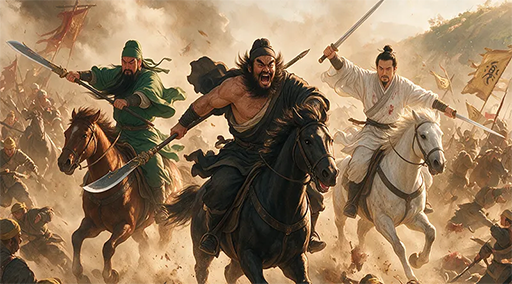
- Romance of the Three Kingdoms Vol. 1: The Peach Garden by Eiji Yoshikawa
- 795: The Complete Waka of Genji Monogatari by Murasaki Shikibu
There are two new releases today, the first being the aforementioned Yoshikawa work, the second being all 795 poems from The Tale of Genji. For more information on both, including excerpts, visit Castalia Library.