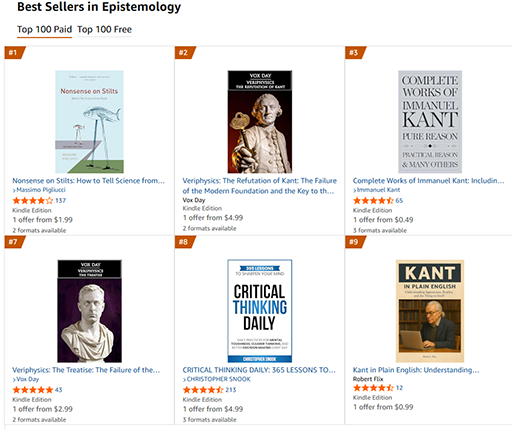
I found the juxtaposition between The Refutation of Kant and Complete Works of Immanuel Kant to be mildly amusing. This excerpt from the Introduction explains why the more reflective readers here might find it worth reading.
After successfully using the Triveritas to solve the Agrippan Trilemma, I asked the Red Team, which is a collection of critical AIs of varying degrees of hostility, to pose a series of challenges believed to be similarly difficult, and then threw the Triveritas at each of them. These challenges, which had been characterized by the Red Team as “impossibilities,” were as follows:
- The Agrippan Trilemma
- The scientific demarcation problem
- The underdetermination problem
- The hard problem of consciousness
- Hume’s is-ought distinction
- Gödel’s Incompleteness Theorem
The surprising thing was not that the Triveritas managed to solve all of these supposedly impossible problems, it was that it solved all of them by repeatedly utilizing the same tactic to find the same fundamental flaw that appeared in every one of them. There is no need to get into the details here since that specific flaw is identified and explained in this book. Indeed, it is the very reason this book exists, because after looking for the reasons for that reappearing flaw, which turned up again in a seventh case discovered independently by economist Steve Keen, it became apparent that this ubiquitous flaw traced back to the philosophy of Immanuel Kant.
“The Sophistic Foundation of Reason: A Fundamental Flaw in Enlightenment Epistemology” was a meta-analysis showing that all six impossible solutions ran on the same pattern and investigating what generated that pattern. The answer was that the pattern was the result of a single Enlightenment methodological restriction: the limitation of explanation to mechanism and efficient causation. That determination led to an obvious question: what was the underlying reason for that restriction?
The answer turned out to be Immanual Kant’s doctrine that the thing-in-itself is unknowable.
Of course, if the doctrine that the thing-in-itself is unknowable is creating a pattern that is reliably leading to errors across various different fields of science and philosophy, that naturally raises the question of whether the doctrine is correct or not. As I will demonstrate in this book, the doctrine is not correct. Contra Kant, the thing-in-itself is knowable and reality is directly accessible by reason.
Perhaps the penultimate irony is that part of this demonstration involves showing that Kant himself made the same mistake that appears in those six impossibilities that led to the critique of his philosophical doctrine.
The greatest irony can be found in Appendix B. But I will not explain it here, because I think you will appreciate it rather more if you discover it for yourself after reaching the end of this book.
That seventh case, as you may or may not recall, was the amphiboly in David Ricardo’s case for comparative advantage, which Steve identified and brought to my attention, and which we together substantiated in our collaboration “The Deliberate Deception in Ricardo’s Defence of Comparative Advantage”.
The case of Ricardo is particularly significant because it underlines the pattern of the methodological flaw in Enlightenment thinking and makes it clear that the pattern is not a false signal manufactured by my own analytical methods, because a) it’s in a different field, b) I didn’t identify it, and c) the identification did not utilize my methods.