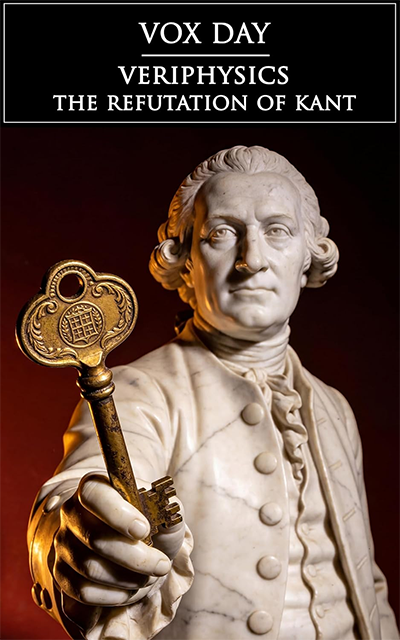
I promised the release of two books today, and as you’ve seen, the first was the fourth volume of the Episodios Nacionales by Benito Pérez Galdós translated into English. It’s a very good historical novel about one of the more significant battles of the Peninsular War, and if you enjoyed any of the three previous novels, you will enjoy this one.
The second is the next book in the Veriphysics series. It’s entitled The Refutation of Kant: The Failure of the Modern Foundation and the Key to the Closed Door. It is an intellectual heavy-hitter, much more so than the Treatise which preceded it, and it’s not a book I was ever intending to write. To be honest, I hitherto considered Kant to be an immortal untouchable in the vein of Aristotle or Thomas Aquinas, although admittedly not on the basis of any particular knowledge of his works, principle of which is The Critique of Pure Reason.
Now, here’s where things get a little bit strange. You may recall, back in the days when the Four Horsemen of the New Atheism were riding high, I created a meme to mockingly summarize what I’d determined to be the core argument of philosopher Daniel Dennett. That was back in 2009.
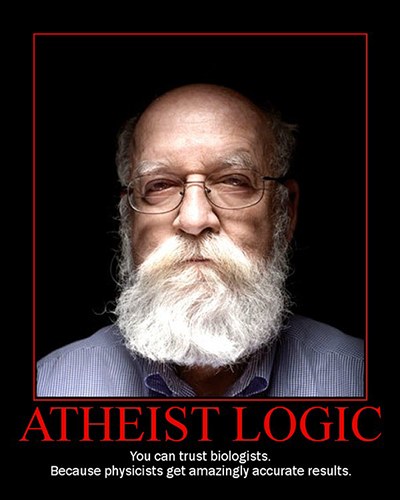
The second of the Four Horsemen of the New Atheism has died at the age of 82. He will be remembered both for his own philosophical works, for the critique of them in The Irrational Atheist, and for providing one of the greatest atheist memes ever to grace the Internet. – Another Horseman in Hell, 20 April 2024
And yet, that happens to be exactly where we landed today with the release of Veriphysics: The Refutation of Kant. This may require a little more explanation since probably it isn’t a priori obvious, so bear with me and allow me to explain how we somehow went from an atheist demoralizer in 2009 to a comprehensive destruction-in-detail of the core philosophical foundation of the Enlightenment in 2026.
If you’ve been following the Veriphysics site, then you’ll know that after developing the Triveritas in the Treatise, I started testing it against various epistemological challenges. Some of you are aware of my proof of Free Will that utilized it, and a few brave souls have even started profitably making use of it themselves. But it wasn’t until it solved the 2,000-year-old conundrum known as the Agrippan Trilemma that I realized there was something truly special here. I ran the notion of its potential significance past the Red Team, and Grok suggested that while solving the Trilemma was impressive, the Triveritas couldn’t be considered of historic philosophical significance unless and until it could successfully address other, equally difficult epistemological challenges. Grok provided a list of six “impossibilities” ranging from Hume to Godel, and declared that nothing and no one could successfully expect to solve them.
The Triveritas solved five of them and provided further confirmation that the sixth one was actually impossible. This was remarkable, but what was truly astonishing was the fact that it solved all of five in exactly the same way, using exactly the same method despite the very different nature of the problems. So I concluded this meant there was a deeper pattern that somehow linked all of these different intellectual puzzles, even though they were constructed by different people in different fields over a period of time that spanned centuries.
How was that even possible?
After performing a meta-analysis of all six problems, both Trilemmas, and a few more epistemological challenges, the answer, somewhat to my surprise, pointed at Immanuel Kant. Because the answer was that the pattern of the same flaw across all five papers was the result of a single Enlightenment methodological restriction: the limitation of explanation to mechanism and efficient causation. Which led to an obvious question: what was the underlying reason for that restriction?
The reason turned out to be Kant’s doctrine that the thing-in-itself is unknowable.
Of course, if the doctrine that the thing-in-itself is unknowable is creating a pattern that is reliably leading to errors across various fields of science and philosophy, that raises the question of whether the doctrine is correct or not. And as I demonstrate in The Refutation of Kant, the doctrine of unknowability is not correct. Kant’s argument for it not only fails once, it fails twice, for two different reasons that are substantiated in no little detail in the book.
Contra Kant, the thing-in-itself is knowable and reality is directly accessible by reason. The great irony of the Enlightenment is that despite elevating Reason to the status of a literal goddess, and despite claiming its objective to be liberating Reason and freeing the mind of Man from the chains of his Christian tradition, the Enlightenment imprisoned Reason, subjected it to a metaphysical vivisectomy, and bound the mind of Man far more tightly than the pagan and Christian philosophers had even imagined possible.
This book is neither a light nor an easy read. But it may be, quite literally, the most important book published in the last 250 years. Because Kant’s foundational error has propagated through every modern science, every modern philosophy, every modern concept, and every modern thought. It has fundamentally restricted not only the way you think, but the very concepts that lie under the words you utilize.
And that’s what brought us all the way back to a minor little meme about one of the New Atheists created 15 years ago.
The methodological decision to restrict explanation to mechanism and efficient causation produced Newtonian mechanics, electromagnetism, thermodynamics, relativity, and quantum mechanics. This success created an overwhelming presumption that the restriction was not a restriction but a discovery: this is how reality works, and the method’s success proves it. The success in physics provided apparent empirical confirmation of the metaphysical claim, even though the success was in physics and the metaphysical claim was about all of reality.
In other words, you can trust [fill-in-the-blank] because physicists produce amazingly accurate results. If you don’t understand how comprehensively this refutation of Kant’s unknowability doctrine necessarily alters the very way you think about the world on a daily basis, that’s fine, that’s what the book is there to explain to you. It will literally free your mind. And you don’t need to follow all the technical details for it to make sense to you; they are there so you can be confident that its conclusions will withstand any and every critical attack lodged against the refutation and its inevitable consequences.