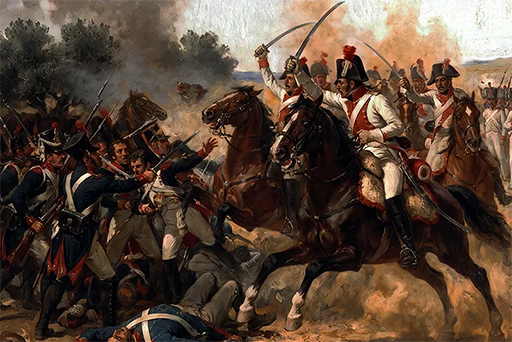
The fourth volume of the Episodios Nacionales — the great historical novel cycle of Spain
July 1808. Napoleon’s armies are invincible. They have crushed Austria, humiliated Prussia, and forced the Tsar to the negotiating table. Now twenty thousand French soldiers occupy Andalucía, and all Europe waits for Spain to submit as every other nation has submitted.
Gabriel Araceli, a young Spanish soldier who survived the slaughter of the Dos de Mayo and the French firing squads in Madrid, rides south with the ragged army assembling to challenge the Empire. Around him march raw recruits, militia volunteers, and hard-bitten regulars — fourteen thousand men with short rations, blistering heat, and the knowledge that no army on the continent has yet beaten Napoleon in open battle.
But Gabriel is fighting two wars. On the parched plains before Bailén, he faces Dupont’s veteran infantry and the terrible French marines. In the intercepted letters he carries in his coat, he faces something worse: the news that Inés, the woman he loves, is to be made legitimate and married to another man — his own commanding officer’s son. While the armies clash under a pitiless Andalusian sun, while men kill each other for a mouthful of water and the guns fall silent for want of powder, Gabriel must reckon with the possibility that victory on the battlefield will mean defeat in everything that matters to him.
Bailén is the fourth novel in Benito Pérez Galdós’s Episodios Nacionales, the great historical cycle that follows Gabriel Araceli from Trafalgar through the upheaval of the Napoleonic Wars. In this volume, Galdós delivers one of the finest battle narratives in nineteenth-century fiction — the engagement that shattered the myth of Napoleonic invincibility and changed the course of European history.
Now available for Kindle, KU, and audiobook on Amazon. The ebooks have already been sent out to the paid subscribers. To receive a new translation every week and support the translation efforts, become a paid subscriber to the Castalia Library substack which has already produced and released more than a dozen original translations from Spanish and Japanese, most of which had never before been available in English.
About the author. Benito Pérez Galdós (1843–1920) is widely regarded as the greatest Spanish novelist since Cervantes. Over four decades, he produced the Episodios Nacionales, one of the most incredible accomplishments of world literature ever written; only 8 of its 46 volumes have ever been translated into English. Pérez Galdós was nominated for the Nobel Prize in Literature five times but never won.
EXCERPT
On the following day we made a movement along the left bank, upstream, as far as a point well above Mengíbar. We understood nothing of it; but Santorcaz, whether from vanity or because he had truly penetrated Reding’s intention, told us:
“Our general knows what he is about, and is a man who understands the philosophy of marches.”
Halting on the banks of the Guadalimas, part of the army occupied itself with incomprehensible movements, and having spent more than a day at this, we found ourselves once more before Mengíbar at nightfall on the 18th, a point which the division of the Marqués de Coupigny had reached some hours earlier. The two armies being reunited, there was no halt beyond what was strictly necessary to collect the provisions of which we stood in such want, and well into the night we took the road for Bailén. We were fourteen thousand men. Everything announced that we were about to have a formal encounter with the French army.
According to our intelligence, Dupont remained at Andújar, reinforced by Vedel’s division. Had they engaged our third corps and the reserve which, having crossed the river at Marmolejo, were situated on the right bank? We believed so, unless Castaños were waiting to attack in earnest until the first and second divisions should fall upon the rear of Dupont’s army, descending from Bailén. Was this the object that guided us on our march? So it seemed.
While the moment of the drama drew near, far from us and upon the flanks of the imperial army, a thousand dramatic convulsions were hastening the catastrophe, tormenting the enemy by degrees. The bodies and columns of guerrilleros, commanded by Don Juan de la Cruz, the Conde de Valdecañas, and the cleric Argote, had scattered like a deadly swarm through the towns and hamlets commanding the French headquarters in the first foothills of the sierra north of Andújar. So furiously did those ardent countrymen pursue the French, and with such rapidity did they disperse to avoid attack, that the invaders found it utterly impossible to be tranquil for a single moment. The powerful giant swatted those venomous horseflies with a blow of his hand; but they returned to buzz about him, tormented him with their terrible stings, and escaped unharmed, fearing neither sword nor cannon, for these weapons were not made for mosquitoes.
The French could not stir from their headquarters save in large detachments: frequently a thousand men were sent to fill a few water-jugs at the nearest spring. If by chance small parties ventured out to forage, they were dispatched by the guerrilleros in less time than it takes to say a creed. Rather than suffer the French to seize a granary, the people burned it: the springs were fouled with mud and dung so they could not drink: the mills were dismantled and their stones buried so that not a single grain could be ground. Woe to any Frenchman who fell behind on the march! He felt himself seized by a thousand furious hands, dragged off by the women, pinched by the children, and knifed by the men, until his existence was extinguished with a terrible shock in the cold depths of a well. The invader found no shelter anywhere, and forcibly confined within the limits of his headquarters, he saw men and nature conspired alike against him.
For this reason, raging and desperate, he longed to fight a pitched battle, confident in his skill and habit of war; and lamenting the stupefaction of the commander-in-chief, he cried: “Let us fight a battle, and though half the army perish, the other half will conquer a puddle to drink from and a handful of dry wheat to put in our mouths.”