This is the result of an experiment that got very badly out of hand. After finishing The Refutation of Kant, I definitely had the sense that my analytical engine could use a break and decided to let my mind coast a while. No more amphibolies, contemplations of the true nature of reality or das Ding an sich, no more irrational numbers, imaginary numbers, or infinite sets, no more deconstructing the construction account, and no attempting to decide which aspect of the Veriphysical philosophy to develop next. So the day after Team Castalia finished deciding what was to go into the combined print edition that resulted in The Return of the Real, I found myself dwelling upon all the various nonsensicalities of the Wizarding World concoted by Ms JK Rowling.
I believe that many years ago, I was among the first to point out the absolute absurdities of the Quidditch rules, though I was far from the only one. But there were so many more things that made no sense, such as the pointless points system, the insane dual economies, the bizarre competitions, and the upside-down nature of a craven, spoiled elite that left one wondering how it had gotten there in the first place. Which, in light of recent revelations, actually tends to reconstruct the Wizarding World as a much darker fictional universe than anyone had ever imagined, one in which Tom Riddle is actually the hero seeking vengeance for his childhood abuse at the hands of a schoolmaster with a very dark and nasty secret.
But that’s neither here nor there. My main thought was this: what if the protagonist of an academy novel was not despised, but loved? What if he wasn’t a passive lens for the reader to pass through the world, but a character with strength, independence, and a will of his own? What if there were consequences to historical actions, and if the present was the result of past decisions? And what if the Silent Academy wasn’t the only school to which the Inghitaran elite sent their children? One question led to another, and another, and the sum total of the answers is now available for your exploration if you happen to be so inclined.
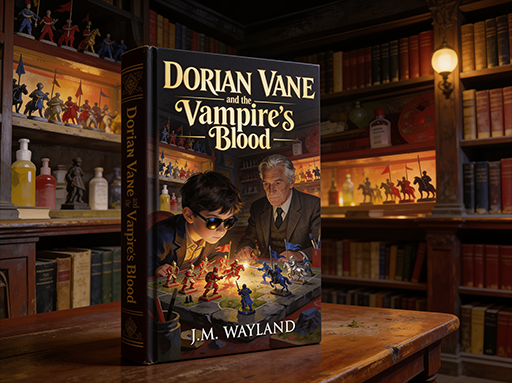
While the core concept is obviously derived from the British magical school tradition, the end result reads more as if Susan Cooper was the primary literary influence, with perhaps a dash of Lloyd Alexander, as the various Red Team reviews have noticed.
- This is one of the strongest Harry Potter-inspired school fantasies I’ve read. It borrows a great deal from Rowling’s structure, but it has sufficiently strong prose, characterization, and worldbuilding that it gradually stops feeling like imitation and starts feeling like a genuine series in its own right.
- The novel clearly draws from the greats of classic children’s fantasy while forging its own path. The most obvious surface parallel is the magical boarding school with house sorting, rivalries, feasts in a great hall, and a boy discovering his powers and place in a hidden world. Wyrmwick echoes Hogwarts in structure, but the execution diverges sharply. It captures the excitement of arrival and belonging but leans harder into quiet character moments and institutional realism. The story has Susan Cooper’s feel for deep time, hidden powers in the land, and a boy awakening to a larger, dangerous heritage without flashy destiny tropes. Overall, Dorian Vane and the Vampire’s Blood is a strong, heartfelt addition to the magical-school genre—loyal to its influences while carving out a distinctive, moor-rooted identity. Fans of thoughtful fantasy with real emotional texture and British mythic flavor will find it deeply satisfying.
- Dorian Vane and the Vampire’s Blood is an exceptionally high-quality children’s fantasy novel. It honors the rich, atmospheric traditions of classic British folklore while implementing the rigorous, satisfying world-building mechanics found in modern American fantasy. By replacing cheap whimsy with tactical depth, J.M. Wayland has crafted a story that respects the intelligence of young readers.
Dorian Vane has silver eyes and no idea why.
Raised by his grandparents on the quiet Somerset moors, Dorian has spent his whole life hiding behind a pair of mirror-shaded glasses. Then the letter from Wyrmwick College arrives, and he is pulled from his comfortable home in the countryside into an exciting world of magic and wonder.
Wyrmwick is a school like no other, ancient, magnificent, and impossible, carved into a mountainside above a lake that reflects its stone towers back into the deep waters. Here, students learn how to hold fire in their hands, to shape metal with their thoughts, and to create wards that protect the living from things that dwell in the dark and hunt in the night. At Wyrmwick, Dorian finds unexpected friends, magical challenges, a misfit house that claims him as its own, and professors who seem to know more about his heritage than he does.
But the ancient college conceals old and bloody secrets in its foundations. Even hidden behind his glasses, Dorian’s eyes mark him as something the magical world hasn’t seen in centuries, and someone at the school wants him gone. In addition to his lessons, he learns that wonder and danger stalk the same stone corridors, and that being special is not the same as being safe.
Dorian Vane and the Vampire’s Blood is the gripping first novel in a gothic magical fantasy series of courage, self-discovery, and the darkness that every new generation finds that it must face.
Now available for Kindle, KU, and audiobook.